Vision Board: How to Make One That Becomes a Plan
A vision board maps your yearly goals by life area. Five categories, six steps, a worked example with real numbers, and ideas that lead to action.

Contents
- 01What a vision board does, and what it does not do
- 02Vision board or dream board: pick the one you mean
- 03The five categories for a vision board, and the four sections
- 04How to make a vision board in six steps
- 05Dana's vision board, worked through with numbers
- 06Vision board ideas for every category
- 07Paper or digital: where the vision board should live
- 08The three mistakes that turn a vision board into wall decoration
- 09From the vision board to the goal chain: year, quarter, month, week, day
- 10Frequently asked questions about vision boards
A vision board is not a wish list. It is a visual map of the goals you plan to reach in the next twelve months, sorted by life area, with a picture, a number, and a first step for each one. A wish list says what you would like. A vision board says what you are going to do about it, and by when.
Three things make the difference: a structure, a number for every square, and a path from the picture on the wall to the thing you do on Tuesday. The structure is five categories. The number turns a mood into a goal. The path is a chain from year to quarter to month to week to day. All of it is worked through on the board of Dana, a pediatric nurse in Columbus who wants to open her own lactation practice, along with six steps, ideas for every category, and the three mistakes that turn a vision board into wall decoration by February.
What a vision board does, and what it does not do
A vision board does one job well: it keeps your goals in front of your eyes every day, so they compete with everything else that wants your attention. That is not a small job. Most goals do not fail in a dramatic moment. They fade, because nothing reminds you of them between the day you set them and the day you notice the year is over. A board on the wall by the coffee maker interrupts that fading. Every morning it asks the same quiet question: still working on this?
What a vision board does not do is the part the Pinterest collages leave out. It does not attract anything. It does not replace a plan. Gabriele Oettingen spent two decades testing what happens when people picture a desired future, and she lays out the results in Rethinking Positive Thinking from 2014. Picturing the outcome alone made people calmer and less likely to act. The pleasant picture felt like progress and lowered the energy to go and get it. Her fix is called mental contrasting: picture the outcome, then picture the obstacle standing in the way, then plan what you do when the obstacle shows up.
That lines up with an older study. In 1999 Lien Pham and Shelley Taylor asked students to spend a few minutes each day either picturing themselves getting a high grade or picturing themselves studying for it. The students who pictured the studying studied more hours and scored higher. The students who pictured the grade did neither. That means: a board full of outcomes is a board full of the wrong pictures. The picture that works shows you doing the thing, or it sits next to the number that tells you how much of the thing is left.
Mental contrasting
A method from Gabriele Oettingen: name the wish, picture the best outcome, then name the main obstacle inside you, then write an if-then plan for it. On a vision board that is one square with a picture, a number, and a sentence that starts with when. The picture alone is the version Oettingen warned about.
None of this makes the collage useless. Cutting pictures out of magazines on a Sunday afternoon is a good way to find out what you actually want. The collage is a research step. It is just not the finished board. Anyone who hangs the collage and calls it done has stopped one step early.
Vision board or dream board: pick the one you mean
A dream board collects what you long for. A vision board commits to what you will reach this year. Most people use the two words for the same poster, and that is where the trouble starts, because the two serve different purposes and get read in different ways.
| Dream board | Vision board | |
|---|---|---|
| Purpose | Find out what you want | Commit to what you will do this year |
| Time frame | Open, five to twenty years | Twelve months, sometimes one quarter |
| Content | Pictures and feelings | Pictures plus a number plus a first step |
| Number of items | As many as move you | Five to ten, one or two per life area |
| Where it lives | Journal, folder, phone album | A wall you pass daily, the lock screen, the first page of the planner |
| What you do with it | Revisit twice a year | Check weekly, update quarterly |
| Question it answers | Who do I want to become? | What am I doing about it this week? |
Both are useful. The dream board comes first and feeds the vision board, the same way a long list of life goals feeds a plan for the year, which is the logic behind our guide on how to achieve goals. If you have never made either, start with the dream board for one afternoon and then pick the five squares that belong to the next twelve months. Everything else waits until next year's board. Whoever skips the dream board tends to put other people's goals on the vision board, the ones that look good in a magazine. Whoever skips the vision board keeps dreaming.
The five categories for a vision board, and the four sections
The five categories most vision board templates use are career, money, health, relationships, and growth. The four sections are an older layout: be, do, have, give. Both solve the same problem. A board without categories fills up with whatever was in the magazine, usually travel and kitchens. Categories force you to ask about the areas you would rather not look at.
Five categories: one square per life area
- Career and work. The role, the business, the skill, the exit. Question: what will be true about my work on December 31 that is not true today?
- Money. A debt that is gone, a number in an account, an income that covers one specific thing. Question: which single number would I most like to change this year?
- Health and body. A race, a weight, a sleep schedule, the check-up that has been postponed for two years. Question: what does my body need to be able to do in twelve months?
- Relationships. Partner, kids, parents, friends. Rarely a picture of the people, more often a picture of the thing you do together, with a count. Question: who gets more of my time this year, and how much?
- Growth and meaning. Learning, faith, creativity, the thing you do for its own sake. Question: what will I know or be able to do that I cannot do now?
Five is not a law. Many boards add home, travel, or community. Keep the total under seven, or the board becomes a wish list again, this time with headings. Dana used the five above and added nothing, because her career square already contained most of her year.
Four sections: be, do, have, give
The four-section layout splits the board by type of goal instead of by life area. Be is who you become, a trait or an identity. Do is an experience, a trip, a race, a performance. Have is a thing or a number. Give is what you contribute, time or money or care. It is a good layout for anyone whose goals fall mostly into one life area, because it still forces variety. It is a weaker layout for a year with one clear priority, because it hides the fact that most squares serve the same goal.
In short: use five categories if you want the board to map onto a plan for the year. Use four sections if you want it to balance your life. Either way, every square still needs a number.
The number rule
Every square on a vision board gets a number: a date, an amount, a count, or a distance. A picture of a beach is a mood. A picture of a beach with Lisbon, May 14 to 21, $2,400 saved by April 30 written under it is a goal. The number is what lets you check the square in December.
How to make a vision board in six steps
Two hours on a weekend afternoon, a stack of magazines or a folder of saved images, a board or a blank page, and one more thing most guides leave out: your plan for the year, if you have one. If you do not, the board will hand you one by the end of step four.
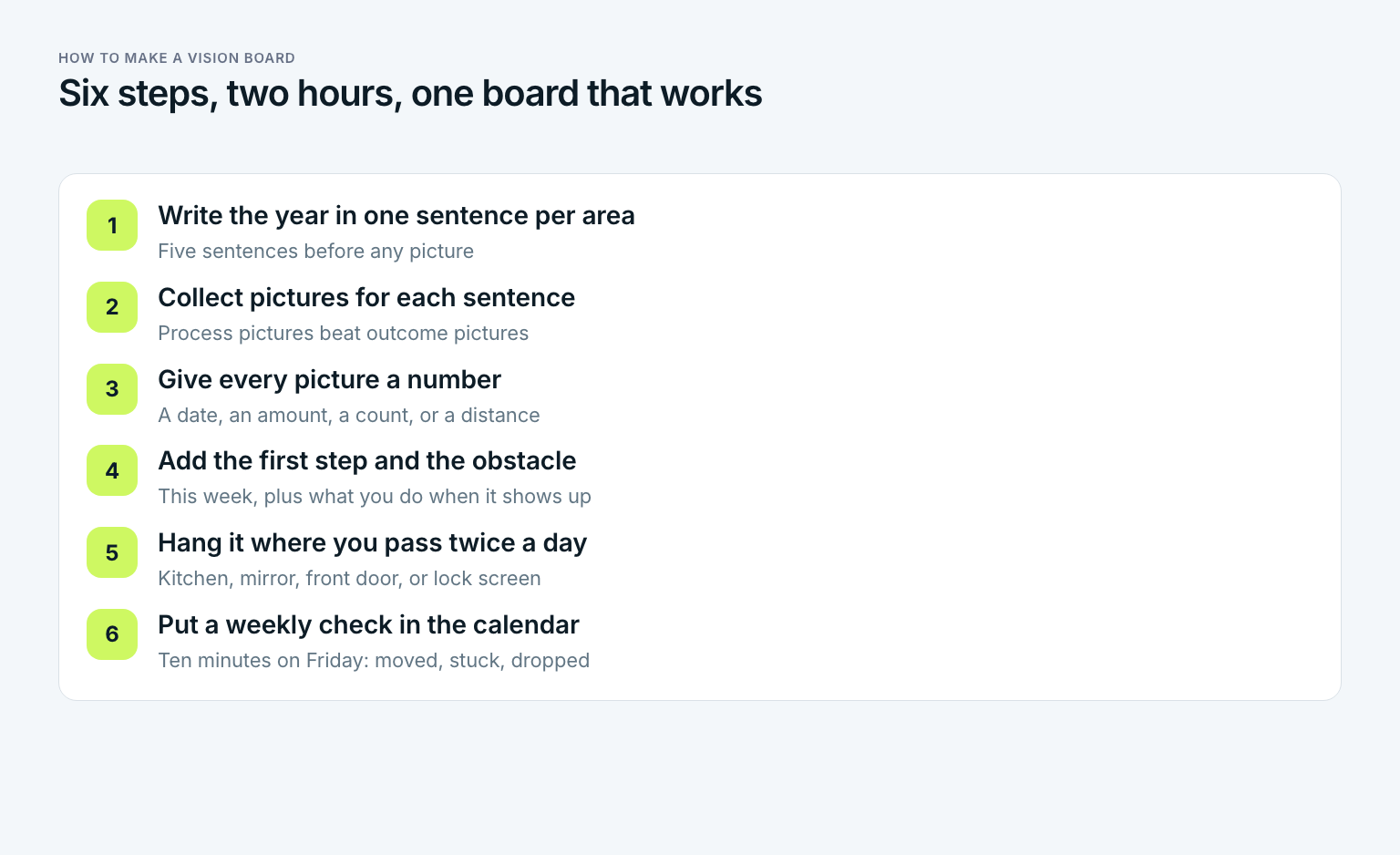
Write the year in one sentence per area, 15 minutes
Before any picture: what has to be true on December 31 for you to call this a good year? One sentence per life area, five sentences total. Dana's career sentence: by December 15 the practice is open and three families have paid. These sentences are the spine of the board. Pictures come after them, not before.
Collect pictures for each sentence, 30 minutes
Now hunt for images, but each one has to serve a sentence. Process pictures beat outcome pictures: the running shoes by the door, not the medal. The desk, not the bestseller list. Pham and Taylor's students scored higher with the studying picture. If an image moves you and fits no sentence, it goes on the dream board pile.
Give every picture a number, 15 minutes
A date, an amount, a count, or a distance. 13.1 miles on October 18. $6,400 down to zero by December 31. 24 Sunday dinners. A square without a number stays a wish and comes down. This step removes about a third of most boards, and the board gets stronger for it.
Add the first step and the obstacle, 20 minutes
Under each number, two lines: the first thing you do this week, and the one obstacle most likely to stop you, with what you do when it shows up. This is Oettingen's mental contrasting made visible. Dana's obstacle for the course was the night shift: when I come off a night, I sleep until noon and study at 1 pm, not at 9 am.
Lay it out and hang it where you pass twice a day, 20 minutes
Five columns or four quadrants, one or two squares each, the year sentences across the top. Kitchen, bathroom mirror, or the inside of the front door. A board in a drawer is a dream board. A digital board goes on the phone lock screen or the first page of the planner, and nowhere else.
Put a weekly check in the calendar, 5 minutes
Ten minutes on Friday or Sunday: which squares moved this week, which did not, what is the one thing next week? Without the check, the board becomes wallpaper in about six weeks. With it, the board turns into a plan you can read at a glance.

Dana's vision board, worked through with numbers
Dana is 38, a pediatric nurse in Columbus, Ohio. She works three twelve-hour shifts a week, two of them nights, and she wants out of the hospital schedule within 18 months. Her plan is a private lactation consulting practice. Her certification path requires a 95-hour course and 300 supervised clinical hours, and she has 90 of those hours logged. Her first board, made two Januaries ago, had a bright office, a beach, a pair of running shoes, and the word freedom. It stayed on the wall until March and did nothing. Her second board looks like this.
| Category | Picture | Number | First step this week | Obstacle and plan |
|---|---|---|---|---|
| Career | Her kitchen table with the laptop and the course textbook open | Course done by March 31, 300 clinical hours by August 31, three paying families by December 15 | Register for the course, block Tuesday and Thursday 1 to 5 pm | Night shifts. When I come off a night, I sleep until noon and study at 1 pm |
| Money | A screenshot of the car loan balance, $6,400, with a red line through it | $0 by December 31, $540 a month | Set up the automatic payment for the 2nd of each month | Practice start-up costs. Website and insurance come from a separate $150 a month, never from the loan payment |
| Health | Running shoes by the apartment door at 6 am | 13.1 miles on October 18, three runs a week | Sign up for the race, run 3 miles on Saturday | Shift fatigue. When I miss a weekday run, the Saturday long run still happens, the midweek run is the one that drops |
| Relationships | Her mother's dining table | 24 Sunday dinners this year, two a month | Put the first two Sundays in both calendars | Schedule swaps. When a shift lands on a dinner Sunday, the dinner moves to Monday, it does not get skipped |
| Growth | A stack of three books on infant feeding and one on running a small practice | Twelve books by December 31, one a month | Start the first one on the bus to the hospital | The phone. On the bus the phone stays in the bag and the book comes out |
Five squares, five numbers, five first steps, five obstacles. Nothing on the board is a mood. The beach is gone, not because Dana stopped wanting a vacation, but because there was no number she was willing to commit to this year, so it moved to the dream board. The word freedom is gone too. It is what the career square means, and the career square has a date.
Look at the career square once more. It carries three numbers, and they are not equal. The course comes first, because the clinical hours cannot be counted toward certification until it is done. The hours come second and are the long middle of the year: 210 to go, roughly five hours a week over 42 weeks. The three paying families come last and depend on both. That ordering is the plan hiding inside the picture. A vision board that works always has one, and anyone who cannot say which number comes first has a square that is still a wish.
Vision board ideas for every category
The best vision board ideas show a process or carry a number. Below are ideas that pass that test, sorted by category, plus variations for couples, families, and teams. Take what fits a sentence you wrote in step one. Ignore the rest.
Career and money
- A photo of your own desk with the finished thing on it: the manuscript, the certificate, the first invoice, the launch screen.
- The job posting for the role you want, with the three requirements you do not meet yet circled, and a date next to each.
- The loan statement with the balance crossed out and the monthly payment written beside it.
- A thermometer drawn by hand for the emergency fund, $0 to $9,000, filled in with a marker each month.
Health and relationships
- The race bib with your name and the date, printed from the registration email.
- A calendar strip with the three run days or gym days shaded, so the board shows the habit, not the body.
- A photo of the actual table where the dinners happen, with a tally box for 24.
- An empty frame labelled date night, to be filled with a photo after the first one. The empty frame is the reminder.
Growth and meaning
- The spines of the twelve books, photographed in a stack, with a check mark added as each one is finished.
- The sheet music, the recipe, the language certificate, the course syllabus with its modules listed and checkable.
- One line in your own handwriting with the question you want to be able to answer by December.
For couples, families, and teams
A shared vision board follows the same rules with one addition: every square has an owner. Couples usually split the board into mine, yours, and ours, with the ours column no bigger than the other two. Families with kids give each child one square they chose themselves and one number they can count, like 20 library books or a 5K in May. Teams keep the board to one quarter and one wall of the office, three squares, each a measurable result, and the weekly check happens in the Monday meeting. Whoever owns the square reports on it. Nobody else does. How a shared set of goals stays visible for everyone involved is the subject of the article on shared goals in a space.
Paper or digital: where the vision board should live
Paper wins on interruption, digital wins on updating. Paper on the kitchen wall catches your eye twenty times a day without asking. A digital board catches your eye only when you open it, and the phone has two hundred other things that want to open first. On the other hand, a digital board can hold the current number, 140 of 300 hours, $3,100 of $6,400, and it can live on the lock screen.
| Paper board | Digital board | |
|---|---|---|
| Daily interruption | High, you walk past it | Low, unless it is the lock screen |
| Updating the numbers | Marker and a new sticky note | Edited in a minute |
| Weekly check | Stand in front of it with a pen | Open it on the Friday reminder |
| How it dies | Becomes wallpaper, you stop seeing it | Buried under apps, you stop opening it |
| Best for | Individuals and families at home | Couples living apart, teams, anyone who moves often |
The honest answer for most people is both. The paper board on the wall carries the five pictures and the five year numbers. The phone carries the current count, because that is where the weekly check happens anyway. Dana has the paper board on the inside of her front door and a note on her phone with five lines, updated on Fridays. In short: the wall is for remembering, the phone is for measuring.
The three mistakes that turn a vision board into wall decoration
Most vision boards do not fail loudly. They fail quietly somewhere in February, and nobody notices because the board is still hanging there, looking fine. Three mistakes do almost all of the damage. Which one is yours?
The most common mistake: pictures of outcomes with no next step
A board of finished results, the medal, the office, the beach, feels motivating for about three weeks. Then it starts to feel like a reproach, and you stop looking at it. Oettingen's research explains why: the finished picture gives the brain a small sense of arrival, and arrival lowers effort. The fix is mechanical. Under every picture, one number and one line that begins with this week. If you cannot write the line, the square is a dream, and it belongs on the other board. When the board stops motivating you, the guide on how to stay motivated shows which level of the goal chain to fix.
- Too many squares. Fifteen pictures mean fifteen priorities, which means none. The board stops being a plan and goes back to being a mood. Five to ten squares, one or two per category. If a category has four candidates, pick the one that would make the other three easier.
- No weekly check. A board that is never asked a question becomes part of the wall within six weeks. The eye learns to skip it the way it skips the fire extinguisher. Ten minutes on Friday with a pen: moved, stuck, dropped. The check, not the board, is what produces the year.
- Last year's board in February. Goals change, and a board that still shows the goal you quietly abandoned in March teaches you to ignore the board. Take squares down when they are done or dead. Add a square when a new goal has earned one. A vision board is a living document with a twelve-month shelf life, not a poster.
Notice that none of the three is about design. The fonts, the colors, the quality of the printouts, none of it decides whether the board works. Anyone who spends the two hours on layout instead of numbers has made a nice poster.
From the vision board to the goal chain: year, quarter, month, week, day
A vision board shows the year. It does not show Tuesday. The gap between the two is where most boards lose, and closing it takes one more layer: each square becomes a yearly goal, each yearly goal gets a quarterly goal, a monthly goal, weekly goals, and a daily goal. That is the goal chain, and it is the same chain behind any solid annual planning. Dana's career square, run through it:
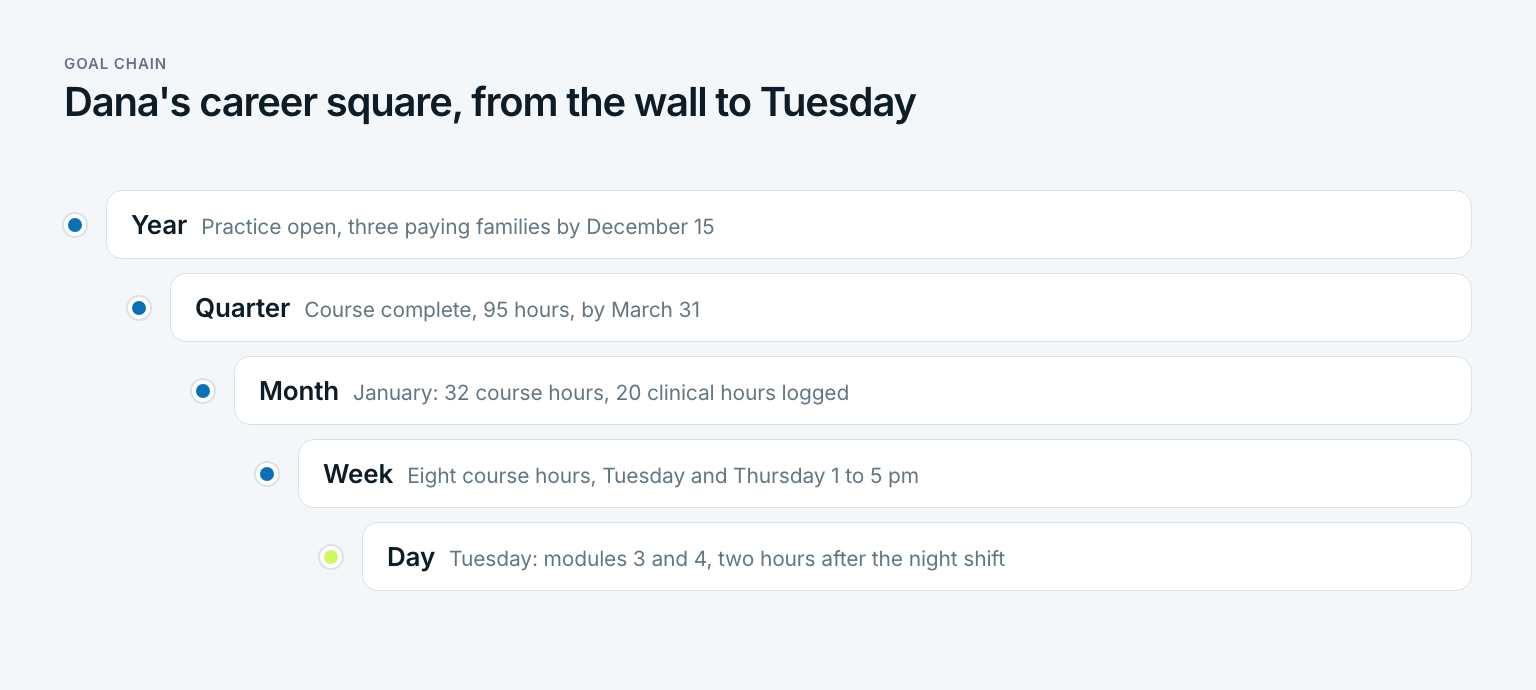
Each level answers a different question. The year says where. The quarter says what has to be true in 13 weeks for the year to still be possible. The month says what gets done this month. The week has at most three goals, and one of them comes straight from a square on the board. The day is one task, small enough to finish on a bad day. Whoever skips the week level jumps from a poster to a to-do list and wonders why the two never meet. How the translation from year to day works in detail, including what to do when a week breaks, is in the article on turning yearly goals into daily steps.
In Gaapp this chain is the structure: five levels from year to day, every goal attached to the one above it, progress per period shown as the share of goals checked off. The vision board is the top of that chain made visible on a wall. The app is the rest of it.
The weekly check from step six is where the two meet. Friday, ten minutes, in front of the board or with the phone: which square moved this week, measured in its own number? Which one did not, and was that the plan or the obstacle? What is the one thing next week? That means: a square that has not moved in three checks is either too big or no longer yours, and both are fixed with a pen. How to run that check so it stays under ten minutes is in the ten-minute weekly review.
Three questions before you hang yours, or about the one already on your wall:
- Can you say the number for every square without looking?
- Does every square have a line that begins with this week?
- When did you last take a square down?
Anyone who answers no to one of the three does not have a bad vision board. They have a dream board with the wrong name, and the fix is a pen and twenty minutes. In short: a vision board is not a picture of the life you want. It is the first page of the plan to get there.
Frequently asked questions about vision boards
What does a vision board do?
A vision board keeps your goals for the year in front of your eyes every day, so they compete with everything else that wants your attention. It does not attract anything and it does not replace a plan. Gabriele Oettingen's research shows that picturing an outcome alone lowers effort, so a board that works pairs each picture with a number and a first step.
How do I create my own vision board?
Write one sentence per life area about what has to be true on December 31. Collect pictures that show the process, not just the result. Give every picture a number, add the first step and the main obstacle underneath, hang the board where you pass it twice a day, and put a ten-minute check in your calendar for every Friday. Two hours is enough for the first version.
What are the 5 categories for a vision board?
Career, money, health, relationships, and growth. Many boards add home, travel, or community, but more than seven categories turns the board back into a wish list with headings. One or two squares per category is plenty, and each square needs a number you can check in December.
What are the four sections of a vision board?
The classic four sections are be, do, have, and give: who you become, what you experience, what you own or reach, and what you contribute. Some templates use health, wealth, love, and happiness instead. Four sections balance a board well. Five categories map better onto a plan for the year.
Do vision boards actually work?
As a reminder system, yes. As a cause, no. Pham and Taylor showed in 1999 that students who pictured themselves studying did better than students who pictured the grade, and Oettingen found that outcome fantasies alone reduce effort. A board of process pictures with numbers, first steps, and a weekly check does the useful part. A board of finished results on its own does not.
What is the difference between a vision board and a dream board?
A dream board collects what you long for over an open time frame and answers the question of who you want to become. A vision board commits to five to ten goals for the next twelve months, each with a number and a first step, and answers what you are doing about it this week. Make the dream board first, then pick the squares for this year.
Last updated: 19 October 2026
Read next
 Personal Growth
Maslow's Hierarchy of Needs: The 5 Levels Explained
Maslow's hierarchy of needs sorts motivation into five levels. What each level means, what research says today and a needs audit you can run yourself.
14 min read
 Personal Growth
Mindfulness Exercises: 12 for Everyday Life
Mindfulness exercises are not about emptying your mind. 12 techniques for stress and focus, what research shows, and a four-week plan to practice daily.
16 min read
 Personal Growth
Positive Affirmations: 50 Examples You Can Believe
Positive affirmations are not magic words. What research shows, 50 daily affirmations you can believe, and a five-step method with a worked example.
16 min read