How to Stay Motivated: What to Do When It Fades
How to stay motivated is not about a bigger spark. Three causes of low motivation, five steps out of a slump and a minimum version, with a worked example.

Contents
- 01Staying motivated: what motivation is, and what it is not
- 02What causes lack of motivation: three causes behind every slump
- 03What really happens in a slump: Dana’s five weeks in March
- 04How to stay motivated in five steps
- 05How to get motivated on hard days: the minimum version
- 06What keeps you going when the feeling is gone
- 07What helps when motivation is low, and what only sounds good
- 08The slump in your goal chain: which level to change
- 09The biggest motivation killer: three mistakes that stretch a slump
- 10Frequently asked questions about how to stay motivated
Knowing how to stay motivated is not about finding a bigger spark. It is a diagnosis: when your drive fades, you work out whether you are short on energy, short on a reason that still holds today, or stuck in front of a first step that is too big, and then you fix that one thing. Whoever runs out of motivation is rarely short on willpower. They are usually treating the wrong cause. Why motivation follows progress is covered in goals and motivation. This article is about the weeks when the goal still makes sense and you still cannot start.
Whoever is exhausted needs sleep, not a pep talk. Whoever has lost the reason needs a new answer to what this is for. Whoever faces a step that is too big needs a smaller one. All of it is worked through on Dana, an ER nurse in Columbus, Ohio, who planned her first half marathon for this October and barely ran for five weeks in March. You also get three diagnostic questions, five steps, a minimum version for bad days and three mistakes that stretch a slump.
Staying motivated: what motivation is, and what it is not
Motivation is the drive to start something and to keep going with it. It is not a trait you either have or lack. It rises and falls with sleep, stress, season and everything else going on in your life. A slump is therefore not a character flaw. It is a signal that one of the conditions underneath has changed.
On hard days most people look for a spark: a video, a quote, a loud playlist. That is not wrong. A good line can give you ten minutes of momentum, and sometimes that is enough to start. But the spark is built for the start, not for week four. Whoever needs a new spark every evening has a problem with one of the three conditions below it.
Three things tend to get mixed up here:
- Low motivation. You know what to do and basically want to. The drive just does not reach the start today. This is the normal slump.
- Resistance to a task. The task itself is unpleasant or boring. It is about one thing, not about you, and often fades a few minutes after you begin.
- Exhaustion that does not lift. Everything feels heavy, even things you enjoy. When it lasts for weeks, it belongs with a doctor, not in a training plan.
When it is no longer a motivation question
If low mood, lack of drive and loss of interest in things you used to enjoy last longer than two weeks, depression may be behind it. That is a treatable health condition, not a planning error, and the right next step is your doctor or a mental health professional, not a better plan. The steps here are built for the ordinary slumps of any goal that runs longer than a few weeks.
What causes lack of motivation: three causes behind every slump
A slump always feels the same: you sit there and you do not start. The causes behind it differ, and each one needs a different fix. Whoever treats the wrong cause loses weeks. So which one is it for you right now?
First cause: you are out of energy
Energy is the base everything else stands on. Whoever sleeps badly, works under pressure or has just been sick simply has less left at the end of the day. Psychologist Kelly McGonigal describes in The Willpower Instinct, published in 2011, how sleep loss and chronic stress weaken self-control. You recognize this cause by its reach: the reluctance is not limited to your goal, it covers almost everything. That means: no trick for getting started will help here. Recovery will. How to plan recovery as one of three pillars is covered in the guide to how to manage stress.
Second cause: the reason has gone quiet
Every goal starts with a reason. A few months in, the reason is often still there, but you no longer feel it. “I want this” turns into “I still have to finish this.” You recognize this cause because you have energy for other things, just not for this one goal. Sometimes the reason really has expired. Then the goal is the problem, not your motivation.
Third cause: the next step is too big
The most common cause is the least dramatic. You actually want to, but the next step is unclear or does not fit into the time you have. Whoever has 40 minutes in the evening and looks at a task that takes two hours will not start at all. That feels like a lack of motivation. It is friction, and friction can be made smaller.
Three questions separate the causes. Would you do something tonight that you normally enjoy? If not, you are short on energy. Can you say in one sentence why you are chasing this goal, and do you still agree with that sentence today? If not, the reason has gone quiet. Would you start right now if the step only took ten minutes? If yes, the step is too big.
| Cause | How you recognize it | What helps | What does not help |
|---|---|---|---|
| Out of energy | Reluctance about almost everything, even things you usually enjoy | Sleep, recovery, planning less for one to two weeks | More pressure, more discipline, motivational videos |
| Reason gone quiet | Energy for other things, just not for this goal | Rewriting the reason in one sentence, or changing the goal | Outside rewards meant to replace the reason |
| Step too big | You want to, but you do not start | A minimum version that takes less than ten minutes | Long planning sessions, new apps, new systems |
What really happens in a slump: Dana’s five weeks in March
Dana is 36, an ER nurse in Columbus, Ohio, and the mother of Maya, who is nine. She works three 12-hour shifts a week and has never run farther than a 5K. Her yearly goal for 2026: finish a half marathon in mid-October, 13.1 miles, without walking. Her plan: four runs a week on her days off, three of about 30 minutes and a Sunday long run that grows by half a mile every other week.
January and February go to plan. By the end of February her Sunday run is up to five miles. Then March arrives. The hospital moves her to night shifts for six weeks, a stomach bug goes through the house twice, and the next step on the plan is her first six-mile run, which takes her about 75 minutes. This is what the five weeks look like:
| Week | Planned runs | Runs done | Average sleep | What Dana told herself |
|---|---|---|---|---|
| Week 10 | 4 | 1 run, 25 minutes | 6 h | “Once I get used to nights, it’ll be fine.” |
| Week 11 | 4 | 0 | 5.5 h | “Nothing works this week.” |
| Week 12 | 4 | 1 run, 20 minutes | 5.5 h | “On Sunday I’ll finally do the six miles.” |
| Week 13 | 4 | 0 | 6 h | “I just have no motivation anymore.” |
| Week 14 | 4 | 1 run, 25 minutes | 6.5 h | “Maybe a half marathon was never realistic.” |
| Total | 20 | 3 runs, 70 minutes | Six-mile run: not attempted |
In week 13 Dana says the sentence almost everyone says in a slump: I have no motivation. The table tells a different story. She slept between 5.5 and 6.5 hours, in daylight, instead of her usual 7.5. The next step was a 75-minute run that fits neither before nor after a night shift. And the reason, “run a half marathon,” had turned into an obligation like a dentist appointment.
That means: Dana did not have one problem, she had all three. No new resolution on Monday fixes that. Each cause needs its own step, in the right order.
Why does the order matter? Whoever is exhausted and forces a big step fails and wakes up with guilt on top. The guilt costs energy too, so the next attempt starts with less. That is how a hard week becomes a hard month. The loop breaks where it is weakest: at energy and at the first step.
How to stay motivated in five steps
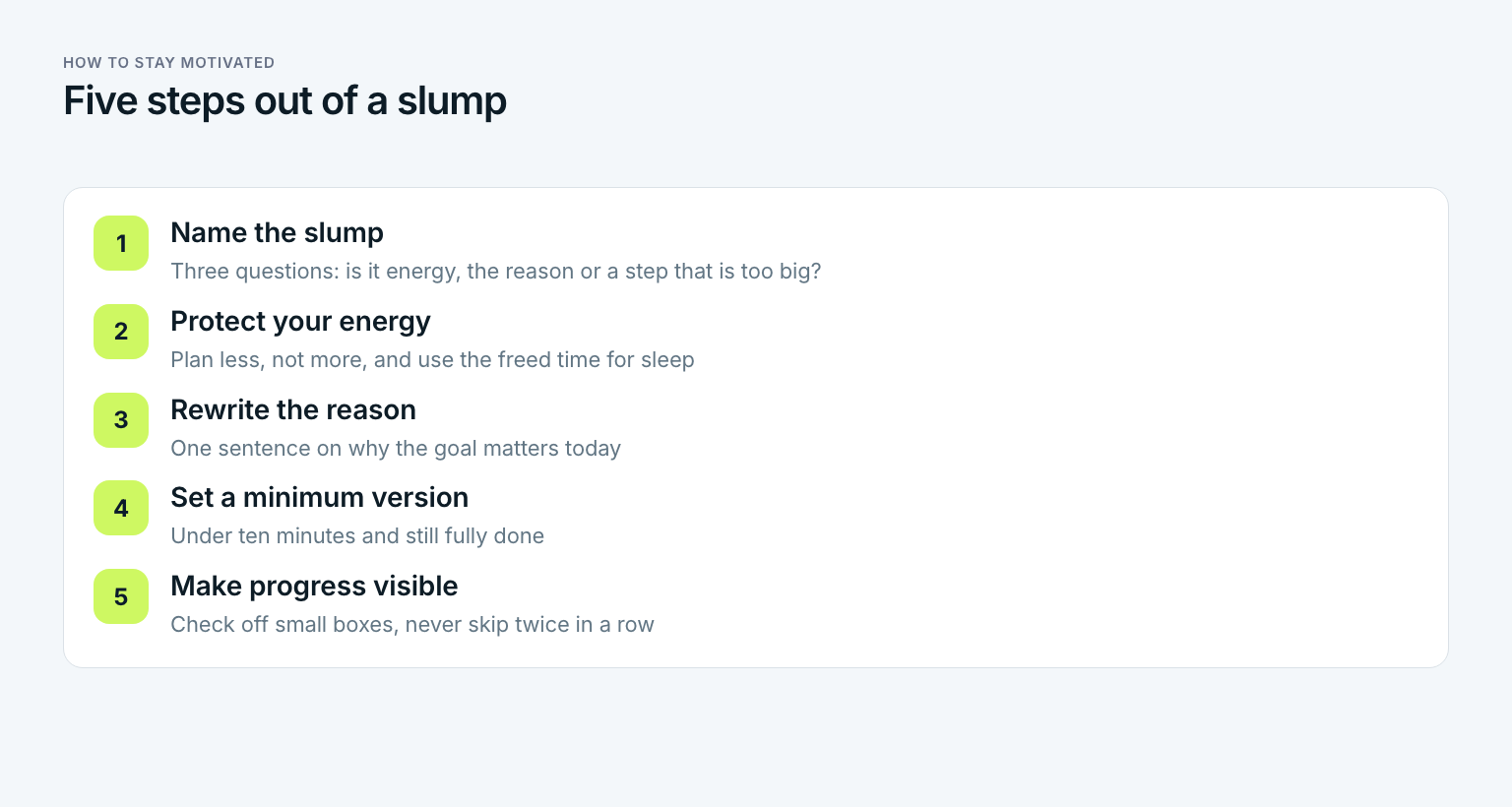
The five steps follow the three causes: name the slump, protect your energy, renew the reason, shrink the step and then make progress visible. The first pass takes about 30 minutes and one sheet of paper. Ask around for five ways to stay motivated and you hear five unrelated tips. These five steps work best in this order.
Name the slump
Answer the three diagnostic questions in writing and note for each cause whether it applies right now. Usually it is one or two. For Dana it was all three. Whoever has done nothing for two weeks needs a gentler restart than someone with one bad evening.
Protect your energy first
If energy is the problem, plan less, not more. Cut one of the fixed sessions for your goal and use that time for sleep. From April on Dana planned three runs a week instead of four and used the free slot to sleep in after her last night shift of the week. It feels like giving up. It is the condition for everything that follows.
Rewrite the reason in one sentence
Write down why the goal matters to you today, not why it mattered in January. If no honest sentence comes, that is an answer too: then you change the goal or drop it. Dana’s sentence reads: “I want Maya to watch me train for something hard and finish it.” It is taped to the inside of the closet door, right above her running shoes.
Set a minimum version
For every planned session, define a version that takes less than ten minutes and still counts. For Dana it is: shoes on, out the door, ten minutes at an easy pace. It counts as fully done even if you stop afterward. If you keep going, that is a bonus, not a duty.
Make progress visible
Split the goal into units you can check off every week. Dana printed a sheet with 84 boxes, one for every planned run from April to mid-October, and stuck it on the fridge. One rule goes with it: never skip two planned runs in a row. One missed run is a slip. Two are the start of a new slump.
The rule from step five comes from James Clear, who describes it in Atomic Habits, published in 2018. Missing once is an accident, missing twice is the start of a new habit. You do not have to show up every time. You only have to keep one missed day from becoming a missed week.
What the five steps changed for Dana
Dana worked through the five steps on the last Sunday in March, in 25 minutes at the kitchen table, and tracked the same numbers from April to June:
| Measure | March, five weeks | April to June, 13 weeks |
|---|---|---|
| Planned runs | 20 | 39 |
| Runs completed | 3, or 15 percent | 35, or about 90 percent |
| Minimum version only | none defined | 10, and seven of them turned into runs of 25 minutes or more |
| Longest run | 5 miles, from February | 9 miles |
| Time running | 70 minutes | about 26 hours |
| Boxes checked on the fridge | no sheet yet | 35 of 84 |
Dana planned fewer runs and ran far more. Seven of her ten minimum versions turned into a normal run because the start was enough. Her long run reached nine miles by June and twelve by the end of September, and the race is less than two weeks away. Did she suddenly find more motivation in April? No. She had more sleep, a reason she agrees with, and a start that fits into any day.

How to get motivated on hard days: the minimum version
How to get motivated sounds like a question about more: more drive, more excitement, more energy. On hard days it works the other way around. You get motivated by lowering the demand until it fits under the day you are having. Whoever has started often finds the drive in the doing.
That is also the honest answer to a question many people type into a search bar: how do I force myself to stay motivated? You do not. Force works for a day or two, then it costs the energy you were short on. What works is a bar low enough to clear without motivation. Each daily goal gets three versions, and all three count as done:
| Version | When | Dana’s daily goal | Time |
|---|---|---|---|
| Minimum version | after a night shift, when sick, on an overloaded day | shoes on, ten minutes at an easy pace | 10 minutes |
| Normal version | an ordinary day off | 30 minutes of easy running or the planned intervals | 30 to 40 minutes |
| Best version | Sunday after a good night’s sleep | the long run of the week | 75 to 120 minutes |
The minimum version does not protect the result of a single day. It protects your connection to the goal. Whoever has run for ten minutes is still in training the next day. Whoever has done nothing for two weeks has to start over, and those restart costs are the real reason slumps drag on.
Three tools make the start even smaller:
- If-then plans. Psychologist Peter Gollwitzer described in 1999 how specific plans in the form “If situation X happens, then I will do Y” make action easier. Dana’s plan: if I get home from a day shift and Maya is still at soccer practice, then I change into running clothes before I sit down. The decision is made once, not every day.
- Setup the day before. Put the first step where you will see it before you need it. Dana leaves her running clothes on the chair by the door with her shoes underneath.
- One person who knows. Every Sunday Dana texts a photo of the fridge sheet to her sister in Dayton. Her sister does not comment. Knowing someone looks is enough.
Gabriele Oettingen adds a fourth tool in Rethinking Positive Thinking, published in 2014. In her studies, people who only pictured a happy outcome tended to put in less effort than those who also pictured the obstacles. Her method is called WOOP: wish, outcome, obstacle, plan. Dana’s version fits on a sticky note. Wish, finish the half marathon. Outcome, Maya at the finish line. Obstacle, the day after a night shift. Plan, the minimum version on those days and nothing more. The obstacle is the part most people skip.
What matters is that the minimum version is set in advance. Whoever invents it on a hard evening negotiates with themselves, and that negotiation burns the very energy that is missing. Set on a good day, it is just one line to follow on a bad one.
What keeps you going when the feeling is gone
The strongest motivation is the kind that does not depend on your mood. Enjoyment comes and goes with the day, and outside rewards only work while they still pull. What carries you through hard days is a reason you agree with yourself, even when the thing is not fun right now.
Psychologists Edward Deci and Richard Ryan describe this in self-determination theory, which they developed from 1985 on. Between pure enjoyment of an activity and pressure from outside, they describe a form they call identified motivation: you do something because you recognize its value for yourself. That is exactly Dana’s sentence about Maya. Mile eleven of a long run in August is not fun. The reason behind it is hers.
The second stable source is visible progress. For their 2011 book The Progress Principle, Teresa Amabile and Steven Kramer analyzed nearly 12,000 diary entries from 238 employees. On the days when people felt most motivated, the most common event was a small step forward in work that felt meaningful to them. That means: a reason and progress together are stronger than any mood. The reason tells you what it is for. The progress shows you that it is working.
Every completed minimum version is also proof that you show up, even on a bad day. How that confidence builds is the subject of self-efficacy. For staying motivated, protect the chain of small wins, and the big feeling often returns on its own.
What helps when motivation is low, and what only sounds good
There are countless tips for a slump. Most are not wrong. They just help with a different cause than yours:
- Motivational videos and quotes. They give you a few minutes of momentum, and whoever uses exactly those minutes to start has gained something. They do nothing for exhaustion.
- Rewards. A good coffee after a run is a kind gesture toward yourself. It helps with a boring task but hides a missing reason.
- A break. The best help for low energy and the worst for friction. Whoever only faces a step that is too big makes it last longer with a break.
- A new system. A new app, a new notebook, a new plan. It feels like progress, but it only helps if the old system was the problem, which is rare.
So what helps? Whatever matches the cause. In short: energy needs rest, a reason needs one honest sentence, friction needs a smaller step. If the slump is mostly about putting things off, the plan in how to stop procrastinating helps as well.
The slump in your goal chain: which level to change
A slump feels as if the whole goal is shaking. Usually only one level is. Whoever breaks a yearly goal down into quarter, month, week and day can change exactly the level that no longer fits during a slump and leave the rest standing. How the chain works in general is explained in how to achieve goals.
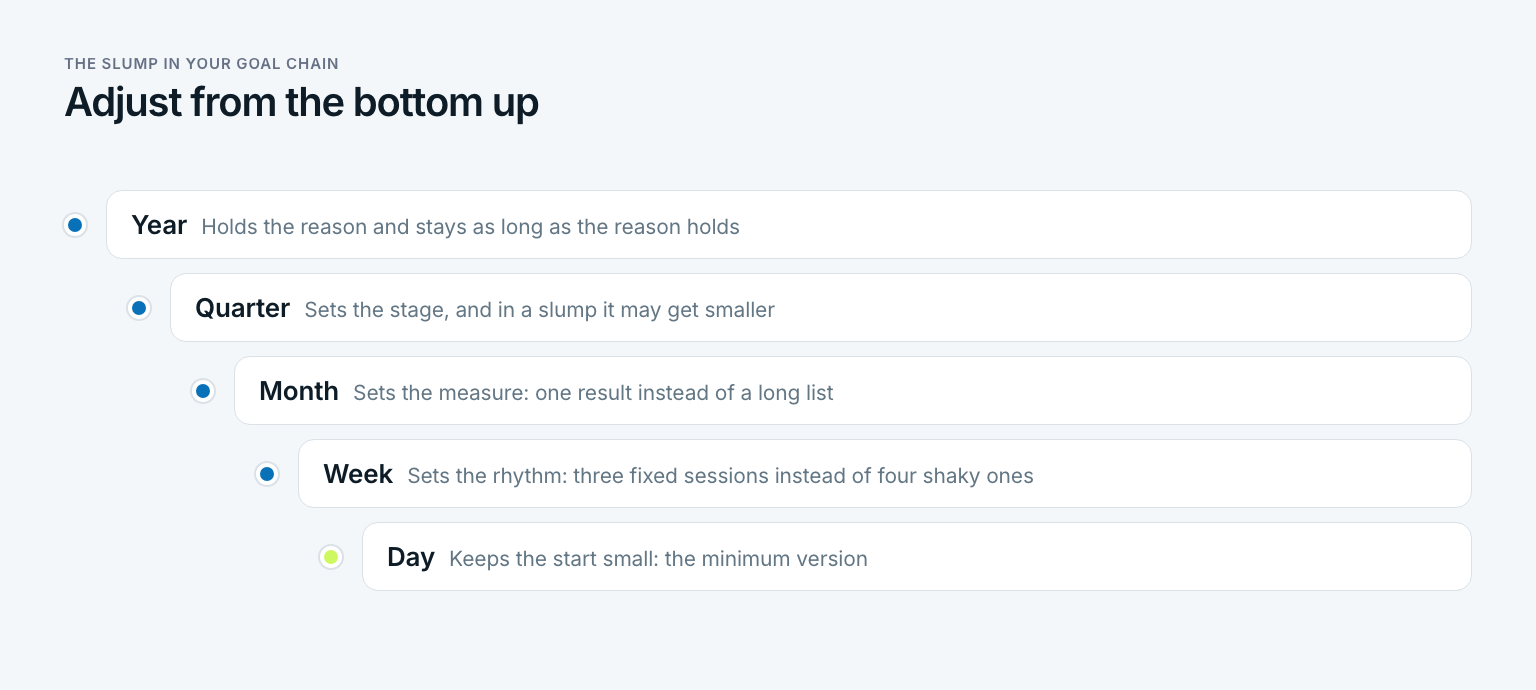
| Level | What it does in a slump | Dana’s change in April |
|---|---|---|
| Year | holds the reason | unchanged: half marathon in mid-October, no walking |
| Quarter | sets the stage | second-quarter long run target lowered from ten miles to eight |
| Month | sets the measure | April: run 30 minutes without walking, nothing more |
| Week | sets the rhythm | three runs instead of four, on days off only |
| Day | keeps the start small | minimum version: ten minutes at an easy pace |
The rule behind it: in a slump you adjust from the bottom up. First the day gets smaller, then the week gets lighter, then the month gets more modest. The yearly goal stays as long as the reason holds. Only if the reason is gone do you change the top. Dana lowered her quarterly long run target to eight miles and reached nine anyway, because the bar no longer scared her off.
In Gaapp this chain is the core: every daily goal hangs on a weekly goal, every weekly goal on a monthly goal, all the way up to the year. During a slump you can see there that even a small daily goal pays into the yearly goal. That is what the minimum version needs so it does not feel like cheating. How to write daily goals you can check off each evening is covered in daily goals.
The biggest motivation killer: three mistakes that stretch a slump
Many slumps end once the cause goes away. Three mistakes that feel reasonable stretch them. Do you recognize one of them?
The most common mistake: solving an energy problem with willpower
Whoever is exhausted and forces themselves into a big step with sheer discipline uses up the last reserve and fails anyway. Dana tried this twice in March, both times on a Sunday after a night shift, with the plan to run the full six miles. That means: when energy is missing, planning less is not giving up. It is the only measure that works.
- Making up for everything at once. Dana’s first impulse at the end of March was to run five times a week in April to get back on schedule. With three 12-hour shifts that plan would have delivered the next slump. Whoever comes back starts at the normal level or below it, not above.
- Quietly dropping the goal. Dropping a dead goal is fine. Keeping it on the list without pursuing it turns it into nightly guilt. Whoever drops a goal on purpose wins back energy for the others.
Three questions to ask before your next slump
Answer these three questions before the next slump arrives. They take five minutes:
- Do you know how you recognize low energy in yourself before you mistake it for low motivation?
- Can you state the reason for your most important goal in one sentence that you still agree with today?
- Does every daily goal you have come with a minimum version that takes less than ten minutes?
Whoever answers no to one of them knows where to start before the next slump. In short: on hard days you do not stay motivated by searching for motivation. You stay motivated by making the start so small that it works without it.
Frequently asked questions about how to stay motivated
What are 5 ways to stay motivated?
Name the cause of the slump, protect your energy, rewrite your reason in one sentence, set a minimum version that takes less than ten minutes, and make progress visible. They work best in that order, because each step removes one cause. Tips without a diagnosis help one time in three at best.
What causes lack of motivation?
Usually one of three things: you are short on energy, the reason behind your goal has gone quiet, or the next step is too big for the time you have. Sleep loss, stress and illness drain energy. A goal that no longer fits your life drains the reason, and an unclear or oversized task creates friction that feels like low motivation.
How do I force myself to stay motivated?
You do not force it, because force burns the energy you are short on. Lower the bar instead: define a minimum version of your daily goal that takes less than ten minutes and counts as done. Combine it with an if-then plan so the moment to start is already decided.
What is the biggest motivation killer?
Trying to solve an energy problem with willpower. Whoever is exhausted and forces a big step fails anyway and adds guilt, which drains even more energy. Close behind are trying to make up for everything at once after a slump and leaving a dead goal on the list.
Is it normal to lose motivation?
Yes. Slumps are part of every goal that runs longer than a few weeks, especially after stressful periods, illness or schedule changes. They signal that a condition has changed, not that you are weak. If low mood and lack of drive last longer than two weeks, talk to your doctor.
How long does a motivation slump last?
That depends on the cause. An energy slump after a stressful stretch often lifts within one to two weeks of better sleep. A slump caused by friction lasts until someone makes the first step smaller, and that can take months.
Last updated: 14 October 2026
Read next
 Personal Growth
Maslow's Hierarchy of Needs: The 5 Levels Explained
Maslow's hierarchy of needs sorts motivation into five levels. What each level means, what research says today and a needs audit you can run yourself.
14 min read
 Personal Growth
Mindfulness Exercises: 12 for Everyday Life
Mindfulness exercises are not about emptying your mind. 12 techniques for stress and focus, what research shows, and a four-week plan to practice daily.
16 min read
 Personal Growth
Positive Affirmations: 50 Examples You Can Believe
Positive affirmations are not magic words. What research shows, 50 daily affirmations you can believe, and a five-step method with a worked example.
16 min read