Self-Discipline: How to Build It Without Willpower
Self-discipline is doing what you decided, when you decided, regardless of mood. Definition, seven steps, ten rules, and a plan from year to day.

Contents
- 01What self-discipline actually is, and what it is not
- 02Why willpower fails: the three mistakes nobody notices
- 03Discipline, motivation, and habit: what each one is built for
- 04How to build self-discipline in seven steps
- 05The ten rules of self-discipline, and the five that carry the rest
- 06How to be disciplined on the days you do not feel like it
- 07Self-discipline in the goal chain: from year to day
- 08Marcus's first month in numbers
- 09Three questions that tell you whether your discipline is holding
Self-discipline is not willpower. It is the ability to do what you decided to do, at the time you decided to do it, whether or not you feel like it in that moment. Willpower is the force you use when nothing else is in place. Self-discipline is what you have when the decision has already been made, the time is already booked, and the first step is already small enough to start.
That definition changes the question. Nobody needs to learn how to want things more. The useful question is how to set up a week so that the thing you decided on actually happens. Three things are needed for that: a behavior with an hour attached, a start that is too small to refuse, and a Friday that counts. All three are worked through on Marcus, an emergency room nurse who works three 12-hour shifts a week, is enrolled in an online nursing degree that asks for about eight hours of study a week, and has twice stopped studying after three weeks.
What self-discipline actually is, and what it is not
Being self-disciplined means your behavior follows your decisions instead of your mood. Three parts are fixed: a decision made in advance, a time and a place attached to it, and a start small enough that the mood of the moment cannot veto it. Discipline in this sense has nothing to do with being hard on yourself. Whoever punishes themselves after a missed day is practicing regret, not discipline. Whoever books the next attempt is practicing discipline.
The word carries baggage. In everyday speech, discipline means punishment, drill, the sergeant's voice. In the research on self-regulation it means something quieter: the gap between intention and action, and how reliably you close it. Angela Duckworth and Martin Seligman measured that gap in eighth graders in 2005 and found that self-discipline predicted grades, attendance, and homework hours better than IQ did. The disciplined students were not smarter. They started earlier, and they stopped less often.
Self-discipline, self-control, and self-regulation: three terms, one mechanism
Self-control is the moment of resistance: not reaching for the phone. Self-regulation is the whole system that steers behavior toward a goal, including planning and review. Self-discipline is the everyday word for self-regulation applied over weeks. The distinction matters for one reason. Self-control is a moment, and moments get lost. Self-regulation is a setup, and setups hold. Everything in this guide builds setups.
Marcus had the standard picture in his head. He believed that disciplined people feel like studying after a 12-hour shift and that he was simply not one of them. The picture was wrong on both counts. Nobody feels like studying at 8 p.m. after twelve hours in an emergency room. The people who study anyway have not scheduled studying for 8 p.m. after a shift.
Why willpower fails: the three mistakes nobody notices
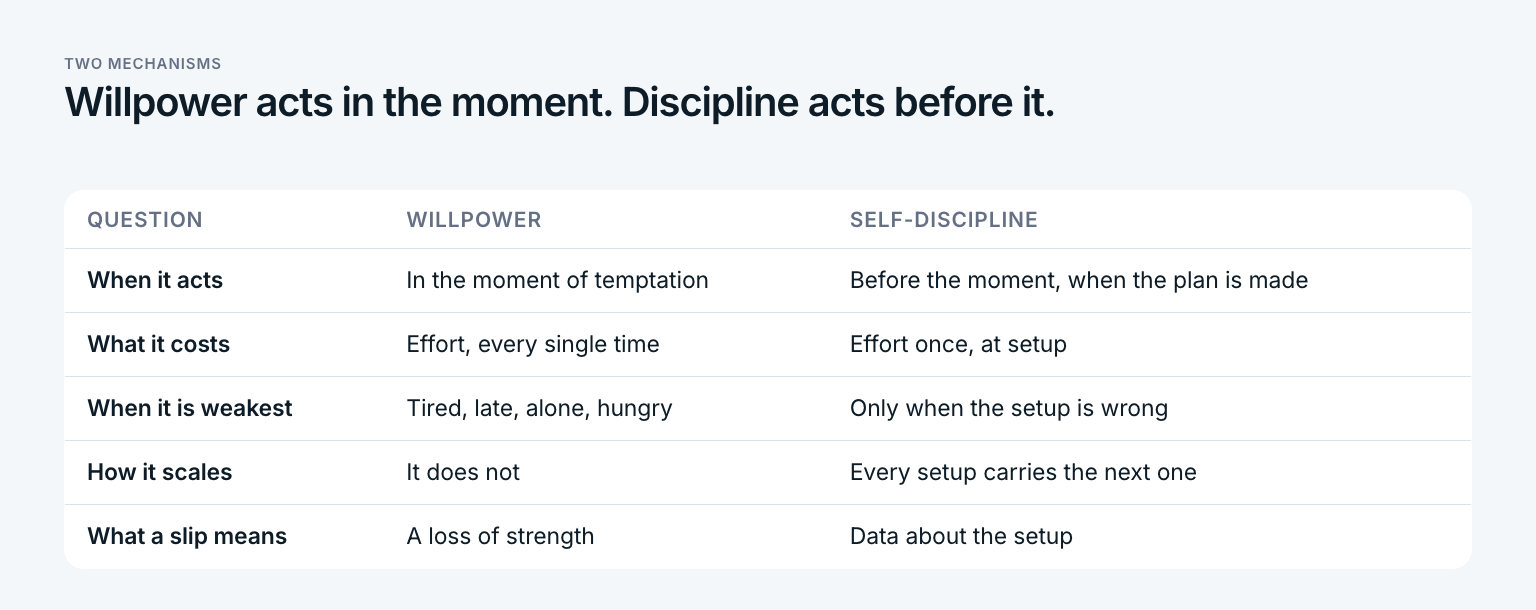
Willpower is real. It is the capacity to override an impulse in the moment, and everyone uses it several times a day. It is just not a plan. Roy Baumeister's experiments in 1998 suggested that willpower drains like a battery, a claim that a large multi-lab replication in 2016 could not confirm. Whether or not it drains, one thing is settled: willpower is at its weakest exactly when you need it most, late in the day, tired, alone with a screen. A method that depends on it is a method that fails at 8 p.m.
Three mistakes hide inside almost every failed attempt at discipline. None of them looks like a mistake while you are making it.
- The attempt starts at the hardest moment. Marcus planned to study after shifts because that was when he was home. It was also when he had the least left. The plan was checked against his calendar and never against his energy.
- The goal is a feeling, not an action. Be more disciplined. Study more. Get serious. None of these can be done at 7:30 on a Tuesday. An action has a verb, a duration, and a place: open module four at the kitchen table for 50 minutes.
- The first slip is read as a verdict. One missed evening becomes proof of a character flaw, and the proof ends the attempt. In a 2010 study by Phillippa Lally and colleagues, people building a new daily habit took a median of 66 days to reach automaticity, and a single missed day made no measurable difference to the curve. Two in a row started to. James Clear turned this into the rule never miss twice, which the Atomic Habits summary explains alongside the four laws.
What do these three have in common? Each one is a design flaw, not a character flaw. That means: the fix is in the setup, and the setup can be changed this week. Anyone who has failed at discipline three times has usually failed the same way three times, and has usually drawn the wrong conclusion all three times.
Discipline, motivation, and habit: what each one is built for
Three words that get swapped for each other. Each is built for a different job, and the confusion costs people months. The question is not which one is best. The question is which one is on duty right now.
| Motivation | Self-discipline | Habit | |
|---|---|---|---|
| What it is | The wish to act, felt in the moment | Acting on a prior decision regardless of the moment | Acting without deciding at all |
| Where it comes from | Novelty, meaning, mood, other people | A decision plus a time, a place, and a small start | Repetition in a stable context, 66 days on median |
| How reliable it is | High on day one, thin by day nine | As reliable as the setup | Very reliable once formed, fragile while forming |
| Its job | Getting you to decide | Carrying you from the decision to the habit | Carrying the behavior without effort |
| Failure mode | Waiting to feel like it | A setup that still depends on willpower | The context changes and the cue disappears |
Motivation is a fine thing. It is what made Marcus enroll, and it is what makes anyone enroll in anything. It is only built for the start. Whoever waits for motivation to return before studying is waiting for a feeling that was designed to fade. Discipline is the bridge: the stretch between the first excited week and the point where the behavior runs on its own. The bridge is long, roughly two months for a daily behavior according to Lally's data, and longer for something you do four times a week. In short: discipline is temporary by design. It is what you use until you no longer need it. And when the feeling has not just faded but turned into a slump that lasts for weeks, how to stay motivated becomes a question of finding which of three causes is behind it.
How to build self-discipline in seven steps
People search for seven ways to gain self-discipline, so here are seven, in the order Marcus used them. Each one removes a reason to need willpower. Together they take about an hour to set up, and after that one Friday review a week. None of them asks you to become a different person. All of them ask you to change the room, the hour, or the sentence.
Pick one behavior and write it as a verb, ten minutes
Not more disciplined, not study more. One behavior that a stranger could watch you do. Marcus wrote: work on the current module for 50 minutes at the kitchen table. One behavior at a time, because discipline built on two fronts splits in half. The second behavior gets its turn once the first one no longer needs a Friday review.
Measure two weeks before you change anything, zero effort
Count how often the behavior happens now, without trying harder. Marcus logged 1.5 hours across 14 days. The number stung. It was also the first honest baseline he had ever had, and every later number would be compared to it rather than to a fantasy of eight hours a week.
Move the behavior to your best hour, 15 minutes
Find the hour in your week when you have the most energy and the fewest claims on you. For Marcus that was 7:30 a.m. on the four days without a shift, before his wife and daughter were up. Studying moved from the worst hour of his day to the best one. Nothing else changed yet, and that one change did half the work.
Write the if-then sentence, five minutes
Peter Gollwitzer showed in 1999 that people who wrote down when, where, and how they would act followed through at far higher rates than people who merely intended to. The form is: if it is 7:30 a.m. on a non-shift day, then I sit down at the kitchen table and open the current module. The sentence takes the decision out of the morning. The morning only has to execute.
Shrink the start to two minutes, five minutes
The hard part of a 50-minute block is minute one. So the rule is not study for 50 minutes. The rule is: sit down, open the course, read the first heading. If after two minutes nothing comes, you are allowed to stop. Marcus stopped twice in a month. Thirty other times, minute three arrived on its own.
Decide the floor and the recovery rule, ten minutes
The floor is the minimum that still counts. For Marcus it was two 50-minute blocks on each of the four non-shift days, eight blocks a week, about six hours and forty minutes. That is below the program's eight hours, and it was chosen on purpose, because a floor you hit beats a target you miss. The recovery rule is one sentence: a missed block is rebooked for the next free morning, never for tonight.
Review every Friday, ten minutes
Count blocks done against blocks planned, write one sentence about what got in the way, and change one thing in the setup. Not in yourself, in the setup. Marcus's third-week review said: picked up two extra shifts, lost four mornings. The change was a rule about extra shifts, not a resolution to try harder. A [ten-minute weekly review](/en/blog/ten-minute-weekly-review) is the step that keeps the other six alive.
The most common mistake: keeping the behavior and skipping the hour
Most people who try to build self-discipline pick the right behavior and leave it in the wrong hour. They study after work, run after dinner, write after the kids are asleep, because that is when the calendar is empty. The calendar is empty then because the person is too. Whoever keeps the behavior and changes the hour usually fixes the problem in a week. Whoever keeps the hour and tries to change themselves usually quits in three.
The ten rules of self-discipline, and the five that carry the rest
The ten rules that circulate online come in many versions. This one is consistent with the seven steps and with what the research supports. The first five do most of the work. The second five protect the first five from a bad month.
- Decide once, in advance. Every decision made in the moment is a decision made by the tired version of you.
- Attach every behavior to a time and a place. A behavior without an hour is a wish.
- Make the first two minutes trivially small. Starting is the only skill. Continuing mostly takes care of itself.
- Set a floor, not a ceiling. The minimum that still counts, hit every time, beats a maximum hit sometimes.
- Never miss twice. One miss is noise. Two in a row is the beginning of a new pattern, so the second one gets rebooked the same day.
- Remove the competing cue. The phone charges in the hallway. The laptop opens on the course, not the inbox. In Walter Mischel's marshmallow studies from the late 1960s, the children who waited longest did not stare harder at the treat. They looked away, sang, covered their eyes.
- Track behavior, not outcome. Blocks done, not grades earned. Outcomes lag by months and lie by the week.
- Review weekly and change the setup, not the person. A missed week is information about the plan.
- Protect the hour out loud. Say the time to whoever shares your home. A spoken 7:30 holds better than a private one.
- Count the rebookings as wins. Discipline is not an unbroken streak. It is the speed of the return.
Which five are the points of self-discipline that people ask about? Rules one through five: decide in advance, attach a time, shrink the start, set a floor, never miss twice. Anyone who does only those five has a working system. The other five make it survive the week when a daughter gets sick and two colleagues call out.
How to be disciplined on the days you do not feel like it
The question how to be disciplined usually means something narrower: how to act in the exact minute when every part of you votes no. That minute is real, and no setup makes it disappear. The setup makes it short.
Three things happen in a well-built minute of friction. First, there is no decision left to make, because the if-then sentence made it last Friday. Second, the first step is two minutes long, so the vote is not about 50 minutes but about sitting down. Third, the competing option has been moved out of reach, so saying no to it costs nothing. Marcus's worst morning was a Thursday in week three. He had slept five hours, the kitchen was cold, and the phone was in the hallway where he had left it the night before. He sat down because sitting down was the whole rule. He read one heading. At minute four he was taking notes. The feeling never arrived. The block happened anyway.
That is the part most advice gets backwards. It tries to produce the feeling: motivational videos, affirmations, a new planner. The feeling is not required. What is required is a sentence, a small start, and an empty hallway. Does that sound too mechanical? It is mechanical. That is why it works at 7:30 a.m. on five hours of sleep, when nothing inspired would.
Friction: the ten seconds that decide the day
Friction is everything between the decision and the first action: finding the book, logging in, clearing the table, choosing a chapter. Every second of it is a chance for the tired version of you to vote. BJ Fogg argues in Tiny Habits, 2019, that a behavior happens when motivation, ability, and a prompt meet in the same moment, and that ability is the lever you actually control. Marcus cut his friction to almost nothing: the laptop lived on the kitchen table, open on the course, with the next module bookmarked the night before. Lowering friction is not cheating. It is the method.
Self-discipline in the goal chain: from year to day
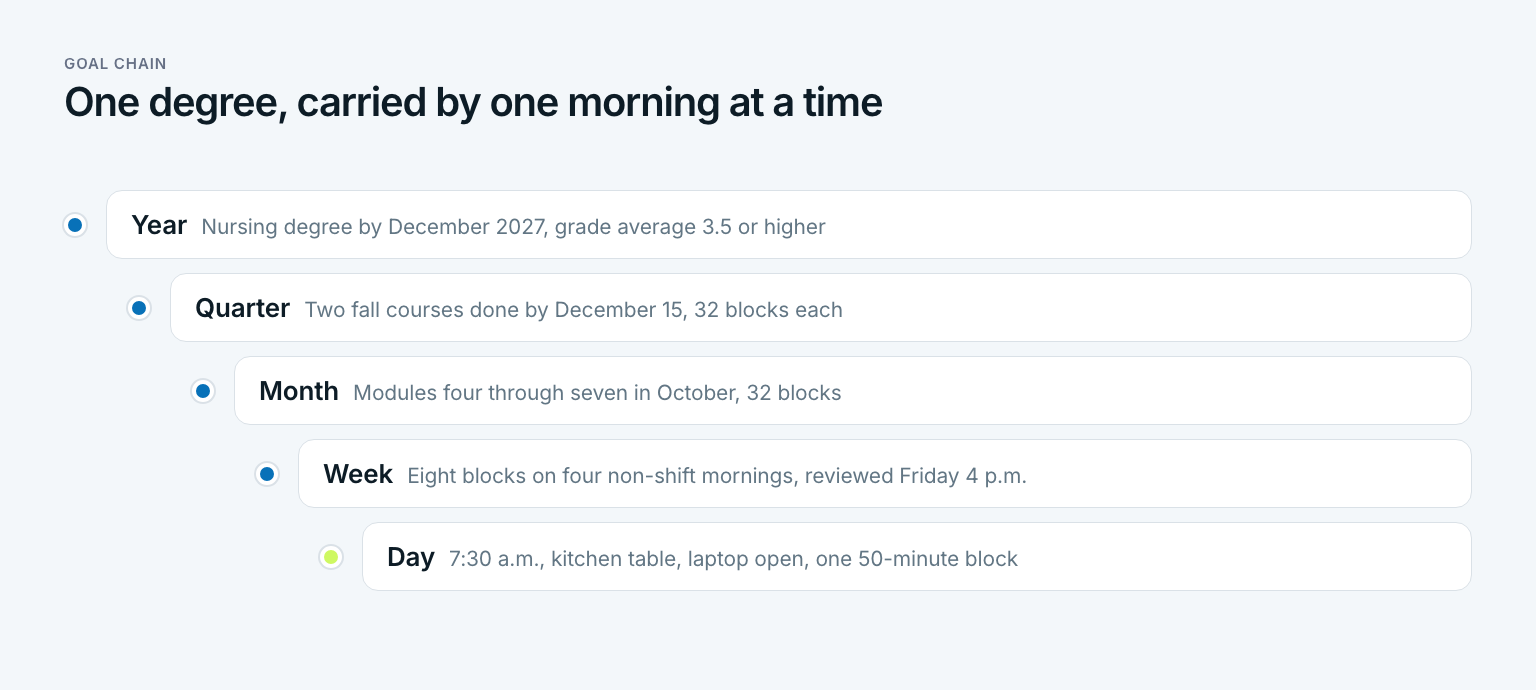
Discipline without a direction is a treadmill. The reason Marcus could sit down on a cold Thursday was not the sentence alone. It was that the sentence belonged to a chain he could see: a degree in 2027, this semester's two courses, this month's four modules, this week's eight blocks, this morning's one. Each level answers the question above it. When the morning is hard, the chain supplies the why without a speech.
- Year. Finish the nursing degree by December 2027 with a grade average of 3.5 or higher. One sentence, written once, visible every Friday.
- Quarter. Complete the two fall courses by December 15 with at least 32 study blocks per course. The quarter turns a degree into a number of blocks.
- Month. Finish modules four through seven in October, 32 blocks. One module a week, which is the first time the degree had a weekly pace.
- Week. Eight blocks on the four non-shift days, two per morning, reviewed on Friday at 4 p.m. Extra shifts move blocks to the next free morning. They never delete them.
- Day. 7:30 a.m., kitchen table, laptop already open, 50 minutes, then a second block after breakfast. The day is the only level where anything actually happens.
The chain does two things for discipline. It makes every block count toward something you can name, and it makes a missed block small: one of 32 this month, not a verdict on the degree. Whoever sees only the day lives in a series of tests. Whoever sees the chain lives in a plan that absorbs a bad Thursday. In Gaapp the chain is the structure itself: the yearly goal sits at the top, each level below is an answer to the one above, and the Friday review shows blocks done against blocks planned on one screen. The same structure works on paper, as long as all five levels are visible in one place. The method behind it is laid out under how to achieve goals, and the translation step is described in turning yearly goals into daily steps.
Marcus's first month in numbers
Here is what the setup produced in October, measured in blocks of 50 minutes, against a baseline of 1.5 hours across the two weeks before. The last column is the only one that changed anything.
| Week | Planned | Done | Hours | What the Friday review changed |
|---|---|---|---|---|
| Week 1 | 8 | 5 | 4 h 10 min | Second block moved from after breakfast to right after the first, before the house woke up |
| Week 2 | 8 | 7 | 5 h 50 min | Nothing. One block lost to a sick daughter, rebooked for Saturday |
| Week 3 | 8 | 4 | 3 h 20 min | Two extra shifts cost four mornings. New rule: an extra shift gets its blocks moved before it is accepted |
| Week 4 | 8 | 8 | 6 h 40 min | Nothing. First full week |
| October | 32 | 24 | 20 h | Baseline for the two weeks before: 1 h 30 min |
Twenty hours in a month against 1.5 in the two weeks before. Nothing about Marcus changed. He did not become a different person in October. The hour changed, the sentence existed, the phone was in the hallway, and Friday had a job. Week three is the most important row in the table. Under the old picture of discipline, four of eight blocks is failure, and failure means stop. Under the new one, it is a data point about extra shifts, and the fix was a rule written in ten minutes that held in week four. That means: the system is better than it was in week one, and Marcus is the same.
Is 24 of 32 good enough? For a program that asks for eight hours a week, 20 hours a month is slightly under target. For a person whose last two attempts ended after three weeks with nothing to show, it is the first month that produced a number worth improving. The floor did its job. November's floor can be nine blocks, and the extra block has a morning before it has a reason to be skipped. How the single block is set up on the day level is described under daily goals.
Three questions that tell you whether your discipline is holding
Before you change anything, run the audit. Three questions, one minute each, every Friday. They are the same three every week on purpose. A review that changes its questions measures nothing.
- Does the behavior have an hour, and is it my best one? If the honest answer is that it sits in the empty slot after work, the problem is not you.
- Did I rebook the misses, or did I count them? Rebooked misses are discipline. Counted misses are a diary of guilt.
- Did my Friday review change the setup, or did it change my opinion of myself? Only one of those produces a different week.
Whoever can answer all three with the first option has a system, and the system will carry the behavior until habit takes over, somewhere around the second or third month. Whoever cannot has a specific thing to fix, and it is never a character trait. It is an hour, a sentence, or a hallway.
In short: self-discipline is not a strength you have or lack. It is a setup you build once and repair on Fridays. Marcus did not find discipline in October. He stopped needing it at 8 p.m. and started needing very little of it at 7:30 a.m., which is a different thing, and the only kind that lasts.
What is being self-disciplined?
Being self-disciplined means your behavior follows a decision you made earlier rather than the mood you are in now. In practice it has three parts: a behavior written as an action, a fixed time and place for it, and a start small enough that the moment cannot veto it. It is not the same as being hard on yourself. A self-disciplined person rebooks a missed block. A self-punishing person counts it.
What are 7 ways to gain self-discipline?
Pick one behavior and write it as a verb, measure two weeks before changing anything, move the behavior to your best hour, write an if-then sentence for it, shrink the start to two minutes, set a floor and a recovery rule, and review every Friday for ten minutes. Each of the seven removes one reason to need willpower. They take about an hour to set up in total.
What are the 10 rules of self-discipline?
Decide once in advance, attach every behavior to a time and a place, make the first two minutes trivially small, set a floor rather than a ceiling, never miss twice, remove the competing cue, track behavior instead of outcome, review weekly and change the setup rather than the person, protect the hour out loud, and count rebookings as wins. The first five build the system. The last five keep it alive through a bad month.
What are the 5 points of self-discipline?
The five points that carry everything else are: decide in advance, attach a time and a place, shrink the start, set a floor, and never miss twice. Anyone who does only these five has a working system. The remaining rules protect that system from interruptions, other people, and the temptation to measure outcomes too early.
Can self-discipline be learned, or are you born with it?
It can be learned, because most of it is setup rather than temperament. People differ in impulsivity, and that difference is real. But the gap between intention and action closes through decisions made in advance, a well-chosen hour, a small start, and a weekly review, and all four are skills. Duckworth and Seligman's 2005 study found that self-discipline predicted school grades better than IQ, which is one reason it is worth learning at any age.
How long does it take to build self-discipline?
The setup takes about an hour. The point where a behavior runs on its own takes longer: Phillippa Lally's 2010 study found a median of 66 days for a daily behavior, with a range from 18 to 254 days depending on the person and the behavior. Something you do four times a week takes longer than something daily. Plan for two to three months of Friday reviews, and expect the need for discipline to shrink rather than vanish.
Last updated: 19 October 2026
Read next
 Habits
75 Hard: Rules, Risks and a Version You Can Finish
75 Hard is not a fitness program. The full rules, four health risks, 75 Soft compared and a custom version built around a real goal.
15 min read
 Habits
Digital Detox: A 7-Day Plan to Reduce Screen Time
A digital detox isn't a weekend offline. What the research shows, how to measure and reduce screen time, plus a 7-day plan with a worked example.
15 min read
 Habits
Delayed Gratification: Meaning, Examples, How to Build It
Delayed gratification isn't self-denial, it's a trade: what the marshmallow test really showed, everyday examples, five proven strategies and a plan.
15 min read