How Long Does It Take to Form a Habit? About 66 Days
Forming a habit is not a 21-day project. The 2009 study found a median of 66 days, range 18 to 254. What it means, plus a 66-day plan with an example.

Contents
- 01How long does it take to form a habit? The short answer
- 02Where 66 days comes from: Lally's 2009 study
- 03The 21 day habit myth and the 21/90 rule
- 04Why some habits take 18 days and others 254
- 05Three mistakes people make with the 66 days habit number
- 06How long to build a habit, phase by phase: a 66-day plan
- 07Maya's first twelve weeks in numbers
- 08How long to form a habit inside a goal chain
- 09Three questions to answer before day one
- 10Questions about how long it takes to form a habit
Forming a habit is not a 21-day project. So how long does it take to form a habit? In the best-known field study on the question, by Phillippa Lally and her colleagues, published in the European Journal of Social Psychology in 2009, a new daily behavior took a median of 66 days to become automatic. The range ran from 18 to 254 days. That means: plan for about two months, expect anything from three weeks to eight months, and check for automaticity instead of counting down.
To make that concrete, this guide follows Maya, a 36-year-old accountant in Chicago who wants to walk for 20 minutes after lunch on every workday. She is training for a 50-mile charity walk in September 2027. You will see where the 66 days come from, why the 21 day habit idea refuses to die, the three things that decide whether you land at 18 days or 254, a 66-day plan in phases, and Maya's first twelve weeks in numbers.
How long does it take to form a habit? The short answer
The short answer is about 66 days for a simple daily behavior, with a very wide spread. That is the honest summary of the research. It does not promise you a finish date. It replaces a wrong expectation with a realistic one, and that alone keeps a lot of people going.
What the number does not say matters just as much. It is not a deadline after which the habit is done. It is not a streak you have to protect at all costs. And it does not apply equally to every behavior. Drinking a glass of water with breakfast and going for a run after work are very different jobs for your brain.
Three misreadings show up in almost every article on the topic:
- Day 66 as a deadline. A median means half the people were faster and half were slower. Anyone who is slower is not behind schedule. They are in the other half.
- Day 66 as an unbroken streak. The study counted days since the start, not days in a row. Missing a single day barely changed the curve.
- Day 66 as the end of effort. Automaticity means starting no longer takes a decision. The action itself is still work. A 20-minute walk does not get shorter, it just gets easier to begin.
Median, not average
The median is the middle value when you line up every result from shortest to longest. Half fall below it, half above. With a range of 18 to 254 days, that matters, because a few very long cases would drag an average upward. For you it means 66 days is the middle, not the norm. Whoever still has to think about the habit on day 66 has not failed. They are simply in the second half.
Where 66 days comes from: Lally's 2009 study
The number comes from a field study at University College London. Phillippa Lally, Cornelia van Jaarsveld, Henry Potts, and Jane Wardle asked volunteers to pick one new behavior they wanted to do every day in the same situation. The choices were ordinary: a piece of fruit with lunch, a bottle of water with lunch, a run before dinner. Every day, participants rated how automatic the behavior felt.
So the study did not measure who stuck with it. It measured how strongly the behavior started without a conscious decision. From those daily ratings, the team drew a curve for each person. They were looking for the point where the curve stopped rising much, the plateau of automaticity.
The result: the median plateau came at 66 days. The fastest habit got there in 18 days, the slowest in 254. The longest values were projections from the shape of the curve, because the observation did not run that long. For some participants the curve never rose enough to estimate a plateau at all. In short: the study does not give you a number for you. It gives you a range for people like you.
The curve is steep, then flat
The curve rises fast at the start and then flattens out. The first repetitions add the most automaticity. After that, each extra day is a smaller step. That explains a feeling almost everyone knows: week one feels like progress, week five feels like nothing is happening.
For Maya it looks like this. In the first three weeks she notices she is already reaching for her sneakers when she closes her lunch container. From week four, the flat stretch begins. She keeps walking, but it does not feel any easier than the week before. Anyone who reads that stretch as a standstill quits right where the habit is setting.
What a missed day costs
A single missed day left almost no trace in the study. The curve simply carried on. That contradicts the idea of a streak you must never break. A gap is not a reset to zero, it is one day without a gain.
That means: you do not need to be perfect, you need to keep going. The danger is not the first gap. It is the feeling afterwards that everything is lost anyway. James Clear's rule never miss twice, covered in our Atomic Habits summary, fits the data well. Whoever shows up the day after a gap loses practically nothing.
The 21 day habit myth and the 21/90 rule
The 21 day habit idea is older and far better known than the 66 days. It goes back to Maxwell Maltz, a plastic surgeon who wrote in Psycho-Cybernetics, 1960, that his patients needed a minimum of about 21 days to get used to a changed face. That was an observation about adjusting, not a measurement of habits. Over the decades, a minimum of about 21 days turned into exactly 21 days.
To be fair, three weeks is not useless. It is a good first checkpoint. By then you know whether the cue holds, whether the dose fits, and whether the action survives a normal week. What you usually do not have after three weeks is a finished habit. Why does the number stick around anyway? Because it sounds short enough to start.
What is the 21/90 rule?
The 21/90 rule is an extension that spread through forums and social media. It says 21 days to build a habit and 90 days to make it part of your lifestyle. No study stands behind it. It is still interesting, because by accident it sits closer to Lally's data than the plain 21 day habit rule does. Ninety days cover the median and leave room for the slower half.
| Rule | Source | Claim | Evidence | How to use it |
|---|---|---|---|---|
| 21 day habit | Maxwell Maltz, Psycho-Cybernetics, 1960 | Three weeks and the habit is set | An observation about adjusting, not a measurement | First checkpoint: does the cue hold? |
| 21/90 rule | Forums and social media | 21 days to build, 90 to make it a lifestyle | No study | A quarter as your planning frame |
| 66 days habit | Lally and colleagues, European Journal of Social Psychology, 2009 | A median of 66 days to automaticity | Field study, range 18 to 254 days | A check on day 66, not a finish line |
Why some habits take 18 days and others 254
How long to build a habit depends mostly on three things: how simple the behavior is, how stable the context is, and how often you repeat it. The study gave direct evidence for the first. The other two follow from the way habits were measured. Together they explain why there is so much room between 18 and 254 days, and they show you where you can turn the dial yourself.
One: how simple the behavior is
Simple behaviors became automatic faster than demanding ones. In the study, eating and drinking habits reached their plateau sooner than exercise. That makes sense. A glass of water has one step, a run has ten. Every step is a place where a decision can creep back in.
Maya used this on purpose. Her habit is not called exercise. It is called putting on her sneakers after lunch. The 20 minutes outside follow almost by themselves. Whoever makes the starting move tiny shortens the road to automaticity, even if the full session stays long.
Two: how stable the context is
A habit is a link between a cue and an action. The more often the cue looks the same, the faster the link sets. Same time, same place, same action right before. Whoever practices in a different situation every day builds a new link every day.
Maya's cue is finishing lunch at her desk, which happens every workday. A clock time like 12:30 p.m. would not have held, because her meetings move around. The sneakers live under her desk, so the step from lunch to walk does not need a second decision.
Three: how often you repeat it
The study looked at daily behaviors. So 66 days meant roughly 66 chances. A habit you only do on weekdays collects five chances a week instead of seven. In the same calendar time, you get fewer repetitions, and the habit needs more weeks to catch up.
Maya runs straight into this. A quarter from April 5 to June 30 has 87 calendar days but only 63 workdays. On calendar day 66 she has walked about 43 times, not 66. Whoever counts in calendar days for a weekday habit will check too early and think the method failed.
Can you form a habit in 14 days?
Probably not, if you mean a habit that runs without a decision. The fastest case in Lally's study took 18 days, and that was a simple daily behavior. Two weeks are enough to test a cue and feel the first gains. They are rarely enough to stop thinking about it.
Three mistakes people make with the 66 days habit number
Sixty-six days is a useful number that often gets misused. Three mistakes come up again and again, and each one turns a planning tool into a reason to quit. None of them is about discipline. All three are about how the number gets read.
Mistake one: you treat it as a countdown
Whoever starts a 66-day countdown waits for the day it gets easy. When that day comes and it is not easy yet, it feels like failure. Yet for half of all people that is exactly what to expect. Put day 66 on your calendar as a checkpoint, not a finish line.
Mistake two: you reset the counter after a gap
Many apps show streaks. Break the streak and you see a zero. That looks like a restart, but it is not one. The link in your head did not disappear because of one missed day. Whoever starts counting from zero after a gap punishes themselves for something that barely cost the habit anything.
Mistake three: you count days instead of checking automaticity
The study did not count days. It measured automaticity, and the days were just the axis. If you keep going past day 66 without checking, you do not know whether the habit is built. If you check, you do. Our guide on how to build good habits has a four-statement automaticity check that takes two minutes.
The most common mistake: caring more about the streak than the habit
Almost every dropout follows the same pattern: one day missed, the streak shows zero, motivation follows it down. Lally's data says something else, because a single missed day barely changed the curve. What costs you is the break that grows out of the gap. So do not count the streak, count the rate: days done divided by days planned. Anyone with a rate of 85% is on track, even if the streak broke yesterday.
How long to build a habit, phase by phase: a 66-day plan
The shape of the study's curve suggests a plan. It is not a scientific schedule, it is a rule of thumb based on that shape: steep start, flat middle, settling. Each phase has a different job. Whoever knows which phase they are in reads their own feelings correctly.
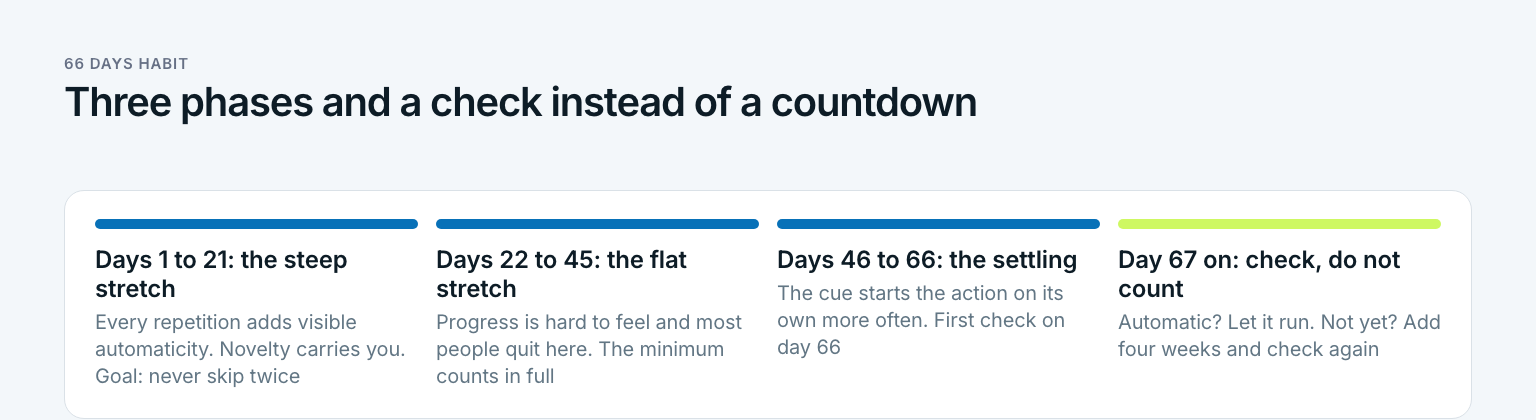
Days 1 to 21, the steep stretch. All that matters is that the action happens. Novelty carries you, and each day adds noticeable automaticity. The job of this phase is to test the cue. Does it fire on every day you planned, including the messy ones?
Days 22 to 45, the flat stretch. The novelty is gone and progress is hard to feel. This is where most people quit, because week five feels exactly like week four. The minimum helps here: the smallest version of the action that still counts in full. For Maya that is walking to the end of the block and back.
Days 46 to 66, the settling. The cue starts the action on its own more often. You notice it when you are already standing up before you thought about it. Day 66 goes on the calendar as the first check.
Day 67 on, check instead of count. If the action runs automatically, it keeps running and you can drop the check marks. If it does not yet, add four weeks and check again. That is not detention. That is the second half of the range.
Pick one action that serves a goal
Not more exercise, but the one action that feeds a yearly goal. Maya: a 20-minute walk after lunch on workdays, for a 50-mile charity walk in September 2027.
Set the cue and the minimum
The cue is something that already happens every day you plan to act. Maya: finishing lunch at her desk. The minimum is one block and back, about three minutes.
Put three dates on the calendar
Day 21 as the first checkpoint, day 45 as the end of the flat stretch, day 66 as the check. Starting Monday, April 5, 2027, those are April 25, May 19, and June 9.
Track the rate, not the streak
One check mark per walk, and on Sunday the weekly rate: done divided by planned. Below 80%, look at the cue before you blame yourself.
Check on day 66 and decide
Does the walk start without a decision? Then it keeps running. If not, extend by four weeks and check again. For a weekday habit, also count repetitions, not just days.
Maya's first twelve weeks in numbers
Here is how Maya's first twelve weeks went. The numbers are an example, not study data. They show the shape Lally described: a quick rise, a long flat stretch, a late settling. The last column shows how automatic the start felt each Friday, on a scale from 1, a conscious decision, to 5, it just happens.
| Week | Walks done of 5 | Of those, minimum | What happened | Automaticity 1 to 5 |
|---|---|---|---|---|
| 1 | 5 | 0 | New and exciting, full 20 minutes every day | 1 |
| 2 | 5 | 1 | Thursday storm, one block and back under an umbrella | 2 |
| 3 | 4 | 0 | Lunch meeting downtown on Wednesday, no desk, no cue | 2 |
| 4 | 5 | 1 | First checkpoint on day 21 behind her: the cue holds | 2 |
| 5 | 3 | 1 | Month-end close, two lunches eaten in a conference room | 2 |
| 6 | 4 | 0 | Feels exactly like week five, no sense of progress | 3 |
| 7 | 5 | 2 | Head cold, two days of the minimum only | 3 |
| 8 | 4 | 0 | Rainy Tuesday, skipped instead of doing the minimum | 3 |
| 9 | 5 | 0 | Memorial Day at home, walked after lunch anyway | 3 |
| 10 | 5 | 0 | Day 66 on Wednesday: 43 walks so far, start mostly automatic | 4 |
| 11 | 5 | 0 | First time she is outside before she remembers deciding | 4 |
| 12 | 5 | 0 | Check marks feel optional, she keeps only the weekly rate | 4 |
Three things stand out. Maya missed five walks in twelve weeks and never started over. Weeks five to eight looked like a standstill, even though she walked at least three times in each of them. And her habit settled around week ten, after roughly 45 to 50 walks, close to the study's median in repetitions but well past it in calendar days. Yours might take 30 days or 150.
What would have happened if Maya had judged herself after three weeks with the 21 day habit rule in mind? She would have written down an automaticity of two and wondered what was wrong with her. With the 66 days in mind, week three was exactly what it should be: a first checkpoint. Whoever sets expectations by the right number gets through the flat stretch.
If you want to see the rate on one page instead of in your head, a simple habit tracker does the job. What matters is that it shows the rate and not only the streak.
How long to form a habit inside a goal chain
A quarter is the natural frame for a new habit. It has about 90 days, the median plus a buffer of three weeks or so. That means exactly one new habit fits into one quarter, and by the end of it you know whether it has set. Whoever starts two habits at once splits their attention right in the flat stretch.
So Maya did not set up her walk as a resolution. She hung it in a chain of goals. At the top sits the yearly goal, at the bottom the moment after lunch. Each level answers a different question: why am I doing this, what is due this quarter, this month, this week, today?
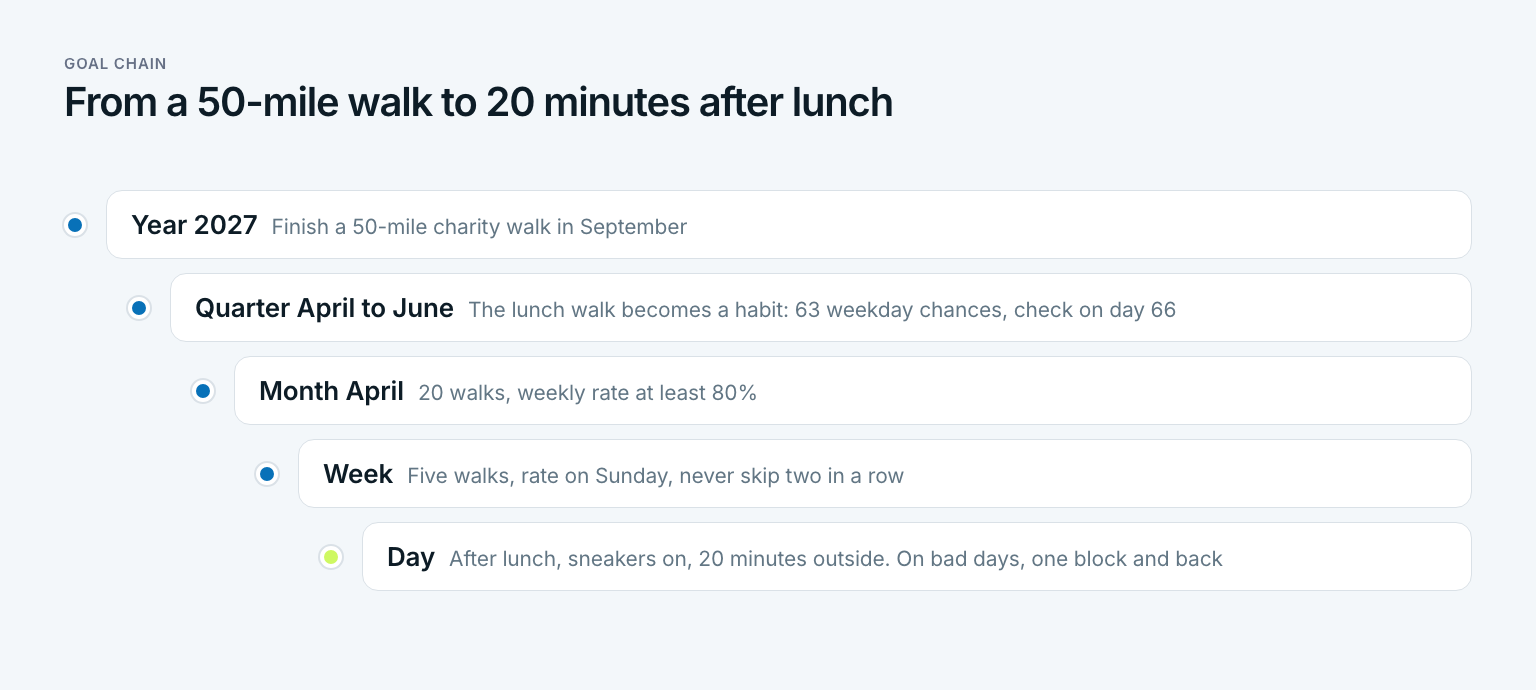
- Year: Finish a 50-mile charity walk in September 2027. That is the reason she puts on her sneakers after lunch.
- Quarter: The lunch walk becomes a habit. From April 5 to June 30 she has 63 workdays, with a check on day 66, June 9, and a second look at the end of June.
- Month: 20 walks in April, a rate of at least 80%. In May the same, and in June a longer Saturday walk joins in once the check is passed.
- Week: Five planned walks, the rate on Sunday. A gap is allowed, two in a row are not.
- Day: After lunch, sneakers on, 20 minutes outside. On bad days, one block and back. That is the daily goal, nothing more.
In the third quarter the next habit is due: a long walk every Saturday, because 50 miles need endurance. The lunch walk keeps running without check marks by then. That turns the 66 days into a rhythm for the whole year: four quarters, four habits, each with a buffer. In Gaapp, this chain lives as one yearly goal linked to quarterly, monthly, weekly, and daily goals. If you prefer shorter cycles, the 12 week year gives you a frame of almost the same length.
Three questions to answer before day one
Before you start tomorrow, answer three questions in writing. They take five minutes and decide more about the next 66 days than any burst of motivation on the first morning.
- Which goal does this habit serve? If no goal comes to mind, you will find no reason to continue in the flat stretch.
- Which action that already happens every day is your cue? A clock time is not a cue. Brushing your teeth, your first coffee, or finishing lunch are.
- What is your minimum for the worst day? It has to be small enough to manage when you are sick, tired, or traveling.
Whoever has answered these three has turned a number into a plan. In short: the 66 days do not tell you when you are done. They tell you how long to be patient before you judge.
Questions about how long it takes to form a habit
What is the 3-3-3 rule for habits?
The 3-3-3 rule is a rule of thumb from social media, not a finding from habit research, and its versions differ. The most common one splits a day into three hours on your most important project, three shorter tasks, and three small maintenance chores. It can structure a day, but it does not form a habit on its own. For that you still need one cue, one small action, and enough repetitions.
What is the 21-90 habit rule?
The 21/90 rule says it takes 21 days to build a habit and 90 days to make it part of your lifestyle. It comes from forums and social media, and no study backs it. It is still a decent planning frame, because 90 days cover the 66-day median from Lally's 2009 study with a buffer.
Does it really take 21 days to make or break a habit?
No. The 21 days go back to Maxwell Maltz, who in 1960 described how long his patients took to adjust to a changed face. When Lally and colleagues measured habit formation in 2009, the median was 66 days and the range ran from 18 to 254 days. Treat day 21 as a first checkpoint, not a finish line.
Can you form a habit in 14 days?
Rarely, if you mean a habit that starts without a decision. The fastest case in Lally's study took 18 days, and that was a simple daily behavior. Two weeks are enough to test your cue and feel the first gains.
Does missing a day reset the clock?
No. In the study, a single missed day barely changed the curve. What hurts is the longer break that often follows a gap. Show up the next day, with the minimum if you have to.
How long does it take to break a habit?
The 2009 study only looked at how new behaviors become automatic, not how old ones fade, so it gives no number for breaking a habit. In practice, it helps to replace the old habit with a new action on the same cue. Then plan for that new action with the same 66-day frame.
Last updated: 6 October 2026
Read next
 Habits
75 Hard: Rules, Risks and a Version You Can Finish
75 Hard is not a fitness program. The full rules, four health risks, 75 Soft compared and a custom version built around a real goal.
15 min read
 Habits
Digital Detox: A 7-Day Plan to Reduce Screen Time
A digital detox isn't a weekend offline. What the research shows, how to measure and reduce screen time, plus a 7-day plan with a worked example.
15 min read
 Habits
Delayed Gratification: Meaning, Examples, How to Build It
Delayed gratification isn't self-denial, it's a trade: what the marshmallow test really showed, everyday examples, five proven strategies and a plan.
15 min read