Willpower: What It Is and How It Really Works
Willpower is not a tank that runs dry. The definition, the honest state of ego depletion research, and six steps that work before temptation hits.

Contents
- 01Willpower: definition, and what it is not
- 02The muscle model: where the empty tank idea came from
- 03Ego depletion and the replication crisis: what is left
- 04What people with strong willpower actually do differently
- 05“I have no willpower”: three mistakes behind the feeling
- 06How to find willpower: six steps that work before the moment
- 07The Willpower Instinct, revisited: what held up and what did not
- 08Willpower in the goal chain: from year to Tuesday night
- 09Three questions before you wish for more willpower
- 10Willpower FAQ
Willpower is not a fuel tank that reliably runs dry by evening. Willpower is the ability to hold back a short-term impulse because a longer-term goal matters more to you. Psychologists call it self-control. It is real and it matters, but it works differently from the way most advice describes it. The best-known theory about it, ego depletion, has largely failed to hold up in large replication studies. What does hold up is less dramatic: people with a lot of willpower simply run into fewer temptations.
Maya is 31, a UX designer in Denver, and she wants $6,000 in an emergency fund by December 2027. Her budget leaves room for $500 a month. The leak is takeout. In September she ordered dinner 14 times, almost always between 8:30 and 10 p.m. after a long day, at about $27 per order. That is $378 in one month, most of her savings target. Her verdict on herself came fast: “I have no willpower.” It sounds honest. It is almost always the wrong diagnosis.
Willpower: definition, and what it is not
Willpower describes the ability to steer your behavior toward a goal while an impulse pulls the other way. In daily life it shows up in three forms: starting something you do not feel like doing, resisting something that tempts you, and remembering in the moment what you actually want. Stanford psychologist Kelly McGonigal calls these the “I will,” “I won't,” and “I want” powers. All three share one feature. Two goals are in conflict, and one of them is closer.
A cluster of words gets used for the same idea. They overlap, but each one leans a different way:
- Willpower is the everyday word, and it suggests a force you either have or lack.
- Self-control and self-regulation are the research terms. Almost every study uses one of them.
- Self-restraint stresses holding back an impulse, the no to the second slice of pizza.
- Grit and perseverance stress duration, staying with a goal over months and years.
- Self-discipline describes the result: you do what you decided, when you decided it.
If you want to build discipline as a system with fixed times and if-then plans, the article on self-discipline covers it step by step. This one is about the force that supposedly sits behind it, and about an awkward question. How much of it is there, and can you actually use it up?
What it means to run on willpower
People say someone is running on willpower when they push through by sheer force, without habits, rest, or a plan to carry them. It works for a while, the way sprinting works for a while. Anyone who runs on willpower alone has to win the same argument with themselves every single day. That means the problem is rarely the amount of willpower. It is how often you ask it to show up.
The muscle model: where the empty tank idea came from
The idea that willpower gets used up has a clear origin. In 1998, Roy Baumeister, Ellen Bratslavsky, Mark Muraven, and Dianne Tice published an experiment that became a classic. Hungry students sat in front of a plate of freshly baked chocolate chip cookies and a bowl of radishes. One group could eat the cookies. The other group was told to eat only radishes. Then everyone worked on a puzzle that was, in fact, unsolvable. The radish group gave up after a little over eight minutes. The comparison groups lasted more than twice as long.
Baumeister called the effect ego depletion. The explanation was intuitive. Every act of self-control draws on a shared, limited reserve. Spend it on skipping the morning donut, and you have less left for your taxes at night. Like a muscle, willpower tires with use and grows stronger with training. In 2007, Matthew Gailliot and colleagues added blood sugar to the story. A sugary drink, they reported, could refill the empty tank.
Hundreds of studies followed the same pattern. A 2010 meta-analysis by Martin Hagger, Chantelle Wood, Chris Stiff, and Nikos Chatzisarantis pooled 198 tests and found a medium to large effect. Baumeister and journalist John Tierney brought the model to a mass audience in their 2011 book Willpower. Most advice on how to get more willpower still builds on it today. And honestly, does it not feel exactly like that when you open the delivery app at 9:45 on a Thursday?
Ego depletion
Ego depletion is the claim that self-control uses up a limited resource. It is almost always tested with two tasks in a row: first one that demands restraint, then a second one that measures persistence. If the depleted group does worse on the second task, that counts as evidence. From around 2014 on, this exact design came under serious scrutiny, and with it the question of whether your evening slump is really an empty tank.
Ego depletion and the replication crisis: what is left
In the early 2010s, psychology began to recheck its own classics. Many famous effects shrank or vanished in new, larger studies. Ego depletion was an early target because it was cited so often and had rarely been tested independently. In 2015, Evan Carter, Lilly Kofler, Daniel Forster, and Michael McCullough reanalyzed the existing studies and corrected for publication bias, the tendency for studies without an effect to stay in the drawer. After that correction, little or nothing of the effect remained.
The real test came in 2016. Martin Hagger, the lead author of the big 2010 meta-analysis, led a Registered Replication Report together with Nikos Chatzisarantis. Twenty-three labs in several countries ran the same preregistered experiment with a little over 2,100 participants in total. The result was an effect close to zero, with an effect size of d = 0.04. For comparison, the 2010 meta-analysis had reported around 0.6. The authors concluded that if the effect exists at all, it is far smaller than anyone had assumed.
Baumeister and others objected that the task used in 2016 was too weak to truly deplete anyone. That is a fair objection. So Kathleen Vohs, a coauthor of many of the early studies, organized a second large project with tasks chosen with input from supporters of the model. It was published in 2021: 36 labs, more than 3,500 participants. The effect size was d = 0.06. That is small enough to matter very little in daily life. The research is not closed, but the strong version of the theory no longer has solid evidence behind it.
| Year | Study | What it found |
|---|---|---|
| 1998 | Baumeister, Bratslavsky, Muraven, Tice | People who resisted cookies quit an unsolvable puzzle sooner |
| 2007 | Gailliot and colleagues | Sugar was said to restore depleted self-control |
| 2010 | Hagger, Wood, Stiff, Chatzisarantis | Meta-analysis of 198 tests, medium to large effect |
| 2010 | Job, Dweck, Walton | Depletion showed up mainly in people who believed willpower is limited |
| 2015 | Carter, Kofler, Forster, McCullough | After correcting for publication bias, little effect remained |
| 2016 | Hagger, Chatzisarantis, and 23 labs | Effect size d = 0.04, practically zero |
| 2021 | Vohs and 36 labs | Effect size d = 0.06, very small |
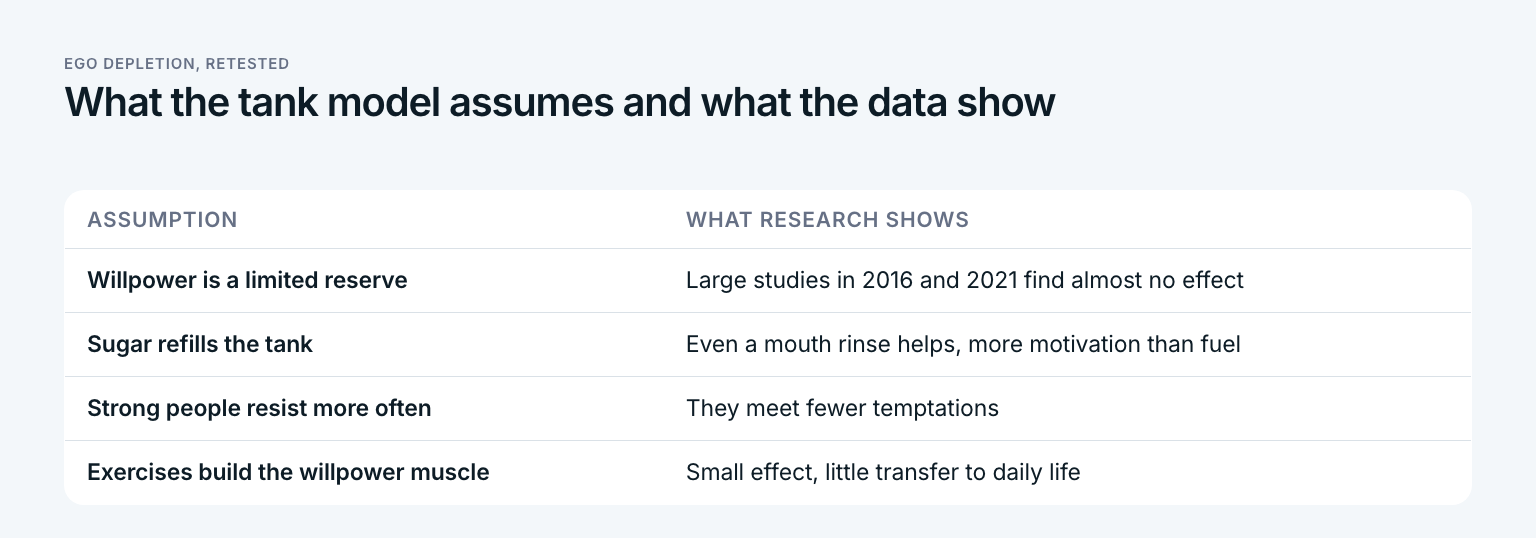
The sugar story did not survive either. Robert Kurzban pointed out in 2010 that the brain uses barely more glucose during a hard mental task than at rest. In 2012, Daniel Molden and colleagues showed that simply rinsing the mouth with a sugar solution helped, without swallowing any sugar at all. That looks more like a signal to motivation than a refilled tank.
One finding from that period is especially useful in daily life. In 2010, Veronika Job, Carol Dweck, and Gregory Walton found that performance dropped after a draining task mainly in people who believed willpower is limited. Those who believed effort can be energizing did not show the effect. Dweck is also the researcher behind the growth mindset, and the idea is the same: what you believe about your abilities changes how you use them. Later studies have not always found it as strongly. It does fit a newer view that Michael Inzlicht and Brandon Schmeichel proposed in 2012. After a hard stretch, what shifts is motivation, not fuel. You still can. You just would rather do something else.
So what is the honest summary? Nobody disputes that fatigue, hunger, and stress affect behavior. After a long day, many things get harder. What is disputed is the strong claim that every act of restraint measurably drains one shared reserve that you have to ration or train. In short: the tank is a vivid image, but it is not a proven explanation. Anyone who plans their life around it may be solving a problem that does not exist in that form.
What people with strong willpower actually do differently
If not a bigger tank, then what? The most revealing answers come from studies that follow people through ordinary days instead of lab tasks. In 2012, Wilhelm Hofmann, Roy Baumeister, Georg Förster, and Kathleen Vohs pinged about 200 adults on their phones several times a day for a week. Each time, participants noted whether they felt a desire, whether it clashed with a goal, and whether they gave in. The surprising result: people who scored high on self-control did not report resisting more often. They reported fewer temptations in the first place.
Brian Galla and Angela Duckworth found one reason in 2015. Across several studies, high self-control went hand in hand with good habits such as regular exercise, set study times, or healthy eating. Those habits explained a large share of the benefit. People with strong self-control do not fight harder or more often. They have arranged their lives so they need to fight less. A 2012 meta-analysis by Denise de Ridder and colleagues pointed the same way. Trait self-control is most strongly linked to automatic, habitual behavior.
Marina Milyavskaya and Michael Inzlicht followed students through a semester in 2017. Those who often resisted temptation actively did not reach their goals any better. What mattered was how many temptations showed up at all. Milyavskaya and colleagues had already shown a second lever in 2015. People pursuing goals they want to reach, rather than goals they feel they have to reach, experience fewer temptations along the way. Wanting is not a soft factor. It changes how often you need willpower at all.
None of this means self-control is unimportant. The Dunedin study led by Terrie Moffitt followed about 1,000 children in New Zealand to age 32. Those who showed more self-control as children were, on average, healthier, more financially secure, and less likely to have a criminal record as adults, even after accounting for intelligence and family background. The better-known marshmallow test is read far more cautiously today, as the guide to delayed gratification shows. The question is not whether willpower matters. It is how it works on an ordinary Tuesday.
Is willpower genetic?
Partly. A 2019 meta-analysis of twin studies by Yayouk Willems and colleagues estimated that around 60 percent of the differences in self-control between people are linked to genetic differences. That number describes variation across a population. It is not a ceiling for any one person. Whoever inherited a restless temperament still decides where the phone charges and when the groceries get bought.
What was really happening in Maya's evenings
For two weeks, Maya kept a tally of every evening between 8 and 10 p.m. No journal, just a cue and what followed. The result surprised her more than any study:
| Cue | Evenings out of 14 | What followed |
|---|---|---|
| Delivery app on the phone's home screen | 14 | Scrolling menus “just to look” on the couch |
| Nothing ready to cook when she got home | 10 | Ordering felt like the only realistic option |
| Worked past 7 p.m. | 6 | Too tired to decide, ordered the usual |
| Friend texted a restaurant suggestion | 3 | Split an order, felt social, spent $30 |
That means Maya had to win three or four small decisions against the app every evening before dinner even started. She did not lose because she is weak. She lost because she had to fight the same fight every night, at the worst hour of the day. Anyone who sets up their evenings that way is asking for more than people with strong willpower ever ask of themselves.
“I have no willpower”: three mistakes behind the feeling
Most plans do not fail for lack of willpower. They fail because of three assumptions that feel reasonable and still lead you the wrong way.
Mistake 1: treating willpower as a verdict on your character
“I have no willpower” is a sentence about a person, not about a situation. It feels honest, but it leads nowhere. Whoever sees themselves as weak-willed looks for the fix inside and misses the evenings, places, and times where they actually give in. Maya spent seven weeks doubting herself before spending two weeks with a tally sheet. If the feeling that you cannot manage anything lasts for weeks, freezes you, or comes with hopelessness, that is not a willpower problem but a good reason to talk to a doctor, a therapist, or the 988 Suicide and Crisis Lifeline by calling or texting 988.
Mistake 2: scheduling the hard thing for your weakest hour
Deciding on dinner at 9 p.m. after a long workday is a brave plan. Fatigue may not drain a tank, but it does shift what you want. The couch looks better, cooking looks harder, and the app is one tap away. Anyone who puts their most important decision into that hour needs the most willpower exactly when it is hardest to find.
Mistake 3: leaving the temptation within reach
The app on the home screen, the snacks at eye level, the show set to autoplay. Each small thing demands a decision, and every decision can be lost. The studies by Hofmann and by Galla show that people with high self-control start right here. They move the temptation out of the way instead of resisting it every day.
The most common mistake: waiting for a strong moment
Whoever plans to simply be stronger tonight is moving the decision into the moment when they are most tired and the temptation is closest. That is the worst point in the whole sequence. Make the decision earlier: when you plan the week, when you clear the counter, when you set the time. Willpower in the moment is the emergency brake, not the steering wheel.
How to find willpower: six steps that work before the moment
In 2016, Angela Duckworth, Tamar Gendler, and James Gross sorted self-control strategies by when they intervene in the life of an impulse. The early ones work best: choosing your situation and changing your situation. The weakest is what most people try first, suppressing the urge at the last second. These six steps follow that order, from the earliest point to the latest.
Find your battleground
For two weeks, write down when you give in: time, place, and what was within reach. A tally is enough. Maya's answer was clear. Almost every order happened between 8:30 and 10 p.m., on the couch, with the app already open.
Choose the situation
Move the decision to a time and place with less temptation. Maya now decides dinner on Sunday afternoon for the whole week. She shops at 10 a.m. on Sunday and cooks two big batches, so the weeknight decision is already made.
Change the situation
Add friction where you give in and remove it where you want to start. Maya deleted both delivery apps from her phone and only orders from her laptop. Three freezer meals sit in the front of the freezer. The fewer steps between you and the good option, the less willpower the start requires.
Decide in advance
Write an if-then plan that makes the decision for you: “If I get home after 8 p.m., then I heat up a freezer meal.” Peter Gollwitzer and Paschal Sheeran found in a 2006 meta-analysis of 94 studies that plans like this have a medium to large effect on reaching goals.
Clarify what you want
Write one sentence about why you want the goal, not why you should. Maya's sentence: “With $6,000 in the bank, a broken car or a lost contract will not scare me anymore.” It sits as her phone's lock screen. It is not magic, but it makes the app a little smaller.
Plan for slips
Decide what happens after a missed day before it happens. Maya's rule is one planned takeout night every Friday and never two unplanned orders in a row. Anyone who throws out the whole plan after one bad evening loses far more than that evening.
Notice what is missing from this list: gritting your teeth. The real willpower sits in the first five steps, and it gets spent on Sunday afternoon, not at 9:45 p.m. If you want the mechanics of building a new routine, how to build good habits walks through them. If the problem is an old habit you want gone, how to break bad habits shows how to keep the cue and swap the routine.
The Willpower Instinct, revisited: what held up and what did not
Kelly McGonigal's The Willpower Instinct, based on a course she taught at Stanford, is one of the most widely read books on the topic. It gets a lot right. The third of its powers, “I want,” the habit of remembering what you really want, fits well with the later research on want-to goals. The book is also kind about failure. It treats harsh self-criticism as a reason people give up, not as a cure, and that advice has aged well.
Where it aged is the biology. Like most books of its time, it leaned on the muscle model and on the glucose findings, which the replication work has since put in doubt. The practical tips that follow from that model, such as small daily exercises to strengthen the willpower muscle, have not held up well either. In a 2017 meta-analysis, Malte Friese, Julius Frankenbach, Veronika Job, and David Loschelder found that self-control training produced a small effect that shrank further after correcting for publication bias. They found little evidence that it carries over to unrelated areas of life.
Cold showers are not pointless. They mostly train one thing: taking cold showers. Whoever does a specific thing often enough finds that specific thing easier, because it becomes a habit. That is valuable, but it is habit building, not strength training for a general will. So why brush your teeth with your other hand when you can practice the goal itself? What really grows with practice is your belief that you can do it. Albert Bandura called that self-efficacy, and its strongest source is your own track record.
Willpower in the goal chain: from year to Tuesday night
Most willpower battles happen at the bottom: on a weekday, at 9 p.m., on the couch. They are won higher up. Whoever breaks a yearly goal down to the day makes the hard decisions once a quarter and once a week, calmly, instead of every evening under pressure. By the time the day arrives, only one small action is left.
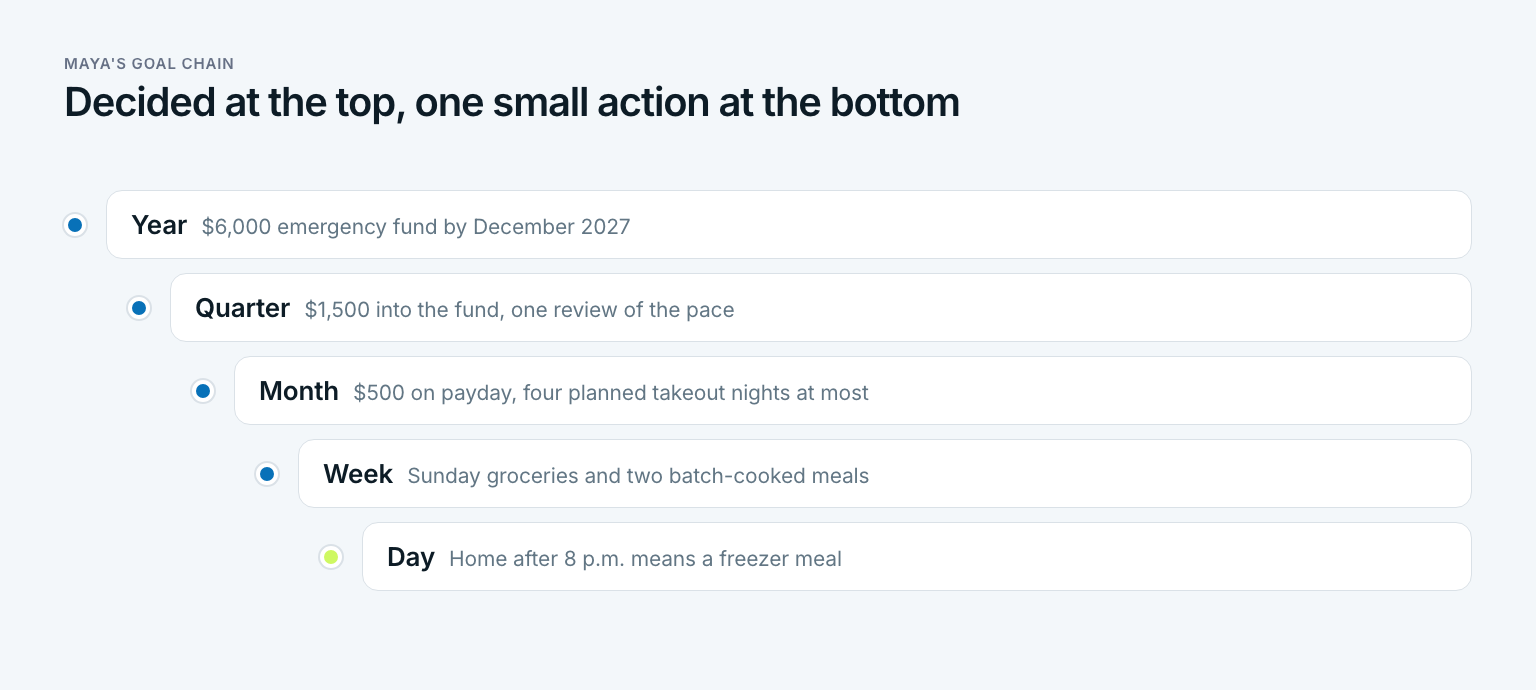
For Maya, it looks like this. The yearly goal is fixed: $6,000 saved by December 2027. Each quarter, $1,500 moves into the fund, and a quarterly review checks whether that pace holds. Each month, $500 goes in on payday and takeout is capped at four planned nights. Each week, groceries and two batch-cooked meals happen on Sunday. On the day itself, only the if-then plan is left: home after 8 p.m. means a freezer meal.
In October, Maya ordered takeout four times, all of them planned Friday nights, for $105. Her willpower probably did not grow in those four weeks. What grew was the number of evenings when she did not need it at all. In Gaapp, every weekly task is linked to its yearly goal, so on Friday you can see whether the week still matches the year. For the broader method behind goals that last, see how to achieve goals.
Three questions before you wish for more willpower
Before you promise yourself to be stronger starting tomorrow, take an honest look at three questions. Together they take less than ten minutes:
- When exactly do I give in, and what is within reach at that moment?
- Do I want this goal, or do I feel I have to want it, and can I say the reason in one sentence?
- Which decision can I make today so that I do not have to make it tomorrow night?
Anyone who answers these three questions has done more for their willpower than any cold shower ever could. In short: willpower is less a force you summon in the moment than a life you build so that you rarely need it.
Willpower FAQ
What does it mean for someone to be on willpower?
People usually say someone is running on willpower when they push through by force, without habits, rest, or a plan to carry them. It works for a while, the way sprinting works for a while. Over weeks it tends to break down, not because a tank empties, but because every day starts the same fight again.
How do you find willpower?
Look for it before the moment, not in it. Choose times and places with fewer temptations, add friction between you and what you want to avoid, and decide in advance with an if-then plan. Most people who seem to have a lot of willpower have arranged their days so they need less of it.
Is willpower genetic?
Partly. A 2019 meta-analysis of twin studies by Willems and colleagues estimated that around 60 percent of the differences in self-control between people are linked to genes. Heritability describes variation across a population, not a limit for one person, so habits and surroundings still shape what you do each day.
What is more powerful than willpower?
Habits and environment. Studies by Hofmann and colleagues in 2012 and by Galla and Duckworth in 2015 suggest that people with high self-control rely on routines and avoid temptations rather than resisting them more often. A behavior that runs on a cue no longer needs a decision.
Is willpower a limited resource?
The ego depletion theory says yes, but two large replication projects with 23 and 36 labs found almost no effect in 2016 and 2021. Fatigue, hunger, and stress can still make self-control harder. A fixed reserve that every act of restraint measurably drains, however, has not been shown.
Can you train willpower?
General exercises such as cold showers showed only small effects in a 2017 meta-analysis by Friese and colleagues, with little transfer to other areas. It works better to practice the exact behavior you want until it becomes a habit. Add if-then plans and an environment that keeps temptations out of reach.
Last updated: 22 October 2026
Read next
 Habits
75 Hard: Rules, Risks and a Version You Can Finish
75 Hard is not a fitness program. The full rules, four health risks, 75 Soft compared and a custom version built around a real goal.
15 min read
 Habits
Digital Detox: A 7-Day Plan to Reduce Screen Time
A digital detox isn't a weekend offline. What the research shows, how to measure and reduce screen time, plus a 7-day plan with a worked example.
15 min read
 Habits
Delayed Gratification: Meaning, Examples, How to Build It
Delayed gratification isn't self-denial, it's a trade: what the marshmallow test really showed, everyday examples, five proven strategies and a plan.
15 min read