How to Break Bad Habits: Keep the Cue, Swap the Routine
Breaking a bad habit is not a willpower test. Find the cue, test the reward, swap the routine, plan for slips: seven steps and twelve weeks of numbers.

Contents
- 01How to break bad habits: what actually has to change
- 02Why bad habits are so hard to break: the psychology in plain words
- 03How long it takes to break a bad habit
- 04The three mistakes that bring a bad habit back
- 05How to break a bad habit in seven steps
- 06Four ways to stop bad habits, compared
- 07Dan's twelve weeks in numbers
- 08Breaking bad habits in the goal chain: from a yearly goal to 5:40 p.m.
- 09Common bad habits and what to replace them with
- 10Three questions before the next cue shows up
- 11Frequently asked questions about breaking bad habits
Breaking a bad habit is not a test of willpower. It is a swap: you keep the cue that sets the habit off and the reward it gives you, and you replace the action in between. That is how to break bad habits for good, and it explains why quitting cold so often fails. Delete a habit and you leave a gap. The old routine walks right back into it.
The example here is Dan, 36, an operations manager at a distribution center outside Columbus, Ohio, married, with a seven-year-old daughter. His shift ends at 5:15 p.m. At 5:40 he pulls into the same gas station on his way home, buys a 44-ounce soda and a bag of chips, and finishes both in the truck before the last twelve minutes of the drive. Five workdays a week, for four years. It costs him about $6.50 a day, and his doctor now brings up his weight at every checkup. Dan has quit three times. The longest run lasted nine days.
How to break bad habits: what actually has to change
To break a bad habit, you change the middle of a loop, not the whole loop. Charles Duhigg calls this the Golden Rule of habit change in The Power of Habit, published in 2012: keep the old cue, deliver the old reward, insert a new routine. He shows it at work in Alcoholics Anonymous and in a behavioral therapy for nail biting. That means: you stop fighting a cue that will show up anyway, and you decide in advance what you will do when it does.
Quitting cold sounds simpler, and for some habits it works. The trouble is that the cue does not quit with you. Dan's shift still ends at 5:15, and the drained feeling after ten hours on the warehouse floor still arrives on schedule. Anyone who only decides “no more gas station” is at the same exit ramp on day four, with the same need and no plan. The habit that is already there wins.
Changing a habit is not the same as building one. When you change a habit, the situation stays and only the action changes: Dan still leaves work at 5:15 and still has twelve minutes alone in the truck. Starting a habit from nothing is covered in how to build good habits. This guide is the mirror image: what is already running and should stop.
In short: a bad habit does not leave because you decided it should. It leaves when another action fills the same slot more reliably.
Why bad habits are so hard to break: the psychology in plain words
A habit is a stored shortcut. Your brain links a context, meaning a place, a time, a mood or the action right before, so tightly to a response that the response starts before you have decided anything. The psychologist Wendy Wood explains in Good Habits, Bad Habits, from 2019, that habitual behavior barely responds to intentions and responds strongly to context. Anyone who changes their intention and leaves the context alone changes very little.
The loop: cue, routine, reward
Every habit can be split into three parts. The cue starts it, the routine is what you do, and the reward is the reason your brain keeps it. For breaking one, the third part matters most, because the reward is rarely what it looks like.
Dan was sure the habit was about sugar. After one week of notes, it looked different. On the Friday he left early for his daughter's soccer game, he drove past the gas station without noticing. On the Wednesday after an argument with a shift supervisor, he stayed in the parking lot for 25 minutes. The reward was not the soda. The reward was fifteen minutes between work and home where nobody needed anything from him.
Why willpower loses to context
One experiment shows this better than any theory. In 2011, David Neal, Wendy Wood and colleagues handed moviegoers popcorn that was a week old. People who habitually ate popcorn at the movies ate nearly as much stale popcorn as fresh, even though they said afterward that it tasted bad. When they had to eat with their non-dominant hand, they ate noticeably less, and in a room that did not feel like a movie theater the effect faded too. Taste barely mattered. Context decided.
That leads to an uncomfortable finding. People with high self-control do not necessarily resist temptation better. They run into it less often. In 2012, Wilhelm Hofmann and colleagues tracked the desires of adults through the day for a week, and those with high self-control reported fewer temptations, not more victories. That means: discipline is largely good planning of your surroundings. And surroundings can be rebuilt. The guide to building self-discipline shows how to turn that into a system.
How long it takes to break a bad habit
A habit does not break after a fixed number of days. It breaks when the new routine wins in the old context more often than the old one does. The popular claim that it takes 21 days traces back to the surgeon Maxwell Maltz, who noted in 1960 how long his patients needed to get used to a changed appearance. It was never a study of habits.
The better number comes from Phillippa Lally and her team at University College London. In their 2010 study, a new behavior took a median of 66 days to feel automatic, with a range from 18 to 254 days. Breaking a habit adds a second point that most advice leaves out.
Why the old habit is never fully erased
The learning researcher Mark Bouton has shown over decades that an unlearned behavior is not deleted. It is overwritten. The old link stays stored, the new one sits on top of it and holds mostly in the context where it was learned. Change the context through a vacation, an illness or a stressful month, and the old response can come back. That means: a slip after six good weeks is not proof that nothing worked. It is the expected case, and your plan needs a step built for it.
For Dan, that meant planning for twelve weeks, not three. Week one is observation, weeks two and three are rebuilding, weeks four through eight are repetition, and the last four test whether the new routine survives bad days. There is no finish line in the strict sense. There is only a point after which the new routine is the more likely one.
The three mistakes that bring a bad habit back
Most attempts to break a habit do not fail for lack of willpower. They fail because of three planning mistakes that look like weakness from the outside. Dan made every one of them in his first three tries:
Mistake one: you remove the habit instead of replacing it
A ban leaves a gap. The cue shows up on time, the need behind it shows up too, and the answer is missing. On his first attempt, Dan simply told himself to drive past. On day four he pulled in anyway, because the ramp came up and he had nothing else lined up for that moment. Whoever only removes a habit is asking themselves to say no again every single day.
Mistake two: you guess the reward instead of testing it
Most people assume the obvious reward is the real one. Whoever believes they snack at night for the taste swaps chips for carrot sticks and wonders why the craving stays. Often the reward is a break, company, distraction from worry, or simply the feeling that the workday is over. Without that test you build a substitute for the wrong need.
Mistake three: you treat the first slip as a verdict
In the 1980s, the psychologist Alan Marlatt described what he called the abstinence violation effect. Anyone who slips once after a stretch of restraint tends to read it as proof of weakness and gives up entirely. One evening turns into a week. The mistake is not the slip. It is the story you tell about it. Without a rule decided in advance for the day after, every slip becomes the end.
The most common mistake: a rule with no replacement
Most plans to break a bad habit are one sentence long: “Starting Monday, no more.” A rule like that is sincere, and it shows you have spotted the problem. It is just built for something else: a single decision, not a cue that arrives at the same time every day. Replace every rule with a sentence in the form “When X happens, I will do Y.” Only then does the cue have an answer that is not the old one.
How to break a bad habit in seven steps
The seven steps run the loop backward: first find out what the old habit gives you, then build a replacement, then arrange your surroundings so the replacement is the easier choice. For Dan, the preparation took two weeks. The rest was repetition.
Pick exactly one habit
Choose the one that costs you the most, not the one that annoys you the most. Describe it so a stranger could observe it: “gas station stop on the drive home” rather than “eating junk.” Anyone who tries to break three habits at once faces three times the cues with the same energy.
Log it for one week without changing anything
Each time it happens, write down five things: time, place, mood, who was around, and what happened right before. Do not intervene, just record. After five to seven entries a pattern almost always shows up that you had not seen.
Test the reward
Try a different replacement on several days and ask yourself 15 minutes later: is the urge still there? If not, you have found the real reward. Dan tested a diet soda at home, a call to his brother, and a ten-minute walk at a park on the way. The walk won.
Write an if-then plan
One sentence ties the cue to the new routine: “When I pull out of the lot at 5:20, I drive to the park on Maple Street and walk ten minutes with a podcast.” Peter Gollwitzer calls this an implementation intention, and his 2006 review with Paschal Sheeran found that such plans raise follow-through well beyond good intentions.
Make the old routine harder and the new one easier
Every bit of effort counts. Dan changed his route so it no longer passes the gas station, kept a cooler with cold sparkling water on the passenger seat. Whoever adds even a few minutes of hassle to the old habit often gains more than any promise could.
Set a plan for slips
Decide in advance what happens after a miss: “One stop is a data point. Tomorrow the plan applies again.” Add a minimum version for hard weeks. For Dan, that was five minutes in the park lot with the radio on, no walk required.
Count once a week
Do not grade every day. On Sunday, write down one number: on how many workdays the plan won. The weekly rate shows the trend your mood hides. A simple [habit tracker](/en/blog/habit-tracker) is enough for this.
The cue log: Dan's first week
The log is the step almost everyone skips. It costs a week and feels like standing still. It is also the only place where you find out what you are actually up against. Dan typed one line into his phone each evening after dinner:
| Day | Time | Mood | What happened right before | Stopped? | Spent |
|---|---|---|---|---|---|
| Monday | 5:41 p.m. | drained | Late truck pushed back the loading schedule | yes | $6.79 |
| Tuesday | 5:38 p.m. | calm | Normal shift | yes | $6.49 |
| Wednesday | 5:52 p.m. | angry | Argument with a shift supervisor | yes | $9.20 |
| Thursday | 5:35 p.m. | tired | Double inventory count | yes | $6.49 |
| Friday | 5:10 p.m. | good | Left early for his daughter's soccer game | no | $0 |
Two patterns jump out. First, the stop happens on every day he leaves work tense or tired. Second, the one day he skipped was the day he had something to look forward to at home. That means: Dan does not need a replacement for sugar. He needs a replacement for a buffer, a few minutes between a loud warehouse and a busy house where he answers to nobody.
Four ways to stop bad habits, compared
There are four ways to take the ground out from under a habit. None is better than the others. Each one fits a different situation, and most changes that last combine two of them.
| Lever | What you do | Works best when | Dan's version |
|---|---|---|---|
| Replace | Same cue, same reward, new routine in between | the cue comes every day and cannot be avoided | Ten-minute park walk instead of the gas station |
| Add friction | More steps and more time before the old routine | the old routine is very convenient | New route home, no gas station on the way |
| Avoid | Take the cue itself out of your day | the cue is optional | Leaves at 5:20 instead of rushing out at 5:15 still wound up |
| Change the setting | Change place, room or order so the old context is missing | a life change is already coming, or a small one is easy to create | Cooler on the passenger seat, podcast queued before he starts the truck |
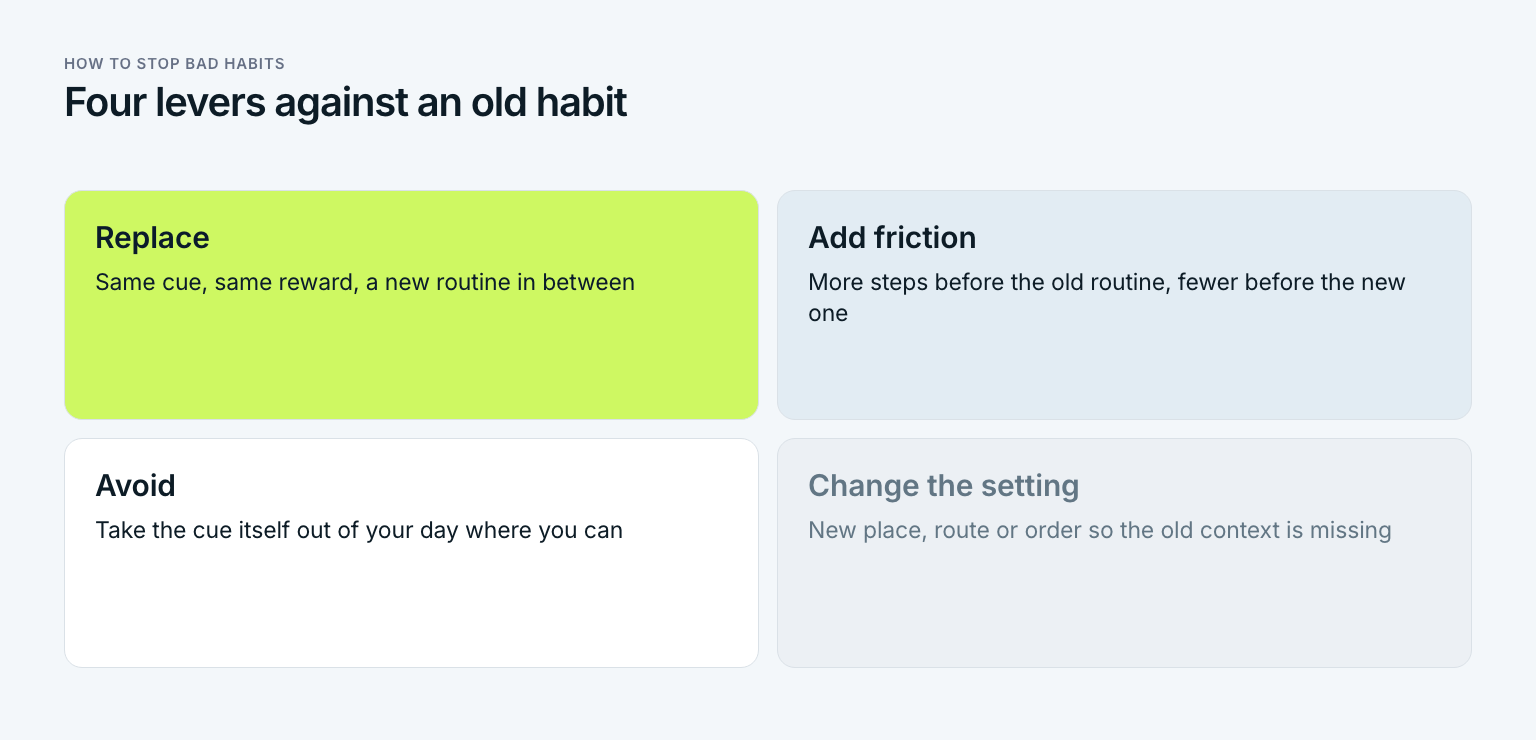
The fourth lever is the underrated one. In 2006, Bas Verplanken and Wendy Wood described how life changes such as a move, a new job or a new baby knock old habits loose for a while, because the familiar cues disappear. In that window, intentions matter again. Whoever is about to go through a change anyway should use it. Whoever is not can create a small one, like a new route home.
James Clear sums up the first three levers in Atomic Habits as the inversion of his four laws: make the bad habit invisible, unattractive, difficult and unsatisfying. The full version of those laws is in our Atomic Habits summary. Here the core is enough: every obstacle in front of the old routine is a vote for the new one.
Dan's twelve weeks in numbers
Dan started in mid-October 2026. He tracked two things: gas station stops per week out of five workdays, and how many days the if-then plan won. What happens when you write down just those two numbers honestly?
| Week | Stops | Plan won | What was going on |
|---|---|---|---|
| 1 | 4 of 5 | no plan yet | Log only |
| 2 | 3 of 5 | 2 of 5 | Tested replacements |
| 3 | 1 of 5 | 4 of 5 | New route home starts |
| 4 | 1 of 5 | 4 of 5 | Normal week |
| 5 | 0 of 5 | 5 of 5 | First week with no stop |
| 6 | 3 of 5 | 2 of 5 | Peak season, mandatory overtime |
| 7 | 2 of 5 | 3 of 5 | Minimum version for overtime days |
| 8 | 1 of 5 | 4 of 5 | Normal week |
| 9 | 0 of 5 | 5 of 5 | Normal week |
| 10 | 1 of 5 | 4 of 5 | Holiday party at work |
| 11 | 0 of 4 | 4 of 4 | Short week before Christmas |
| 12 | 0 of 4 | 4 of 4 | Back to a normal schedule after New Year's |
The math after twelve weeks: in the last four weeks, Dan stopped once in 18 workdays, down from four or five stops a week. At about $6.50 a stop, that is roughly $25 a week he no longer spends, or more than $1,200 a year. He is also six pounds lighter without starting a diet.
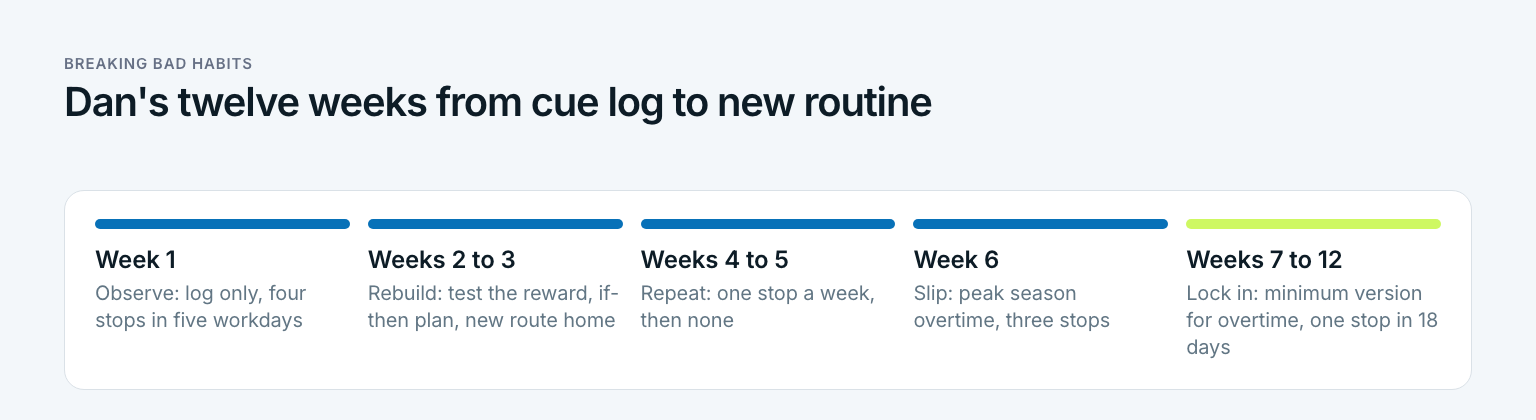
The slip in week six, and what Dan did next
In week six the plan won on only two of five days. Peak season hit the distribution center, overtime was mandatory, and Dan left at 7:30 p.m. three days in a row, with the park already dark. On those evenings the walk felt impossible. In earlier attempts, this is where he would have quit. This time step six kicked in: from week seven on, overtime days had a minimum version, five minutes parked at the lot with the radio on, then home. The stops rose for a week. The new habit survived.
That means: the slip was not a break, it was a test of the plan. Bouton would have predicted it, because the context had changed. Anyone who decides on a smaller version for that case in advance loses a week, not the habit.
Breaking bad habits in the goal chain: from a yearly goal to 5:40 p.m.
A changed habit lasts longer when it serves a goal bigger than giving something up. Dan did not just want to skip soda. He wanted to feel better, hear less from his doctor, and put the money toward something his family would enjoy. That is the difference between a rule and a direction.
| Level | Dan's chain | How he measures it |
|---|---|---|
| Year 2027 | Down to 211 pounds by December, from 231 last October, old gas station money goes into a family trip | Scale on the first Monday of each month, trip fund balance |
| Quarter Q1 2027 | Fewer than one stop a week, another eight pounds down | Stops per quarter |
| Month January | Park walk on at least four workdays a week | Monthly rate |
| Week 3 | If-then plan on five of five workdays, minimum version on overtime days | Weekly rate on Sunday |
| Day Tuesday | 5:20 p.m. pull out, new route, ten minutes at the park | Yes or no |
The chain works in both directions. From the top, it gives the drive home a reason: the walk is not a sacrifice, it is one of roughly 230 workdays that move the scale and the trip fund. From the bottom, it provides proof: every weekly rate shows whether the quarterly goal is still in reach. Whoever watches only the habit sees check marks. Whoever ties it to a yearly goal sees progress.
How to break any yearly goal into quarters, months and weeks is covered in how to achieve goals. Dan put his if-then plan into Gaapp as a daily goal under the yearly one. On Sunday he sees the week's rate next to the quarter's progress without adding anything up.
Common bad habits and what to replace them with
Most bad habits follow a handful of patterns. The table shows six common ones with the usual cue, the reward that often hides behind it, and a replacement that delivers the same reward. Test the reward yourself anyway, because it differs from person to person.
| Bad habit | Common cue | Likely reward | Replacement with the same reward |
|---|---|---|---|
| Scrolling the phone late at night | Kids asleep, couch, tiredness | Switching off, nobody to answer | Book in a fixed spot, phone charges in another room |
| Snacking out of boredom or stress | Afternoon slump at the desk | A break, a change of scene | Five-minute walk to the break room, fruit prepped the night before |
| Procrastinating on hard tasks | A task with no clear first step | Relief, the tension drops | Write a two-minute first step and do it right away |
| Drinking more than you meant to | Getting home, opening the fridge | The switch from work to off-duty | Sparkling water in the same glass, a short walk around the block |
| Staying up too late | Next episode starts on its own | Time for yourself at the end of the day | Fixed me-time at 9 p.m., autoplay off |
| Nail biting | Boredom, tension in meetings | Releasing tension, something to do | Keep the hands busy: pen, stress ball, folded hands |
For nail biting there is even a dedicated method. Nathan Azrin and Gregory Nunn developed habit reversal training in 1973: notice when the hand moves toward the mouth, then briefly clench your fists, a response that makes biting impossible. Notice first, then do something that rules out the old action.
There is a limit worth stating. Anyone trying to change a habit tied to dependence, such as alcohol, nicotine, drugs or gambling, should also get help from a doctor or a licensed counselor. The steps here do not replace treatment. They work for the everyday habits that cost time, money and sleep but are not an illness.
Three questions before the next cue shows up
Before you try to break a habit, answer three questions in writing. Anyone who cannot answer them needs a week of logging first, not a plan:
- What exactly happens right before? Not “when I'm stressed,” but a moment you could point to: a door, a time, a place, an exit ramp.
- What does the old habit really give you? If you do not know, test three replacements and check after 15 minutes whether the urge is gone.
- What will you do the day after your first slip? Write that sentence now, not when you need it.
Dan wrote his three answers on an index card that is still clipped to the sun visor. He barely looks at it anymore. That is the best sign there is.
In short: you do not break a habit by becoming stronger than it. You break it by giving the same question a better answer.
Frequently asked questions about breaking bad habits
What is the 3-3-3 rule for habits?
The 3-3-3 rule has no single source, and the versions online differ. The common habit version says: work on no more than three habits at once, wait three weeks before adding another, and start with a version that takes three minutes or less. For breaking a bad habit, the useful part is the cap. Change one habit, not three, until the replacement wins on most days.
What are the 7 steps to breaking a habit?
Pick one habit, log it for a week without changing anything, and test which reward it really gives you. Then write an if-then plan, make the old routine harder and the new one easier, and decide in advance what happens after a slip. Finally, count once a week how often the new routine won. The weekly number tells you more than how you feel on any given day.
How do you stop a very bad habit?
Make it harder to do and remove the cue where you can, because a strong habit beats willpower in the moment. Then replace the routine with one that delivers the same reward and plan for slips in advance. If the habit involves alcohol, nicotine, drugs or gambling, or is harming your health or relationships, talk to a doctor or a licensed counselor. Those are dependencies, not just habits, and they deserve real treatment.
What are the top 5 bad habits?
Lists vary, but five come up again and again: scrolling the phone late at night, snacking out of boredom or stress, procrastinating, drinking more than intended, and staying up too late. Nail biting and skipping exercise follow close behind. What they share is a reliable cue and a fast reward. That is why the same method works on all of them: keep the cue, keep the reward, swap the routine.
How long does it take to break a bad habit?
Usually two to three months, and longer for some people and some habits. The new routine needs many repetitions in the same context before it starts on its own. The old habit stays stored in memory and can return under stress. Plan for twelve weeks and write a plan for slips before you start.
Is it better to quit cold turkey or cut back gradually?
It depends on the habit and on you. The writer Gretchen Rubin distinguishes abstainers, who find all or nothing easier, from moderators, who do better with limits. For everyday habits, a replacement usually beats both, because it fills the gap the old routine leaves. For dependencies, follow the advice of a doctor.
Last updated: 14 October 2026
Read next
 Habits
75 Hard: Rules, Risks and a Version You Can Finish
75 Hard is not a fitness program. The full rules, four health risks, 75 Soft compared and a custom version built around a real goal.
15 min read
 Habits
Digital Detox: A 7-Day Plan to Reduce Screen Time
A digital detox isn't a weekend offline. What the research shows, how to measure and reduce screen time, plus a 7-day plan with a worked example.
15 min read
 Habits
Delayed Gratification: Meaning, Examples, How to Build It
Delayed gratification isn't self-denial, it's a trade: what the marshmallow test really showed, everyday examples, five proven strategies and a plan.
15 min read