How to Build Good Habits: Six Steps That Stick
Building a good habit is not a willpower contest. One cue, a two-minute minimum, a weekly rate: six steps, ten weeks of numbers, and a goal chain.

Contents
- 01What a habit is, and what building one does not take
- 02How habits form: cue, routine, reward, and the room you are in
- 03How long it takes to build a habit: 21 days, 66 days, or longer
- 04The three mistakes that end new habits in week three
- 05How to build good habits in six steps
- 06Derek's first ten weeks in numbers
- 07Good habits in the goal chain: from a yearly goal to 8:15 p.m.
- 08Ten daily habits worth building, each with a cue and a minimum
- 09Three questions before you start tomorrow
- 10Frequently asked questions about building good habits
Building a good habit is not a willpower contest: it is one small action, tied to a cue that already happens every day, repeated in the same spot until it starts without a decision. That is how to build good habits that last, and nearly every method you have read is a version of it. Knowing this is easy. Week three is hard.
Three things carry a habit through week three: a cue that shows up every day, an action small enough for your worst day, and a weekly count that tells you whether the repetition is holding. The worked example here is Derek, 41, an operations manager at a logistics company in Columbus, Ohio, with two kids, ages five and eight. In college he read 30 books a year. In 2026 he finished one. His phone reports that his evenings disappear into 70 minutes of scrolling after the kids are asleep. His goal for 2027 is ten books.
What a habit is, and what building one does not take
A habit is an action that a cue starts, not a decision you make. In 2002, psychologist Wendy Wood and her colleagues asked people to write down, once an hour, what they were doing and what they were thinking about. About 43 percent of the actions were repeated almost daily in the same context, often while the person's mind was somewhere else. That means: close to half of your day already runs on autopilot. The only open question is what runs there.
So building a habit is not willpower training. Willpower acts in the moment, and the moment is often tired, hungry, or late. A habit moves the decision forward. You make it once, at the planning table, and after that the cue does the work. Anyone who asks every evening whether tonight is a reading night has not built a habit yet. They have built a nightly vote.
Three words get mixed up here. None of them is wrong, and each one is built for something different:
- Resolution. A decision about the future: I will read more next year. It is a fine start because it sets a direction. It just does not start anything on its own, so every single day needs a fresh decision.
- Routine. A sequence you go through on purpose, like a morning routine with fixed blocks. It takes attention at first and gets lighter with time. Most good routines are made of several habits. How several routines add up to a whole day is the subject of the guide to the daily routine.
- Habit. A single action that a cue starts without you thinking about it. Once it stands, it costs almost no effort. That is where every new action is headed.
In short: a resolution says what you want. A habit makes it happen on the night you do not want to.
How habits form: cue, routine, reward, and the room you are in
Every habit runs on the same loop. Charles Duhigg described it in The Power of Habit, 2012, as three parts: a cue, a routine, and a reward. The cue can be a place, a time, an earlier action, or a feeling. The reward is what your brain remembers, so that the next time the cue shows up, the routine starts a little faster. Whoever wants to build a good habit has to build the whole loop, not just the action in the middle.
BJ Fogg, a behavior scientist at Stanford, puts the same idea into a formula in Tiny Habits, 2019: a behavior happens when motivation, ability, and a prompt meet at the same moment. Motivation swings from day to day. Ability you control by making the action smaller. The prompt you control by attaching it to something that already happens every day. That means: the lever most people pull first is the least reliable of the three. Motivation still matters in the weeks before a habit runs on its own, and how to stay motivated on a hard day mostly comes down to a smaller next step.
Derek's loop looks like this. The cue is the moment he turns off the light in the kids' room, around 8:15 p.m. The routine is ten pages in the armchair by the window, with the book already waiting on the seat. The reward is a check mark on the sheet of paper by the lamp and the small pleasure of a story that keeps going. None of it needs a good day, and none of it needs motivation.
Context: why the room matters more than the resolve
Context is everything around an action: the place, the time, the action right before it, the people nearby. The more stable the context, the faster a repetition turns into something automatic. It is the reason habits break on vacation and form quickly after a move. Anyone who wants to build a habit should choose the context first and the action second.
How long it takes to build a habit: 21 days, 66 days, or longer
The 21-day rule is the most quoted number on the subject and the least supported. It traces back to Maxwell Maltz, a plastic surgeon who wrote in Psycho-Cybernetics, 1960, that his patients needed a minimum of about 21 days to get used to a changed face. That was an observation about adjusting to a mirror image, not a measurement of habits. Over the decades, a minimum of about 21 days turned into exactly 21 days.
The first real measurement came from Phillippa Lally and her team at University College London. They followed 96 volunteers for 12 weeks. Each person picked one new daily behavior in a fixed context, such as a glass of water with lunch or a 15-minute run before dinner. The results, published in the European Journal of Social Psychology in 2010, showed a median of 66 days until the behavior reached its peak automaticity. The range ran from 18 to 254 days. Missing a single day barely changed the curve.
What does that mean for you? Plan for ten weeks, not three. Simple behaviors like drinking water became automatic faster than exercise did. And the early weeks pay the most: the first repetitions add a lot of automaticity, then the curve flattens. Whoever feels let down after three weeks because the habit still feels like work is right on schedule.
How to tell when a habit is built: the automaticity check
A calendar cannot tell you when a habit is built. One question can: does the action start before you decide? In 2012, Benjamin Gardner and his colleagues pulled four statements out of a longer habit questionnaire that Bas Verplanken and Sheina Orbell had published in 2003. Those four measure only automaticity. Rate each one from 1, not true at all, to 5, completely true:
| Reading ten pages is something I | Derek on day 14 | Derek on day 35 | Derek on day 70 |
|---|---|---|---|
| do automatically | 2 | 3 | 4 |
| do without having to consciously remember | 2 | 3 | 5 |
| do without thinking | 3 | 3 | 4 |
| start doing before I realize I am doing it | 2 | 3 | 4 |
| Total out of 20 | 9 | 12 | 17 |
Around 16 out of 20, a habit carries itself. That is not a scientific cutoff. It is a working rule: four out of five on every statement means the cue is doing the job. Derek got there in week ten, close to the study's median. You might get there in 30 days or in 150, and both are normal.
The three mistakes that end new habits in week three
Most new habits do not fail because the idea was bad. They fail quietly in week three, when the novelty is gone and the automaticity is not there yet. None of these mistakes feels like one while you are making it. Which one is yours?
Mistake one: you start with the version you want to end with
An hour at the gym, 30 pages a night, a full lesson every day. That is the version you hope to reach in three months. As a starting version, it is too big, because it does not fit your worst day. One night slips, then two, then the whole plan. The fix is a minimum, the smallest form of the action that still counts as done. James Clear calls this the two-minute rule in Atomic Habits, 2018: a new habit should start with a version that takes less than two minutes. The rule belongs to the third of Clear's four laws, make it easy, and an Atomic Habits summary shows how the other three laws support it.
Mistake two: you build three habits at once
January is the season of bundles: get up earlier, work out, drink more water, scroll less. Every new habit needs attention in its first weeks, and attention runs out. Anyone who starts four habits at once spreads that attention across four construction sites and finishes none. Build one until it stands, then the next. The guide to self-discipline shows how to hold the first one through the dull weeks.
Mistake three: you tie the habit to a clock time instead of a cue
Every day at 7 p.m. sounds firm. But 7 p.m. is dinner on Monday, a school event on Wednesday, and traffic on Friday. A clock time is an appointment, not a cue. A cue is an action that happens anyway: the first coffee, closing the laptop, the kids' light going off. Peter Gollwitzer called these if-then plans implementation intentions in 1999. A 2006 meta-analysis he ran with Paschal Sheeran across 94 studies found a medium to large effect on reaching goals.
The most common mistake: reading a gap as the end
Almost every abandoned habit follows the same path: one night missed, then the feeling that the streak is broken, then nothing. Lally's data says the opposite. One missed day costs a habit almost nothing. What costs it is the second miss right after the first. Clear's rule for this is never miss twice: one miss is a data point, two in a row are the start of a new pattern. Whoever knows that can save the whole habit with a one-page night right after the gap.
How to build good habits in six steps
Six decisions and half an hour on a Sunday. After that, the cue takes over. This is how Derek set up his reading habit:
Pick one habit that feeds a goal
Not read more, but the one action that carries the goal. Derek: ten books in 2027, so ten pages on six nights a week. A habit without a goal is a pastime. A goal without a habit stays a wish.
Set a standard and a minimum
The standard is the normal session, the minimum is the version for bad nights. Derek: ten pages as the standard, one page as the minimum. Both count as done, and that is what keeps the week intact when the day falls apart.
Write the cue as one sentence
Use the pattern: after I do X, I will do Y. Derek wrote: after I turn off the kids' light, I sit in the armchair and open the book. The cue has to show up on every night the habit is supposed to happen. If some nights have no such cue, they need a second sentence.
Prepare the room
Everything between the cue and the action is a chance to put it off. Derek leaves the book open on the armchair, sets the lamp on a timer for 8:10 p.m., and plugs his phone in on the kitchen counter before he goes upstairs. What is prepared does not need a decision.
Check off every session and count the week
One check mark per night, and on Sunday the weekly rate: nights done divided by nights planned. A rate is more honest than a streak, because one gap does not reset it to zero. A simple [habit tracker](/en/blog/habit-tracker) on one sheet of paper is all it takes.
Review the rule on Sunday, not yourself
Ten minutes, three questions. What was the rate? Where did it break, and was it the day or the plan? What do I change about the cue or the dose? The answer is always an adjustment, never a grade.
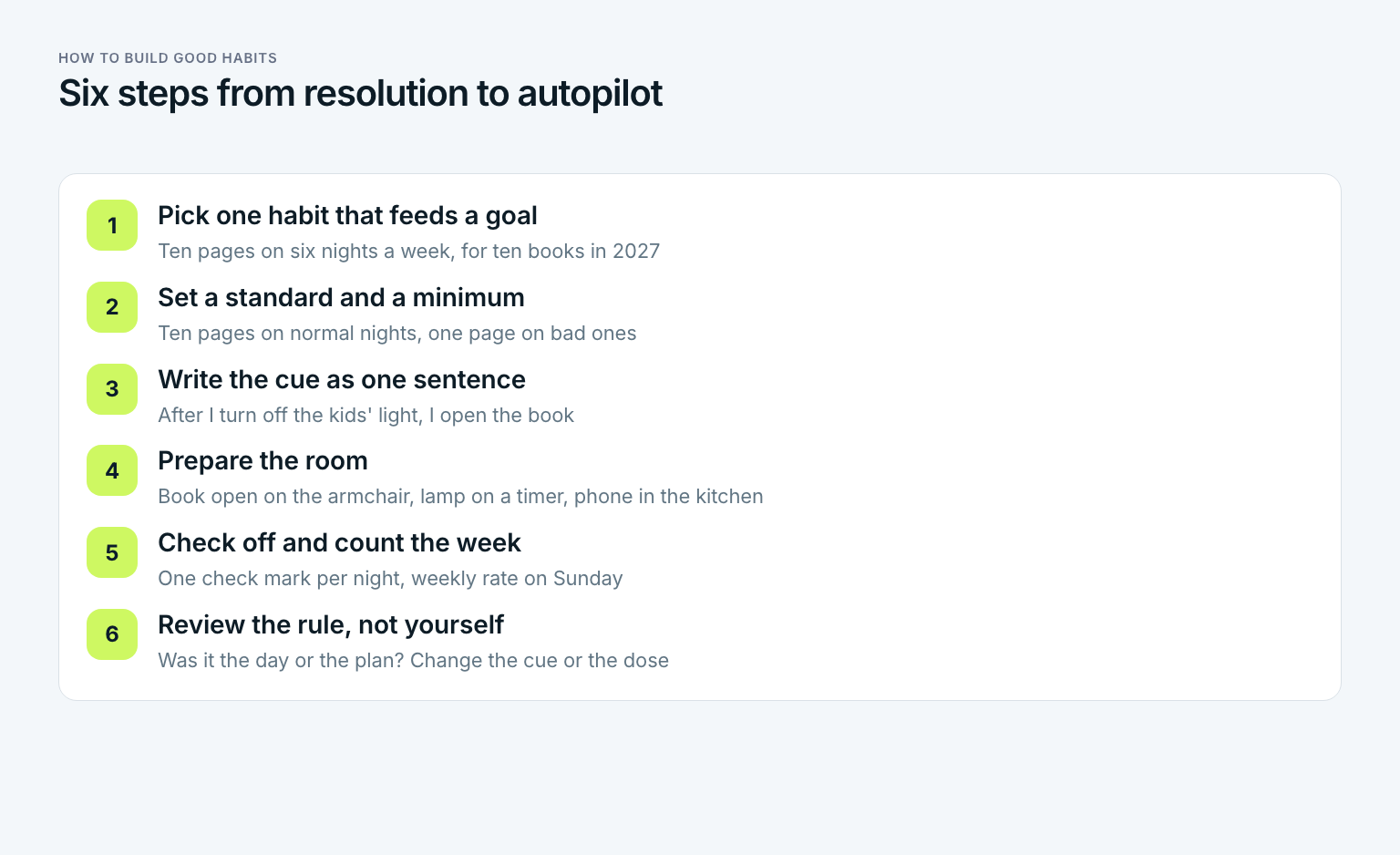
Step three is where most plans get stuck. Whoever cannot write the cue as one sentence does not have one yet. And writing it down often reveals the nights when it never shows up. Those nights are not exceptions. They belong in the plan.
Derek's first ten weeks in numbers
Derek started in mid-October, not on January 1, so the habit would be standing before the yearly goal starts counting. Six nights a week, Saturday off for family movie night, 60 planned nights in ten weeks. He counted every Sunday, which took two minutes:
| Week | Nights done of 6 | Of those, minimum | Pages | What happened |
|---|---|---|---|---|
| 1 | 6 | 0 | 72 | Novelty carries, most nights past ten pages |
| 2 | 6 | 1 | 66 | Late soccer practice, one page on Thursday |
| 3 | 5 | 0 | 51 | Work call ran past 9 p.m., night skipped |
| 4 | 3 | 0 | 30 | Work trip: two hotel nights and a late flight home, no cue |
| 5 | 6 | 0 | 70 | Hotel sentence written, book lives in the carry-on |
| 6 | 6 | 2 | 55 | Flu, two nights of one page each |
| 7 | 5 | 1 | 54 | Birthday dinner ran late, one night lost |
| 8 | 6 | 0 | 68 | One hotel night, the new sentence holds |
| 9 | 6 | 0 | 75 | Second habit added in the morning |
| 10 | 6 | 1 | 72 | Automaticity check: 17 of 20 |
| Total | 55 of 60 | 5 | 613 | Rate 92 percent, about two books |
The rate is 92 percent, and the table still says more than the number. Three of the five missed nights had one cause: Derek was not home, so there was no kids' light to turn off. He did not fail on those nights. His cue simply never came. That means: a gap almost always points at the plan, rarely at the person.
Week four is the only time he missed twice in a row, and it is the week that changed the plan. In week five he wrote a second sentence: after I plug in my phone at the hotel, I open the book. Since then no hotel night has been lost, including the one in week eight. The minimum saved five nights that would otherwise have been gaps. Without it, the rate would be 83 percent, and the flu in week six would have meant a second double miss.
And the pages? 613 pages in ten weeks is about two books, from a man who finished one in all of 2026. No single night was special. The total is.
How to build a habit on top of one that already runs
In week nine, Derek's automaticity check reached 16. Only then did a second habit join, attached to something that has happened every morning for years: the coffee maker. After I pour my first coffee, I write down the one thing that matters today. One minute, one line, on the same sheet as the reading check marks. Fogg calls a new action anchored to an existing one a recipe. Clear calls the same idea habit stacking.
Whoever stacks a second habit while the first one still wobbles puts both at risk. Whoever waits until the first one runs without thinking gives the second one full attention. One new habit every two or three months sounds slow. It adds up to four to six a year, and they are still standing in December.
Good habits in the goal chain: from a yearly goal to 8:15 p.m.
A habit without a goal eventually loses its reason. A goal without a habit loses its rhythm. The goal chain connects the two: the yearly goal says what for, the habit says when, and every level in between says how much. Here is Derek's chain:
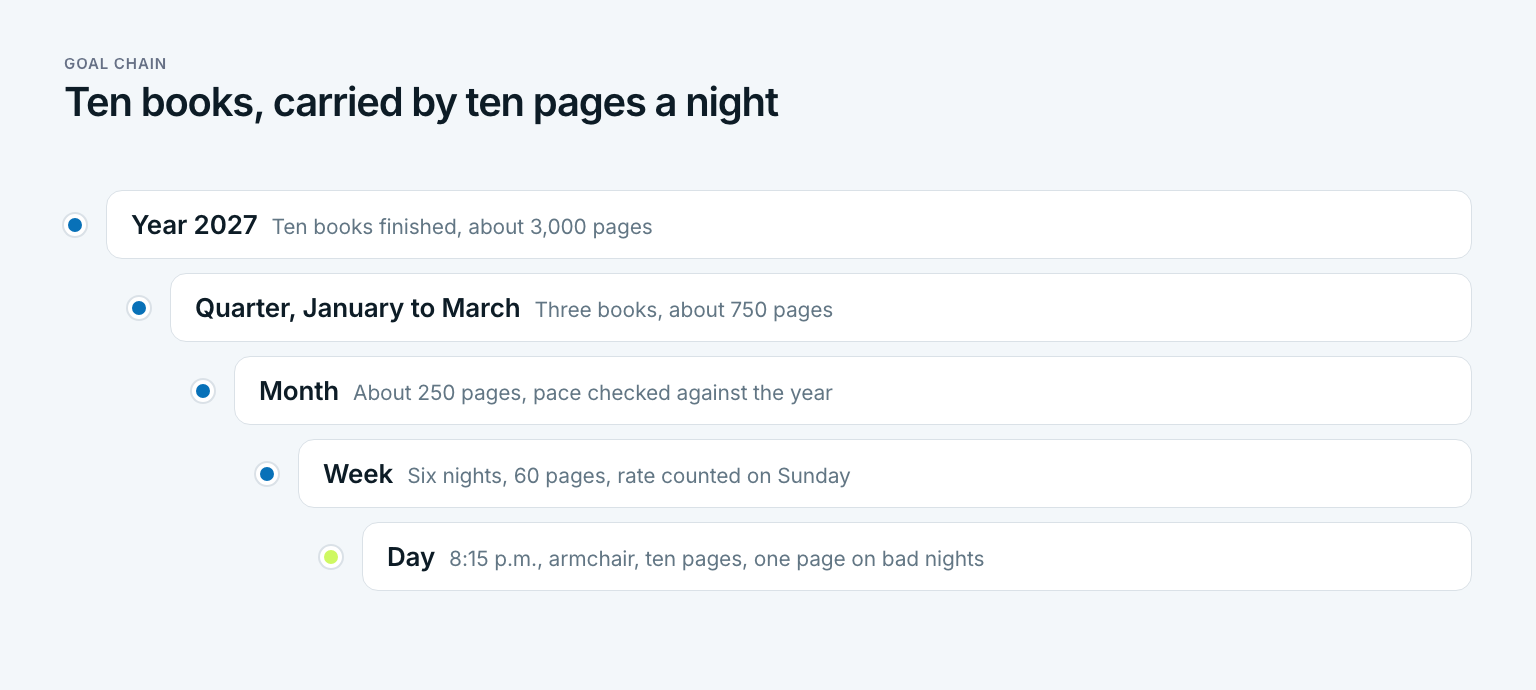
- Year 2027: ten books, about 3,000 pages. This is the result that counts in December.
- Quarter, January to March: three books, about 750 pages. The quarter turns a distant goal into a stretch you can see the end of.
- Month: about 250 pages. This is the level where Derek sees whether the pace still fits the year.
- Week: six nights, 60 pages, counted on Sunday. The week is where the habit lives and where it gets measured.
- Day: 8:15 p.m., the armchair, ten pages, one page on bad nights. The day is just a check mark.
The chain earns its keep in bad weeks. Whoever only looks at the habit asks, after a gap, whether they failed. Whoever looks at the chain only asks whether the month still works. Derek read 219 pages in his first four weeks, against a plan of 240. The month came up a little short, and the quarter was never in danger. That answer is calmer than any streak.
In Gaapp, that chain is the core: five levels from year to day, each goal hanging from a larger one. The habit becomes a daily goal you check off, and the weekly rate becomes a weekly goal. How to word a daily goal so you can answer it with yes or no at night is covered in the guide to daily goals. How a wish becomes a chain in the first place is the subject of how to achieve goals.
Ten daily habits worth building, each with a cue and a minimum
Good habits are not a checklist to work through. They are a menu. Pick the one that feeds a goal you already care about. Each of these ten daily habits comes with a suggested cue and a minimum for bad days:
| Habit | Cue | Standard | Minimum | Feeds |
|---|---|---|---|---|
| Walk | After you close the laptop for lunch | 20-minute walk | Once around the block | Health, energy |
| Read | After the kids' light goes off | Ten pages | One page | Learning, sleep |
| Drink water | After you get out of bed | One full glass | One sip | Health |
| Set a daily goal | After you pour your first coffee | Write down one daily goal | One word | Any goal |
| Strength work | After you shower | Ten minutes of bodyweight work | Five squats | Back, fitness |
| Stretch | After you brush your teeth at night | Five minutes of stretching | One stretch | Back, sleep |
| Phone out of the bedroom | When you walk upstairs for the night | Phone charges in the kitchen | Airplane mode | Sleep, relationship |
| Reach out | Sunday after breakfast | Call one person | One text | Friendships |
| Daily review | After dinner | Three lines about the day | One check mark | Any goal |
| Reset the kitchen | After you cook | Kitchen done in ten minutes | Counter cleared | Family, calm |
The list also shows what almost every good habit has in common: a small, repeatable action with a fixed cue. Anyone who wants two from the list still starts with one. The second one joins when the automaticity check says the first is carrying itself. Water and the daily goal fit the start of the day. Reading, stretching, and the phone rule fit its end.
And bad habits? They run on the same loop, like reaching for the phone the moment you stand in a checkout line. Fighting them rarely works, because the cue stays. It works better to keep the cue and swap the action: whoever waits in line can send one friend a text instead of scrolling. The full sequence, from logging the cue to an if-then plan, is in the guide to how to break bad habits.
Three questions before you start tomorrow
Before your first repetition, answer three questions in writing:
- Can you write your cue as one sentence that starts with after I?
- Is your minimum small enough that you would have done it on your worst day last week?
- Do you know which goal the habit feeds, and where you will write the weekly rate on Sunday?
Whoever answers no to any of the three does not need more willpower. They need a better plan. Derek answered all three in ten minutes and has changed one answer since, in week five. In short: you do not build a good habit by holding on. You build it with a cue that shows up every day.
Frequently asked questions about building good habits
What is the 3-3-3 rule for habits?
The 3-3-3 rule is a planning rule of thumb, not a finding from habit research. In its most common version, you give each day three hours of focused work on your most important project, three shorter tasks, and three small maintenance chores. It can help you structure a day, but it does not build a habit by itself. For that you still need one cue, one small action, and repetition.
What are the 7 life-changing habits?
The best-known list comes from Stephen Covey's 1989 book The 7 Habits of Highly Effective People: be proactive, begin with the end in mind, put first things first, think win-win, seek first to understand, synergize, and sharpen the saw. They are principles rather than daily actions. To turn one into a habit, translate it into something you do after a cue, such as writing down tomorrow's one priority after dinner.
What are 10 good habits?
Ten good habits are a daily walk, reading before bed, a glass of water after waking up, one written daily goal, a few minutes of strength work, stretching, keeping the phone out of the bedroom, reaching out to one person a week, a short evening review, and resetting the kitchen after cooking. Each one only works with a fixed cue and a minimum for bad days. Start with the one that feeds a goal you already care about.
What are 5 habits that can improve my life?
Five habits with a wide reach are a daily walk, reading before bed, a phone that sleeps outside the bedroom, one written daily goal, and a short review each evening. Each one is small, takes under 20 minutes, and feeds more than one area of life. Pick one and build it alone for about ten weeks before you add the next.
How long does it take to build a habit?
In the best-known study, by Phillippa Lally and colleagues at University College London in 2010, it took a median of 66 days for a new daily behavior to reach its peak automaticity. The range ran from 18 to 254 days, depending on the person and the behavior. Plan for about ten weeks and treat day 21 as an early checkpoint, not a finish line.
What should I do when I miss a day?
Do the minimum version the next day, without making up the missed one. A single miss barely changes how a habit forms, but two misses in a row start a new pattern. On Sunday, check whether the miss came from the day or from the plan, for example a cue that never showed up, and fix the plan.
Last updated: 19 October 2026
Read next
 Habits
75 Hard: Rules, Risks and a Version You Can Finish
75 Hard is not a fitness program. The full rules, four health risks, 75 Soft compared and a custom version built around a real goal.
15 min read
 Habits
Digital Detox: A 7-Day Plan to Reduce Screen Time
A digital detox isn't a weekend offline. What the research shows, how to measure and reduce screen time, plus a 7-day plan with a worked example.
15 min read
 Habits
Delayed Gratification: Meaning, Examples, How to Build It
Delayed gratification isn't self-denial, it's a trade: what the marshmallow test really showed, everyday examples, five proven strategies and a plan.
15 min read