Daily Planner Template: Plan Tomorrow Tonight
A free daily planner template with seven fields, printable or digital. Plan tomorrow in six steps, see a filled-in example, and adapt it for ADHD.

Contents
- 01Daily planner, daily schedule, to-do list: what each is built for
- 02What really happens to an unplanned day
- 03The daily planner template: seven fields on one page
- 04How to create your own daily planner in six steps
- 05Dana's daily plan for Tuesday, filled in
- 06The three mistakes nobody notices
- 07What does an ADHD planner look like?
- 08Is there a free daily planner app? Paper, spreadsheet, or app
- 09Your daily plan in the goal chain: from a yearly goal to Tuesday night
- 10Frequently asked questions about daily planner templates
A daily planner template is not a to-do list with times attached. It is a one-page sheet with seven fixed fields that you fill in the evening before, in about ten minutes: the date, your weekly goal, one daily goal, fixed appointments, a focus block with a start and end time, three small tasks, and an evening check. A to-do list holds everything you might do. A daily plan decides what happens tomorrow, and when.
A daily plan that survives until dinner needs three things: a weekly goal to measure against, a template with few fields, and a rule for how much of the day you are allowed to fill. Below, all three are worked through on one Tuesday in the life of Dana, who runs a bookkeeping side business next to a full-time job and a six-year-old. You also get three printable layouts, six steps for the evening, a version for ADHD, and the three mistakes that end most daily plans before lunch.
Daily planner, daily schedule, to-do list: what each is built for
Five tools work on the same day. None of them is wrong, and each is built for something else. The only question is: which one decides what matters tomorrow?
| Tool | Built for | What it does not do |
|---|---|---|
| To-do list | Capturing everything that is waiting, so your head is free | It does not say when anything happens, or which item matters |
| Calendar | Appointments with other people, with a time and a place | It shows what others want from you, not what you plan to do |
| Daily schedule | Routines that repeat every day: school, shifts, practice | Anything that changes from one day to the next |
| Daily plan | Deciding one day: one goal, one time window, one buffer | It replaces neither the list nor the calendar, it reads from both |
| Daily planner | The notebook, binder, or app where your daily plans live | It is the container, not the method. An empty planner plans nothing |
The to-do list is a good tool. It empties your head, and anyone who writes everything down at night tends to sleep better. It just does not sort. On a normal Monday night, Dana's list has 19 items, from renewing her car registration to filing quarterly taxes, and they all look equally urgent. The daily plan takes the few items that get a place tomorrow and gives the most important one a start time. That means: the list is the warehouse, and the daily plan is tomorrow's order.
The Ivy Lee method, 1918
As the story is usually told, the consultant Ivy Lee gave Charles Schwab, who ran Bethlehem Steel at the time, a short routine in 1918. At the end of each workday, write down the six most important things to do tomorrow and rank them. The next day, work on the first one until it is done before touching the second. Schwab is said to have sent him a check for $25,000 a few months later. The real insight is the timing. The decision happens the evening before, while the day is still fresh and nobody is asking for anything yet. The template uses the same timing, with one daily goal instead of six.
What really happens to an unplanned day
Unplanned days feel flexible. That is the trap. Without a plan, the first message of the morning decides where you start, and the second decides where you go next. By evening you have been busy all day and still cannot say whether the day moved anything.
Here is what that looked like for Dana, 38, a claims adjuster who works remotely for an insurance company in Columbus, Ohio. Her son Leo is six and needs to be picked up from after-school care by 5 p.m. On the side, she is building a bookkeeping practice for local contractors and has two paying clients. Her goal for the year is five by December 31. Her weekly goal for the week of October 5: pricing page live on her website and three discovery calls booked. She has about two hours each weeknight once Leo is asleep. Here is a Tuesday without a plan:
| What Dana did on an unplanned Tuesday | Time | Moves the weekly goal? |
|---|---|---|
| Day job, remote: claims, two team calls | 8.5 h | No, but fixed |
| Pickup, dinner, homework, Leo's bedtime | 3.5 h | No, but fixed |
| Browsed other bookkeepers' websites for ideas | 0.75 h | Partly, nothing written |
| Changed the logo color twice | 0.5 h | No |
| Answered two LinkedIn messages and a client email | 0.5 h | Partly, the client yes |
| Watched a video on pricing strategy | 0.5 h | No |
| Total after 8:15 p.m. | 2.25 h free | 0 words of the pricing page |
Two and a quarter hours were free. Not one sentence of the pricing page got written. The browsing felt like research, the logo felt like progress, the video felt like learning. None of it moved the weekly goal. By Friday the page was still a blank document, and no discovery call was booked, because there was nothing to send people to. Did Dana lack time? No. She lacked a decision made the night before: which page, which part of it, from when to when.
This is not laziness. Whoever has to decide at 8:15 p.m., after a full workday and a bedtime routine, what to work on will pick whatever costs the least effort. Browsing costs less than writing. That means: the decision has to happen while there is still energy for it, which is the evening before, not the moment itself.
The daily planner template: seven fields on one page
The template fits on one sheet of letter paper, portrait. Two lines at the top connect the day to the week, and five fields below cover the day itself. More fields do not make the sheet better, only longer. Anyone with ten minutes each evening can fill in seven fields. Anyone with twenty fields will stop after a week.
What goes on a daily planner: seven fields
- Date. Which day is tomorrow, and what makes it different? Office day, remote day, a birthday, a parent-teacher conference.
- Weekly goal. Which weekly goal does tomorrow serve? Copied from your weekly plan, not invented on the spot.
- Daily goal. The one thing that has to be done tomorrow for the day to count. Written so that you can answer yes or no at night. The book The One Thing by Gary Keller and Jay Papasan builds a whole method on that single choice.
- Fixed appointments. Everything with a time that cannot move: work, pickup, doctor, practice. Copied from your calendar, plus the things that never make it into a calendar.
- Focus block. A window of 60 to 120 minutes with a start and an end, reserved for the daily goal. Without a time, it is a wish.
- Three small tasks. Anything else that should get done, three items at most from your to-do list. The rest stays there.
- Evening check. Daily goal yes, partly, or no, plus one sentence: what do I carry into tomorrow?
| Field | Question | Place on the sheet |
|---|---|---|
| Date | Which day is tomorrow? | one line, top left |
| Weekly goal | What does this day serve? | one line, top right |
| Daily goal | What must be done by tomorrow night for the day to count? | one line, large letters |
| Fixed appointments | What is already set, with a time? | time column from 6 a.m. to 10 p.m., left side |
| Focus block | From when to when do I work on the daily goal? | highlighted in the time column |
| Three small tasks | What else should get done? | three lines with checkboxes, right side |
| Evening check | Daily goal yes, partly, or no? What do I carry over? | two lines at the bottom |
Printable daily planner: build the sheet in five minutes
You do not need a designer for this. Take a sheet of letter paper in portrait or open any spreadsheet. On the left, a column of hours from 6 a.m. to 10 p.m., one row per hour, which makes 17 rows. Top right, the daily goal in large handwriting, below it three lines with checkboxes for small tasks, and two lines at the very bottom for the evening check. Print 14 sheets at once. That covers two weeks and removes one decision from every evening.
Word, Excel, Google Sheets, or paper is a secondary choice. Whoever works at a computer should still keep the sheet next to the keyboard. A daily plan you have to open will stop being opened by day three. In other words, visibility beats design.
Daily schedule template, time blocks, or list: three layouts
The core of daily goal, focus block, and evening check stays the same. Only the time column changes. Which layout fits depends on how fixed your day is.
| Layout | Time column | Best for |
|---|---|---|
| Hourly daily schedule | one row per hour, 6 a.m. to 10 p.m. | Days packed with meetings, remote work, shifts with fixed hours |
| Time blocks | three boxes: morning, afternoon, evening | Parents, students, days that do not fit into neat hours |
| List | no time column, only the daily goal with a time and three tasks | People who keep their calendar digital and only need the focus |
Dana uses the hourly layout on weekdays and the time blocks on Saturdays, when her day revolves around Leo's soccer game rather than meetings. So what is the best daily planner template? The one you actually fill in the night before. The layout is secondary, the ten minutes are not.
How to create your own daily planner in six steps
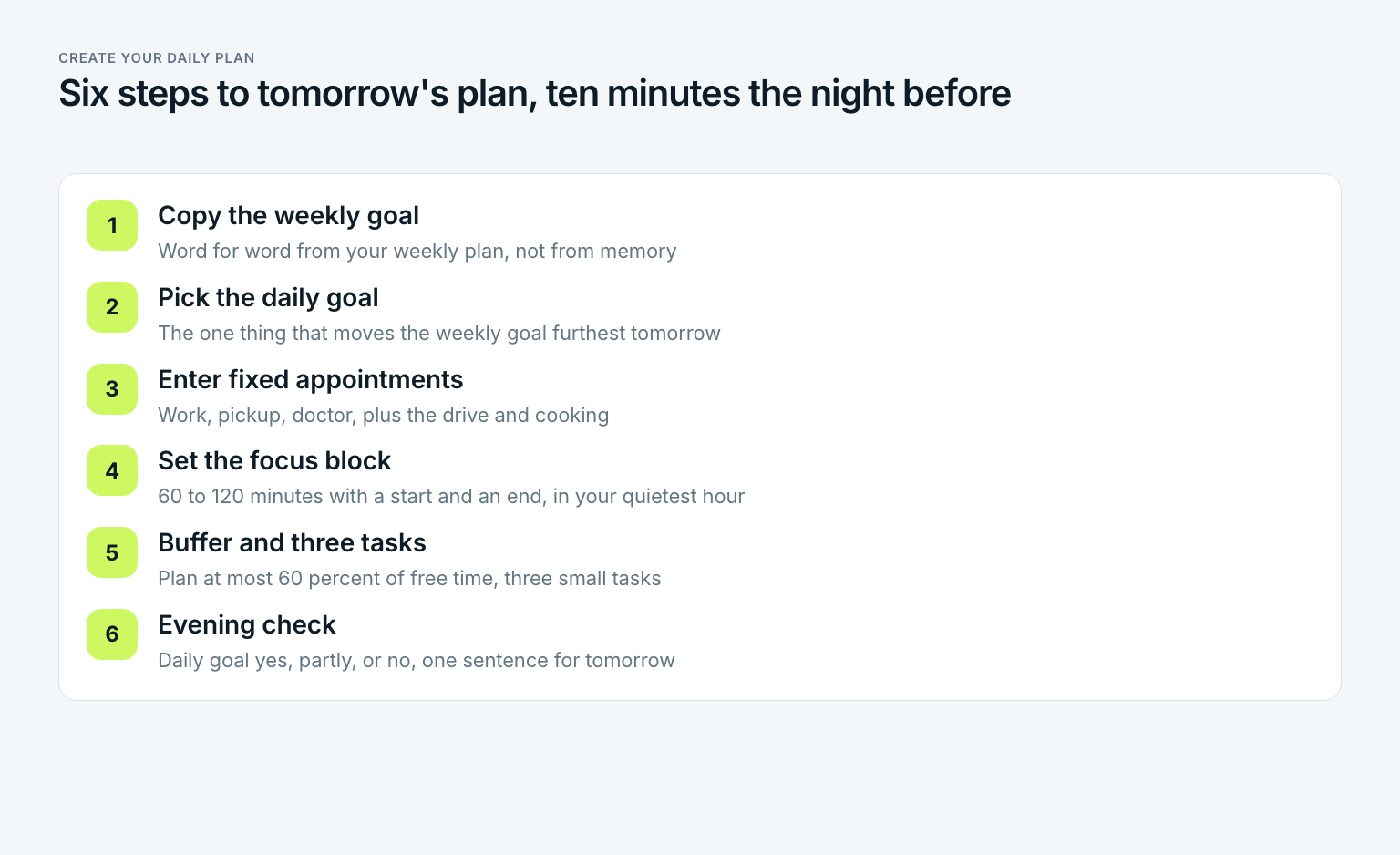
Ten minutes is a budget, not an estimate. Have three things in front of you: your weekly plan, tomorrow's calendar, and your to-do list. The order of the steps matters more than the paper they end up on.
Copy the weekly goal, one minute
Write your weekly goal on the second line, word for word from your weekly plan. Whoever cannot copy it because there is none is planning tomorrow around being busy. How to set weekly goals and spread them across seven days is covered in the guide to [weekly planning](/en/blog/weekly-planning). For Dana: pricing page live, three discovery calls booked.
Pick the daily goal, two minutes
Choose the one thing that moves the weekly goal furthest tomorrow, and make it small enough to fit in one focus block. Not “work on the website” but “draft the pricing page, three packages.” How to phrase [daily goals](/en/daily-goals) you can check off at night is a topic of its own.
Enter fixed appointments, one minute
Copy everything with a time from your calendar into the time column, including what never makes it into a calendar: pickup, cooking, the drive. Only then can you see how much of the day is actually free.
Estimate the length and set the focus block, two minutes
Estimate how long the daily goal takes and give it a window with a start and an end. Put it in the hour when you are least likely to be interrupted, not in the hour that happens to be left over.
Leave a buffer and pick three tasks, three minutes
Plan no more than 60 percent of your free time. From the to-do list, at most three small tasks go on the sheet, ones that fit into the gaps. Everything else stays on the list, and that is a decision, not a failure.
Evening check, one minute the next night
Mark the daily goal: yes, partly, or no. Add one sentence about what you carry over. Then fill in the sheet for the next day, and the loop closes.
Why the focus block has a start time
For his 2015 book “15 Secrets Successful People Know About Time Management,” Kevin Kruse interviewed billionaires, Olympic athletes, straight-A students, and entrepreneurs. Two habits keep coming up: they name one most important task for the day, and they work from their calendar rather than from a to-do list. A task without a time slot competes with everything else on the list. A task with a slot only competes with the clock. The focus block is both habits in one field: the most important task, with a start and an end.
The 60 percent rule comes from the German time management author Lothar Seiwert. Plan about 60 percent of your available time and leave the rest for the unexpected and for what other people want from you. Whoever plans 100 percent has a plan that breaks with the first phone call. Whoever plans 60 percent has a plan that bends.
Dana's daily plan for Tuesday, filled in
Dana fills in the sheet on Monday at 10 p.m., hourly layout, because Tuesday is a full remote workday. Weekly goal: pricing page live, three discovery calls booked. Daily goal: draft the pricing page, three packages, about 400 words.
| Time | Entry | Field |
|---|---|---|
| 6:30 to 7:45 a.m. | Breakfast, Leo dressed, school bus at 7:40 | Fixed appointment |
| 8:00 a.m. to 4:30 p.m. | Day job, remote, team call at 9:30, lunch at 12:15 | Fixed appointment |
| 12:15 to 12:25 p.m. | Send the October invoice to client two | Small task one |
| 12:25 to 12:35 p.m. | Email the logo file to the web designer | Small task two |
| 4:45 to 8:15 p.m. | Pickup, dinner, homework, Leo's bedtime | Fixed appointment |
| 8:15 to 8:30 p.m. | Reply to the roofing contractor on LinkedIn | Small task three |
| 8:30 to 9:30 p.m. | Draft the pricing page, three packages, phone in the kitchen | Focus block for the daily goal |
| 9:30 to 10:30 p.m. | empty | Buffer |
| 10:30 to 10:40 p.m. | Evening check, fill in Wednesday's sheet | Evening check |
Let us do the math. Her free time on this Tuesday runs from 8:15 to 10:30 p.m., 135 minutes. Planned: the focus block and one small task, 75 minutes, or 56 percent. The other 60 minutes stay empty. That is not idle time. If Leo needs a second glass of water and a third story, or the contractor replies with a question, nothing slides, because there is room.
Why is the focus block in the evening and not at 6 a.m.? Dana tried mornings in September. Leo wakes at 6:15, and that hour belongs to him. The evening hour works for one reason only: the task was decided the night before, so at 8:30 there is nothing left to decide, only something to do. Anyone who puts the focus block where their day actually has quiet needs less discipline to keep it.
At 10:30 p.m. her evening check reads: daily goal yes, three packages drafted, 420 words. Small tasks three of three. Note for tomorrow: ask client two what she would have paid for the middle package. By Friday the pricing page is live and two of three discovery calls are booked. The third becomes Monday's daily goal instead of a vague intention.
The three mistakes nobody notices
The beautifully designed daily planner templates you find online are not the problem. Many are lovely, and anyone who enjoys planning in color is more likely to keep going. But daily plans rarely fail because of design. They fail because of three mistakes that feel like thoroughness at the time.
The most common mistake: the 15-minute grid
Whoever schedules every quarter hour of the day has a plan that is already wrong by 9:40 a.m. One call runs twelve minutes long, and every row after it is off. By lunch the sheet is face down on the desk, and by evening the day feels like a failure. The plan did not lack discipline. It lacked air. A daily plan needs exactly one block with a fixed time, the focus block. Everything else can be approximate.
- Mistake two: a daily goal without a weekly goal. Without the second line, the evening picks tomorrow's goal by mood. Sometimes it is the urgent thing, sometimes the pleasant one, and by Friday the week has five finished daily goals that have nothing to do with each other. Whoever copies the weekly goal first picks the daily goal from a direction.
- Mistake three: planning in the morning instead of the night before. Planning in the morning beats not planning at all. But the morning is often your most productive hour, and it goes to planning. Add the first messages of the day, and they get a vote too. The night before, you still know what slipped today and can weigh it calmly.
What does an ADHD planner look like?
An ADHD planner is not a stricter planner. It is usually a simpler one: fewer fields, bigger time cues, and everything visible at the moment you need it. The psychologist Russell Barkley describes ADHD as a problem of doing what you know rather than knowing what to do, and he recommends putting information and time cues at the point of performance, where the work actually happens. For a daily plan, that changes four things:
- One daily goal, in large letters. Same field as above, but it is the only thing on the top half of the page. Anyone who has to choose between six tasks at 8:30 p.m. will choose the easiest one.
- Time you can see. Instead of an hourly grid, three or four blocks, with a visible timer or an analog clock next to the sheet. Many people with ADHD describe time as hard to feel, and a timer turns an abstract block into a countdown.
- Transitions as entries. Ten minutes between blocks to switch gears, written on the plan. A transition that is planned does not quietly eat the next block.
- A parking lot. A box at the bottom for ideas and tasks that pop up during the focus block. They get written down, not done.
None of this is treatment, and a planner does not replace a diagnosis or professional support. It is a layout that asks you for fewer decisions. That means: if a standard template feels like too much, remove fields before you add willpower.
Is there a free daily planner app? Paper, spreadsheet, or app
Yes, and paper is free too. There is no best daily planner, only one that fits your day. You can choose from three forms, and all three are available at no cost. If the app should also hold your tasks, the guide to the best to-do list app compares seven of them.
| Form | Strength | Weakness | Fits if |
|---|---|---|---|
| Paper, printed | always visible, no screen, fast to fill in | no look back across weeks, no reminders | you work at the same desk every day |
| Spreadsheet in Excel or Google Sheets | built once, printed as often as you like, easy to adjust | hidden on your computer unless you print it | you want to design the template yourself |
| App | daily goal linked to the weekly goal, progress calculated for you | one more screen, one more notification | you want to keep the week and the month in view |
Dana prints the sheet and also checks off the daily goal in her goal app, because that is where she sees on Friday how much of the weekly goal is done. That is not double work. The paper is for the day, the app is for the week. Whoever wants only one should pick the thing that is already in their hand at 10 p.m. Whoever wants the week and the month on the same screen can extend the sheet into a digital planner.
Your daily plan in the goal chain: from a yearly goal to Tuesday night
The day is the bottom level of the goal chain, and the daily plan is the sheet where the chain lands. Read from the top, Dana's chain looks like this. Yearly goal for 2026: five paying bookkeeping clients by December 31. Quarterly goal for Q4: three new clients signed. Monthly goal for October: website live and ten discovery calls held. Weekly goal for October 5 to 11: pricing page live and three calls booked. Daily goal for Tuesday: pricing page drafted, 8:30 to 9:30 p.m.
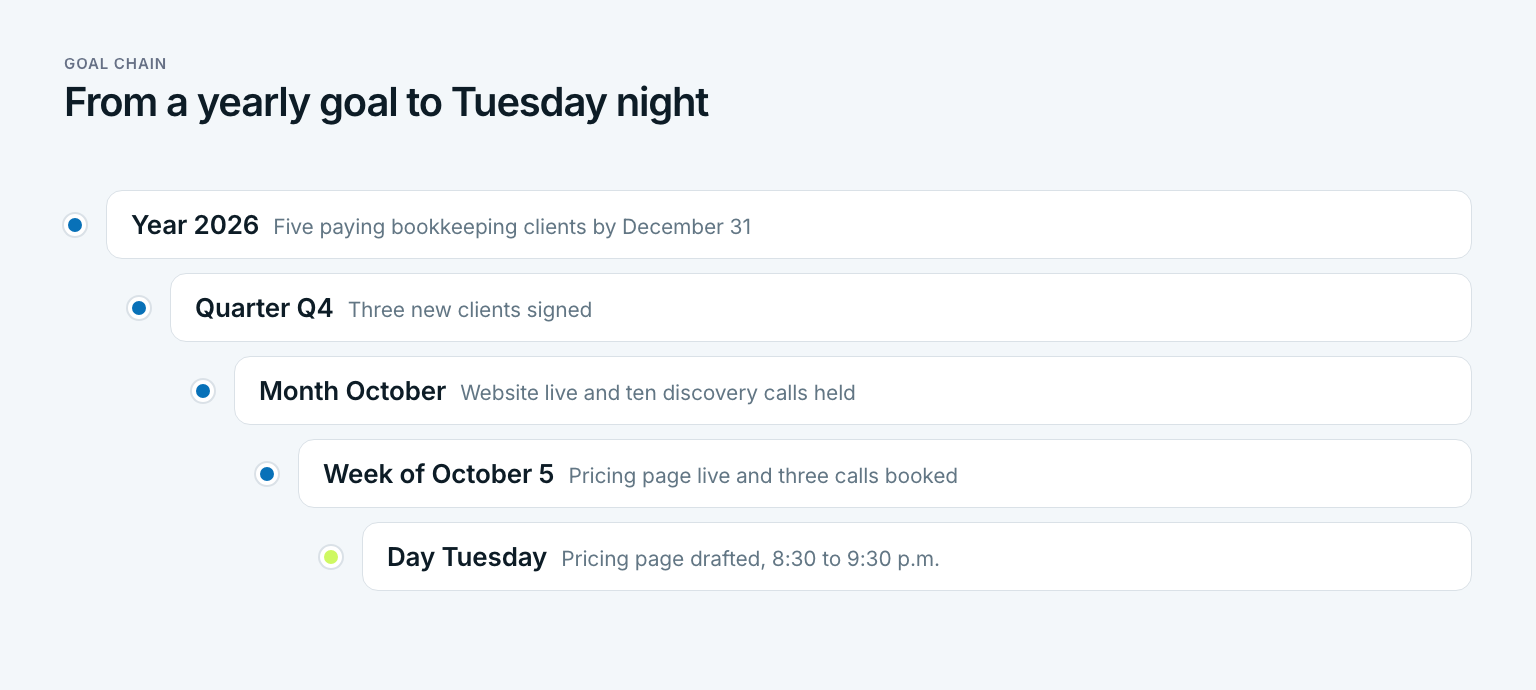
Each level answers the question of the level above it. Tuesday's focus block does not matter because it is on the sheet. It matters because it is one of the daily goals that carry the weekly goal. Take out a level and the daily plan floats. That means: whoever plans only days plans very carefully in a direction nobody has chosen.
In Gaapp, this chain is the core: five levels from year to day, and each goal usually hangs from a larger one. Progress for any period is the share of goals completed, and a thin line shows how much of the time has passed. How to get from a yearly goal to quarters and months is covered in the guide to annual planning. Ready-made goal sets that break a yearly goal down to the daily level are in the templates.
Three questions before you plan tomorrow:
- Can you name tomorrow's daily goal in one sentence before you go to bed?
- Do you know when you will work on it tomorrow, with a start time?
- How many hours of tomorrow are deliberately empty?
Whoever cannot answer one of these does not need a prettier template, but a decision the night before. In short: a daily plan is not a form for your day, it is a decision about it.
Frequently asked questions about daily planner templates
How can I create my own daily planner?
Take a sheet of letter paper in portrait: an hour column from 6 a.m. to 10 p.m. on the left, the daily goal top right, three lines with checkboxes below it, and two lines at the bottom for the evening check. Print 14 copies and staple them, and you have a daily planner for two weeks. Fill in each sheet the night before, in about ten minutes.
What is the best daily planner template?
The one you actually fill in every evening. A good template has few fields: the date, a weekly goal, one daily goal, fixed appointments, a focus block with a start time, three small tasks, and an evening check. Design matters far less than keeping the sheet visible.
Is there any free daily planner app?
Yes. Your phone's calendar and notes app are free, and many goal and task apps offer free plans. An app is worth it when you want your daily goal linked to a weekly goal and your progress calculated for you. If you only need tomorrow on one page, printed paper is free and always visible.
What does an ADHD planner look like?
Usually simpler than a standard planner: one daily goal in large letters, three or four time blocks instead of an hourly grid, a visible timer, planned transitions, and a parking lot for ideas that come up during focus time. The aim is fewer decisions at the moment of work. A planner can help with structure, but it does not replace a diagnosis or professional support.
Should I plan my day the night before or in the morning?
The night before. You still remember what slipped today, and your morning goes to work instead of planning. If evenings are impossible, plan in the morning, but before you open email or messages.
How many tasks should be on a daily plan?
One daily goal and no more than three small tasks. Everything else stays on your to-do list. More items do not make a plan more ambitious, they make it more fragile, because one delay shifts half the list.
Last updated: 19 October 2026
Read next
 Planning
Cleaning Schedule: Daily, Weekly and Monthly Tasks
A cleaning schedule is not a Saturday to-do list: daily, weekly and monthly tasks, a printable template and a fair split for families.
15 min read
 Planning
Study Plan: How to Make One You Can Actually Follow
A study plan is not a schedule. Make one in six steps: inventory, hours math, buffer, a sample study schedule and a template, with a worked example.
17 min read
 Planning
Bullet Journal: How to Start One You'll Actually Keep
A bullet journal is not an art project. Learn the bullets, four core modules, migration and a six-step setup, with an example, 12 ideas and a goal chain.
15 min read