The One Thing: Book Summary and How to Use It
The One Thing is not a time management book but one about subtraction: the Focusing Question, domino effect, six lies, time blocking, and goal cascade.

Contents
- 01The One Thing book summary in five main points
- 02The domino effect: why success is built one step at a time
- 03The six lies between you and your one thing
- 04The Focusing Question at the heart of The One Thing
- 05Goal Setting to the Now: purpose, priority, and the goal cascade
- 06Time blocking your one thing: hours that belong to you
- 07Criticism of The One Thing: three objections
- 08How to apply The One Thing: six steps for your first week
- 09Three questions before you close the book
- 10Frequently asked questions about The One Thing book
The One Thing is not a time management book but a book about subtraction: Gary Keller and Jay Papasan argue that extraordinary results come from narrowing your attention to the one thing that makes everything else easier or unnecessary. Their tool for finding it is a single question, the Focusing Question. You ask it about your life, about your year, and about the next two hours. That is the core idea. The rest of the book explains why it is so hard to live by and how to live by it anyway.
The book came out in 2013. Keller cofounded the real estate company Keller Williams Realty, and Papasan is his longtime coauthor. This summary follows the book in plain words and tests every idea on one person: Dana, 42, who runs a two-person bookkeeping firm in Columbus, Ohio, with her business partner Luis. She wants to grow from 34 to 60 monthly clients by the end of 2027. Her list has 13 items on it, from a new website to Google Ads to a software migration, and none of them has moved much in a year. She also coaches her son's soccer team on Tuesdays and Saturdays, and that part is not up for negotiation.
The One Thing book summary in five main points
The book is short, and it rests on five ideas. Anyone who knows these five can place every chapter:
- Success is sequential. One thing leads to the next, the way one domino knocks over another. Whoever pushes ten things at once moves none of them very far.
- Not everything matters equally. A few tasks produce most of the result. Keller and Papasan keep narrowing that idea until only one thing is left.
- Six common beliefs get in the way. The book calls them lies. Each one sounds like sensible work advice, and each one scatters your focus.
- One question replaces the long list. The Focusing Question looks for the one thing that makes everything else easier or unnecessary. You ask it every day until asking it becomes a habit.
- The one thing needs a fixed place on your calendar. Without blocked time, the urgent wins. That is why the book ends with time blocking and a goal cascade that runs from a someday goal down to right now.
In short: The One Thing moves productivity from doing to choosing. Dana is not lazy. She is working on 13 things at the same time, and none of them gets enough time to fall over.
How the book by Gary Keller is structured
The three parts build on each other. First the book clears away bad assumptions, then it hands you a tool, then it shows how the tool becomes a daily routine:
| Part | What it covers | Core question |
|---|---|---|
| The Lies | Six beliefs that scatter your focus | What keeps you from focusing on one thing? |
| The Truth | The Focusing Question, the success habit, the path to great answers | How do you find your one thing? |
| Extraordinary Results | Purpose, priority, productivity, Goal Setting to the Now, time blocking, three commitments, four thieves | How do you keep the one thing alive every day? |
The domino effect: why success is built one step at a time
The domino effect is the central image of the book. Keller and Papasan point to physicist Lorne Whitehead, who showed in a 1983 paper in the American Journal of Physics that a domino can knock over another one about 50 percent larger. Line up dominoes that each grow by half, and the growth turns geometric. The book works out that if the first domino is two inches tall, the 57th would reach almost all the way to the moon. Nobody builds that line. The picture still shows how impact happens: not through many pushes at once, but through a chain.
Anyone who takes the image seriously stops asking what needs to happen today. The better question is which domino has to fall now so the next one can fall. That sounds obvious. In practice, most people do the opposite and nudge a dozen small dominoes every morning without tipping any of them over.
For Dana, it looked like this. In one year she redesigned half of her website, posted on LinkedIn for six weeks, ran a small Google Ads test, compared four bookkeeping platforms, and drafted a job post for a part-time assistant. None of these dominoes knocked over a second one. The ads brought in two price shoppers. The website gets maybe a dozen visits a week. A steady stream of referrals, on the other hand, would tip several dominoes at once: new clients without ad spend, a reason to finally hire the assistant, and less need for a polished website.
That means: success is sequential, not simultaneous. Habits work the same way. Keller and Papasan cite research from University College London that found it took an average of 66 days for a new behavior to become automatic. The study was led by Phillippa Lally and published in 2009, and our article on how long it takes to form a habit covers it in detail. For The One Thing, the lesson is simple: you do not need iron discipline for everything. You need selected discipline for one habit, long enough for it to carry itself.
The six lies between you and your one thing
The first part of the book is a cleanup job. Keller and Papasan name six beliefs that almost everyone accepts as reasonable. Each one sounds like good work habits. Each one splits your attention:
| The lie | What the book says instead | In Dana's week |
|---|---|---|
| Everything matters equally | A few tasks carry most of the result. Replace the to-do list with a success list | 13 items on the list, one of them drives growth |
| Multitasking saves time | Every switch costs attention. The most important work gets your full presence | Writing a proposal with client emails pinging in the corner |
| Success takes a disciplined life | Selected discipline for one habit until it runs on its own | One new habit only: the 8 a.m. focus block |
| Willpower is always on call | Willpower fades over the day. Do the most important thing first | Growth work moves from 4 p.m. to before the first client call |
| A good life is a balanced life | Go out of balance at work on purpose, keep a short leash at home | Tuesday and Saturday soccer stay untouchable |
| Big is bad | Think big, then make the first action small | From a few more clients to a firm that runs without her for a month |
Everything matters equally, and multitasking helps
A to-do list is a useful tool. It collects, but it does not rank. Keller and Papasan set a success list against it, a short list sorted by impact. They start from the Pareto principle and push it to the extreme. From the top 20 percent of your tasks you take the top 20 percent again, and again, until one thing is left. Dana works her 13 items down to three and then to one: a referral partnership with local tax preparers who send her small business clients.
The book treats multitasking as a misunderstanding. You can walk and talk at the same time, but you cannot focus on two demanding things at once. What looks like doing both is fast switching, and every switch costs time and care. Whoever sits down to work on their one thing closes everything else. For Dana, that means the inbox stays closed, her phone sits in a drawer, and only the document with her partner pitch is open.
Discipline, willpower, balance, and thinking big
The third and fourth lies are connected. Successful people, the book argues, are not disciplined about everything. They are very disciplined about a few things until those things become habits that no longer need discipline. And because willpower fades over the course of a day, they put the most important work first. Keller and Papasan lean on Roy Baumeister's research on self-control as a limited resource here. Dana used to schedule growth work for 4 p.m., after client calls. By then she had answered 60 emails and her willpower was gone.
On balance, the book argues against a favorite word of self-help. Whoever keeps everything in balance gives nothing enough time to become extraordinary. Keller and Papasan suggest counterbalancing instead. At work, you can go out of balance for long stretches when one thing demands it. At home, you keep a short leash: health, family, and friends never wait for long. Dana gives her firm long mornings during the busy season. Tuesday practice and Saturday games with her son stay on the calendar no matter what.
The sixth lie is that big is bad. The book disagrees: whoever thinks small plans small steps and gets small results. A big goal changes the question you ask today. For years Dana talked about getting a few more clients. Once she started talking about a firm that could run without her for a month, she asked different questions and got different answers. Isn't a big goal discouraging? Only when it has no first step.
The Focusing Question at the heart of The One Thing
The Focusing Question is the tool the whole book builds toward. In essence, it asks which one thing you could do that would make everything else easier or unnecessary. The question has two parts. The first forces you to give a single answer. The second gives you a test, because a good answer is a domino that knocks over others.
Keller and Papasan describe two versions. The big picture version asks about direction: what is the one thing in my life, my career, my marriage? The small focus version asks about the next step: what is the one thing I can do right now? The big question without the small one stays a dream. The small one without the big one stays busywork.
For Dana, the big picture version is: what is the one thing that would make growing to 60 clients easier or unnecessary to chase? Her answer is a reliable referral source. The small focus version comes on Monday at 8 a.m.: what can I do in the next three hours to get that source started? Her answer is to email three tax preparers she has met at chamber of commerce breakfasts and ask each of them for coffee.
The success habit: ask the question every day
A question you ask once changes very little. The book calls asking the Focusing Question every day the success habit. Keller and Papasan suggest keeping the question in sight so it finds you before the day does. Dana wrote it on an index card that leans against her monitor. Every morning at 8 she reads it before she opens her inbox.
Big and specific: the great question
Not every Focusing Question is equally good. The book sorts questions along two lines: small or big, broad or specific. A small, broad question gets small, vague answers. The best question is big and specific, because it ties an ambitious goal to a measurable result and a deadline. How high can you aim without losing your footing?
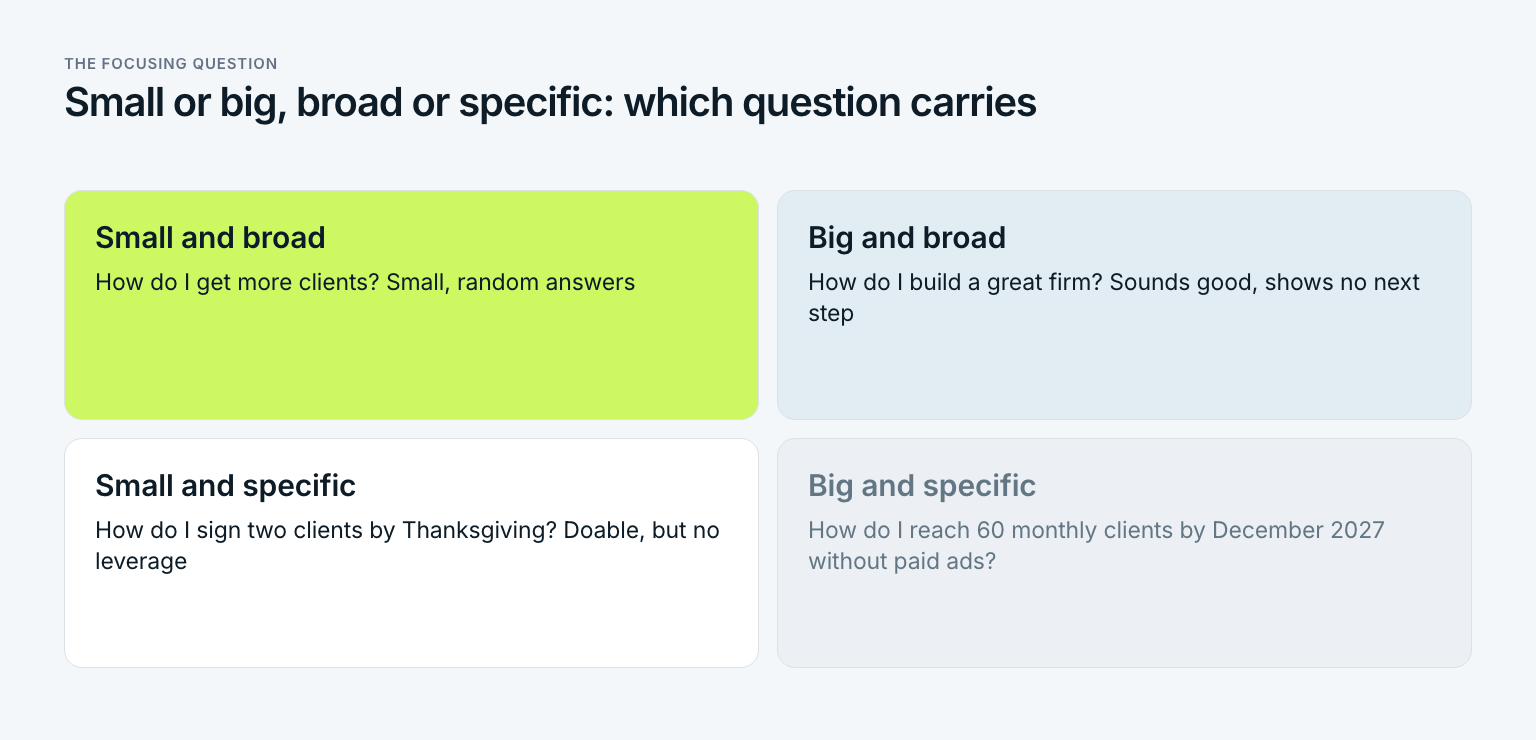
The book also sorts answers into three levels. A doable answer sits within what you can already do. A stretch answer sits at the edge of your ability and asks you to learn something. A possibility answer sits beyond what you know. For that level, the book recommends looking at benchmarks and trends: who has already done this, and how? Dana calls two bookkeepers in other states who doubled their client base. Both of them grew mostly through referrals from tax preparers, not through ads.
Goal Setting to the Now: purpose, priority, and the goal cascade
Goal Setting to the Now is the method the book uses to break a big goal down to the present moment. You start with your someday goal, the thing you want to achieve eventually. Then you use the Focusing Question to find the one thing for the next five years that moves you toward it. After that comes the one thing for this year, this month, this week, today, and finally right now. Each level answers the Focusing Question for the level above it.
Purpose, priority, productivity
Before the cascade, the book sets up a chain of three links. Your purpose sets your priority. Your priority decides what you are productive at. Whoever has no purpose sets priorities by volume. And whoever has no priority ends up busy instead of productive.
Purpose in this book is nothing grand. It is your answer to what gets you up in the morning and what you are willing to give up for it. For Dana, it is building a firm that gives small business owners clean numbers and gives her the freedom to be at every game. That would not look good on a poster, but it carries her through a slow January. Keller and Papasan also insist on priority in the singular. Anyone with five priorities, strictly speaking, has none.
Behind the cascade sits the idea of present value. A goal five years out feels far away, so it loses to everything that is loud today. The cascade pulls the distant goal onto today's calendar. What matters today is no longer the most urgent request, but the part of the big goal that is due today.
The cascade as a goal chain: year, quarter, month, week, day
The cascade in the book has no quarter. In practice, that is exactly the level people tend to skip, because there is too much room between a yearly goal and the month of October. Anyone who adds a quarter gets a checkpoint where the course can still be corrected. This is Dana's chain:

The chain reads from top to bottom as a series of questions. What is the one thing this quarter that makes the yearly goal easier? Two referral partners. What is the one thing in October that brings those partners closer? Coffee meetings. And today? The next email. You can map a chain like this in Gaapp, where every daily goal hangs on a weekly, monthly, and yearly goal. The tool matters less than the rule that each level has only one answer.
Time blocking your one thing: hours that belong to you
The Focusing Question is useless if the answer never gets a slot on your calendar. That is why the book recommends time blocking in a fixed order. First you block your time off, meaning vacations and rest, because it is the first thing to disappear otherwise. Then you block time for your one thing. Finally you block planning time, an hour each week to look at your yearly and monthly goals.
For the one thing, Keller and Papasan name a clear amount: four hours a day, ideally in the morning. That sounds like a lot, and for many people it is. The point is that your most important work gets time that is as protected as a meeting with your biggest client. Whoever moves the block for an urgent request is saying the request matters more than the goal. Our guide to time blocking covers how to plan a full week in blocks. This section is only about the one block that carries the goal.
Protecting the block is the real work. The book suggests finding a place where nobody can find you, getting everything you need ready beforehand, removing distractions, and telling the people around you when you are off limits. Dana works from 8 to 11 a.m. at a table in the back room of the office. Luis takes every client call before 11, and in return she takes his Friday afternoon calls. Her inbox stays closed until the block ends.
Dana does not get four hours every day. Tax season, payroll deadlines, and month end take some mornings away. She blocks three hours on four mornings a week, which makes 12 hours instead of the book's 20. Is that cheating the method? No. The principle is not the number but the order: the one thing comes first, before the day belongs to everyone else.
A related method is the Ivy Lee method. It ranks six tasks for the next day and works through them in order. The One Thing goes one step further and asks whether the first task alone is enough, as long as it is the right one.
Three commitments and four thieves
Near the end, the book names three commitments that keep the block going for months. The first is the path to mastery: your one thing gets better with every repetition, and you keep looking for the next level. The second is the move from an entrepreneurial approach to a purposeful one: instead of doing things the way you already know, you ask what the goal demands next. The third is the accountability cycle: you treat results as the outcome of your own actions and find someone who asks about them, such as a coach or a partner.
Against them stand four thieves that steal time from your one thing: the inability to say no, the fear of the chaos that piles up outside the block, poor health habits, and an environment that does not support your goals. For Dana, the first thief is the big one. Long-time clients call with rush jobs and expect her to drop everything, because she always has.
Criticism of The One Thing: three objections
The One Thing is a good book. It is just not a scientific one. Three objections come up in reviews again and again, and each has some truth in it:
- The willpower research is shaky. The book bases its advice to do the most important thing early on studies of self-control as a resource that runs out. A large replication effort led by Martin Hagger across more than 20 labs found little or no effect in 2016. The practical advice still holds up, because early in the day fewer people interrupt you.
- Four hours a day is unrealistic for many. Anyone who works shifts, has small children, or sits in an open office on call cannot block half a day. The method works with less time too, as long as the block comes before the rest of the day.
- Much of the evidence is success stories. Keller often draws on his own company and on well-known founders. Whoever succeeded likes to say that focus was the reason. You hear much less from people who focused just as hard and failed anyway.
There is one more objection the book half anticipates: your one thing can be the wrong one. Whoever bets twelve months on the wrong goal loses more than someone who spread their effort. That is why weekly planning time belongs to the Focusing Question. It is the moment you check whether the domino you are pushing actually knocks over another one.
How to apply The One Thing: six steps for your first week
The book ends with a lot of ideas at once. To get started, one week and six steps are enough:
Empty your head
Write down everything on your mind, at work and at home. Dana ends up with 13 items, from the website to the software migration.
Ask the big Focusing Question
Pick one area of your life and ask which one thing would make everything else easier or unnecessary. Cross things off until one answer is left. For Dana, it is a referral partnership.
Write your cascade
Break the answer down into year, quarter, month, week, and today. Each level is one line with a number or a date.
Book your first block
Put the block for your one thing on the calendar before other meetings land there. In the morning if you can, and as long as your life honestly allows.
Protect the block
Set everything up the night before, turn off notifications, and tell the people around you when you are unreachable.
Review on Sunday
Take half an hour of planning time. How many blocks actually happened, and did your one thing knock over another domino?
The most common mistake: picking a task instead of a lever
Anyone asking the Focusing Question for the first time often answers with the most annoying task: taxes, the website, the overflowing inbox. Finishing it feels like progress, but it knocks over nothing else. Your one thing is the task after which other tasks get easier or disappear. Test every answer with a follow-up question: what does this make easier or unnecessary? If nothing comes to mind, it is not your one thing.
Dana's first six weeks in numbers
| Week | Blocks kept of 4 | Hours | Partner conversations | Referrals received | What Dana changed |
|---|---|---|---|---|---|
| 1 | 2 | 6 | 1 | 0 | Blocks scheduled after lunch, two lost to client emails |
| 2 | 3 | 9 | 2 | 0 | All blocks moved to 8 a.m., inbox closed until 11 |
| 3 | 4 | 12 | 3 | 0 | Luis takes every call before 11 |
| 4 | 3 | 9 | 2 | 1 | Said no to a rush cleanup job on a Thursday morning |
| 5 | 4 | 12 | 2 | 2 | Signed a referral agreement with a two-person tax office |
| 6 | 4 | 12 | 1 | 3 | Three new monthly clients from referrals, $450 each |
After six weeks, Dana has kept 20 of 24 planned blocks, held eleven partner conversations, received six referrals, and signed three new monthly clients worth $1,350 a month together. The website is still half finished. It also matters less now, because none of the new clients found her through a search engine. That is the domino effect on a small scale: the first partner brings the first referrals, and the referrals make the second partner easier to win.
Where Atomic Habits fits in
The two books often sit side by side on the shelf, but they answer different questions. The One Thing asks what to focus on. Our Atomic Habits summary shows how one action turns into a habit that runs without much willpower. Whoever combines them picks the one thing with Keller and builds the habit that makes it possible every morning with Clear. Dana's habit is tiny: the index card on the monitor and the inbox closed before she sits down.
Three questions before you close the book
A summary does not replace the book. It can still take you further in one evening than the book does in a weekend, if you answer three questions:
- What is the one thing in your most important area of life that would make everything else easier or unnecessary? Write one sentence, not a list.
- When is your block? One weekday and one time that already applies tomorrow.
- Who or what will steal it? Name the thief most likely to strike, and decide now what you will tell it.
Whoever answers these three questions today has put more of the book to work than many readers do after the last chapter. In short: The One Thing is not a call to do less. It is permission to do the right thing first.
Frequently asked questions about The One Thing book
What is the one thing concept?
The concept is that extraordinary results come from narrowing your focus to a single thing that matters most. Gary Keller and Jay Papasan put it into the Focusing Question, which asks for the one thing that makes everything else easier or unnecessary. You ask it about your life, your year, and the next few hours.
Is The One Thing a good book?
For anyone who pushes many projects at once and finishes few of them, yes. It is short, easy to read, and gives you a tool you can use the same day. It is not a scientific book, some of its evidence is anecdotal, and the four hours of daily focus time it recommends do not fit every life.
What is a famous quote from the book The One Thing?
One of the most quoted lines is “Extraordinary results are directly determined by how narrow you can make your focus.” The Focusing Question itself is probably even better known. Both make the same point: results grow when the number of things you pursue shrinks.
What is the book The One Thing about?
The book explains in three parts why common beliefs like multitasking and balance scatter your focus, how the Focusing Question works, and how to bring it into daily life with time blocking and a goal cascade. It was published in 2013 by Gary Keller, cofounder of Keller Williams Realty, and his coauthor Jay Papasan.
What are the six lies in The One Thing?
Keller and Papasan name six beliefs that scatter focus: everything matters equally, multitasking works, success requires a disciplined life, willpower is always on call, a balanced life is the goal, and big is bad. The book answers each lie with a truth that points back to the one thing.
How many hours should I time block for my one thing?
The book recommends four hours a day, ideally in the morning. If your life does not allow that, the order matters more than the length. A protected 90-minute block before anything else does more than four hours that keep getting interrupted.
Last updated: 6 October 2026
Read next
 Habits
75 Hard: Rules, Risks and a Version You Can Finish
75 Hard is not a fitness program. The full rules, four health risks, 75 Soft compared and a custom version built around a real goal.
15 min read
 Habits
Digital Detox: A 7-Day Plan to Reduce Screen Time
A digital detox isn't a weekend offline. What the research shows, how to measure and reduce screen time, plus a 7-day plan with a worked example.
15 min read
 Habits
Delayed Gratification: Meaning, Examples, How to Build It
Delayed gratification isn't self-denial, it's a trade: what the marshmallow test really showed, everyday examples, five proven strategies and a plan.
15 min read