Eat That Frog Summary: 21 Principles and a Review
Eat That Frog is not a book about early mornings: Brian Tracy's 21 principles in plain words, what still works, a fair review, and four weeks of practice.

Contents
- 01Eat That Frog book summary in five main ideas
- 02Who wrote Eat That Frog and how the book is built
- 03The 21 principles of Eat That Frog in plain words
- 04Brian Tracy's 7 steps to setting and reaching a goal
- 05What still works in Eat That Frog and what has aged
- 06Eat That Frog review: who should read it and what is missing
- 07Eat That Frog in a goal chain: from yearly goal to tomorrow's frog
- 08Three questions before you close the book
- 09Frequently asked questions about the Eat That Frog book
Eat That Frog is not a book about getting up early but a book about priorities: Brian Tracy shows in 21 short chapters how to find the one task that matters most and how to finish it before the day crowds it out. The frog is that task. The other 20 principles help you choose it, prepare for it, and stay with it until it is done. That is the Eat That Frog summary in three sentences. The rest of the book is practice.
The book first came out in 2001 and has been revised several times since. How to pick your frog and eat it in the first hour is covered step by step in the guide to the eat the frog method. This page is about the book itself: how it is built, all 21 principles in plain words, what still holds up, and what does not. Everything is worked through with one person. Jordan, 33, is a marketing manager at a 40-person software company in Denver. In January her VP asked for a library of customer case studies that sales could use in demos. Since then she has finished exactly one, because every week something louder came first.
Eat That Frog book summary in five main ideas
The book has 21 chapters, but it rests on five ideas. Whoever knows these five can place every chapter:
- Clarity comes before speed. Anyone who does not know what they want only gets to the wrong place faster. That is why the book opens with goals, not with the frog.
- A few tasks carry most of the results. Tracy borrows the 80/20 rule: of ten items on your list, two are usually worth more than the other eight combined.
- Importance is measured by consequences. A task matters when doing it, or not doing it, changes something that lasts. Urgency alone tells you nothing about that.
- Leaving things undone is a decision. You will never do everything. So you decide on purpose what to put off instead of leaving it to chance.
- Starting and finishing beat talent. Whoever starts the most important task first and stays with it until it is done gets more out of the same hours than someone who plans better and starts later.
In short: Tracy moves productivity from the question of how much you get done to the question of what you work on. Do the right thing first and the rest of the day gets easier. Do the wrong things quickly and you end the day tired and no further along.
Who wrote Eat That Frog and how the book is built
The author of Eat That Frog is Brian Tracy, a Canadian-American speaker and author born in 1944. He spent decades running seminars on sales, leadership, and time management and has written dozens of books. Eat That Frog is the best known of them. Its subtitle promises 21 great ways to stop procrastinating and get more done in less time, and the book keeps that tone: short chapters, memorable rules, plenty of stories, and a lot of direct instructions.
How the Brian Tracy book is laid out
A short introduction explains the frog. Then come 21 chapters, one principle each, and every chapter closes with short exercises to try the next morning. Tracy does not divide the chapters into parts, but they fall into five groups as you read. The early chapters settle what matters. The middle ones make sure you are prepared and skilled enough. The last ones push you into action and keep you there. A short conclusion lists all 21 again.
The style is that of a trainer in a seminar room, not of a researcher. Whoever expects a study of procrastination is reading the wrong book. Whoever wants a toolbox that fits in a bag is reading the right one. It is a slim book that most people can finish in an evening or two.
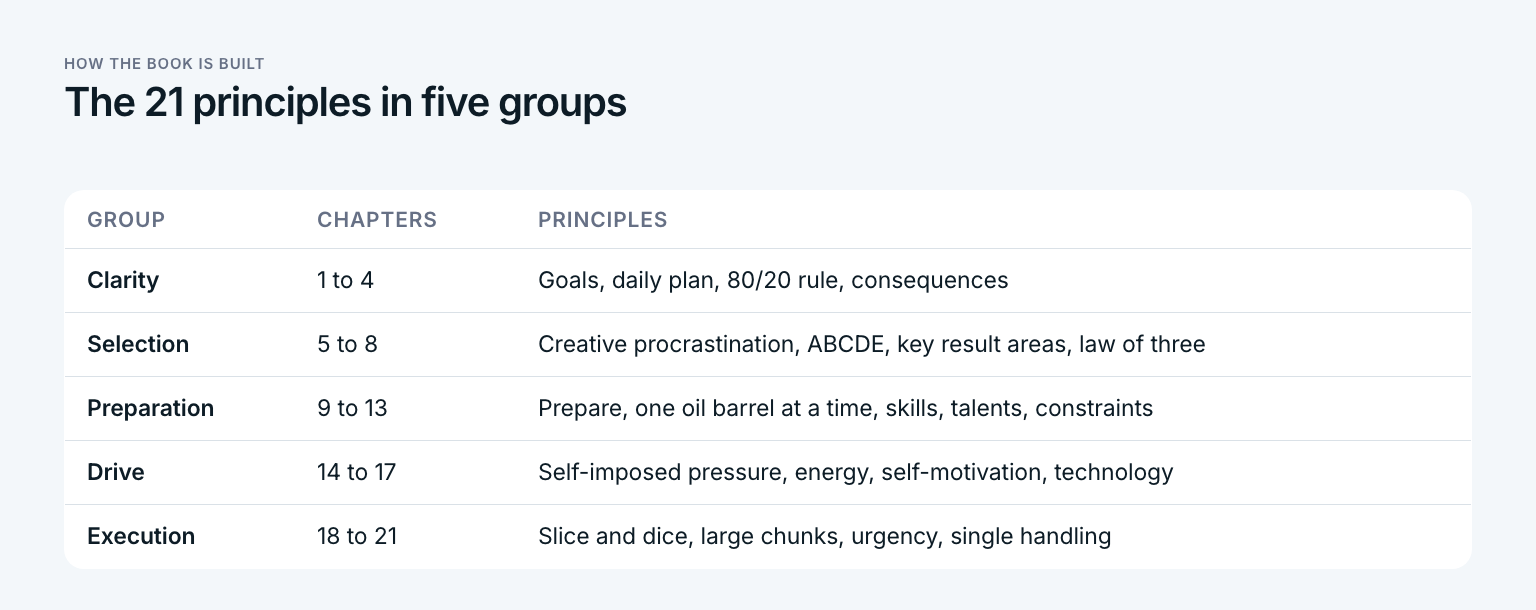
The 21 principles of Eat That Frog in plain words
The chapter titles below follow the most widely read edition. Later editions added material on technology and attention, so a few titles and numbers shift depending on which copy you hold. The ideas stay the same.
Principles 1 to 4: clarity before speed
- 1. Set the table. Before you can eat a frog, you need to know which one is on your plate. Tracy opens with written goals and a seven-step process, covered in full further down.
- 2. Plan every day in advance. Tracy works with four lists: a master list for everything, plus monthly, weekly, and daily lists. You plan tomorrow tonight. His rule of thumb is that every minute spent planning saves up to ten minutes in execution.
- 3. Apply the 80/20 rule to everything. A fifth of your tasks produce most of your results. The frog nearly always sits in that fifth, and it is rarely the task that feels easiest. The guide to the Pareto principle explains the rule behind it.
- 4. Consider the consequences. What matters is what has long-term consequences. Tracy adds what he calls the law of forced efficiency: there is never time for everything, but there is always time for the most important thing.
Jordan tries it on a Sunday night. Her list for the week has 38 items. Which of them will still matter a year from now? Seven survive the question, and the case studies are the only item that has been on every weekly list since January.
The law of forced efficiency
The idea: whoever cannot do everything has to choose, and the shortage forces clarity. You know it from the last workday before a vacation. That day you only do what truly matters, and you get a surprising amount done. Tracy wants that state to be the rule, not the exception before a trip. Anyone who asks each morning what must not be left undone today finds the frog almost by itself.
Principles 5 to 8: what to drop and what to weigh
- 5. Practice creative procrastination. You are going to put things off anyway, because you cannot do everything. Tracy wants you to do it on purpose, with low-value tasks and never with the frog. One test question, in paraphrase: knowing what you know now, would you start this task again today?
- 6. Use the ABCDE method continually. A is a must, with serious consequences. B is a should, with mild ones. C would be nice but has no consequences. D gets delegated, E gets eliminated. You never start a B while an A is open, and your first A task is your frog. The guide to the ABC prioritization method goes deeper.
- 7. Focus on key result areas. Every job has a handful of areas where results are expected. Tracy has you grade yourself on each from one to ten. Your weakest area caps how much your strengths can do.
- 8. Apply the law of three. According to Tracy, three core tasks make up most of your contribution. Whoever knows them knows where the best hours belong and can keep the rest small.
Jordan's ABCDE sort gives her four A, seven B, 16 C, six D, and five E items. She deletes the five E items and hands the six D items to her two coordinators and the design contractor. Her key result areas are campaigns, website, content, reporting, and sales enablement. She grades sales enablement a three out of ten and everything else six or higher. That means: as long as sales has no customer stories to tell, a better campaign report changes nothing. Her three core tasks follow from that: case studies, campaign launches, and the weekly pipeline report.
Principles 9 to 13: get ready and get better
- 9. Prepare thoroughly before you begin. Everything you need is within reach before you start. A clear desk takes away the excuse to do something else first.
- 10. Take it one oil barrel at a time. Tracy tells of crossing the Sahara on a route marked by oil barrels. You never saw the destination, only the next barrel. That is how you handle a big project: you only need to see as far as the next step.
- 11. Upgrade your key skills. Many tasks get postponed because you feel unsure doing them. Whoever gets better at the skill shrinks the frog. Tracy recommends reading in your field regularly and learning wherever you can, including in the car.
- 12. Leverage your special talents. Find out what you do especially well and what others value in your work. That is where your time has the most leverage.
- 13. Identify your key constraints. Between you and your goal there is usually one limiting factor. Tracy finds it more often inside yourself or your own organization than outside.
Jordan's oil barrels are the twelve case studies, and each one has four barrels of its own: request, interview, draft, customer approval. The very first barrel is not a case study at all but a shortlist of customers worth asking. Her constraint is quick to find. Is it skill, or is it time? She writes well and has interviewed customers for years. What she lacks is a block of time that Slack does not get a say in.
Principles 14 to 17: pressure, energy, and drive
- 14. Put the pressure on yourself. Do not wait for someone else to set a deadline. Tracy suggests a thought experiment: imagine you had to leave town for a month tomorrow. What would you make sure to finish first?
- 15. Maximize your personal powers. Sleep, exercise, food, and days off are not side issues. Anyone who is exhausted procrastinates, because the energy for the frog is gone. Hard tasks go into your best hours of the day.
- 16. Motivate yourself into action. The way you talk to yourself shapes whether you start. Tracy relies on optimism and on treating problems as solvable.
- 17. Get out of the technological time sinks. Email, messages, and notifications eat the time that belongs to the frog. Tracy advises switching devices off on purpose and checking messages at set times instead of being reachable all day.
Jordan takes principle 17 literally. During a frog block her Slack is paused, her email is closed, and her phone is in her bag. It sounds trivial. But this is exactly where every attempt since January had stalled.
Principles 18 to 21: start and stay with it
- 18. Slice and dice the task. Tracy describes two techniques. With the salami slice method, you cut the task into thin slices and finish one at a time. With the Swiss cheese method, you punch holes in it by working on it for a short, fixed time, however far you get.
- 19. Create large chunks of time. Demanding work needs unbroken stretches of 60 to 90 minutes. You put these blocks in your calendar like a meeting with yourself.
- 20. Develop a sense of urgency. Whoever starts fast and keeps moving gets into a flow that carries the work. Tracy's formula is a short phrase you repeat to yourself until you begin: do it now.
- 21. Single handle every task. Once you start, you keep going without detours until the task is finished. Every interruption costs you the time it takes to get back in. For Tracy, self-discipline is the key that holds all the other principles together.
For Jordan this turns into three blocks a week, Tuesday, Thursday, and Friday from 8 to 9:30 a.m. One block, one draft. And on days when 90 minutes are impossible? Then she punches a hole in the cheese: 30 minutes on one section, nothing more.
Brian Tracy's 7 steps to setting and reaching a goal
When people ask about Brian Tracy's 7 steps, they mean the process in the first chapter. It is the foundation the frog stands on, because without it there is no way to tell which task is the most important. Jordan worked through the seven steps at her kitchen table on the Sunday before Labor Day:
Decide exactly what you want
Not more case studies but an outcome someone could check. Jordan's sentence: twelve customer case studies live on the website by June 2027, and sales uses one in every demo.
Write it down
Tracy insists on paper. A goal in your head stays negotiable, a goal on your desk does not. Jordan's sentence is now taped to the bottom of her monitor.
Set a deadline, with sub-deadlines
June 2027 for the goal, eight case studies approved by mid-December, the first four pages live on the website by the end of October.
List everything you will need to do
No order yet, only completeness. Jordan lists 27 items, from the customer shortlist to a web page template and a slide for the sales deck.
Organize the list into a plan
Sequence first, then priority. What has to happen before what? The customer requests go first, because interviews depend on other people's calendars.
Take action immediately
That same night Jordan writes a shortlist of 15 customers. It takes 20 minutes, but the project finally has a first page.
Do something every day that moves you toward the goal
On block days, one draft. On the other days one small step, such as a follow-up email to a customer or a quote pulled from a call recording.
The most common mistake: looking for a frog without a goal
Many readers skip straight to the frog and past the first chapter. Then the frog becomes the most unpleasant task of the day instead of the most important one, and that is often just the loudest complaint in the inbox. Tracy put goals first for a reason. Whoever has no written goal has no way to measure the frog and ends up eating a different one every morning.
Jordan's first four weeks in numbers
Jordan started on Tuesday, September 8. In the eight months before, the project had produced one finished story and a folder of notes. She planned three frog blocks a week. Interviews happen on the customers' schedule, so the blocks are for writing:
| Week | Blocks kept | Minutes on case studies | Output | What changed |
|---|---|---|---|---|
| 1 | 1 of 3 | 90 | Shortlist of 15 customers, five requests sent | Two blocks lost to Slack and a launch fire drill |
| 2 | 2 of 3 | 180 | Two interviews, one first draft | Slack paused until 9:30, phone in her bag |
| 3 | 3 of 3 | 270 | Two interviews, two drafts, one approval | Next section chosen the night before |
| 4 | 3 of 3 | 210 | One draft, one more approval | Son home sick, one block cut to 30 minutes |
| Total | 9 of 12 | 750 | Four interviews, four drafts, two approvals | Rate 75 percent |
Three things stand out. The jump did not come from more willpower but from principle 17: once Slack stayed paused until 9:30, Jordan kept nearly every block. Her son's sick day in week four did not end the streak, because the Swiss cheese method allowed a smaller version. And nothing else fell apart. The campaigns launched and the pipeline report went out every Monday as always, just after 9:30.
Twelve and a half hours in four weeks sounds modest. But after eight months of putting it off, two new case studies are approved and two more are with customers. Is that enough for June? At one new draft a week, she reaches eight approved stories by mid-December, which leaves the spring for the last four.
What still works in Eat That Frog and what has aged
The book is more than 20 years old, and it shows in places. The core has aged well, better than many newer productivity books. The table separates the two:
| Principles | What still works | Where it falls short |
|---|---|---|
| Frog and goals, 1 to 4 | Important before urgent, written goals, planning the night before | Assumes your morning belongs to you |
| 80/20 and ABCDE, 3 and 6 | Simple, fast, and usable in almost any job | The ratios are rules of thumb, not measurements |
| Oil barrels and slicing, 10 and 18 | Breaking big projects into small steps | Hardly new, but clearly explained |
| Large chunks of time, 19 | Lives on today as time blocking and deep work | Hard to protect in open offices and shift work |
| Technology, 17 | Notifications off, messages at set times | The first edition predates the smartphone |
| Pressure and motivation, 14 and 16 | Self-imposed deadlines work, even without a boss | Sales seminar tone, little about the feelings behind procrastination |
That means: the tools have held up better than the reasoning. The ABCDE list works today exactly as it did in 2001. The assumption that everyone controls their own morning does not hold for many readers. Anyone who wakes kids at 6 a.m. or starts a hospital shift at 7 needs a different time for the frog, not a different method.
Eat That Frog review: who should read it and what is missing
Is the book as good as its reputation? It is short, clear, and full of exercises that work the very next morning. Few productivity books get you from reading to doing this fast. Three objections still hold.
First: little evidence. Tracy works with rules of thumb and anecdotes. The ten minutes saved by every minute of planning is a seminar formula, not a measurement. Whoever looks for studies will find almost none in the book.
Second: 21 principles are closer to five. Many chapters repeat the same idea in new clothes: know what matters and do it first. That makes the book easy to remember but also repetitive. Anyone who has absorbed the first eight chapters will find much of the rest familiar.
Third: discipline instead of feelings. Tracy treats procrastination as a matter of decision and self-discipline. Research sees more to it. Fuschia Sirois and Timothy Pychyl described procrastination in 2013 as an attempt to escape unpleasant feelings in the short term. Whoever avoids a task because it triggers fear or shame gets little help from being told to do it now. What helps in that case is covered in the guide on how to stop procrastinating.
So who should read it? Three groups get the most out of it:
- Beginners in time management who want a short, practical start and a real change after one evening of reading.
- People with some control over their day, such as founders, managers, and knowledge workers who decide at least part of their morning.
- Readers who plan a lot and start little. For them the second half of the book is worth more than the first.
It is worth less to anyone who already knows Covey or Getting Things Done, and to anyone whose day is set mostly by others. What the book lacks most is the middle. Tracy has the goal at the start and the frog in the morning. He mentions monthly and weekly lists, but no review that checks whether the frogs of recent weeks added up to the yearly goal. In short: the book tells you what to do first today. It does not tell you whether that is enough over a year.
Eat That Frog in a goal chain: from yearly goal to tomorrow's frog
The missing middle is easy to add. Tracy's seven steps give you the yearly goal, his daily list gives you the morning. In between you need three levels that show every week whether the frogs are adding up. For Jordan it looks like this:
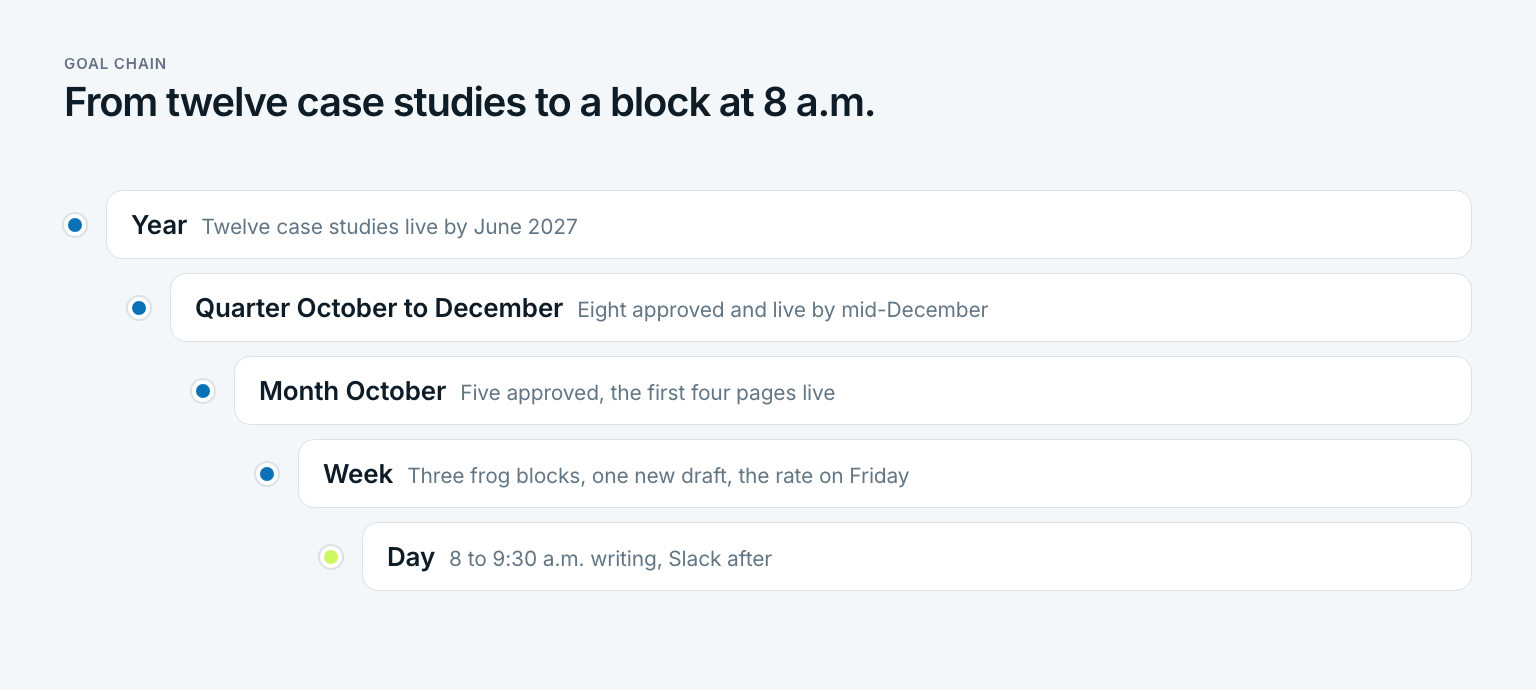
- Year: twelve customer case studies live by June 2027, and sales uses one in every demo.
- Quarter October to December: eight case studies approved and live by mid-December.
- Month October: five approved in total, the first four pages live on the website.
- Week: three frog blocks, one new draft, the rate on Friday.
- Day: Tuesday, Thursday, and Friday from 8 to 9:30 a.m. writing, Slack after.
The frog sits on the bottom level as a daily goal. Every level above checks whether the mornings add up. If Jordan has only four approvals by the end of October instead of five, she sees it on October 31, not in May. Then one extra block in November is enough, instead of a scramble in spring. That means: the book gives you the frog, and the goal chain tells you whether it was the right one.
In Gaapp you set a yearly goal, break it down through quarter, month, and week, and check off the frog every day as a daily goal. How to turn a big ambition into a chain like this is explained in the guide on how to achieve goals.
Three questions before you close the book
A summary changes nothing as long as it is only read. Three questions check whether reading turns into a different morning:
- Which written goal decides what tomorrow's frog is?
- Which three tasks make up most of my contribution, and which items on my list can I delete or hand off?
- Which block in my week belongs to the frog, and who keeps my inbox away during it?
Whoever can answer all three in one sentence each does not need a second read. Whoever gets stuck knows which chapter to start with. In the end, Eat That Frog is not a book about frogs but about who gets the best hour of your day.
Frequently asked questions about the Eat That Frog book
What does it mean to eat the frog first?
It means doing your most important task before anything else, before email and small requests can push it aside. The frog is the task with the biggest consequences and the one you are most likely to put off. Brian Tracy built his book Eat That Frog around this idea in 2001.
What are Brian Tracy's 7 steps?
Brian Tracy's 7 steps for reaching a goal are: decide exactly what you want, write it down, set a deadline, list everything you need to do, organize the list into a plan, take action immediately, and do something every day that moves you toward the goal. He presents them in the first chapter of Eat That Frog. They decide which task becomes your frog.
Is Eat That Frog by Brian Tracy worth reading?
Yes, if you want a short, practical book that gets you to act the next morning. Its strengths are the frog, the ABCDE method, and the seven steps. Its weaknesses are thin evidence, a lot of repetition, and little attention to the feelings behind procrastination.
Who is the author of Eat That Frog?
Eat That Frog was written by Brian Tracy, a Canadian-American speaker and author born in 1944. He spent decades teaching sales, leadership, and time management and has written dozens of books. Eat That Frog, first published in 2001, is the best known of them.
What is the ABCDE method in Eat That Frog?
The ABCDE method sorts tasks by their consequences. A tasks have serious consequences, B tasks mild ones, C tasks none, D tasks can be delegated, and E tasks can be eliminated. You never start a B task while an A task is still open, and your first A task is your frog.
What is the main message of Eat That Frog?
The main message is that results come from doing the few most important tasks first and finishing them without detours. Clear written goals tell you which tasks those are. The other principles help you prepare, stay focused, and keep going.
Read next
 Productivity
Feynman Technique: Four Steps to Real Understanding
The Feynman technique is not a memorization trick: four steps, a worked example from a stats class, a one-page template, and what research says.
16 min read
 Productivity
Zettelkasten: How to Turn Notes Into Your Own Ideas
A Zettelkasten is not an archive: Luhmann's method, the three note types, a five-step setup and an Obsidian template, with a worked example.
15 min read
 Productivity
Second Brain: How to Build One You Actually Use
A second brain is not a note archive: Tiago Forte's CODE steps, the PARA method with an example, a five-step setup and the mistakes that sink it.
15 min read