Eat the Frog: How to Pick the One Task That Matters
Eat the frog means doing the one task that moves your goal before anything else. Origin, five steps, a worked week with numbers, ADHD notes and a template.

Contents
- 01What does it mean to eat the frog
- 02Who originally said eat the frog: Mark Twain, a French moralist, and Brian Tracy
- 03How to pick your frog: the evening test with two questions
- 04The eat the frog method in five steps
- 05What really happens in your first hour: Dana’s first week in numbers
- 06Eat that frog, the ABCDE method and the other methods in the pond
- 07Does eat the frog work for ADHD
- 08The three mistakes nobody notices
- 09Eat the frog in your goal chain: year, quarter, month, week, day
- 10Frequently asked questions about eat the frog
Eat the frog means doing your most important task first, before email, before meetings, before anything that feels easier. The frog is the one task you are most likely to put off and most likely to regret putting off. Brian Tracy built a whole book around the image in 2001. Most summaries turn it into a rule about hard tasks. It is not. It is a rule about what happens in your first working hour, and about who decides what goes there: you, or your inbox.
Three things make the method work: a frog small enough to finish, a fixed hour nobody else can book, and a log of whether you ate it. Without the third, the first two drift within a week. All three run through Dana, a high school chemistry teacher in Ohio who is finishing a master’s thesis before school: her first week in numbers, the fixes for week two, the question of ADHD, and a template you can copy tonight.
What does it mean to eat the frog
To eat the frog means to start the day with the task that has the biggest effect on your goals and the smallest appeal. Tracy defines the frog as your biggest, most important task, the one you are most likely to procrastinate on if you do nothing about it. Two rules follow from the image. If you have to eat two frogs, eat the ugliest one first. If you have to eat a live frog at all, it does no good to sit and look at it. Those two sentences are the whole method. Everything else in the book is about keeping them.
Notice what the definition does not say. It does not say the hardest task or the longest task. It says the most important one, and importance is measured against a goal, not against your mood. Whoever picks the frog by dread alone will eat a lot of frogs that never needed eating. The task you avoid most is often avoided for a good reason: it does not matter. The frog is the task you avoid although it matters.
Frog, tadpole, and pond
A frog is a task that moves a goal and that you would skip if nobody checked. A tadpole is a small task that feels productive and moves nothing: inbox zero, a tidy desk, a reorganized folder. The pond is everything that will happen to your day after 9 a.m. anyway. The method is one sentence: one frog before the pond fills up. Tadpoles can wait, and most of them can wait forever.
Dana’s frog is easy to name and hard to eat. She teaches five chemistry classes a day, grades in the evening, and is 12,000 words short of a master’s thesis due December 15. The chapter she avoids is the literature review. Every morning she has about 75 minutes between her alarm at 5:30 and leaving for school at 7:00. For three months that window went to lesson prep and email. Lesson prep is a tadpole: it would get done anyway, in her planning period. The thesis does not get done anyway. That is the frog.
Who originally said eat the frog: Mark Twain, a French moralist, and Brian Tracy
The frog quote is usually credited to Mark Twain: if it is your job to eat a frog, do it first thing in the morning, and if it is your job to eat two frogs, eat the biggest one first. There is no record of Twain writing or saying either sentence. The site Quote Investigator traced the idea to the French writer Nicolas Chamfort in the 18th century, who advised swallowing a toad every morning so that nothing more disgusting could happen for the rest of the day. The toad became a frog in English retellings, and the pessimism became a productivity rule.
Brian Tracy made it a method. His book Eat That Frog, first published in 2001, lists 21 ways to stop procrastinating, and the frog is the first way and the frame for the other twenty. A quarter century later, eat that frog is one of the most searched productivity phrases in English, and most people who use it know the book only from a summary of Eat That Frog.
Why does the origin matter for your morning? Because Chamfort’s toad and Tracy’s frog describe two different things. Chamfort’s toad is the worst thing in the day, swallowed early so the rest feels better. Tracy’s frog is the most important thing, done early so the goal moves. The first is about mood. The second is about results. Anyone who mixes them up will spend the first hour on an unpleasant errand and call it discipline. In short: eat the frog that matters, not the toad that stinks.
How to pick your frog: the evening test with two questions
The frog is chosen the night before, never in the morning. Mornings choose the loudest task. Evenings can still choose the right one. Two questions do the sorting. Does this task move a goal I have written down for this month? Would I skip it this week if nobody checked? Yes to both is a frog. Yes only to the first is a normal to-do that will get done. Yes only to the second is a chore you dread and can delegate, batch, or drop.
| Candidate for Dana’s Monday | Moves the monthly goal? | Would she skip it unchecked? | Verdict |
|---|---|---|---|
| Write 500 words of the literature review | Yes, chapter due October 31 | Yes, for three months now | Frog |
| Prep Tuesday’s titration lab | No, it gets done in the planning period anyway | No | To-do, after 7 a.m. |
| Answer 14 parent emails | No | No, she answers within an hour | Tadpole |
| Renew her teaching license online | No | Yes, deadline in March | Chore, batch on Saturday |
| Reply to her advisor about the committee date | Yes | Yes, for two weeks | Second frog, Tuesday |
The table shows what the to-do list hides. Five tasks, one frog. The advisor email is a second frog, and Tracy’s rule says the ugliest first, so it waits until Tuesday. It takes four minutes. She has avoided it for two weeks because answering it makes the December deadline real. That is what frogs look like up close: rarely big, often four minutes, always tied to something that matters.
Whoever has a monthly goal written down can run this test in two minutes. Whoever does not has a harder problem, because the frog cannot be found without a goal to measure it against. The guide on how to achieve goals covers the chain from a yearly goal down to this month. For the frog, the monthly goal is enough.
The eat the frog method in five steps
The method takes five steps, and four of them happen the evening before. The morning only has to execute. Dana set hers up on Sunday, October 4, for the week of October 5. Here is the version she settled on.
Name the frog the night before, with a number
Not “work on thesis”. “Write 500 words of the literature review, section 2.3”. The number is the finish line, and a frog without a finish line is eaten until the alarm rings, which means never. Dana’s first Monday had no number: she reread, fixed six commas and produced zero new words in 20 minutes.
Put it in the first hour, on the calendar
A frog without an hour is a wish. Dana blocked 5:45 to 6:45, Monday through Friday, as a repeating event. Whoever eats the frog “sometime in the morning” eats it at 11:40 after the third meeting, if at all.
Clear the pond the night before
Open the document, put the next sentence in the first line, phone charging in the kitchen, coffee set. The method dies in the three minutes between sitting down and starting. That is where the inbox lives. Remove every reason to open it.
Eat it before anything else, no previews
No quick look at email, no quick look at the news. Tracy treats the preview habit as the main enemy of the method. The first screen you open is the frog. Dana’s Wednesday fell to a quick look at a parent email that turned into four replies and a 15-minute frog.
Log it, then name tomorrow’s frog
One line in a notebook or your goal app: date, frog, done or not, minutes, number reached. Then name tomorrow’s frog while today’s is fresh. The log is the step most people drop, and the only one that tells you after four weeks whether the method works for you.
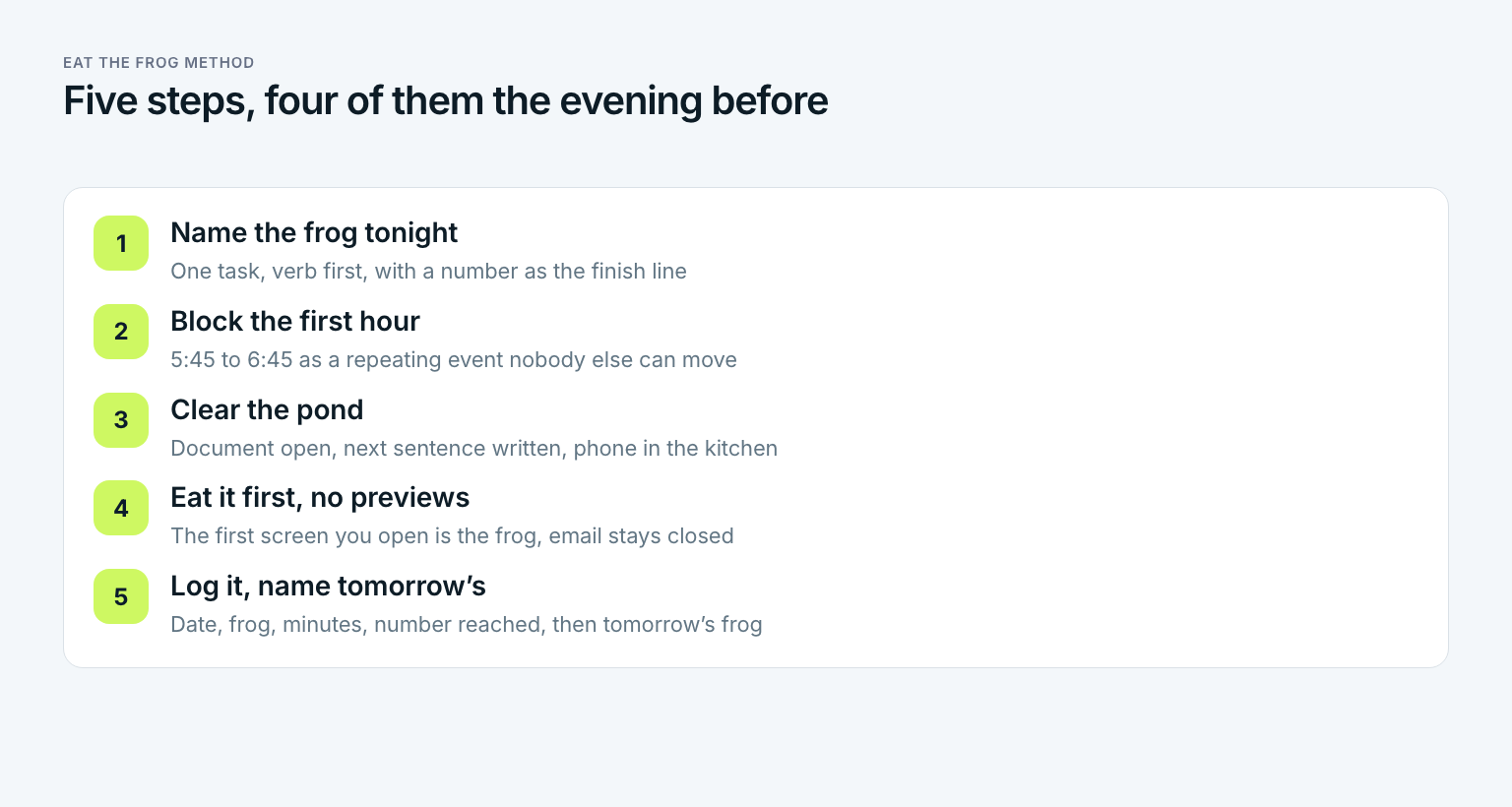
Five steps, one of them in the morning. Anyone who tries to decide, prepare and execute at 5:45 is asking a tired brain to do three jobs. The method moves two of them to the evening and leaves the morning one task: start.
What really happens in your first hour: Dana’s first week in numbers
A plan is a hypothesis. The log is the test. Dana planned five frogs for the week of October 5, each one hour, each 500 words, for 2,500 words toward the 12,000 she needs by December 15. The minimum is 1,200 a week with no time for revision, 1,500 to leave three weeks for editing. Here is what the log showed on Friday.
| Day | Frog as written | Started | Minutes | Words | What happened |
|---|---|---|---|---|---|
| Monday | Work on thesis | 5:52 | 20 | 0 | Reread chapter one, fixed commas, no finish line |
| Tuesday | Write 500 words, section 2.3 | 5:47 | 55 | 480 | Done, stopped mid-sentence when the alarm rang |
| Wednesday | Write 500 words, section 2.3 | 6:38 | 15 | 110 | Checked email first, four parent replies, frog at 6:38 |
| Thursday | Write 500 words, section 2.4 | 5:45 | 60 | 620 | Done, best hour of the week |
| Friday | Write 500 words, section 2.4 | none | 0 | 0 | Graded until 11:30 p.m. on Thursday, slept through the block |
Two frogs eaten out of five. Two hours and 30 minutes on the thesis, 1,210 words. The number sits on the minimum, and it got there by accident, because Thursday ran well. Without the log, Dana would have remembered a decent week. With the log, she sees three failures with three causes, none of them about willpower.
Monday failed on the name. “Work on thesis” has no finish line, so the hour filled with rereading, which feels like work and produces nothing. Wednesday failed on the preview: one email at 5:50 cost 48 minutes. Friday failed at 11:30 p.m. the night before, when grading ate her sleep. The frog does not fail in the morning. It fails the evening before. That means: fix the evening and the morning fixes itself.
Tracy’s Law of Three, applied to the evening
Tracy’s Law of Three says that three of your tasks account for most of your contribution, and the frog is the first of them. The same rule fits the evening setup: name the frog, block the hour, clear the pond. Whoever does those three things before bed has done the hard part. The morning is execution. The evening is where the method is won or lost.
Week two, with the evening fixed. Every frog got a section number and a word count. Email stayed closed until 7:00, the phone charged in the kitchen, grading got a hard stop at 9:30 p.m. The result: five frogs out of five, four hours and 50 minutes, 2,640 words. At that pace the draft is finished by November 13, with four weeks for revision instead of none. Same person, same alarm, same thesis. The difference is three evening habits and one log.
Eat that frog, the ABCDE method and the other methods in the pond
Eat that frog is one of several methods for the shape of a working day, and each is built for something different. Tracy’s own companion is the ABCDE method: label every task A for must do, B for should do, C for nice to do, D for delegate, E for eliminate, then start with A1. The frog is A1. The Eisenhower matrix sorts by urgent and important, the Pomodoro Technique cuts work into 25-minute rounds, time blocking puts tasks on the calendar, and The One Thing by Gary Keller and Jay Papasan asks for the single task that makes everything else easier. None of them competes with the frog. Most of them feed it.
| Method | Answers the question | Where the frog fits | Weak spot |
|---|---|---|---|
| Eat the frog | What do I do first? | It is the frog | Says nothing about the rest of the day |
| ABCDE method | What matters most on this list? | A1 is the frog | Labeling takes time, and everything becomes an A |
| Eisenhower matrix | Urgent or important? | The frog is important and not yet urgent | Urgent wins when the matrix is drawn in the morning |
| Pomodoro Technique | How long do I focus? | Eat the frog in two rounds | The ring can cut the best sentence |
| Time blocking | When do I do it? | The frog gets the first block | A calendar full of blocks is a wish list with times |
| The One Thing | Which task makes the rest easier? | Often the same task as the frog | Hard to answer without a goal to measure against |
Dana uses three of these without calling them anything. The evening test is the Eisenhower question, the hour is a time block, and inside it she runs two 25-minute rounds with a short break, which is why her good days land between 480 and 620 words. Whoever reads the six methods as rivals will pick one and feel guilty about the rest. Whoever reads them as answers to six questions will notice that the frog is the only one that says what to do at 5:45. The rest describe the pond.
There is a fair objection. Some people do their best thinking at 10 p.m., and for them the first hour of the day is the worst hour. Tracy is firm about the morning, and he is wrong for a night owl. The method does not depend on the clock. It depends on the order. Eat the frog first in your working day, whenever that day begins, before the pond fills. The rule is first, not early.
Does eat the frog work for ADHD
Often yes, with two sharp edges. There is no clinical trial on eat the frog and ADHD, and anyone who tells you the method is proven for ADHD is quoting a blog, not a study. What there is: the method removes two of the hardest parts of an ADHD morning. It removes the decision, because the frog was named last night. It removes the preview, because the first screen is already the task. For many people with ADHD, task initiation is the wall, and the method puts a door in it.
The two edges. First, the morning may be your worst window: medication not yet working, sleep short, the best hour in the late afternoon. Second, a frog without a number is a trap: an open-ended task invites the brain to wander for an hour and then punish itself. Three adjustments help, and none of them break the method.
- Move the hour, keep the order. Put the frog block at your best hour, even if that is 4 p.m. The frog stays first in that session. Nothing else opens before it.
- Shrink the frog to ten minutes. Name a frog you can finish in ten minutes, and let the hour continue only if it wants to. A finished small frog beats an abandoned big one, and the log stays honest.
- Make the log visible. A paper chart on the fridge, one box per day, works better than a note in an app you will not open. Whoever can see five checked boxes on Friday has a reason to start on Monday that does not depend on mood.
The three mistakes nobody notices
The method rarely fails on the first day. It fails in week two or three, quietly, in one of three ways that each feel like doing the method. Which one is yours?
The most common mistake: the frog is a project, not a task
“Work on the thesis” is a project. “Write 500 words of section 2.3” is a task. A project cannot be eaten in an hour, so the hour fills with circling: rereading, reorganizing, opening references. It feels like work, and the log shows zero. The fix is a finish line you can see from the start: a word count, a number of calls, a file sent. If the frog cannot be done in one block, it is not a frog yet. Cut it until it is.
- Picking the frog by dread instead of by goal. The task you dread most is often a chore that moves nothing, and eating it feels brave. That is Chamfort’s toad, not Tracy’s frog. If the task does not move a written goal, it is not the frog, however loud it is.
- Eating the frog, then rewarding yourself with the pond. Frog done at 6:45, then two hours of email as a reward. The frog was one task. The goal needs twenty. Anyone who treats the frog as the day’s quota has turned a method for starting into a method for stopping. After the frog comes the second most important task.
- Keeping no log. The frog gets eaten for a week, the log does not, and in week three nobody can say how many frogs were eaten or what they produced. Without the log, the method cannot be adjusted, only abandoned. One line a day.
A template: the frog log on one page
The log has six lines and lives wherever you will see it at 5:45: a notebook on the desk, a note in your goal app, a sheet on the fridge. Four lines are filled in the evening, two in the morning. Here is Dana’s Thursday from week two.
| Line | What you write | Dana, Thursday, October 15 |
|---|---|---|
| Date | Day of the week and date | Thursday, October 15 |
| Monthly goal | The goal this frog serves, in one line | Literature review chapter complete by October 31 |
| Frog | One task, verb first, with a number | Write 500 words of section 2.5, on inquiry-based labs |
| Block | Start and end time | 5:45 to 6:45 |
| Result | Done or not, minutes, number reached | Done, 58 minutes, 540 words |
| Tomorrow’s frog | Named now, while today’s is fresh | Write 500 words of section 2.6, print the two studies tonight |
Six lines, two minutes. On Friday, two numbers go to the bottom: frogs eaten out of five and the total of the result line. Whoever has four weeks of these has something no productivity book can give them: their own data on which hour works, which frog size works, and what the evening has to look like for the morning to happen.
Eat the frog in your goal chain: year, quarter, month, week, day
A frog is the smallest unit of a goal. On its own it tells you that one task got done before 7 a.m. Attached to a chain of goals from year to quarter, month, week and day, it tells you every morning whether the year is on track. That is the part most frog articles leave out, and the part that keeps the method alive past week three, because a frog with a visible reason is easier to eat than a frog on a list.
Dana’s chain, from the top. Year: master’s degree in science education completed, graduation in May 2027. Fourth quarter: thesis submitted to the committee by December 15. October: literature review chapter complete, around 6,000 words. Week of October 12: sections 2.5 through 2.9 drafted, 2,500 words. Thursday: 500 words of section 2.5. Each level is the frog of the level above it, and each morning’s frog moves all five at once.
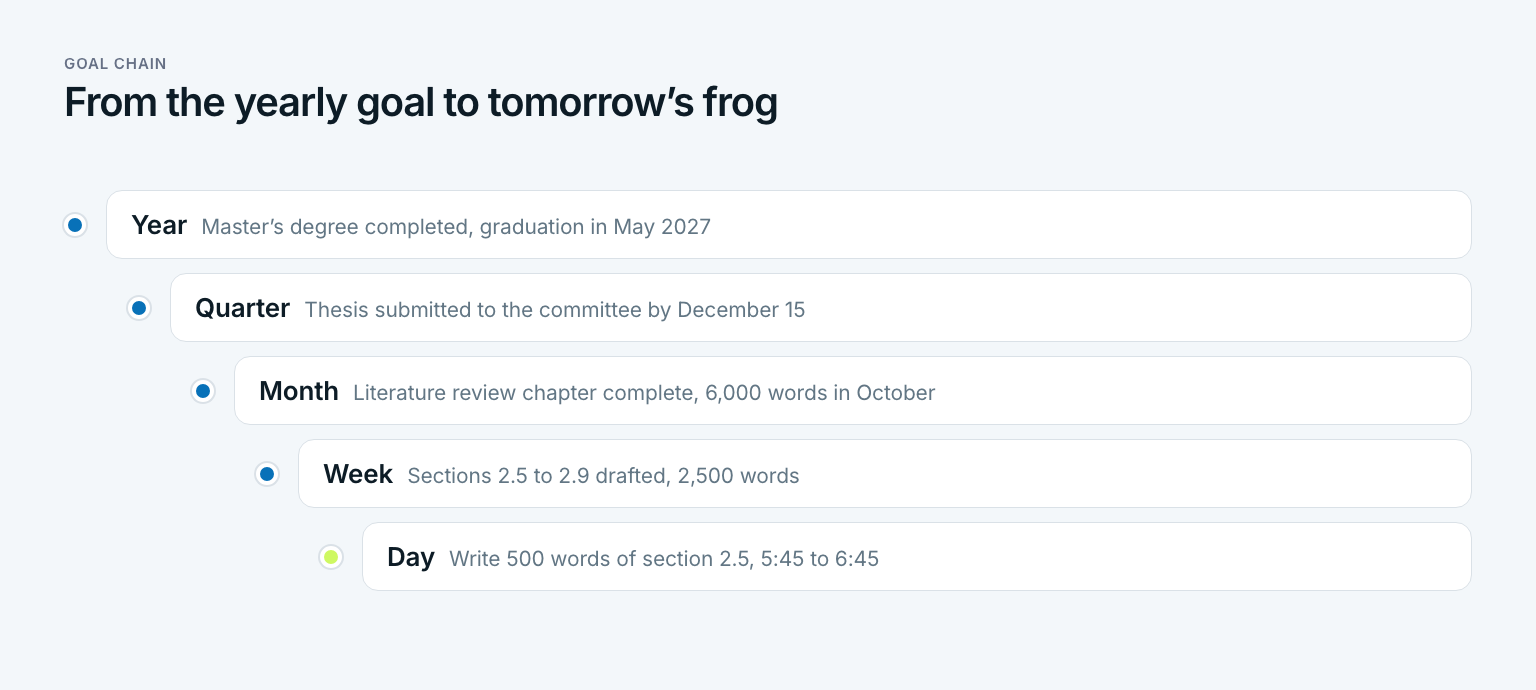
Run the chain downward and the frog names itself. Run it upward and the log becomes a forecast: 2,640 words a week against 10,790 left means the draft is done in the second week of November, four weeks before the deadline. Whoever can see that number on a Tuesday morning does not need motivation to open the document. The number is the motivation.
In Gaapp this chain is the structure itself: five levels from year to day, each goal attached to a larger one, progress on each level shown as the share of goals completed next to the share of time passed. The frog is the daily goal, one per day, and the evening ritual is naming tomorrow’s. How to word a daily goal so that it can be checked off at 6:45 is its own short guide. The ten-minute weekly review on Friday turns five frog logs into next week’s five frogs, and a frog that was not eaten three days in a row gets cut or renamed instead of carried.
Anyone who works in a team can run the same method with one twist: the frog is named in the open. A shared list of five people’s morning frogs does more for focus than any meeting, because it makes the first hour visible. And anyone with more than three goals per month will find that the frog test keeps returning the same three. That is not a flaw. It is the method showing you why three goals are enough for one month.
Three questions before tomorrow’s frog
Three questions about your last working week, before you name anything:
- Can you say, without looking, which single task moved your monthly goal the most last week?
- How many of your first working hours last week went to a task you had chosen the evening before, as a number and not a feeling?
- What did you do in the first ten minutes at your desk yesterday?
Anyone who cannot answer the first has a goal problem, and the frog test will not run until a monthly goal is written down. Anyone who answers the second with zero or one has a method problem, and the five steps fix it in an evening. Anyone who answers the third with email has a pond problem, and the fix is the phone in the kitchen. In short: eat the frog is not a rule about hard tasks. It is a decision about who gets your first hour, made the night before, kept in a log, and tied to a goal you can name.
Frequently asked questions about eat the frog
What does it mean to eat the frog?
To eat the frog means to do your most important task first, before email, meetings or anything easier. The frog is the task that moves a goal and that you would put off if nobody checked. Brian Tracy popularized the image in his 2001 book Eat That Frog. The method is less about hard tasks than about who decides what fills your first working hour.
What did Mark Twain mean by the phrase eat the frog?
Twain is credited with saying that if it is your job to eat a frog, you should do it first thing in the morning, and if you have two frogs, eat the biggest one first. The meaning attached to it is to get the worst task over with early so the rest of the day is lighter. There is no record of Twain actually writing or saying it. The attribution is popular, not documented.
Who originally said eat the frog?
The oldest known version comes from the French writer Nicolas Chamfort in the 18th century, who advised swallowing a toad every morning so that nothing more disgusting could happen for the rest of the day. The toad became a frog in English retellings and was later attached to Mark Twain. Brian Tracy turned it into a method with Eat That Frog in 2001.
Does eat the frog work for ADHD?
Often yes, because it removes the two hardest parts of task initiation: the decision, since the frog was named the night before, and the preview, since the first screen is already the task. There is no clinical trial on it. Two adjustments help: move the frog block to your best hour instead of forcing the morning, and shrink the frog to something you can finish in ten minutes. Keep a visible log so a good week is a fact, not a feeling.
What is the difference between eat the frog and eat that frog?
Nothing in substance. Eat That Frog is the title of Brian Tracy’s book, and eat the frog is how most people name the method it describes. Both mean doing your most important task first. If you search for the book, use the title with that. If you search for how to do it, either phrase will find the same method.
What if my frog takes more than an hour?
Then it is not a frog yet, it is a project. Cut it until one block of your morning can finish it: a word count, a number of calls, one file sent. Dana’s thesis is twelve thousand words, and her frog is 500 of them. The project gets eaten over weeks, one finishable frog at a time, and the log shows the progress.
Last updated: 14 October 2026
Read next
 Productivity
Feynman Technique: Four Steps to Real Understanding
The Feynman technique is not a memorization trick: four steps, a worked example from a stats class, a one-page template, and what research says.
16 min read
 Productivity
Zettelkasten: How to Turn Notes Into Your Own Ideas
A Zettelkasten is not an archive: Luhmann's method, the three note types, a five-step setup and an Obsidian template, with a worked example.
15 min read
 Productivity
Second Brain: How to Build One You Actually Use
A second brain is not a note archive: Tiago Forte's CODE steps, the PARA method with an example, a five-step setup and the mistakes that sink it.
15 min read