ABC Prioritization Method: Rank Tasks by Value
The ABC prioritization method ranks tasks A, B or C by value to your goal. Five steps, a worked Monday with 21 tasks, and how ABCDE compares.

Contents
- 01What the ABC prioritization method is
- 02Where the ABC method of time management comes from
- 03Quantity versus value: the rule of thumb behind A, B and C
- 04How to use the ABC method in five steps
- 05A worked example: Priya's Monday with 21 tasks
- 06ABC vs ABCDE method: what the two extra letters add
- 07ABC prioritization method compared with the Eisenhower Matrix and Pareto
- 08The ABC method in your goal chain: year, quarter, month, week, day
- 09The three mistakes nobody notices
- 10Three questions for tomorrow's list
- 11Frequently asked questions about the ABC method
The ABC prioritization method is not a to-do list with letters in front. It is a way to rank every task by its value to a goal you have written down: A tasks move that goal and are hard to hand to anyone else, B tasks keep things running and can wait a few days, C tasks are routine with little value. Then one rule runs your day: A first, B next, C batched at the end or not at all. A to-do list collects what you could do. The ABC method decides what counts.
Three things make it work: a test for what earns an A, an honest look at how your time is split, and a fixed order you follow even when the inbox is loud. All three are worked through here on one Monday of Priya, a product marketing manager at a 60-person software company in Denver who is launching a new pricing tier next month. Her list had 21 tasks and 10 hours 35 minutes of estimated work. Her calendar left her seven hours. Something had to give, and the question was what.
What the ABC prioritization method is
The ABC method sorts tasks by a single question: how much does this task contribute to the result you are after? Not how urgent it feels. Not how long it takes. Not who asked for it most recently. Every task gets exactly one letter, and the letter decides when it happens. That means: the method is a judgment about value, not a sort by due date.
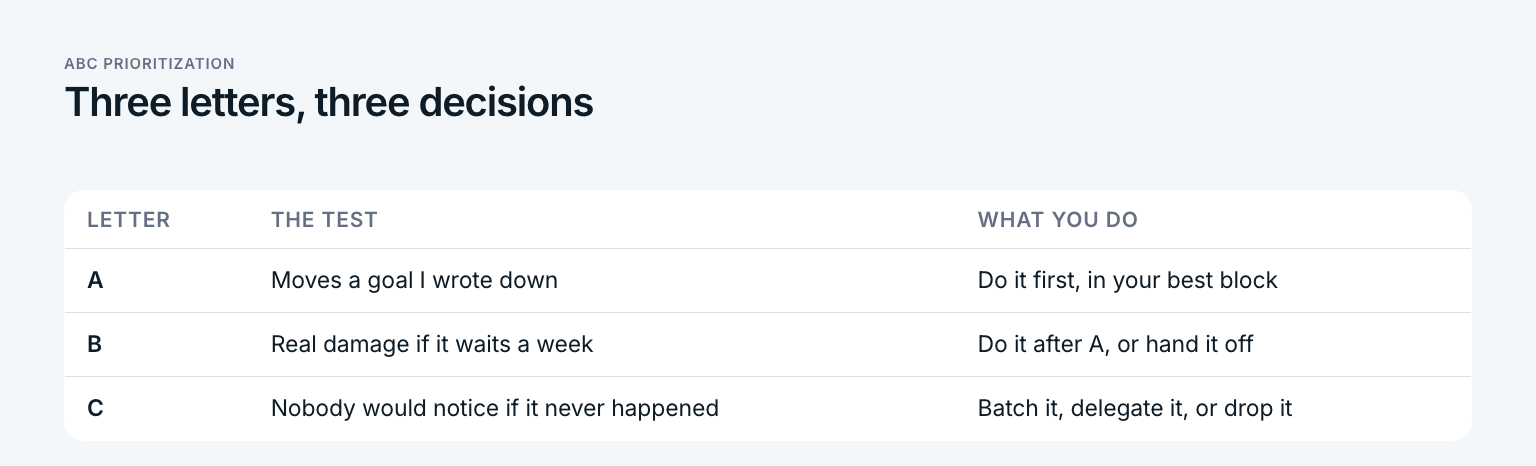
| Letter | What it means | The test | What you do with it |
|---|---|---|---|
| A | High value, moves a weekly or monthly goal directly, hard to hand off | Does finishing this move a goal I have written down? | Do it first, in your best block of the day, yourself |
| B | Medium value, keeps work running or protects a goal, sometimes delegable | Does real damage happen if this waits a week? | Do it after the A tasks, schedule it, or hand it off |
| C | Low value, routine, admin, small stuff | Would anyone notice if this never got done? | Batch it, delegate it, shrink it, or drop it |
The test for A carries the whole method. Anyone who answers it honestly rarely finds more than three A tasks on a normal workday. Many lists contain none at all, and that is useful to know. A day without an A task is a day in which no goal moved, however busy it felt. In short: an A is not a feeling of importance, it is a connection to a goal.
Inside each letter, you number. Three A tasks become A-1, A-2, and A-3, and A-1 is where your day starts. B tasks get a rough order. C tasks get no numbers at all, because their order does not matter. This sub-ranking is not a modern add-on. It comes from the book that put the method on American desks.
Where the ABC method of time management comes from
Alan Lakein made the ABC system famous in 1973 with “How to Get Control of Your Time and Your Life.” His instruction was short: write the list, mark each item A, B, or C, split the A items into A-1, A-2, and A-3, and start with A-1. He also gave readers a question to ask themselves several times a day, now known as Lakein's Question: what is the best use of my time right now? The ABC letters are simply that question answered in advance, once, for the whole list.
Lakein had a second idea that most summaries leave out. He suggested putting C items in a drawer. Not deleting them, not doing them, just putting them away. Most of them, he observed, never had to come out again, because nobody missed them. Whoever has ever cleaned out an old to-do list knows the feeling: half the items solved themselves or stopped mattering. The C drawer simply makes that happen on purpose.
The letters are older than Lakein. Operations managers have used ABC analysis for decades to sort inventory by value, tightly controlling the few expensive items and loosely managing the many cheap ones. That is why a search for ABC prioritization often lands on warehouse articles. The logic is the same as the Pareto principle: a small share of items carries most of the value. Only the object is different. Lakein moved it from shelves to tasks.
ABC analysis, ABC method, ABC prioritization
Three names for one tool. ABC analysis stresses the measuring part, how much value sits in each class. ABC method and ABC prioritization stress the consequence, what you do first. Whoever runs the analysis and then starts the day at the top of the list anyway has a nicely labeled list and the same day as before.
Quantity versus value: the rule of thumb behind A, B and C
A rule of thumb travels with ABC analysis in time management books, especially in Germany, where it has been repeated since the 1980s. It is a practitioner's estimate, not a finding from a study. It says that roughly 15 percent of your tasks carry about 65 percent of the value, 20 percent carry about 20 percent, and the remaining 65 percent of tasks carry only about 15 percent of the value.
Treat those numbers as a direction, not a target. Nobody has measured that exactly 15 percent of your tasks produce 65 percent of your results, and your Monday will look different. What the rule gets right is the imbalance. Your list is full of C tasks, and the few A tasks drown in it, because every line on a list looks the same size.
There is a second half to the imbalance that most explanations skip: time. Whoever spends time in proportion to the number of tasks spends most of the day on C work, simply because there is so much of it. Is that a discipline problem? Usually not. It is a design problem. The ABC method flips the design. A tasks get time first, as much as they need. B tasks get what is left. C tasks get one small, fixed block, and whatever does not fit waits or disappears. That means: you stop planning a list and start planning a budget per letter.
How to use the ABC method in five steps
A daily ABC list takes about ten minutes. Do it the evening before or first thing in the morning, before you open email. Have three things in front of you: this week's goal, your calendar with fixed meetings, and every open task you can think of.
List everything and estimate it, three minutes
Write down every open task, including the small ones and the ones you have been carrying for a week. Next to each, write an estimate in minutes. Without estimates you cannot tell later whether your A tasks even fit into the day.
Calculate your open time, one minute
Working hours minus fixed meetings equals the time you can actually assign. Plan about three quarters of it. The rest is buffer for questions, interruptions, and the things nobody announces in advance.
Assign a letter to every task, three minutes
Use the test from the table. Give out no more than three A's. Whoever ends up with more than three runs each one against the weekly goal again until three remain.
Rank inside each letter, one minute
A-1 is the task that moves the goal most, not the most pleasant one and not the shortest. B tasks get a rough order. C tasks get none.
Assign time by letter, two minutes
A tasks go into the first and best block of the day, B tasks after them. C tasks get one fixed block of 30 to 45 minutes, usually mid-afternoon. Anything that does not fit is moved to another day, handed off, or put in the C drawer.
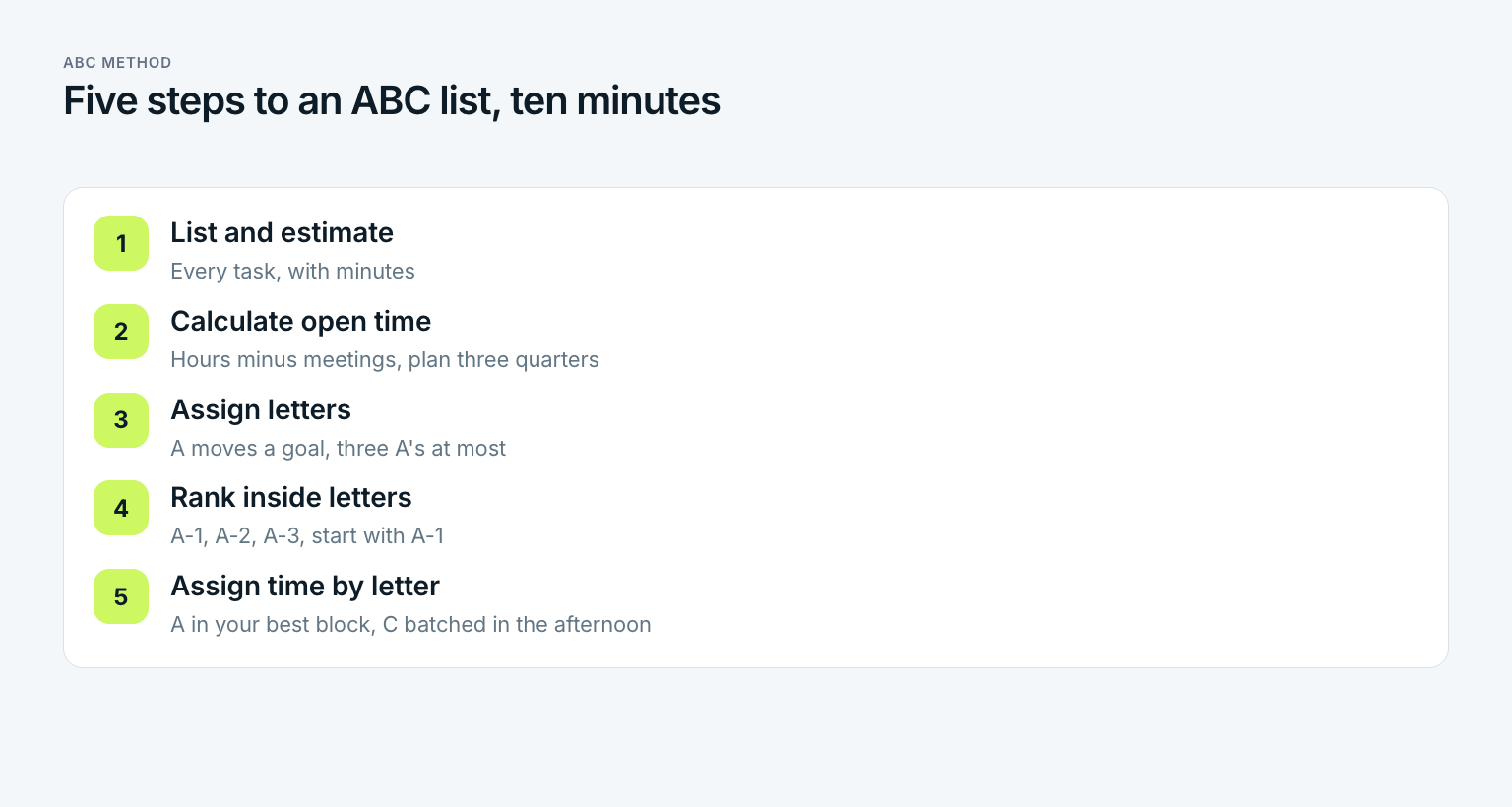
Step five is the one that matters. The first four organize the list. Only the fifth changes the day. Anyone who labels every task and then starts at the top, where the email triage sits, has done an ABC analysis and skipped the ABC method.
A worked example: Priya's Monday with 21 tasks
Priya's company is adding a Team tier to its pricing on November 17. She owns the launch. Her goal for this week has two parts: the messaging document goes to leadership by Wednesday, and two customer interviews for the launch story are done. Her Monday runs from 9:00 to 5:30 with a 30-minute lunch, which makes eight working hours. A standup and a product sync take one hour. That leaves 420 minutes she can assign.
On Sunday evening, her list had 21 items. Here is how she lettered them:
| Letter | Tasks | Count | Estimated time |
|---|---|---|---|
| A | A-1 draft the messaging document for the Team tier, A-2 interview two customers for the launch story, A-3 review the landing page draft with the designer | 3 | 225 minutes |
| B | Slides for Thursday's sales enablement, answer the sales team's positioning questions, update the competitor comparison sheet, approve the agency invoice, prep notes for her one-on-one with her direct report | 5 | 140 minutes |
| C | Email triage, Slack catch-up, expense report, reorganize shared drive folders, read two industry newsletters, RSVP to a webinar, update her LinkedIn profile, book the conference hotel, request a software license renewal, fix formatting in an old deck, answer the team lunch poll, clean up the project board, reply to a vendor pitch | 13 | 270 minutes |
| Total | every task on the list | 21 | 635 minutes, or 10 hours 35 minutes |
The count looks almost exactly like the rule of thumb. Three of 21 tasks are A, which is 14 percent. Thirteen are C, which is 62 percent. The time tells a different story. The 13 C tasks would eat 270 minutes, more than the three A tasks at 225 minutes. Left alone, the small stuff would take the biggest share of her day. And the full list does not fit anyway: it is three and a half hours longer than her open time.
Without letters, Priya's Monday would have started the usual way: email, Slack, the expense report because it is quick, then the sales team's questions. By lunch she would have checked off eight items and written zero words of messaging. The document would have happened Tuesday night, tired and rushed. With letters, her Monday looked like this:
| Time | Block | Letter | Minutes |
|---|---|---|---|
| 9:00 to 9:15 | Standup | fixed | 15 |
| 9:15 to 11:15 | Draft the messaging document | A-1 | 120 |
| 11:15 to 12:15 | Two customer interviews, back to back | A-2 | 60 |
| 12:45 to 1:30 | Landing page review with the designer | A-3 | 45 |
| 1:30 to 2:15 | Product sync | fixed | 45 |
| 2:15 to 3:35 | Sales slides, positioning questions, invoice approval | B | 80 |
| 3:35 to 4:15 | C block: email triage, webinar RSVP, lunch poll | C | 40 |
| 4:15 to 5:30 | Buffer for follow-ups and surprises | open | 75 |
Of her 420 open minutes, Priya assigned 345 and left 75 as buffer. All three A tasks happened before the product sync. The two remaining B tasks, the competitor sheet and her one-on-one notes, went to Tuesday afternoon, since her one-on-one is on Wednesday. That left ten C tasks worth 230 minutes. She decided each one:
- Friday C block, 50 minutes: expense report, conference hotel, license renewal, vendor reply. All four have a deadline, and none of them falls before Friday.
- Delegated, 30 minutes saved: the project board cleanup went to the team coordinator, who maintains the board anyway.
- Dropped, 25 minutes saved: the Slack catch-up. She reads her mentions and the launch channel, nothing else.
- C drawer, 125 minutes: shared drive folders, newsletters, LinkedIn profile, old deck formatting. They went onto a separate list with a review date four weeks out. Whatever nobody has asked for by then gets deleted.
Result: the messaging draft was done by 11:15 on Monday, two days before the deadline, and both interviews were in the can. Three hours of work left her week without anyone losing anything. In short: the ABC method did not give Priya more time. It moved the time she had to the tasks that carry the launch.
ABC vs ABCDE method: what the two extra letters add
The ABCDE method is Brian Tracy's extension of Lakein's system, described in “Eat That Frog!” in 2001. A means must do, with serious consequences if skipped. B means should do, with mild consequences. C means nice to do, with no consequences. D stands for delegate, and E stands for eliminate. Tracy's rule is the same as Lakein's: never do a B while an A is left, and start with A-1. Tracy’s book holds 21 methods in all, and a summary of Eat That Frog lays out the core ideas.
Is ABCDE better than ABC? It is more explicit, not more powerful. The two extra letters name decisions that the ABC method makes inside the C pile anyway. Priya's Monday shows it: the project board was a D, the Slack catch-up an E, and she never needed the letters to make those calls. Whoever finds it hard to hand work off or let it go benefits from seeing D and E written on the page. Whoever already batches and trims their C tasks can stay with three letters. The Eat the Frog guide covers Tracy's side of this: why A-1 is the frog and why it goes first.
ABC prioritization method compared with the Eisenhower Matrix and Pareto
The ABC method is not the only way to prioritize, and it is not the best tool for every situation. Each method answers a different question. Anyone who knows the question they are asking can pick the tool instead of stacking all of them.
| Method | The question it answers | Strength | Limit |
|---|---|---|---|
| ABC method | What is each task worth to my goal? | Fast, one question per task, produces an order | Blind to deadlines, you check them yourself |
| ABCDE method | What happens if I skip it, and who else could do it? | Makes delegating and dropping explicit | Five letters take longer to assign |
| Eisenhower Matrix | Is it important, and is it urgent? | Separates deadline pressure from value | Two questions per task, no order inside a quadrant |
| Pareto principle | Which few things produce most of the result? | Good for weeks, projects, and client lists | No instructions for a single day's list |
The Eisenhower Matrix is the closest relative. It adds urgency as a second axis and sorts tasks into four quadrants. The ABC method gets by with one question, which makes it faster, but it can miss a deadline hiding in a C task. Priya handles that by writing the due date next to every B and C. Whoever works mostly on other people's deadlines, in support or operations, is better served by the matrix. Whoever mainly needs to defend their own goals against small stuff gets there faster with A, B, and C. For a wider view of the options, the time management guide compares the main methods side by side.
The ABC method in your goal chain: year, quarter, month, week, day
The ABC method is only as good as its definition of A. Whoever has no written goal assigns A by feel, and feel mistakes urgent for important almost every time. A goal chain supplies the definition. An A task feeds a weekly goal, which feeds a monthly goal, which feeds a quarter, which feeds the year. Here is Priya's chain:
| Level | Priya's goal | What counts as A at this level |
|---|---|---|
| Year | Ship the new pricing model by December and publish three customer stories | Only work that moves pricing or customer stories |
| Quarter | Team tier live on November 17 with a landing page and one customer story | Launch assets, the story, the page |
| Month | October: messaging approved, landing page built, interviews done | Messaging, page, interviews, nothing else |
| Week | Messaging document to leadership by Wednesday, two interviews done | A-1 and A-2 of Monday |
| Day | Monday: messaging draft finished | A-1 in the first block of the day |
Read from the bottom, the chain explains why the landing page review is an A even though it is not in the weekly goal. It feeds the monthly goal directly, and a page that slips in October pushes the launch date in November. That gives you a rule: an A task can skip a level, as long as it hangs somewhere on the chain. A task that hangs on no level is not an A, however urgent the email sounds.
The chain also makes the method faster. Whoever sets the weekly goal on Sunday has already answered the A test on Monday, before the list even exists. The step-by-step version of building that chain is in turn yearly goals into daily steps. For the ABC method, one sentence is enough: no A without a goal above it.
The three mistakes nobody notices
The ABC method is simple, so it rarely fails on technique. It fails on habits that feel productive. The most common one first:
The most common mistake: everything becomes an A
Whoever treats every task as important hands out ten A's and ends up with a second list instead of a priority. The cause is rarely laziness. It is usually discomfort, because labeling a request C feels like judging the person who sent it. The fix is a hard cap of three A tasks per day and a test based on the goal, not on the feeling.
- C tasks first, because they are quick. Five checkmarks before 9:30 feel great. They also use up the hours when your head is clearest. That means: the C block belongs in the afternoon slump, never in the morning.
- B becomes a parking lot. B tasks have real value, they keep work running. Whoever pushes them back week after week turns a B into an urgent A, usually at the worst possible moment. Give B tasks a fixed slot in the week, not just whatever is left of the day.
- The letters stay while the situation changes. A task is not a C forever. When a deadline gets close or a goal shifts, a C becomes a B or an A. Re-letter the list every day instead of copying last week's letters.
All three mistakes share a root. The letters get assigned, but time does not follow them. Without a budget per letter, the ABC method is just a labeling exercise.
Three questions for tomorrow's list
Before you start the first task tomorrow, check your list against three questions:
- Does every A hang on a goal I have written down, or only on a feeling that it matters?
- Is A-1 in the first block of the day, before email?
- Which C task would nobody miss if it sat in the drawer for four weeks?
Anyone who answers all three honestly needs no other technique for that day. The ABC prioritization method is not a way to organize your list. It is a decision about what your best hours are for.
Frequently asked questions about the ABC method
What is the ABC method of prioritizing?
It is a way to rank tasks by value: A tasks move a written goal, B tasks keep work running, C tasks are routine with little value. You work in the order A, B, C, starting with A-1 in your best block of the day. C tasks are batched into one short block, handed off, or dropped.
What are the four methods of prioritization?
There is no official list of four. The ones named most often are the ABC method, the Eisenhower Matrix, the Pareto principle, and MoSCoW, which sorts project requirements into must have, should have, could have, and won't have. The first three work well for personal task lists, MoSCoW is built for projects and product scope.
What is the ABC method?
In time management, the ABC method is Alan Lakein's system from 1973 for marking tasks A, B, or C by value and doing them in that order. The same name also refers to ABC analysis in inventory management and to the ABC model in cognitive behavioral therapy. Those are unrelated tools that share three letters.
What are the ABCs of prioritization in nursing?
In nursing, ABC stands for airway, breathing, and circulation, a framework taught to nursing students for deciding which patient need to address first. It is a clinical rule, not a task management method. The only thing it shares with the ABC method is the idea that the most critical item comes first.
What is the ABCDE method?
The ABCDE method is Brian Tracy's version of ABC prioritization from “Eat That Frog!”. A, B, and C rank tasks by the consequences of skipping them, D marks tasks to delegate, and E marks tasks to eliminate. It makes the handoff and drop decisions explicit.
How many A tasks should I have per day?
Three at most, and often one or two are enough. More rarely fit into a day with meetings, and a list with seven A's is just an unsorted list again. The common rule of thumb puts A tasks at around 15 percent of a list, which on Priya's 21 tasks meant three.
Last updated: 14 October 2026
Read next
 Productivity
Feynman Technique: Four Steps to Real Understanding
The Feynman technique is not a memorization trick: four steps, a worked example from a stats class, a one-page template, and what research says.
16 min read
 Productivity
Zettelkasten: How to Turn Notes Into Your Own Ideas
A Zettelkasten is not an archive: Luhmann's method, the three note types, a five-step setup and an Obsidian template, with a worked example.
15 min read
 Productivity
Second Brain: How to Build One You Actually Use
A second brain is not a note archive: Tiago Forte's CODE steps, the PARA method with an example, a five-step setup and the mistakes that sink it.
15 min read