Eisenhower Matrix: How to Sort Urgent From Important
The Eisenhower Matrix sorts tasks by urgent and important into four quadrants. Four decisions, six steps, a worked week with 23 tasks, and a free template.

Contents
- 01What the Eisenhower Matrix is in simple terms
- 02Urgent vs important: the distinction that decides everything
- 03What really happens to your week: urgency is not progress
- 04How to use the Eisenhower method in six steps
- 05Quadrant 2: the only quadrant that moves your goals
- 06The Eisenhower Matrix in your goal chain: year, quarter, month, week, day
- 07Eisenhower Box, the 1-3-5 rule, and ADHD: where the matrix helps and where it fails
- 08The three mistakes nobody notices
- 09A free Eisenhower Matrix template, on paper or in a spreadsheet
- 10Frequently asked questions about the Eisenhower Matrix
The Eisenhower Matrix is not a to-do list. It is a sorting tool that splits every task along two questions, is it urgent and is it important, and lands it in one of four quadrants: do it now, schedule it, delegate it, or delete it. A to-do list tells you what is on your plate. The Eisenhower Matrix tells you what deserves to be there.
Three things make it work: a definition of important that is not a feeling, a weekly moment to sort, and the willingness to leave a quadrant empty. All three are shown here on one week of Dana, who runs operations for a 45-person online furniture retailer in Columbus, Ohio, and is leading a warehouse software rollout on top of her regular job. Her Monday list had 23 items and 24.5 hours of estimated work. By Tuesday noon, ten items were left on her own plate. The rest had a new owner or no future at all.
What the Eisenhower Matrix is in simple terms
The Eisenhower Matrix is a two by two grid. The horizontal axis asks whether a task is urgent. The vertical axis asks whether it is important. Every task gets a yes or a no on both, and the two answers decide its quadrant. That is the whole method. Everything else is practice.
Urgent means the task has a deadline that is close and real, and someone else pays if you miss it. Important means the task moves a goal you have written down, or prevents damage to one. The two are independent. A task can be both, one of them, or neither. The matrix exists because most people treat urgent as a synonym for important, and the two words describe different things.
| Quadrant | Urgent? | Important? | Decision | Dana's example |
|---|---|---|---|---|
| Quadrant 1: Do | Yes | Yes | Do it today, yourself | Wholesale shipment stuck at the carrier, customer on the phone |
| Quadrant 2: Schedule | No | Yes | Put it in the calendar with a date and a length | Migration plan for the new warehouse system |
| Quadrant 3: Delegate | Yes | No | Hand it off, or shrink it to a batch of minutes | Marketing wants warehouse photos by Friday |
| Quadrant 4: Delete | No | No | Drop it, without a replacement | Reorganizing the shared drive folders |
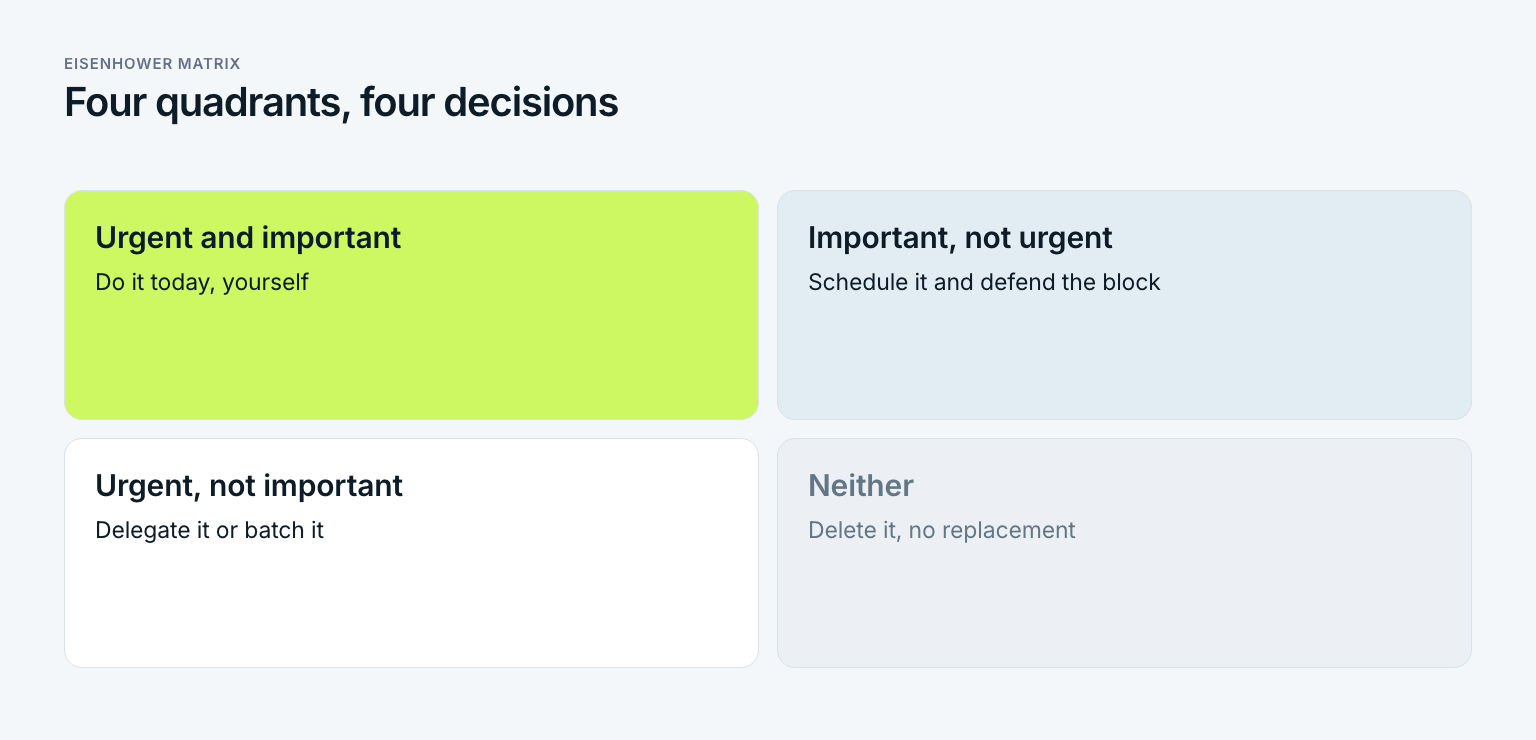
Read the table from the bottom up and you see what the matrix is for. Quadrant 4 is noise. Quadrant 3 is other people's priorities with your name on them. Quadrant 1 is the fire you cannot ignore. Quadrant 2 is the only place where your own goals live, and it is the only quadrant that never shouts. In short: the matrix is a device for protecting Quadrant 2 from the other three.
Who built it: Eisenhower, Covey, and the Eisenhower Box
Dwight D. Eisenhower never drew the grid. In 1954, as President, he spoke in Evanston, Illinois, and quoted a former college president: “The urgent are not important, and the important are never urgent.” The line stuck because it names a trap everyone recognizes. Eisenhower was describing his own problem in office, not teaching a method.
The grid came 35 years later. Stephen R. Covey published The 7 Habits of Highly Effective People in 1989 and built Habit 3, Put First Things First, around a time management matrix with the same two axes. Covey numbered the quadrants, argued that effective people live in Quadrant 2, and made the model teachable. Most of what you read about the Eisenhower Matrix today is Covey's matrix with Eisenhower's name on it.
The third name is newer. Eisenhower Box is the term the writer James Clear used in a 2014 essay on his blog, and it spread through the productivity scene from there. Eisenhower Matrix, Eisenhower Box, Eisenhower method, urgent important matrix: four names, one tool. If a template calls it a priority matrix or a decision matrix, it is still the same four cells.
Urgent vs important: the distinction that decides everything
Most people can define the two words. Far fewer can apply them under pressure, because urgency has a feeling attached and importance does not. A ringing phone feels important. A calendar block labeled migration plan feels optional. Both feelings are wrong, and the matrix is only as good as your test for each axis.
The two tests for important
Test one: Does this task move a goal I have written down for this month or this quarter? Not a goal you could imagine having. A goal that exists on paper or in an app, with a date. If you have no written goals, the matrix cannot work, because important becomes a mood. Whoever has written goals can answer this in two seconds per task.
Test two: If nobody did this for 30 days, would a written goal get damaged? This catches the maintenance work that moves nothing forward but prevents collapse: the one on one with a team member who is wobbling, the backup that nobody checks, the carrier contract that expires quietly. Pass either test and the task is important. Fail both and it is not, no matter who asked.
The one test for urgent
Is there a real deadline inside the next 48 hours, set by someone or something that produces a consequence if you miss it? A customer, a payroll cutoff, a legal date, a truck leaving. Not a deadline you invented to motivate yourself. Not a Slack message with the word ASAP in it. ASAP is a request for attention, not a deadline. Anyone who treats every ASAP as urgent hands their calendar to whoever types fastest.
Urgent, important, and the trap between them
Urgency is about time: how soon the consequence arrives. Importance is about goals: whether the task moves one. The trap is that urgency is loud and importance is quiet, so an unsorted day gets spent in the order of loudness. The matrix replaces loudness with two questions, asked once per task. The ABC prioritization method for tasks asks only one, the value of each task to your goal, and ranks the whole list by it.
What really happens to your week: urgency is not progress
A full week feels like a productive week. That is the error the matrix is built to catch, and Dana's week shows it with numbers. On Monday morning, October 5, she listed everything she was expected to do that week: 23 items. Her estimate for all of them: 24.5 hours. Her available time outside standing meetings: 22 hours. The list was 2.5 hours over before the first email arrived. Sound familiar?
Her goals, for context. Yearly goal 2026: the new warehouse management system live in both warehouses, returns processing cut from nine days to three. Goal for the fourth quarter: pilot complete in one warehouse zone by November 30. Monthly goal for October: vendor contract signed and the data migration plan approved by the CFO. Two tests for important, one for urgent, 23 items. Here is what came out.
| Quadrant | Items | Hours | What was in it |
|---|---|---|---|
| Quadrant 1: Do | 4 | 5 | Wholesale shipment stuck at the carrier. Payroll correction for two team members due at 5 p.m. Board slide with third-quarter numbers due Tuesday. Label printer in zone B down, shipping halted. |
| Quadrant 2: Schedule | 6 | 11 | Vendor contract review, 3 hours. Migration plan draft, 4 hours. Two one on ones, 1 hour. Seasonal hiring plan, 2 hours. Pilot success metrics with IT, 1 hour. |
| Quadrant 3: Delegate | 9 | 6.5 | Fourteen status pings in Slack. Holiday party venue question. Supplier call about a new catalog. Expense approvals under 50 dollars. Warehouse photos for marketing by Friday. Three meeting invites without an agenda. A desk assignment form from HR. |
| Quadrant 4: Delete | 4 | 2 | Industry newsletters. Reorganizing shared drive folders. A webinar on AI in logistics. Comparing tools for a decision already made. |
| Total | 23 | 24.5 |
Look at the two middle rows. Quadrant 2 holds six items and 11 hours, almost half of her estimated work, and every one of those hours sits on her goal chain. Quadrant 3 holds nine items, the most of any quadrant, and not one of them moves a written goal. Without sorting, Quadrant 3 would have been done first, because every item in it had a person attached who would follow up. Quadrant 2 would have gotten what was left: Thursday at 4 p.m., tired.
That means: the matrix did not give Dana more hours. It changed which hours went where. She delegated four Quadrant 3 items to her team lead and her coordinator, batched the Slack pings and approvals into two 30-minute slots, declined the three agenda-free meetings, and deleted Quadrant 4 without a replacement. Quadrant 3 shrank from 6.5 hours to 2. Her scheduled week: 5 hours of Quadrant 1, 11 of Quadrant 2, 2 of Quadrant 3. Eighteen of 22 hours, with four hours of buffer for the fire that had not started yet. What would your Quadrant 3 row look like?
How to use the Eisenhower method in six steps
The sorting takes 20 minutes the first time and under ten once the questions are habit. Do it on Monday morning or, better, on Friday afternoon for the coming week. You need your written goals for the month, your calendar, and the full list. Nothing else.
Dump everything, five minutes
Write down every task, request, and open loop for the week in one list. Email, Slack, meeting notes, the thing your manager mentioned in the hallway. Do not sort while writing. A list that is missing items produces a matrix that is missing fires.
Attach each item to a goal, or to none, five minutes
Next to every item, write the goal it serves: the monthly goal, the quarterly goal, or none. This is the importance test made visible. Items marked none are not important by definition, unless the 30-day damage test rescues them.
Apply the urgency test, three minutes
For each item, ask: real consequence inside 48 hours, set by someone other than me? Mark yes or no. Strike the word ASAP from your vocabulary while you do this.
Place every item in a quadrant, two minutes
Two marks, one quadrant. Do not argue with the result yet. If an item feels wrong in its quadrant, that feeling is information about your tests, not about the item.
Decide per quadrant, not per item, three minutes
Quadrant 1 gets a slot today or tomorrow. Quadrant 2 gets a calendar block with a date and a length. Quadrant 3 gets a name that is not yours, or a 30-minute batch. Quadrant 4 gets deleted, and nothing replaces it.
Schedule Quadrant 2 first, then Quadrant 1
Put the Quadrant 2 blocks in the calendar before anything else, because they are the only ones that will not fight for their place. Then fit Quadrant 1 around them. Whoever schedules fires first finds no room left for the work that prevents the next fire.
Repeat weekly. The Friday version takes ten minutes, because most items from last week are already placed and only the new arrivals need the two tests. If you already run a ten-minute weekly review, the sort fits inside it as the second step, right after you check which weekly goals got done.
Quadrant 2: the only quadrant that moves your goals
Covey's central claim in 1989 was that effective people spend most of their time in Quadrant 2, and he was describing a choice, not a talent. Quadrant 2 is planning, building, learning, relationships, prevention. It is the migration plan, the hiring plan, the one on one before the resignation. Nothing in Quadrant 2 is due this week. Everything in Quadrant 2 is due eventually, and by then it has moved to Quadrant 1 with a worse deadline.
That is the mechanism to understand. Quadrant 1 is largely yesterday's Quadrant 2, unscheduled. The stuck shipment started as a carrier contract nobody reviewed. The label printer went down because the maintenance ticket sat in Quadrant 3 for a month. Dana's board slide was urgent on Monday because the numbers had been available since September and the slide was on nobody's calendar. Whoever lives in Quadrant 1 is not unlucky. They are collecting on Quadrant 2 debt.
Quadrant 2 debt
Every Quadrant 2 task you leave unscheduled is a loan. The interest is paid in Quadrant 1, when the same task returns with a deadline, a stakeholder, and no room to do it well. Scheduling Quadrant 2 is not optional planning. It is paying down the debt before it comes due.
The practical consequence: Quadrant 2 is the only quadrant you have to defend with the calendar. Quadrant 1 defends itself. Quadrant 3 has a person attached who defends it for you. Quadrant 4 defends itself with comfort. Only Quadrant 2 has no advocate except you. Dana's 11 hours went into four blocks, Tuesday through Thursday, 9 to 11 a.m., when her inbox is quietest. Did she protect all four? Three. The fourth collided with a Quadrant 1 fire, and she moved it to Friday morning rather than cancel it. Moved is not cancelled. That distinction is the whole discipline.
The Eisenhower Matrix in your goal chain: year, quarter, month, week, day
The importance test has a hidden requirement: written goals with dates. Most explanations of the matrix skip this, and that is why the matrix fails for so many people within two weeks. Important becomes whatever feels heavy. A goal chain fixes the test, because it tells you exactly what important means at every level: a task is important if it hangs on the chain.
Dana's chain, from the top. Year: the warehouse system live in both locations, returns from nine days to three. Quarter: pilot complete in zone B by November 30. Month: contract signed, migration plan approved. Week of October 5: contract redlines returned to the vendor, migration plan draft v1 sent to IT. Tuesday: two hours on the inventory count section of the migration plan. Five levels, one line. Every Quadrant 2 item on her Monday list sits on this line. Nothing in Quadrant 3 or 4 does.
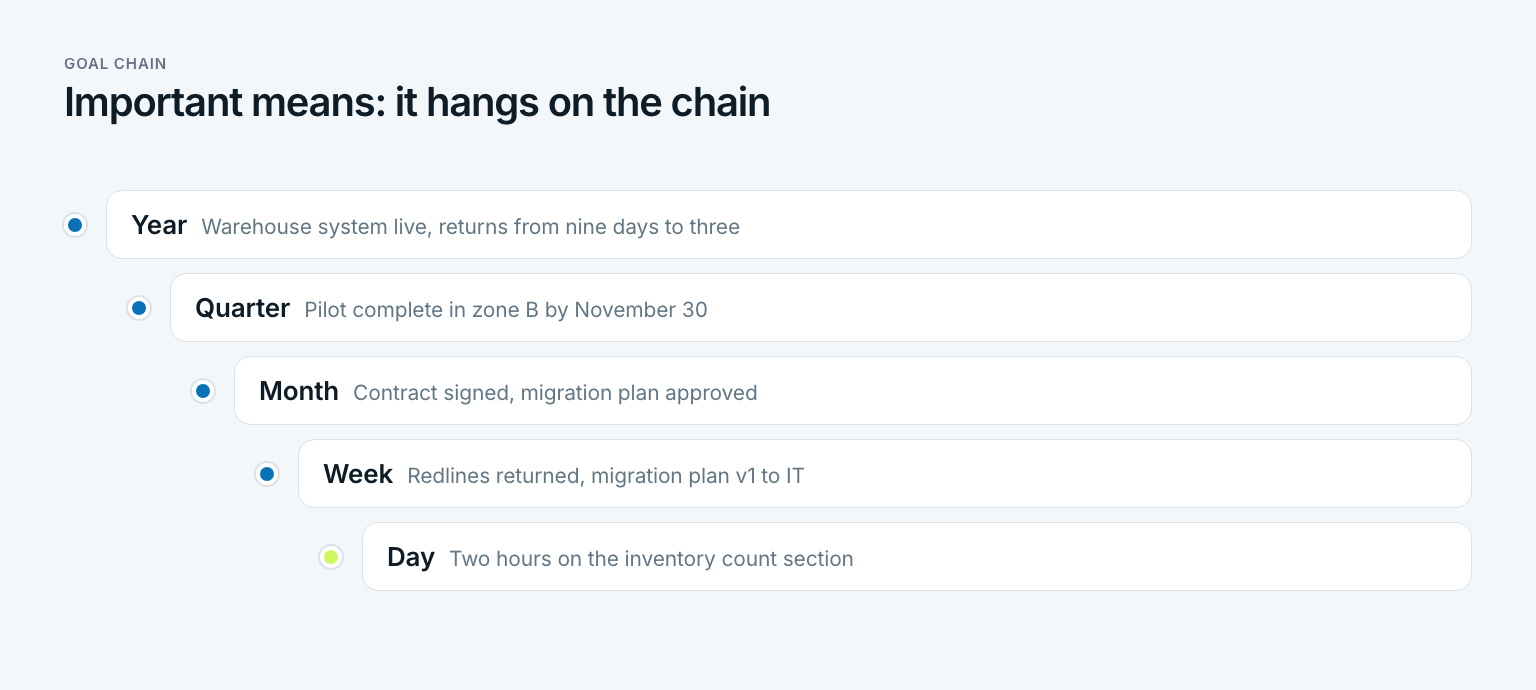
Run the matrix at each level and it asks a different question. Yearly: which of my three yearly goals deserves a quarter of my Quadrant 2 time? Monthly: which tasks hang on this month's goal, and which only look like they do? Daily: of today's three to five tasks, which one is Quadrant 2 and gets the first protected hour? How to phrase that one task so it gets done is covered under daily goals. The quadrants stay the same. The horizon of the word urgent shrinks from months to hours.
The chain also sets a limit the matrix cannot set on its own. If you keep more than three goals alive at each level, every task passes the importance test and Quadrant 2 overflows. Three goals per level is the ceiling, and the article on why three goals are enough shows what happens past it.
In Gaapp this chain is the structure itself: five levels from year to day, each goal attached to a larger one, progress per level as the share of goals completed. The matrix sits on top as a filter. Anything that cannot be attached to a goal in the chain is Quadrant 3 or 4 by definition, and you see that gap before the task reaches your calendar. In short: the matrix sorts, the chain defines. Without the chain, the matrix sorts by feeling. Without the matrix, the chain fills up with urgent tasks that belong to someone else.
Eisenhower Box, the 1-3-5 rule, and ADHD: where the matrix helps and where it fails
Eisenhower Box or Eisenhower Matrix: same grid, different horizon
The Eisenhower Box is the same grid. The name comes from Clear's 2014 essay, and the usage he described is slightly different: a daily box rather than a weekly matrix, with the four cells filled fresh each morning. That works when your week is unpredictable. It fails for Quadrant 2, because a daily box never has room for a four-hour migration plan. Use the box daily for Quadrants 1 and 3, and the weekly matrix for Quadrant 2. The names do not matter. The horizon does.
The 1-3-5 rule sizes the day, the matrix sorts it
The 1-3-5 rule says a day holds one big task, three medium tasks, and five small ones. It is a capacity rule, not a priority rule, and it pairs well with the matrix. The one big task comes from Quadrant 2, scheduled first. The three medium tasks come from Quadrant 1 and whatever Quadrant 2 work is due this week. The five small tasks are the Quadrant 3 batch: approvals, replies, the two-minute favors. Dana's Tuesday: migration plan as the one, board slide and two one on ones as the three, and five Slack replies in a 30-minute slot as the five. Anyone who fills the one slot from Quadrant 1 has already lost the day to the fire.
Is the Eisenhower Matrix good for ADHD?
It can be, with three adjustments, and it is worth being honest about why. The matrix asks for 23 small decisions in a row, each one overriding a feeling of urgency with a question. For many people with ADHD, that override is the hard part, not the grid. The grid itself helps: it moves the decision onto a page, so you are not holding four categories in working memory while an inbox refills.
Three adjustments make the tool bend without breaking. First, a hard cap: no more than three items in any quadrant per day, with the rest parked in a holding list outside the matrix. Second, manufactured urgency for Quadrant 2: a scheduled block with another person, so the block carries a consequence if missed. Third, a time box for the sort itself: ten minutes, timer running, and whatever is unsorted at the bell goes to Quadrant 3 by default. None of this is medical advice. It is how the tool adapts when deciding is the expensive part.
The three mistakes nobody notices
The matrix rarely fails loudly. It fails on a Tuesday when the grid looks fine and the week still goes to other people. Three mistakes do most of the damage, and the first one is so common that it deserves its own box.
The most common mistake: everything lands in Quadrant 1
If more than a third of your items come out urgent and important, your tests are broken, not your week. Usually the importance test is missing, so every task with a deadline becomes important by default. Fix: write the goal next to every item first. An item with no goal cannot enter Quadrant 1, however loud its deadline.
- Quadrant 3 with your name still on it. Delegating is the decision the matrix asks for in Quadrant 3, and it is the one most people skip, because handing off feels slower than doing. Dana handed four items to two people on Monday. It cost her 20 minutes of explaining and saved 4.5 hours. Whoever cannot delegate can still shrink: a 30-minute batch instead of nine interruptions is a decision too.
- Quadrant 4 with a replacement. Deleting a task and immediately adding a new one is not deleting. The newsletter you stop reading becomes a podcast. Quadrant 4 exists to return hours to Quadrant 2, not to rotate distractions. Delete, and leave the hole open.
- Sorting once. The matrix is a weekly instrument, not a one-time cleanup. Items move. Tuesday's Quadrant 2 is Friday's Quadrant 1 if the block got cancelled. A sort that is not repeated is a snapshot of a week that no longer exists.
A free Eisenhower Matrix template, on paper or in a spreadsheet
If you want a printable sheet, use the free Eisenhower Matrix template, a two-page PDF with a blank and a filled-in page. You do not need to download anything, though. The template is a list with seven columns, and it works in a notebook, a spreadsheet, or a notes app. A spreadsheet adds one convenience: sort by the Quadrant column and the four groups appear as blocks without drawing a grid.
| Column | What you write | Dana's row |
|---|---|---|
| Task | One line, verb first | Draft migration plan v1 |
| Goal | The month or quarter goal it serves, or none | October: migration plan approved by the CFO |
| Urgent? | Yes only with a real consequence inside 48 hours | No |
| Important? | Yes if it passed one of the two goal tests | Yes |
| Quadrant | 1 Do, 2 Schedule, 3 Delegate, 4 Delete | 2 |
| Decision | Slot, calendar block, a name, or deleted | Tuesday and Wednesday, 9 to 11 a.m. |
| Done? | Checked on Friday | Yes, sent Wednesday 3 p.m. |
If you prefer the visual grid, draw a two by two on a page, label the axes, and write the task titles into the cells. The grid shows you the shape of your week. The list is where decisions get made and checked. Whoever wants the same structure for the goals themselves, from yearly goal down to the daily task, finds ready-made goal packs under templates.
Three questions before you sort your week
Before you draw your first grid, three questions about last week. They tell you which quadrant is eating your time, and the answer is usually not the one you expect.
- How many of the tasks you finished last week can you attach to a goal you had written down before the week started?
- How many hours went to requests that arrived with the word urgent attached, and how many of those had a consequence you can name?
- When did you last delete a task without replacing it?
Anyone who struggles with the first question has an importance problem: the goals are not written, so the test cannot run. Anyone who struggles with the second has an urgency problem: other people's deadlines run the calendar. Anyone who cannot remember the third is living in Quadrant 4 part time and calling it rest. The fix for all three starts with written goals, which is why the pillar on how to achieve goals comes before any sorting tool. In short: the Eisenhower Matrix is not a way to get more done. It is a way to decide what deserves to be done at all, and to say so with a date.
Frequently asked questions about the Eisenhower Matrix
What is the Eisenhower Matrix in simple terms?
It is a two by two grid that sorts tasks by two questions: Is it urgent? Is it important? Urgent and important tasks you do now. Important but not urgent tasks you schedule. Urgent but not important tasks you delegate. Tasks that are neither you delete. The point is to protect the second group, because it is where your goals live and it never demands attention on its own.
Is the Eisenhower Matrix good for ADHD?
It can help, because it moves the decision out of your head and onto a page and gives a fixed script for every task. The hard part with ADHD is usually the override: urgency feels like importance. Three adjustments help: cap each quadrant at three items a day, schedule Quadrant 2 blocks with another person so they carry a consequence, and time box the sort to ten minutes. Whatever is unsorted at the bell goes to Quadrant 3 by default.
What is the 1-3-5 rule for prioritizing tasks?
The 1-3-5 rule limits a day to one big task, three medium tasks, and five small ones, nine in total. It sizes the day but does not say which tasks earn a slot. Combine it with the matrix: the one comes from Quadrant 2, the three from Quadrant 1 and due Quadrant 2 work, the five from a batched Quadrant 3. Filling the one with a Quadrant 1 fire is the usual way the rule goes wrong.
Is there a free Eisenhower Matrix template for Excel?
You can build one in two minutes, and it works better than most downloads. Make a list with the columns Task, Goal, Urgent, Important, Quadrant, Decision, Done. Fill Urgent and Important with yes or no, write the quadrant number, and sort by that column. The four groups appear as blocks. A drawn grid is nice for the overview, but the list is where decisions get tracked and checked on Friday.
What is the difference between urgent and important?
Urgent is about time: a real deadline inside the next 48 hours with a consequence set by someone else. Important is about goals: the task moves a written goal for this month or quarter, or prevents damage to one within 30 days. The two are independent. A task can be urgent and unimportant, which describes most interruptions, or important and not urgent, which describes most planning.
How often should you use the Eisenhower Matrix?
Once a week for the full sort, ideally Friday afternoon for the coming week, plus a two-minute check each morning for new arrivals. The weekly sort takes 20 minutes the first time and about ten once the two tests are habit. Sorting only once turns the matrix into a snapshot. Items move between quadrants as deadlines approach, so the grid has to move with them.
Last updated: 19 October 2026
Read next
 Productivity
Feynman Technique: Four Steps to Real Understanding
The Feynman technique is not a memorization trick: four steps, a worked example from a stats class, a one-page template, and what research says.
16 min read
 Productivity
Zettelkasten: How to Turn Notes Into Your Own Ideas
A Zettelkasten is not an archive: Luhmann's method, the three note types, a five-step setup and an Obsidian template, with a worked example.
15 min read
 Productivity
Second Brain: How to Build One You Actually Use
A second brain is not a note archive: Tiago Forte's CODE steps, the PARA method with an example, a five-step setup and the mistakes that sink it.
15 min read