Family Meeting: Agenda, Guidelines and Ideas
A family meeting is not a lecture: a weekly agenda in five parts, guidelines by age, 20 family meeting ideas and a worked example.
Contents
- 01What a Family Meeting Is, and What It Isn't
- 02Where Family Meetings Come From
- 03What Actually Happens in a Family Week
- 04Weekly Family Meeting Agenda: Five Parts in 25 Minutes
- 05Family Meeting Guidelines Everyone Agrees On
- 06Family Meeting Ideas: 20 Topics and Fun Endings
- 07Three Mistakes Nobody Notices
- 08Your Family Meeting in the Goal Chain
- 09Three Questions Before Your First Family Meeting
- 10Family Meeting FAQ
A family meeting is not a lecture with snacks. It's a short, regular get-together, usually once a week, where everyone who lives in your home sits down to sort out the schedule, talk through problems and make decisions together. Every voice counts, kids included, and every decision holds until the next family meeting.
That might sound like bringing office culture to the kitchen table. It works the other way around. Anyone who sets aside 25 minutes a week for the hard conversations stops having them in the hallway at 9 p.m. What it takes: a simple agenda in five parts, a handful of guidelines that grow with your kids, and a running list of topics on the fridge. The example comes from Rachel and Dev in Columbus, Ohio, and their kids Maya and Theo.
What a Family Meeting Is, and What It Isn't
A family meeting has three features. Everyone in the household is at the table. It happens at a set time, not only when things blow up. And it ends with decisions someone writes down. Drop any one of these and you have a family conversation instead. That's not a bad thing. It's just built for something else.
Most families already use a few tools that get mistaken for a family meeting. Each one has its place. None of them does the whole job.
| Format | What it's built for | What it lacks |
|---|---|---|
| Dinner table check-in | Hearing about everyone's day and staying connected | A decision. Topics come up, but nobody owns the follow-up |
| Parent huddle | Two adults agreeing on rules before they announce them | The kids' voice. Rules arrive finished, and kids treat them that way |
| Shared family calendar | Keeping track of practices, appointments and rides | A place to talk about why the week feels hard |
| Family meeting | A fixed weekly slot where everyone raises topics, proposes solutions and agrees on next steps | Nothing essential, as long as it actually happens every week |
The difference isn't formality. A family meeting can happen on the couch in pajamas. What matters is that it has a rhythm and an outcome. In short: a family meeting turns a dozen small negotiations into one conversation with a result.
Where Family Meetings Come From
The idea is older than most parenting blogs. Viennese psychiatrist Alfred Adler argued in the early 20th century that children need a sense of belonging and significance, and that they find both by contributing. His student Rudolf Dreikurs moved to the United States in 1937 and turned that idea into a household practice. In 1974 he described it with Shirley Gould and Raymond Corsini in the book Family Council.
Jane Nelsen built on Dreikurs in Positive Discipline, first published in 1981, and made family meetings one of its core tools. Her version opens with compliments, aims for consensus instead of a vote and keeps meetings short. Bruce Feiler took a different route. In The Secrets of Happy Families, published in 2013, he describes borrowing a weekly check-in from agile software teams, built on three questions: What worked well in our family this week? What went wrong? What will we work on next week?
Across all three, the core stays the same. Kids are more likely to follow rules they helped make. The United Nations Convention on the Rights of the Child put a version of this into Article 12 in 1989: children have the right to express their views on matters that affect them, and those views get weight according to age and maturity. A family meeting turns that principle into a slot on Sunday evening.
Equal voice doesn't mean voting on everything
Adler and Dreikurs talked about equality in worth, not equality in responsibility. Every person's wishes get heard. That doesn't mean your nine-year-old votes on the mortgage or the vaccine schedule. Whoever says up front which topics parents decide alone protects the meeting from feeling fake. Everything else goes on the table.
What Actually Happens in a Family Week
Families rarely fight about big things. They fight about small things that come back every week. And they usually settle them on the fly, in favor of whoever is loudest or most stubborn.
That's how it went for Rachel, 38, an ER nurse working three 12-hour shifts a week, and Dev, 40, a high school chemistry teacher. They live in a three-bedroom house in Columbus with Maya, 13, and Theo, nine. In October, Rachel kept a tally on a sticky note on the fridge for one week: every argument, and how it ended. Not as evidence. Just to see.
| What came up in week 41 | How often | How it ended |
|---|---|---|
| Screen time after dinner | six times | Gave in four times, took the tablet away twice |
| Who empties the dishwasher | four times | Dev did it himself because it was faster |
| Maya wanting to walk to a friend's house alone | twice | Put off, no decision |
| Weekend plans | three times | Decided Saturday morning, Theo was upset |
| Rides to Theo's soccer practice | three times | Sorted out by text, late once |
None of it was dramatic. But together it drained every evening, and nearly all of it came back the next week. The real finding was in the third column. Almost nothing was decided. Things were given up, put off or pushed through. Maya summed it up at dinner: “You guys decide everything anyway.”
How often did you give in this week just to get some quiet? That's the gap a family meeting fills. It moves those 18 small negotiations into one slot a week. That doesn't mean nobody talks on Wednesday. It means: whoever has a problem writes it on the list instead of arguing it out at bedtime.
Weekly Family Meeting Agenda: Five Parts in 25 Minutes
A weekly family meeting needs a fixed agenda, or it turns into a debate about everything. The five parts below draw on Dreikurs and Nelsen. Rachel and Dev hold theirs on Sundays at 6:30 p.m., right after dinner, with a kitchen timer set to 25 minutes.
Appreciations, four minutes
Each person tells someone else one thing they appreciated that week. It sounds forced the first time. It changes the tone anyway. Anyone who just heard something kind is less likely to get defensive five minutes later. In the first meeting Theo thanked Maya for helping with his science poster, and Maya didn't know what to say.
Check last week's decisions, four minutes
What did you agree on last week, and did it work? No blame, just an honest look. A decision that didn't work gets adjusted, not punished. Skip this part and the meeting piles up rules nobody remembers.
Topics from the list, ten minutes
During the week, everyone writes topics on the list on the fridge, with their name. In the meeting you take them in order. The person who wrote it explains first. Then everyone suggests solutions without judging them yet. Only then do you decide. Anything without agreement waits a week.
Plan the week, four minutes
Shifts, practices, rides, who cooks which night. This part stays short because the calendar holds the details. For a one-page version of that plan, see the [family weekly planner](/en/blog/family-weekly-planner).
Pick something fun, three minutes
End with one thing to do together that week: taco night, a bike ride, a board game. The kids take turns choosing. That way the meeting ends on something to look forward to, not on the last complaint.
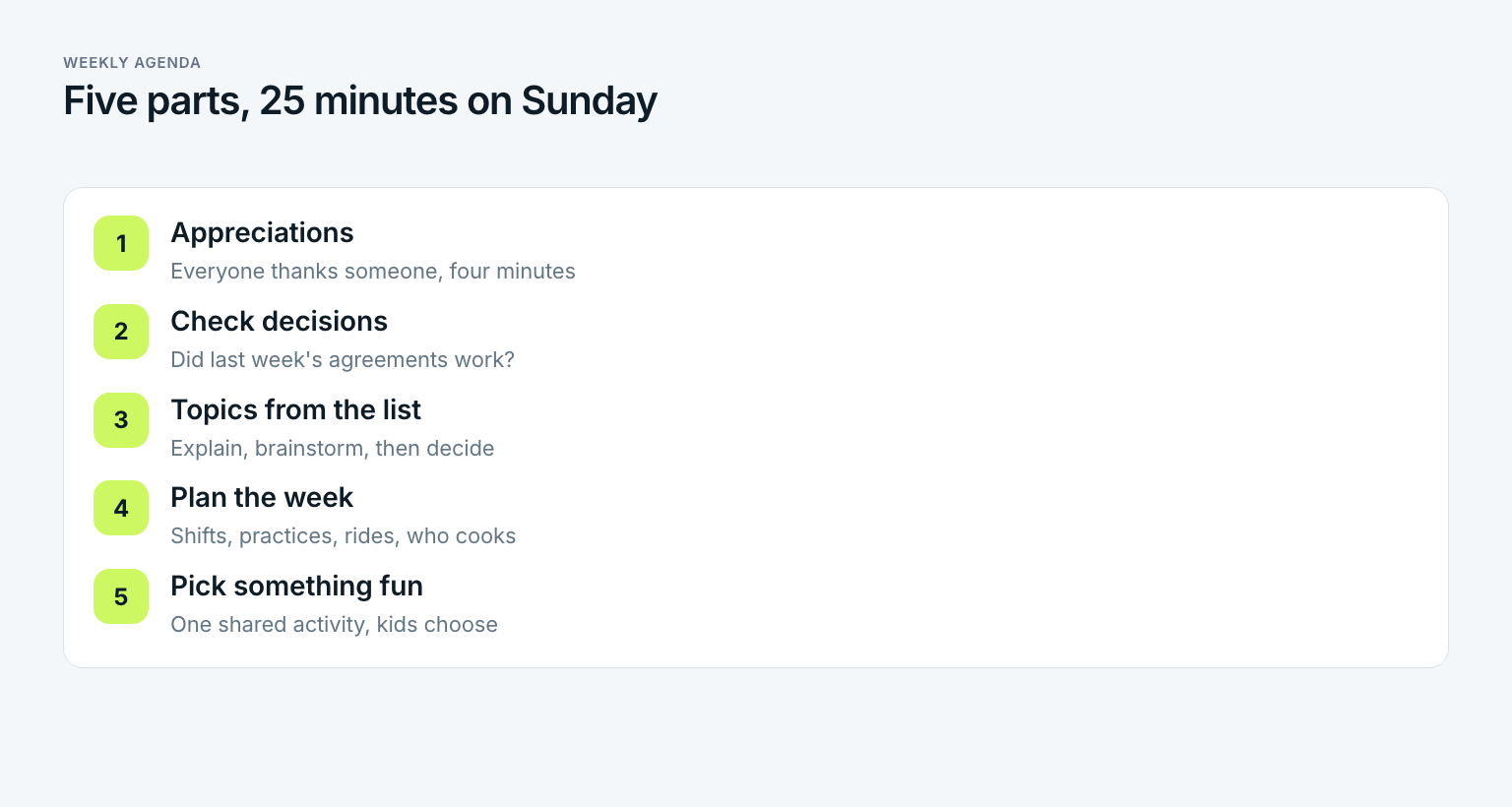
The order matters. Appreciations first lower everyone's guard. The check-in shows that decisions are real. And the fun ending is why the kids show up next Sunday. In short: a family meeting works when it doesn't feel like a meeting.
Family Meeting Guidelines Everyone Agrees On
Family meeting guidelines should be few, and they apply to everyone, parents included. Rachel and Dev wrote six with the kids in their first meeting and taped them to the fridge. Maya typed them up. Theo signed them in green marker.
| Guideline | Why it matters |
|---|---|
| Same time every week | Whoever knows Sunday is coming can hold a complaint on Tuesday |
| The chair rotates | Each week someone else runs the meeting, Theo included. It shows this isn't a parents' format |
| One person talks at a time | An object in hand shows whose turn it is. Rachel and Dev use a wooden spoon |
| “I” statements, not accusations | “I get frustrated when the dishwasher sits full” leads to solutions. “You never help” leads to defense |
| No punishments in the meeting | The meeting solves next week. It doesn't put last week on trial |
| Decisions are a one-week trial | If it doesn't work, it comes back next Sunday. That makes agreeing easier |
That leaves the question of how you decide. Nelsen recommends consensus over majority vote, because in a family of four a vote quickly creates two losers. Anyone who can't reach agreement tables the topic for a week. That sounds slow. In practice, many topics settle themselves during that week or come back with less heat. For bigger choices with real tradeoffs, the methods in how to make decisions help you weigh the options clearly.
Family meetings by age
Kids can join from around age four if the meeting stays short and they have a concrete job. Their role grows as they do. Treat the table below as a starting point, not a rulebook. Some seven-year-olds chair like pros, and some 13-year-olds need more time.
| Age | What works | What to watch |
|---|---|---|
| 4 to 6 | Saying an appreciation, helping pick the fun activity, drawing a topic for the list | Keep it under 15 minutes, then let them leave the table |
| 7 to 10 | Writing their own topics, suggesting solutions, chairing once a month | Take their ideas seriously even when they're impractical, and test them together |
| 11 to 14 | Chairing, taking notes, negotiating more freedom | Don't settle curfew before the meeting. Teens spot a staged discussion instantly |
| 15 and up | Owning parts of the household, a budget for family fun, leading tough topics | Don't force attendance, but decisions still apply when they skip |
Maya chaired for the first time in the second month. She put screen time on the list herself, with a proposal: 60 minutes on school days, used whenever she likes, and no phones at the dinner table for anyone, parents included. It passed with one change. Rachel says weeknight arguments about screens have mostly stopped.
One limit applies at every age. A family meeting is built for everyday friction, not for situations that feel unsafe. If conflict at home turns threatening or someone is in crisis, reach out for professional help, and in the US you can call or text 988 at any hour.
Family Meeting Ideas: 20 Topics and Fun Endings
Family meeting ideas fall into two groups: topics worth deciding together and ways to end on a good note. Rachel's family kept a running list. The ideas below came up in their first two months, and the kids added several of them.
Topics to decide together
- Screen time rules for school days and weekends
- Who does which chores on the cleaning schedule, and how to trade them
- Allowance and what it has to cover
- Bedtimes and when they move
- Rules for having friends over
- Where to go on the next family trip
- How to handle fights over shared things
- Whether the family is ready for a pet
- Phones at the dinner table
- How to split the driving to practices
- One new recipe to try each week
- A family goal for the year
Ways to end the meeting
- Taco night with a kid as head chef
- A short walk around the block right after the meeting
- Movie night, with the chooser rotating each week
- Baking something together
- A Saturday morning bike ride
- An ice cream run
- A blanket fort with the youngest in charge
- Writing a thank-you note to a grandparent
Keep the list where everyone can see it. A topic that sits on the fridge for a few days often loses its edge before Sunday. And a fun ending that's already written down is one less thing to negotiate.
Three Mistakes Nobody Notices
Family meetings rarely fail in the first week. They fade out in the second month, quietly, because of three mistakes that seem reasonable at first. How do you know it's happening? Usually nobody asks anymore when the next meeting is.
The most common mistake: the meeting becomes a parent agenda
Many parents start with good intentions and their own list: clean rooms, homework, screen time. After three weeks the kids realize the meeting is a place to get told off, and they stop engaging. Whoever wants kids to take part makes sure at least half the topics come from them. In Rachel and Dev's first month, exactly half did.
- The time keeps moving. One week it's a birthday party, the next Rachel picks up an extra shift. After three skipped weeks the meeting is gone. Fix: agree on a backup slot right away. For Rachel and Dev it's Monday at 7 p.m.
- Nobody writes anything down. A week later everyone remembers a different version. Three lines per topic are enough: topic, decision, who does what by when.
- It's all problems. Anyone who only discusses conflict turns the meeting into a chore. Appreciations and the fun ending aren't decoration. They're the reason everyone comes back.
After four weeks, Rachel and Dev took stock. Four meetings, none skipped, 16 topics on the list, eight of them from the kids. Ten got decided, four were tabled, two solved themselves. Rachel's sticky note in week 45 showed six arguments instead of 18.
That's not magic, and it's not a promise. It's the result of one simple shift: the topics stayed the same, but now they have a place. That means a family meeting doesn't end every argument. It keeps the same argument from starting over every night.
Your Family Meeting in the Goal Chain
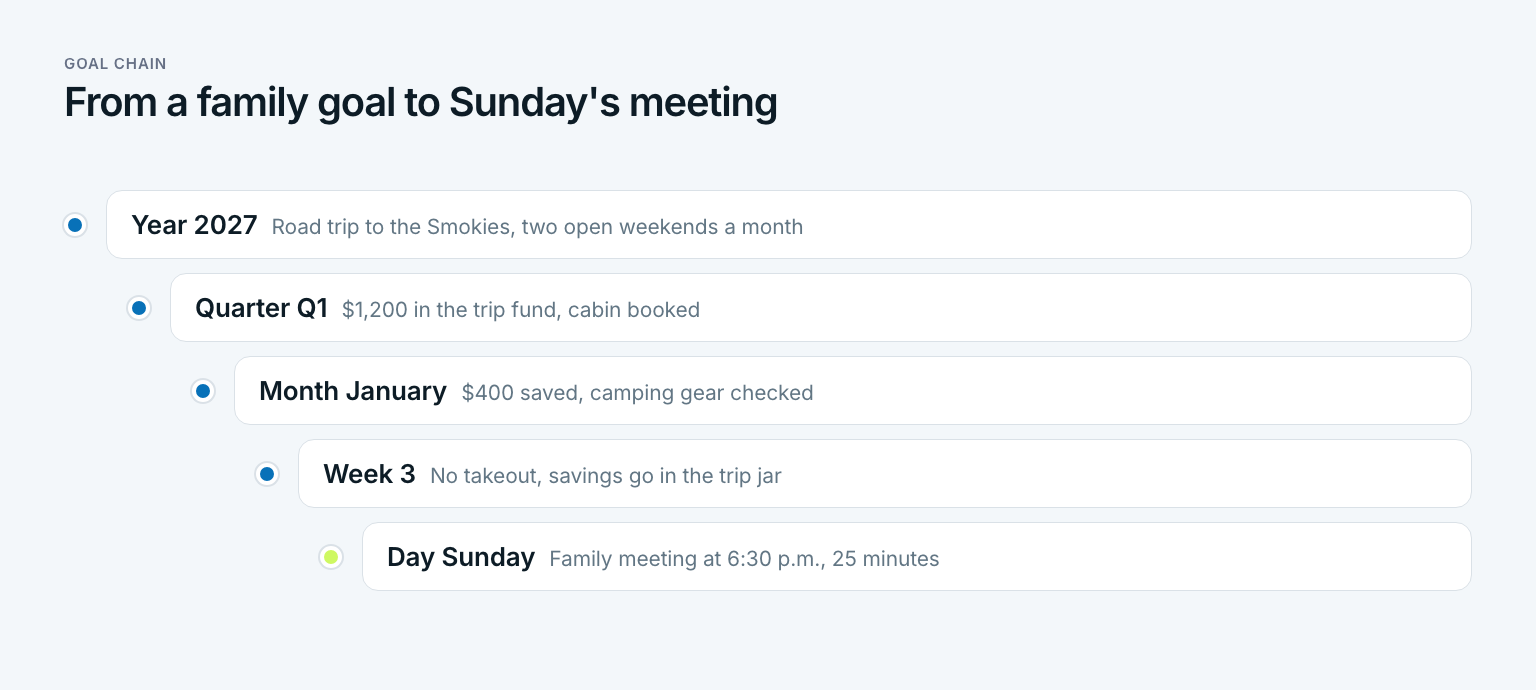
A family meeting runs the week. It gets stronger when it knows what the week is for. That's where the goal chain comes in: year, quarter, month, week, day. It links a big family goal to what you talk about on Sunday.
In November, Rachel and Dev used a meeting to talk about 2027 for the first time. Maya wanted a road trip to the Great Smoky Mountains, and Theo wanted more weekends without plans. Together those became one shared goal the family could break down all the way to Sunday.
| Level | The family in Columbus | What happens in the meeting |
|---|---|---|
| Year 2027 | A one-week road trip to the Smokies and two open weekends a month | Decided together in November, everyone could propose one goal |
| Quarter Q1 | $1,200 in the trip fund, cabin booked | A quick progress check once a quarter |
| Month January | $400 saved, camping gear checked | The first meeting of the month reviews the monthly goal |
| Week 3 | No takeout, the savings go in the trip jar | Plan-the-week part: who cooks which night |
| Day Sunday | Family meeting at 6:30 p.m., 25 minutes | Decisions go in the notes |
That means the family meeting picks up a second job besides settling arguments. It becomes the place where the family checks once a week whether it's on track. If you want a structured version, the ten-minute weekly review fits right into the meeting, and the guide to yearly goals shows how to pick a goal worth a whole year. For the week itself, three weekly goals are plenty.
In Gaapp you can set up a family goal like this as a shared goal and break it into quarter, month and week. Then everyone sees the same progress on Sunday, Maya included, on her phone.
Three Questions Before Your First Family Meeting
Before you sit down for the first time, answer three questions honestly. Anyone who does that up front avoids most of the disappointment of the first few weeks.
- Am I willing to be outvoted? If the answer is no on a topic, that topic doesn't belong in the meeting. Say so up front.
- Which topics do we parents decide alone? Health, safety, money for rent and school. A short, clear list protects trust.
- What should be different after four weeks? Rachel and Dev wanted fewer arguments at night. The sticky note on the fridge showed whether it worked.
In short: a family meeting isn't a trick to get kids to cooperate. It's a fixed place where a family learns to decide together.
Family Meeting FAQ
How do you deal with a controlling family member?
Name the specific behavior and the boundary you want, in a calm moment rather than in the middle of an argument. Decide ahead of time what you will do if the boundary is crossed, and follow through. If the control involves threats, intimidation or abuse, talk to a professional, and if you or someone else is in crisis, call or text 988.
How do families start?
Families start in many ways: through partnership or marriage, the birth or adoption of a child, foster care, or two households joining as a blended family. What makes a group of people work as a family is less the starting point than shared routines and decisions. A weekly family meeting is one of the simplest routines to begin with, at any stage.
What are some examples of family problems?
Everyday family problems include arguments over screen time, chores, money, curfews and how weekends are spent. Larger problems include breakdowns in communication, ongoing sibling conflict, divorce, grief, illness or financial stress. Family meetings work well for the everyday kind. Larger problems often need outside support, such as a licensed family therapist.
Is family estrangement normal?
It is more common than many people think. In a national survey described in his 2020 book Fault Lines, Cornell researcher Karl Pillemer found that 27 percent of American adults reported being estranged from a relative. Common does not mean easy, and a licensed family therapist can help if you want to reconnect or cope. If it feels overwhelming, 988 is available by call or text around the clock.
How long should a family meeting last?
Twenty to 30 minutes is enough for most families, and 15 minutes when the kids are under seven. A timer helps everyone stay focused. It is better to end on time and table a topic than to run long and lose the kids for next week.
What age should kids start family meetings?
Kids can join from around age four if they have a simple job, like sharing an appreciation or picking the fun activity. From early elementary school they can add their own topics and suggest solutions. By about ten, many kids can chair the meeting themselves.
Last updated: 22 October 2026
Read next
 Planning
Cleaning Schedule: Daily, Weekly and Monthly Tasks
A cleaning schedule is not a Saturday to-do list: daily, weekly and monthly tasks, a printable template and a fair split for families.
15 min read
 Planning
Study Plan: How to Make One You Can Actually Follow
A study plan is not a schedule. Make one in six steps: inventory, hours math, buffer, a sample study schedule and a template, with a worked example.
17 min read
 Planning
Bullet Journal: How to Start One You'll Actually Keep
A bullet journal is not an art project. Learn the bullets, four core modules, migration and a six-step setup, with an example, 12 ideas and a goal chain.
15 min read