Weekly Goals: Examples and How to Set Three That Stick
Weekly goals are not tasks. Learn to write two or three goals with a result, a number and a Friday deadline, with 36 weekly goals examples and five steps.

Contents
- 01What weekly goals are and what they are not
- 02What actually happens in your week: nine intentions, zero results
- 03The weekly goal formula: result, number, Friday
- 04How to set weekly goals in five steps
- 05Weekly goals examples: 36 goals for work, health, money and home
- 06What should your weekly goal be? Start from the gap
- 07The three mistakes nobody notices
- 08Weekly goals in the goal chain: from a yearly number to Tuesday morning
- 09Three questions before your week starts
- 10Frequently asked questions about weekly goals
A weekly goal is not a task. Weekly goals are two or three results that should be true by the end of the week, written so you can answer yes or no on Friday, and taken from a monthly goal. A task describes what you do. A weekly goal describes what is different afterward.
Three things turn an intention into a weekly goal: a result instead of an activity, a number instead of a feeling, and a monthly goal it pays into. All of it is worked through on two weeks of Priya, 31, a freelance graphic designer in Columbus, Ohio, who wants two new retainer clients by Halloween and is training for her first 10K, a Turkey Trot on Thanksgiving morning. You also get a one-line formula, five steps, 36 weekly goals examples, and a way to pick the goal that matters most.
What weekly goals are and what they are not
A weekly goal is a sentence about Friday. It describes a state that is reached by then: a case study published, three runs done, fifteen pitches sent. Three parts are fixed. The result is visible, the number is countable, and the link upward is named. If one of the three is missing, you have an intention.
Most people confuse weekly goals with their to-do list for the week. That makes sense, since both are written on the same Sunday night. They are just built for different jobs. Here is how the six terms that meet in any week differ:
| Term | What it is built for | Priya's example |
|---|---|---|
| Intention | A direction with no finish line | Get more clients |
| Task | One action you finish in one sitting | Update the LinkedIn headline |
| Habit | Something that repeats every week and never ends | Invoice every Friday |
| Daily goal | The one result of a day | Write five pitches before lunch |
| Weekly goal | One result by Friday you can answer yes or no | Fifteen tailored pitches sent |
| Monthly goal | The measure your weekly goals hang on | Two retainer clients signed by October 31 |
A weekly goal sits between the month and the day. It is bigger than a task and smaller than a monthly goal. Where your weekly goals land in the calendar, which day gets which hour, is the job of weekly planning. This article is about the step before that: the sentence itself. Whoever writes the wrong sentence plans the wrong week, no matter how clean the calendar looks.
Why the week, of all units? A day is too short to finish a case study. A month is too long to notice on Wednesday that something is off. Teresa Amabile and Steven Kramer found in The Progress Principle, 2011, that making progress in meaningful work is the strongest single lift to how people feel about their workday. A week is long enough to produce progress you can see and short enough to correct course. That means: Weekly goals are the smallest unit in which you can see yourself moving.
What actually happens in your week: nine intentions, zero results
A full list feels like a plan. That is the trap. On the Monday of October 5, Priya wrote down nine items, all sensible, all sincere. Next to client work she has about ten open hours a week for growing the business and for training. Here is the list on Monday and what stood on Friday:
| Priya's list on Monday | What stood on Friday | Yes or no answer possible? |
|---|---|---|
| Work on portfolio | Five hours spent, layout rebuilt twice, nothing published | No |
| Reach out to leads | Four emails sent, two of them follow-ups | No |
| Network more | One webinar watched | No |
| Run | One run, 3 miles | No |
| Send September invoices | Sent | Yes |
| Learn Figma variables | Two tutorials started | No |
| Clean the studio | Desk yes, closet no | No |
| Call Mom | Done | Yes |
| Sleep more | In bed before 11 p.m. twice | No |
Priya was not lazy. She put about twelve hours into that list, more than she had planned. Still, she can answer only two items with yes on Friday, and both were ten-minute tasks. The portfolio, the thing that wins retainers, got five hours and zero published pages. So how was the week? Good, because a lot happened? Bad, because nothing is finished?
The list allows both answers, and that is exactly the problem. An item like "work on portfolio" is satisfied after ten minutes and still open after ten hours. It measures attendance, not progress. In short: Anyone who plans a week in activities can never lose on Friday, but can never win either.
The weekly goal formula: result, number, Friday
A good weekly goal follows a fixed sentence pattern. It feels stiff the first time and saves you every argument with yourself later. The sentence has four parts, and each part does one job:
The weekly goal formula
By Friday, result with number is done, so that monthly goal. For Priya: By Friday, fifteen tailored pitches are sent, so that two retainers are signed by October 31. The day makes the goal checkable, the result makes it visible, the number makes it countable. The "so that" clause is the link to your monthly goal, and without it a weekly goal is just an intention with a deadline.
The formula stands on solid ground. Edwin Locke and Gary Latham summarized decades of research in A Theory of Goal Setting and Task Performance, 1990: Specific, challenging goals lead to better performance than the instruction to do your best. "Run more" is a do-your-best goal. "Three runs, 10 miles total" is a specific one. If you want the full method for writing any goal, the guide on how to write SMART goals walks through it. For a week, the short version above is enough, because the deadline is already set.
Three types of weekly goals
Not every weekly goal is a finished product. There are three types, and a good week mixes them:
| Type | What it measures | Example | Works for |
|---|---|---|---|
| Outcome goal | A finished piece that did not exist on Monday | One case study live, 800 words | Projects, launches, exams |
| Volume goal | A count of repetitions by Friday | Fifteen tailored pitches sent | Sales, job search, practice |
| Rhythm goal | How often something happens in the week | Three runs, 10 miles total | Fitness, sleep, family time |
Outcome goals move the monthly goal the most but are the hardest to predict. Volume goals are predictable as long as the count is honest. Rhythm goals protect the parts of life that vanish first in a busy week. Whoever sets only outcome goals loses the training. Whoever sets only rhythm goals runs a lot and ships nothing.
The Friday test: four questions for every weekly goal
Before a sentence goes on your list, ask it four questions. If it fails one, rewrite it:
- Can I answer it with yes or no on Friday? Anyone who can end up at "sort of" has written an activity.
- Could someone else see whether it is done? Fifteen sent emails can be counted. "Better positioned" cannot.
- Does it fit into this week's open hours? For Priya that means ten hours, shared with her other goals.
- Do I know which monthly goal it pays into? If you cannot name one, it is a task for the list, not a goal.
How to set weekly goals in five steps
Writing your weekly goals takes about fifteen minutes. The best time is right after you look back on the old week, on Friday afternoon or Sunday evening. Have two things in front of you: your monthly goal and last week's results. Where the monthly goal comes from is covered in the guide to setting monthly goals. The month around it gets planned once, in a 45-minute monthly planning session on the last Friday.
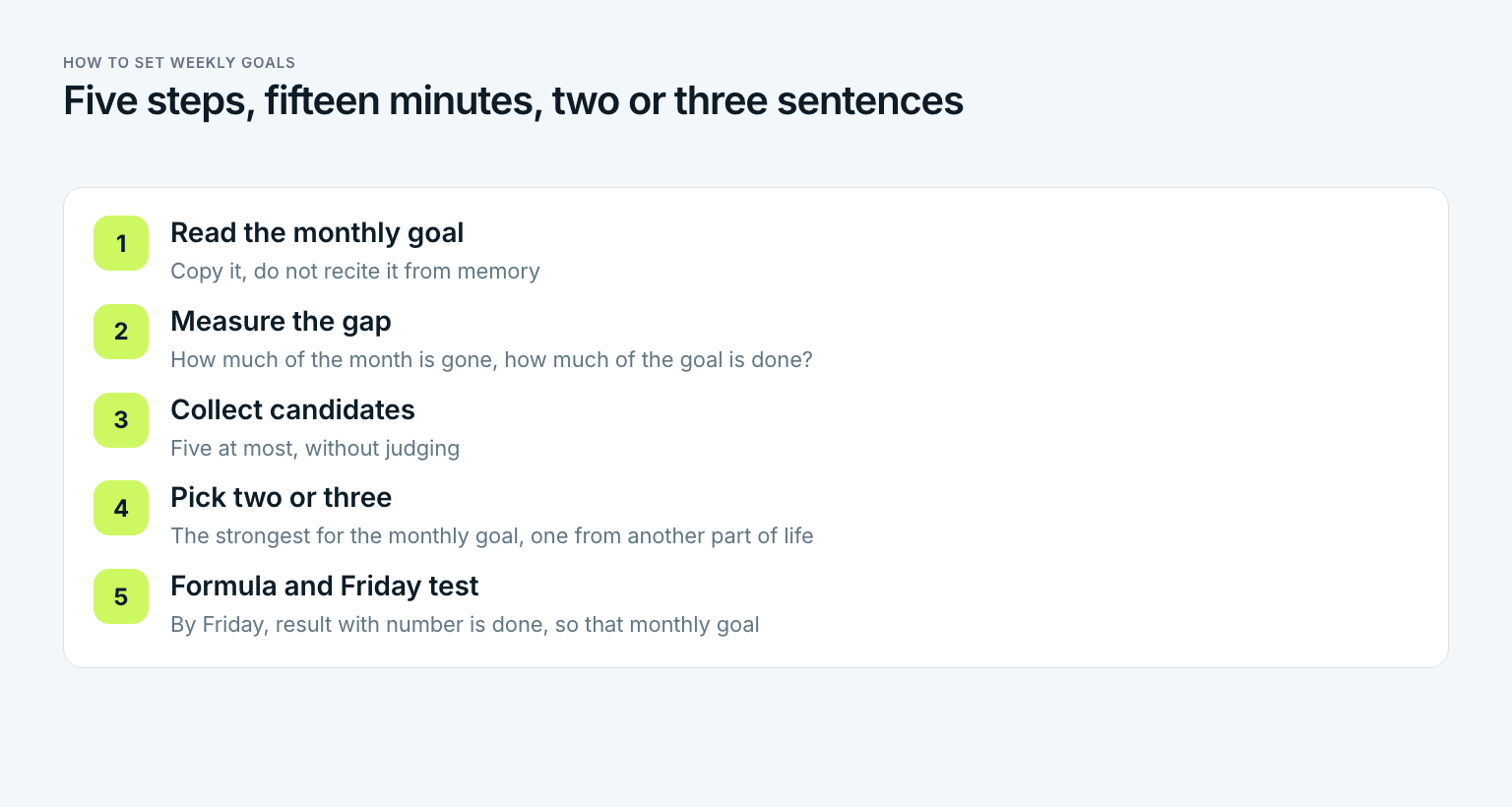
Read the monthly goal, one minute
Copy it, do not recite it from memory. For Priya: two retainer clients signed by October 31. Her second one: 40 miles of running in October.
Measure the gap, two minutes
How much of the month is gone, and how much of the goal is done? On October 11, 35 percent of the month is over. Priya has zero of two clients and 3 of 40 miles. The gap is the raw material for your weekly goals.
Collect candidates, five at most, three minutes
Write down everything that would shrink the gap this week, without judging. For Priya: pitches, a case study, a referral ask, runs, a new pricing page.
Pick two or three, four minutes
Take the one that moves your most important monthly goal the most. Then one from another part of your life. A third only if your hours can carry it. The rest goes on the task list or into next week.
Apply the formula and run the Friday test, five minutes
Write each goal as "By Friday, … is done, so that …" and ask the four questions. A goal that fails gets smaller or more specific, never longer.
Here is what Priya ended up with for the week of October 12. Nine items became three sentences:
- By Friday, fifteen tailored pitches are sent to agencies and in-house teams, so that two retainers are signed by October 31. A volume goal.
- By Friday, one case study is live on the portfolio, 800 words and six images, so that every pitch links to proof. An outcome goal.
- By Sunday, three runs are done, 10 miles total, so that October ends at 40 miles. A rhythm goal.
What is missing matters just as much. Networking is no longer a goal, because the pitches are the networking. Figma variables can wait until November. The invoices and the call to Mom are tasks, and they live on the task list. "Sleep more" is gone. Priya knows this week cannot carry it, and she does not want a goal that is a guaranteed no on Friday.
On the Friday of that week, the score looks different from the week before. Goal one: yes, fifteen pitches, two replies, one discovery call booked. Goal two: no, the draft is written but two images are missing. Goal three: yes, 10.5 miles. Two of three, or 67 percent. That is not a perfect week, but an honest one. And it is the first week Priya can actually measure.
Weekly goals examples: 36 goals for work, health, money and home
Every example follows the formula, minus the "so that" clause, because only you know that part. Do not copy any of them as is. Take the shape and put in your own number. A weekly goal is only good if the number fits your week.
Work and career
- Client proposal finished and sent by Thursday.
- Five customer calls held, one note logged for each.
- Quarterly review deck done, twelve slides, rehearsed out loud once.
- Inbox under 20 messages at 4 p.m. on Friday.
- Onboarding plan for the new hire written and reviewed with her.
- Three job applications sent to roles that match your target list.
School and learning
- Chapter three of the term paper drafted, six pages.
- Two practice exams done under time pressure and graded.
- 100 flashcards made for statistics and reviewed once.
- Thesis outline sent to your advisor.
- Five sources read for the presentation, half a page of notes each.
- Thirty minutes of Spanish on five days.
Health and fitness
- Three runs, 10 miles total.
- Two strength sessions, 40 minutes each.
- In bed before 11 p.m. on five nights.
- 8,000 steps on four days.
- Annual physical booked and on the calendar.
- No soda on five days.
Money
- $250 moved into the emergency fund.
- All subscriptions reviewed, at least one canceled.
- Every expense of the week logged, each evening.
- Last year's tax documents in one folder.
- Two car insurance quotes collected and compared.
- November budget written, one page.
Relationships and family
- Two screen-free evenings with your partner.
- Saturday outing planned and booked.
- Thirty minutes alone with each kid.
- Grandparents called once and the Thanksgiving visit settled.
- Family schedule for the week posted on the fridge on Sunday.
- Birthday gift for your sister bought and wrapped.
Home and life admin
- Garage cleared, three boxes dropped at the donation center.
- Dinner plan for five nights written, one grocery run.
- Closet sorted, one bag donated.
- Every paper on the desk filed.
- Bike tire patched and the bike rideable again.
- Vacation days for spring break requested.
Notice what none of the examples contain? No "more", no "better", no "work on". Each one ends in a state you can check on Friday. Here is how weak sentences turn into strong ones:
| Before: intention or activity | After: weekly goal |
|---|---|
| Work on portfolio | One case study live, 800 words and six images |
| Get in shape | Three runs, 10 miles total |
| Look for a new job | Three applications sent to roles on the target list |
| Eat healthier | Home-cooked dinner on five nights |
| Get organized | Desk clear, every paper filed |
| Spend more time with family | Saturday from 2 p.m. at the lake, phones in the car |
If you are looking for bigger goals to break down, the list of personal goals examples has 50 of them, each with a number and a date. Every one of them can be cut into weekly goals with the steps above.
What should your weekly goal be? Start from the gap
Your first weekly goal should be the result that closes the biggest share of the gap in your most important monthly goal. Not the most urgent one, not the most pleasant one. The gap from step two is the compass. If your monthly goal is two clients and you have zero, the weekly goal is the thing that most directly produces clients, which for Priya was pitches, not a prettier website.
That sounds obvious and is hard in practice, because the biggest lever is often the most uncomfortable one. Pitches can be rejected. A portfolio layout cannot. So which goal would you pick if nobody could see the result but you? Here is how the rule plays out in five common situations:
| Situation | Monthly goal | First weekly goal |
|---|---|---|
| College senior before finals | Pass statistics with a B or better | Two practice exams done and graded by Friday |
| Job seeker | Three first-round interviews in November | Five applications sent to roles on the target list |
| New parent back at work | Back to three workouts a week | Two 20-minute workouts at home, Tuesday and Thursday |
| First-time manager | One-on-ones running with all six reports | Three one-on-ones held, notes shared after each |
| Side business owner | First ten paying customers | Landing page live and shared in two communities |
The second goal comes from another part of your life, usually health or family, because those are the first to disappear. The third is optional. Whoever adds a third goal to a week that is already full has not raised the bar, only lowered the odds.
The three mistakes nobody notices
Most weekly goals do not fail because of willpower. They fail because of the sentence, and the mistake only shows up on Friday, when it is too late. Which one is yours?
The most common mistake: the weekly goal with no end
"Work on the presentation" sounds like a goal and is an activity. It has no end, so there is no moment when it is done. Whoever writes goals like this works all week and has nothing to check off on Friday. The fix costs one phrase: Replace "work on" with the result. "Presentation done, twelve slides" has an end.
- Too many weekly goals. Five goals feel ambitious, and ambition is not a flaw. But a week has five workdays, and two of them never go to plan. Anyone who sets five goals often ends the week with one finished and four half done. Three is a ceiling, not a target.
- Weekly goals with no monthly goal. A weekly goal that hangs on nothing is good intent with a deadline. You can hit it and still move nothing. Priya could have hit "studio fully organized" in her first week, a complete week without a single step toward a client. Every outcome goal needs its "so that".
- The number from your best week. Whoever sizes weekly goals by the best week of the year plans every normal week as a defeat. Take the number from an average week and add 20 percent, not 100. Friday tells you whether the number was right, and next week gets more accurate.
All three mistakes have one thing in common: They do not hurt on Sunday. The list looks good, the ambition is right. Only Friday shows whether the sentences held. That is why every set of weekly goals needs a short look back at the end of the week, and the ten-minute weekly review shows how to do that without turning it into a journal.
Weekly goals in the goal chain: from a yearly number to Tuesday morning
A weekly goal is the middle link in a chain of five levels. The year sits at the top, the day at the bottom. Each level is smaller than the one above and hangs on it. For Priya, the chain for the week of October 12 looks like this:
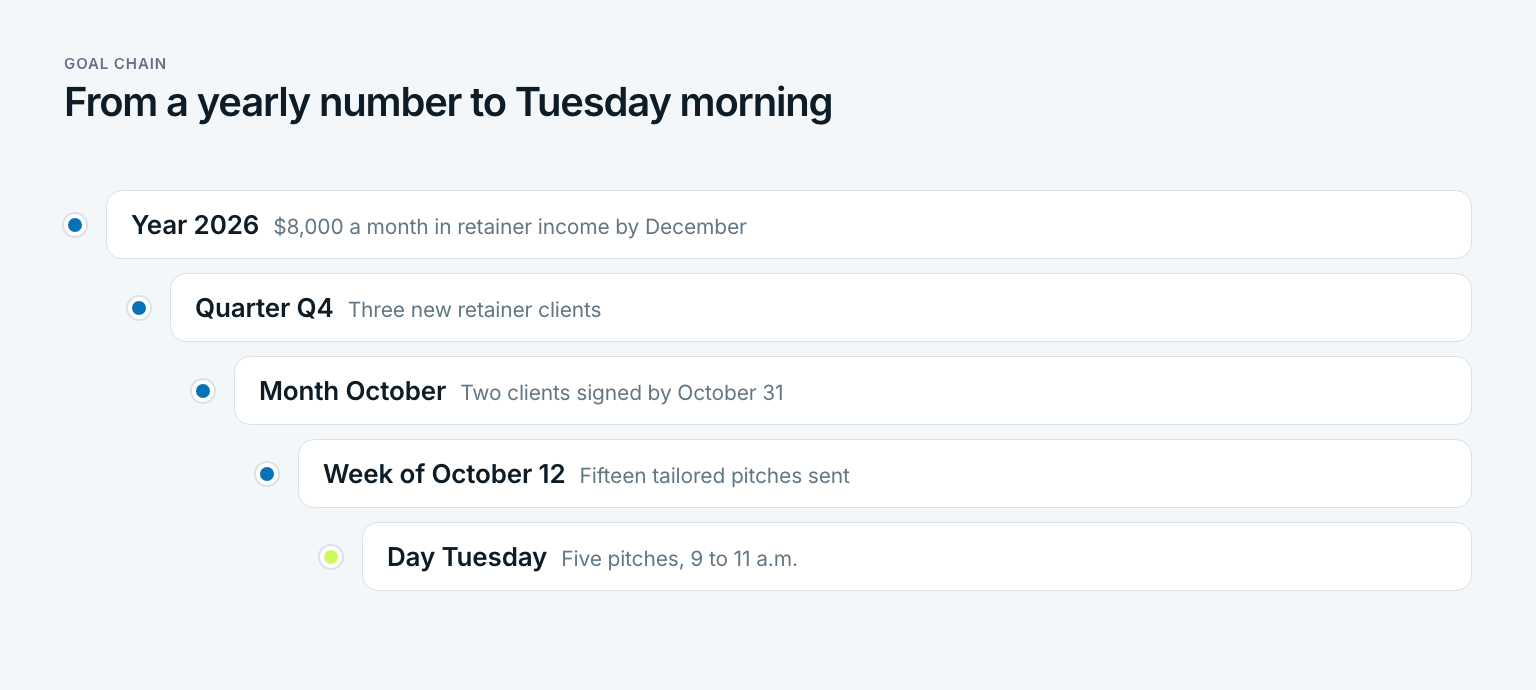
The chain answers the question behind every weekly goal: Is this important, or just urgent? The pitches are important because they hang on the monthly goal, which hangs on the quarter, which hangs on the yearly income number. Cleaning the studio is sometimes urgent, but it hangs on no level. That does not make it wrong, just a task.
From the week down, the chain gets concrete fast. Each day gets one result that belongs to a weekly goal and fits into one block of time. For Priya on Tuesday, that is "five pitches, 9 to 11 a.m.". How to write those so you can check them off at night is covered in the guide to daily goals.
In Gaapp, this chain is the core: year, quarter, month, week, and day, with every goal hanging on a bigger one. The progress of a week is the share of weekly goals done, for Priya two of three. A thin line next to it shows how much of the week has passed. Open weekly goals do not roll over on their own. On Friday you decide whether to set them again or let them go.
If you work with OKRs or the 12 week year, the shape is the same. Weekly goals are called initiatives or tactics there, and the formula holds: result, number, Friday. If you plan as a couple or a family, you set shared weekly goals, and everyone sees on Friday what got done.
Three questions before your week starts
Before you lock in next week's goals, ask yourself three questions. They take one minute and save you the frustration on Friday:
- Can I answer each of my weekly goals with yes or no on Friday, without arguing with myself?
- Do I know which day each goal gets time?
- Would I call the week a success if only the first goal worked out?
Anyone who answers the third question with no has put the wrong goal first. Whoever hesitates on the first one still has an activity on the list. In short: A weekly goal is not a plan for the week, it is a promise to Friday.
Frequently asked questions about weekly goals
What are some examples of weekly goals?
Good weekly goals describe a result with a number by Friday, such as "proposal sent", "three runs, 10 miles total", or "chapter three drafted, six pages". Weak ones describe activities like "work on the project" or "exercise more". The article above lists 36 weekly goals examples across six areas, from work to home.
What should my weekly goal be?
Your first weekly goal should be the result that closes the biggest share of the gap in your most important monthly goal. Measure how much of the month is gone and how much of the goal is done, then pick the result that moves that number most. Add a second goal from health or family, and a third only if your week has room.
What are 5 good personal goals?
Five solid personal goals cover different parts of life: a health goal like running a 10K, a money goal like saving $3,000, a career goal like earning a certification, a relationship goal like a weekly date night, and a learning goal like reading twelve books. Each becomes useful once it has a number and a date, and then you can break it into weekly goals.
What are the 10 examples of goals?
Common examples include running a 10K, saving an emergency fund, paying off a credit card, earning a promotion, learning a language, reading twelve books a year, getting eight hours of sleep, cooking at home five nights a week, finishing a degree, and spending one screen-free evening a week with family. Each one only works when you give it a number, a date, and a first weekly goal.
How many weekly goals should I have?
Two or three. One for your most important monthly goal, one for another part of your life such as health or family, and a third only if your open hours can carry it. More than three weekly goals usually means none of them is fully done on Friday.
When should I set my weekly goals?
Right after you review the old week, on Friday afternoon or Sunday evening. Then you know what stayed open, and the goals come from a measurement instead of a mood. Anyone who writes them on Monday morning is planning between the first emails.
Last updated: 19 October 2026
Read next
 Planning
Cleaning Schedule: Daily, Weekly and Monthly Tasks
A cleaning schedule is not a Saturday to-do list: daily, weekly and monthly tasks, a printable template and a fair split for families.
15 min read
 Planning
Study Plan: How to Make One You Can Actually Follow
A study plan is not a schedule. Make one in six steps: inventory, hours math, buffer, a sample study schedule and a template, with a worked example.
17 min read
 Planning
Bullet Journal: How to Start One You'll Actually Keep
A bullet journal is not an art project. Learn the bullets, four core modules, migration and a six-step setup, with an example, 12 ideas and a goal chain.
15 min read