How to Make Decisions: Five Methods That Use Your Goals
Making decisions is not a gut call. A decision matrix, 10-10-10, a pre-mortem and the Bezos two-way door rule, worked through with your goals as criteria.

Contents
- 01How to make decisions: what deciding actually means
- 02Why you struggle to make decisions
- 03The decision making process in five steps
- 04Method 1: the weighted decision matrix
- 05Method 2: a pros and cons list with weights
- 06Method 3: the 10-10-10 rule by Suzy Welch
- 07Method 4: the pre-mortem by Gary Klein
- 08Method 5: one-way doors and two-way doors
- 09How to make a decision that fits your goals
- 10Three decision making mistakes nobody notices
- 11Frequently asked questions about making decisions
Learning how to make decisions is not about trusting your gut or your head. It means choosing one option out of at least two, measuring each against criteria you set before you look at the options, and writing the choice down so you can check it later. You usually own the best criteria already: your goals. Anyone who knows where they want to be in three years does not start from zero when a hard choice lands on the table.
Five methods cover almost every big decision: the weighted decision matrix, a pros and cons list with weights, Suzy Welch's 10-10-10 rule, Gary Klein's pre-mortem, and the split between reversible and irreversible decisions that Jeff Bezos laid out in his 2015 letter to Amazon shareholders. All five are worked through with one real-world case. Marcus, 37, teaches high school chemistry in Denver. A medical device company has offered him a job in corporate training, and he has two weeks to answer.
How to make decisions: what deciding actually means
A decision is a commitment made under uncertainty. You pick one path and give up the others. Every decision has three parts: options, criteria, and a moment when you choose. Remove one and the decision turns into rumination. Without options, there is nothing to choose. Without criteria, every option looks equally good. Without a deadline, the same question comes back every night at 11 p.m.
Deciding is also not the same as thinking it over. Thinking it over is useful. It surfaces arguments that would otherwise get lost. It is simply built for something else: weighing collects, deciding closes. Anyone who only weighs keeps every door open and walks through none of them. That means: every method in this guide ends with a sentence that starts with “I choose.”
Here is where Marcus stands. The company is offering $92,000 a year to design training for sales reps and hospital staff. He makes $64,000 as a teacher. He loves the classroom, and he loves his summers with his wife Alisha and their two kids, ages eight and eleven. He also has $31,000 left on his student loans. For ten days he has asked himself the same question: take the job or not? Every morning the answer flips. That is not a character flaw. It is a sign that he has no yardstick.
Why you struggle to make decisions
Most hard decisions are not hard because you lack information. They are hard because of the way the question is framed. Three causes show up again and again, and all three can be fixed:
- No yardstick. Anyone without goals to measure options against ends up comparing apples to oranges. Every option has upsides and downsides, and the scale stays stuck in the middle. A goal with a number and a date is a yardstick. It tells you which upside counts.
- A frame that is too narrow. In their 2013 book “Decisive,” Chip and Dan Heath describe the trap of “whether or not” decisions. Anyone who only asks “Should I take the job?” has already ruled out every option they have not yet seen. The Heaths recommend widening your options before you evaluate them.
- Everything feels permanent. Many decisions feel irreversible when they are not. Anyone who treats a job with a probation period like buying a house brings the effort of a huge decision to a medium one, and then keeps postponing it.
On top of that comes a standard the economist Herbert Simon described back in 1956. You can maximize, which means hunting for the best possible option. Or you can settle for the first option that meets all your criteria. Simon called the second approach “satisficing.” In “The Paradox of Choice” from 2004, psychologist Barry Schwartz describes how maximizers often feel worse about their choices, even when the outcome is good. In short: whoever chases the perfect option rarely finds peace.
You may have read that the average adult makes about 35,000 decisions a day. The number appears in countless articles. Nobody has been able to trace it to an actual study, so treat it as unsourced. It does not matter for you anyway. The question is not the thousands of small choices between coffee and tea. It is the three or four decisions a year that move your goals.
How to make a decision when you can't decide
Sometimes you have weighed everything and still nothing moves. Then a trick that sounds silly helps: flip a coin. Pay attention not to the result but to your reaction when it lands. If you feel relief, you know what you want. If you feel disappointment, you know that too. The coin does not decide. It shows you where your gut was already leaning.
The economist Steven Levitt took this seriously. In a study published in the Review of Economic Studies in 2021, he had people who were stuck on a major life decision flip a coin online. Those who went on to make the change, such as quitting a job, reported being happier six months later, on average, than those who kept things as they were. Participants signed up on their own, so this is not proof for everyone. It does suggest that people who feel stuck tend to underestimate the upside of change.
The decision making process in five steps
The decision making process follows almost the same sequence no matter which method you use in step four. The order matters more than the method. Above all: criteria come before scoring, never after.
Name the decision and set a deadline
Write the question as one sentence and add the date by which it will be decided. Marcus writes: “Which path do I take next year? Decided by Sunday, October 18, 8 p.m.” He picks a date a few days before the company's deadline so he still has room for follow-up questions.
Widen your options to at least three
A yes or no question only has two options. Ask yourself: what would I do if both options disappeared tomorrow? Marcus finds a third path he had never considered. His school district has posted an opening for a science curriculum specialist, a role that stays in education, pays more, and runs on a shorter contract than the corporate job.
Turn your goals into weighted criteria
Take your life goals and yearly goals and turn each one into a criterion. Spread 100 percent across them. Do this before you score a single option. Anyone who sets the weights afterward will quietly push them toward the option their gut already likes.
Score and decide
Rate each option from 1 to 5 on each criterion, multiply by the weight, and add it up. Then stress-test the result with 10-10-10 and a pre-mortem. You finish with one sentence: “I choose option C.”
Record it, act on it, set a review date
Write three lines: what you decided, why, and how you will know in ten months whether it was right. Put the review date on your calendar. Without a review date, you never learn from a decision. You only remember how it turned out.
Five steps sound like a lot of work. For Marcus, it adds up to about two hours across three evenings. For choosing a restaurant, it adds up to zero steps. How to tell which decision deserves which level of effort comes up in the section on one-way and two-way doors below.
Method 1: the weighted decision matrix
A decision matrix is a table with your options in the columns and your criteria in the rows. Each criterion gets a weight, and each option gets a score on each criterion. The weighted total shows which option best fits what you care about. Engineers and project managers use the same tool under the names Pugh matrix or weighted scoring model.
Marcus does not pull his criteria out of thin air. He takes them from goals he set back in January. His family goal: home for dinner five nights a week and at least six weeks of summer with the kids. His money goal: the remaining $31,000 in student loans paid off by December 2028. His career goal: lead something bigger than one classroom by 2030. And one he only named while doing this exercise: work that still feels meaningful. That gives four weighted criteria: family time 35 percent, debt payoff 25 percent, career growth 25 percent, meaningful work 15 percent.
| Criterion and weight | A: corporate training job | B: stay in the classroom | C: district curriculum role |
|---|---|---|---|
| Family time, 35% | 2 | 5 | 4 |
| Loans paid off by 2028, 25% | 5 | 2 | 4 |
| Lead beyond a classroom by 2030, 25% | 5 | 2 | 4 |
| Meaningful work, 15% | 3 | 5 | 4 |
| Unweighted total | 15 | 14 | 16 |
| Weighted total | 3.65 | 3.50 | 4.00 |
The numbers explain why Marcus kept flipping. Without weights, the corporate job and the curriculum role are almost tied, and the money makes the corporate job feel like the grown-up choice. With weights taken from his goals, the corporate job drops behind the curriculum role, because it scores worst on the criterion he cares about most. That means: the matrix did more than rank the options. It showed that the original question, corporate job yes or no, left out his best option.
A matrix is still not an oracle. Anyone who feels disappointed by a close result has learned something: a criterion is missing, or a weight is off. You may change it, as long as you write the change down before you score again and do not keep adjusting until your favorite lands on top. Deciding which goal deserves the most weight is a question of priorities, covered in the piece on why three goals are enough.
Method 2: a pros and cons list with weights
The pros and cons list is the oldest decision making tool there is. It works far better than its reputation when you use it the way it was meant to be used. In 1772, Benjamin Franklin described it in a letter to the scientist Joseph Priestley and called it moral or prudential algebra. Two columns, reasons for and against, collected over several days. Then came the step most people skip: Franklin gave each reason a weight and crossed out reasons of equal weight on opposite sides.
The plain version only counts. Five pros, four cons, so do it. That is a mistake, because one heavy reason can outweigh ten light ones. Add weights from 1 to 3, and the list turns into a small matrix for exactly two options.
Marcus first ran his original question through it: take the corporate job, yes or no?
- For: $28,000 more per year, weight 3. New skills in instructional design, weight 2. Working with adults for a change, weight 1. Total 6.
- Against: Losing most of the summer with the kids, weight 3. Traveling about one week a month, weight 2. Leaving his students in the middle of the school year, weight 2. Total 7.
Seven to six against, a narrow margin. Following Franklin's rule, Marcus crosses out the money against the summers and the new skills against the travel. What remains is one light pro against one medium con. Is that a clear no? Not really. It says the question pits two important goals against each other: paying off debt and being present for his family. Anyone who sees a near tie like this should stop hunting for more arguments. The better move is to look for an option that serves both goals.
A weighted pros and cons list works best for yes or no questions with moderate stakes: a course, a big purchase, a volunteer role. Once more than two options are in play, the matrix is the better tool.
Method 3: the 10-10-10 rule by Suzy Welch
The 10-10-10 rule tests a decision at three points in time: How will you feel about it in ten minutes, in ten months, and in ten years? Journalist Suzy Welch described it in her 2009 book “10-10-10.” The rule separates the feeling of the moment from the consequences that last. It is not a calculation. It is a way to get some distance.
Why does that help? The feelings of the next ten minutes are loud and clear: fear, guilt, relief. The consequences ten years out are quiet and abstract. Without a method, the loud side almost always wins. In “Decisive,” the Heath brothers call this attaining distance and cite 10-10-10 as a tool for exactly that. The same imbalance runs between short-term and long-term goals: the near one is loud, the far one is quiet.
Marcus ran option C, applying for the curriculum role and turning down the corporate offer, through all three time frames:
- In ten minutes: A knot in his stomach at the thought of saying no to $92,000. A nagging voice asking whether he is just afraid of change.
- In ten months: Either he is in the curriculum role, with a contract that still leaves him most of July at home, or he is back in the classroom for one more year and applying again. Either way, the loan balance is lower than today, though more slowly than with the corporate salary.
- In ten years: He has spent a decade shaping how thousands of students learn science, and his kids remember summers with him. Nobody will remember the evening he turned down an offer.
The pattern is clear. What speaks against C sits almost entirely in the next ten minutes. What speaks for it sits in ten months and ten years. In short: the fear of turning down money is real, but it is not a criterion. Whoever uses 10-10-10 quickly sees which side is merely loud.
The rule has a limit. Ten years is too far away for many questions to answer honestly. In that case, use your yearly goal as the third point and ask: Where do I stand on December 31 if I decide this way today?
Method 4: the pre-mortem by Gary Klein
A pre-mortem is a look back at a failure that has not happened yet. You imagine the decision has been made, a year has passed, and it has gone badly wrong. Then you write down why. Psychologist Gary Klein introduced the method for project teams in Harvard Business Review in 2007. It works just as well for one person at a kitchen table.
The trick is the perspective. If you ask “What could go wrong?”, you search half-heartedly, because you secretly like the decision already. If you ask “It went wrong. Why?”, you tell a story, and stories come easier than risk lists. Klein bases the approach on research into what psychologists call prospective hindsight, dating back to the late 1980s.
Marcus spends 20 minutes writing down why option C failed by August 2027. Four reasons end up on the page, and he adds a countermeasure to each:
- He did not get the curriculum role. And the corporate offer was gone. Countermeasure: before he declines, his principal confirms that his teaching position is safe for next year, and he submits the district application within a week, not next month.
- The role turned out to be mostly admin. Spreadsheets and compliance reports instead of curriculum work. Countermeasure: before applying, he calls the current specialist and asks what a normal week looks like.
- The loan plan slipped. The raise disappeared into everyday spending. Countermeasure: the full difference from his teacher salary goes to the loans by automatic transfer, starting with the first paycheck.
- Alisha felt left out. The decision felt like his alone. Countermeasure: they fill out the matrix together, and she sets her own weights.
None of the four reasons argues against C. All four argue for doing C better. That is the typical outcome of a pre-mortem: it rarely flips the decision, but it changes the plan. Anyone who still backs away after a pre-mortem has found a reason no countermeasure can handle. That is a useful result too.
Method 5: one-way doors and two-way doors
Not every decision deserves the same effort. In his 2015 letter to Amazon shareholders, Jeff Bezos split decisions into two types. Type 1 decisions are consequential and irreversible or nearly so, which he called one-way doors. They should be made slowly, carefully, and with consultation. Type 2 decisions are reversible, two-way doors you can walk back through. They should be made quickly by one person or a small group with good judgment.
Bezos warned mostly about one danger: organizations that use the heavy process for two-way doors become slow, avoid risk without thinking, and stop experimenting. The reverse mistake is rarer but more expensive. A year later, in his 2016 letter, he added that most decisions should be made with somewhere around 70 percent of the information you wish you had. If you wait for 90 percent, you are probably being slow.
For personal decisions, a second axis helps: how much is at stake. Reversibility and stakes together form a matrix with four fields, and each field calls for a different speed.
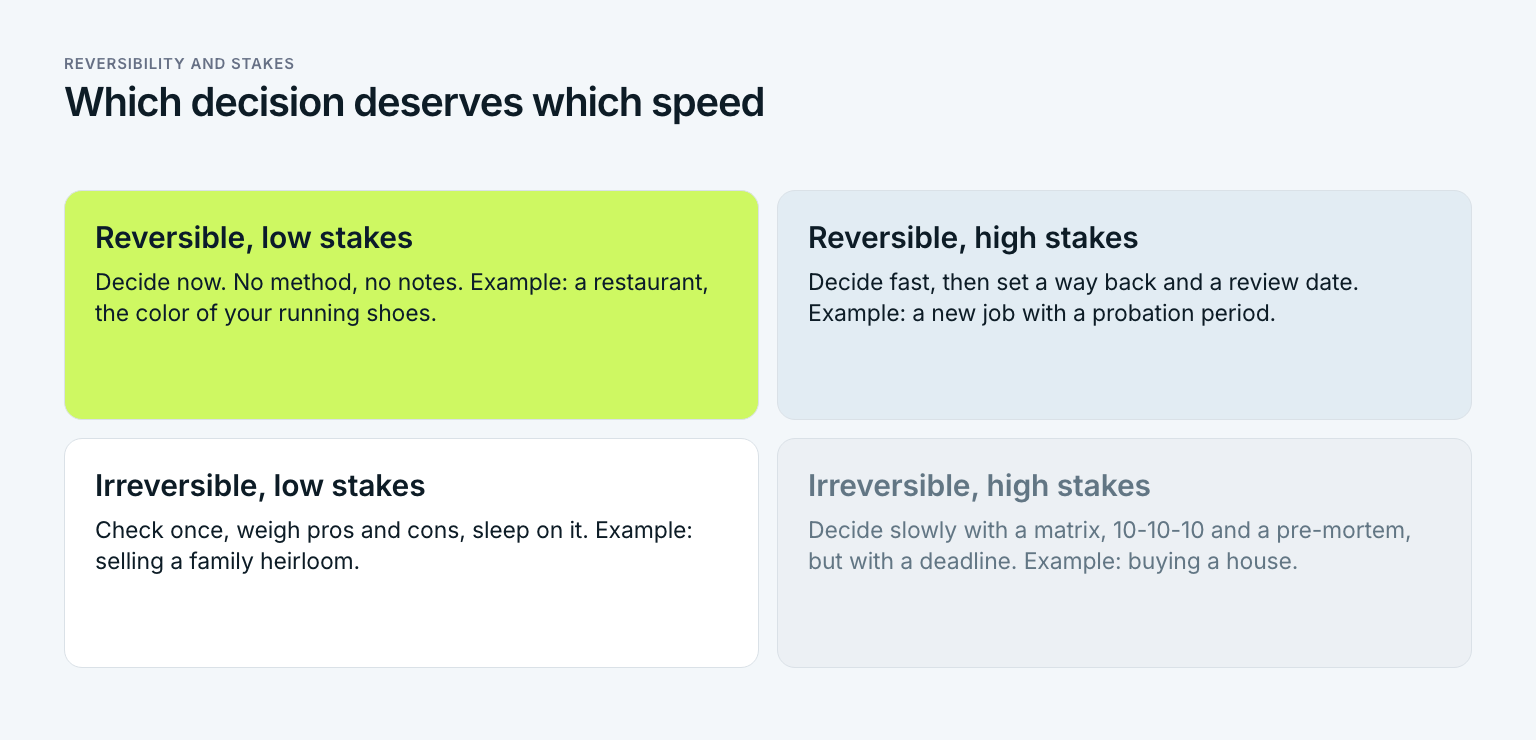
Looked at closely, Marcus's decision has a one-way part and a two-way part. Turning down the corporate offer is close to a one-way door, because the company will hire someone else. Applying for the curriculum role is a two-way door: if it falls through, his teaching job is still there, and that is a fine place to be. That means: asking about reversibility often makes a big decision smaller than it feels. Marcus can move fast on the two-way part and spend his care on the one-way part.
What reversible really means
Reversible does not mean free. A job change that fails still costs energy and a few months. Reversible means you can return to a situation that is roughly as good as the one you have today. Whoever can answer yes to that for an option is allowed to decide faster than feels comfortable.
Which method fits which decision
| Method | Best for | Time needed |
|---|---|---|
| Reversibility check | Every decision, first, because it sets the effort | two minutes |
| Weighted pros and cons | Yes or no questions with moderate stakes | 20 minutes |
| Weighted decision matrix | Three or more options that touch several goals | 30 to 60 minutes |
| 10-10-10 | Choices where a strong feeling in the moment drowns out everything else | ten minutes |
| Pre-mortem | After you choose, before you act | 20 minutes |
The methods do not compete. They build on each other. Marcus used all five because his decision is big and partly one-way. For whether to sign up for an evening course in the spring, a reversibility check and two minutes of pros and cons are enough.
How to make a decision that fits your goals
A good decision is one that fits your goals. You cannot know more than that in advance, because the outcome always depends partly on luck. Former professional poker player Annie Duke, in her 2018 book “Thinking in Bets,” calls the habit of judging decisions by their outcomes “resulting.” Anyone who grades a decision only by how it turned out learns from luck instead of from their own process.
That is why it pays not to invent new criteria for every decision. Whoever sets their goals once a year already has a weighted list for every major choice. How to find goals worth that role is covered in the guide to life goals. How goals hold up in everyday life is the subject of how to achieve goals. For the many small daily calls, such as what comes first and what does not happen at all, the Eisenhower matrix is the right tool. This guide is built for the decisions that shift an entire goal chain.
Your decision in the goal chain: year, quarter, month, week, day
It also works the other way around. A decision is only finished once it shows up in your plan. Otherwise it stays a resolution without consequences. Marcus translates his choice into five levels:
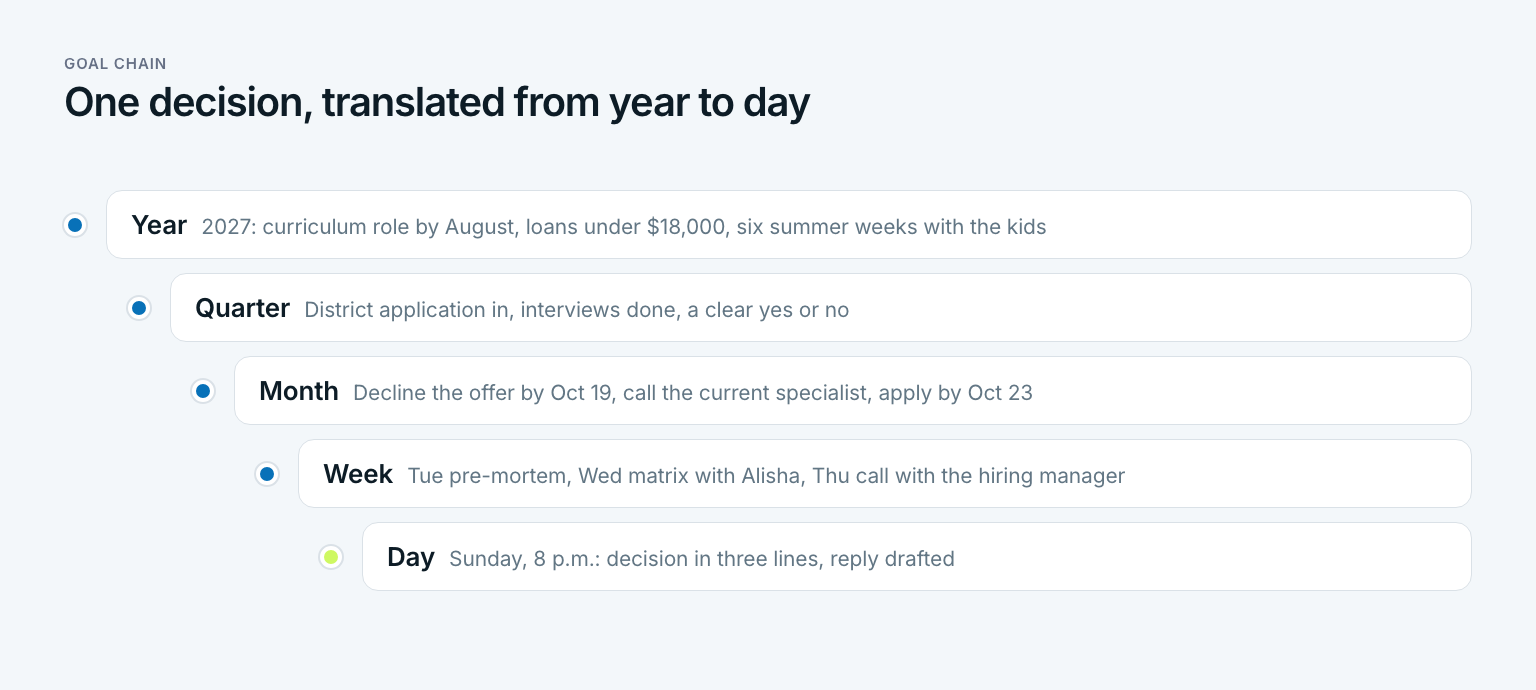
- Year 2027: In the curriculum role by August, loan balance under $18,000, six weeks of summer with the kids.
- Quarter through December: District application submitted, interviews done, a clear yes or no from the district.
- Month of October: Decline the corporate offer by October 19, call the current curriculum specialist, submit the district application by October 23.
- This week: Tuesday the pre-mortem, Wednesday the matrix with Alisha, Thursday the call with the hiring manager.
- Today: Sunday, 8 p.m., 30 minutes. Write the decision in three lines and draft the reply.
One entry most people forget: the review date. Marcus puts August 1, 2027 on his calendar, about ten months after the decision, matching the middle step of his 10-10-10. On that day he answers three questions: What did I expect? What happened? What would I decide differently now? In Gaapp, that note lives right on the yearly goal, so the why sits next to the progress. For smaller decisions, your weekly review works as the review date.
Three decision making mistakes nobody notices
Getting better at decision making mostly means dropping three habits that feel like diligence. None of them is foolish. Each one looks thorough from the outside and still gets in the way of a good choice.
The most common mistake: criteria after options
Most people look at the options first and then think about what matters. That produces criteria that let the favorite win. Set your criteria and weights from your goals before you score the first option. Then the matrix actually measures instead of just confirming what you already wanted.
- Deciding without a deadline. A question without a date stays open, and open questions drain energy every evening. Anyone who sets a deadline will sometimes decide with 70 percent of the information. For two-way doors, that beats not deciding almost every time.
- Confusing the outcome with the decision. When something goes wrong, it does not mean the choice was wrong. On your review date, check whether your assumptions held, not only whether you like the result.
- Deciding alone what others will live with. If a decision affects a partner, family, or team, their goals belong in the criteria. Otherwise the matrix is cleanly calculated and still wrong.
Marcus nearly made the third mistake. He filled out his first matrix alone. When Alisha set her own weights, family time went up from 30 to 35 percent and meaningful work came down. The winner did not change. The feeling of having decided together changed a great deal.
Three questions before you commit
- Which of my goals does this decision move, and by how much?
- Is it a one-way or a two-way door, and what would the way back cost?
- How will I know on my review date whether it was right?
Whoever can answer these three questions no longer needs a perfect method. Marcus sent his reply to the company on Sunday at 8:25 p.m. and his district application on Monday morning. In short: a good decision is not one that feels safe. It is one you can measure against your goals.
Frequently asked questions about making decisions
What are 5 ways to make a decision?
Five reliable methods are a weighted decision matrix, a pros and cons list with weights, the 10-10-10 rule, a pre-mortem, and a reversibility check that sorts one-way doors from two-way doors. Start with the reversibility check, because it tells you how much effort the decision deserves. Use the matrix when you have three or more options and several goals at stake.
What is the 10-10-10 rule for decisions?
The 10-10-10 rule comes from journalist Suzy Welch, who described it in her 2009 book of the same name. You ask how you will feel about a decision in ten minutes, ten months, and ten years. It separates the loud emotions of the moment from the consequences that last.
Why do I struggle making decisions?
Usually because you have no clear yardstick, the question is framed too narrowly as yes or no, or the decision feels more permanent than it is. Many people also aim for the perfect option instead of a good one. Deriving criteria from your goals and setting a deadline clears most of these blocks.
How do you make a decision when you can't decide?
Set a deadline, check whether the decision is reversible, and add a third option if you only have two. If you are still stuck, flip a coin and notice whether you feel relief or disappointment when it lands. That reaction tells you what you actually want.
What is the decision making process?
The decision making process is a sequence of five steps: name the decision and set a deadline, widen your options, turn your goals into weighted criteria, score and decide, then record the decision and set a review date. The order matters more than the tool you use in each step. Criteria always come before scoring.
Should I trust my gut when making decisions?
Your gut is reliable in areas where you have a lot of experience and get fast feedback, such as your own field of work. Daniel Kahneman and Gary Klein reached exactly that conclusion in a joint paper in 2009. For rare, big decisions like a career change, that experience is missing, and a method helps more.
Last updated: 19 October 2026
Read next
 Goal Setting
Intrinsic Motivation: What Drives You From the Inside
Intrinsic motivation is not a personality trait. Meaning, 12 examples, the three needs behind it and five steps to build it, with a worked example.
17 min read
 Goal Setting
Financial Goals: How to Turn Wishes Into a Plan
Financial goals are not wishes with a dollar sign. Short and long term examples, SMART savings goals and a five step plan, worked through one year.
17 min read
 Goal Setting
WOOP Method: Four Steps From Wish to If-Then Plan
The WOOP method is not positive thinking. What WOOP stands for, the research, if-then plans, eight goal examples and a five-minute guide.
18 min read