Yearly Goals: How to Pick Three to Five That Last
Yearly goals are not a to-do list: three goal types, a three-question test, six steps, and 30 annual goals examples for 2027, with a worked example.

Contents
- 01What yearly goals are and how they differ from resolutions
- 02Three types of annual goals: outcome, habit, limit
- 03The three-question test for your goals for the year
- 04How to set yearly goals in six steps
- 05Marcus's yearly goals for 2027: a worked example
- 06Yearly goals examples: 30 goals for 2027
- 07From yearly goals to a Saturday morning: the goal chain
- 08Three mistakes that end yearly goals by March
- 09Three questions before you lock in your list
- 10Frequently asked questions about yearly goals
Yearly goals are not a to-do list for the next twelve months. They are three to five results, habits, or limits that you can check with a plain yes or no on December 31, one for each area of life that matters most this year. A to-do list collects everything you could do. Yearly goals decide what you will actually do this year, and what you will not.
Three things turn a wish into a yearly goal: a type, a price, and a first step. The type tells you what you will check at the end of the year. The price tells you how many hours per week the goal costs. The first step has a date in January. All of it is worked through with Marcus, a teacher who writes down 16 wishes for 2027 in December and keeps five. You also get a three-question test, six steps to copy, and 30 yearly goals examples written as finished goal statements.
What yearly goals are and how they differ from resolutions
A yearly goal is a state you want to reach by December 31, written so that the calendar decides whether you made it, not your mood. It sits between two other levels. Above it are life goals, which take decades. Below it are quarterly and monthly goals, which cut the year into checkpoints. Anyone who mixes up these levels ends up with life goals that have a year attached, or monthly goals stretched over twelve months.
| Term | Time frame | Shape | Example |
|---|---|---|---|
| Life goal | ten to 30 years | A direction and a state | Be able to retire from teaching at 55 and tutor part time |
| Yearly goal | twelve months | Outcome, habit, or limit with a number | Pay off the $7,200 car loan by December 31, 2027 |
| Quarterly goal | three months | A checkpoint with a number | Car loan balance down to about $5,400 by March 31 |
| Resolution | open | An intention with no number | Get better with money |
Resolutions are a fine place to start. They tell you what you care about. The trouble is that nobody can say on December 31 whether you got better with money. A yearly goal turns the same intention into a number with a date. Life goals, on the other hand, are too big for one year, but they give your annual goals a direction. That is why the question of what you want from life belongs before your yearly planning, not in the middle of it.
Yearly goals are the core of an annual plan, but not the whole plan. A full plan also includes a review of the past year, quarters, months, and a fixed weekly rhythm. The step-by-step guide to annual planning walks through all of that with a template. This article covers the step before: which goals deserve a place in that plan, and how to word them so they survive until December. How to turn a finished goal into a plan with milestones is in the guide to goal planning.
Three types of annual goals: outcome, habit, limit
Not every annual goal is a result. Many of the goals that matter most in a year are repetitions or caps. Whoever forces every goal into the same shape gets numbers that mean nothing or habits that nobody counts. Three types cover almost everything:
- Outcome goal. A state with a number and a date: exam passed, loan paid off, book published. On December 31 it is either done or not. Outcome goals need checkpoints, or you find out in October that the time ran out in June.
- Habit goal. An action with a yearly count: 150 workouts, 24 books, 24 date nights. The number is a tally, not a finish line. Habit goals survive bad weeks because the rest of the year can make up for them.
- Limit goal. A ceiling for something you want less of: takeout no more than four times a month, no work email after 8 p.m. on more than ten nights. Limit goals cost no hours. They cost attention, which is exactly why they need a counter.
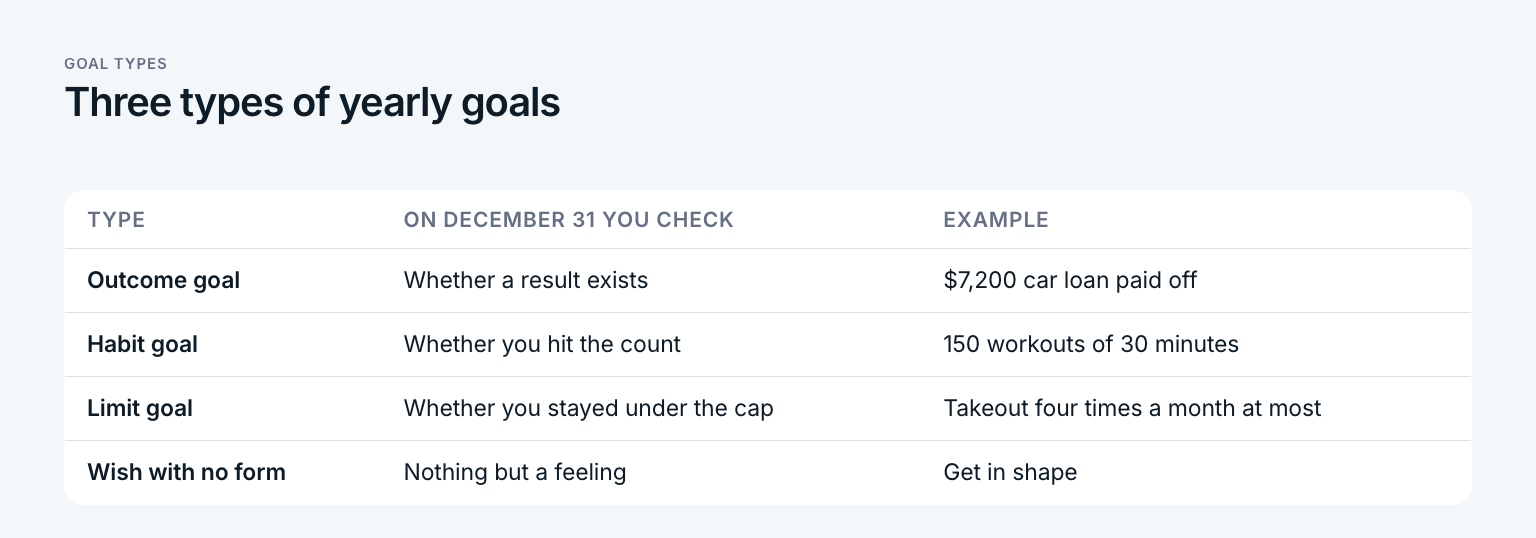
Which type fits which wish? The rule of thumb is simple. If something should be finished at the end, use an outcome goal. If you want to do something more often, use a habit goal. If you want less of something, use a limit goal. That means: get in shape can become three very different yearly goals, depending on what you want to see on December 31. A 10K under 55 minutes, 150 workouts, or never more than two weeks in a row without exercise.
Most lists contain nothing but outcome goals. That looks ambitious, but an outcome goal that wobbles in June drags the whole year down, because it only knows yes or no. A mix holds up better: habits bring a small win every week, and limits protect the time and money your other goals need.
What goal research says about numbers
Edwin Locke and Gary Latham summarized decades of studies in their 1990 book A Theory of Goal Setting and Task Performance. Their finding: specific, challenging goals lead to better performance than the instruction to do your best. The number in a yearly goal is not paperwork. It is the yardstick that lets you correct course in March.
The three-question test for your goals for the year
A good yearly goal passes three questions. The SMART rule checks whether the sentence is well built. This test also checks whether your year can carry the goal. You need both. For a closer look at the SMART formula, see these SMART goals examples.
The yearly goal test
Checkable: could a stranger answer yes or no on December 31? Priced: do you know how many hours per week the goal costs, and do you have those hours? Ready: does the first step have a date in January? A no does not mean the goal is wrong. It means the sentence is not finished yet.
The first question separates goals from intentions. Live healthier fails. Work out for 30 minutes or more on 150 days passes. The second question is the one almost every list skips. A year has 52 weeks, and your free time inside them is limited. Anyone who sets five goals that need 20 hours a week but has six hours free has already decided in December which goals will die in May. They just do not know it yet.
The third question protects you from the February slump. A goal without a first step waits for the right moment, and the right moment rarely shows up. Psychologist Peter Gollwitzer described in 1999 how plans with a fixed when and where get carried out far more often than plans without them. He called them implementation intentions. For yearly goals that means the first step gets a date, not a week. In short: checkable makes a goal honest, priced makes it possible, ready makes it real.
How to set yearly goals in six steps
The six steps take about two hours, a quiet evening in December, and your January calendar. How many workdays 2027 holds in each quarter is in our guide to goals for the new year. Marcus, 36, teaches high school chemistry in Raleigh, North Carolina. He is married to Priya, and their daughter Maya is six. He worked through the steps on a Sunday in mid December, and his numbers appear in every step. The first step, a short look back at the old year, grows into a full year in review if you give it three hours.
Review the past year, 20 minutes
Three questions are enough: what worked, what ate your time, what do you never want to repeat? Marcus noticed one thing above all. Of his seven resolutions for 2026, only one survived: a $100 monthly transfer to savings, set up once in January and never touched again. It needed no willpower.
Write down every wish, 15 minutes
No filter and no polish, including the awkward ones. Marcus ends up with 16 entries, from get in shape and learn Spanish to fix up the backyard. The list is raw material, not a plan.
Pick one wish per area of life, 20 minutes
Sort the wishes into six areas: health, money, career, family and relationships, learning, and home and community. Only one wish per area moves on. Marcus has four entries under health and three under learning. Six candidates remain.
Cut to three to five areas, 15 minutes
Ask of each candidate: is my year better if this is done by December 31? Cross off whatever would only be nice. Marcus drops learning and home. Spanish and the backyard are not forgotten. They go on a list for 2028 or for a quiet quarter.
Turn each wish into a goal statement, 30 minutes
Choose the type and write the sentence so it passes the test. Get in shape becomes work out for 30 minutes or more on 150 days. Pay off the car becomes pay off the remaining $7,200 on the car loan by December 31.
Set the price and the first step, 20 minutes
Estimate the hours per week for each goal and add them up. If the total is more than your free time, cut further or shrink a goal. Then give each goal a first step with a date in January, and spread the starts over several days.
The order matters. Anyone who starts by wording goals ends up polishing sentences for goals they will cut in step four. Anyone who skips the price ends up with five beautiful sentences and no year to fit them into. Two hours is not much for twelve months.
Marcus's yearly goals for 2027: a worked example
Marcus's 16 wishes would have cost about 26 hours a week. He estimated that in step six, wish by wish. During the school year he has about six free hours a week: three weeknight hours after Maya is asleep and three on Saturday morning. During the ten weeks of summer break he has about 20. His list was more than four times the size of a normal school week. No wonder only one of his 2026 resolutions made it.
| Yearly goal 2027 | Type | Hours per week, school year | Hours per week, summer | First step in January |
|---|---|---|---|---|
| Self-publish a 120-page chemistry study guide by August 15 | Outcome | 1 | 10 | Jan 9: list the twelve chapters |
| Pay off the remaining $7,200 car loan by December 31 | Outcome | almost 0 | almost 0 | Jan 4: raise autopay from $350 to $600 |
| Work out for 30 minutes or more on 150 days | Habit | 1.5 | 2 | Jan 5: first run, Tuesday 6:15 a.m. |
| 24 date nights with Priya, two a month | Habit | 1.5 | 1.5 | Jan 15: first date night, sitter booked |
| Takeout no more than four times a month | Limit | 0 | 0 | Jan 4: delete two delivery apps |
| Total | 4 of 6 | 13.5 of 20 | Five starts on four days |
Every number in the table checks out. The workouts need just under three sessions a week, because 150 days spread over 52 weeks is 2.9. The car loan needs $7,200 in twelve months, which is $600 a month plus a little interest that his spring tax refund covers, and about one hour of work in January. The study guide is the expensive goal at roughly 120 hours. About 20 of them happen in one-hour Saturday slots from January to May. The other 100 happen in ten summer weeks at ten hours each.
That is the real lesson of Marcus's list. His year is not 52 identical weeks. A goal that would never fit into a school week fits easily into the summer, as long as the plan says so in January. Whoever has a busy season and a quiet one should put the expensive goal where the hours are. Is that cheating? No. It is the only honest way to plan a year that is not flat.
The fifth goal costs no time. It pays for another goal. Marcus had not planned a takeout limit at all. He added it in step six, when the car loan math did not work. In 2026 the family ordered takeout about ten times a month at roughly $40 an order. Cutting to four frees around $240 a month, almost exactly the $250 he needs to raise the car payment from $350 to $600. That means: without the limit goal, the outcome goal would have stayed a wish. Whoever sets an expensive outcome goal should ask which limit goal can fund it.
How many yearly goals you should set
Three to five, and the ceiling is set by your calendar, not your discipline. Marcus has five goals, but two of them cost almost no time. Anyone with three expensive outcome goals is full at three. Anyone who plans mostly habits and limits might manage five. Isn't that too few for an entire year? Not really, because every goal you cut gives its hours to the goals you keep. The case for fewer goals is made in detail in why three goals are enough.
Yearly goals examples: 30 goals for 2027
The examples below are finished goal statements that pass the three-question test. Do not copy any of them word for word. Change the number until it fits your year, then check the price. The table sorts 18 examples by area of life and type. After it come twelve more for work, money, couples, families, and teams.
| Area of life | Outcome goal | Habit goal | Limit goal |
|---|---|---|---|
| Health | Run a 10K under 55 minutes by October 31 | Work out for 30 minutes or more on 150 days | In bed after 11 p.m. on no more than 40 nights |
| Money | Pay off the remaining $7,200 car loan by December 31 | Review last month's spending on the first of every month, twelve times | Impulse buys online capped at $75 a month |
| Career | Earn the certification your next role requires by September 30 | Read 40 industry articles and write three takeaways for each | Work email after 8 p.m. on no more than ten nights |
| Family and relationships | Summer trip booked and paid for by March 31 | 24 date nights, two a month | No more than two weekends a year where one of us works |
| Learning | Pass a Spanish exam at level A2 by November 30 | Read 24 books, two a month | Social media capped at 60 minutes a day, weekly average |
| Home and community | Garage cleared down to four shelves by April 30 | 26 hikes, one every other weekend | No more than 20 new pieces of clothing all year |
Yearly goals for work: career and business examples
Career goals rarely fail because of the number. They fail because they come from a manager or the market instead of from you. Anyone who is employed should keep the company's performance goals separate from their own yearly goal. Anyone who is self-employed needs a goal that protects them from their own business.
- Ask for a raise by June 30, with a specific number and three documented wins from the past year.
- Move into a team lead role by March 31, or get a clear no with reasons.
- Have twelve coffee conversations with people outside your team, one a month.
- As a freelancer, grow revenue from $60,000 to $75,000 while averaging no more than 40 hours a week.
- As a business owner, take four weeks off, two of them in a row, all on the calendar by January 31.
- Run no more than three client projects at once, on every day of the year.
Yearly goals for couples, families, and teams
Shared goals follow the same rules, with one difference. Everyone involved must be able to check the sentence with a yes or no without asking the others. A goal only one person understands is not a shared goal. It is an assignment.
- As a couple: one weekend a quarter without the kids, all four dates on the calendar by January 31.
- As a couple: $15,000 saved for a down payment by December 31, $1,250 a month together.
- As a family: 160 dinners a year with no screens at the table, just over three a week.
- As a family: the youngest can swim one length of the pool unaided by July 31.
- As a team: response time to customer requests cut from five business days to two by December 31.
- As a team: twelve retrospectives a year, one a month, each ending with exactly one agreed change.
From yearly goals to a Saturday morning: the goal chain
A yearly goal on its own is too far away to act on today. Between December 31 and this Saturday morning sit four levels: quarter, month, week, and day. Each level has its own goal, and each one hangs on the level above. Each month gets up to three monthly goals, set in a 45-minute monthly planning session before it starts. For Marcus's most expensive goal, the chain looks like this:
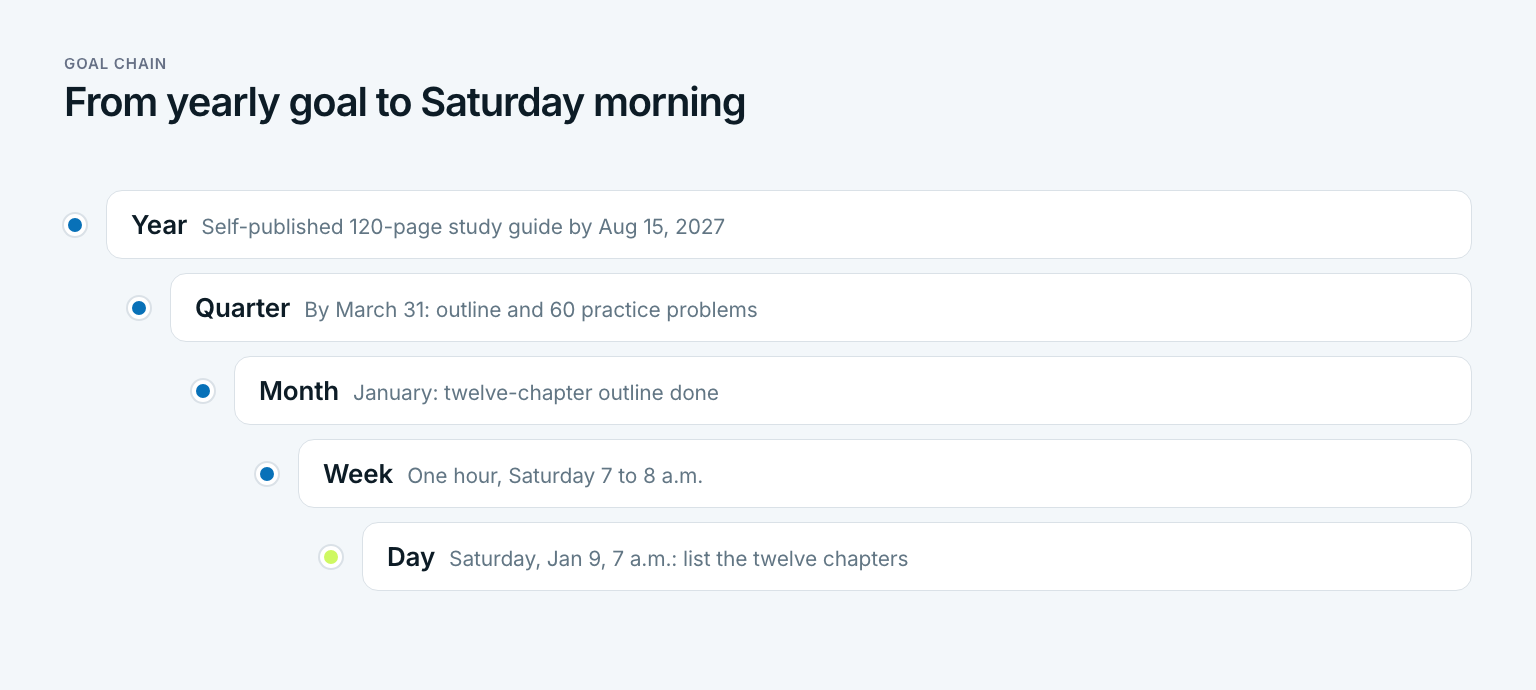
The chain makes something visible that the yearly goal hides. Marcus's study guide is back-loaded on purpose. When school ends in early June, about 20 of 120 hours are done, roughly 17 percent, while more than two thirds of the time until August 15 has passed. On a straight line he would look hopelessly behind. On his quarterly plan he is exactly on schedule. Without the quarters, how would he tell the difference? The mid-year review in June is where he reads that difference and decides whether the goal still holds.
For habit goals, the chain is shorter. 150 workouts a year come to about 38 per quarter, 13 per month, and three per week. Limit goals only need a monthly counter. Four takeout orders a month means anyone already at four by the 15th knows something in the routine is broken, not their willpower. How to break each level down cleanly is covered in turn yearly goals into daily steps.
In Gaapp this chain is the whole structure: year, quarter, month, week, and day, with each goal hanging on a bigger one. Progress for each period is the share of goals completed, shown next to the time that has passed. At the end of each quarter you spend one hour on every yearly goal and decide: keep going, shrink it, or drop it. Four of those check-ins a year are enough when the weeks in between keep moving.
Three mistakes that end yearly goals by March
Most yearly goals do not die in December. They die between February and April, quietly, from mistakes that felt right when you wrote the list. Do you recognize one of these from last year?
The most common mistake: goals with no price
Almost every list of yearly goals is bigger than the year it is meant for. Nobody does the math, because wishes do not come with hours. Marcus's list would have needed 26 hours a week with six available. Anyone who does not pay the price in December pays it in March, with the first goal that quietly disappears.
The other two mistakes are quieter:
- Everything starts on the same day. January 1 is a good starting point. Hengchen Dai, Katherine Milkman, and Jason Riis described the fresh start effect in 2014: after temporal landmarks such as New Year's Day, people are more likely to start working on their goals. The problem is that five goals then begin in the same week, and the first full week of January becomes overload. Stagger the starts. Marcus raises the car payment on January 4, runs on January 5, outlines on January 9, and has his first date night on January 15.
- Goals that someone else set. Expectations from a boss, family, or social media often sound like your own goals. They are usually well meant. They just lack a reason of your own, and without one no goal lasts until October. Ask of each goal: would I still pursue this if nobody ever found out? Anyone who hesitates should cut the goal or find their own reason for it.
All three mistakes have one thing in common. They do not come from laziness. They come from optimism. In December the year feels huge, and every week in it looks empty. That means the best protection is not stronger willpower, but more honest math.
Three questions before you lock in your list
Before you close your list for 2027, answer three questions in writing, with numbers:
- Is the total of hours per week lower than your free time, with at least one hour to spare?
- Does every goal have a first step with a date in January, and do they start on different days?
- Would you pursue every goal even if nobody ever found out about it?
Anyone who answers no to one of these does not lack ambition. They have not decided yet. Cutting a goal is cheap in December and expensive in May. For the bigger picture, from life goals down to daily goals, see the guide on how to achieve goals. In short: yearly goals are not a list of everything you want. They are a decision about what your year can hold.
Frequently asked questions about yearly goals
What are the 10 examples of goals?
Ten solid examples for one year: work out on 150 days, pay off a car loan, read 24 books, save $15,000, pass a certification exam, have 24 date nights, cap takeout at four times a month, take four weeks off, run a 10K, and clear out the garage. Each one only becomes a goal once it has a number and a date. The 30 examples above show the full wording.
What are 5 good goals?
Five good goals cover five different areas of life and mix all three types. For example: 150 workouts for health, a $7,200 loan paid off for money, a certification by September for your career, 24 date nights for your relationship, and a takeout cap as a limit. Together they should cost fewer hours than you have free each week.
What are some goals this year?
For 2027, pick three to five goals from different areas of life and give each one a type: an outcome, a habit, or a limit. Good starting points are a savings or debt number, a workout count, one career milestone, and a cap on something that eats your time or money. Then check whether the total hours fit your week.
What are the 10 goals in life?
There is no fixed list, but most lasting life goals fall into the same ten areas: health, money, career, relationships, family, learning, home, community, adventure, and meaning. Life goals take decades. Yearly goals are the steps that move one or two of these areas forward this year.
How many yearly goals should I have?
Three to five. Your calendar sets the ceiling: add up the hours per week each goal needs and compare the total with your free time. Goals that cost almost no time, like an autopay change or a limit goal, can usually be added on top.
When should I set my goals for the year?
The second half of December works best, after a short review and before your first workday in January. That way every goal can start with a dated first step in the first two weeks of the year. Starting later costs nothing: a yearly goal can begin on February 1, it just needs a smaller number.
Last updated: 19 October 2026
Read next
 Planning
Cleaning Schedule: Daily, Weekly and Monthly Tasks
A cleaning schedule is not a Saturday to-do list: daily, weekly and monthly tasks, a printable template and a fair split for families.
15 min read
 Planning
Study Plan: How to Make One You Can Actually Follow
A study plan is not a schedule. Make one in six steps: inventory, hours math, buffer, a sample study schedule and a template, with a worked example.
17 min read
 Planning
Bullet Journal: How to Start One You'll Actually Keep
A bullet journal is not an art project. Learn the bullets, four core modules, migration and a six-step setup, with an example, 12 ideas and a goal chain.
15 min read