SMART Goals: Meaning, Examples and How to Write Them
SMART goals turn a wish into a result a stranger could check: the five criteria explained, seven steps, five examples, and one goal from year to day.

Contents
- 01What SMART goals are and what the acronym means
- 02The five SMART criteria, letter by letter
- 03Where SMART comes from, and what Doran actually wrote
- 04How to write SMART goals in seven steps
- 05Five SMART goals examples for work and personal life
- 06The three mistakes that make SMART goals fail quietly
- 07SMART goals in the goal ladder: from year to day
- 08When SMART goals are the wrong tool
- 09Your SMART goals template and three questions before you commit
- 10Frequently asked questions about SMART goals
SMART goals are goals written so that five questions have a clear answer before you start: What exactly will be done, how will you know it is done, is it within your reach, why does it matter, and by what date. The letters stand for Specific, Measurable, Attainable, Relevant and Time-bound. A SMART goal is not a checklist you tick once and file away. It is a test you run on a wish before you give it a single week of your life.
Most wishes fail the test on the first pass. “Get in shape” names no measure. “Grow the business” names no date. “Read more” names nothing at all. That is not laziness. It is how people talk about what they want, and talk is where every goal starts. The SMART criteria translate that talk into a sentence a calendar can hold. Everything below gets worked through on one example: Dana, 34, an ER nurse in Denver who works three twelve-hour shifts a week and wants to finish her first half marathon.
What SMART goals are and what the acronym means
SMART is an acronym, and each letter names one criterion a goal has to meet before it counts as a goal rather than a hope. Specific: the goal names one result, not a direction. Measurable: a number or a yes-or-no event shows whether it happened. Attainable: the result is within reach with the time and money you actually have. Relevant: it matters to something larger than itself. Time-bound: there is a date. Five criteria, one sentence. Whoever gets all five into the sentence has a SMART goal. Whoever misses one has a wish with good intentions.
The SMART goals meaning gets lost the moment people treat the acronym as a form. Anyone who writes “Specific: yes, Measurable: yes” down the margin of a goal has filled out a form. Anyone who rewrites the goal until a stranger could check it on the due date has used the method. The difference shows in one test. Could someone who does not know you read the goal on the deadline and say, without asking you a single question, whether it happened? Dana's first version was “get back into running this year.” No stranger could check that. Her final version was “finish a half marathon in Denver on October 17 in under 2 hours and 15 minutes.” A stranger with the results page could check it in ten seconds.
That is the whole method. The five letters are not five separate jobs. They are five angles on the same question: Would a stranger know?
The five SMART criteria, letter by letter
Each criterion fixes one way goals go soft. Taken together they leave the sentence no room to hide. Here is what each one asks, and what it caught in Dana's first draft.
- Specific. What exactly, and what is not included? “Run more” is a direction. “Finish a half marathon” is a result with an edge: 13.1 miles, one race, one day. Specific does not mean detailed. A specific goal can be short. It only has to name one result that cannot be confused with its neighbor.
- Measurable. How will you know? The measure is a number, a date or an event that either happened or did not. “Run faster” fails. “Under 2:15” passes. A measure also needs a baseline, and this is where most drafts quietly break. Dana timed a 5K in April: 34 minutes. Only with that number did 2:15 for 13.1 miles, about 10:18 per mile, become a real stretch instead of a random one.
- Attainable. Is it within reach with the hours you have? Dana works three shifts of twelve hours, which leaves four days and a tired body. Three runs a week fit. Six do not. Attainable is the letter people get wrong in both directions. Too timid, and the goal changes nothing. Too bold, and it dies in March.
- Relevant. Why this, and why now? Dana turns 35 in November and wants proof that shift work has not taken her fitness. That is her sentence. Relevant also means relevant to the rest of your year. A goal that competes with everything else you want is not relevant. It is a distraction with a deadline.
- Time-bound. By when? Not “this year.” A date. October 17. A date does something no other letter does: it counts backward. From the second week of January that is 40 weeks, and 40 weeks can be cut into quarters, months and Tuesdays.
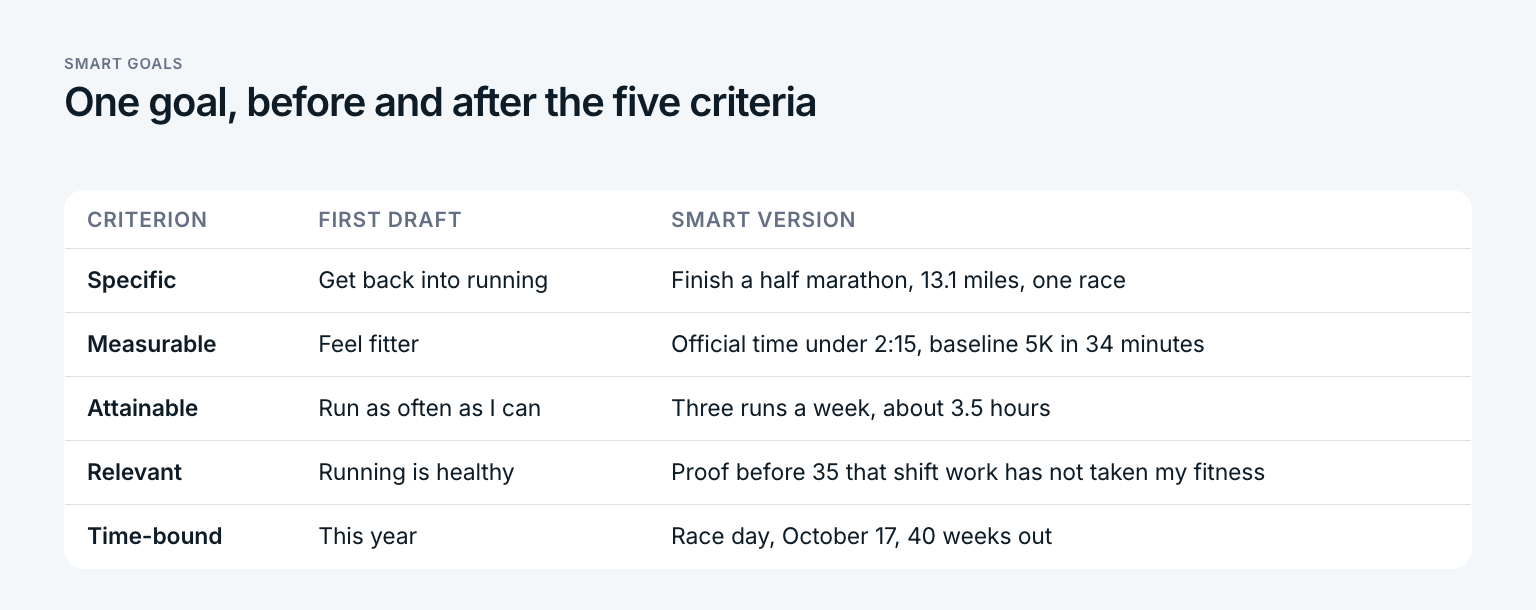
Here is Dana's goal before and after, letter by letter. Notice that the SMART version is not longer. It is simply checkable.
| Letter | The question | Dana's first draft | Dana's SMART version |
|---|---|---|---|
| Specific | What exactly? | Get back into running | Finish a half marathon, 13.1 miles, one race |
| Measurable | How will I know? | Feel fitter | Official time under 2:15, baseline 5K in 34 minutes |
| Attainable | Does it fit my hours? | Run as often as I can | Three runs a week, about 3.5 hours including warm-up |
| Relevant | Why does it matter? | Everyone says running is healthy | Proof before turning 35 that shift work has not taken my fitness |
| Time-bound | By when? | This year | Race day, October 17, 40 weeks from the start |
Where SMART comes from, and what Doran actually wrote
The acronym first appeared in print in November 1981. George T. Doran, a consultant and former director of corporate planning, published a two-page article in Management Review titled “There's a S.M.A.R.T. Way to Write Management's Goals and Objectives.” His letters were Specific, Measurable, Assignable, Realistic and Time-related. Assignable meant: name who will do it. Realistic meant: state what can be achieved with the resources at hand. Doran also wrote a sentence most summaries leave out. Not every objective, he said, has to meet all five criteria. The acronym was a prompt for managers writing objectives, not a law.
Attainable and Relevant came later, as the method traveled out of corporate planning and into personal development. Paul J. Meyer, who built a career around goal setting and published “Attitude Is Everything” in 2003, carried it to people setting goals for themselves. In a personal goal nobody assigns anything, so Assignable gave way to Attainable, and Relevant took the place of Realistic in most versions you will meet today. Some add E and R for Evaluated and Reviewed and call it SMARTER.
That means: when a guide lists “the five principles of SMART goals,” it is quoting one version among several. The letters shift. The test does not. Every version asks whether a stranger could check the goal on the due date. Anyone who argues about Attainable versus Achievable has stopped setting goals and started collecting acronyms.
How to write SMART goals in seven steps
Writing the sentence takes 20 minutes the first time and five the second. The order matters, because each step protects the next from wishful thinking. Dana's answers are in every step.
Write the wish exactly as you say it
Use the words you would say to a friend. Do not improve them yet. Dana wrote: “I want to get back into running.” That sentence is the raw material, and it is honest.
Name the result, not the activity
Ask: What will be true when this is done? Running is an activity. A finished race is a result. Dana wrote: “Finish a half marathon.” If your answer is still a verb, ask the question again.
Measure your baseline, then pick the number
Before you set a target, measure where you are. Dana ran a timed 5K: 34 minutes, just under eleven minutes per mile. From there, 2:15 for a half marathon means holding a slightly faster pace for four times the distance. Without the 34, the 2:15 would be a guess.
Count the hours you really have
Look at a normal week, not an ideal one. Dana has four days off, two of them for recovery and family. Three runs, about 3.5 hours including warm-up. If the goal does not fit the hours, shrink the goal. Do not shrink the honesty.
Write down why, in one sentence
“Proof before I turn 35 that shift work has not taken my fitness.” If you cannot write the sentence, the goal belongs to somebody else: your doctor, your boss, a feed. Keep it anyway if you must, but know it will lose every tie.
Set the date and count backward
October 17 is 40 weeks away. Dana splits them: a 5K without stopping by March 31, a 10K by June 30, an eleven-mile long run by September 30. Each quarter gets a measurable result of its own.
Run the stranger test and write the final sentence
Read the sentence as a stranger with the results page in hand. Could they check it? Dana's final version: “Finish a half marathon in Denver on October 17 in under 2:15, training three runs a week from January 11.” Then put it where you see it every Sunday.
Seven steps sound like a lot for one sentence. They are not seven sentences. They are seven places where a goal usually leaks, and step three is the one almost everyone skips. Anyone who skips the baseline ends up with a goal that feels SMART and measures nothing. Anyone who skips step four ends up with a goal that is SMART on paper and homeless in the calendar. Four ways to put a number on a goal with nothing obvious to count are laid out in measurable goals examples.
Five SMART goals examples for work and personal life
Personal SMART goals follow the same five letters as goals at work. Only the Relevant line changes, because nobody assigns the goal to you, so the reason has to be yours. Here are five examples across five areas of life, each with the vague version it started from and the measure a stranger would use on the due date. The work side, with examples by role and industry, is covered in SMART goals for work.
| Area | Vague version | SMART goal | Measure on the due date |
|---|---|---|---|
| Fitness | Get in shape | Finish a half marathon on October 17 in under 2:15, training three runs a week | Official finishing time |
| Money | Save more | Move $400 into a separate savings account on the first of every month, reaching $4,800 by December 1 | Account balance on December 1 |
| Career | Get better at presenting | Give four 15-minute presentations to the team by June 30 and collect written feedback after each one | Four dated feedback notes |
| Family | Spend more time with the kids | Eat dinner together at the table, phones in the kitchen drawer, four nights a week through May 28, tracked on the fridge calendar | Calendar count, at least 4 of 7 each week |
| Learning | Learn Spanish | Hold a 15-minute conversation in Spanish with a tutor without switching to English by September 30, after 100 lessons of 20 minutes | Tutor confirms, lesson log shows 100 |
Look at what the five have in common. None of them says “try” or “more.” Each names a result, a number and a date, and each has a baseline hiding behind it: the current account balance, zero presentations given, two dinners a week, no Spanish. The family goal looks like an activity, and it is. Four dinners a week is a frequency, and frequency is a fine measure when the result you want is a habit. The money goal is the easiest to check and the hardest to keep, which is why the transfer sits on the first of the month, before anything else can claim the $400. More worked examples by life area, each with the measure spelled out, are collected under SMART goals examples.
The three mistakes that make SMART goals fail quietly
The method is simple, and that is its strength. Simple methods fail in simple ways. Most SMART goals that die do not die from a missing letter. They die from one of three habits that look like the method and are not. Which one is yours?
- Measuring the activity instead of the result. “Run three times a week” is a plan, and a good one. As a yearly goal it fails, because you can run three times a week for 40 weeks and still not finish the race. Activity belongs on the weekly level. The yearly level holds the result.
- Attainable turned into timid. Anyone who has been burned by a big goal tends to write the next one so small it cannot fail. It also cannot change anything. Dana's safe version was “run a 5K.” She had done that in April. Attainable means within reach with effort, not within reach from the couch.
- A deadline so far away that nothing happens before it. October tells you nothing about Tuesday. A date 40 weeks out protects you from urgency for 36 of them. The fix is not a closer deadline. It is a chain of closer ones, and that chain is the next section.
The most common mistake: a number without a baseline
“Increase by 20 percent” means nothing until you know today's number. “Under 2:15” meant nothing until Dana had run a timed 5K. Whoever sets a target without a baseline is guessing twice, once at the start and once at the end, and will not know on the due date whether the goal was hard or easy. Measure first. Then set the number. If measuring takes a week, that week is part of the goal.
SMART goals in the goal ladder: from year to day
A SMART goal with an October date is a yearly goal. It tells you where you will stand on October 17. It does not tell you what to do on Tuesday. That gap is where most goals are lost, not in the writing but in the 39 weeks between the writing and the date. The way to close it is to write the goal five times, once per time frame, and keep every version SMART in its own frame.
Dana's chain looks like this. Year: finish the half marathon on October 17 under 2:15. Quarter one, by March 31: run a 5K without stopping, three runs a week, 36 runs logged. Quarter two, by June 30: a 10K under 68 minutes. Quarter three, by September 30: one long run of eleven miles. Month, January: twelve runs, longest 3 miles. Week two of January: three runs, Tuesday, Thursday and Saturday, 8 miles in total. Tuesday: 30 minutes easy, 2.5 miles, before the house wakes up. Every level has a number and a date. Every level can be checked by a stranger. And every level answers to the one above it.
| Level | Dana's goal | Measure | Due |
|---|---|---|---|
| Year | Finish a half marathon in under 2:15 | Official time | October 17 |
| Quarter 1 | Run a 5K without stopping, three runs a week | 36 runs logged, one continuous 5K | March 31 |
| Month, January | Twelve runs, longest 3 miles | Run log | January 31 |
| Week 2 | Three runs, 8 miles in total | Tuesday, Thursday, Saturday checked off | Sunday |
| Day, Tuesday | 30 minutes easy, 2.5 miles | Done or not done | Tuesday, 6:30 a.m. |
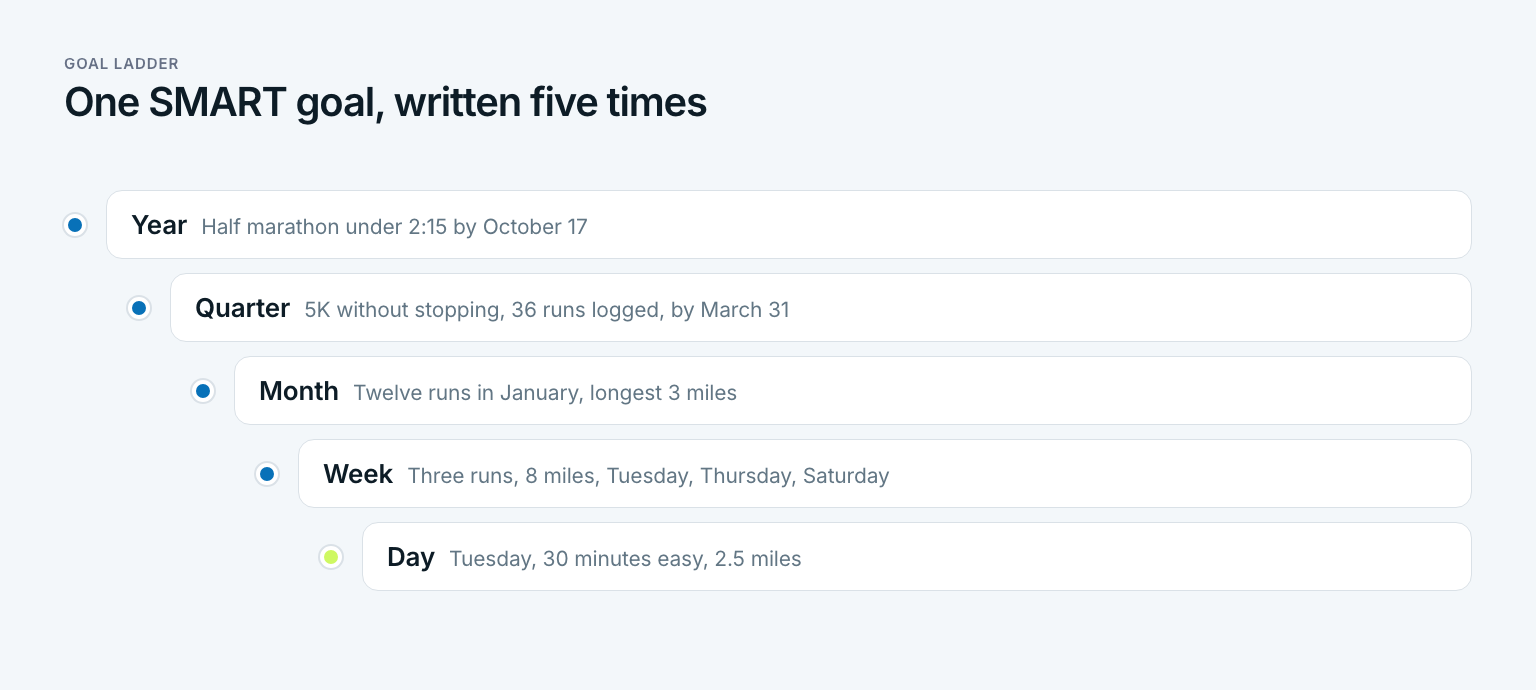
Two things change when the goal exists on all five levels. First, Attainable becomes a weekly question instead of a yearly guess. Dana does not need to know in January whether 2:15 is realistic. She needs to know whether three runs fit this week, and she finds out on Sunday. Second, progress becomes a count. At the end of January she has twelve runs or she does not. At the end of March she has one continuous 5K or she does not. The yearly goal stops being a feeling and becomes a sum of checked boxes.
This is the structure Gaapp is built around: a yearly goal at the top, quarter and month goals hanging from it, weekly goals under those, and one daily goal at the bottom. Each level shows what share of its goals is done next to what share of its time has passed. If the week is 60 percent over and one of three runs is checked, you see it on Wednesday, not in October. How to set the yearly level well is covered in annual planning, how to write the bottom level so you can check it off at night is in daily goals, and the whole chain from the first sentence to the last checkbox is in how to achieve goals.
When SMART goals are the wrong tool
SMART goals are good at one thing: turning a result into a checkable sentence. Three situations ask for something else, and knowing them saves you from forcing the acronym where it does not fit. Which framework fits which situation, from OKRs to the 12 Week Year, is compared in goal setting frameworks.
- Teams that want to stretch. OKRs, Objectives and Key Results, split a goal into a direction and two to four measures and expect you to reach about 70 percent of them. SMART expects 100. If you lead a team and want ambitious targets without punishing every miss, OKRs fit better. Each key result inside an OKR should still pass the SMART test. The OKR framework explains the difference level by level.
- Habits with no finish line. “Meditate ten minutes every morning” has no due date, because the point is that it never ends. Give it a SMART trial period instead: ten minutes every morning for 30 days, tracked. After the 30 days the habit either exists or you learned something about your mornings.
- Exploration. Anyone who does not yet know what they want cannot write a measurable result. “Figure out whether I want to leave nursing” is not SMART and should not be. Make the exploration SMART instead: three conversations with people who left, one shadow day in another field, a written decision by March 1.
In each case the acronym still earns its place one level down. The direction may stay open. The next step never does.
Your SMART goals template and three questions before you commit
A SMART goal fits in one sentence with five blanks. Fill them in order, because the order is the method. The template is written out below, followed by Dana's filled-in version so you can see how short the answer is allowed to be.
The SMART goals template
By DATE, I will RESULT as shown by MEASURE, which matters because REASON, and I will give it HOURS a week. Dana's version: By October 17, I will finish a half marathon as shown by an official time under 2:15, which matters because I want proof before 35 that shift work has not taken my fitness, and I will give it three runs and 3.5 hours a week.
Before you commit the sentence to the top of your year, ask three questions:
- Could a stranger with the right document check this on the due date without calling me?
- Do I know today's number, the baseline this goal moves from?
- Have I written the first week, not only the last day?
Whoever answers no to the first has a wish. Whoever answers no to the second has a guess. Whoever answers no to the third has a goal that will wait until September. Fix the no, then commit. Ready-made goal sets that break a yearly goal down to the week and the day are available as templates, and every goal in them can be renamed or deleted.
In short: a SMART goal is not a checklist you pass once. It is the sentence a stranger could check on the due date, written five times, once for each level of your year.
Frequently asked questions about SMART goals
What are 5 SMART goals examples?
Five from this article: a half marathon under 2:15 by October 17, $4,800 saved by December 1 at $400 a month, four 15-minute presentations with written feedback by June 30, family dinner without phones four nights a week through May 28, and a 15-minute conversation in Spanish with a tutor by September 30. Each names a result, a number and a date. That is what makes them checkable by a stranger on the due date.
How do I write my SMART goals?
Start with the wish in your own words, then name the result instead of the activity. Measure your baseline before you pick the target number, count the hours you really have, and write one sentence on why it matters. Set the date, count backward into quarters and months, and finish with the stranger test: could someone with the right document check it on the due date without asking you?
What are the 5 principles of SMART goals?
Specific, Measurable, Attainable, Relevant and Time-bound in the most common version. Doran's original from 1981 used Assignable and Realistic for the A and the R, and some versions say Achievable or add Evaluated and Reviewed for SMARTER. The letters vary, the test does not: one result, one measure, within reach, for a reason, by a date.
What are the 7 steps to set a SMART goal?
Write the wish as you say it, name the result instead of the activity, measure your baseline and pick the number, count your real hours, write the reason in one sentence, set the date and count backward, and run the stranger test on the final sentence. The first time takes about 20 minutes. The step most people skip is the baseline, and it is the one that makes the number mean something.
What is the difference between SMART goals and OKRs?
A SMART goal is one checkable sentence that you expect to reach in full. An OKR pairs a direction with two to four key results and expects about 70 percent, which suits teams that want to stretch. Each key result should still pass the SMART test, so the two are not rivals but levels.
Can SMART goals be used for personal life?
Yes, and the method changes less than you would expect. The five letters stay the same, only Relevant has to come from you, since nobody assigns a personal goal. Fitness, money, family and learning goals all turn into SMART sentences once they have a result, a number, a baseline and a date, and the weekly level is where they live or die.
Last updated: 19 October 2026
Read next
 Goal Setting
Intrinsic Motivation: What Drives You From the Inside
Intrinsic motivation is not a personality trait. Meaning, 12 examples, the three needs behind it and five steps to build it, with a worked example.
17 min read
 Goal Setting
Financial Goals: How to Turn Wishes Into a Plan
Financial goals are not wishes with a dollar sign. Short and long term examples, SMART savings goals and a five step plan, worked through one year.
17 min read
 Goal Setting
WOOP Method: Four Steps From Wish to If-Then Plan
The WOOP method is not positive thinking. What WOOP stands for, the research, if-then plans, eight goal examples and a five-minute guide.
18 min read