Short-Term and Long-Term Goals: How One Carries the Other
Short-term and long-term goals are not two lists. How the time horizons differ, 12 paired examples, five steps, and a goal chain down to one day.

Contents
- 01Short-term and long-term goals: what the time horizon changes
- 02Long-term vs. short-term goals: five differences
- 03How short-term goals carry long-term goals: three conditions
- 04How to create short and long term goals in five steps
- 05Dana's plan: from support lead to UX designer
- 06Short-term goals examples: 12 goals and the long-term goal each one serves
- 07How to answer "What are your short-term and long-term goals?" in an interview
- 08The three mistakes nobody notices
- 09Short and long term goals in a goal chain: from 2031 to Wednesday night
- 10Three questions before you start
- 11Frequently asked questions about short-term and long-term goals
Short-term and long-term goals are not two separate lists. A long-term goal describes where you want to be in three to ten years. A short-term goal describes what will be true in the next few weeks to 12 months, and it only earns its place if it makes the long-term goal more likely. Anyone who keeps the two apart ends up with a dream and a busy calendar. Anyone who connects them has a path.
The difference between the two is more than the number of months. Precision, control, and how often you check in all change as a goal moves closer to today. This guide works through one example from start to finish: Dana, 29, a customer support lead who wants to be a senior UX designer by 2031. You also get 12 short-term goals examples paired with the long-term goal each one serves, five steps to create both, and a sample answer for the interview question about your goals.
Short-term and long-term goals: what the time horizon changes
A time horizon is the distance between today and the date a goal gets checked. The usual split has three levels: short-term means up to one year, medium-term means one to three years, and long-term means anything beyond that. These lines are a convention, not a law. Finance teams often stretch medium-term to five years, and for an athlete a single season already feels long. The exact boundary matters less than this: each level does a different job.
What long-term goals are
Long-term goals describe where you want to stand in three, five, or ten years. They set the direction and decide which short-term goals are even worth considering. Typical long-term goals are results you cannot force inside a single year: a degree, a career change, a paid-off mortgage, your own business. A long-term goal can be open about the route. It cannot be vague about the destination. "Work in design someday" is a direction. "Senior UX designer at a product company by December 2031" is a long-term goal.
If you still need to find yours, start with the guide to life goals. This article picks up after that point, with the question every long-term goal eventually faces: what do you do this week?
What short-term goals are
Short-term goals describe a result in the next few weeks to 12 months. They are precise, measurable, and mostly within your control. A good short-term goal has a deadline on which the answer is yes or no: "Finish the UX certificate course by March 31, 2027." Their strength is proximity. You see within days whether you are moving, and that keeps you going. Their weakness is the same proximity. Anything that is quick to check off feels like progress, even when it leads nowhere.
Medium-term goals: the bridge most plans skip
Most plans have a gap between the five-year goal and this month's to-do list. Medium-term goals close it. They sit one to three years out and mark the milestones without which the long-term goal is impossible. For Dana, that milestone is her first full-time UX job. Nobody becomes a senior designer without first being a junior one, so this is not one step among many. It is the bottleneck of the whole plan. What such milestones look like in practice is shown in the article with examples of medium-term goals.
Anyone who skips the medium-term goal ends up planning the short term blind. They know where they want to be in 2031, and they know what they are doing this week. Whether one leads to the other is a guess. That means: the question "What has to be true two years from now?" is often the most useful question in the whole plan.
Long-term vs. short-term goals: five differences
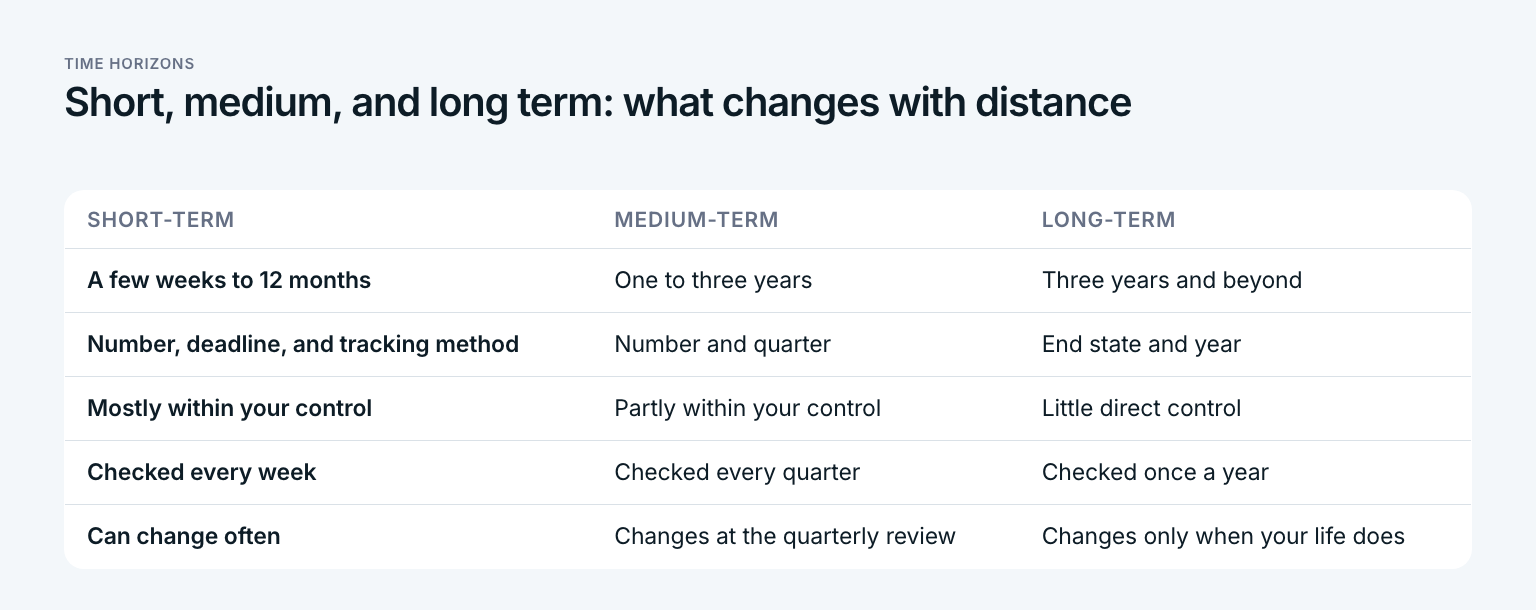
The calendar is only the first difference. As the time horizon shrinks, a goal becomes more precise, more within your control, and more frequently checked. The table shows all five differences using Dana's plan.
| Trait | Short-term | Medium-term | Long-term |
|---|---|---|---|
| Time frame | A few weeks to 12 months | One to three years | Three years and beyond |
| Precision | Number, deadline, and tracking method down to the day | Number and quarter | End state and year |
| Control | Mostly yours | Partly yours, hiring managers and timing play a role | Low, the market and your life will shift |
| Check-in rhythm | Every week | Every quarter | Once a year |
| How often it changes | Any time it stops carrying weight | At the quarterly review | Only when your life changes |
| Dana's example | UX course finished by March 31, 2027 | First full-time UX role by June 30, 2028 | Senior UX designer by December 2031 |
Two rows deserve a second look. Control drops with distance. Whether Dana lands a senior role in 2031 depends on the job market. Whether she studies for 75 minutes this Wednesday depends on her. The rate of change runs the other way. Short-term goals are allowed to change often, long-term goals rarely.
Anyone who flips that ends up rewriting the big goal every January while clinging to a weekly routine that clearly is not working. It happens more often than it sounds, because a distant goal is abstract and easier to swap out than a habit. In short: the long-term goal is the anchor, and the short-term goal is the tool.
What present bias means
Present bias is a term from behavioral economics: people weigh a reward today more heavily than a bigger reward later. That is why an evening on the couch usually beats a career change three years away. Katy Milkman describes in How to Change, published in 2021, how to work with this pull instead of fighting it. For your goals, that means: the short-term goal is the reward within reach that defends the distant goal today.
How short-term goals carry long-term goals: three conditions
Not every short-term goal carries weight. Plenty of them are simply short. For a short-term goal to move the long-term goal closer, it has to meet three conditions.
It is derived, not collected
A short-term goal that carries weight is built backward. You start at the long-term goal and ask: what has to be true a year before that? And before that? Each answer becomes a link in a chain, and each link makes the next one possible. Collected goals are built forward, from whatever seems useful right now. They can be good goals. They just do not necessarily belong on the path.
Dana could have spent 2027 learning to code, which is useful and in demand. A portfolio of three case studies, on the other hand, is the thing every UX hiring manager asks for first. It pays directly into the first UX job, and through that into the senior role. Whoever has to choose between two good goals should pick the one that sits in the chain. For a bigger choice, such as a job offer, a weighted matrix helps, and the guide to how to make decisions works one through.
It is a checkpoint, not a substitute
A short-term goal tells you whether you are on track. It does not replace the long-term goal. The difference sounds subtle, but it decides everything. If Dana finishes her course by March 31, she knows the case studies can start in April. If she does not, she also learns something: the 2028 timeline is at risk, and now is the time to adjust.
Either way, the short-term goal tells her something about the long-term one. A goal that reveals nothing about the bigger plan once its deadline passes is a box to tick, not a checkpoint. How do you tell them apart? By the question you ask afterward. If it is "Now what?", it was a box. If it is "Am I still on schedule?", it was a checkpoint.
It is allowed to correct the long-term plan
Information does not only flow downward. Short-term results are the only real data you have about your long-term goal. If Dana discovers after six months that she can save $300 a month instead of $500, the senior role does not change. The route does. She might look for a junior role that accepts a smaller pay cut, or push the switch from June to September 2028.
That means: the long-term goal stays put, and the deadlines beneath it flex. Why go to all this trouble? Because a short-term goal without a long-term one is just activity, and a long-term goal without short-term ones is just a wish. Both feel comfortable. Only the connection makes them uncomfortable enough to work.
How to create short and long term goals in five steps
Setting this up takes about an hour the first time. You need a sheet of paper, a pen, and one long-term goal with an end state and a year. If you do not have that yet, begin with the guide to goal setting and come back afterward.
Write the long-term goal as an end state, ten minutes
One sentence, one year, one result another person could verify. Not "get into design", but "by December 2031 I work as a senior UX designer at a product company". Whoever stays vague here cannot derive anything below it, because every direction fits equally well.
Name the bottlenecks, 15 minutes
Ask yourself: what absolutely has to be true first, or the goal is impossible? Usually there are two to four things. For Dana there are three: a first UX job, a portfolio that gets interviews, and enough savings to absorb a pay cut. These bottlenecks become your medium-term goals, each with a number and a deadline.
Schedule backward, ten minutes
Give each bottleneck the latest date by which it must be in place for the long-term goal to hold. Then step back again: what has to be true 12 months earlier? A first UX job by June 2028 means applications start in January 2028. So the portfolio has to be finished by September 2027.
Pick no more than three short-term goals, 15 minutes
Once you have scheduled backward, the short-term goals almost write themselves. Choose no more than three for the next 12 months. Each one gets a number, a deadline, and a way to track it. Dana chooses to finish the course by March 31, publish three case studies by September 30, and save $6,000 by December 31, 2027.
Run the load test, ten minutes
Read each short-term goal and ask two questions. If I hit this, is the long-term goal more likely? If I miss it, will I learn something about the plan? Two yeses mean the goal carries weight. A no means cut it or rebuild it before you plan your first week.
What comes next is the part that matters in daily life: the first weekly goal. The goal chain section below shows how it falls out of the year. First, here is the whole plan in one view.
Dana's plan: from support lead to UX designer
Dana is 29 and has spent five years in customer support at a software company, the last two leading a team of four. She sits in on design reviews because her team hears every complaint first. The wish to switch into design is old. What is new is that in October 2026 she wrote it down with a year attached. Here is her plan after the five steps.
| Horizon | Goal | Deadline | How Dana checks it |
|---|---|---|---|
| Long-term | Senior UX designer at a product company | December 31, 2031 | Job title and offer letter |
| Medium-term | First full-time UX designer role | June 30, 2028 | Signed offer |
| Medium-term | Portfolio with five case studies that gets interviews | December 31, 2028 | Interview invitations from applications |
| Short-term | UX certificate course finished | March 31, 2027 | Course certificate |
| Short-term | Three case studies published in the portfolio | September 30, 2027 | Live portfolio pages |
| Short-term | $6,000 saved as a cushion for a lower junior salary | December 31, 2027 | Automatic $500 transfer on the 1st, account balance |
Notice what is missing. Networking has no short-term goal yet. That is deliberate. Dana has three goals for 2027 and knows a fourth would dilute the other three. Networking becomes a short-term goal in early 2028, when she starts applying and actually has a portfolio to show. Is that too slow? No. It is the order in which the bottlenecks really appear. Anyone who attacks all of them at once moves too slowly on each.
The math behind the cushion is simple. Dana expects her first UX salary to be about $6,000 a year below what she earns now, and she wants one full year covered. $6,000 over 12 months is $500 a month. If her balance is below $3,000 at the end of June 2027, she knows after six months that the route needs adjusting, not in 2028, when it would be too late.
Short-term goals examples: 12 goals and the long-term goal each one serves
A short-term goal is only as good as the long-term goal above it. That is why every example below comes as a pair: on the left the long-term goal, on the right a short-term goal that carries it. Do not copy the pairs word for word. Copy the shape.
| Area | Long-term goal | Short-term goal that carries it |
|---|---|---|
| Career | Lead a team of five by 2029 | Lead one cross-team project with three colleagues by April 30 and review it with your manager |
| Career | Move into software engineering by 2028 | Finish a Python course with your own capstone project by June 30 |
| Education | Part-time bachelor's degree by 2030 | Submit your application for the fall semester by March 1 |
| Money | $60,000 down payment for a home by 2032 | Save $7,200 by December 31, $600 a month by automatic transfer |
| Money | Debt-free by the end of 2028 | Pay off the $3,000 credit card balance by June 30 |
| Health | Run a marathon in under four hours in 2029 | Run 10K without walking breaks by May 31 |
| Health | Stay free of back pain in daily life at 50 | Twelve weeks of back training, twice a week for 30 minutes, checked off on the calendar |
| Language | Live in Madrid for a year with C1 Spanish by 2030 | Pass the B1 Spanish exam by November 21 |
| Family | A road trip through all of Canada's provinces with the kids by 2030 | Two weekend camping trips by August 31 as a trial run |
| Creative | Publish your own book by 2029 | Ten chapters in rough draft by March 31, 1,000 words a week |
| Side business | $2,000 a month in side income by 2028 | Three paying clients by September 30 |
| Relationships | A circle of friends in your new city by 2028 | Twelve evenings with new people by December 31, one a month |
Notice anything? Not one short-term goal says "be more motivated" or "learn more". Each one has a deadline on which the answer is yes or no. And each one, if it works, measurably shortens the distance to the long-term goal. If your long-term goal is about work, the guide to career goals has more examples built the same way.
Long-term goals examples: what a good one looks like
The left column follows three rules. First, an end state you can see on the deadline. Second, a year, not "someday". Third, at least one bottleneck you can name today. A long-term goal without a visible bottleneck is usually still a wish.
Here are five long-term goals examples that pass all three tests: senior UX designer by 2031, debt-free by the end of 2028, a $60,000 down payment by 2032, a published book by 2029, a marathon under four hours in 2029. Whoever writes "a down payment for a home" without knowing the amount a lender will require does not have a goal yet. They have a research task. That is not a flaw. It simply becomes the first short-term goal: two lender conversations by the end of the month and the number written down.
How to answer "What are your short-term and long-term goals?" in an interview
Interviewers ask this question for one reason: they want to see whether this job fits on your path. A list of wishes does not answer that. A chain does. The best answers have three parts: a long-term goal stated as a direction the employer can recognize, a short-term goal that this specific role helps you reach, and one piece of evidence that you are already working on it.
Here is how Dana would answer in her first UX interview in 2028: "Long term, I want to lead design work on a product used by thousands of people, ideally as a senior designer within three or four years. In the short term, my goal is to ship my first features end to end in a team like yours, from research to handoff, within my first six months. I've been preparing for this for two years: I finished a UX certificate course and published three case studies based on support data from my current job."
Notice what the answer avoids. It names no specific salary and no other company, and it does not suggest the role is just a stepping stone. It also stays honest. Anyone who invents a long-term goal for an interview gets caught by the first follow-up question. Anyone who has actually built the chain can talk about it for ten minutes.
The three mistakes nobody notices
Short-term goals have a good reputation, and they have earned it. They deliver quick wins, they are concrete, and they fit into a single week. They are just built for something other than direction. Three mistakes happen exactly where people treat them as if they were.
The most common mistake: the short-term goal replaces the long-term one
A short-term goal is easier to reach and faster to check off. That is exactly why it quietly slides into the place of the big goal. Dana finishes her course in March, feels great, and says yes to a team lead training her company offers for the fall. The case studies slip by six months, and she never actually decided that. Without the question about the long-term goal, every finished short-term goal becomes an excuse for the next convenient one. That means: after every goal you reach, look up first, then look ahead.
Mistake two: the long-term goal has no year. "Someday I'll switch careers" cannot be planned backward. Without a year there is no latest date for the bottlenecks, and so no reason to start the short-term goal this year instead of next. Whoever names no year postpones without noticing.
Mistake three: the middle level is missing. Between "senior designer in 2031" and "study this week" lie five years. That is too far away to feel like progress. Without a medium-term goal, each week only measures itself, and after three months you start wondering why you are studying at all. A milestone two years out makes the week meaningful again, because it pays into something you can see.
Short and long term goals in a goal chain: from 2031 to Wednesday night
Short-term and long-term are not two categories. They are the two ends of a single chain, with year, quarter, month, and week in between. Every level is long-term for the one below it and short-term for the one above it. A yearly goal feels distant from inside a week and close from the vantage point of 2031. Here is Dana's chain for the first quarter of 2027.
| Level | Dana's goal | Distance | Checked |
|---|---|---|---|
| Long-term | Senior UX designer at a product company by December 2031 | Five years | Once a year, in December |
| Medium-term | First full-time UX designer role by June 30, 2028 | Two years | Every quarter |
| Year 2027 | Course finished, three case studies published, $6,000 saved | 12 months | Every quarter |
| Quarter 1 | Course finished, first case study drafted, $1,500 saved | Three months | Every month |
| Month of January | Twelve course lessons done, case study topic chosen, $500 transferred | Four weeks | Every week |
| Week | Three study sessions on Monday, Wednesday, and Saturday, 75 minutes each | Seven days | Sunday evening |
| Day | Wednesday 7 pm, 75 minutes, lesson 9, phone in the bedroom | One evening | Wednesday 8:15 pm, one check mark |

The day is the only place where anything actually happens. Every other level is a checkpoint. Whoever sits down at the kitchen table at 7 pm on Wednesday is working on the 2031 goal, even if it feels like lesson 9. Gaapp makes exactly this connection visible: a check mark on the day counts toward the week, the week toward the month, the month toward the quarter, and the quarter toward the year.
How often to review each level
Each level has its own rhythm, and the rhythm follows the horizon. You check the weekly goal every Sunday in a few minutes, for example with a ten-minute weekly review. The quarter is the most important checkpoint, because 12 weeks is long enough to see progress and short enough to change course. That is the whole idea behind the 12 week year.
You review the long-term goal once a year with a single question: do I still want this? Anyone who questions the big goal every week never gets past the first quarter. Anyone who never questions it may spend five years walking toward a goal that stopped being theirs long ago.
Three questions before you start
Before you plan your first week, hold your plan up against these three questions. If one of them makes you hesitate, that is where the work is.
- Can I name the long-term goal that each short-term goal carries? If not, it is a project of its own. That is fine, it just does not belong on the same list.
- Do I know what I will do if the first short-term goal is missed? This means a plan B for the route, not for the destination. Dana's answer: finish the course in April and start the first case study anyway.
- Is the next action on my calendar with a day and a time? A short-term goal without a first action is just a long-term goal with a closer deadline.
In short: a short-term goal is not a small goal. It is the piece of a big goal you can pick up this week.
Frequently asked questions about short-term and long-term goals
What are your short-term and long-term goals?
Your long-term goals describe where you want to be in three to ten years, such as a role, a degree, or financial freedom. Your short-term goals are the results you plan to reach in the next 12 months that make the long-term goal more likely. In an interview, connect the two: name the direction, the short-term goal this role supports, and one thing you are already doing about it.
What are 10 short-term goals examples?
Finish an online course by March 31, run 10K without walking by May 31, pay off a $3,000 credit card by June 30, save $7,200 this year, pass a B1 language exam, land three paying side clients, publish three portfolio case studies, read 12 books, lead one project at work, and meet one new person a month. Each works best when it sits under a long-term goal it moves forward.
What are 5 examples of long-term goals?
Five long-term goals examples are a senior role in your field by 2031, being debt-free by the end of 2028, a $60,000 home down payment by 2032, a published book by 2029, and a marathon under four hours in 2029. Each one names an end state and a year. The route can stay open until you derive your first short-term goals.
How do you create short and long term goals?
Start with the long-term goal as an end state with a year. Name the two to four bottlenecks that must be true first, schedule them backward, and pick no more than three short-term goals for the next 12 months. Then test each one: does reaching it make the long-term goal more likely?
How long is a short-term goal?
A short-term goal usually runs from a few weeks to 12 months. Anything from one to three years is medium-term, and anything beyond three years is long-term. The exact cutoffs are a convention, so what matters more is that each short-term goal has a clear deadline.
How many short-term goals should you have at once?
No more than three for the next 12 months, and one or two per long-term goal. More goals split your attention, and by spring only the easiest ones are still alive. Add a new short-term goal only when one is reached or deliberately dropped.
Last updated: 14 October 2026
Read next
 Goal Setting
Intrinsic Motivation: What Drives You From the Inside
Intrinsic motivation is not a personality trait. Meaning, 12 examples, the three needs behind it and five steps to build it, with a worked example.
17 min read
 Goal Setting
Financial Goals: How to Turn Wishes Into a Plan
Financial goals are not wishes with a dollar sign. Short and long term examples, SMART savings goals and a five step plan, worked through one year.
17 min read
 Goal Setting
WOOP Method: Four Steps From Wish to If-Then Plan
The WOOP method is not positive thinking. What WOOP stands for, the research, if-then plans, eight goal examples and a five-minute guide.
18 min read