Medium-Term Goals: 40 Examples for Work and Life
Medium-term goals are not small life goals. How long mid-term is, 40 examples for work, career, money, health, five steps, and six-month checkpoints.

Contents
- 01What are medium-term goals?
- 02Why the middle horizon is where real change happens
- 03What makes a good mid-term goal: end state, checkpoints, weekly rhythm
- 04How to set medium-term goals in five steps
- 05Andre's plan: three mid-term goals for 2027 and 2028
- 06Mid-term goals examples for work and your career
- 07Medium-term goals examples for money, health, and learning
- 08Three mistakes that quietly stall medium-term goals
- 09From a two-year goal to Monday night: the goal chain
- 10Frequently asked questions about medium-term goals
Medium-term goals are not smaller life goals, and they are not bigger yearly goals. A medium-term goal, also called a mid-term goal, is a result you want to reach in six months to three years, such as a certificate, a paid-off credit card, or a new role. It is the bridge between what you do this week and where you want to be in ten years. Without that bridge, every week only measures itself.
Three things make a medium-term goal work: an end state with a date, a checkpoint every six months, and a fixed rhythm in your week. This guide works through all three with Andre, 31, a shift supervisor at a distribution center outside Columbus, Ohio, who wants to be an operations manager by the end of 2028. Along the way you get 40 mid-term goals examples for work, career, money, health, and learning, five steps to set your own, and the three mistakes that quietly stall goals with a two-year runway.
What are medium-term goals?
A medium-term goal sits between two poles. A short-term goal is done in weeks or a few months and fits inside a quarter. A long-term goal is three to ten years away and gives you a direction more than a deadline. The medium-term goal is the first one that has both: a real change and a date you can put in your calendar today.
So what is a mid-term goal in plain terms? It is the answer to one question: what has to be true in about two years for my long-term plan to stay possible? Andre's long-term direction is to run operations for an entire site one day. His mid-term goal is the step that makes that direction real: operations manager by December 31, 2028. Medium-term and mid-term mean the same thing.
How long is a medium-term goal?
For personal goals, medium-term means roughly six months to three years. The classic split into short, medium, and long term says one to three years, and that is the core of it. In practice the middle horizon starts wherever a goal no longer fits into a single quarter. Anyone who wants to reach conversational Spanish in nine months plans differently from someone who finishes three lessons this week. That means: medium-term is less a fixed distance on the calendar than the stretch of time in which you need checkpoints.
| Context | What medium-term usually means | Typical example |
|---|---|---|
| Personal goals | six months to three years | Run a half marathon, pay off a credit card, reach B1 in a language |
| Work and career | one to three years | Earn a certificate, move into a team lead role |
| Saving and money | about one to five years, depending on the source | Down payment on a home, a car paid in cash |
| Business | usually two to five years | Enter a new market, open a second location |
| Students | one year to graduation | Raise your GPA, land an internship, finish a degree |
For your own goals one rule of thumb is enough: anything that takes longer than a quarter and less than three years needs the tools in this guide. If you want the full comparison of the two ends and how one carries the other, read the guide to short-term and long-term goals. This one stays in the middle.
Why the middle horizon is where real change happens
Look back at the last three years. What actually changed in your life? Probably a certificate, a new job, a move, a number in your bank account, or a habit that now feels normal. Almost none of it happened in a week, and almost none of it took ten years.
That is not a coincidence. A week is too short to change anything that lasts. Ten years is too long to steer, because the job market, your family, and your own wishes shift several times along the way. In between lies the stretch where effort and result are still visibly connected: six months to three years. Anyone who wants real change plans on this horizon.
And yet this is the level most plans skip. Plenty of people have a dream for someday and a to-do list for tomorrow. The dream is too far away to decide anything on a Tuesday. The list is too close to show whether it leads anywhere. The medium-term goal translates between the two. It tells the dream what has to be true by the end of 2028, and it tells the week what it is for.
Proximal goals and distal goals
In a 1981 study, Albert Bandura and Dale Schunk followed children who were teaching themselves subtraction. Children who set a near goal for every session progressed faster, solved more problems correctly, and came out more confident than children who only had the distant goal at the end of the series. For medium-term goals, that means a deadline two years out barely motivates. The checkpoints before it are what make it feel real.
What makes a good mid-term goal: end state, checkpoints, weekly rhythm
A medium-term goal has three parts. If one is missing, it turns into either a wish or a project that never ends.
An end state with a date
The goal describes what is true on the deadline, not what you will do until then. “Get better with money” is a direction. “On December 31, 2028, my credit card balance is zero” is an end state. You notice the difference on the deadline: you cannot answer the first sentence with yes or no, but you can answer the second. The guide to SMART goals shows how to build a sentence like that.
A checkpoint every six months
A deadline two years away creates no pressure. It is so far off that every single week looks like a week without consequences. That is why every medium-term goal gets checkpoints, one for each half-year. Each checkpoint is an end state of its own: $7,200 left on the card by the end of June 2027, $4,800 by the end of December. Six months is long enough for real progress and short enough that you can still catch up if you fall behind.
Why six months and not three? A quarter is too short for many checkpoints, especially for certificates and health goals. A year is too long, because a bad February only shows up in December.
A fixed rhythm in your week
Checkpoints tell you where you want to be. The weekly rhythm tells you when you work on it. For a debt goal that is an automatic payment on the first of the month, for a certificate two fixed evenings, for a language 20 minutes every lunch break. Whoever leaves the rhythm open works on the goal when there is time left over, and there is rarely time left over.
What an implementation intention is
Peter Gollwitzer calls them implementation intentions. In everyday language they are if-then plans: “If it is Thursday at 6 pm, I pack my bag for Spanish class.” In a 1999 review he shows that plans like this make follow-through considerably more likely than the intention alone. For a medium-term goal, it is the weekly rhythm in a single sentence.
How to set medium-term goals in five steps
Set aside one quiet evening for the first draft. You need your calendar for the next two years and the willingness to end up with no more than three goals. Work through the steps in order, because each one builds on the last.
Name your direction
Write one sentence about where you want to be in five to ten years. It can be rough. Andre writes: “I run operations for a whole site.” Without a direction, you pick medium-term goals by mood.
Ask backward: what has to be true in two years?
Do not ask what you would like to do. Ask what has to be reached by the deadline so the direction stays possible. For Andre that is three things: proof that he understands supply chain beyond his own shift, a clean financial slate, and the ability to talk with every person on his team.
Write no more than three goals
Phrase each one as an end state with a date. Three is the ceiling because all of them draw on the same evenings and weekends. A fourth goal takes time the other three need.
Set a checkpoint for every six months
Split each goal into checkpoints, one per half-year. Each checkpoint can be verified: an amount, a passed exam, a level reached. Count backward from the deadline, not forward from today.
Put the rhythm and the review dates in your calendar
Decide on which days and at what time you work on each goal. Then add two review dates a year, at the end of June and the end of December, plus a short check at the end of every quarter. The plan is finished only when the dates are in the calendar.
Anyone who gets stuck on step two usually does not lack a direction but has several. That is no reason to stop. In that case your first medium-term goal is the decision itself: one direction by the end of March, after three conversations with people who already work where you might want to go.
Andre's plan: three mid-term goals for 2027 and 2028
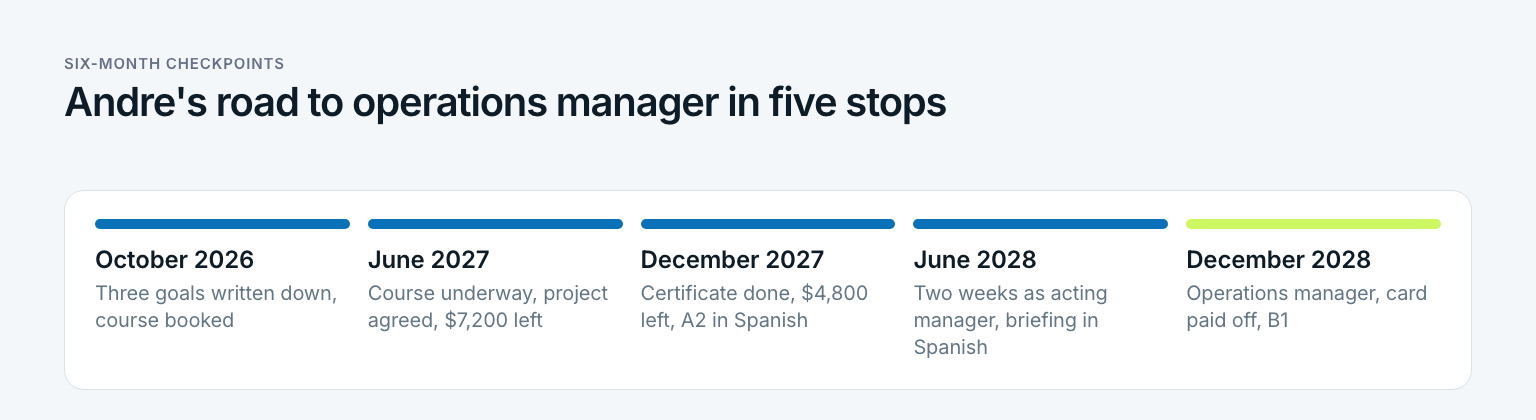
Andre is 31 and has worked at a regional distribution center for seven years, the last three as a day shift supervisor with 22 people on his team. He knows the floor, the scanners, and every shortcut that leads to a mis-pick. In October 2026 his general manager asks in his annual review where he sees himself in three years. Andre has no answer beyond “still here, probably.” Two weeks later he sits down on a Sunday afternoon with a legal pad.
His direction for 2033 comes quickly: run operations for a whole site. From that he derives three medium-term goals for January 2027 through December 2028, one each for career, money, and learning.
| Area | Goal by end of 2028 | Six-month checkpoints | Weekly rhythm |
|---|---|---|---|
| Career | Operations manager, at this company or another, with a supply chain certificate | June 2027: course underway, project to cut mis-picks agreed. December 2027: certificate done. June 2028: covered for the operations manager for two weeks. December 2028: in the role. | Monday and Wednesday, 7 to 9 pm coursework |
| Money | Credit card balance of $9,600 paid off | $7,200 left by June 2027, $4,800 by December 2027, $2,400 by June 2028, zero by December 2028 | Automatic payment of $400 on the first of every month |
| Learning | Conversational Spanish at B1 level | June 2027: A1 done. December 2027: A2. June 2028: runs a short shift briefing in Spanish. December 2028: B1. | 20 minutes every workday lunch break, Thursday class from 6:30 to 8 pm |
The money goal rests on simple math. $9,600 over 24 months is $400 a month. Andre picked the credit card on purpose. A new role may mean a move or a short gap in pay, and he does not want to make that call with interest running on a balance. The money goal has a reason, and the reason is tied to the career goal.
The Spanish goal looks like a side project at first. It is not. About half of Andre's team are native Spanish speakers, and the supervisors people trust most are the ones who can explain a change to everyone on the floor. Twenty minutes on every workday plus a 90-minute class each week adds up to about 150 hours a year. That is enough for solid conversation at work, not for fluency. That is why the goal says B1 and not “fluent.”
Just as telling is what is not on Andre's pad: no fitness goal and no goal for the house he and his partner keep talking about. Both sit on a note for 2029, because three goals over two years are plenty next to a full-time job with evening coursework.
Mid-term goals examples for work and your career
Most goals at work that change something real take one to three years, because a genuine step on a résumé rarely happens faster than that. Each example below comes with its first checkpoint after six months. Do not copy them word for word. Swap in your own numbers and check whether the checkpoint is realistic in your half-year.
Mid-term goals for work
| Goal | First checkpoint after six months |
|---|---|
| Lead a project with its own budget | Project agreed with your manager, scope and budget in writing |
| Cut the turnaround time in your area from ten days to six | Current state measured, the two biggest bottlenecks named |
| Become the go-to person at work for one topic, such as data privacy or customs rules | Foundation course done, first internal training held |
| Train a backup so you can take two weeks off without calls | Every process documented, backup has covered one week alone |
| Grow revenue from existing clients in your territory by 10 percent | Accounts ranked by potential, meetings held with the top ten |
| Move one paper-based process to a digital tool | Process mapped, tool chosen, pilot run with one team |
| Present to 50 people without notes | Three presentations given to your own team, feedback collected |
| Keep overtime under five hours a month for a full year | Three months of overtime tracked, two recurring tasks handed off |
Mid-term career goals
What are some examples of mid-term career goals? They are the goals that change your title, your field, or your pay. The guide to career goals covers how to find yours. Here are eight, each with a first checkpoint:
| Goal | First checkpoint after six months |
|---|---|
| Move into a team lead or supervisor role | Conversation with your manager held, gaps named, one acting lead role taken on |
| Earn a professional certification in your field, such as project management or supply chain | Study plan set, half the material covered, exam date booked |
| Switch departments, for example from sales to product | Three conversations with people in the target team, one joint project started |
| Raise your pay by 15 percent, internally or by changing jobs | Market rate researched, last year's wins written down with numbers |
| Build a side business with five paying clients | Offer described, price set, first client signed |
| Finish a part-time degree | Enrolled, first two courses passed |
| Speak at two industry events | Topic chosen, first proposal submitted |
| Return from parental leave into a part-time role with leadership duties | Model discussed with HR, return plan in writing |
If an interviewer asks about your mid-term goals, answer with one of these and its checkpoint. “In two years I want to lead a team, and in the next six months I want to run my first project with its own budget” shows that you think in steps.
Medium-term goals examples for money, health, and learning
The same pattern works outside of work. Together with the two tables above, these make 40 examples of mid-term goals, each with a checkpoint you can verify after six months.
Medium-term saving goals and money goals
What are some medium-term saving goals? The most common are an emergency fund, a debt payoff, and a down payment. They share one feature: a fixed amount, a fixed date, and a monthly figure you can automate.
| Goal | First checkpoint after six months |
|---|---|
| Build an emergency fund worth three months of expenses | Spending tracked for three months, automatic transfer set up, first third saved |
| Pay off all credit card debt | Every balance listed, highest interest rate first, one third paid off |
| Save $30,000 for a down payment in three years | Target confirmed with a lender, $5,000 saved |
| Buy your next car in cash instead of financing it | Price set, monthly amount calculated, first $2,000 in a separate account |
| Lower your fixed monthly costs by $300 | Every subscription and contract reviewed, three canceled or renegotiated |
| Invest 10 percent of your take-home pay every month | Account opened, automatic contribution running for six straight months |
| Build a side income of $500 a month | Idea tested, first $100 earned |
| Save $8,000 for a sabbatical or a long trip | Trip and timing set, $2,000 saved |
Health and fitness
| Goal | First checkpoint after six months |
|---|---|
| Run a half marathon | 6 miles without a walking break |
| Lose 20 pounds and keep them off for a year | 8 pounds down, two months of meals logged |
| Strength train twice a week for a full year, no break longer than two weeks | Program in place, 40 sessions done |
| Quit smoking and stay smoke-free for a year | Quit date set, three months smoke-free |
| Sleep seven hours on five nights out of seven | Two months of sleep tracked, fixed bedtime in place |
| Learn to swim laps and swim 1,000 yards without stopping | Lessons done, 400 yards without stopping |
| Limit alcohol to two evenings a week | Three months tracked, average under three evenings |
| Bike to work three days a week from April to October | Bike ready, route tested, two days a week reached |
Learning and personal growth
| Goal | First checkpoint after six months |
|---|---|
| Reach B1 in a new language | A1 done, weekly class started |
| Learn enough Python to automate one report at work | Intro course done, first small script running |
| Learn an instrument well enough to play ten songs | Teacher found, three songs solid |
| Read 24 nonfiction books in your field and write one page of notes on each | Twelve books read, notes kept in one place |
| Get your motorcycle license | Course booked, written test passed |
| Cook 30 meals without a recipe | Ten meals solid, a cooking night every Sunday |
| Publish 24 issues of a newsletter on your field | Topic chosen, six issues published |
| Volunteer 100 hours with one organization | Organization chosen, 25 hours logged |
All 40 examples have one thing in common: the checkpoint after six months can be answered with yes or no. Not one goal says “live healthier” or “learn more.” Whoever cannot name the first checkpoint of a goal does not have a medium-term goal yet, but a wish. That is not a criticism. It is a task for the next half hour.
Three mistakes that quietly stall medium-term goals
Medium-term goals rarely fail in one big moment. They fade week by week through mistakes that feel reasonable at the time. Which one is yours?
The most common mistake: one deadline in two years and none before it
A goal for the end of 2028 does not feel urgent in January 2027, and it does not feel urgent in February either. Without a checkpoint there is no moment when falling behind becomes visible. Without the December 2027 date, Andre might have noticed only in the fall of 2028 that the certificate was still unfinished. The fix is not more willpower. It is a date every six months.
Mistake two: too many goals for the same evenings. Medium-term goals are ambitious, or they would be short-term goals. Each one needs fixed hours every week for months. Anyone who chases five goals at once spreads a handful of free evenings across five projects and gets none of them past the first checkpoint. Three is enough, and two often is.
Mistake three: never adjusting the goal, or swapping it out all the time. Both happen. Some people hold on to a date even after their situation has changed, and then give up entirely. Others replace the goal every month because a new one sounds more exciting. The rule in between: you may move dates and checkpoints at your half-year review, and the direction only once a year. The guide to the mid-year review shows how that review works.
From a two-year goal to Monday night: the goal chain
A medium-term goal only works once it reaches your week. The goal chain translates it into five levels: year, quarter, month, week, and day. Each level is the bigger goal for the one below and a checkpoint for the one above. Here is how that looks for Andre's career goal:
| Level | Andre's goal | Checked |
|---|---|---|
| Medium-term, by end of 2028 | Operations manager, at this company or another, with a supply chain certificate | every six months |
| Year 2027 | Certificate done, mis-pick project led | end of June and end of December |
| Q1 2027 | Course started, no session missed, project agreed with his manager | end of March |
| February | Eight coursework evenings done, project outline written | end of the month |
| Week | Monday and Wednesday coursework, Friday 15 minutes on the mis-pick data | Sunday night |
| Day | Monday at 7 pm at the desk in the spare room, laptop charged the night before | checked off that night |
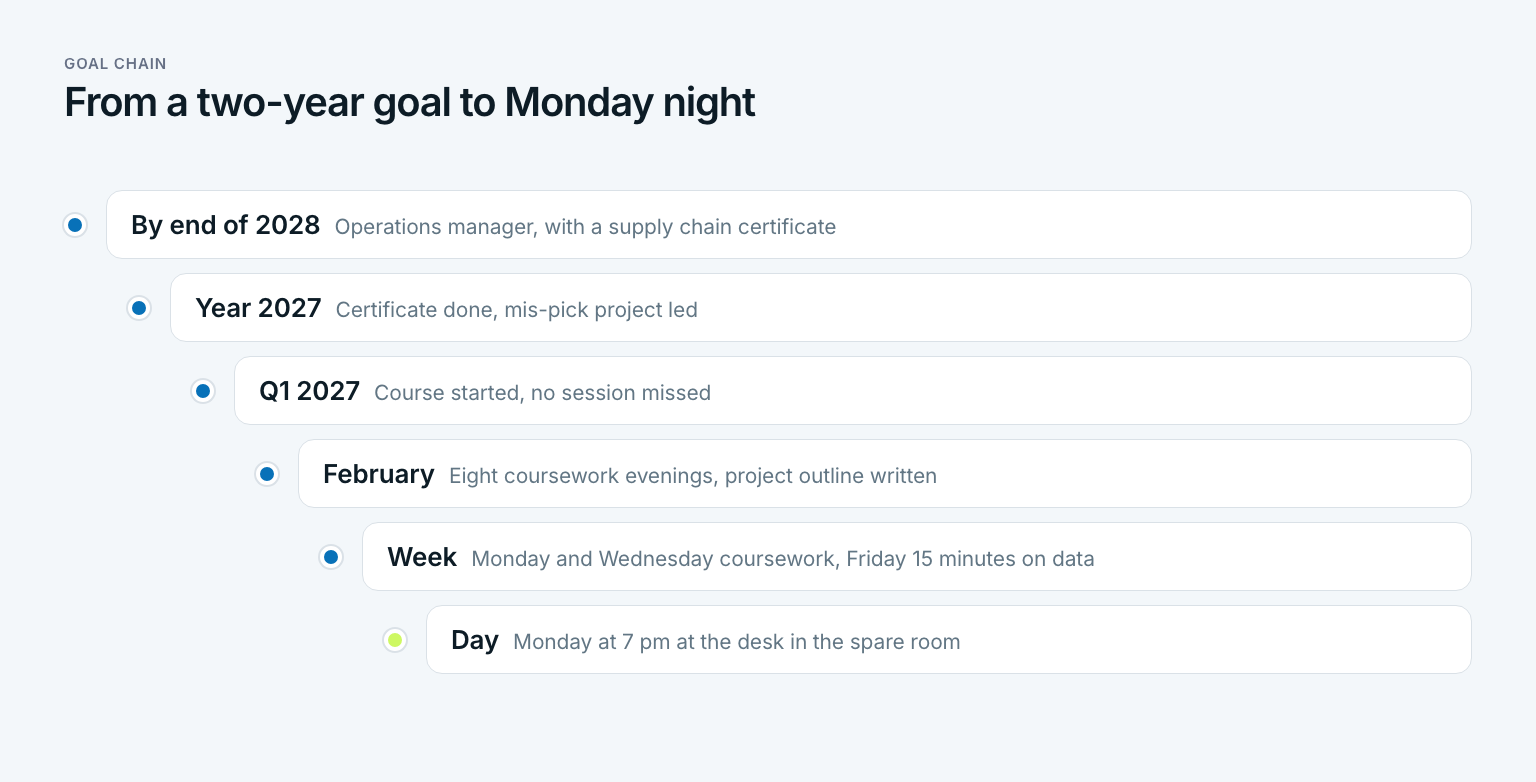
Work only happens on a given day. Every level above it measures whether the days add up. Whoever sits down at 7 pm on a Monday with a module on inventory math is working on the 2028 role, even if it does not feel like it. The quarter is where checkpoints turn into concrete goals, as the guide to quarterly planning shows. In Gaapp the chain starts at the year. A two-year goal becomes two yearly goals there, and the six-month checkpoints become quarterly goals. Each goal hangs on a bigger one, and the progress of a level is the share of finished goals beneath it.
Three questions before you commit:
- Can you say, for each of your medium-term goals, what has to be true on June 30 next year?
- Are the evenings you will work on it already in your calendar, with a time?
- Do you have three medium-term goals at most, and do you know which one you would drop if a fourth came along?
Whoever answers no to one of these does not have a goal that is too small, but a missing checkpoint. In short: a medium-term goal is not a distant deadline. It is a series of half-years you can win one at a time.
Frequently asked questions about medium-term goals
What are examples of medium-term goals?
Typical medium-term goals take six months to three years: earning a certificate, moving into a team lead role, paying off a credit card, saving a down payment, running a half marathon, or reaching B1 in a new language. What makes them medium-term is not the topic but the time frame and the need for checkpoints. Each of the 40 examples above comes with a first checkpoint after six months.
What is a mid-term goal?
A mid-term goal, also called a medium-term goal, is a result you want to reach in roughly six months to three years. It sits between short-term goals for the next few weeks and long-term goals for the next decade. It answers one question: what has to be true in about two years so that your long-term plan stays possible?
What are some medium-term saving goals?
Common medium-term saving goals are an emergency fund worth three to six months of expenses, paying off credit card debt, a down payment on a home, a car bought in cash, and money for a sabbatical or a wedding. Each works best with a fixed amount, a date, and an automatic monthly transfer. Divide the amount by the number of months, and you have your monthly figure.
What are some examples of mid-term career goals?
Mid-term career goals change your title, your field, or your pay within one to three years: moving into a team lead role, earning a professional certification, switching departments, raising your pay by 15 percent, or building a side business with five paying clients. Each one needs a first checkpoint after six months, such as a project you lead or an exam date you have booked.
Is a one-year goal short-term or medium-term?
It depends on how much has to change. A goal you can reach with steady weekly steps, such as reading twelve books, behaves like a short-term goal even over a full year. A goal that needs stages, such as a certificate with an exam at the end, behaves like a medium-term goal and deserves a checkpoint after six months. Most definitions draw the line at one year, but the need for checkpoints is the better test.
How many medium-term goals should you have at once?
Two or three. Every medium-term goal needs fixed hours in your week for months, and all of them draw on the same evenings and weekends. With more than three, each goal gets too little time to reach its first checkpoint. A fourth goal belongs on a list for later.
Last updated: 19 October 2026
Read next
 Goal Setting
Intrinsic Motivation: What Drives You From the Inside
Intrinsic motivation is not a personality trait. Meaning, 12 examples, the three needs behind it and five steps to build it, with a worked example.
17 min read
 Goal Setting
Financial Goals: How to Turn Wishes Into a Plan
Financial goals are not wishes with a dollar sign. Short and long term examples, SMART savings goals and a five step plan, worked through one year.
17 min read
 Goal Setting
WOOP Method: Four Steps From Wish to If-Then Plan
The WOOP method is not positive thinking. What WOOP stands for, the research, if-then plans, eight goal examples and a five-minute guide.
18 min read