Goal Setting for Employees: Goals They Actually Own
Goal setting for employees is not handing out targets: three goal types, 12 SMART examples, a five-step meeting, a one-page template and check-ins.

Contents
- 01What goal setting for employees is, and what it is not
- 02Goals for employees: three types and twelve examples
- 03Why most employee goals are forgotten by March
- 04SMART goals examples for employees: from wish to measure
- 05Setting goals for employees in five steps
- 06How to track employee goals: four check-ins and one number
- 07The three mistakes nobody notices
- 08From employee goals to the goal chain: year, quarter, month, week, day
- 09Your self audit before the next goal setting meeting
- 10Frequently asked questions about goal setting for employees
Goal setting for employees is not handing out targets. It is a structured conversation in which a manager and an employee agree on three to five measurable goals for a fixed period, usually a year, and on how both of them will track those goals. A target is announced. A goal is agreed, and the difference shows up in March, when nobody remembers the target but the person who helped write the goal still knows where it stands.
Three things decide whether employee goals survive the year: the right mix of goal types, wording that reads the same in December as it did in January, and a rhythm of check-ins that keeps the goals in view. This guide walks through all three with Rachel, who runs an eight-person inside sales team at a dental supply distributor in Columbus, Ohio, and Luis, one of her reps. You also get twelve examples of goals for employees, a five-step goal setting meeting, a one-page template and the three mistakes that quietly kill employee goals by summer.
What goal setting for employees is, and what it is not
Employee goal setting means turning what the team needs this year into a few results that one person owns. The idea goes back to management by objectives, which Peter Drucker described in “The Practice of Management” in 1954: lead through agreed results, not through detailed instructions. Andy Grove adapted it at Intel in the 1970s as objectives and key results, and John Doerr later carried that version to Google. The core word has not changed in 70 years. Agreed.
Goal setting is also not the same as a job description, a quota or a performance review. A job description lists what someone does every week. A goal describes what should be different by the end of the period. A review looks back and rates. Goal setting looks forward and commits. Whoever mixes these up ends up paying a bonus for routine work or rating people on goals nobody tracked.
| Tool | Who sets it | What it is built for | Time frame |
|---|---|---|---|
| Employee goals | Manager and employee together | Results one person owns, plus growth | One year, checked every quarter |
| Quota or target | The company | A number the role has to hit, often tied to pay | A month, a quarter or a year |
| Job description | The company | Ongoing duties and responsibilities of a role | Open ended |
| OKRs | The team, aligned with leadership | Ambitious team outcomes with measurable key results | One quarter |
Quotas are not wrong. In sales they are the norm, and every rep on Rachel's team carries one. But a quota measures the job. A goal changes something about how the job gets done, or about the person doing it. That means: Luis can hit his quota and still have three goals that matter more for his next year. If you set team goals by the quarter, the OKR framework covers that side in detail.
Agreed or assigned: what the research says
In a set of joint experiments published in 1988, Gary Latham, Miriam Erez and Edwin Locke tested whether goals work better when employees help set them. The answer was more nuanced than either camp expected. Assigned goals worked about as well as goals set together, as long as the manager explained why the goal mattered. Goals handed down curtly, with no reason given, did worse. For you, that means agreement is not a ritual. It is how commitment gets built, and commitment is what carries a goal through a hard quarter.
Goals for employees: three types and twelve examples
Most goals for employees fall into three types. Performance goals describe a result you can count. Development goals describe a new skill or a bigger role. Behavior goals describe how someone works with other people. A good set mixes them, usually two performance goals and one development goal.
Why not only performance goals? Because a list where only the company wants something feels like a quota, even when it is signed by both sides. The development goal is the part the employee signs up for personally. These twelve examples show how specific a good goal can be:
| Role | Type | Example goal |
|---|---|---|
| Inside sales | Performance | Raise the 90-day reorder rate of 140 assigned accounts from 55 to 65 percent by December 31 |
| Customer support | Performance | Cut first response time on email tickets from nine hours to four hours by June 30 |
| Marketing | Performance | Generate 40 sales-qualified leads per month from the website from July on, tracked in the CRM |
| Software engineering | Performance | Reduce the median time to fix a priority bug from ten days to four days by September 30 |
| Accounting | Performance | Close the books by the fifth business day every month from April on |
| Warehouse | Performance | Lower picking errors from 0.8 to 0.4 percent of orders by year end |
| Recruiting | Performance | Fill engineering roles in 45 days instead of 70, measured from posting to signed offer, by Q4 |
| Nursing | Development | Complete preceptor training by June 30 and precept two newly graduated nurses in the second half of the year |
| Project management | Development | Lead one project with a budget above $50,000 from kickoff to sign off |
| Any role | Development | Present the team's quarterly results to leadership twice this year |
| Team lead | Behavior | Hold a 30-minute one on one with each direct report every two weeks, logged in the calendar |
| Sales and support | Team | Together cut quote turnaround from five business days to two, tracked in the CRM |
Every example names a baseline, a target and a date. Whoever borrows one should swap in their own numbers instead of keeping the ones above. Twenty more employee goals examples by role show the sentence pattern behind them. And how many goals belong on one person's list? Three is a good number, five is the ceiling. Every goal beyond that thins out the attention the others get, and in the end none of them gets finished properly.
Why most employee goals are forgotten by March
Most employee goals are written with care in January and read again in December. In between sits a year of real work that has little to do with the document. Is that the employee's fault? Rarely. A goal that lives in an HR system competes every day with the inbox, and the inbox wins.
The research on this is unusually clear. Edwin Locke and Gary Latham summarized decades of studies in “A Theory of Goal Setting and Task Performance” in 1990: specific, challenging goals lead to better performance than being told to do your best. The effect has conditions, though. The person has to accept the goal, and they need feedback on where they stand. Without feedback, even a well written goal loses much of its effect.
That means: Goal setting for employees has two halves, and only one of them is the document. The other half is the rhythm in which both sides see where each goal stands. Anyone who does only the first half ends the year with a signature and an argument about numbers nobody tracked.
That is what happened to Rachel. She is 38 and has run the inside sales team for three years. Last year she set goals with all eight reps, 26 goals in total. In December she counted. Eleven goals were hit, eight had been overtaken by a price change in May, and seven could not be scored because nobody had said how to measure them. More than half of the goals steered nothing.
This year Rachel wants it to go differently, and her first meeting is with Luis. He is 28, two years on the team, and the rep the dental practices ask for by name. He wants to move into a key account role within two years. Rachel wants more repeat business. Only 55 percent of the practices assigned to Luis reorder within 90 days, which means almost half buy once and then drift to a competitor. Two interests, one meeting.
SMART goals examples for employees: from wish to measure
A well written employee goal answers five questions in one sentence: What changes, measured how, from what baseline, to what target, by when? The best known checklist for this is SMART. George T. Doran introduced the acronym in Management Review in 1981. Today it usually stands for specific, measurable, achievable, relevant and time-bound. You will find more worked examples for each letter on the page SMART goals examples.
What the A in SMART originally meant
In Doran's original article the A did not stand for achievable. It stood for assignable, which means you specify who will do it. For employee goals that is the more useful reading. A goal the employee cannot move is not a goal for them, it is a wish for the company. Whoever is measured on reorder rates needs a say in the reminder emails and the offers that drive them.
The formula behind a good goal has five parts: a deadline, a measure, a baseline, a target and the source the number comes from. If one is missing, December turns into a negotiation instead of a reading. Here are Luis's goals as he first drafted them, and after the meeting:
| First draft | After the meeting | What was missing |
|---|---|---|
| Grow repeat business | Raise the 90-day reorder rate of my 140 accounts from 55 to 65 percent by December 31, measured in the monthly CRM report | Measure, baseline, target, date, source |
| Set up reorder reminders | Reorder reminder sequence for the 20 most ordered products, live for all 140 accounts by June 30 | Scope and deadline |
| Learn key account work | Join the key account manager on six practice group visits by September 30, then lead one visit alone in Q4 | Observable result and checkpoint |
| Be a better team player | Dropped, because nobody could score it and it was not clearly in Luis's hands | A measure and an owner |
The fourth goal is the lesson. “Be a better team player” sounds good, and no one would object to it. That is exactly the problem. A goal nobody can disagree with is a goal nobody can measure. In short: Whoever cannot turn a goal into a number or an observable result should either drop it or rewrite it as a behavior other people can see.
How to write a goal when there is no number
Not every goal has a metric. A development goal like Luis's third one is measured by an outcome someone can sign off on: a finished plan, a passed exam, a visit led alone with a short debrief afterwards. The rule is simple. Decide in January who judges in December, and by what. Anyone who leaves that open is booking a dispute for year end.
Partial credit helps here. Instead of hit or missed, you describe what halfway looks like and what done looks like. For Luis, six visits as an observer is halfway, and one practice group visit led on his own is done. That makes even a qualitative goal readable, without anyone inventing a metric for it.

Setting goals for employees in five steps
The goal setting meeting is where the year's goals get made. In many teams it sits inside the annual review, in others it is a separate meeting right after. Both work, as long as the look back comes first. Whoever sets new goals before scoring the old ones repeats the old mistakes. The ongoing conversation about the goals then belongs in your regular one on one meetings.
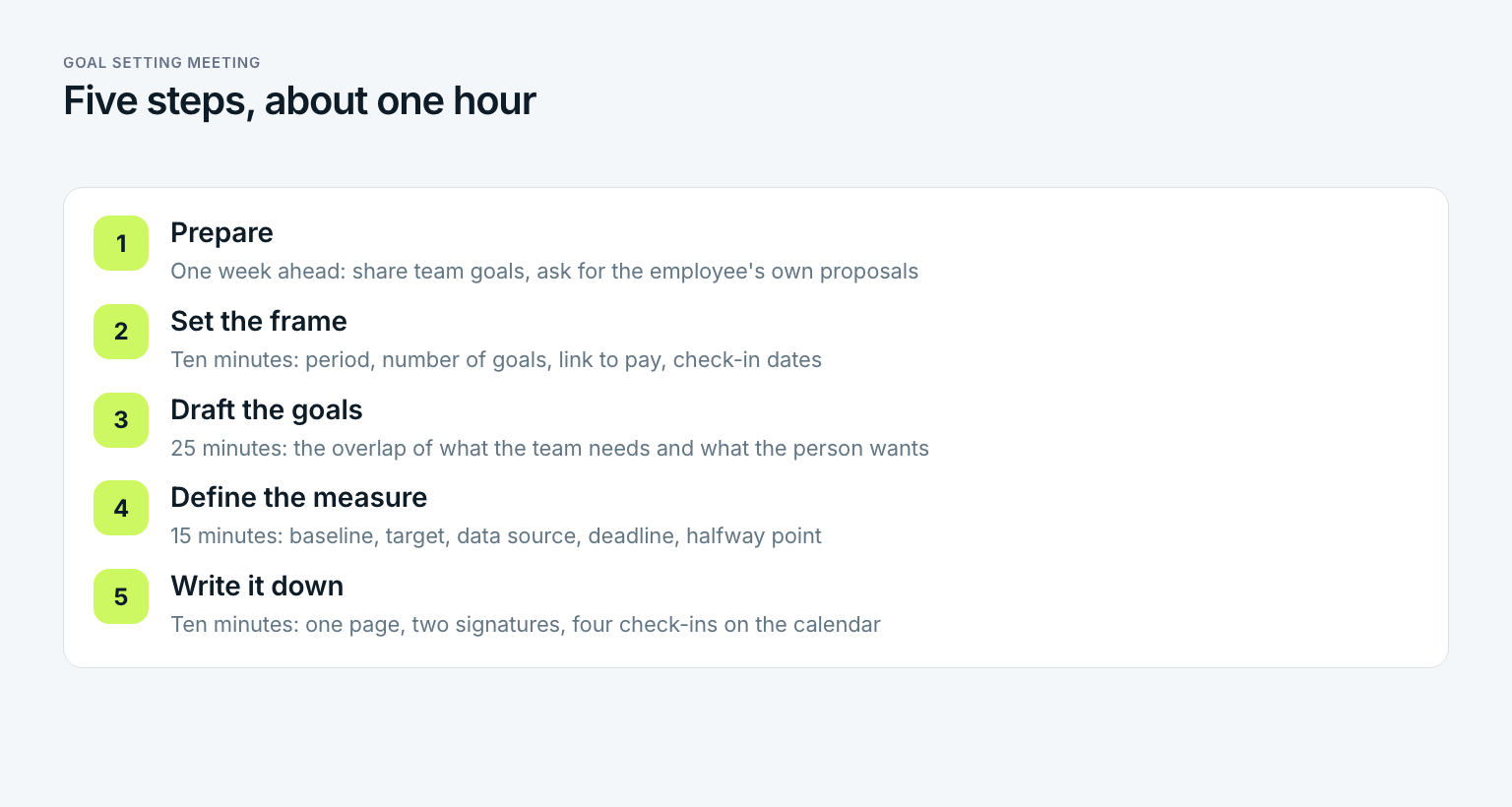
Prepare, one week ahead
Share the team's goals for the year and ask the employee to bring two or three goals of their own. Bring your own list of what needs to change, with baselines from your reports. A manager who shows up empty handed ends up dictating.
Set the frame, ten minutes
Name the team goal, the period, the number of goals, how the goals connect to pay if they do, and when the check-ins happen. Rachel tells Luis that his goals do not touch his commission, but they decide whether the key account role opens up for him next year.
Draft the goals, 25 minutes
Start with the employee's proposals, then add yours. Look for the overlap between what the team needs and what the person wants. Three to five goals, at least one of them a development goal.
Define the measure, 15 minutes
For each goal: baseline, target, data source, deadline and what counts as halfway. This step feels like paperwork. It is the step that decides December.
Write it down and book the check-ins, ten minutes
Put the goals on one page, both of you sign, and the four quarterly check-ins go on the calendar before you leave the room. Without those dates the page is a contract nobody enforces.
The example: Rachel and Luis in January
Luis brings three ideas: automatic reorder reminders, a product cheat sheet for new reps, and time with the key account manager. Rachel brings one number, 55 percent. The overlap is quick to find. Most practices do not reorder because nobody reminds them before they run low, and then a competitor's rep walks in. A reminder sequence moves the reorder rate. Luis's first idea is the lever for Rachel's number.
The cheat sheet gets dropped as a goal. It is a task, not a result, and it shows up later in his quarterly plan. Three goals remain: the reorder rate, the reminder sequence and the key account visits. The meeting takes 55 minutes. Could it have taken 40? Yes, if Rachel had pulled the reorder report before the meeting instead of during it.
Employee goal setting template: one page
Employee goals fit on one page. More space invites prose, and prose can be read two ways in December. The template needs these fields:
- Header: name, role, manager, period, date of the meeting.
- Link: the team or company goal these goals serve, in one sentence.
- Per goal: type, the goal as one sentence, measure, baseline, target, data source, deadline.
- Scoring: what counts as not started, halfway, done and above target.
- Support: what the manager contributes, such as time, budget, access or training.
- Check-ins: four dates in the year.
- Change rule: when a goal may be changed during the year, for example after a reorg or a role change.
- Sign off: both names and the date.
The field most templates miss is the change rule. Without it, a goal that no longer makes sense either stays on the page until December or quietly disappears. Both damage trust in the whole process. Whoever writes the change rule down in January does not have to improvise in May.
How to track employee goals: four check-ins and one number
Tracking employee goals does not need a dashboard. It needs four check-ins of 30 minutes and one number per goal. At each check-in you ask the same question for every goal: Where does it stand against the target for this quarter? Not for the year. The year is too far away to steer by.
Here is Luis's first goal across the year, with the quarterly targets he and Rachel set in January:
| Check-in | Reorder rate | Quarter target | Decision |
|---|---|---|---|
| April | 57 percent | 58 percent | Slightly behind. Work on the reminder sequence starts in May instead of June. |
| July | 60 percent | 61 percent | Reminders live since June 12. Keep going. |
| October | 63 percent | 63 percent | On target. Add a second reminder for slow-moving products. |
| December | 64 percent | 65 percent | Year end: 90 percent of the gap from 55 to 65 closed. |
Luis misses the target by one point. Is that a failure? Not by the scale they agreed on in January, which counted 60 percent as halfway and 65 percent as done. He closed 90 percent of the gap, the reminder sequence went live 18 days early, and he led his first practice group visit in November. That is a strong year, and both of them can read it off the page without a debate. That means: The scoring scale moves the argument from December to January, where it can still change something.
The three mistakes nobody notices
Employee goals rarely fail loudly. They fail in July, when nobody is looking. Three mistakes are behind most of it, and the first one is by far the most common.
The most common mistake: a goal without a measure
“Improve customer satisfaction.” “Optimize processes.” “Be more proactive.” Goals like these show up in a lot of employee plans because nobody objects to them in January. In December both sides object, because now someone has to decide whether satisfaction improved, and there is no yardstick. Without a measure the score becomes the manager's gut feeling, the exact thing goal setting was supposed to replace. Test every goal with one question: Could a third person read off in December whether it was hit?
- Goals without a measure. The mistake from the box above. It only shows up in December, when it is too late to start measuring.
- Goals outside the employee's control. Company revenue as a goal for a support rep motivates nobody, because she can barely move it. Company goals belong in the header as context, not in the middle as a goal. Anyone paid for something they cannot influence experiences the bonus as a lottery.
- Goals without check-ins. The page goes into the HR system, and the next look at it happens in December. By then some goals are stale that could have been fixed in May. Four check-ins of 30 minutes a year are enough to prevent it.
For Rachel's team last year, it was mostly the third one. Eight of 26 goals were overtaken when prices changed in May. Would anyone have caught that in time? Yes, at the first check-in, if there had been one. This year the four dates were on the calendar before the ink was dry.
From employee goals to the goal chain: year, quarter, month, week, day
Employee goals describe the year. Work happens in weeks and on days. The gap between the two is where most goals disappear. The goal chain closes it: every yearly goal gets a quarterly goal, every quarterly goal a monthly goal, and from that follows what to do this week and today.
For Luis's first goal, the reorder rate, the chain looks like this:
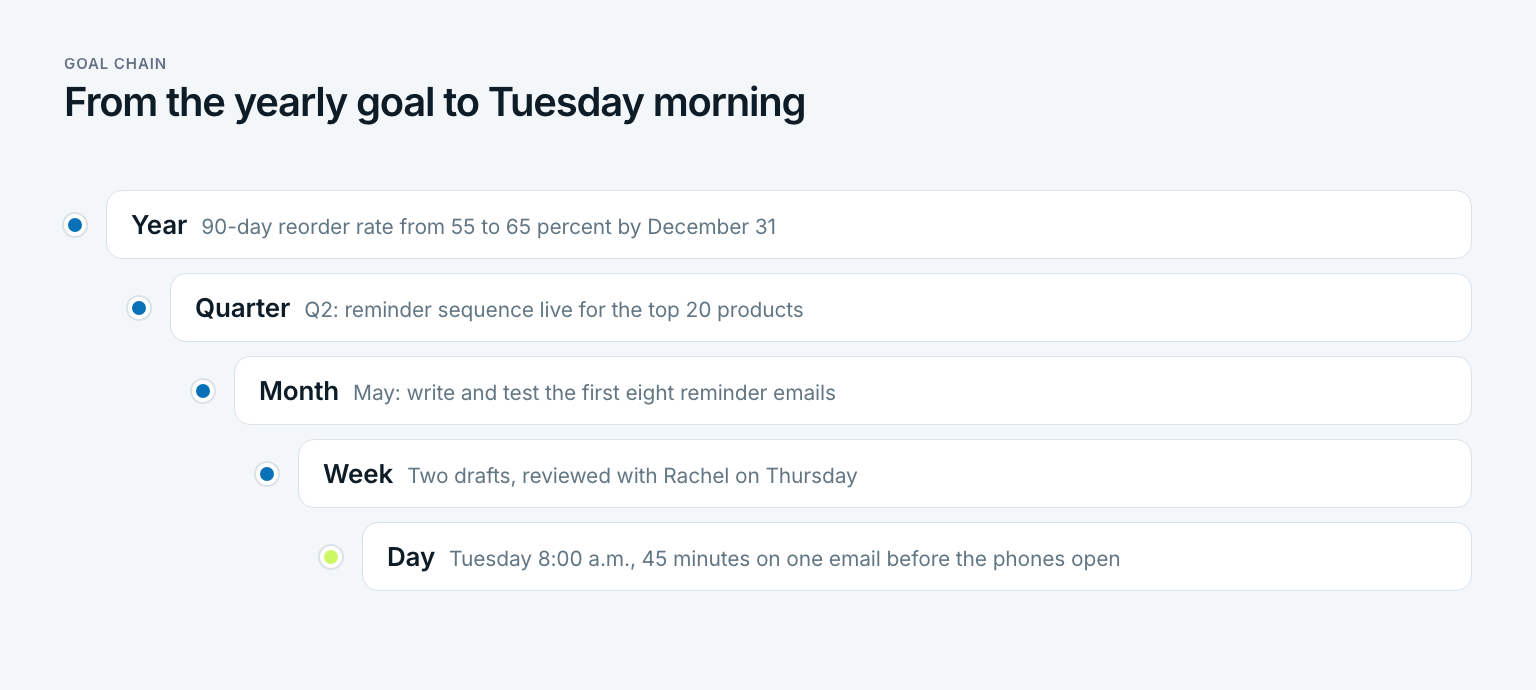
Each level answers one question: What does the yearly goal mean for this quarter, this month, this week? The daily step is small, 45 minutes on a Tuesday before the phones open. But it is the only place where the reorder rate actually moves. The full method is in turn yearly goals into daily steps.
For the check-ins, that means Rachel and Luis do not look at the yearly goal. They look at the quarterly goal. If it holds, the year is on track. If it slips, they adjust now, not in December. In Gaapp, Luis can set up his three goals as a chain and share them with Rachel in a shared space, so both see the same status without anyone writing a report. In short: Goal setting for employees sets the direction, and the goal chain makes sure it reaches Monday morning.
Your self audit before the next goal setting meeting
Before you sign the next set of goals, as a manager or as an employee, check them against six questions:
- Does every goal have a baseline, a target, a deadline and a data source?
- Is every goal mostly in the hands of the person who signs it?
- Are there five goals or fewer, and is at least one of them a development goal?
- Is it clear in advance what counts as halfway and what counts as done?
- Are the four check-ins already on the calendar?
- Do you know what you will do this week for the most important goal?
Whoever answers all six with yes has goals nobody needs to interpret in December. Whoever hesitates at the last one has a good document and no plan yet. For the bigger picture on making any goal stick, read how to achieve goals. Employee goals are not a form you file, they are a promise you keep a little every week.
Frequently asked questions about goal setting for employees
What are the 5 SMART goals examples for employees?
Five solid examples: raise the 90-day reorder rate from 55 to 65 percent by December 31, cut first response time on email tickets from nine to four hours by June 30, close the books by the fifth business day each month from April on, lower picking errors from 0.8 to 0.4 percent by year end, and complete preceptor training by June 30. Each one names a measure, a baseline, a target and a date. Swap in your own numbers before you use them.
What are some good goals to set for employees?
Good goals for employees are few, measurable and mostly in the employee's own hands. A strong set usually has two performance goals tied to the team's priorities and one development goal tied to where the person wants to grow. Goals that only restate the job description or depend on company revenue are weak choices.
What are the 5 C's of goal-setting?
There is no single official list. The version most people mean goes back to Locke and Latham's goal setting research and its five principles: clarity, challenge, commitment, feedback and task complexity, sometimes reworded so that all five start with C. For employee goals the practical lesson is the same: clear measures, a real stretch, genuine buy in, regular check-ins and enough time for complex goals.
What are 5 good personal goals?
For an employee, five good personal goals are to learn one skill the next role requires, present your work to leadership twice a year, build a relationship with a mentor outside your team, finish one certification, and protect one focused block per week for your most important goal. Each works best with a date and a visible result. Personal goals belong in the development part of the plan, not in the bonus part.
How many goals should an employee have?
Three to five goals per year is the usual range, and three is often the better number. Every additional goal takes attention away from the others. At least one of them should be a development goal.
How often should you review employee goals?
Review them at least once a quarter in a short check-in, and touch on them in your regular one on ones. A yearly review alone comes too late to adjust goals that a reorg or a market change has made obsolete.
Last updated: 19 October 2026
Read next
 Leadership & Teams
Leadership Styles: Which One Fits Which Situation
Leadership styles are not personality types: 11 types compared, Lewin, Goleman, situational leadership and five steps to find the style that fits you.
14 min read
 Leadership & Teams
Retrospective: How Teams Learn From Every Sprint
A retrospective is not a blame session: what the word means, five phases, seven retrospective examples and action items that stick, shown on one team.
16 min read
 Leadership & Teams
How to Delegate Tasks: Hand Off Work, Keep Results
Delegation is not dumping work: five levels of delegation, seven steps, a handoff script and what to keep, shown on one marketing team.
15 min read