One-on-One Meetings: Agenda, Questions and Template
A one on one meeting is a private, recurring conversation the report owns. Agenda in five parts, 21 questions, cadence, three mistakes, one team's quarter.

Contents
- 01What a one on one meeting is, and what it is not
- 02Why most 1:1 meetings turn into status updates
- 03Whose meeting it is: the report owns the agenda, you own the follow through
- 04The best agenda for a one on one meeting: 30 minutes in five parts
- 05What should be discussed in a 1 on 1 meeting, and what should not
- 06One on one meetings with employees: how often, how long, and in which format
- 07One on one meeting questions: 21 that open the conversation
- 08The three mistakes nobody notices until someone leaves
- 09Goals in the one on one: from the team's yearly goal to this week
- 10Your self audit before the next 1:1, and one sentence to keep
A one on one meeting is not a status update. It is a recurring, private conversation between you and one of your direct reports, usually 30 minutes every week or every two weeks, in which the report sets the agenda and you listen, coach, and clear obstacles. A status update tells you what happened to the work. A one on one meeting tells you what is happening to the person doing it.
Three things make the difference: who owns the agenda, which questions get asked, and whether anything changes between two meetings. All three are worked through on the calendar of Elena, a newly promoted support team lead at a software company in Phoenix with eight direct reports. She spent her first quarter as a manager holding 30-minute 1:1s every week, 104 slots in total, and still lost her strongest person to a competitor in week eleven. His exit interview had one sentence in it that stuck: I never knew where I stood. By the end, her meetings look the same on the calendar and do something completely different.
What a one on one meeting is, and what it is not
A one on one meeting is a standing conversation between a manager and a single team member. Four things are fixed: the two people, the slot in the calendar, the private setting, and the ownership. The slot repeats. The setting has no third person and no audience. The ownership belongs to the report. Andrew Grove, who ran Intel and wrote High Output Management in 1983, put it in one line: the one on one is the subordinate's meeting, and the manager's job in it is to learn and to coach. Whoever treats the slot as their own reporting line has already lost half of its value. Coaching in a 1:1 stays informal. In a paid engagement, coaching goals with a client get a written end state and a date.
What it is not fills a longer list. It is not a team meeting with one attendee. It is not a performance review, which happens once or twice a year and looks back. It is not a project check in, which belongs in the stand up or in the ticket system. And it is not a friendly chat without a purpose, however pleasant that is. A chat is a good thing. It just does not change what the person does on Tuesday.
One on one, 1:1, or 1 on 1: is it correct to say one on one meeting?
All three are in use and all three mean the same thing. Dictionaries list the adjective as one-on-one with hyphens, so a careful writer puts the hyphens in before the noun: a one-on-one meeting. In calendars and chat, 1:1 and 1 on 1 have won because they are faster to type. Say whichever your team says. What matters is that the word stands for a fixed, private slot and not for a hallway conversation.
| Format | Who sets the agenda | Looks at | Rhythm | Built for |
|---|---|---|---|---|
| Status update | The manager | The work, this week | Daily or weekly, often in a group | Coordination |
| One on one meeting | The report | The person, the obstacles, the growth | Weekly or every two weeks, 30 to 45 minutes | Trust, coaching, early warning |
| Performance review | The manager and HR | The past six or twelve months | Once or twice a year | Rating, pay, promotion |
| Team meeting | The manager | The team's goals and decisions | Weekly | Alignment |
The table shows where the confusion comes from. A one on one meeting sits between the status update and the performance review, and it borrows from both. It looks at the work, but through the person. It looks at growth, but every week instead of once a year. That means: if your 1:1 has an agenda full of tickets, you are running a status update in a private room. If it has no agenda at all, you are running a chat.
Why most 1:1 meetings turn into status updates
Elena's first 1:1s followed a pattern she had never chosen. She opened with how is it going, the report answered fine, and then the two of them went through the open tickets for 25 minutes. Nobody had decided that. It happened because tickets are easy to talk about and worries are not, and because both people wanted to leave the room feeling productive. By week four, three of her eight reports had started sending their updates in writing before the meeting, which should have been a signal. She read it as efficiency.
The pattern is understandable. Status is concrete, it is safe, and it fills the time. Nobody leaves a status update feeling exposed. But the status update is built for something else. It coordinates work that is already decided. The one on one is where the undecided things live: Is this person growing? Are they stuck on something they have not said out loud? Do they still want to be here in six months? None of those questions fits between two ticket numbers.
Three signs tell you that your 1:1 has quietly become a status update: you talk more than the report, the notes contain only tasks, and nothing in the notes from three weeks ago has changed. Elena hit all three. Whoever checks their last four sets of 1:1 notes against that list usually finds the same thing. In short: a status update in a private room is still a status update.
Whose meeting it is: the report owns the agenda, you own the follow through
The report owns the agenda. That single rule fixes more 1:1s than any question list. Grove's argument from 1983 still holds: the report knows where the problems are, and the manager's job is to find them out, which works better when the report chooses the order. Kim Scott makes the same point in Radical Candor from 2017 and adds that the manager's role in a 1:1 is to listen and to help, not to update.
Owning the agenda does not mean the report walks in with a slide deck. It means a shared document that both of you can write in during the week, with three fixed sections: what the report wants to talk about, what you want to talk about, and what was agreed last time. The report's section comes first and gets the most time. Yours comes second and is usually short. The third section is where the meeting earns its slot, because an agreement that is never checked is a wish. A ready-made one on one meeting template sets up those sections and adds notes, action items and a monthly growth check.
What do you own, then? The follow through. If the report says the on call rotation is wearing them down, your job is not to sympathize for ten minutes and move on. It is to write down one thing you will do before the next meeting, do it, and report back. Whoever runs eight 1:1s a week and leaves each one with a single task has eight tasks. That is manageable. Eight unresolved complaints are not.
The best agenda for a one on one meeting: 30 minutes in five parts
The best agenda for a one-on-one meeting is short, repeats every time, and leaves most of the minutes to the report. Thirty minutes is enough if the structure holds. Here is the version Elena switched to in week twelve, with the minutes next to each part.
Check in, three minutes
Open with one question that is not about tickets: How was your week? What is on your mind? Michael Bungay Stanier calls the second one the kickstart question in The Coaching Habit from 2016, because it lets the report pick the topic. Listen to the whole answer. If the answer is a work topic, that becomes the first agenda item.
The report's topics, twelve minutes
Go through what the report wrote in the shared document, in their order. Ask before you advise. The ratio to aim for is two questions for every suggestion. If a topic needs a decision from you, make it in the room or name the date by which you will.
Goals and progress, eight minutes
Look at the report's current goals, not the task list. Which of the quarter's goals moved this week? Which one is stuck, and why? This is the part most managers skip, and it is the part that tells both of you where the person stands.
Your topics, four minutes
Feedback, a heads up about a change, a request. Keep it to one or two items. If you have five, you have been saving them up, and saving feedback up is the second of the three mistakes below.
Agreements and next step, three minutes
Read back what was agreed: who does what by when. Write it in the third section of the document. The next meeting opens with this list. One or two items is right. Six means the meeting tried to be a planning session.
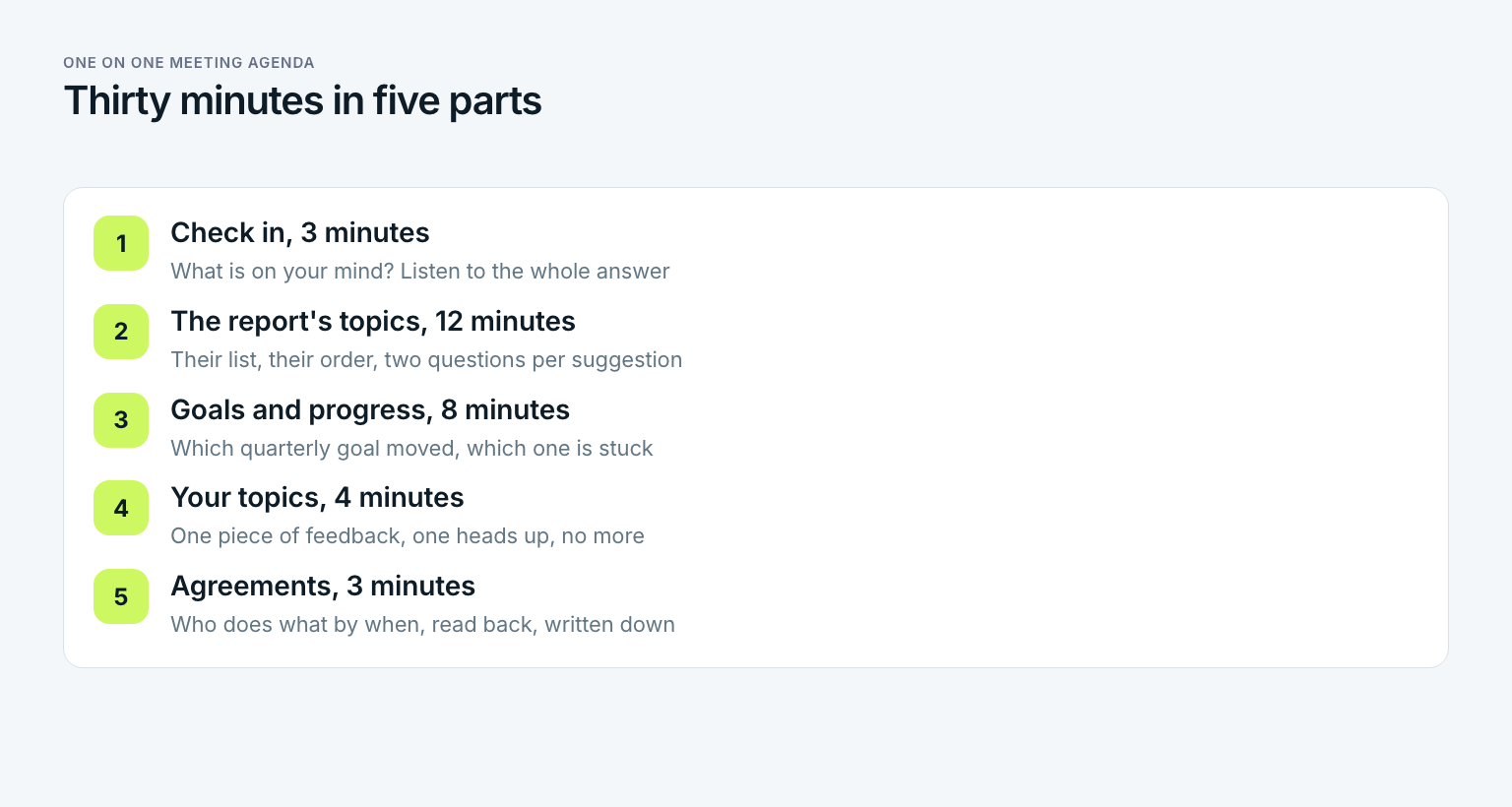
The minutes are a guide, not a timer. Some weeks the check in takes 20 minutes because something happened at home, and that is the meeting. Some weeks the report has nothing on the list, and you spend the time on goals. What should not move is the order: the report first, you second, agreements last. Whoever flips the order to get their own items in early teaches the report that the meeting is not theirs.
What should be discussed in a 1 on 1 meeting, and what should not
A 1 on 1 meeting should cover four things: obstacles, growth, feedback in both directions, and the link between this person's work and the team's goals. It should not cover status, scheduling, or anything a message could settle in two lines.
- Obstacles. What is slowing the report down that they cannot fix alone: a dependency on another team, a tool, a decision waiting on you, a colleague. These are the items where your follow through matters most.
- Growth. What the report wants to be able to do in a year that they cannot do today, and what this quarter contributes to it. Growth talk once a year in a review is too late to steer. Once a month in a 1:1 is about right.
- Feedback in both directions. One specific observation from you, and one question to the report: What could I do differently as your manager? The second half is the one most managers skip. Elena asked it for the first time in week 13 and learned that her Monday morning messages read as urgent when they were not. The first half works best with a clear shape, which the guide on how to give feedback to employees lays out in four steps.
- The link to the goals. How the report's work connects to the quarter's goals and to the team's yearly goal. People who can name that link stay. People who cannot start reading job postings. Achieving goals as a team starts with every person knowing which goal their week belongs to.
What stays out: the ticket walk through, the vacation calendar, the meeting that could have been an email. Not because those things do not matter, but because they crowd out the things that only fit here. Is there a week when status really has to be discussed in the 1:1? Yes, during an incident or a launch. Call it what it is, and go back to the format the week after.
Psychological safety, in one sentence
Amy Edmondson, who introduced the term in 1999, describes psychological safety as the shared belief that it is safe to speak up with a question, a concern, or a mistake. A 1:1 is the smallest room in which that belief is built or broken. Whoever gets a defensive answer to a concern once brings the next concern to a friend instead of to you.

One on one meetings with employees: how often, how long, and in which format
Weekly for 30 minutes is the default, and it beats every alternative for new reports, new managers, and anyone going through a change. Every two weeks for 45 minutes works for experienced people in stable roles. Monthly is too rare for a one on one and turns it into a small review. Elena ran all eight weekly, which cost her four hours a week. She considered cutting everyone to every two weeks to save time and instead kept weekly for the three newest people only, which saved her 75 minutes a week and changed nothing for the people who needed the slot most.
| Situation | Cadence | Length | Why |
|---|---|---|---|
| New hire, first 90 days | Weekly | 30 minutes | Questions pile up fast, and the cost of a wrong assumption is high |
| Experienced report, stable role | Every two weeks | 45 minutes | Fewer open items, more room for growth topics |
| Remote or hybrid report | Weekly | 30 minutes | The hallway does not exist, so the slot has to replace it |
| Report in a difficult phase | Weekly, never skipped | 30 to 45 minutes | Skipping now reads as withdrawal |
| Senior lead with their own team | Every two weeks | 45 to 60 minutes | Their own 1:1s take time, and the topics are larger |
Format matters less than people think, with one exception. In person, on a call, or walking all work. What does not work is a 1:1 that moves around the calendar. Grove's observation was that a regular 1:1 lets both sides save topics for it instead of interrupting each other during the week, and that only happens if the slot is predictable. Pick a day and a time per person, repeat it, and treat it like a customer meeting. The exception: do not run 1:1s in an open area where the report's colleagues can hear. A meeting room, a call, or a walk. Never the desk.
One on one meeting questions: 21 that open the conversation
Questions do the work that advice cannot. A good question in a 1:1 is open, specific to this person, and asked once, then followed by silence. Here are 21, in three groups of seven. Pick two per meeting, not twenty.
Questions about the week and the obstacles
- What is on your mind this week?
- What is taking longer than it should, and why?
- Where are you waiting on someone, including me?
- What did you have to work around this week?
- If you could drop one thing from your plate, what would it be?
- What are you worried about that nobody has asked you about?
- What went better than expected, and what made the difference?
Questions about growth and goals
- Which of your quarterly goals moved this week?
- Which one is stuck, and what would unstick it?
- What do you want to be able to do a year from now that you cannot do today?
- What part of your work would you like more of, and what less?
- Who on the team or outside it do you learn the most from?
- What skill would make next quarter easier?
- What would you need from me to take on the next bigger thing?
Questions about you as a manager and about the team
- What could I do differently as your manager?
- What is one thing I do that makes your work harder?
- How clear are the team's priorities to you, from one to ten, and what would move it up one point?
- Is there a decision you are waiting on from me?
- What is the team not talking about that it should?
- What have you heard about me that I have not?
- Do you know where you stand with me? What would make that clearer?
The last group is the uncomfortable one, and it is the one that moves the needle. Elena's first answer to what could I do differently was a long pause and then nothing. Her third was the Monday messages. Her sixth was a request to stop solving problems in the meeting and let the report try first. Whoever asks the question six times gets the sixth answer. A longer list of one on one meeting questions separates what managers ask from what reports ask.
The three mistakes nobody notices until someone leaves
Three mistakes run through most failing 1:1s, and none of them feels like a mistake while you make it. Each one is small in the moment and large in the exit interview.
The most common mistake: rescheduling the one on one
Something urgent comes up, you move the 1:1 to Thursday, then to next week. It feels like a small thing. To the report it is a message: your time is less important than the thing that came up. Elena moved or cancelled eleven of Devon's 13 1:1s in his last quarter, each time for a good reason. His exit interview did not mention any of the reasons. The fix is one rule: the 1:1 moves only if the report moves it, and a moved 1:1 still happens the same week.
The second mistake is saving feedback for the review. A comment that would take 30 seconds in week three becomes a paragraph in a document in month six, and by then it is a verdict instead of a correction. Scott's rule in Radical Candor is to give feedback within days, in private, and about something specific. The 1:1 is the private part, already in the calendar. Whoever has five pieces of feedback for one meeting has skipped four meetings.
The third mistake is leaving without a written next step. The conversation was good, both of you felt heard, and nothing changed. Three weeks later the same obstacle comes up and the report wonders whether you remember. You do not, because there is no note. One line per agreement, with a name and a date, read back at the start of the next meeting. That is the whole system. A 1:1 without that line is a conversation. A 1:1 with it is management.
Goals in the one on one: from the team's yearly goal to this week
A 1:1 gets its backbone from the goals. Without them, the goals and progress part of the agenda becomes a second status round. With them, eight minutes a week is enough to know where each person stands, which is exactly what Devon said he never knew. The chain has five levels: year, quarter, month, week, day. The 1:1 lives at the level of the week and looks up to the month.
Elena's team has one yearly goal for 2026: cut the median first response time on support tickets from 9 hours to 4 while keeping the satisfaction score at 4.6 or above. Each report owns one quarterly goal that feeds it. One of them, Priya, owns the knowledge base: by December 31, 40 new help articles, so that the 60 most common tickets each have a linked answer. That breaks down into a monthly goal of 13 articles, a weekly goal of three, and a daily step of one draft or one review. Her 1:1 agenda item is always the same question: Which three this week, and what is in the way?
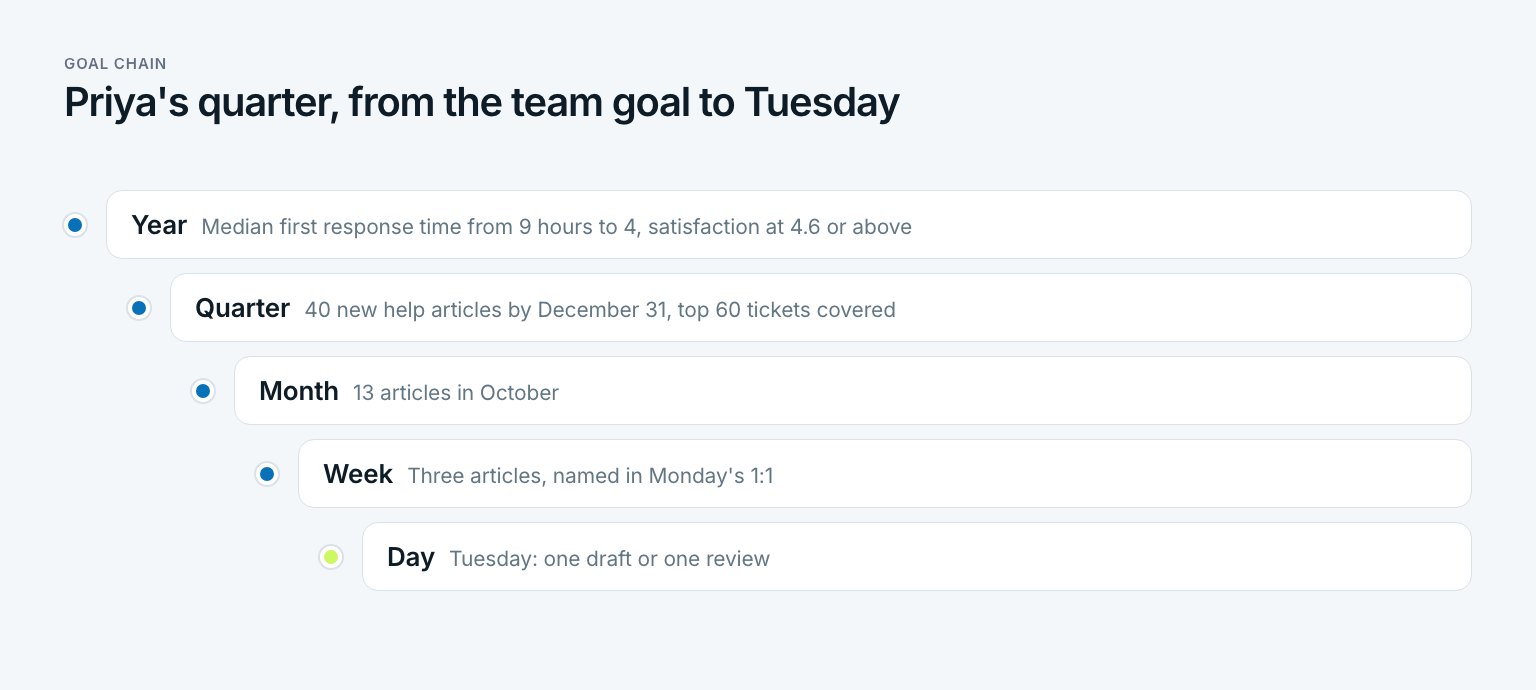
What changes in the meeting? The goals part stops being abstract. You do not ask how the knowledge base is going. You ask which of this week's three articles are done, and the answer is a number. If the number is zero two weeks in a row, that is not a performance problem yet. It is an obstacle you have not found. The goal chain turns the 1:1 from a feelings check into an early warning system, and it does that without a single ticket on the agenda. Whoever keeps the chain visible in the shared document, from the yearly goal down to this week, never has to ask where someone stands. Both of you can see it. Ten minutes on Friday in a weekly review keep the week's number current, and the 1:1 picks it up on Monday.
If your team runs OKRs, the quarterly goal is the objective and the 40 articles are a key result. If it does not, a plain number with a date does the same job. The format matters less than the rule: one goal per person per quarter, broken down to the week, visible in the 1:1. The team's annual planning sets the yearly goal in December, and the quarterly goals are agreed in the first 1:1 of each quarter, not announced in a team meeting.
Elena's quarter in numbers: what changed between Q3 and Q4
Numbers from one team of eight, counted from Elena's shared documents, nothing more. They show what the format did for her, not what it proves in general.
| Measure | Q3, status update format | Q4, agenda above |
|---|---|---|
| 1:1s held as scheduled | 61 of 104 | 98 of 104 |
| Share of the meeting the report spoke | About a third, by Elena's own count | About two thirds |
| Written agreements per meeting | 0 | 1.4 on average |
| Obstacles raised that needed Elena to act | 4 in the quarter | 27 in the quarter, 23 resolved |
| Reports who could name their quarterly goal when asked | 2 of 8 | 8 of 8 |
| Voluntary departures | 1 | 0 |
| Elena's weekly time in 1:1s | 4 hours | 2 hours 45 minutes |
Two numbers matter more than the rest. Obstacles raised went from four to 27, which did not mean the team had more problems. It meant Elena finally heard about them while they were still small. And meetings held as scheduled went from 61 to 98, which is the one lever that cost nothing except a rule. The time saved came from moving five experienced people to every two weeks. That means: the better format was also the cheaper one.
Your self audit before the next 1:1, and one sentence to keep
Before your next one on one, open the notes from the last four and answer three questions honestly. Who talked more? Did anything written three weeks ago change? Can the report name the goal their week belongs to? If the answers are you, no, and no, you have a status update with a private room. That is where Elena started, and the fix took one quarter and a document with three sections.
Three more for the braver manager: When did I last ask what I could do differently? When did I last move a 1:1 for my own reasons? Have I given a piece of feedback in the past two weeks that I would otherwise have saved for the review? None of these takes longer than a minute to answer. All of them change the next meeting.
In short: a one on one meeting is the half hour a week in which a person finds out where they stand, and you find out what you would otherwise learn in an exit interview.
What is a one-on-one meeting?
A one-on-one meeting is a recurring, private conversation between a manager and one direct report, usually 30 minutes every week or every two weeks. The report owns the agenda, the manager listens, coaches, and clears obstacles, and both write down what was agreed. It is not a status update and not a performance review.
Is it correct to say one on one meeting?
Yes. One on one, one-on-one, 1:1, and 1 on 1 all describe the same meeting. Dictionaries hyphenate the adjective before a noun, so one-on-one meeting is the formal spelling. In calendars and chat, 1:1 is the most common version because it is shortest.
What should be discussed in a 1 on 1 meeting?
Four things: obstacles the report cannot clear alone, growth and what this quarter contributes to it, feedback in both directions, and how the report's work connects to the team's goals. Status, scheduling, and ticket walk throughs belong in other meetings or in a message. The report's topics come first and get the most time.
What is the best agenda for a one-on-one meeting?
Five parts in 30 minutes: a check in of three minutes, the report's topics for twelve, goals and progress for eight, the manager's topics for four, and agreements for the last three. The order matters more than the exact minutes. The report goes first, the manager second, and the meeting ends with written next steps that open the following one.
How often should you have one on one meetings with employees?
Weekly for 30 minutes is the default and the right choice for new hires, remote reports, and anyone in a difficult phase. Experienced people in stable roles do well with 45 minutes every two weeks. Monthly is too rare and turns the meeting into a small review. Whatever the cadence, the slot should not move unless the report moves it.
Should the manager or the employee run the 1:1 meeting?
The employee sets the agenda, the manager runs the follow through. Andrew Grove called it the subordinate's meeting in High Output Management, and the rule still holds. A shared document with three sections, the report's topics, the manager's topics, and last time's agreements, keeps both roles clear without anyone having to announce them.
Last updated: 19 October 2026
Read next
 Leadership & Teams
Leadership Styles: Which One Fits Which Situation
Leadership styles are not personality types: 11 types compared, Lewin, Goleman, situational leadership and five steps to find the style that fits you.
14 min read
 Leadership & Teams
Retrospective: How Teams Learn From Every Sprint
A retrospective is not a blame session: what the word means, five phases, seven retrospective examples and action items that stick, shown on one team.
16 min read
 Leadership & Teams
How to Delegate Tasks: Hand Off Work, Keep Results
Delegation is not dumping work: five levels of delegation, seven steps, a handoff script and what to keep, shown on one marketing team.
15 min read