Employee Goals Examples: 20 Work Goals by Role
Employee goals examples are not templates to copy: 20 work goals by role, a five-part formula, a filled-out sheet and three mistakes to avoid.

Contents
- 01Why copied work goals examples fail
- 02The five-part formula behind good goals for work
- 03Employee goals examples by role: 20 goals at a glance
- 04Good goals for a good employee when there is no number
- 05Before and after: five goals rewritten
- 06How to turn an example into your own goal in five steps
- 07The three mistakes when copying goals for work examples
- 08From example to goal chain: year, quarter, month, week, day
- 09Your self audit before you sign
- 10Frequently asked questions about employee goals examples
Employee goals examples are not templates to copy. They are worked models that show how a goal for one specific role gets written: what changes, from what baseline, to what target, by when, and where the number will be read at the end. Anyone who borrows an example should borrow the sentence structure, not the numbers. The numbers come from your own business.
Below are 20 examples of goals for work, sorted by role across four groups, from field sales to new hires, each with its goal type and the place it gets measured. You also get a five-part formula, five weak goals rewritten, one filled-out goal sheet and the three mistakes people make when they copy work goals examples. The thread through all of it is Priya, the HR manager at a 110-person commercial printing company in Minneapolis who supports goal setting for every team in the building.
Why copied work goals examples fail
Examples are useful. Anyone writing goals for the first time needs a feel for how specific a goal can be and how much fits into one sentence. The trouble starts when the example replaces the thinking instead of starting it. That is how you end up with goals that fit every role and steer none of them.
Priya saw this up close last year. She is 38 and has run HR at the printer for six years. In January, the nine managers in the company wrote 52 goal sheets. When Priya collected them in December to calculate bonuses, 31 contained the same three lines: “improve productivity,” “improve communication” and “complete a training course.” The lines came from an old template on the shared drive. Not one of them could be scored without an argument.
Why do so many managers reach for lines like that? Because a generic example is comfortable. It fits every role, and that is exactly why it steers none. A useful example is so specific that it only fits one role. That means: a list of employee goals examples has to be sorted by role, not by goal type, and every example needs a data source the business actually has.
This year Priya rebuilt the list. One example per role, each tied to a report that already exists in the company. Managers get it two weeks before goal setting, with a single rule attached: copy the structure, measure your own numbers. How the goal setting meeting runs and how goals connect to pay is covered in goal setting for employees. This article is only about the wording.
The five-part formula behind good goals for work
Every example below follows the same five-part formula. Whoever understands it once can write a goal for any role, including one that is not on this list. Here is how it looks for a press operator:
| Part | Question it answers | Press operator example |
|---|---|---|
| Verb and measure | What changes, and how will you see it? | Cut makeready time on Press 2 |
| Baseline | Where are we today? | from 40 minutes per job |
| Target | Where do we want to end up? | to 25 minutes per job |
| Deadline | By when? | by June 30 |
| Source | Where will we read the result? | the press monitoring report |
Put together, that becomes one sentence: Cut makeready time on Press 2 from 40 to 25 minutes per job by June 30, measured in the press monitoring report. The grid behind it is SMART, which George T. Doran introduced in Management Review in 1981. If you want to test a sentence letter by letter, how to write SMART goals walks through it with before and after versions.
Most work goals examples you find online miss a sixth part: the counterweight. A goal that only measures speed gets reached at the cost of care. A goal that only measures volume gets reached at the cost of quality. Several examples below carry a short clause starting with “at most” or “with no increase in” for exactly that reason.
Pair your measures, the Andy Grove rule
Andy Grove, who ran Intel through its biggest growth years, argued in “High Output Management” in 1983 that indicators should come in pairs: one for the effect you want and one for the side effect you fear. Measure only output and you get output, with the errors showing up at the customer. For employee goals, that means a speed goal gets a quality limit and a revenue goal gets a discount limit. Half a sentence is enough, and it keeps a goal from being reached the wrong way.
Employee goals examples by role: 20 goals at a glance
The 20 examples are grouped into four areas. Most are performance goals, because they are the easiest to measure. Every area also includes at least one development or behavior goal. A goal sheet where only the company wants something reads like a quota, even with two signatures on it. All numbers are sample values from Priya's company. Whoever borrows them swaps in their own.
Sales and customer-facing roles: five examples
| Role | Type | Example goal | Measured in |
|---|---|---|---|
| Field sales rep | Performance | Grow new-account revenue in the northern territory from $310,000 to $380,000 by December 31, with average discounts at 10 percent or less | CRM new-account report |
| Account manager | Performance | Hold a quarterly business review with each of the 15 largest accounts, with a written action plan sent within two business days | CRM activity log |
| Customer service rep | Performance | Return 95 percent of customer callbacks within four business hours by Q3, up from 78 percent | Phone system callback report |
| Estimator | Performance | Raise the share of jobs whose final cost lands within 5 percent of the estimate from 70 to 85 percent by year end | Job costing report |
| Marketing coordinator | Performance | Publish six customer case studies, each approved in writing by the customer, by November 30 | Website and approval emails |
The field sales goal is the instructive one. It measures new-account revenue, not total revenue, because new business is what the rep actually controls. The discount cap is the Grove counterweight. Without it, any revenue goal can be bought with price cuts, and the company pays for the bonus twice.
The account manager goal has no revenue number at all. Revenue from large accounts follows their own budget cycles, which nobody knows in January. What the account manager can control is whether each of the 15 accounts gets a real review and a written plan. Anyone who cannot move a number directly should commit to the activity that moves it most.
Operations and production roles: five examples
| Role | Type | Example goal | Measured in |
|---|---|---|---|
| Press operator | Performance | Cut makeready time on Press 2 from 40 to 25 minutes per job by June 30, with no increase in paper waste | Press monitoring report |
| Prepress technician | Performance | Reduce files that reach the press with errors from 6 percent to 2 percent of jobs by September 30 | Reprint and error log |
| Maintenance technician | Performance | Complete 95 percent of scheduled preventive maintenance on time each month from April on, up from 78 percent | Maintenance work order system |
| Shipping lead | Performance | Raise on-time shipments from 91 to 97 percent by year end, with damage claims at eight or fewer for the year | Shipping system and claims log |
| Quality inspector | Performance | Cut customer complaints about color mismatch from 22 last year to ten or fewer this year | Complaint log |
The press operator goal shows the counterweight in its purest form. Makeready can almost always get faster if someone checks the first sheets less carefully. The clause “with no increase in paper waste” closes that shortcut. The quality inspector goal uses a count instead of a percentage. With 22 complaints a year, a percentage would only add false precision.
The maintenance goal is worth a second look too. It does not promise fewer breakdowns, because breakdowns also depend on how hard the presses run. It promises the thing the technician owns: scheduled work done on schedule.
Office, finance and IT roles: five examples
| Role | Type | Example goal | Measured in |
|---|---|---|---|
| Payroll specialist | Performance | Cut off-cycle payroll corrections from an average of five per pay period to one or fewer from April on | Payroll system audit log |
| Accounts payable clerk | Performance | Pay 96 percent of vendor invoices within terms by Q3, up from 82 percent, with zero duplicate payments | AP aging report |
| Purchasing agent | Performance | Qualify a second approved supplier for each of the 25 highest-spend materials by September 30 | Vendor master file |
| IT administrator | Performance | Install security patches on all 160 devices within 14 days of release, at a rate of at least 95 percent from March on | Patch management dashboard |
| HR manager | Performance | Cut time to fill for hourly production roles from 52 to 35 days, measured from posting to accepted offer, by year end | Applicant tracking system |
The HR goal is Priya's own. She considered committing to a number of hires, but hiring volume depends on how many orders come in, not on her. Time to fill is different. She can move it with faster callbacks and two fixed interview days a week. That is the line between a goal and a wish addressed to the company.
The accounts payable goal pairs speed with accuracy again. Paying faster is easy if nobody checks for duplicates. Zero duplicate payments is the limit that keeps speed honest.
Leaders, projects and new hires: five examples
| Role | Type | Example goal | Measured in |
|---|---|---|---|
| Shift supervisor | Behavior | Run a ten-minute shift handoff at the board with the three most important open issues, on at least 90 percent of workdays from March on | Handoff board, spot checks by the plant manager |
| Project manager | Performance | Deliver four client projects above $80,000 with no milestone more than five business days late | Project milestone report |
| First-time manager | Behavior | Hand weekly press scheduling to a senior operator by April 30 and approve only exceptions after that, confirmed in the scheduling log | Scheduling log |
| New hire, first 90 days | Development | Run Press 3 solo on standard jobs by day 90, signed off by the shift supervisor after three observed jobs | Sign-off sheet |
| Senior operator aiming for lead | Development | Train two new operators to solo sign-off this year and lead the Friday safety huddle once a month | Sign-off sheets, huddle log |
For people who lead, behavior goals often matter more than output numbers. A shift supervisor cannot move total output alone, but can decide whether the next shift knows where the problems are. That is visible on a board and in a spot check. Whoever sets a behavior goal should always name who observes it and how often.
The two development goals end with a sign-off. For new hires and for people growing into a bigger role, that is the most honest measure. A percentage would come too early. A feeling would be too little.

Good goals for a good employee when there is no number
In a one-on-one, a lot of goals are about behavior and growth: working with other teams, speaking up, a new skill. These need a second formula. Instead of a baseline and a target, they name an observable behavior, a frequency and the person who confirms it. Here are four common wishes translated into that formula:
- Instead of “communicate better”: Open every Monday production meeting from March on with a three-sentence status of my two projects, risks first, recorded in the meeting notes.
- Instead of “take more ownership”: Cover for the shift supervisor during vacations from July on, including signing off the daily schedule, at least four times this year.
- Instead of “improve my Spanish”: Run two press checks with Spanish-speaking clients on my own by October, with feedback from the sales manager.
- Instead of “be a better team player”: Answer every question from the bindery within one business day, with 20 questions spot checked each quarter by the bindery lead.
All four have one thing in common: a third person could say in December, without asking anyone, whether the goal was met. Anyone who sets a development goal should describe the result of the development, not the course that leads there. For turning a vague growth wish into a skill you can prove, see professional development goals.
And what if the manager rarely sees the behavior? Then a second person belongs in the sentence, such as the bindery lead or the sales manager. That sounds like surveillance. In practice it is the opposite, because it stops the December conversation from turning into a verdict on impressions.
Before and after: five goals rewritten
Most weak goals are not bad ideas. They were just written down too early, before anyone asked how the result would be recognized. Priya took the five most common lines from last year's sheets and set a better version from the new list next to each one:
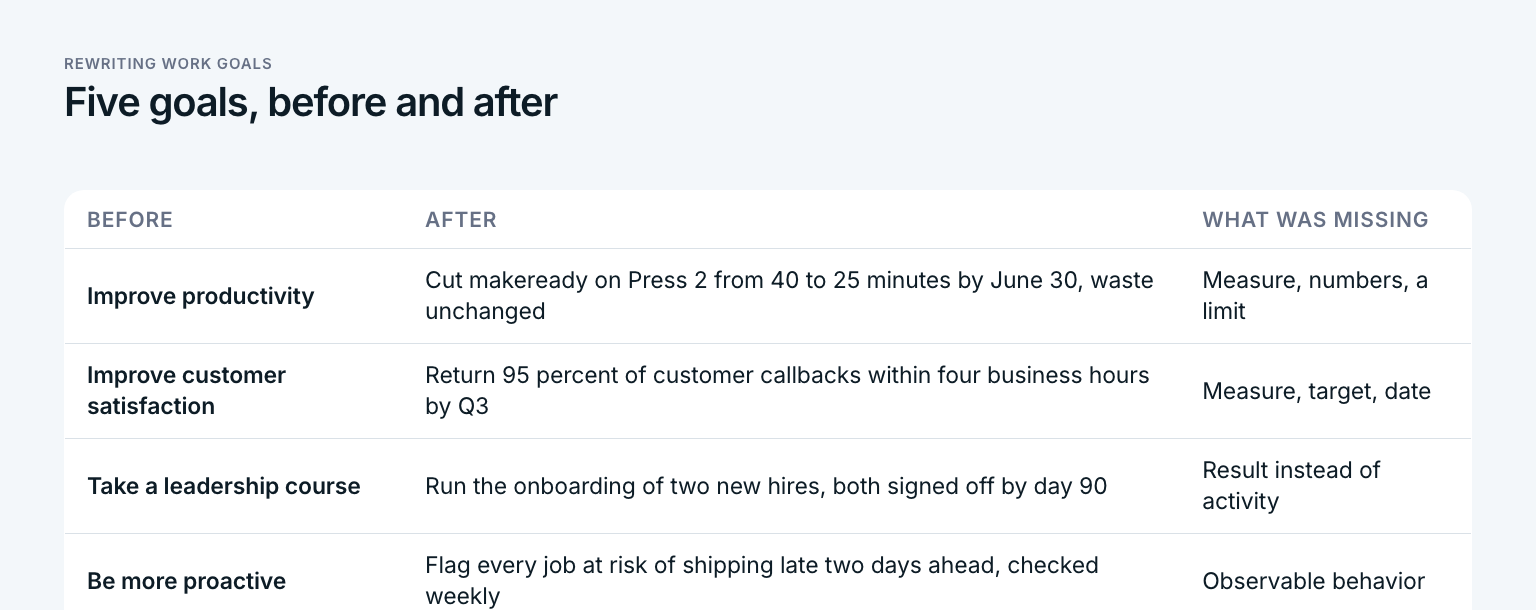
Side by side, a pattern shows. The weak lines are little more than a verb and a noun. The strong ones have a number or a sign-off, a date and often a limit. They are longer, but not more complicated. A 25-word sentence that everyone reads the same way beats a three-word sentence that everyone reads differently.
The leadership course row is the sneaky one. “Take a leadership course” is met on the day of the course, whether or not anything changes afterward. In short: an activity is not a result. It belongs in the plan for reaching the goal, not on the goal sheet.
How to turn an example into your own goal in five steps
An example is a starting point. Turning it into a goal that fits one person and one year takes five steps. Priya printed them on the back of the list she sends to managers:
Name the link
Write down in one sentence which team or company goal this role feeds. Without that link, you pick an example by gut feeling instead of by need.
Pick an example, keep the structure
Find the role on the list closest to yours and keep only the structure: measure, direction, counterweight. Delete the numbers right away.
Measure your own baseline
Pull today's value from a report that exists in your business. If no such report exists, the example is wrong for this role, or you agree on a sign-off instead of a number.
Set the target and the limit
Agree on a target together, ambitious but within the person's control. Add the limit that stops the goal from being reached at the expense of something else.
Write down the source and check-in dates
Note where the result will be read in December and when you will look at progress during the year. Four check-ins a year are enough.
Employee goal example: one filled-out sheet
Here is what the result looks like for Andre. He is 31, has run presses at the company for eight years and is the go-to person when a job will not register. His supervisor agreed on three goals with him, one of each type:
| Goal | Type | Baseline | Target and date | Weight |
|---|---|---|---|---|
| Makeready time on Press 2, read in the press monitoring report, with no increase in paper waste | Performance | 40 minutes | 25 minutes by June 30 | 40 percent |
| Train new operators to solo sign-off on Press 3, signed off by the shift supervisor | Development | none trained | two by November 30 | 30 percent |
| Flag every job at risk of shipping late two days ahead in the scheduling log, checked weekly | Behavior | about half flagged | 90 percent from April on | 30 percent |
Three rows, one page. The sheet deliberately leaves room for nothing else. Every row can be read in December without Andre or his supervisor having to explain anything. That is the whole test of a well written goal.
The three mistakes when copying goals for work examples
A list of strong examples does not automatically produce strong goals. Three mistakes come up again and again when people copy them, and the first is by far the most common.
The most common mistake: borrowed numbers without your own baseline
The example says 25 minutes, so the goal sheet says 25 minutes. At Priya's company, one supervisor did exactly that for an operator on the newer Press 4. That press already averaged 22 minutes in January. The goal was met before the year started. Before anyone signs, check that every baseline comes from your own report and not from the example.
- Borrowing the numbers. The mistake from the box. A target only makes sense relative to your own baseline. Whoever copies it agrees to either a free goal or an impossible one.
- A measure your business does not track. Many examples online assume metrics a smaller company never collects, such as a Net Promoter Score. Anyone who signs that goal will have to invent a number in December. A plainer measure that already sits in a report is better.
- A number with no counterweight. The economist Charles Goodhart observed in 1975 that a measure loses its value once pressure is put on it. The anthropologist Marilyn Strathern put it more sharply in 1997: when a measure becomes a target, it ceases to be a good measure. A Grove-style limit is the simplest defense.
Priya turned these three mistakes into one rule. Before signing, every goal sheet gets a column showing where each baseline came from. If it says “example” or “estimate,” nobody signs. That made four meetings longer in the first round and, by her count, prevented four arguments in December.
From example to goal chain: year, quarter, month, week, day
A well written example describes the year. Work, though, happens in weeks and on days. That gap is where most goals disappear, including the well written ones. The goal chain closes it: every yearly goal gets a quarterly goal, every quarterly goal a monthly goal, and from that follows what to do this week and today.
For Andre's first goal, the chain looks like this:
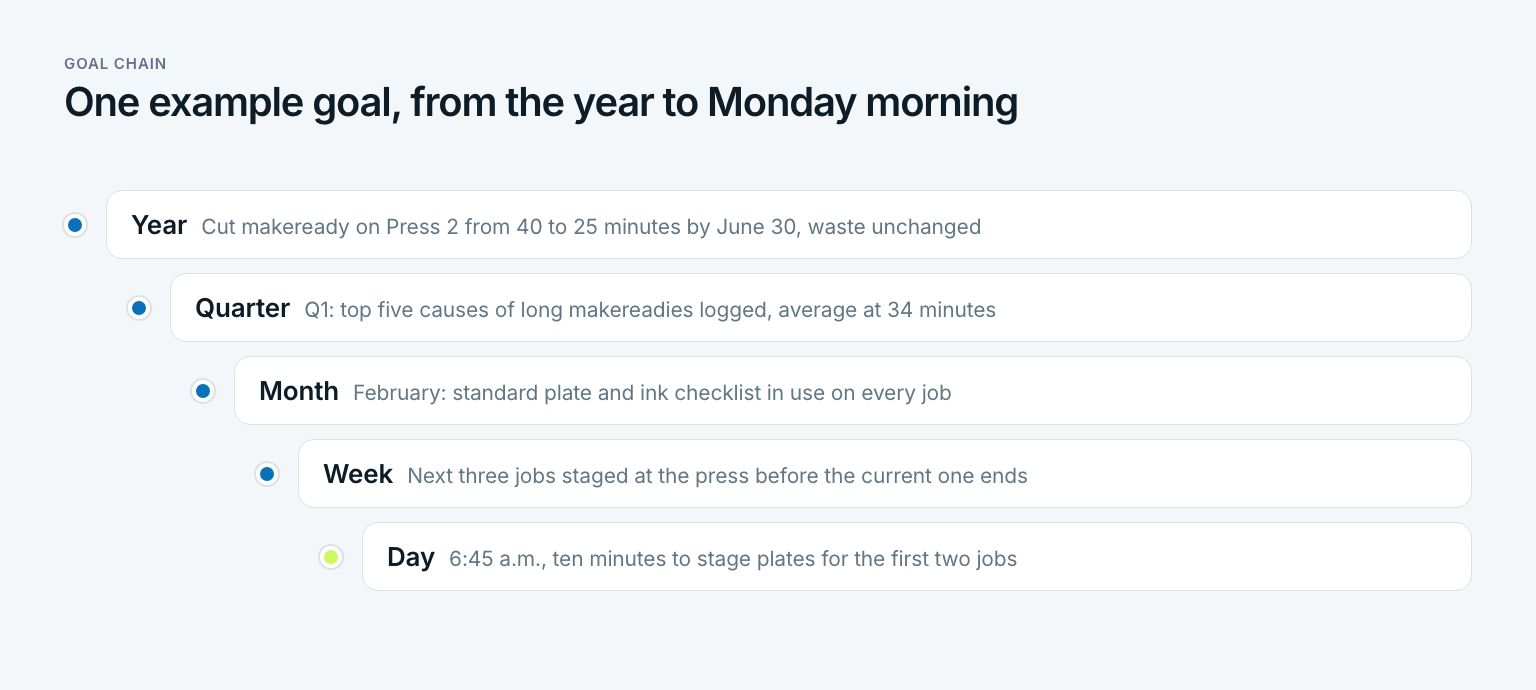
Each level answers one question: what does the yearly goal mean for this quarter, this month, this week? The daily step is small, ten minutes of staging plates before the first job. But that is the only place where makeready actually gets shorter. For a step by step method, see turn yearly goals into daily steps.
In Gaapp, Andre can set up his three goals as a goal chain and share them with his supervisor in one space. At each quarterly check-in, they look at the quarterly goal instead of the yearly one, and course correction starts in April instead of December. In short: the example gives you the sentence, the goal chain gives you the path.
Your self audit before you sign
Before you sign a goal sheet that started from an example, check it against six questions:
- Does each goal fit only this one role, or could it sit on anyone's sheet?
- Does every baseline come from a report in your own business?
- Does every speed, volume or revenue goal have a limit that rules out the wrong shortcut?
- Is at least one goal a development or behavior goal?
- Does every goal without a number say who signs it off and based on what?
- Do you know what happens this week for the most important goal?
Whoever answers yes to all six has turned someone else's example into their own goal. Anyone who hesitates at the first question still has a template on the sheet. A good example, in the end, is not text to copy but a question you answer for your own role.
Frequently asked questions about employee goals examples
What are good examples of work goals?
Good work goals name one measure, a baseline, a target, a deadline and the report where the result is read. For example: cut makeready time on Press 2 from 40 to 25 minutes by June 30, with no increase in paper waste. Or: pay 96 percent of vendor invoices within terms by Q3, with zero duplicate payments.
What are the 5 SMART goals examples for employees?
Five SMART examples from different roles: grow new-account revenue from $310,000 to $380,000 by December 31 with discounts at 10 percent or less. Return 95 percent of callbacks within four business hours by Q3. Cut time to fill for hourly roles from 52 to 35 days by year end. Complete 95 percent of preventive maintenance on time from April on. Run Press 3 solo by day 90, signed off after three observed jobs.
What are some good goals for a good employee?
Good goals for a strong employee mix results with growth: two performance goals tied to the role and one development or behavior goal. Development goals work best when they describe a visible result, such as training two new operators to sign-off or leading a monthly safety huddle. That gives a strong performer a path toward a bigger role, not just a higher number.
What are the 10 examples of goals?
Ten common goal types at work are revenue, speed, quality, accuracy, reliability, on-time delivery, customer response, skill development, leadership behavior and onboarding. Each one becomes a real goal only with a baseline, a target, a date and a source. The 20 examples above cover all ten types across four groups of roles.
How many goals should an employee have?
Three goals is a good number, five is the upper limit. A mix of two performance goals and one development or behavior goal works for most roles. Every goal beyond five thins out the attention the others get.
Can I copy employee goals examples from the internet?
Copy the structure, not the numbers. A target only makes sense against your own baseline, and the measure has to exist in a report your business already runs. If you check both, any example can serve as a model.
Last updated: 19 October 2026
Read next
 Leadership & Teams
Leadership Styles: Which One Fits Which Situation
Leadership styles are not personality types: 11 types compared, Lewin, Goleman, situational leadership and five steps to find the style that fits you.
14 min read
 Leadership & Teams
Retrospective: How Teams Learn From Every Sprint
A retrospective is not a blame session: what the word means, five phases, seven retrospective examples and action items that stick, shown on one team.
16 min read
 Leadership & Teams
How to Delegate Tasks: Hand Off Work, Keep Results
Delegation is not dumping work: five levels of delegation, seven steps, a handoff script and what to keep, shown on one marketing team.
15 min read