Growth Mindset: Meaning, Examples and How to Build One
A growth mindset is not positive thinking. What Carol Dweck meant, fixed vs growth mindset, what the research shows, examples and five steps.

Contents
- 01Growth mindset meaning: what Carol Dweck actually said
- 02Fixed mindset vs growth mindset: five situations side by side
- 03What the research shows, and where it is contested
- 04Growth mindset examples: ten sentences, rewritten
- 05How to develop a growth mindset in five steps
- 06A worked example: Marcus and twelve months of SQL
- 07Growth mindset for kids: praise that teaches
- 08Growth mindset in the goal chain: year, quarter, month, week, day
- 09Frequently asked questions about growth mindset
A growth mindset is not positive thinking. It is the belief that abilities such as intelligence, math skills or musical talent can be developed through practice, better strategies and help from other people. Stanford psychologist Carol Dweck coined the term, and its opposite is the fixed mindset: the belief that talent is set at birth and every test simply reveals how much of it you got. Which of the two is speaking at a given moment decides whether a failure sounds like a verdict or like data.
To use the idea, you need three things: the meaning Dweck actually intended, an honest look at the research, which is far more cautious today than most articles admit, and a way to change your thinking in one specific area of your life. All of it is worked through with Marcus, 34, a warehouse shift supervisor in Columbus, Ohio. Last spring he bombed the SQL screening test for a data analyst job and decided he is “just not a tech person.” His goal for the next twelve months is to move into an analyst role at his own company.
Growth mindset meaning: what Carol Dweck actually said
Carol Dweck has studied since the 1970s why some children quit after a mistake while others push on. In 1978, together with Carol Diener, she described two patterns among late elementary school children who hit problems that were too hard for them. One group turned helpless, blamed themselves and fell apart. The other group searched for new approaches and barely seemed to register that they were failing. Both groups had performed equally well beforehand. The difference was what the children believed about their own ability.
In 1988, Dweck and Ellen Leggett turned those observations into a theory in the journal Psychological Review. Anyone who believes intelligence is a fixed quantity tends to chase performance goals: look smart, avoid looking dumb. Anyone who believes it can grow tends to chase learning goals: get better, even if it looks bad for a while. Back then the labels were entity theory and incremental theory. Her 2006 book Mindset: The New Psychology of Success gave them the names everyone uses now.
Two points get lost in most summaries of the Carol Dweck growth mindset. First, it does not mean anyone can become anything. Dweck says plainly that people start with different aptitudes. The belief concerns direction only: from wherever you start, you can improve. Second, nobody has a pure version of either. Since 2015 Dweck has stressed that everyone is a mixture and that certain situations trigger the fixed mindset, such as criticism, a colleague who is clearly better, or a tight deadline. That means: the useful question is not which mindset you have. It is when each one takes over.
The brain as a muscle: what the metaphor gets right
Many growth mindset programs tell kids the brain grows like a muscle. The picture is not entirely wrong. In 2004, Bogdan Draganski and colleagues reported in Nature that adults who practiced juggling for three months showed more gray matter in specific brain areas. After a period without practice, the gain shrank again. The metaphor is simplified, but the direction holds. That means: practice changes the brain, but only for as long as the practice continues.
Fixed mindset vs growth mindset: five situations side by side
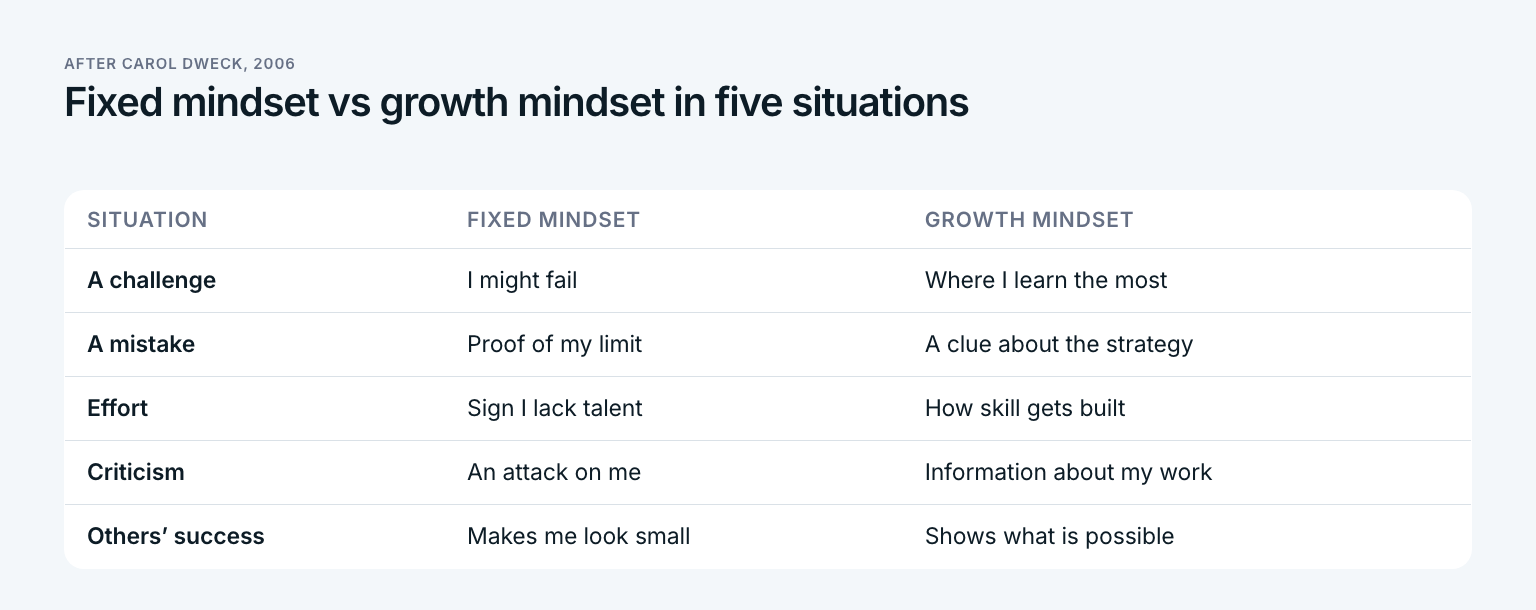
What is the opposite of a fixed mindset? In Dweck’s work, it is the growth mindset, and the two differ not in skill but in how a person reads ordinary moments. The table shows the same five situations through both lenses. Read the left column first and notice how reasonable each sentence sounds.
| Situation | Fixed mindset thinks | Growth mindset thinks |
|---|---|---|
| A challenge | If I fail, everyone will see I can’t do it. | This is where I learn the most, because it is hard. |
| A mistake | The mistake proves my limit. | The mistake shows which strategy is not working. |
| Effort | If I have to try this hard, I’m not cut out for it. | Effort with a good strategy is how skill gets built. |
| Criticism | Criticism is an attack on me. | Criticism is information about my work. |
| Someone else’s success | Their success makes me look small. | Their path shows me what is possible. |
Can you give an example of a fixed mindset? Marcus is one. The SQL test had fifteen questions and a 45-minute timer. He solved four. Instead of asking which four he got right and why, he closed the browser tab and told his wife he was “not built for this stuff.” For the next ten months he did not open a single SQL tutorial. Whoever reads one bad hour as proof of a permanent trait stops collecting evidence. That was the real damage, not the low score.
It also helps to separate the growth mindset from a close cousin. A growth mindset is the general belief that ability can grow. Self-efficacy is the specific belief that you can handle this particular task right now. Marcus could fully accept that adults learn to code and still feel sure he would freeze in the next timed test. How that second belief gets built is the subject of the article on self-efficacy. In short: the mindset opens the door, and self-efficacy decides whether you walk through it.
What the research shows, and where it is contested
The growth mindset is one of the best-known ideas to come out of psychology in the past 20 years. Schools across the US built it into their classrooms, and companies wrote it into their leadership values. The research behind it is real. It is just smaller than the reputation.
The early studies were striking. In 1998, Claudia Mueller and Carol Dweck praised fifth graders after a set of problems, either for being smart or for working hard. After a second, much harder set, the kids praised for intelligence enjoyed the task less, gave up sooner and did worse on a third round. In 2007, Lisa Blackwell, Kali Trzesniewski and Dweck followed about 370 seventh graders for two years. Students who believed intelligence could grow saw their math grades rise, while the others stayed flat. In a second study, an eight-session workshop reversed the usual slide in math grades.
Then the idea was tested at scale, and the effects shrank. In 2019, David Yeager and a large team reported in Nature on an online program of less than an hour given to more than 12,000 ninth graders across the US. Grades of lower-achieving students went up by roughly 0.1 GPA points on average. For under an hour of effort that is notable. It is not a transformation. A 2018 meta-analysis by Victoria Sisk, Brooke Macnamara and colleagues, covering more than 200 studies, found only a weak link between mindset and academic achievement and a very small average effect for interventions.
In 2023, the journal Psychological Bulletin published two meta-analyses with different conclusions. Brooke Macnamara and Alexander Burgoyne argued that in well-designed studies the effect on grades is close to zero. Jeni Burnette and colleagues found real effects for some groups, mainly students facing harder circumstances and programs that were carefully implemented. On one point the two teams are not far apart: a short lecture about the growing brain changes little if daily life stays the same afterward.
What does that mean for you? Anyone who trains a growth mindset as an attitude alone should not expect miracles. Anyone who pairs it with a concrete goal, a better learning strategy and regular feedback is using the part with the strongest evidence. That means: the mindset is not the engine. It is the willingness to start the engine at all.
One limit belongs here. A growth mindset is no substitute for treatment when low mood, anxiety or self-doubt last for weeks, and it is no reproach to anyone who simply has no energy left right now. If you are in crisis, you can call or text 988, the Suicide and Crisis Lifeline in the US, at any hour.
Growth mindset examples: ten sentences, rewritten
The best-known growth mindset sentence comes from Dweck herself and hinges on a single word: yet. In her 2014 TED talk she described a Chicago high school that gave students who had not passed a course the grade “Not Yet” instead of a failing mark. Whoever turns “I can’t do this” into “I can’t do this yet” stops describing a trait and starts describing a checkpoint.
Sentences alone do not change how you think. They are still useful because they make a habit visible. The pairs below come from Marcus’s notes in his first four weeks. The left side is what he actually thought. The right side is what he wrote down afterward.
| Fixed mindset sentence | Growth mindset sentence |
|---|---|
| I’m not a tech person. | I haven’t practiced this in ten months. |
| I can’t write SQL. | I can’t write SQL yet. |
| This is embarrassing. | This is unfamiliar, and unfamiliar wears off. |
| The analysts just get it. | The analysts have more hours of practice. |
| I messed up the join again. | Which part of the join did I misread, and where can I see it explained? |
| I’ll never be fast at this. | What is the next small step toward faster? |
| I give up. | I’ll try a different approach. |
| This is too hard for me. | This needs more time and a different method. |
| That’s just how I am. | That’s how I have been so far. |
| The feedback was unfair. | What in that feedback can I use next week? |
Notice that the right column does not sound more cheerful than the left. It sounds more precise. “I give up” does not become “I can do anything.” It becomes an action you can take tomorrow morning. Anyone who writes down sentences they do not believe is only practicing how to tune themselves out. A good growth mindset sentence is therefore always a testable one: it names a strategy, a time frame or a question.

How to develop a growth mindset in five steps
How do you get a better mindset? Not by reading about it, but by running a series of small experiments in the one area where your fixed mindset is loudest. The five steps combine Dweck’s own advice with two well-studied planning techniques. You need a notebook or an app, 15 minutes to set up and an area of your life you have been avoiding.
Find your triggers, one week
In the 2016 edition of her book, Dweck recommends watching for the situations that switch on your fixed mindset. For one week, write down every time you think a sentence like “I can’t do this,” and what was happening. Marcus logged six entries. Five were about data or spreadsheets. The sixth came when a younger supervisor got praised in a meeting.
Give the voice a name
Dweck also suggests giving your fixed mindset persona a name. It sounds silly, and it has a purpose: whoever names a thought can watch it instead of obeying it. Marcus called his voice Coach Dale, after the high school algebra teacher who once told him some kids are just not math kids.
Set a learning goal, not a performance goal
Write a goal for the area that rewards practice, not polish. Not “ace the next assessment,” but “solve 20 practice queries a week and write down the one concept that tripped me up.” In 1988, Elaine Elliott and Carol Dweck showed that children working toward learning goals held up far better after failure than children working toward performance goals.
Name the obstacle in advance
Psychologist Gabriele Oettingen found that simply picturing success tends to weaken effort. Her method, WOOP, links Wish, Outcome, Obstacle and Plan. Write down the most likely inner obstacle and an if-then plan for it, a technique Peter Gollwitzer described in 1999. Marcus wrote: “If a query throws an error, then I read the error message out loud before I touch anything.”
Change the strategy, not just the effort
After four weeks, check whether your numbers are moving. If they are not, change the method before you add more hours. Dweck calls effort without learning a false growth mindset. After his first month, Marcus dropped the video course he had been half watching and switched to a site where every lesson ends in a problem he has to solve himself.
The order matters. Whoever knows the triggers first can spot the fixed mindset before it makes the decision. Whoever has a learning goal can survive a bad day without losing the goal. And whoever checks the strategy after four weeks does not confuse being busy with making progress.
The most common mistake: praising effort instead of learning
Once people have heard of the growth mindset, they start praising themselves and others for sticking with it. Dweck warned against exactly that in a 2015 essay for Education Week. Effort that changes nothing is not growth. It is just activity. Anyone who tells a child after a failed test “Well, you tried hard” is offering comfort, but not a way forward. That means: praise the process that produced progress, meaning the strategy, the practice and the decision to ask for help.
A worked example: Marcus and twelve months of SQL
Marcus started in January. His yearly goal: by December, be in an analyst role, or at least own one weekly operations report his manager actually uses. His time budget: 30 minutes on four weekday evenings, a two-hour block every Saturday morning and, from the third quarter on, one real data request a month from the operations team. He tracked three numbers and logged them every four weeks.
| Point in time | Practice queries per week | Timed test score, out of 15 | Confidence, 0 to 10 |
|---|---|---|---|
| Week 1 | 6 | 4 | 2 |
| Week 8 | 18 | 7 | 4 |
| Week 16, failed internal skills check | 20 | 6 | 3 |
| Week 26 | 25 | 10 | 5 |
| Week 38, first report used by his manager | 25 | 12 | 7 |
| Week 50, analyst interview passed | 22 | 14 | 8 |
The most important row is week 16. Marcus took the internal skills check the data team uses for transfers and scored six out of 15, one point lower than in week 8. His confidence dropped from four to three. Coach Dale showed up with the familiar line. This time there was a second column in the notebook. Marcus wrote: “I can’t do window functions yet. I have never practiced them.” The following week he spent both Saturday blocks on nothing else.
The second key stretch sits between week 26 and week 38. His practice volume stayed flat at 25 queries a week, but his timed score rose from ten to 12. Volume did not make the difference. The strategy did: he stopped solving random exercises and started rebuilding real reports from the warehouse, using the same tables his future job would use. In short: the growth mindset did not make Marcus good at SQL. It made him read the week 16 result as a measurement instead of a verdict.
In December, he passed the analyst interview. He blanked once on a question, said “let me think out loud,” and got there. Anyone who flips through his notebook today finds no sentences about talent in the last six months. They find strategies, error messages and dates.
Growth mindset for kids: praise that teaches
Many parents search for the growth mindset because they want to pass it on. The Mueller and Dweck study shows where the lever is: in how adults praise. Praise for being smart sounds kind, and yet it teaches that performance proves a trait. A child who then meets a hard problem would rather not risk that proof.
Marcus’s son Eli, eight years old, said one evening in spring: “I’m just bad at reading.” Marcus heard his own sentence come out of someone else’s mouth for the first time. He tried three kinds of responses that felt familiar from his notebook:
- Process, not person. Not “You’re so smart,” but “You sounded out that long word in two parts. That worked.”
- Not yet instead of not. Not “Chapter books just aren’t your thing,” but “You can’t read chapter books on your own yet. Which page was the last one that felt easy?”
- Mistakes as information. Not “Don’t worry about it,” but “Let’s find the word where the sentence stopped making sense.”
More important than any phrase is the example. Kids listen closely to how their parents talk about their own failures. In 2016, Kyla Haimovitz and Carol Dweck found that children’s mindsets tracked their parents’ views of failure more closely than their parents’ views of intelligence. Whoever treats mistakes at home as useful teaches more than any poster on the classroom wall. Marcus told Eli at dinner about week 16. Eli asked if he had felt dumb. Marcus said yes. And that he had practiced window functions the next Saturday anyway.
Growth mindset in the goal chain: year, quarter, month, week, day
A growth mindset is an attitude, and an attitude needs a place where it shows up. Otherwise it stays a good intention. A goal chain is such a place, because it breaks learning into checkpoints. A yearly goal on its own delivers one verdict in December. A chain of quarter, month, week and day delivers dozens of measurements that show whether a strategy is working.
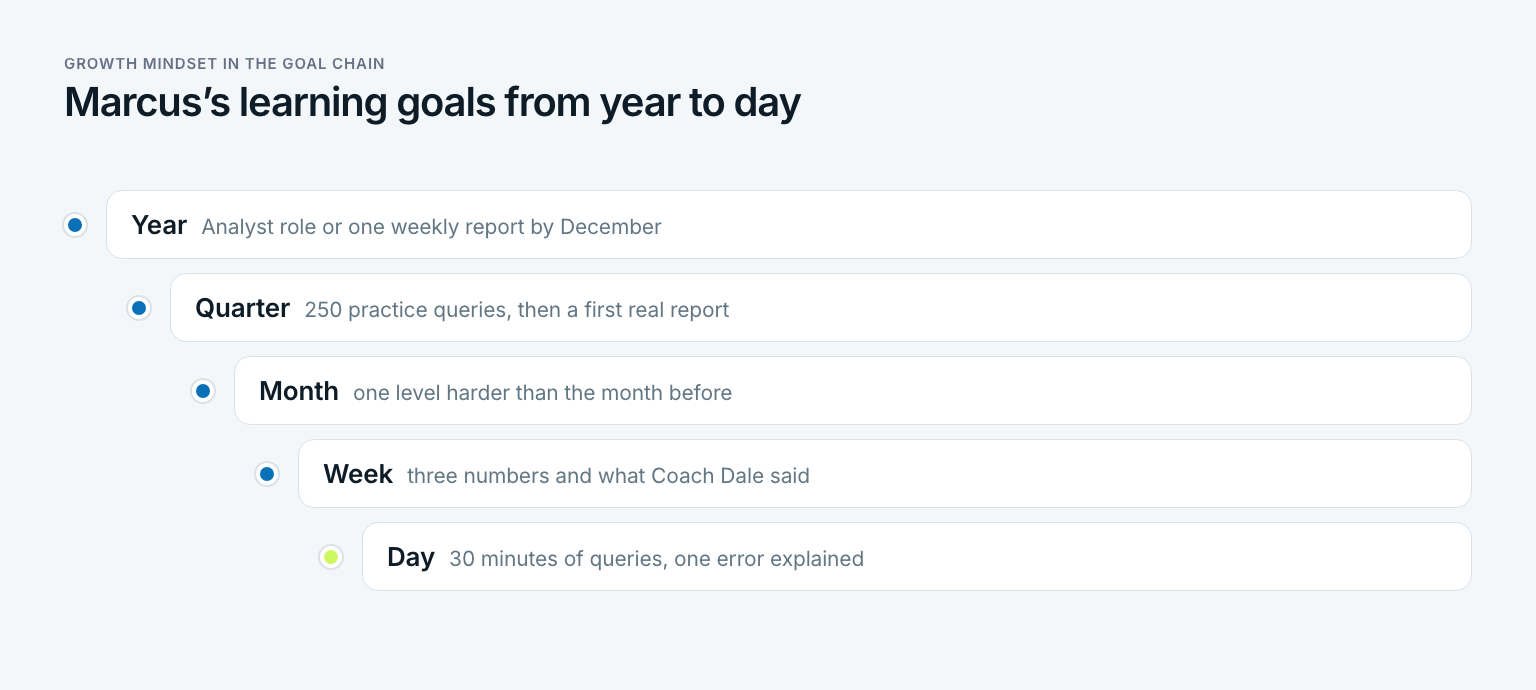
Here is how the method translates into the five levels:
- Year. One goal in the area where your fixed mindset is loudest. For Marcus: an analyst role, or one weekly report his manager uses, by December. The guide on how to achieve goals shows how to break a goal like that down cleanly.
- Quarter. A learning goal, not a performance goal: 250 practice queries in the first quarter, the first real report in the third. At the end of each quarter you check whether the strategy still fits.
- Month. One level harder than the month before. From guided exercises to blank editors, from practice databases to the warehouse’s own tables.
- Week. Three numbers and one line: queries solved, latest timed score, confidence, and what Coach Dale said this week.
- Day. One task you can finish today: 30 minutes of queries, one error message explained in your own words, one chart rebuilt from scratch.
In Gaapp, every level hangs from the one above it, and the progress of each period is the share of goals you completed. For a growth mindset that matters, because a setback sits right next to twelve completed weeks instead of standing alone. Anyone who can see their checkpoints is less likely to believe the fixed mindset about one bad day. The questions that help on a Friday are covered in the article on self-reflection. How the mindset fits a bigger plan is laid out in the guide to personal development.
Three questions for your loudest area
- Where do you most often say “I can’t do this,” and when did you last genuinely try there?
- Is your goal in that area a learning goal that rewards practice, or a performance goal that only counts the result?
- When did you last change your strategy instead of just trying harder?
Whoever cannot answer one of these questions does not need a new mindset. They need a first attempt with a number attached. In short: a growth mindset is not a trait you have. It is the habit of reading mistakes as checkpoints.
Frequently asked questions about growth mindset
What is the opposite of a fixed mindset?
The opposite of a fixed mindset is a growth mindset, the belief that abilities can be developed through practice, strategy and help from others. Carol Dweck introduced both terms in her 2006 book Mindset. She also stresses that everyone holds a mix of the two, and that the balance shifts by situation and by area of life.
What are the 7 types of mindsets?
There is no scientific model with seven mindsets. Lists like that come from blogs and coaching material, not from research. Carol Dweck’s work, which the term growth mindset comes from, describes two: the fixed mindset and the growth mindset.
Does Elon Musk have a growth mindset?
Nobody can say from the outside. Dweck treats mindset as a belief that differs by situation and domain, and it can only be judged by how a person reacts to their own setbacks, not by fame or wealth. Public success is not evidence of a growth mindset, and a public failure is not evidence of a fixed one.
Can you give me an example of a fixed mindset?
A typical example is someone who fails a test once and concludes “I’m just not a math person,” then avoids math from that day on. The failure is read as proof of a permanent trait instead of as information about which skills need practice. The growth mindset version would be “I can’t do this yet. Which questions did I miss, and why?”
What is a growth mindset in simple terms?
A growth mindset means believing you can get better at something through practice, better methods and help from others. It does not promise that you will become the best. It means a mistake tells you what to change next instead of telling you who you are.
Is the growth mindset backed by research?
Partly. Early studies by Dweck and colleagues showed clear differences, while a large US experiment led by David Yeager in 2019 found smaller effects, mostly for lower-achieving students. Two 2023 meta-analyses disagree on how much short interventions help, ranging from almost no effect to real benefits for specific groups.
Last updated: 22 October 2026
Read next
 Personal Growth
Maslow's Hierarchy of Needs: The 5 Levels Explained
Maslow's hierarchy of needs sorts motivation into five levels. What each level means, what research says today and a needs audit you can run yourself.
14 min read
 Personal Growth
Mindfulness Exercises: 12 for Everyday Life
Mindfulness exercises are not about emptying your mind. 12 techniques for stress and focus, what research shows, and a four-week plan to practice daily.
16 min read
 Personal Growth
Positive Affirmations: 50 Examples You Can Believe
Positive affirmations are not magic words. What research shows, 50 daily affirmations you can believe, and a five-step method with a worked example.
16 min read