Hoshin Kanri: Turn Strategy Into Daily Work
Hoshin Kanri is not a goal system for a binder: the method, the X matrix, catchball and seven steps, worked through at a 40-person print shop.

Contents
- 01Hoshin Kanri explained: direction, goals, feedback
- 02Where hoshin planning comes from
- 03The Hoshin Kanri X matrix: strategy on one page
- 04Hoshin Kanri in seven steps
- 05Catchball: goals are negotiated, not handed down
- 06Breakthrough objectives versus daily management
- 07Hoshin Kanri vs Kaizen vs OKRs
- 08The three mistakes nobody notices
- 09Hoshin Kanri in your goal chain: year to day
- 10Your self-audit: does your strategy point somewhere?
- 11Hoshin Kanri FAQ
Hoshin Kanri is not another goal system that lives in a binder. Hoshin Kanri is a Japanese management method that sets a few breakthrough objectives for three to five years and breaks them down, year by year, into the work of every team. The name roughly means management by compass needle. Every level points in the same direction, and every level helps decide how it will contribute.
Strategy decks are not useless. They are often built with real care, at offsites, with analysis and good intentions. Their problem is the trip down. Between the slide in the boardroom and Monday morning on the shop floor sit four layers, and each one loses a piece. Hoshin planning is built for exactly that trip.
Marcus will walk with you through this article. He owns a commercial print shop in Columbus, Ohio, with 40 employees, printing brochures, packaging and trade show graphics. For years he set goals at a January kickoff, usually around a dozen of them. By May, nobody could name more than two. An average job takes nine business days from file received to delivery, and 6 percent of jobs have to be reprinted because of an error. Clients who need their materials faster go elsewhere.
Hoshin Kanri explained: direction, goals, feedback
Hoshin Kanri answers three questions in a fixed order. Where do we want to be in three to five years? What has to happen this year to get there? And who owns which part of it? The answers do not live in a thick document. They live on a few pages that every level knows.
The core of the method comes down to four building blocks:
- A few breakthrough objectives. One to three goals for three to five years that cannot be reached by doing what you do today. They force real change.
- Annual objectives with a metric. Each breakthrough objective gets a stage for the current year, with a number and a date.
- Catchball. Goals move back and forth between levels until each level has written its own contribution and stands behind it.
- Regular review. Every month the team looks at the metrics and adjusts using the Deming cycle of Plan, Do, Check, Act.
The difference from a standard annual plan sits in that last block. A plan nobody reviews is a statement of intent. Hoshin Kanri makes the review a fixed appointment, not an exception. Anyone who looks at the same three numbers every month notices in March what they would otherwise have found in December.
Term: what hoshin means in Japanese
The Japanese word hoshin is written with two characters that stand for direction and needle. Together they mean course or policy, which is where the compass needle image comes from. Kanri means management or control. That is why the method is often called policy deployment in English: rolling one policy out across every level.
Where hoshin planning comes from
Hoshin planning grew out of quality management in Japan during the 1960s. Two Western influences met there. One was W. Edwards Deming and his cycle of planning, doing, checking and acting. The other was Peter Drucker, who described management by objectives in his 1954 book The Practice of Management. Japanese companies combined both and added something of their own: alignment across every level.
Tire maker Bridgestone is often cited as an early user of the term in the mid 1960s. Toyota and Komatsu became two of the best known practitioners. The method reached the West mainly in the 1980s, with Hewlett-Packard among the early adopters. A standard reference appeared in English in 1991: Hoshin Kanri: Policy Deployment for Successful TQM, edited by Yoji Akao.
The X matrix that shows up in nearly every Hoshin Kanri article today became popular in the West largely through Thomas L. Jackson. His 2006 book Hoshin Kanri for the Lean Enterprise ties the method to lean management. Since then, Hoshin Kanri has been seen as the strategy tool of lean thinking.
What does that mean for you? The method is not a trend. It is about 60 years old and was tested in manufacturing. It was designed for large companies, but its logic works just as well in a 40-person shop, a single team or even one person's life with a few big goals.
The Hoshin Kanri X matrix: strategy on one page
The Hoshin Kanri X matrix is a form that puts a full year of strategy on a single page. A large X in the middle splits the page into four zones. Each zone answers one question, and dots in the corners show which entries connect. Anyone can see at a glance which initiative feeds which goal.
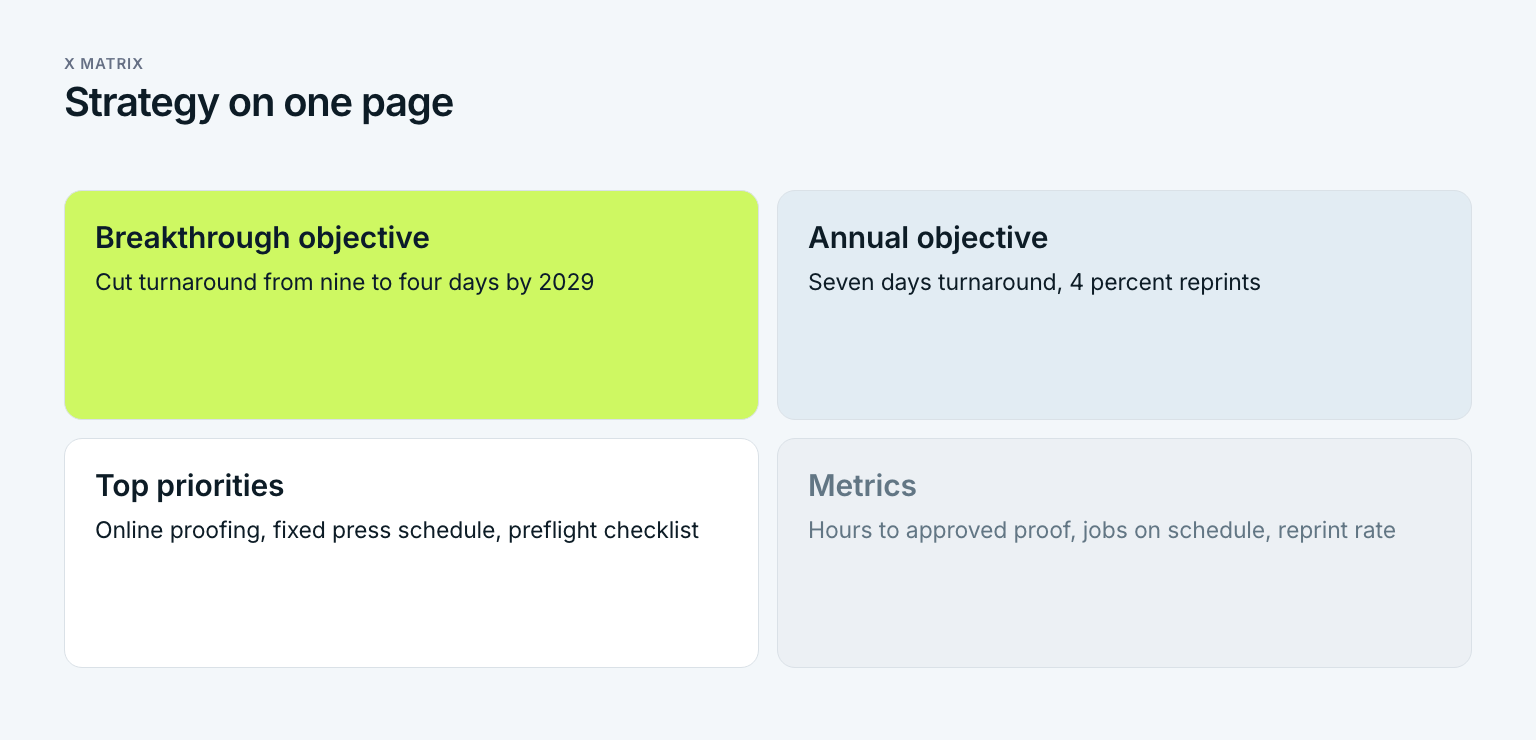
You read the matrix clockwise, starting at the bottom. The table shows the four zones and what Marcus wrote in each:
| Zone | Question | Marcus's entry |
|---|---|---|
| Bottom: breakthrough objectives | Where in three to five years? | Cut average turnaround from nine to four business days by the end of 2029, reprints under 2 percent |
| Left: annual objectives | Which stage this year? | Seven days turnaround, 4 percent reprints |
| Top: top-level priorities | What will we change? | Online proof approval, fixed press schedule, preflight checklist |
| Right: metrics to improve | How do we see progress? | Hours from file to approved proof, share of jobs run on their scheduled day, reprint rate |
| Far right: ownership | Who drives what? | Tanya for prepress, Luis for the press floor, Kim for customer service |
The value of the matrix sits in the dots. Every top priority must connect to at least one annual objective, or it gets cut. Every metric must measure a priority, or it is decoration. Marcus used to have a new website on his January list. In the matrix he could not find a single dot linking it to turnaround or reprints. He moved it to the following year.
A Hoshin Kanri matrix is not mandatory. Plenty of companies use a simple table or an A3 sheet instead. What matters is not the form but the question it forces: Does this feed our goal? Whoever asks that question about every new idea does not need a big form.
Hoshin Kanri in seven steps
Most sources describe the method in seven steps. The labels vary, but the flow is the same everywhere. Here are the steps as Marcus ran them in his shop.
Clarify the vision
Write down in two sentences what your company or team stands for and where it should be in ten years. Marcus wrote: We print it right the first time, and we deliver faster than any shop in central Ohio.
Set breakthrough objectives
Derive one to three goals for three to five years from the vision. Each needs a number and a date. Marcus picked one: average turnaround of four business days by the end of 2029, with reprints under 2 percent.
Derive annual objectives
Ask which stage is realistic and necessary this year. For Marcus, it was seven days instead of nine, and 4 percent reprints instead of 6.
Deploy goals through catchball
Hand the annual objectives to the owners and let them throw back what they need and what they can commit to. For Marcus this took three weeks and two rounds.
Execute
Each top priority gets a plan with monthly milestones. Tanya rolled out online proof approval in the first quarter, and Luis prepared the fixed press schedule.
Review every month
On the first Monday of each month, the leadership team spends 45 minutes on the metrics. Each number gets a color: red, yellow or green. Red triggers a short root cause check and a countermeasure.
Review the year
In December the team compares the annual objectives with the results, writes down what it learned and sets the stage for the next year. Then the cycle starts again.
Step six decides everything. Many companies run the first five steps carefully and then lose the rhythm. Without a monthly review, the X matrix turns into a nice poster on the office wall. That means: put all twelve review dates on the calendar before you write the first goal.
For Marcus, the first red light came in June. Time from file received to approved proof was 40 hours instead of the target of 30. The cause was simple. Clients opened the proof link but did not know they had to click approve, so jobs sat waiting. Kim added one line to the proof email and a reminder call after 24 hours. By August the number was down to 26 hours.
The monthly review in 45 minutes
The monthly review does not have to be long. It just has to run the same way every time, so nobody has to ask what is on the agenda. Marcus's leadership team follows the same order every month:
- Show the numbers, ten minutes. Each owner states their metric and its color, with no explanation yet.
- Work the reds, 20 minutes. For each red number the group asks for the cause and agrees on a countermeasure with a name and a date.
- Watch the yellows, ten minutes. One question is enough here: What has to happen for this to be green next month?
- Record the commitments, five minutes. Every countermeasure is written down and checked first at the next review.
Green numbers get no airtime. That sounds harsh, but it saves the half hour that meetings usually spend on things that are already working. Anyone who spends the review talking about green has no time left for red.

Catchball: goals are negotiated, not handed down
Catchball is what separates Hoshin Kanri from pure top-down planning. The name comes from a simple game of catch. Leadership throws a goal, the next level catches it, checks it and throws back an answer. The ball goes back and forth until both sides believe the plan can work.
Does that sound slow? It is, at least at the start. Marcus needed three weeks before every plan was settled. In return, he barely had to renegotiate anything during the year, because everyone had written their own part.
Here is how catchball played out in the print shop. Marcus threw Luis the goal of a fixed press schedule that no longer changed every afternoon. Luis threw it back: That only works if approved proofs reach me by noon the day before. That ball landed with Tanya and Kim. Tanya said she could hit that deadline only if clients approved proofs online instead of by email. Kim pushed back that many older clients would never use a portal. They agreed on a middle path: online approval by default, with Kim calling anyone who had not responded within 24 hours. The fixed press schedule moved from February to April.
Luis also brought an idea Marcus had not considered. He wanted to batch jobs on the same paper stock into fixed press windows, so the crew changed paper less often. Each changeover took about 20 minutes. Batching saved roughly an hour per shift. Whoever lets the team play catch gets ideas nobody sees from the top.
Term: catchball
Catchball is the alignment process between two levels. The upper level names the goal and the limits. The lower level answers with the approach, the resources it needs and open questions. The process ends when both sides agree on the plan. That is how a directive becomes a commitment.
Breakthrough objectives versus daily management
Hoshin Kanri does not cover everything a company does. The method separates two kinds of work. One is daily management, often called nichijo kanri in Japanese. It covers revenue, cash flow, safety and on-time delivery in normal operations. These things have to run steadily, and they are handled with metrics, routines and standards.
The other kind is the breakthrough. It covers the few things that have to change at the root. Only those go into the X matrix. That is the real discipline of the method: it asks you to leave most topics out on purpose.
Which breakthrough objectives make sense? There is no fixed list. In practice, four patterns come up again and again:
- Speed: cutting lead time or turnaround sharply, as Marcus did.
- Quality: bringing errors, complaints or rework down to a fraction.
- Market: opening a new customer segment or region.
- Capability: building a skill the company lacks today, such as automation or in-house training.
A good breakthrough objective has one property you can test easily. It cannot be reached with today's approach. If everyone working a little harder would get you there, it is an annual objective, not a breakthrough. How metrics for steady operations differ from goals for change is laid out in OKR vs KPI. The same logic applies to Hoshin Kanri.
Hoshin Kanri vs Kaizen vs OKRs
Hoshin Kanri often gets mixed up with two other approaches: OKRs, the goal method from Silicon Valley, and Kaizen, the Japanese practice of continuous improvement. All three have their place. They are just built for different jobs.
| Trait | Hoshin Kanri | OKRs | Kaizen |
|---|---|---|---|
| Purpose | Deploy strategy across every level | Focus and measure ambitious goals | Improve processes in small steps |
| Time horizon | Three to five years, staged yearly | Usually one quarter | Ongoing, daily |
| Direction | Set at the top, aligned through catchball | Partly top-down, partly from teams | Mostly bottom-up, at the workplace |
| Tools | X matrix, A3, monthly review | One objective with two to five key results | Improvement ideas, PDCA, standard work |
| Result | A few big changes | Focus and transparency each quarter | Many small improvements |
OKRs go back to Andy Grove, who introduced them at Intel in the 1970s. John Doerr brought them to Google in 1999. OKRs run on a shorter cycle and lean harder on ambition, while Hoshin Kanri holds the long line. Many companies combine both: Hoshin Kanri for direction over years, OKRs for the quarters in between. For the details of how OKRs work, see the OKR framework.
Kaizen, on the other hand, is the counterpart to the breakthrough. It improves what already exists, in many small steps. When Marcus's press crew reorganizes the ink station, that is Kaizen. Cutting turnaround in half is Hoshin Kanri. In short: Kaizen smooths the road, Hoshin Kanri picks which road to take.
Hoshin Kanri in lean management
In lean management, Hoshin Kanri is the tool for strategy. James Womack and Daniel Jones described five lean principles in their 1996 book Lean Thinking: specify value from the customer's point of view, identify the value stream, create flow, establish pull and pursue perfection. Common lean tools such as 5S, kanban, value stream mapping and poka yoke put those principles to work every day. Hoshin Kanri makes sure all of them point in the same direction.
The three mistakes nobody notices
Most mistakes with Hoshin Kanri do not come from carelessness. They come from the wish to leave nothing important out. That is exactly why they go unnoticed for so long.
The most common mistake: too many breakthrough objectives
Whoever puts five or six breakthrough objectives into the matrix spreads the company's energy across too many fronts. Each priority gets a little time, none gets enough. By year end every number has moved a bit and none has really changed. Marcus chose exactly one breakthrough objective on purpose. The other items from his January list ran as daily management or waited for next year.
- Skipping catchball. Leadership fills in the matrix alone and sends it out by email. That saves three weeks in January and costs the whole year, because nobody sees the goals as their own.
- Metrics without a rhythm. The matrix lists metrics, but nobody looks at them on a schedule. Without a fixed monthly review, nobody notices when a priority drifts off course.
- Stuffing daily work into the matrix. Hold revenue, cut sick days, send invoices on time. All important, none a breakthrough. They clog the matrix and hide what actually has to change.
All three mistakes share a root. They treat Hoshin Kanri as a planning form instead of a working rhythm. Anyone who gets that spends less time perfecting the matrix and more time protecting the twelve monthly reviews.
Hoshin Kanri in your goal chain: year to day
In many textbooks, Hoshin Kanri stops at a department's monthly plan. For the individual person, one question stays open: What do I do this week, and what today? A goal chain closes that gap. It translates an annual goal into quarter, month, week and day, and each level only takes on what fits its time frame.
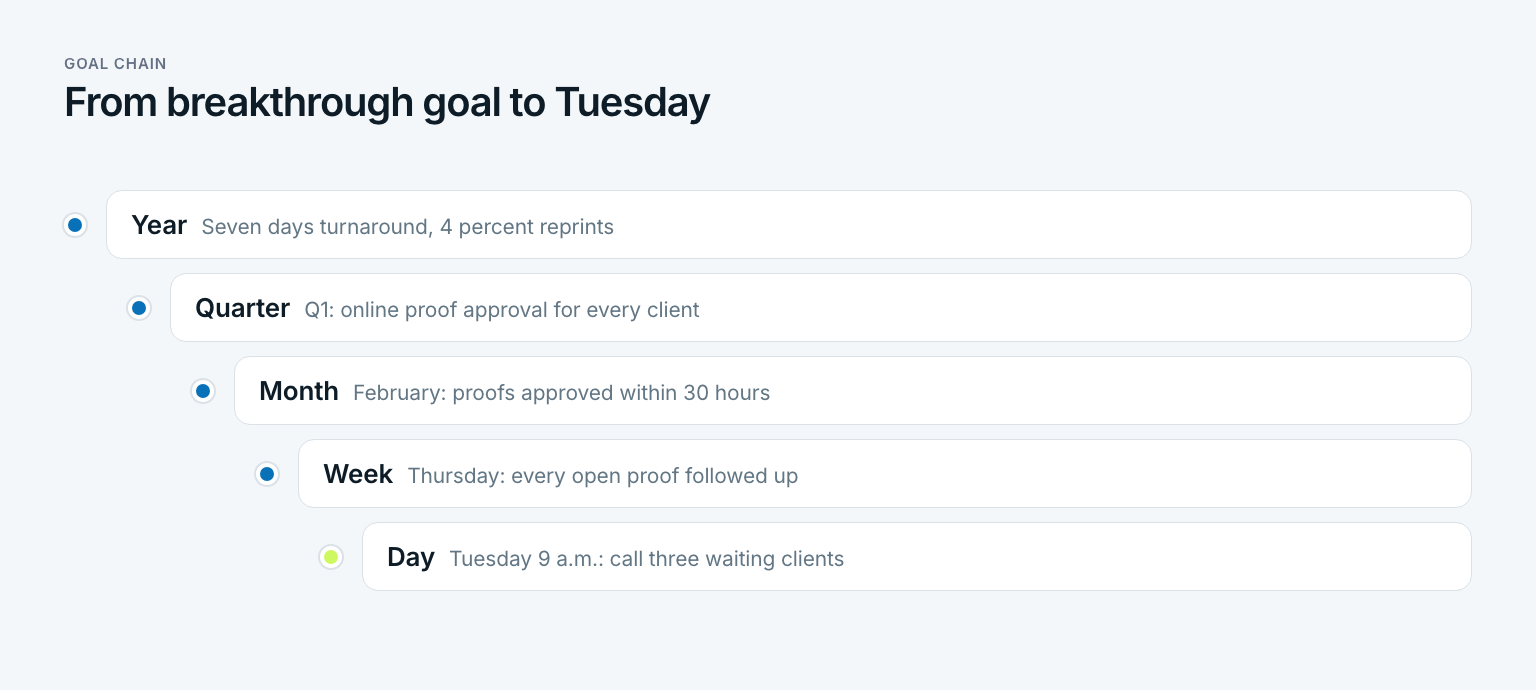
- Year: The annual objective from the X matrix. For Marcus, seven days turnaround and 4 percent reprints.
- Quarter: One top priority takes the lead. In the first quarter, that was online proof approval for every client.
- Month: One milestone with a metric. In February, every proof had to be approved within 30 hours of the file arriving.
- Week: One commitment that holds until Friday. For Kim, that meant every open proof followed up by Thursday.
- Day: One concrete step. Tuesday at 9 a.m., call the three clients whose proofs are older than 24 hours.
The monthly review from step six fits right into this chain. Whoever sees a red metric at the monthly level changes the weekly goals, not the annual objective. How to break a year into quarters is covered step by step in quarterly planning. If a whole team needs to work toward the same goals, the guide to team goals helps.
In a goal app like Gaapp, this chain can live in one shared space. Marcus sets the annual objective, and Tanya, Luis and Kim hang their quarterly and monthly goals beneath it. Everyone can see how their week connects to turnaround time.
Your self-audit: does your strategy point somewhere?
Before you fill in your first X matrix, take an honest look at what already exists. Three questions help:
- Can every person on your team or in your company name the most important goal for the next three years in one sentence?
- When did someone last throw a goal back because it could not work as written, and what happened next?
- Which three numbers did you look at last month to check whether your strategy is working?
Anyone who answers no to the first question needs a clear breakthrough objective first, not more initiatives. Anyone who cannot think of an example for the second is missing catchball. And anyone who has to think hard about the third is missing the rhythm. Each gap is a starting point, and none of them needs a consultant.
In the end, Hoshin Kanri is not a planning tool. It is an agreement: a few goals, written by everyone, checked every month.
Hoshin Kanri FAQ
What does Hoshin Kanri mean?
Hoshin Kanri means management by compass needle, or policy deployment. Hoshin stands for course or direction, and kanri means management or control. The method sets a few long-term breakthrough objectives and deploys them through every level of an organization.
What are the 7 main models of strategic planning?
There is no single official list of seven. Lists commonly include basic or goal-based planning, issue-based planning, alignment models, scenario planning, the balanced scorecard, OKRs and Hoshin Kanri. Hoshin Kanri stands out because it links long-term breakthrough objectives to monthly reviews at every level.
What is hoshin in Japanese?
Hoshin is written with two characters that mean direction and needle. Together they mean course, policy or guiding principle. That is why Hoshin Kanri is often described with the image of a compass needle that keeps everyone pointed the same way.
What is the difference between Hoshin Kanri and Kaizen?
Hoshin Kanri sets the direction and a few breakthrough objectives that require fundamental change. Kaizen improves existing processes in many small steps, mostly driven by the people doing the work. Hoshin Kanri decides which road to take, and Kaizen makes that road smoother.
Is Hoshin Kanri the same as OKRs?
No. Hoshin Kanri aligns an organization over three to five years around a few breakthrough objectives and uses catchball to agree on goals across levels. OKRs usually run on a quarterly cycle with ambitious objectives and measurable key results. Many companies use Hoshin Kanri for the long line and OKRs for the quarters.
Can a small business use Hoshin Kanri?
Yes. The method was built in large manufacturers, but its core works at any size: one breakthrough objective, a few priorities, clear owners and a monthly review. A small business can replace the full X matrix with a simple one-page table.
Last updated: 22 October 2026
Read next
 Leadership & Teams
Leadership Styles: Which One Fits Which Situation
Leadership styles are not personality types: 11 types compared, Lewin, Goleman, situational leadership and five steps to find the style that fits you.
14 min read
 Leadership & Teams
Retrospective: How Teams Learn From Every Sprint
A retrospective is not a blame session: what the word means, five phases, seven retrospective examples and action items that stick, shown on one team.
16 min read
 Leadership & Teams
How to Delegate Tasks: Hand Off Work, Keep Results
Delegation is not dumping work: five levels of delegation, seven steps, a handoff script and what to keep, shown on one marketing team.
15 min read