Team Goals: How to Set and Track Them Together
Team goals are not individual goals added up: four types, a five-step goal setting session, 12 examples and a weekly check-in, shown on one team.

Contents
- 01What team goals are, and what they are not
- 02Types of team goals: four kinds and when you need them
- 03Why most team goals die in a slide deck
- 04Team goal setting in five steps: a 90-minute session
- 05How to write team goals your whole team can measure
- 06Team goals examples: twelve team objectives you can adapt
- 07How to track team goals: the 15-minute weekly check-in
- 08The three mistakes nobody notices
- 09Team goals in the goal chain: year to day
- 10Your self audit before the next team meeting
- 11Frequently asked questions about team goals
Team goals are not individual goals added together. A team goal is a result a team can only reach as a group, with a number, a deadline and a measure that everyone on the team can see. Individual goals describe what one person contributes. The team goal describes what all of those contributions are for.
Three things decide whether a team goal holds: the team sets it together, every person knows their part, and the number is visible every week. This guide walks through all three with Dana, 34, who runs the eight-person fulfillment team at an online plant shop in Portland, Oregon. Along the way you get a five-step team goal setting session, twelve team goals examples by function, a 15-minute weekly check-in, and the three mistakes that quietly kill team goals by spring.
What team goals are, and what they are not
A team goal belongs to the team, not to the manager. It describes a state no single person can create alone, such as orders leaving the building on the day they come in, or calls being answered on the first ring. It is measured by one number that is the same for everyone. Anyone who only knows the team goal from a slide at the all-hands has heard a goal, but has not taken one on. The manager's own goals are a separate set. Goals for managers measure how you lead so the team can deliver, not what the team delivers.
Three terms tend to get mixed up with it. None of them is wrong. Each one is built for something else:
- Individual goal. One person's goal, usually agreed in a review or a goal setting conversation with an employee. It is built for that person's growth and performance. A good individual goal feeds a team goal. It does not replace one. The employee goals examples by role show what a good individual goal sounds like in different jobs.
- Company goal. The goal of the whole organization, such as revenue, market share or customer satisfaction. It is too big for a team to feel in a given week. The team goal translates it into the team's own patch of work.
- Task. Something that gets done, like "build a new shift schedule." A task is finished when it is checked off. A team goal is only reached when the number moves.
That means: a team goal always has a measure the team can influence directly. If it lives only as a sentence on the wall, it is a slogan. A slogan can point a direction. It just does not tell anyone what to do on Tuesday.
Why bother at all? Edwin Locke and Gary Latham, summarizing decades of research in "A Theory of Goal Setting and Task Performance" in 1990, found that specific, challenging goals lead to better performance than being told to do your best. The effect holds for groups as well as individuals. A team without a shared goal does its best. A team with one knows what its best is for.
Types of team goals: four kinds and when you need them
Team goals sort by what they move. Four kinds cover almost every team, and most teams need two of them at the same time. Which kind is missing on yours?
| Type | What it moves | Example from Dana's fulfillment team |
|---|---|---|
| Outcome goal | a result for customers or the business | 97 percent of orders placed before 1 p.m. ship the same day |
| Quality goal | errors, damage, complaints | Damaged deliveries below 1 percent of orders |
| Collaboration goal | handoffs and routines inside the team | Every restock request from packing is filled within 30 minutes |
| Development goal | skills across the team | All eight can pack live plants for heat and cold by October |
Outcome and quality goals are the classics because they are easy to measure. Collaboration goals get skipped, even though they are often what makes the others possible. Development goals pay off when a team depends on a skill only two people have. A team that exists for one launch or event works with project goals instead, with scope, time and cost as the fixed numbers. In short: a team with one outcome goal and one collaboration goal is better set up than a team with four outcome goals.
Term: measure
A measure is the number a team reads progress from, such as the same-day ship rate in the order system. It has to be available without extra work, or nobody will still be collecting it a month later. Anyone who has to invent a tally sheet for a team goal should first check whether a fitting number is already being recorded somewhere.
Why most team goals die in a slide deck
Most teams have goals. They sit in a deck from January, in an email thread, or in the manager's head. That is rarely carelessness. It is speed: whoever keeps the operation running has little room left for goal work. The result is that every person works on what they personally think matters most.
That is where Dana started. Her team has eight people, five full time and three part time. They pick, pack, label and hand orders to the carrier, and in spring the volume doubles. When Dana took over in March, everyone had an individual goal from last year's review. The team as a whole had none. Here is what the order system and the support inbox showed for March:
| Measure | March | What it meant on the floor |
|---|---|---|
| Orders placed before 1 p.m. shipped same day | 84 percent | About one order in six waits a night, and the plant sits in a box |
| Damaged deliveries | 3.1 percent | Roughly 25 replacement shipments a week, each one paid twice |
| Pick errors, wrong plant or pot | 1.4 percent | Return labels, apology emails, bad reviews |
| People trained to pack for heat and cold | three of eight | On hot days, three people pack every live plant |
Everyone on the team knew these problems. Nobody knew the numbers. The packer at station two knew afternoons were rough, but not that one order in six missed the truck. The person handling returns knew damage was common, but not that it cost the shop a replacement shipment every couple of hours. That means: effort was never the gap. What was missing was a shared measure that showed everyone whether anything was moving.
Dana could have set the goals herself, and plenty of managers do exactly that. Goals handed down are faster. They just get carried differently. Whoever helped write a goal defends it even when the manager is on vacation. Whoever had it handed to them meets it as long as someone is watching. Why that happens and what it has to do with drive is covered in the guide on how to motivate employees.
Team goal setting in five steps: a 90-minute session
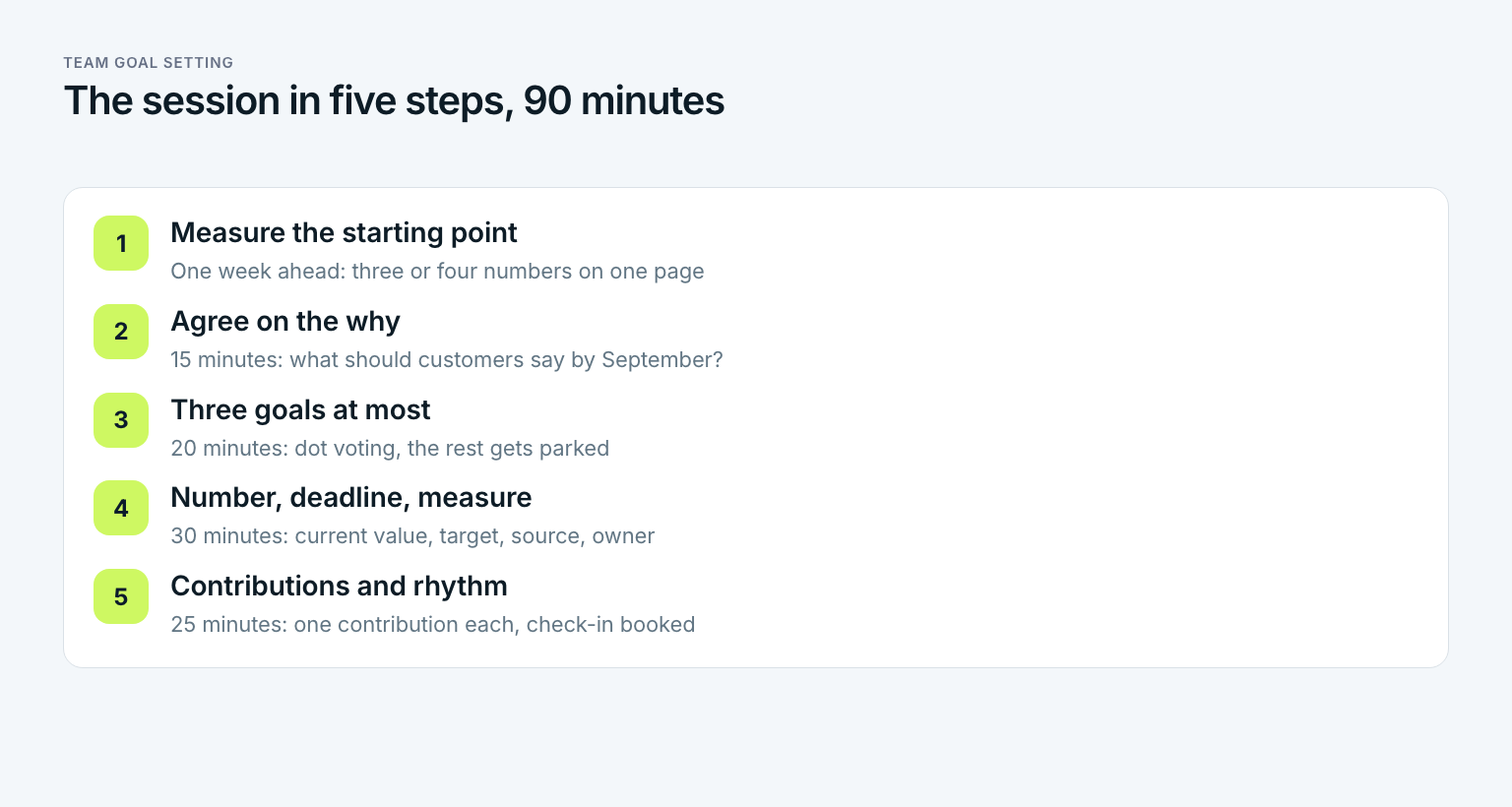
A team goal is best set in one meeting with everyone in the room, not in an email. Ninety minutes is enough if the numbers are on the table before you start. Dana held the session on a Wednesday at 7 a.m., an hour before the first pick wave, with coffee and a whiteboard next to the packing tables. Here is how it ran:
Measure the starting point, one week ahead
Pull the three or four numbers that best describe your team's work and put them on one page. For Dana, those were the four rows in the table above. Without numbers, a team argues about feelings. With numbers, it argues about causes.
Agree on the why, 15 minutes
Ask one question: what should a customer say about our shipping by the end of September? Each person writes one sentence on a card. On five of Dana's eight cards, the sentence was some version of "it arrived fast and alive."
Pick three goals at most, 20 minutes
The cards turn into goal candidates. Every person gets three dot stickers to place. The two or three candidates with the most dots move on. The rest are parked on a list for next quarter, on purpose and in writing.
Set the number, deadline and measure, 30 minutes
For each goal, the team agrees on the current value, the target, the deadline and the source. One person per goal takes over the measurement and brings the number every Monday. That person owns the number, not the goal.
Agree on contributions and rhythm, 25 minutes
Each person names one thing they will do in the next four weeks to move a goal. Then you set the weekly check-in: when, how long, who runs it. The session is over when the first check-in is on the calendar.
Dana's team left with two team goals for the next six months. First: by September 30, 97 percent of orders placed before 1 p.m. ship the same day, measured in the order system. Second: by September 30, damaged deliveries drop below 1 percent, measured from support tickets. The development goal, heat and cold packing for everyone, went on the list for the fall.
Dana did not run the session herself. She asked Luis, her most experienced packer, to facilitate. That was deliberate. A manager who facilitates mostly hears their own ideas repeated back. A manager who listens learns what actually slows the team down. And anyone who walks out of a goal session with more than three goals has not chosen. They have collected.
How to write team goals your whole team can measure
A well-written team goal fits in one sentence that everyone on the team can say from memory. The structure is always the same: we move the measure from the current value to the target by the deadline, measured with the source. The "we" is not decoration. It forces the question of whether everyone can actually contribute.
The SMART criteria help here: specific, measurable, achievable, relevant, time-bound. For team goals, add a sixth check: every person on the team can contribute to it. The guide on SMART goals covers how to write a single goal well. This section is about what makes a team goal different. Here are Dana's drafts before and after the session:
| Before | After | What changed |
|---|---|---|
| Ship faster | We ship 97 percent of orders placed before 1 p.m. the same day by September 30, per the order system | A number, a deadline and a source |
| Fewer broken plants | We cut damaged deliveries from 3.1 to under 1 percent of orders by September 30 | A current value and a target |
| Luis should handle the restocking | Every restock request from packing is filled within 30 minutes | A task for one person becomes a rule for all |
| Better team spirit | Every shift handoff lists open orders, low stock and carrier changes, on 95 percent of days | A feeling becomes a routine you can check |
The last row shows a limit. Team spirit is a fair wish, but it is not a team goal, because nobody can produce it on purpose. It tends to show up as a side effect when a team achieves something together. Anyone who makes morale the goal ends up measuring friendliness instead of work.
Three questions test every draft before it goes on the board:
- Can each person on the team say in one sentence what they contribute to this goal?
- Can everyone see the number without asking someone for it?
- Would the team notice if the goal were forgotten by May?
If any answer is no, the sentence is not done. Usually it is not the number that is missing, but the link to each person's daily work.

Team goals examples: twelve team objectives you can adapt
The examples below are starting points, not targets to copy. Swap in your own current values and your own time frame. Every example has the same three parts: a measure, a target and a deadline. If you need team objectives in OKR format, with one objective and several key results, the article on OKR examples has worked versions for each function.
| Function | Team goal | Type |
|---|---|---|
| Sales | Raise the close rate on first calls from 18 to 25 percent by the end of Q2 | Outcome |
| Sales | Reply personally to 95 percent of inbound leads within four business hours | Collaboration |
| Customer support | Resolve 80 percent of tickets on first contact by September | Outcome |
| Customer support | Cut complaints about wait times in half by year end | Quality |
| Marketing | Publish one in-depth article every week through June, 26 in total | Outcome |
| Marketing | All four people on the team can analyze a campaign on their own by October | Development |
| Engineering | Fix 90 percent of critical bugs within 24 hours from Q3 on | Quality |
| Engineering | Every pull request gets a second reviewer within one business day | Collaboration |
| Operations and fulfillment | Ship 98 percent of orders on the day they arrive by year end | Outcome |
| Operations and fulfillment | Bring returns caused by shipping damage below 1 percent by Q4 | Quality |
| HR and admin | Every new hire has a laptop, all logins and a named buddy on day one | Collaboration |
| Clinic and care teams | Everyone on the front desk triages urgent calls with the same checklist by December | Development |
Notice how little these examples say about effort. None of them reads "show more commitment" or "work harder." Each one describes a state that customers, coworkers or patients would actually feel. That means: a team goal does not ask how much you work. It asks what is different afterward.
An example only becomes your team goal once you know your starting value. A team aiming for 98 percent same-day shipping that already sits at 96 percent has a very different goal from one starting at 70. The number in the example is a placeholder. The real work starts with yours.
How to track team goals: the 15-minute weekly check-in
A team goal nobody looks at is gone within six weeks. The weekly check-in prevents that. It takes 15 minutes, happens at the same time every week, and has three fixed questions. On Dana's team, it is Monday at 8:15 a.m., standing at the packing tables, before the first truck.
The three questions of the weekly check-in
Where is the number, and where should it be today? What moved it last week, up or down? What is blocking us, and who helps before next Monday? The first question measures, the second explains, the third assigns. Nothing else fits in 15 minutes, and nothing else is needed.
The person who took over the measurement brings the number. They write it on a board next to the packing tables that shows both team goals, each with the current value, the target and the value the plan calls for today. Anyone walking past can see whether the team is ahead of or behind the plan. Whoever only sees the number in a monthly report is steering with a four-week delay.
Dana's plan was simple: reach 92 percent by June 30, the quarterly goal, which meant gaining a little under one point a week. Here is how the first team goal moved through the second quarter:
| Week | Same-day ship rate | Plan | What moved the number |
|---|---|---|---|
| Week 15 | 84 percent | 84 percent | Starting value, session on Wednesday |
| Week 17 | 87 percent | 85 percent | Pre-built boxes for the five best sellers |
| Week 18 | 85 percent | 86 percent | Mother's Day rush, order volume up by half, two people out sick |
| Week 22 | 90 percent | 89 percent | Second packing shift from 11 a.m. to 3 p.m. on rush days |
| Week 26 | 93 percent | 92 percent | Order cutoff shown on the site, fewer late orders marked urgent |
Week 18 was the most important week. The number dropped even though everyone worked harder than usual. The check-in did not hunt for blame. It went straight to the third question: what is blocking us? The answer was the early afternoon, when picking and packing peaked at the same time. That led to the second packing shift, and four weeks later the team was ahead of plan again. Without a weekly number, Dana would have seen the dip in a monthly report in June.
The rhythm across the year
The weekly check-in is the smallest loop. Two larger ones sit above it. Once a month, the team takes 45 minutes to look at the trend and decide whether anyone's contribution needs to change. Once a quarter, it asks whether the team goals themselves still make sense. Moving or dropping a goal at that point is not a failure. It is the very decision the quarterly review exists for.
Whether the board is a whiteboard, a spreadsheet or an app depends on where the team works. A team on one floor needs something it can glance at while walking by. A distributed team needs one shared digital place where everyone sees and checks off the same goals. What that kind of shared place looks like is shown in shared goals in a space.
The three mistakes nobody notices
Team goals rarely fail on day one. They fade somewhere between February and April, and none of the reasons feels like a mistake at the time. Do you recognize one of these?
The most common mistake: a team goal that is just individual goals added up
Many teams add up individual targets and call the total a team goal, such as six reps with 50 deals each, so 300 for the team. That is arithmetic, not a shared goal. Nobody helps a colleague, because her number is not his. A real team goal exists only when the result can only be reached together and everyone gains from everyone else's progress.
- A team goal that is a sum of individual goals. Summed targets are convenient because they fall straight out of performance reviews. But they reward each person for their own number, and helping someone else costs time that is missing from your own target. A team goal measures something that only rises together.
- A number only the manager sees. Whoever guards the number keeps control, and the team works without instruments. Put the number where the team works, and let a team member measure it. Trust starts with shared information.
- A goal in January, a look in December. A goal session without a weekly check-in is a nice event. Three weeks later, daily work has pushed the goal out of sight, and December brings a surprise. The fixed check-in matters more than the perfect goal sentence.
In short: team goals rarely fail because the numbers are too low or too high. They fail because the team stops seeing them.
Team goals in the goal chain: year to day
A six-month team goal is too big for a Monday morning. The goal chain makes it usable: every goal hangs from a bigger one, from the year through the quarter, the month and the week, down to the day. Here is Dana's first team goal broken down:
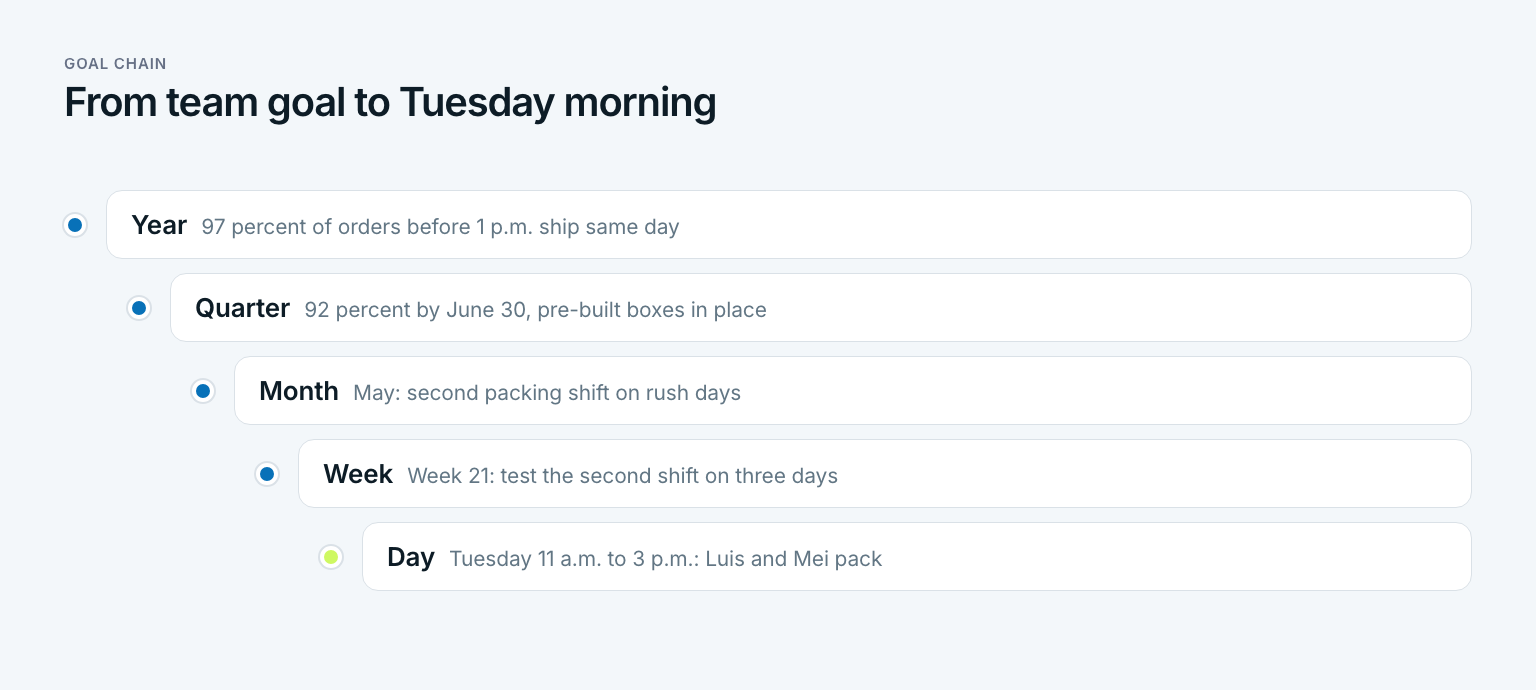
- Year: 97 percent of orders placed before 1 p.m. ship the same day from September 30 on, and the rate holds through the holidays.
- Quarter: 92 percent by June 30, with pre-built boxes in place for the five best sellers.
- Month: In May, a second packing shift runs from 11 a.m. to 3 p.m. on rush days.
- Week: In week 21, the team tests the second shift on three rush days.
- Day: On Tuesday, Luis and Mei run the second shift from 11 a.m. to 3 p.m.
At the daily level, the team goal turns into a task for one person. That is not a contradiction. The goal stays shared. Only the step has a name. Whoever packs on Tuesday afternoon knows which number they are moving. Teams that run quarterly OKRs can treat the team goal as the objective and the measures as key results. The chain underneath stays the same.
In a goal app like Gaapp, this chain is the core: the team shares one space where everyone sees the same yearly, quarterly and monthly goals. Weekly and daily goals hang underneath, and progress for each period shows the share of goals completed, next to a thin line for the time already gone. It is the same logic as the board by the packing tables, just visible to people who are not standing next to it.
Your self audit before the next team meeting
Three questions for your team, answered honestly:
- Can every person on the team name your most important team goal in one sentence, without looking it up?
- Does every person know where the number stands today, as a value and not as a feeling?
- Has the team talked about that number together in the last four weeks?
Anyone who answers no to one of these does not have a motivation problem on the team. They have a visibility problem. That is fixable with one 90-minute session and 15 minutes a week. In short: a team goal is not a sentence the manager announces. It is a number the team looks at together every week.
Frequently asked questions about team goals
What are good examples of team goals at work?
Good team goals describe a result the whole team can feel, with a number and a deadline. Examples: ship 98 percent of orders the same day by year end, resolve 80 percent of support tickets on first contact by September, or give every new hire a laptop, logins and a buddy on day one. Each one names a measure, a target and a date, and each one needs more than one person to reach it.
What are seven tips for achieving team goals?
Set the goal together, keep it to three goals at most, give each goal a number and a deadline, let one team member own the measurement, make the number visible where the team works, check it every week for 15 minutes, and review the goals themselves once a quarter. The weekly check-in carries the rest. Without it, the other six fade by spring.
What are the five SMART criteria for team goals?
Specific, measurable, achievable, relevant and time-bound. A specific goal names one measure, a measurable one has a current value and a target, an achievable one fits the team's capacity, a relevant one connects to a company goal, and a time-bound one has a date. For team goals, add a sixth check: everyone on the team can contribute.
What is the difference between team goals and individual goals?
An individual goal describes what one person achieves or learns, and it is usually agreed in a review. A team goal describes a result that only the group can reach, measured by one number everyone shares. Good individual goals feed a team goal, but adding them up does not create one.
How many goals should a team have at once?
Three at most, and two is often better. Every extra goal spreads attention thinner, and a 15-minute weekly check-in cannot cover more than three numbers. Good candidates that do not make the cut go on a list for next quarter.
How often should a team review its goals?
Check the number weekly in a short 15-minute check-in, look at the trend once a month, and review the goals themselves once a quarter. Weekly is often enough to catch a dip before a whole month is lost. The quarter is the right moment to adjust or drop a goal.
Last updated: 19 October 2026
Read next
 Leadership & Teams
Leadership Styles: Which One Fits Which Situation
Leadership styles are not personality types: 11 types compared, Lewin, Goleman, situational leadership and five steps to find the style that fits you.
14 min read
 Leadership & Teams
Retrospective: How Teams Learn From Every Sprint
A retrospective is not a blame session: what the word means, five phases, seven retrospective examples and action items that stick, shown on one team.
16 min read
 Leadership & Teams
How to Delegate Tasks: Hand Off Work, Keep Results
Delegation is not dumping work: five levels of delegation, seven steps, a handoff script and what to keep, shown on one marketing team.
15 min read