Quarterly Planning: From Yearly Goals to Monthly Plans
Quarterly planning is not a smaller year: a scorecard, six steps, a one-page quarterly planning template, and the goal chain down to a single day.

Contents
- 01What quarterly planning is, and how long a quarter is
- 02Why a year is too long and a month is too short
- 03The four main types of planning, and where the quarter fits
- 04Start with the scorecard: where your yearly goals stand after nine months
- 05How to make a quarterly plan in six steps
- 06Quarterly goals: three results, each with a number and a date
- 07The goal chain: from quarterly goal to Tuesday morning
- 08Three mistakes that quietly end a quarter
- 09A self-audit before you lock in the quarter
- 10Frequently asked questions about quarterly planning
Quarterly planning is not a smaller version of your yearly plan. It is a 90-minute meeting with yourself, once every three months, where you compare your yearly goals with where they actually stand and turn the gap into no more than three quarterly goals for the next 13 weeks. The year sets the direction. The month holds the tasks. The quarterly plan decides what actually gets finished in between.
It takes three things: an honest scorecard, a look at the calendar, and one decision per yearly goal. The example that runs through this guide is Jenna, 38, marketing manager at an outdoor gear retailer in Minneapolis, married, two kids in elementary school. On Friday, October 2, 2026, she sits down to plan her fourth quarter. You will see her numbers, a six-step process, a one-page quarterly planning template with seven fields, the goal chain down to a Tuesday morning, and the three mistakes that quietly end most quarters.
What quarterly planning is, and how long a quarter is
A quarter is three calendar months. Q1 runs from January 1 to March 31, Q2 from April 1 to June 30, Q3 from July 1 to September 30, and Q4 from October 1 to December 31. Each quarter has 90 to 92 days, or about 13 weeks. Companies with a different fiscal year count their quarters from the first month of that year, but the logic stays the same.
| Quarter | Months | Days | What usually eats into it in the US |
|---|---|---|---|
| Q1 | January to March | 90, or 91 in a leap year | New Year's week, Presidents' Day, spring break |
| Q2 | April to June | 91 | Easter in some years, Memorial Day, end of the school year |
| Q3 | July to September | 92 | Fourth of July, summer vacation, back to school, Labor Day |
| Q4 | October to December | 92 | Thanksgiving week, Black Friday, the holidays, year-end close |
Quarterly planning, then, means one sitting at the start of each quarter where you answer three questions. Where do my yearly goals stand? What has to be finished in these 13 weeks so they hold by December? And which part of that happens in which month? The output is a quarterly plan: one page with up to three quarterly goals, a monthly goal under each, and three check-in dates. Anyone who has that page in November no longer has to wonder what matters this week.
Quarterly planning versus a quarterly plan
Quarterly planning is the session. The quarterly plan is what it produces. The session takes about an hour and happens four times a year. The plan sits next to you for all 13 weeks and becomes the yardstick for every weekly review. Without the page, the session is just a good conversation with yourself.
Why a year is too long and a month is too short
Yearly goals are the right starting point. They give the year a direction, and anyone who has written clear yearly goals knows in January what the evenings are for. The problem is scale. In March, December feels far away, and far away quietly turns into later.
A month has the opposite problem. It is close enough for tasks but too short for results. A new process for your team, a debt payoff plan, a home project: very little of that is done in four weeks. Whoever plans only month to month starts over every few weeks and never sees whether the pieces add up by the end of the year.
The quarter sits right in between. Thirteen weeks are long enough to produce a result you can see and short enough that the deadline stays in view from day one. Brian Moran and Michael Lennington built a whole method on that idea in "The 12 Week Year," published in 2013, where twelve weeks replace the year entirely. Quarterly planning goes less far. It keeps the year as the direction and uses the quarter as a leg of the trip. That means: your yearly goals stay, but every three months you decide again which part of them is due now. The same logic carries medium-term goals that run from six months to three years.
How do you know you are missing the quarterly level? Look at how most years go. In January every goal is moving. By April one still is. By September none are, and November turns into an attempt to cram nine months into eight weeks. Quarterly planning adds four honest checkpoints to that year. In short: the year gives you a direction, the quarter gives you a rhythm.
The four main types of planning, and where the quarter fits
Management textbooks usually name four main types of planning: strategic, tactical, operational, and contingency planning. They were written for companies, but they map neatly onto a personal goal chain. Each type answers a different question on a different time horizon.
| Type of planning | Time horizon | Core question | In your goal chain |
|---|---|---|---|
| Strategic | one to five years | Where are we going? | life goals and yearly goals |
| Tactical | about one quarter | Which part of the strategy do we finish next? | quarterly goals |
| Operational | month, week, day | What exactly happens, and when? | monthly goals, weekly goals, daily steps |
| Contingency | any time | What do we do if something breaks? | the risks field in your quarterly plan |
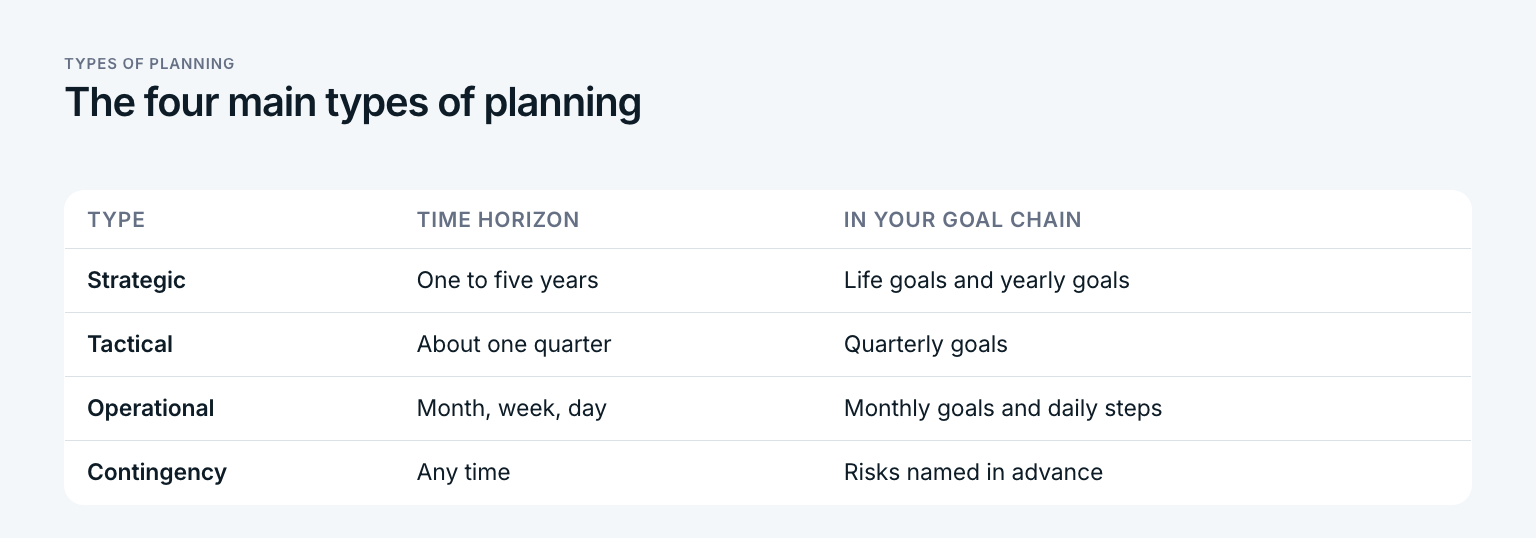
Quarterly planning is tactical planning. It translates the strategic layer, your yearly goals, into a short list of results the operational layer can schedule. That is also why it gets skipped so often. Strategy feels important and daily tasks feel urgent, while the middle layer feels like paperwork. Skip it, though, and the strategy never reaches the calendar.
Three neighbors are worth knowing. Annual planning is the big December review that produces the goals the quarter later divides up. The 12 Week Year suits people who deliberately work without yearly goals and prefer sprints. The OKR framework also runs on a quarterly cadence, but it is built for teams that track progress through key results and align goals across several levels. The approach in this guide is the simplest of the group. It needs no key results and no weekly tactics, only an honest comparison between what the year requires and what has happened so far.
Start with the scorecard: where your yearly goals stand after nine months
A quarterly plan does not start with new goals. It starts with the old ones. Anyone who plans the quarter without a scorecard ends up with quarterly goals that sound good and have nothing to do with the year. At the halfway point of the year, the same scorecard grows into a mid-year review.
Jenna set three yearly goals in January 2026. At work, she wants to grow the company email list from 4,000 to 10,000 subscribers by December 31. At home, she wants to pay off a $9,000 credit card balance and build a 12-by-16-foot backyard deck by the end of October. On Friday, October 2, after the kids are in bed, she takes 90 minutes and writes down where everything stood on September 30:
| Yearly goal 2026 | Status on September 30 | Progress | Decision |
|---|---|---|---|
| Email list from 4,000 to 10,000 | 7,600 subscribers | 60 percent | keep, change the approach |
| Pay off $9,000 card balance | $6,300 paid | 70 percent | keep, raise the payment |
| Backyard deck by October 31 | permit approved, lumber list done | about 30 percent | shrink, finish in spring |
| Time elapsed | 9 of 12 months | 75 percent | the yardstick for all three |
Nine of twelve months are gone, which is 75 percent. Two goals sit a little below that, one far below. The email list needs 2,400 more subscribers, and the monthly growth has slowed to about 400. The card needs $2,700, which is $900 a month instead of the $700 she has been paying. The deck needs almost everything still, and Minneapolis does not let you pour footings into frozen ground. Would a normal fourth quarter cover all of that? Not with Thanksgiving, Black Friday, and the holidays in it.
The pace line
The pace line is the progress a yearly goal would show today if it moved evenly. After Q1 that is 25 percent, after Q2 50, after Q3 75. No goal moves evenly, so the line is not a verdict. It is a question: is the time that is left enough for the work that is left?
Every yearly goal gets one of three decisions: keep, sharpen, or shrink. Keep means the current approach is enough. Sharpen means the goal stays but the approach changes, like a higher payment or a new lever. Shrink means part of the goal moves into next year, and you say so out loud instead of letting it fade.
Jenna shrinks the deck. By November 15, the footings are poured and the frame is built. The boards and the railing move to April 2027, when the ground has thawed. That is not failure. It is the same decision December would have made for her, only three months earlier and with a plan attached. Whoever shrinks a goal keeps it. Whoever lets it sit loses it.
How to make a quarterly plan in six steps
The six steps fit into one 90-minute session. The order matters: look back first, then read the calendar, then plan forward. Anyone who starts with new goals is planning against a calendar they have not looked at yet.
Score the last quarter, 20 minutes
Write down where each yearly goal stood on the last day of the quarter, in the same unit as the goal. Next to it, the pace line: 25, 50, or 75 percent. Jenna pulls the subscriber count from the email platform, the balance from her card statement, and a photo of the empty backyard.
Read the quarter's calendar, ten minutes
Count how many weeks you can actually use. Subtract vacations, holidays, peak seasons, and fixed events. For Jenna, Thanksgiving week and the last two weeks of December are out, and the week of Black Friday is the busiest of the year at work. Thirteen weeks shrink to about ten.
Make one decision per yearly goal, 15 minutes
Keep, sharpen, or shrink. One decision each, in writing, with one sentence on why. Whoever shrinks nothing while a goal sits far below the pace line is only postponing the decision to December.
Write up to three quarterly goals, 15 minutes
Each with a number and a deadline, each derived from a yearly goal. A quarterly goal without a yearly goal above it is allowed when something new becomes urgent. Then something else comes off the list.
Split each goal across three months, 20 minutes
Every quarterly goal gets a monthly goal for October, November, and December. Not evenly, but by the calendar: when a peak is coming, do more before it. Jenna puts the heavy setup work in October because November belongs to Black Friday.
Put the check-ins on the calendar, ten minutes
Three dates go in right away: a weekly review, a midpoint check in week seven, and a closing review at the end of the quarter that also opens the next one. For Jenna that means every Friday at 4 pm, Friday, November 13, and Friday, December 18.
That adds up to 90 minutes. The first time takes longer because the numbers for the scorecard are not collected anywhere yet. From the second quarter on, an hour is often enough, since the weekly reviews and the midpoint check have already done most of the counting.
Quarterly goals: three results, each with a number and a date
A quarterly goal is a result you can check on the last day of the quarter. It has a number, a deadline, and a yearly goal above it. What it is not: a task. "Write a lead magnet" is a task. "10,000 subscribers on December 31" is a quarterly goal. The task is the road. The quarterly goal is the place where you stop and measure.
Jenna writes these three quarterly goals for Q4 2026:
- Email list: 10,000 subscribers on December 31, measured in the email platform. The new lever is a free winter gear checklist plus a sign-up QR code at both store registers.
- Credit card: Balance at $0 on December 31. The payment rises from $700 to $900 on October 1, November 1, and December 1, funded by cutting takeout from weekly to every other week.
- Deck: Footings poured and frame built by November 15. Boards and railing are scheduled for April 2027.
Three quarterly goals, each tied to a yearly goal. All three can be checked with a yes or a no. And all three fit into the roughly ten weeks the calendar leaves. That means: quarterly planning does not create extra work. It only shows which work belongs in which three months.
How many quarterly goals you should set
Three is a good upper limit for one person, and three per team for a team. The reason is not willpower, it is arithmetic. Every quarterly goal needs a fixed block in every week. Anyone with a full-time job and young kids who has ten free hours a week can fit three blocks, maybe four. With five goals, each one becomes a side project, and side projects are the first thing to go in a hard week.
Fewer is always allowed. A quarter with one goal is not a weak quarter if the goal is big and the rest of life is already heavy. Whoever is moving, starting a new job, or expecting a baby is better off with one quarterly goal that holds than three that all wobble.
Quarterly planning template: one page, seven fields
A quarterly plan fits on one page. Paper, spreadsheet, or app, the fields matter more than the tool. Here is Jenna's, filled in for Q4:
| Field | Question | Jenna, Q4 2026 |
|---|---|---|
| 1. Time frame | From when to when, and how many usable weeks? | October 1 to December 31, 2026, about ten usable weeks |
| 2. Scorecard | Where do the yearly goals stand against the pace line? | 60, 70, and 30 percent against 75 |
| 3. Decisions | Keep, sharpen, or shrink? | sharpen the list and the card, shrink the deck |
| 4. Quarterly goals | Which three results at most are true on the deadline? | 10,000 subscribers, $0 balance, frame built |
| 5. Monthly goals | What is done at the end of each month? | list at 8,200, then 9,200, then 10,000 |
| 6. Risks | What could tip the quarter over? | Black Friday workload, early frost, a sick kid |
| 7. Check-ins | When do you measure? | Fridays at 4 pm, November 13, December 18 |
Field six is the one most templates leave out, and it saves the most trouble. It is your contingency plan in one line. Whoever writes down the biggest threat to the quarter in advance plans around it instead of being surprised by it. Jenna has known for years that November is the hardest month in retail marketing. Only on the quarterly plan does that knowledge turn into a rule: the checklist has to be live in October.
The goal chain: from quarterly goal to Tuesday morning
A quarterly goal only works once it reaches the calendar. The chain has five links: year, quarter, month, week, day. Each link asks the same question one level down: what has to happen here so the level above holds? Here is the chain for Jenna's email list:
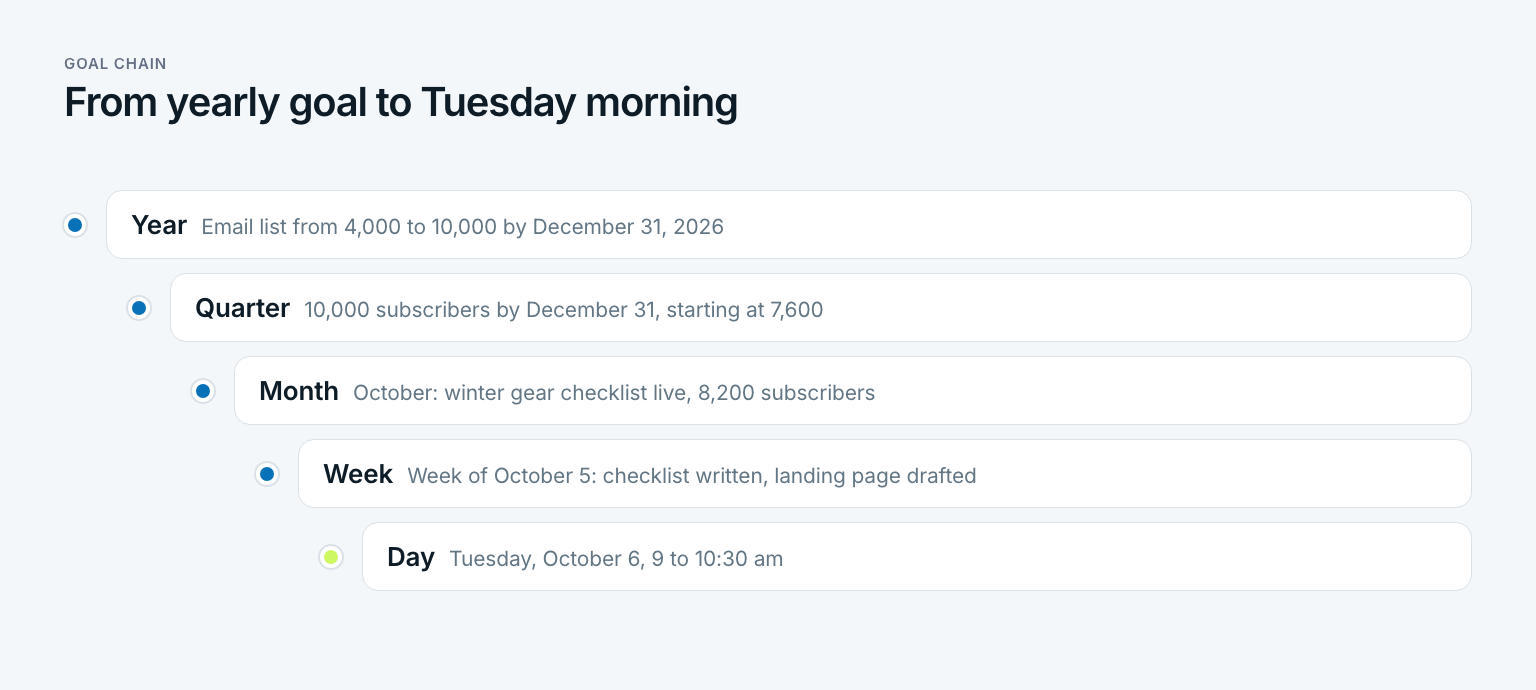
The monthly goals are deliberately uneven. In October Jenna builds the lever: the winter gear checklist goes live by October 9, the QR codes are printed, and the list ends the month at 8,200. In November she uses it. Black Friday early access is offered to subscribers only, which is the strongest sign-up reason of the year, and the target is 9,200 by November 30. In December she launches nothing new and just holds the pace to reach 10,000. That means: the hardest month gets the smallest new project. Each of those months then gets its own short monthly planning session on the last Friday before it begins.
The personal goals need shorter chains. The credit card needs one step a month, a payment on the first, which she sets to autopay once on October 2. The deck needs three Saturdays in October and early November, blocked on the family calendar before anything else can claim them. Every level has its number, but not every goal needs every level equally.
In Gaapp you build exactly this chain: the yearly goal on top, then quarter, month, and week, and on the day you check off the step. At the end of the quarter you see each goal's progress next to the time that has passed, so the pace line is right there without any math.
The smallest check in the chain is the week. Ten minutes on Friday are enough to see whether the week moved the monthly goal, and the ten-minute weekly review shows how. Whoever measures the week never has to rescue the quarter.
Quarterly planning for teams, couples, and families
For a team, the process is the same with the roles split. Jenna prepares the scorecard alone and brings it to a one-hour team meeting. There the team decides how to reach 10,000 subscribers, not whether to. Anyone who helped write a quarterly goal defends it in November when the inbox gets loud.
For couples and families, one quiet evening at the start of the quarter is enough. Three questions cover it: what is coming up this quarter, what are we saving for, and which weekends do we keep free? Jenna and her husband plan the deck that way. In Q4 they build the frame, in Q1 they pick the boards and save for them, and in Q2 they finish it. Three quarters, three legs, one shared goal.
Three mistakes that quietly end a quarter
Quarters rarely fail loudly. They just run out, and on December 31 you notice that Q3 went the same way. Three mistakes are almost always behind it, and none of them is about discipline.
The most common mistake: planning the quarter like a small year
Many people sit down on October 1 and write a fresh list of eight goals, as if the year had never happened. It feels like a clean start. But it cuts the quarter off from the yearly goals, and in December thirteen weeks of work add up to nothing that mattered in January. A quarterly goal without a yearly goal above it should be the exception, not the rule.
Second mistake: planning for 13 weeks when you have ten. Vacations, holidays, and peak seasons are on the calendar before the quarter even starts. Whoever does not subtract them plans about 30 percent too much and blames discipline for the gap in December. It was a math error from day one. The guide to goal planning shows how to run that hours budget for each goal.
Third mistake: no midpoint. Without a check-in in week seven, you only find out at the end of the quarter that a goal is stuck. By then there is no time left to change course. The midpoint check takes 20 minutes and asks one question: is every quarterly goal on pace, and if not, what changes on Monday?
Jenna already knows what she will check on November 13. Is the list at 8,700 or more? Is the card down to $900? Are the footings poured? If any answer is no, she decides that Friday what changes, not in late December when all that is left is regret.
A self-audit before you lock in the quarter
Before your quarterly plan takes effect, test it with three questions. Each takes a minute, and each one can save a quarter before it starts.
- Does every quarterly goal feed a yearly goal? If not, is it truly urgent enough to push another one out?
- Does the total fit into your usable weeks? Add up the weekly hours for all goals and compare them with your free time after vacations and peaks.
- Is the first step of every goal on the calendar? A quarterly goal without a date in week one usually starts when the first month is already half over.
Jenna answers all three with yes, including the second, because she shrank the deck. Without that one decision the math would not have worked. In short: quarterly planning is not extra work on top of the year. It is the moment the year gets honest.
Frequently asked questions about quarterly planning
How do you make a quarterly plan?
Start with a scorecard of your yearly goals against the pace line, then count the usable weeks in the coming quarter. Decide for each yearly goal whether to keep, sharpen, or shrink it, and write up to three quarterly goals with a number and a deadline. Split each one into three monthly goals and put a weekly review, a midpoint check, and a closing review on the calendar.
What are the four main types of planning?
The four main types are strategic, tactical, operational, and contingency planning. Strategic planning sets the direction for one to five years, tactical planning breaks it into results for roughly a quarter, and operational planning schedules the months, weeks, and days. Contingency planning prepares for what could go wrong, which in a personal quarterly plan is the risks field.
What are quarterly goals?
Quarterly goals are results you can check with a yes or a no on the last day of a quarter, such as a number of subscribers, a dollar amount, or a finished project. They are legs of a yearly goal and always have a number and a deadline. Three per person is a sensible upper limit.
What months are in each quarter?
Q1 covers January, February, and March. Q2 covers April, May, and June, Q3 covers July, August, and September, and Q4 covers October, November, and December. Companies with a different fiscal year start counting from the first month of that year instead.
How long should quarterly planning take?
For one person, 60 to 90 minutes. For a team, about one hour of meeting time plus preparation by one person. The first session takes longer because the numbers have to be collected, and from the second quarter on they are usually ready.
Is quarterly planning the same as the 12 Week Year?
No. The 12 Week Year by Brian Moran and Michael Lennington treats twelve weeks as the full planning year and drops annual goals. Quarterly planning keeps your yearly goals as the direction and uses each quarter as a leg of the trip. If you prefer sprints without a yearly anchor, use the 12 Week Year, and if you are working toward a yearly goal, plan by quarter.
Last updated: 19 October 2026
Read next
 Planning
Cleaning Schedule: Daily, Weekly and Monthly Tasks
A cleaning schedule is not a Saturday to-do list: daily, weekly and monthly tasks, a printable template and a fair split for families.
15 min read
 Planning
Study Plan: How to Make One You Can Actually Follow
A study plan is not a schedule. Make one in six steps: inventory, hours math, buffer, a sample study schedule and a template, with a worked example.
17 min read
 Planning
Bullet Journal: How to Start One You'll Actually Keep
A bullet journal is not an art project. Learn the bullets, four core modules, migration and a six-step setup, with an example, 12 ideas and a goal chain.
15 min read