Morning Routine: Build It Around a Goal, Not an Alarm
A morning routine is a fixed sequence that puts your goal into the first free hour. Five steps, four famous formulas compared, 24 ideas, a worked example.

Contents
- 01What a morning routine is and what it is not
- 02Why the best morning routine starts with the goal, not the alarm
- 03Morning routine for success: four famous formulas compared
- 04Elena's morning routine: 55 minutes, one number
- 05How to build your morning routine in five steps
- 06Morning routine ideas, sorted by what they are for
- 07The three mistakes that end a morning routine by week three
- 08The morning routine in the goal chain: year, quarter, month, week, day
- 09Three questions before you set the alarm
- 10Frequently asked questions about morning routines
A morning routine is a fixed sequence of actions you repeat in the same order every morning, before the day starts asking things of you. It is not a wake-up time. Whether you get up at 4:30 or at 7:15 says nothing about whether the routine works. What matters is one question: does the first hour move something you decided on months ago, or does it only move the clock?
Three things make a morning routine hold: an anchor, a sequence, and one block that serves a goal. The anchor is the moment you always have, the sequence is short enough to survive a bad night, and the goal block is the reason the routine exists. All three are worked through with Elena, 38, a product manager in Chicago with two kids, who wants to send a book proposal to literary agents by December. Her routine has 55 minutes and one number in it. You also get four famous formulas compared, 24 morning routine ideas sorted by purpose, and the three mistakes that end most routines by week three.
What a morning routine is and what it is not
A morning routine is a chain of two to five actions that follow the same cue every day. The cue is waking up, or the first thing you reliably do after it. The chain is fixed, so you decide nothing before you are awake enough to decide well. Decisions cost energy, and the morning is when you have the most of it. A routine spends that energy on the thing you chose, not on choosing.
It is not a wake-up time. The 5 am club is a wake-up time. It is not a wellness checklist either. Cold showers, journaling, green juice and a gratitude list are all fine things. Whoever does all four has had a busy morning, not necessarily a useful one. And it is not a morning ritual in the sense of something sacred that must not be touched. A morning ritual that falls apart on the day your child throws up at 6 am was never a routine. It was a performance.
Here is the test: Could you describe your morning routine in one sentence, and does that sentence contain the goal it serves? Elena's sentence: Up at 5:50, water, ten minutes of stretching, 600 words on the book before the kids wake at 6:45. Goal, time, number. That is a routine. “I try to have a calm morning” is a wish.
Why the best morning routine starts with the goal, not the alarm
The best morning routine is the one that puts your most important goal into the first available hour, at whatever time that hour begins. Not the earliest. Not the longest. The one you can repeat 200 times a year. Most guides answer with a wake-up time and a list of healthy habits. Both are fair starting points, and both miss the measure. A routine is good if it moves a goal.
Think about what the morning actually offers. It is the only part of the day that nobody else has claimed yet. No emails, no requests, an empty calendar. Gary Keller and Jay Papasan make this point in The One Thing, 2013: block the early hours for the one activity that makes everything else easier, before the day fills up. The hour itself is not magic. Its emptiness is. That means: whoever fills the empty hour with news and other people's priorities has given away the one slot nobody could take from them.
This is also why a healthy morning routine and a productive one are not two different things. Movement, daylight, water and a real breakfast are the maintenance that lets you use the hour. The goal block is what the hour is for. So what does the best morning routine look like? It looks like your monthly goal, cut into a piece you can finish before anyone needs you. The rest of the day runs on other routines, from a startup routine to a shutdown, which the guide to a daily routine lays out.
Morning routine for success: four famous formulas compared
Four formulas dominate the search results, and each one is built for something. None of them is wrong. The question is which one fits a goal you actually have, and what it costs you in sleep.
| Formula | Who made it known | What it says | Built for | The catch |
|---|---|---|---|---|
| Miracle Morning, SAVERS | Hal Elrod, The Miracle Morning, 2012 | Six practices before the day starts: Silence, Affirmations, Visualization, Exercise, Reading, Scribing. An hour in full, six minutes in the short version | Building a fixed morning from nothing, personal growth | Six items are hard to protect on a bad night. None is tied to a goal unless you tie it |
| 20/20/20 rule | Robin Sharma, The 5 AM Club, 2018 | Up at 5 am, then 20 minutes of movement, 20 minutes of reflection, 20 minutes of learning | People who want structure in the first hour and can be asleep by 9:30 pm | Needs a 9:30 bedtime. The hour is maintenance, the goal has no slot |
| 30/30/30 | Popularized by Gary Brecka in 2023, building on Tim Ferriss, The 4-Hour Body, 2010 | 30 grams of protein within 30 minutes of waking, then 30 minutes of low-intensity movement | Body composition, steady energy, people whose goal is physical | A nutrition protocol, not a routine. Nothing in it moves a project |
| The 4 am rule | Social media, often with Jocko Willink's 4:30 alarm photos as the example | Wake at 4 to get hours nobody else is using | People with early jobs or loud evenings who can also be in bed by 8 | Costs sleep if bedtime does not move. Sleep debt eats the gain in two weeks |
Read the last column again. Three of the four say nothing about a goal. They structure the hour, which is useful, and then leave it empty of anything you decided on in January. Whoever follows SAVERS to the letter has a calm morning and a book proposal exactly as unfinished as before. The Miracle Morning also comes in a six-minute version that keeps the structure and drops most of the hour. The formulas are scaffolding. Your goal is the building.
What the 20/20/20 rule and the 30/30/30 method have in common
Both split the first hour into fixed blocks with a number attached. That is their real strength, and it is worth stealing: a block with a number is a block you can tick. The weakness is what the blocks hold. Movement, reflection, protein and learning maintain you. They do not advance a quarterly goal. Keep the block structure and give the biggest block to the goal.
One more word on the alarm. The American Academy of Sleep Medicine recommends seven or more hours of sleep per night for adults, in a consensus statement from 2015. Whoever moves the alarm from 6:30 to 4:30 without moving bedtime from 11 to 9 has not gained two hours. They have borrowed them at a bad rate, and the routine quits in week three. That looks like a motivation problem and is a sleep problem.
Elena's morning routine: 55 minutes, one number
Elena has 55 minutes. Her alarm is at 5:50 and the kids are reliably up at 6:45. That window is not negotiable, so she stopped negotiating it. Her yearly goal: a nonfiction book proposal sent to 20 literary agents by December 15. Her October goal: two sample chapters drafted, 12,000 words. Over four weeks that is 3,000 words a week, and over five writing mornings it is 600 words a day. The whole routine exists for that number.
| Time | Block | Minutes | What it is for | Done when |
|---|---|---|---|---|
| 5:50 | Up, a glass of water, phone stays in the kitchen drawer | 5 | Waking up without input | Glass empty, she is at the desk |
| 5:55 | Stretching, ten moves she knows by heart | 10 | Her back, after years of laptop work | Last move done, no checking the clock |
| 6:05 | Writing the sample chapter, 600 words | 35 | The monthly goal | The document shows the day's word count |
| 6:40 | Log the word count, write the first sentence for tomorrow | 5 | Making tomorrow start without a decision | One line in the log, one sentence at the top of the page |
Notice what is not in it. No journaling, no reading, no affirmations, no cold shower. Elena tried a longer version in September with all of those. It took 80 minutes she did not have and survived four days. The short version has run since September 15. At the end of the third week of October she had written on 14 of 15 planned mornings and the chapters stood at 8,700 words. That is 72 percent of the month's words with 75 percent of the month gone, 300 words behind plan. One Saturday session closes it. She knows this from a number, not from a feeling.
That means: the routine is not the 55 minutes. The routine is the 600. The water, the stretching and the log are there to make the 600 happen without a single decision before 6:05. Whoever has a block like that in the morning has a routine. Whoever has only the water and the stretching has a nice start.
How to build your morning routine in five steps
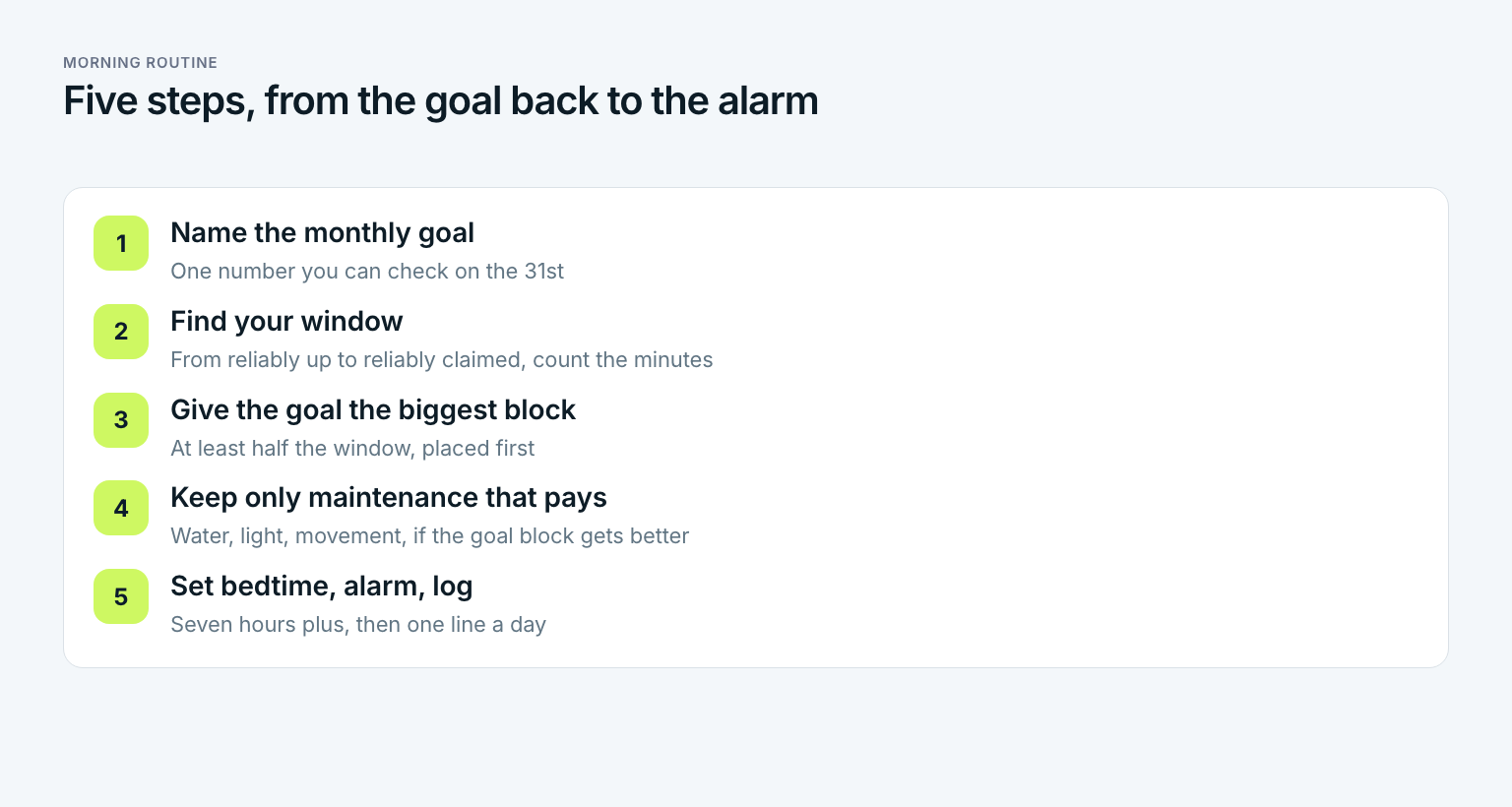
Start from the goal and work backward to the alarm. Most people do it the other way around and end up with an early alarm and nothing to do with it. Five steps, each with Elena's answer:
Name the monthly goal the morning serves
One goal, written down, with a number you can check at the end of the month. Not “work on the book” but “12,000 words of sample chapters by October 31”. No monthly goal yet? Build the chain first: [how to achieve goals](/en/how-to-achieve-goals) shows the way from a yearly goal to a month. Elena: 12,000 words in October.
Find your window and count the minutes
The window is the time between the moment you can reliably be up and the moment the day reliably claims you. Count honestly. Elena's window is 5:50 to 6:45, because the kids wake at 6:45 whether she likes it or not. Whoever has 25 minutes builds a 25-minute routine. A routine that needs 90 minutes you do not have is a plan to quit by Thursday.
Give the goal the biggest block, and put it first
Divide the window. The goal gets at least half of it, right after the shortest warm-up you can manage. Elena: 35 of 55 minutes, after five minutes of water and ten of stretching. The daily portion is the monthly number divided by the mornings you will actually show up: 12,000 divided by 20 is 600. How to cut a goal into portions that small is the subject of [turn yearly goals into daily steps](/en/blog/turn-yearly-goals-into-daily-steps).
Add only the maintenance that pays for itself
Water, daylight, movement, a real breakfast: keep what makes the goal block better and drop the rest. Ask of every item: if I skipped this, would the 600 words suffer? Stretching stays for Elena because her back decides how long she can sit. Journaling went because the writing is the journaling. BJ Fogg's rule from Tiny Habits, 2019, applies: anchor each item to the one before it. After the water, the mat. After the mat, the desk.
Set the bedtime, then the alarm, then log one number
Count back from the alarm: seven and a half hours of sleep plus 20 minutes to fall asleep gives you lights-out. Elena's alarm at 5:50 means lights out at 10:00 pm. Then log one number every morning, the one the goal block produces. Words, minutes, pages, reps. One line. That line is what you look at on Friday.
The minimum version for bad mornings
Every routine needs a version for the morning after a bad night. Not a different routine, the same one at a quarter of the size. It keeps the goal block, shrinks it, and drops everything else, so that a bad day is a short day and never a zero day. Zero days kill routines. Short days keep them alive.
| Block | Full version | Minimum version |
|---|---|---|
| Water | 5 minutes, phone in the drawer | Same, 2 minutes |
| Stretching | 10 minutes, ten moves | Dropped |
| Writing | 35 minutes, 600 words | 10 minutes, 150 words |
| Log and first sentence | 5 minutes | 2 minutes, log only |
| Total | 55 minutes | 14 minutes |
Elena used it twice in October, once after a night with a feverish child and once after a late flight. Both mornings still produced a line in the log. Anyone who has the minimum version written down in advance does not negotiate at 5:50 am. The decision was made weeks ago, with a clear head. Whoever has to decide at 5:50 decides in favor of the pillow, and that is not weakness. It is what tired brains do.
Morning routine ideas, sorted by what they are for
Ideas are cheap. Sorting them is the work. Here are 24 morning routine ideas in three groups: body, mind, goal. Pick one or two from each of the first two groups and exactly one from the third. Whoever picks five from the first two and none from the third has built a spa, not a routine.
Ideas that wake the body
- A full glass of water before anything else, because you have not had any for seven hours.
- Daylight within ten minutes of waking: open the blinds or step outside. Light is the strongest signal your body clock gets.
- Ten minutes of movement you can do in pajamas: stretching, a mobility sequence, bodyweight squats, a walk around the block.
- A cold rinse at the end of the shower, 30 seconds, if you like it. Hating your routine is how routines end.
- Breakfast with protein. The 30/30/30 crowd is right about one thing: a morning on coffee alone crashes at 10.
- Make the bed. It takes 90 seconds and it is the first finished thing of the day.
- Shoes on before the mind catches up. Whoever puts on running shoes at 5:55 goes running.
- Wake at the same time on weekends, within an hour. Monday morning is decided on Sunday night.
Ideas that settle the mind
- Five minutes of silence, with or without an app. Elrod's first letter in SAVERS, and the one most people drop first.
- Three lines in a notebook: yesterday, today, gratitude. Three lines, not three pages. A good gratitude journal entry follows the same rule: four short lines, not a page.
- Ten pages of a printed book, before any screen.
- Review today's one daily goal and the calendar, two minutes.
- The phone stays off until the routine is done. Not on silent in your pocket. Off, or in another room.
- A short walk without headphones.
- Prayer or meditation, if it is part of your life. A morning ritual in the real sense belongs here and deserves its own slot.
- Write the day's first sentence or task on paper the night before, so the morning starts with an answer.
Ideas that move a goal
- Write: 300 to 600 words of the thing you are actually writing.
- Study: one lesson, one chapter, or 20 flashcards for the exam in March.
- Train: the run or the lifting session that belongs to the race you signed up for.
- Build: 30 minutes on the side project, with the ticket chosen the night before.
- Apply: one job application, fully sent, before 8 am.
- Practice: the instrument, the language, the presentation, 25 minutes with a timer.
- Sell: five outreach emails for the business, written and sent before the inbox opens.
- Plan: on Sunday only, the week's three goals and Monday's first daily goal. The guide to daily goals shows how small a daily goal has to be.
Ask yourself: which of the eight goal items would your January self want you to pick? That one goes in the biggest block. The body and mind items are there to carry it.
The three mistakes that end a morning routine by week three
Most morning routines do not fail loudly. They fade. Three mistakes do most of the fading, and none of them feels like a mistake while you are making it.
The most common mistake: building the routine around the alarm instead of the goal
You read about the 5 am club, set the alarm for 5, and fill the hour with good things. Three weeks later the alarm is back at 6:15 and nothing has changed, because nothing in the hour was tied to anything you wanted by December. The fix is not a stricter alarm. It is one block with a number, from a goal you already have, placed first. Whoever starts with the goal can wake at 7 and still have a routine. Whoever starts with the alarm has an alarm.
- Too many items. Six practices, a cold shower, a smoothie and a workout make a beautiful grid of photos and a 90-minute morning. The first bad night cuts it to zero, because you cannot do half of a routine you have not ranked. Charles Duhigg calls the few behaviors that pull others along keystone habits, in The Power of Habit, 2012. Your keystone is the goal block. The rest is optional.
- No bedtime. A morning routine is a bedtime routine wearing a different shirt. Whoever sets the alarm two hours earlier and keeps the same bedtime has not created time. They have moved sleep debt into the morning, where it looks like laziness. Set the lights-out time first. Then set the alarm.
- No log. Without a line a day, the routine is judged by how it feels, and by week three it feels like effort. A log turns 14 of 15 mornings into a fact. Anyone who logs can tell a bad week from a dead routine. Anyone who does not log quits a routine that was working.
There is a fourth, quieter one: expecting it to feel automatic by day ten. Phillippa Lally and colleagues tracked people forming a new daily habit, European Journal of Social Psychology, 2010, and found it took around 66 days on average to feel automatic, with a range from 18 days to more than 250. That means: in week three it is supposed to feel like effort. Effort in week three is not a sign the routine is wrong. It is the routine working.
The morning routine in the goal chain: year, quarter, month, week, day
A morning routine is the day's slot in a chain that starts with the year. Without the chain, the morning is a habit. With it, the morning is where the yearly goal actually gets done, 600 words at a time. Elena's chain, top to bottom:
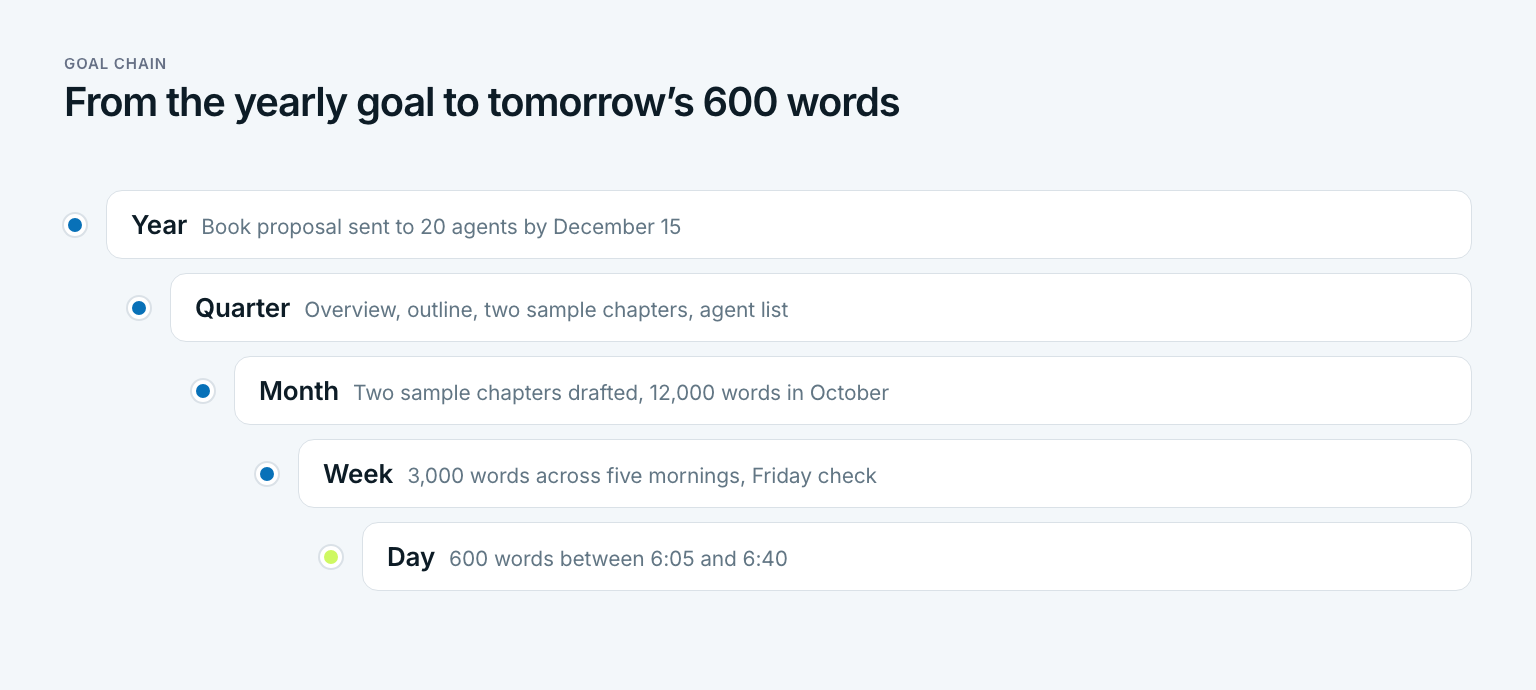
- Year: Book proposal finished and sent to 20 literary agents by December 15.
- Quarter, October to December: Proposal complete: overview, chapter outline, two sample chapters, and a list of 20 agents with their submission guidelines.
- Month, October: Two sample chapters drafted, 12,000 words.
- Week: 3,000 words across five mornings. Friday check: words done, words planned, one thing for next week.
- Day: 600 words between 6:05 and 6:40.
Every level has a number, and the numbers add up. Five mornings at 600 make the week, four weeks make the month, three months make the quarter. If Elena misses two mornings, the week shows 1,800 of 3,000, and on Friday she decides whether Saturday covers it or the month absorbs it. That decision is her entire management system, and it takes ten minutes. How to set the year and the quarters so that the month has a number at all is covered in annual planning.
In Gaapp this chain is the core of the app: five levels from year to day, each goal hanging off a bigger one, progress per level as the share of goals done next to the share of time gone. The morning routine is where the bottom level gets ticked. Whoever ticks the daily goal before 7 am has done the most important thing of the day before the day knows it has started.
For couples and teams the chain works the same way. Two partners with a morning block each for a shared goal see the same monthly number and two daily ticks instead of one. A coach who sets up a client's morning routine starts at the monthly goal, not at the alarm: the alarm is a tool, the goal is the job.
Three questions before you set the alarm
Before you change anything about your mornings, check the current version against three questions:
- Can you name the goal your morning serves, in one sentence, with a number in it?
- Do you know how many mornings in the last two weeks the goal block actually happened, as a count and not as a feeling?
- Does your bedtime match your alarm, with seven or more hours between them?
Whoever answers no to the first question does not have a routine problem. They have a goal problem, and the fix is upstream. Whoever answers no to the second has a routine but no log, and the fix is one line a day. Whoever answers no to the third is running on borrowed sleep and will know it by week three. Ready-made goal chains from a yearly goal down to a daily block are in the templates.
In short: a morning routine is not a wake-up time, a formula, or a list of healthy things. It is the first free hour of the day, spent on the one thing you decided on months ago, at whatever hour your life allows. Elena's starts at 5:50 and ends at 600 words. Yours might start at 7:30 and end at one job application sent. Same routine. Different alarm.
Frequently asked questions about morning routines
What is the best morning routine?
The best morning routine is the one that puts your most important monthly goal into the first free hour, at whatever time that hour begins for you. It has a short warm-up, one goal block with a number attached, and a one-line log. Everything else, from stretching to journaling, is optional maintenance. A routine you can repeat 200 times a year beats a perfect one you keep for ten days.
What is the 4 am rule?
The 4 am rule is the idea, popular on social media, that waking at 4 am gives you several hours nobody else is using. Jocko Willink's 4:30 alarm photos are the most cited example. It works for people who can also be asleep by 8 or 9 pm. For everyone else it costs sleep, and sleep debt wipes out the gain within two weeks. The hour matters less than what you put in it.
What is the 30/30/30 morning routine?
The 30/30/30 method says to eat 30 grams of protein within 30 minutes of waking and then do 30 minutes of low-intensity movement, such as walking. Gary Brecka popularized it in 2023, building on a protein rule from Tim Ferriss's The 4-Hour Body from 2010. It is a nutrition and exercise protocol and can be a useful body block. It does not, by itself, move a project or a goal.
What is the 20/20/20 rule morning routine?
The 20/20/20 rule comes from Robin Sharma's The 5 AM Club, published in 2018. You get up at 5 am and spend 20 minutes moving, 20 minutes reflecting, and 20 minutes learning. The fixed blocks with numbers are its strength. Its two weaknesses are that it needs a bedtime around 9:30 pm and that none of the three blocks is tied to a specific goal unless you add one.
How long should a morning routine be?
As long as the window between waking up and the moment the day claims you, and not a minute longer. For many people that is 30 to 60 minutes. The goal block should take at least half of it. Elena's routine is 55 minutes because her kids wake at 6:45. A 20-minute routine with a 12-minute goal block is a real routine. A 90-minute routine you manage twice a week is a wish.
What should I do if I miss a morning?
Log it and run the full version the next day. One missed morning is a data point, not a verdict. If you miss three in a row, the routine is too long for your current life or the bedtime does not match the alarm. Shrink it to the minimum version, which keeps a short goal block and drops everything else, and build back up from there. Never let a missed morning become a zero day the next morning too.
Last updated: 19 October 2026
Read next
 Habits
75 Hard: Rules, Risks and a Version You Can Finish
75 Hard is not a fitness program. The full rules, four health risks, 75 Soft compared and a custom version built around a real goal.
15 min read
 Habits
Digital Detox: A 7-Day Plan to Reduce Screen Time
A digital detox isn't a weekend offline. What the research shows, how to measure and reduce screen time, plus a 7-day plan with a worked example.
15 min read
 Habits
Delayed Gratification: Meaning, Examples, How to Build It
Delayed gratification isn't self-denial, it's a trade: what the marshmallow test really showed, everyday examples, five proven strategies and a plan.
15 min read