Gratitude Journal: How to Start One That Lasts
A gratitude journal isn't a nightly list of three things. The four-line entry, how often to write, 30 prompts, a template and a worked example.

Contents
- 01What a gratitude journal is, and what it isn't
- 02Does a gratitude journal work? What the research shows
- 03What to write: the four-line gratitude journal entry
- 04How often to write in a gratitude journal
- 05How to start a gratitude journal in five steps
- 06Gratitude journal examples: Marcus's first ten weeks
- 07Gratitude journal prompts: 30 prompts in six groups
- 08A gratitude journal template for one week
- 09Three mistakes that end most gratitude journals
- 10Your gratitude journal in the goal chain
- 11Three questions before you start
- 12Gratitude journal FAQ
A gratitude journal isn't a nightly chore of listing three things. It's a notebook where you write down, once or twice a week, one specific thing you're grateful for, who made it happen, and what your week would have looked like without it. One entry takes about five minutes. The benefits are real but modest, and they depend more on how you write than on how often.
Three choices decide whether your journal lands in a drawer after two weeks or is still going a year later: the format of an entry, how often you write, and the prompts you use. You'll follow Marcus, 44, a high school chemistry teacher in Columbus, Ohio, who coaches the robotics team and used to lie awake replaying parent emails. Along the way you get 30 gratitude journal prompts, a one-week template, and the three mistakes that end most gratitude journals.
What a gratitude journal is, and what it isn't
A gratitude journal is a record of what is already good in your life and where it came from. That sounds simple. The difference between a grateful thought and a gratitude journal is the writing itself: writing forces you to be specific, and specific memories stick. That means: the journal isn't a place for moods. It's a place for observations.
Four practices often get lumped together. None of them is wrong. Each is built for something else:
- Journaling. Free writing about anything on your mind, including worries, anger and plans. It clears your head. It has no fixed direction, and that's the point. The guide on how to start journaling covers formats and a 30-day plan.
- Self-reflection. You measure what you did against a question and decide what to change. The self-reflection guide walks through it in five steps.
- Gratitude journal. You deliberately point your attention at good things that are already there. It doesn't grade and it doesn't plan. It shifts what you notice.
- Wins journal. You log what you accomplished. That builds confidence in your own effort. Gratitude also looks at other people and at luck you never earned.
The line matters because it shapes the format. Anyone who starts solving problems in a gratitude journal is really journaling. Anyone who only collects personal wins is keeping a wins journal. Both are useful. They just aren't the thing researchers measured when they studied gratitude.
Does a gratitude journal work? What the research shows
The landmark study comes from Robert Emmons and Michael McCullough, published in 2003 in the Journal of Personality and Social Psychology as “Counting Blessings Versus Burdens.” In the first study, college students wrote down up to five things they were grateful for, once a week for ten weeks. Comparison groups listed hassles or simply events from their week. The gratitude group rated their lives more positively overall, felt more optimistic about the coming week, and reported fewer physical complaints.
Another study in the same paper asked adults with neuromuscular diseases to write daily for three weeks. The gratitude group reported better moods and, by their own account, longer and better sleep. Notice the word “reported.” Nearly every outcome was self-rated, the samples were modest, and the differences were clear but not dramatic.
Later work confirms the picture, with limits. In 2005, Martin Seligman and colleagues reported in American Psychologist on an exercise in which people wrote down three things that went well each night for one week, plus why each one happened. Gains in happiness showed up in follow-ups as long as six months later, mostly among people who kept going on their own. A 2016 meta-analysis by Don Davis and colleagues in the Journal of Counseling Psychology pooled dozens of studies: gratitude exercises beat doing nothing or doing something neutral, but their edge over other positive exercises was small.
In short: a gratitude journal works if your expectations are realistic. It lifts mood measurably but modestly. It doesn't replace treatment, and it doesn't fix a problem that needs a decision.
Not a substitute for therapy
Gratitude exercises have mostly been studied in healthy adults and college students. If you've felt low for weeks, can't sleep, or have lost interest in things you used to enjoy, talk to a doctor or a licensed therapist. A journal can sit alongside treatment if your clinician thinks it helps. It isn't treatment.
What to write: the four-line gratitude journal entry
Three good things a night is the best-known format. It's a fine way to start. After about two weeks, though, the answers usually repeat, and whoever writes “family, health, coffee” for the tenth time feels nothing while writing it. The four-line entry trades quantity for depth: one thing, written well.
Robert Emmons, lead author of the 2003 study, recommends exactly that trade: go for depth over breadth, focus on people more than things, and pay attention to surprises. The fourth line comes from Minkyung Koo, Daniel Gilbert and colleagues, who showed in 2008 in the Journal of Personality and Social Psychology that imagining your life without a good event lifts your mood more than simply describing the event.
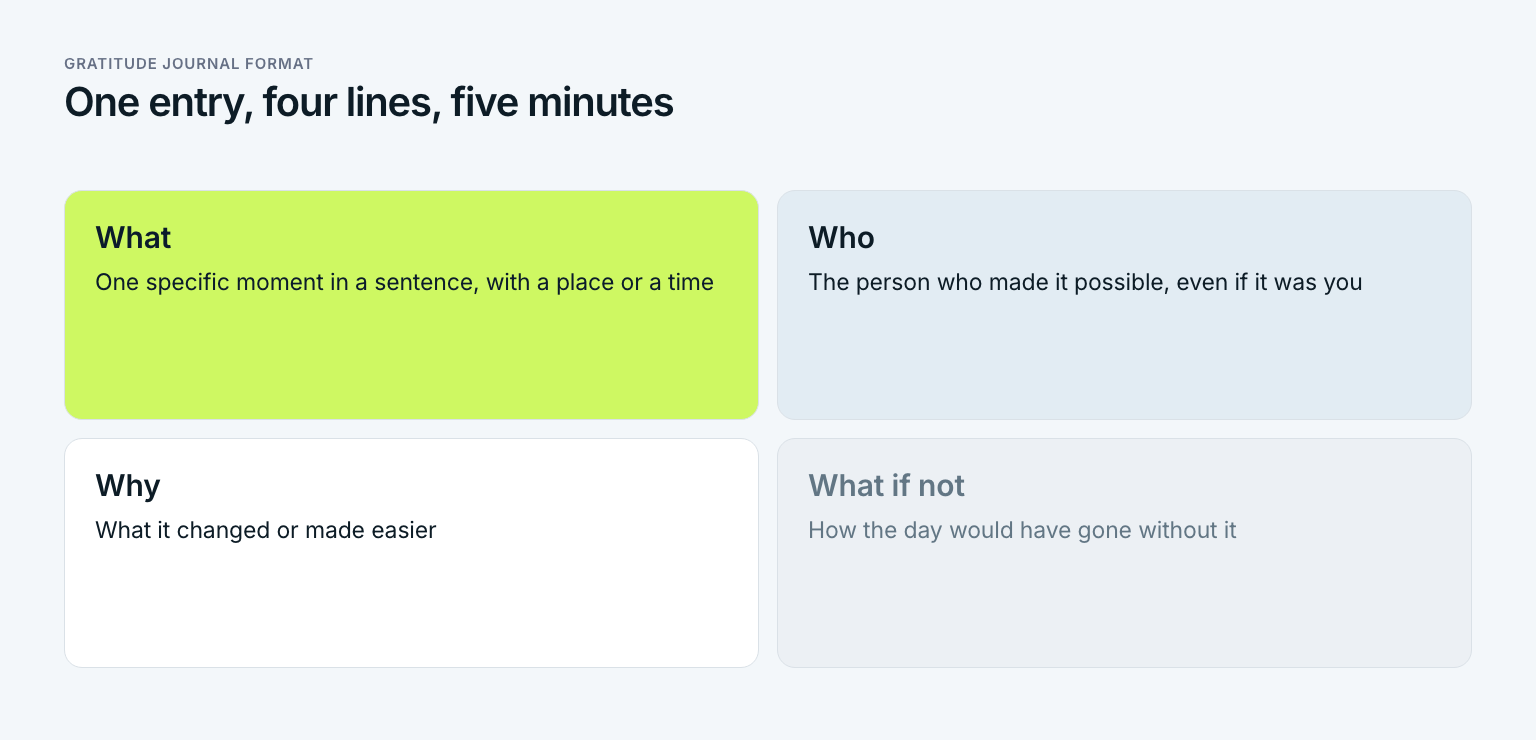
- What happened, in one sentence. Specific, with a place or a time. Not “my daughter,” but “Maya explained black holes to me at dinner using a cereal bowl.”
- Who made it possible? A name, even if it was you. This line turns luck into a relationship.
- Why did it matter? One sentence on the effect: what it changed, what it made easier.
- What if it hadn't happened? One sentence of subtraction: how would the day have gone without it?
An entry in this format has four sentences and takes three to five minutes. Here is one of Marcus's gratitude journal examples, written on a Sunday at 9 p.m.:
“Thursday, robotics lab: Priya finally got the arm to lift the cube after three weeks of failed builds. Mr. Alvarez stayed until six so the building could stay open. I watched a 15-year-old stop doubting herself. Without that evening, I'd have spent Thursday grading quizzes and wondering why I still coach.”
Every sentence answers one line. No sentence is a feeling word without a scene. That means: whoever reads this entry a year from now will see that Thursday again.
Paper or app?
Both work. Paper keeps the screen out of your bedroom and notifications out of your head. An app lets you search and count your entries later. Anyone who writes in bed at night does well with paper. Anyone who wants to analyze entries later types them up once a month or writes digitally from the start.
How often to write in a gratitude journal
Daily isn't automatically better. In 2005, Sonja Lyubomirsky, Kennon Sheldon and David Schkade described an experiment in the Review of General Psychology in which students counted their blessings for six weeks. Those who did it once a week grew happier. Those who did it three times a week didn't. The authors' explanation: frequent repetition wears thin, and the exercise turns into a routine without feeling.
That's one experiment, not a law of nature. It does line up with the landmark study, where one entry a week was enough, and with the experience of many people who quit after two weeks of nightly lists. If you write daily and find something new every time, keep going. If you repeat yourself, write less often and more precisely.
| Rhythm | Time per week | Strength | Risk |
|---|---|---|---|
| Three things every night | 15 to 20 minutes | Fast start, strong habit | Answers repeat after two weeks, feels like homework |
| Twice a week, four lines | 8 to 10 minutes | Deep entries, room for new things | One missed slot weighs more |
| Once a week, up to five things | 10 minutes | Matches the 2003 study design | Monday's details have faded by Sunday |
| One gratitude letter a month | 30 minutes | Strengthens one specific relationship | Doesn't replace an ongoing journal |
For most people the second row fits: twice a week, one four-line entry each time. One slot midweek, one on Sunday evening. If you already have a fixed evening sequence, attach the entry to it. The guide to building an evening routine shows how.
Morning or night?
The studies above don't compare times of day, and Seligman's exercise ran at night. Night gives you a finished day and more material. Morning gives you a fresher head but yesterday's material. What matters is a fixed slot. Anyone who lies awake replaying the day, like Marcus, writes at night, because the entry points the mind somewhere else.
How to start a gratitude journal in five steps
Setup takes 20 minutes. After that, plan on eight to ten minutes a week. Here's how:
Pick a notebook and a spot
A thin notebook or a dedicated note, not your work notebook. Keep it where you'll write, such as your nightstand. A journal you have to hunt for stays empty.
Put two fixed slots on your calendar
For example Wednesday and Sunday at 9 p.m., as recurring events. The day doesn't matter. What matters is that it isn't up for negotiation every week.
Write your first four-line entry
What happened, who made it possible, why it mattered, what if it hadn't. One sentence per line. If nothing comes, pick one of the 30 prompts below.
Flag repeats
When something shows up a second time, only write it if you find a new detail. Otherwise, take a prompt from a different group.
Review after ten to twelve weeks
Read every entry in one sitting and tally what each one is about: people, places, activities. The biggest category tells you what you want more of.

Gratitude journal examples: Marcus's first ten weeks
Marcus needed two tries. In June, at the start of summer break, he wrote three things every night. He stopped after nine days. Seven of the nine entries said nearly the same thing: Maya, his health, the first coffee. It felt like grading his own homework. In early July he started over with four lines and two slots a week.
| Period | Rhythm | Entries | What showed up |
|---|---|---|---|
| June, nine days | Three things nightly | 9 of 9, then quit | Seven entries nearly identical, no feeling left |
| July, weeks 1 to 4 | Wednesday and Sunday, four lines | 8 of 8 | Summer hikes with Maya fill most entries |
| August, weeks 5 to 8 | Wednesday and Sunday, four lines | 7 of 8 | First entries about colleagues once school starts |
| September, weeks 9 and 10 | Wednesday and Sunday, four lines | 3 of 4 | Missed one Wednesday for back-to-school night |
| Total after 10 weeks | Two slots a week | 18 of 20 | Fewer late-night email replays, by his own account |
Eighteen of 20 slots is 90 percent. It isn't a perfect score, and it doesn't need to be. Marcus didn't track sleep or mood data. All he can say is that Sunday nights feel different. That's the honest size of the effect the studies suggest too. Whoever expects more is disappointed by week four. Whoever expects exactly that keeps going.
Gratitude journal prompts: 30 prompts in six groups
Prompts help on nights when nothing comes to mind, and they break up repetition. Pick one prompt per entry, not five. Anyone who picks from a different group each week has looked at every corner of their life within three months.
People
- Who made my week easier without being asked?
- Which conversation stayed with me longer than I expected?
- Who taught me something I still use today?
- Who haven't I told in a long time what they mean to me?
- Which near-stranger was kind to me this week?
Everyday life and body
- What moment today was so small I almost missed it?
- What can my body do today that it couldn't a year ago, or won't always be able to do?
- Which place in my home or neighborhood does me good?
- What food, smell or sound made me happy this week?
- What works so reliably in my life that I never notice it?
Work
- Which coworker had my back this week?
- Which task turned out more enjoyable than I expected?
- What can I do at work now that I couldn't do five years ago?
- Which problem solved itself without me?
- What at my job do I take for granted that isn't a given?
Hard days
- What still worked today, despite everything?
- Who showed up when things were hard?
- What did a bad experience teach me that I wouldn't give back?
- What didn't happen today that I was afraid of?
- Which small thing made this day bearable?
What if not
- What would my week look like without the person I see most often?
- What would I have missed if I hadn't taken my current job?
- Which chance meeting changed more than I expected?
- Which decision from ten years ago still carries me today?
- What do I take for granted that many people go without?
Myself
- Which of my traits helped me this week?
- What can I thank my younger self for?
- Which of my habits makes life easier for someone else?
- What did I do well this week that no one saw?
- What am I looking forward to next week?
After four weeks, Marcus noticed he almost always picked from People, and there almost always found Maya. In August he deliberately took one Work prompt per week. That's how his colleagues and the robotics kids made it into the journal at all. Which group do you skip?
A gratitude journal template for one week
The template fits on one notebook page or in a single note. It holds two entries per week and one tally line. The third column shows Marcus's week nine, so you can see how short a line can be.
| Field | Prompt | Example: Marcus, week nine |
|---|---|---|
| Week | Which week am I recording? | August 31 to September 6, 2026 |
| Wednesday: What | What am I grateful for, in one sentence? | Mr. Alvarez covered my lab period when the school nurse called about Maya's fever |
| Wednesday: Who | Who made it possible? | Mr. Alvarez, the physics teacher next door |
| Wednesday: Why | Why did it matter? | I could pick Maya up without scrambling for a substitute |
| Wednesday: What if not | How would it have gone without it? | Thirty students would have lost a lab day |
| Sunday: What | What am I grateful for, in one sentence? | Maya asked at breakfast if we could hike Hocking Hills again |
| Sunday: Who, why, what if not | Three short sentences | Maya. She wants time with me, not a plan. Without her asking, Saturday would have filled up with errands. |
| Prompt of the week | Which of the 30 prompts did I use? | Work: Which coworker had my back this week? |
| Tally | What are the entries about? | People 2, outdoors 1 |
The tally line is the one most templates leave out. It takes ten seconds a week and makes the review possible later. Anyone who keeps it reads more than a mood out of the journal. They read a pattern.
Three mistakes that end most gratitude journals
Most gratitude journals don't end with a decision. They end quietly, on a night when the notebook stays closed, and nobody notices why. Which of the three is yours?
Mistake one, the most common: quantity over depth
Three things every night sounds disciplined. In practice the answers repeat within two weeks, “health” and “family” are always true and stop triggering anything, and writing turns into a chore without feeling. That's the effect Lyubomirsky described in 2005: writing less often worked better than writing more often. Anyone who writes the same thing for the third time isn't writing too little, but too often. One moment, described well, beats three keywords.
- Mistake two: a promise instead of a slot. Whoever vows to write every single day from now on feels like a failure after the first missed night. Two fixed slots a week outlast a daily resolution. The guide on how to build good habits explains why a fixed cue holds longer than willpower.
- Mistake three: gratitude as a bandage. Covering hard feelings with gratitude only pushes them down. “I should be grateful” isn't an entry. It's a reproach aimed at yourself. Anger and worry belong in a regular journal or a conversation, not in the gratitude journal.
All three mistakes feel right in the moment. More entries look more diligent, a daily promise looks more committed, gratitude instead of anger looks more mature. In short: the journal rarely fails for lack of willpower. It almost always fails because of the wrong format.
Your gratitude journal in the goal chain
A gratitude journal isn't a goal tool. It measures nothing and plans nothing. Yet after ten weeks it delivers something few other methods can: a list of what actually does you good, written down the moment it happened, not polished in hindsight.
In mid-September, Marcus read all 18 entries in one evening and tallied them. Six are about Maya, four about his students, four about time outdoors, two about his own health, one about a book, one about a neighbor. Six entries, whether counted under Maya or outdoors, take place on a trail with his daughter. And all four student entries come from the robotics lab, the commitment he had planned to drop next year.
That's a statement Marcus couldn't have made before. He would have said his daughter matters to him. The journal says something sharper: Saturday mornings on a trail, with no agenda. That means: a gratitude journal doesn't hand you a goal, but it shows you where a goal should point. The guide to life goals shows how to turn hints like these into goals with a number and a year.
Marcus turned it into a yearly goal and broke it down through the goal chain. The journal itself stays the smallest unit:
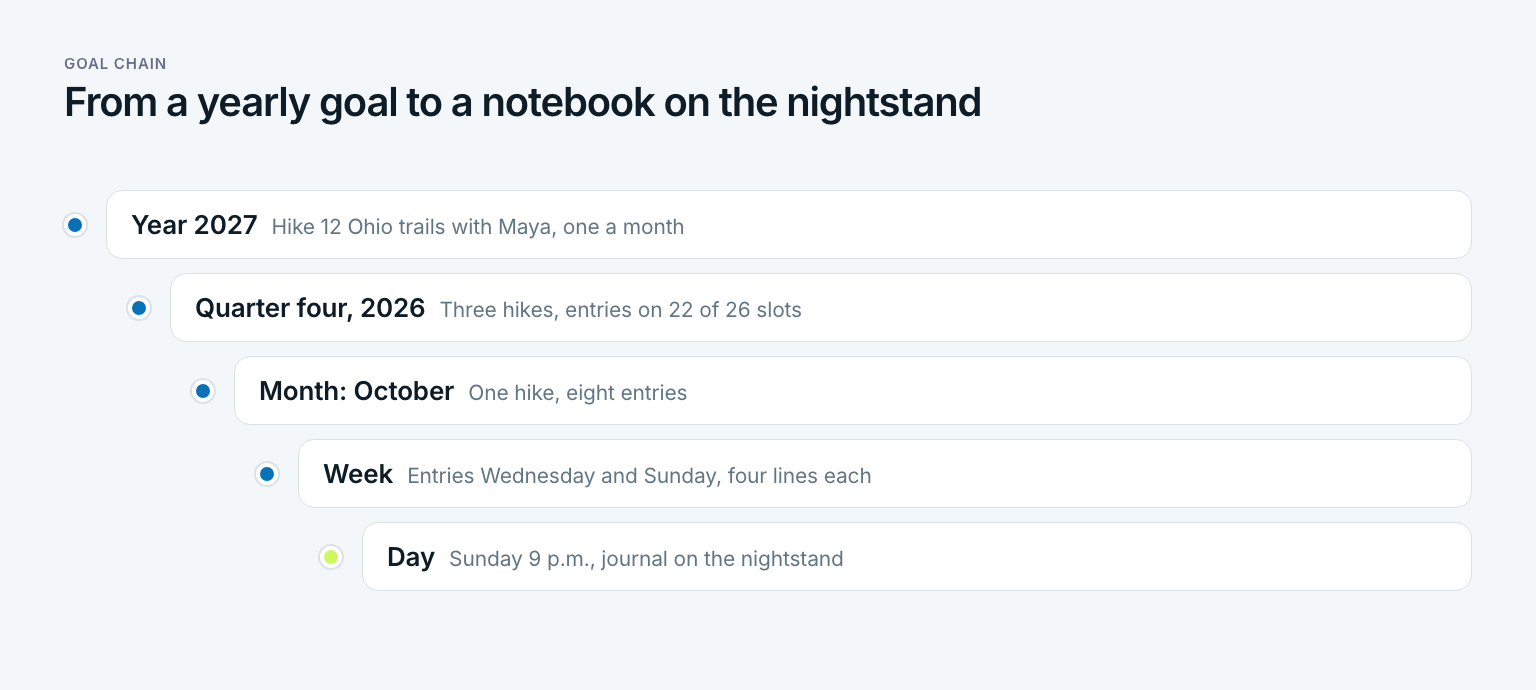
The year holds the goal: hike 12 Ohio trails with Maya in 2027, one a month. The fourth quarter of 2026 is the warm-up, with three hikes and entries on 22 of 26 slots. October has one hike and eight entries. The week has two slots, Wednesday and Sunday. The day has a single action: on Sunday at 9 p.m., the journal lies open on the nightstand.
The entries aren't checkmarks for a statistic. They're how Marcus tests whether the yearly goal carries weight. If December's pages show trails and Maya, the goal works. If they only show deadlines, the plan needs fixing. In Gaapp you set the yearly goal, hang the quarter, month and week beneath it, and check off your two weekly entries as a weekly goal. Anyone who also wants to count entries as a habit can use a simple tally like the one in a habit tracker. Marcus, by the way, kept coaching robotics.
Three questions before you start
Before you buy a notebook or open a new note, answer three questions:
- Which two evenings a week do you reliably have five minutes?
- Where will the notebook live so you never have to look for it?
- How will you know in ten weeks whether it helped?
Anyone who can't answer the third question can still write, just without a yardstick. One tally line per week is yardstick enough. In short: a gratitude journal isn't a list of nice things. It's a record of what holds your life up.
Gratitude journal FAQ
How do I do a gratitude journal?
Pick a notebook, put two fixed slots a week on your calendar, and write one four-line entry each time: what happened, who made it possible, why it mattered, and what your day would have been like without it. After ten to twelve weeks, read every entry and tally what they're about. That review tells you whether the rhythm fits and what you want more of.
What are the four A's of gratitude?
The four A's are a coaching framework, not a research term, and the exact wording varies by source. Most versions move from noticing something good to appreciating it, acknowledging the person behind it, and acting on it, for example with a thank-you. The four-line entry in this guide covers the same ground: what, who, why, and what if not.
What is the golden rule of gratitude?
There's no single official rule. The one the research supports best is specificity: one concrete moment, described in detail, does more than a list of general blessings. Robert Emmons, lead author of the 2003 landmark study, advises going for depth over breadth and focusing on people rather than things.
What is the most popular gratitude journal?
Among printed journals, The Five Minute Journal is one of the best known, with fixed morning and evening prompts. Many people simply use a plain notebook or a notes app instead. The format matters more than the brand: one specific entry with who, why, and what if not beats any preprinted page you fill in on autopilot.
How often should you write in a gratitude journal?
Once or twice a week works for most people. The 2003 study by Emmons and McCullough used one entry a week, and in an experiment by Lyubomirsky and colleagues, once a week worked better than three times. If you write daily and still find something new each time, keep at it.
Does a gratitude journal actually work?
Yes, modestly. Studies show small to moderate gains in life satisfaction, optimism and mood compared with doing nothing, and a 2016 meta-analysis found only a small edge over other positive exercises. A gratitude journal supports a good life. It isn't a treatment for depression or anxiety.
Last updated: 14 October 2026
Read next
 Personal Growth
Maslow's Hierarchy of Needs: The 5 Levels Explained
Maslow's hierarchy of needs sorts motivation into five levels. What each level means, what research says today and a needs audit you can run yourself.
14 min read
 Personal Growth
Mindfulness Exercises: 12 for Everyday Life
Mindfulness exercises are not about emptying your mind. 12 techniques for stress and focus, what research shows, and a four-week plan to practice daily.
16 min read
 Personal Growth
Positive Affirmations: 50 Examples You Can Believe
Positive affirmations are not magic words. What research shows, 50 daily affirmations you can believe, and a five-step method with a worked example.
16 min read