New Year's Resolutions for 2027 That Last Past March
New Year's resolutions fail by February because they are wishes. Turn three into a goal chain from year to day, with a 2027 example, six steps, FAQ.

Contents
- 01What New Year's resolutions are and what they are not
- 02The top 10 New Year's resolutions and why the list barely changes
- 03The best New Year's resolution is the one you can still measure in March
- 04Why most New Year's resolutions end in February: three mistakes nobody notices
- 05From resolution to goal chain: Marcus's three resolutions for 2027
- 06How to set New Year's resolutions in six steps
- 07Resolutions for couples, families, and teams
- 08The first slip: how to restart with the fresh start effect
- 09A self-audit before January 1
- 10Frequently asked questions about New Year's resolutions
New Year's resolutions are promises you make to yourself at the turn of the year to start, stop, or change something in the twelve months ahead. Most of them are wishes dressed up as decisions. A wish says what you want to be true in December 2027. A decision says what you will do on Tuesday, January 5. The difference is not willpower. It is a plan with a measure.
Three things turn a resolution into a goal that survives February: a number, a chain, and a check-in. The number tells you what done looks like. The chain breaks the year into quarters, months, weeks, and days. The check-in is a ten-minute weekly review. All three are worked through on the resolutions of Marcus, a 38-year-old high school teacher in Austin, Texas, who has resolved to get in shape four Januaries in a row and quit by Valentine's Day every time. Along the way: the ten most common resolutions and their measurable versions, the three mistakes that end most resolutions by week six, a six-step method, and what to do the first time you slip.

What New Year's resolutions are and what they are not
A New Year's resolution is a decision about behavior, tied to a date. The date is the point. January 1 is what Katy Milkman, a behavioral scientist at the Wharton School, calls a fresh start in her 2021 book How to Change: a moment when last year's failures feel like they belong to someone else and motivation runs unusually high. That energy is real. It is also short. Milkman's research with Hengchen Dai and Jason Riis, published in 2014, found that gym visits, searches for the word diet, and commitment contracts all spike at the start of a year, a month, or a week, and fall back within weeks.
Resolutions do work better than nothing. John Norcross and his colleagues at the University of Scranton followed people who made resolutions and compared them with people who wanted the same changes but made no resolution. After six months, 46 percent of the resolvers were still on track. Among the non-resolvers it was 4 percent. The study appeared in 2002 in the Journal of Clinical Psychology, and its lesson is simple: deciding helps. Deciding is just not the same as planning.
What a resolution is not: a goal. A goal has a measure and a deadline. Get in shape has neither. Run a 10K on Sunday, May 16, 2027 in under 65 minutes has both. Anyone who keeps the first version keeps a mood. Anyone who keeps the second version keeps a date.
Resolution, goal, habit: three words, three jobs
A resolution is the decision at the turn of the year. A goal is the measurable version with a deadline. A habit is the repeated behavior that gets you there. Marcus's resolution is to get in shape. His goal is a 10K on May 16. His habit is three runs a week. Whoever skips the middle step ends up trying to turn a mood into a habit, and moods do not repeat on schedule.
The top 10 New Year's resolutions and why the list barely changes
The most common New Year's resolutions have looked the same for decades. Year-end surveys in the United States, from YouGov to Forbes Health, put the same five at the top: exercise more, eat healthier, lose weight, save more money, and spend more time with family and friends. Behind them come reading more, quitting smoking or drinking less, learning a new skill, reducing stress, and getting organized. Those ten are the answer to what are the top 10 New Year's resolutions, and the first five are the answer to what the five most common ones are.
Why does the list barely change? Because the same resolutions fail the same way, and in January they are available again. Health, money, relationships, and learning are the four areas where a year feels like the natural unit of change. That is not a problem. The problem is the wording. Every entry on the list is a direction, not a destination, and you cannot arrive at a direction.
| Rank | Typical resolution | Measurable version | What week one looks like |
|---|---|---|---|
| 1 | Exercise more | Run a 10K on May 16 in under 65 minutes | Three 20-minute run-walks: Tuesday, Thursday, Saturday |
| 2 | Eat healthier | Cook dinner at home five nights a week through March | Plan five meals on Sunday, shop once |
| 3 | Lose weight | Lose 15 pounds by June 30, weighed every Friday | Weigh in Friday, log breakfast and lunch |
| 4 | Save more money | $3,000 in a separate emergency account by December 31 | Open the account, set a $58 weekly transfer |
| 5 | More time with family and friends | One screen-free dinner a week, one friend visit a month | Pick the dinner night, text one friend a date |
| 6 | Read more | Twelve books in 2027, one a month | Choose January's book, read ten pages a day |
| 7 | Quit smoking or drink less | Alcohol only on Friday and Saturday through March | Four alcohol-free weeknights, written in the calendar |
| 8 | Learn a new skill | Hold a five-minute conversation in Spanish by September | 15 minutes of lessons on four weekdays |
| 9 | Reduce stress | Lights out by 10:30 pm on weeknights through February | A 10 pm phone alarm on five nights |
| 10 | Get organized | Inbox under 20 messages and a written weekly plan every Sunday | One 30-minute Sunday planning slot |
Read the third column again. Every measurable version has a number and a date. Every first week fits into a normal calendar with a job and a family in it. That is the whole trick, and it is why the list of ten resolutions above is also an answer to the question what the best New Year's resolution is. The best one is whichever you can measure in March. If ten is not enough, the list of 60 New Year resolution ideas sorts them into ten areas of life.
The best New Year's resolution is the one you can still measure in March
The best resolution is not the most ambitious one. It is the one with a number you can check on a Friday in March and a date in the first half of the year. Ambition is a fine thing, and January rewards it with a surge of energy. It only pays out if the resolution survives long enough to be measured. Whoever picks three resolutions picks three measurements. Whoever picks ten picks a wish list.
Three is the limit, not the target. Marcus had six resolutions written on his phone on New Year's Eve 2025: get in shape, read more, save money, cook more, call his mother weekly, learn guitar. By February 2026 he was doing none of them, and not because any single one was too hard. Six new behaviors at once is a lifestyle change, and lifestyle changes compete for the same evenings. For 2027 he keeps three: run a 10K on May 16, read twelve books, and build a $3,000 emergency fund by December 31. The other three move to a parking list for July.
How do you choose which three? Ask three questions. Which resolution would change the most if it worked? Which one has a number already? Which one fits into the hours you actually have on a weekday evening? A resolution that passes all three questions is a goal. A resolution that passes none is a wish. The choice between several good goals, and why fewer goals finish more often, is the subject of the guide on how to achieve goals.
Is a smaller resolution a lesser resolution? No. A resolution kept through the year beats a grand one abandoned in week five, and a kept resolution teaches you something the abandoned one never will: that you are someone who finishes. In short: pick the resolution you can measure, not the one you can announce.
Why most New Year's resolutions end in February: three mistakes nobody notices
Most resolutions do not fail on a bad day. They fade over four quiet weeks. Norcross and Vangarelli followed resolvers for two years in a study published in 1988 and found that 77 percent were still keeping their resolution after one week, 55 percent after a month, and 19 percent after two years. The drop is steepest between week one and week four. Three mistakes do most of the damage, and none of them feels like a mistake at the time. Which one is yours?
- A direction instead of a destination. Exercise more is true after one walk and false after a week off, and nobody can tell which. Writing the resolution as a number with a date gives you something to be wrong about. Marcus's 10K on May 16 can be missed. Get in shape cannot, which is exactly why it never gets done.
- A year with no first week. The resolution lives in December 2027, and January 5 has nothing on it. Anyone who starts the year without a Tuesday plan starts it with a mood. By the second week of January the mood is gone and the calendar is still empty.
- All or nothing after the first slip. One missed run becomes a missed week, and a missed week becomes a quit. Gretchen Rubin lists this in Better Than Before, 2015, as the tomorrow loophole: today does not count anyway, so I will start fresh tomorrow. Tomorrow has the same loophole.
The most common mistake: a resolution without a first week
Almost every resolution on a New Year's Eve list describes the end of the year, not the first week. That means: before you write down what you want to be true in December, write down what Tuesday, January 5 looks like. If you cannot, the resolution is not ready. Marcus's January 5: a 20-minute run-walk after school, shoes by the door the night before.
From resolution to goal chain: Marcus's three resolutions for 2027
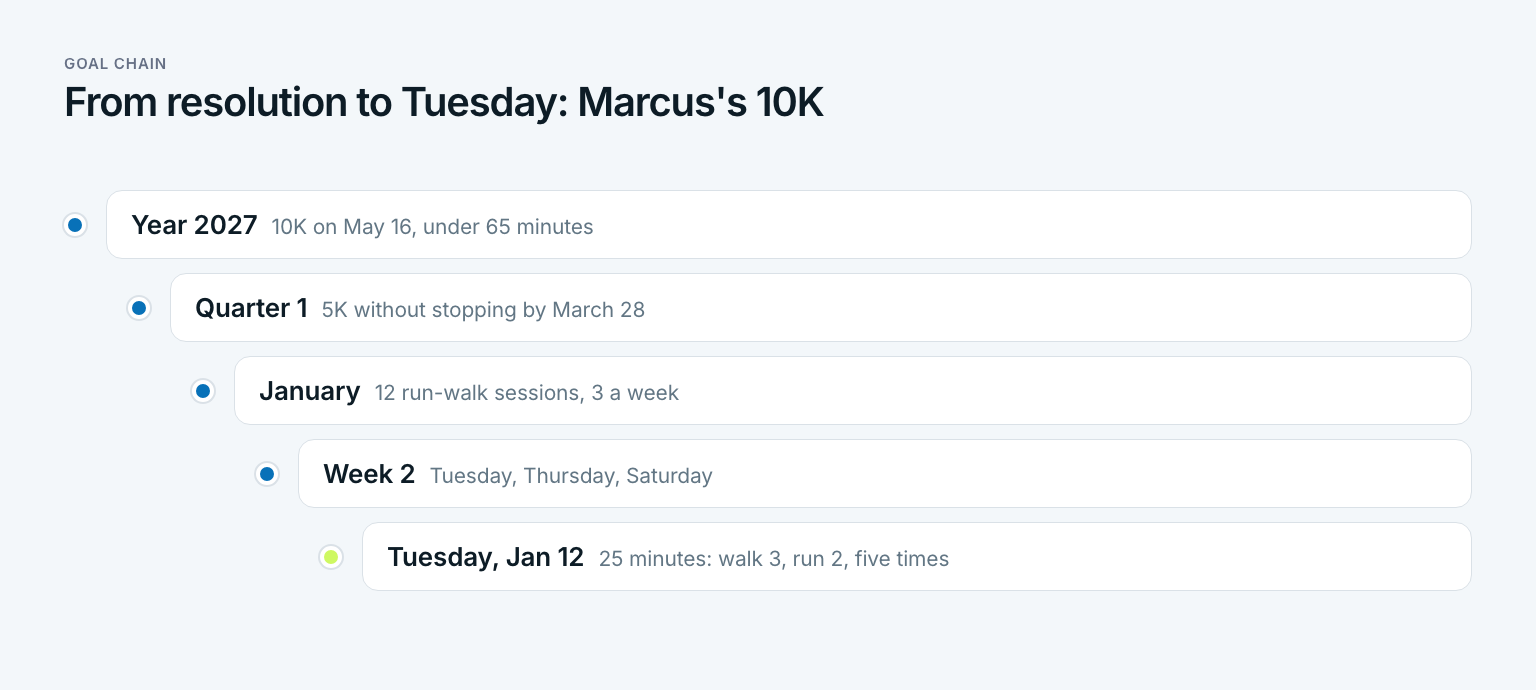
A goal chain translates a yearly resolution into a quarterly milestone, a monthly target, a weekly goal, and a daily step. Each level answers one question: what has to be true at the end of this period so that the level above still works? The chain is what turns January's energy into a Tuesday in March. Here is Marcus's running resolution, worked all the way down.
| Level | Marcus's running goal | Measure |
|---|---|---|
| Year 2027 | Finish a 10K race on May 16 in under 65 minutes | Finish time |
| Quarter 1, January to March | Run 5K without stopping by March 28 | One continuous 5K |
| January | Twelve run-walk sessions of 20 to 30 minutes | 12 sessions, 3 a week |
| Week 2, January 11 to 17 | Three sessions: Tuesday, Thursday, Saturday | 3 of 3 |
| Tuesday, January 12 | 25 minutes: walk 3 minutes, run 2, repeat five times | Done or not |
The numbers are not ambitious, and that is the point. Twelve sessions in January is three a week. Three a week is Tuesday, Thursday, Saturday. The nearly 19 weeks from January 4 to May 16 are enough for a beginner to go from run-walk to 10K, which is why most beginner programs run between twelve and 20 weeks. In short: the year is hard, the Tuesday is easy, and the chain is what connects them.
The same chain for money and reading
The savings resolution breaks down with arithmetic alone. $3,000 by December 31 is $250 a month, $58 a week, or about $8 a day. Marcus sets an automatic transfer of $58 every Friday, which is payday, into a separate account, and the yearly goal is handled in week one, as a system rather than a habit. His quarterly check is a single number: $750 by March 31. Reading works the same way. Twelve books in 2027 is one a month. A 300-page book is ten pages a day, roughly 15 minutes before bed. His January book is chosen on December 30, not on January 1.
Notice what the chain does to the daily level. Nothing on it takes more than 30 minutes. A 25-minute run, a transfer that happens by itself, ten pages. Anyone who can find 45 minutes on a weekday evening can keep all three. Anyone who cannot has a time problem, not a motivation problem, and should drop a resolution now rather than in February. How to build this kind of chain for any goal, with the review rhythm that goes with it, is laid out in the guide to annual planning and in the article on turning yearly goals into daily steps.
In Gaapp, each level of this chain is a goal that hangs on the one above, from year to day, and progress for a period is simply the share of its goals you have checked off. The weekly view is where resolutions live or die, because the week is the smallest unit in which a pattern shows. One missed Tuesday is noise. Three missed Tuesdays in a row is a chain that needs fixing.
How to set New Year's resolutions in six steps
Here is the method, timed. It takes about 90 minutes between Christmas and New Year's Eve, and ten minutes every Friday after that. Do it with the January calendar open and a pen, not on your phone between two messages. A resolution is only one piece of a year plan. The rest, a look back at 2026, the 2027 calendar, and four check-in dates, is in the guide to goals for 2027.
Write everything down, then cut to three. 20 minutes
List every resolution you are tempted by. Marcus had six. Score each on three questions: biggest change if it works, has a number already, fits a weekday evening. Keep the top three. Park the rest in a note dated July 1.
Give each one a number and a date in the first half of the year. 15 minutes
Get in shape becomes run a 10K on May 16 in under 65 minutes. A date before July means you can finish one resolution and start a parked one in the second half. December deadlines invite December panic.
Build the chain down to the first Tuesday. 30 minutes
For each resolution: quarter one milestone, January target, week one goal, first daily step. If you cannot write the daily step, the resolution is not ready. Rewrite it or park it.
Put the first two weeks in the calendar. 10 minutes
Three runs, one Sunday meal plan, the $58 transfer, 15 minutes of reading: each gets a time slot, not a to-do. Set the first run for Tuesday, January 5, not for Friday, January 1.
Remove one obstacle per resolution. 10 minutes
Shoes by the door, the savings account opened on December 30, the January book on the nightstand. One physical change beats one more reminder on your phone.
Book the Friday review. 5 minutes
A recurring ten-minute slot, Friday 4 pm or Sunday evening, with three questions: What did I check off? What slipped, and did it matter? What is the one thing next week? Without this step the other five decay by week four.
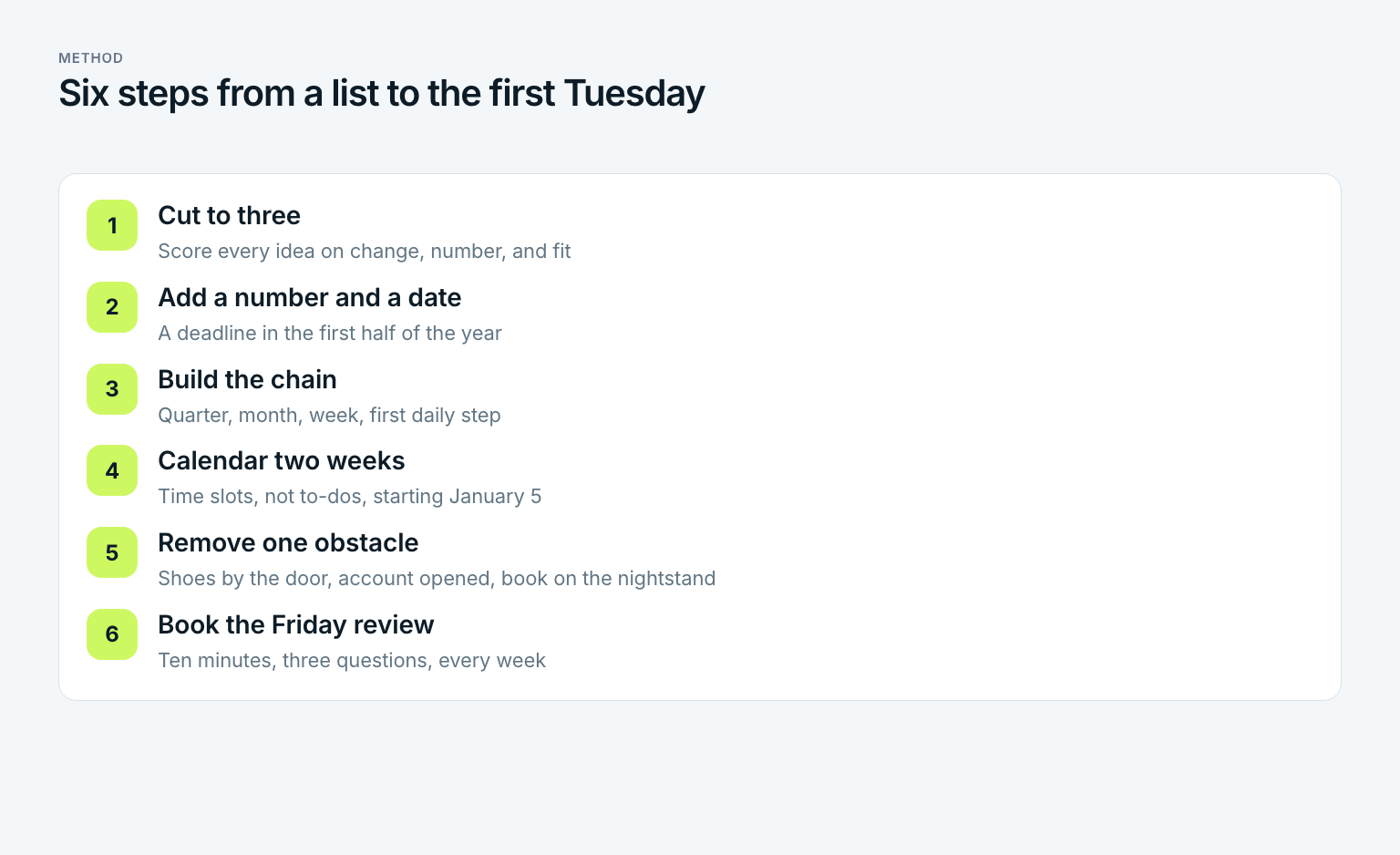
Step six is the one most people skip. It is also the only step that happens after January, which is where resolutions are actually won or lost. A resolution without a weekly check-in is an intention. The ten-minute version of that check-in, with the three questions and a filled-in example, is in the article on the weekly review. Ready-made goal chains for running, saving, reading, and a dozen other common resolutions are in the templates hub, and every goal in them can be renamed or deleted.
Resolutions for couples, families, and teams
Shared resolutions follow the same chain and add one rule: one owner per goal. We will eat healthier as a family has no owner and no number. Five home-cooked dinners a week, Dana plans on Sunday, Marcus cooks Tuesday and Thursday, has both. Couples who set one shared resolution and one each tend to keep the shared one, because two calendars are watching it. Families can give children a resolution with a weekly check mark and a number they can count themselves: ten books by summer break, 20 minutes of piano on four days a week.
Teams call them annual goals or objectives and run into the same February problem under a different name. The fix is the same: a number, a chain down to the week, a Friday check-in, and all goals visible in one place. Whoever has run a quarterly review in a company knows the pattern. Objective for the year, milestones for the quarter, initiatives for the week. A New Year's resolution is the one-person version of exactly that.
The first slip: how to restart with the fresh start effect
You will miss a run. The question is not whether, but what happens the next day. Milkman's fresh start research gives the answer: the motivation of January 1 is not unique to January 1. Mondays, the first of the month, birthdays, and the first day after a vacation all carry a smaller version of it. That means: a missed week is not a failed year. It is a week, and next Monday is a fresh start you did not have to wait twelve months for.
Marcus uses a rule from his running plan: never miss twice in a row. One missed Tuesday is a data point. Two is a pattern, and patterns get a response at the Friday review, not a verdict. In March 2027 he misses a full week with the flu. The old Marcus would have declared the 10K dead. The new one looks at the chain, moves the 5K milestone from March 28 to April 11, and keeps May 16. The year absorbs a bad week when it has a structure. Without a structure, a bad week is the year.
The fresh start effect
The fresh start effect is the finding, published by Hengchen Dai, Katy Milkman, and Jason Riis in 2014, that people are more likely to pursue their goals right after temporal landmarks: a new year, a new month, a new week, a birthday. For resolutions it means two things. Use January 1 for the decision, because the energy is real. And plan next Monday as the restart before you need it, because the energy comes back on a schedule.
What about the resolution that was wrong from the start? Sometimes the Friday review shows three missed weeks and no flu. Then the honest response is not more willpower. It is a smaller number, a later date, or a parked resolution. Whoever strikes a goal in March that was never going to fit has made progress. A list that keeps everything that was ever on it is not a plan. It is an archive.
A self-audit before January 1
Before the year starts, run your list through three questions. Each takes ten seconds and tells you more than another hour of planning would.
- Can you say the number and the date of each resolution without looking at your notes?
- Does Tuesday, January 5 have something on it for each resolution, with a time slot?
- Is there a ten-minute review on the calendar for Friday, January 8?
Whoever answers no to one of them has not resolved too little. They have planned too little, and planning is the cheap part. Marcus answers yes to all three on December 30, 2026, which is 90 minutes of work he never did in the four years before. In short: a New Year's resolution is not a wish for December. It is a decision about the first Tuesday, repeated until May.
Frequently asked questions about New Year's resolutions
What are the top 10 New Year's resolutions?
Year after year the same ten lead the US surveys: exercise more, eat healthier, lose weight, save more money, spend more time with family and friends, read more, quit smoking or drink less, learn a new skill, reduce stress, and get organized. Every one of them is a direction rather than a destination. The table in this article gives each one a measurable version with a number and a date, plus what the first week looks like.
What is the best New Year's resolution?
The best resolution is the one you can still measure in March: a number, a date in the first half of the year, and a daily step that takes less than 30 minutes. For most people that is one health goal with a race or a weigh-in date, because it has a built-in deadline. Ambition matters less than whether you can tell on a Friday if you are on track.
What are the 5 most common New Year's resolutions?
Exercise more, eat healthier, lose weight, save more money, and spend more time with family and friends. These five have topped US year-end surveys for years. They also fail for the same reason: they describe a direction and leave the first week empty. Written as a 10K on May 16, five home-cooked dinners a week, or $58 a week into a separate account, each of them becomes a goal you can check.
What are 10 resolutions I can actually keep?
Run a 10K by mid-May. Read twelve books, one a month. Put $58 a week into an emergency fund until it holds $3,000. Cook dinner at home five nights a week through March. Lights out by 10:30 pm on weeknights. Fifteen minutes of a language on four weekdays. One screen-free family dinner a week. Call a parent every Sunday. Alcohol only on weekends through the first quarter. Inbox under 20 messages every Friday. Each has a number, a date, and a daily step, and three of them are enough for one year.
How many New Year's resolutions should I make?
Three. Six new behaviors at once is a lifestyle change, and lifestyle changes compete for the same evenings. Three resolutions with a daily step of 30 minutes or less fit into a normal week with a job and a family. Park everything else in a note dated July 1 and pick one up when a first-half resolution is finished.
When should I start my New Year's resolutions?
Decide between Christmas and New Year's Eve, and start on the first normal weekday of the year. For 2027 that is Tuesday, January 5, because January 1 is a Friday and a holiday, and the weekend after it is not a normal week either. Starting on a quiet Tuesday with the calendar already filled in beats starting on January 1 with a hangover and a list.
Last updated: 19 October 2026
Read next
 Goal Setting
Intrinsic Motivation: What Drives You From the Inside
Intrinsic motivation is not a personality trait. Meaning, 12 examples, the three needs behind it and five steps to build it, with a worked example.
17 min read
 Goal Setting
Financial Goals: How to Turn Wishes Into a Plan
Financial goals are not wishes with a dollar sign. Short and long term examples, SMART savings goals and a five step plan, worked through one year.
17 min read
 Goal Setting
WOOP Method: Four Steps From Wish to If-Then Plan
The WOOP method is not positive thinking. What WOOP stands for, the research, if-then plans, eight goal examples and a five-minute guide.
18 min read