New Year Resolution Ideas: 60 Measurable Goals for 2027
New year resolution ideas are not slogans: 60 of the best resolutions for 2027 in ten areas of life, each a measurable goal, plus five steps to pick three.

Contents
- 01New year resolution ideas: what separates a good one from a slogan
- 02Popular New Year's resolutions: what most people pick
- 03Best New Year's resolutions for body and mind
- 04Resolution ideas for money, career, and learning
- 05Resolution ideas for family, friends, and community
- 06Resolution ideas for screens, home, and free time
- 07How to choose from the list: five steps to three resolutions
- 08Three mistakes nobody notices when choosing resolutions
- 09From the list to a Tuesday: Priya's goal chain
- 10Frequently asked questions about New Year resolution ideas
New year resolution ideas are not slogans like “get healthy” or “save money.” The good ones are sentences with a number and a date: read twelve books by December 31, put $6,000 into savings by year-end, lights out by 10:30 pm on four weeknights. A slogan tells you where you want to go. A goal sentence tells you how you will know, on June 30, that you are on your way. The 60 ideas below are sorted into ten areas of life, and each one is already written as a measurable goal.
A list alone changes nothing. So the ideas are followed by five steps that turn 60 options into three resolutions at most, and by a goal chain that breaks one of them down to a Tuesday evening in January. The example is Priya, 33, a project coordinator in Denver who moved there from Ohio 18 months ago with her partner, Sam. She has written resolutions every year since college. Most of them were gone by Valentine's Day.
New year resolution ideas: what separates a good one from a slogan
A good resolution idea has three parts: an outcome, a number, and a date. The outcome says what should change. The number makes it checkable, and the date sets when you check. Leave out one of the three and you are back to a wish.
Slogans are not useless. “Move more” points at the area of life where something is missing, and naming it is the first step. But you cannot check off a slogan. Anyone who resolves to “move more” has no answer on January 31 to the question of whether it worked. Anyone who resolves to walk 8,000 steps on five days a week has an answer every Sunday night.
Goal sentence: a resolution you can check
A goal sentence names an outcome, a number, and a date, plus a first action that fits into an ordinary week. It answers “How will I know?” before anyone asks. Every idea below is built this way. All that is left for you is to fit the number to your life.
A second feature is less obvious. Good resolutions describe something you do, not something you avoid. In a Swedish study of more than 1,000 people published in 2020, Martin Oscarsson, Per Carlbring, and colleagues found that approach goals were kept more often after one year than avoidance goals: 58.9 versus 47.1 percent. That means: “Stop snacking at night” is weaker than “Fruit and tea after dinner.” That is why almost every idea below is phrased as an action, even where the real aim is to cut something out.
Popular New Year's resolutions: what most people pick
The most popular New Year's resolutions barely change from one year to the next. Year-end polls in the United States, from YouGov to Forbes Health, keep putting the same areas on top: exercise more, eat healthier, save money, lose weight, and take better care of mental health. The Swedish study shows the same pattern from the other side of the Atlantic. Physical health, weight loss, and eating habits made up about two thirds of all resolutions.
Is that a problem? No. Popular resolutions are popular because they matter. Sleep, movement, money, and time with people hold up almost everything else in a life. The problem is the form, not the topic. “Reduce stress” is on countless lists on January 1 and on no calendar by March, because nobody knows what will be different on a Tuesday.
So the list below translates the popular resolutions too. Anyone who means “reduce stress” will find six versions with a number and a date under sleep, stress, and mental health. “More family time” lives under partner and family. The direction stays yours. The list only supplies the form.
Best New Year's resolutions for body and mind
Body and mind are where a resolution pays off fastest. Anyone who sleeps better has more energy for everything else on the list. Each idea comes with a number you can keep or change. The number is a suggestion, not a standard.
Fitness and movement
- Run a 5K without stopping by June 30, training three times a week for 25 minutes.
- Walk 8,000 steps on five days a week starting in January, counted by your phone.
- Do 20 push-ups in a row by March 31, with two short sessions a week.
- Hike twelve trails you have never hiked in 2027, one a month, logged with date and miles.
- Stretch for ten minutes every morning, on at least 250 days of the year.
- Bike or walk to work on 100 workdays in 2027 instead of driving.
Food and drink
- Cook dinner at home four nights a week starting in January, with meals planned on Sunday.
- Pack lunch for work four days a week from the second week of January.
- Try twelve new recipes by June 30, two a month.
- Eat five servings of fruit and vegetables on five days a week, checked off on a sheet on the fridge.
- Drink alcohol only on Fridays and Saturdays through March 31, with sparkling water on weeknights.
- Drink a full glass of water with every meal, 64 ounces a day on weekdays.
Sleep, stress, and mental health
- Lights out by 10:30 pm on at least four of five weeknights.
- Take a 20-minute walk without headphones at lunch, three days a week.
- Meditate for ten minutes on 60 days by March 31, with a timer and no pressure.
- Write a ten-minute weekly review every Sunday night, three questions on one page.
- Keep one evening a week just for yourself, blocked in the calendar, 40 evenings in the year.
- Use all your paid time off in 2027, including one full week away, booked by January 31.
Notice something? None of these ideas takes more than 30 minutes a day. That is on purpose. A resolution that needs an hour every day competes with everything already on your calendar, and by February it loses.
Resolution ideas for money, career, and learning
Money, career, and learning have one advantage: goals here are easy to measure. A balance is a balance, and an exam is either passed or not. Whoever picks a resolution in one of these areas should take the number seriously and put the deadline in the calendar first.
Money
- Save $6,000 in a separate savings account by December 31, with $250 moved automatically every payday.
- Cut fixed costs by $40 a month by March 31, after reviewing every subscription and bill.
- Pay off one credit card by June 30, with a fixed payment scheduled on the first of each month.
- Review last month's spending for 20 minutes on the first Sunday of each month, twelve sessions in the year.
- File your 2026 taxes by March 15, a month early, in four one-hour sessions.
- Set aside $50 a month for holiday gifts starting in February, so December stays in the black.
Career
- Ask for a raise by March 31, with three documented wins from 2026 on one page.
- Block the first 90 minutes of four workdays a week for your most important task, with email closed.
- Have coffee with someone from another team once a month, twelve conversations by December.
- Finish the certification you have put off for two years by September 30, with three study hours a week.
- Update your résumé and professional profile by April 30, with the projects from 2026.
- Mute work notifications on your phone at 6 pm on every workday starting in February.
Learning
- Read twelve books in 2027, one a month, at ten pages a night.
- Hold a five-minute conversation in Spanish by September 30, with 15 minutes of practice five days a week.
- Play three songs all the way through on guitar by June 30, practicing 20 minutes three times a week.
- Finish the online course you already started by March 31, one lesson a week.
- Attend six talks, readings, or museum exhibits in 2027, one every two months.
- Type 50 words per minute by April 30, with ten minutes of typing practice a day.
Why exactly twelve books? Because a 300-page book at ten pages a night takes one month. The number in a goal sentence is not a guess, it is arithmetic. Anyone who does that math in December finds out then whether a resolution fits the year, not in March.
Resolution ideas for family, friends, and community
Time with people ranks high in every poll and shows up on almost no calendar. When did you last see a friend without a birthday as the reason? Relationships have no deadline. No friend sends reminders the way the IRS does, so these resolutions need a fixed day of the week more than any others.
Partner and family
- Thursday after 8 pm is a screen-free night at home together, on 40 of 52 Thursdays.
- Go out together once a month, twelve evenings by December, with the sitter or the table booked by the 15th of the month before.
- Give each kid one afternoon alone with you every month, and let the kid pick the plan.
- Eat dinner together five nights a week starting in January, with phones in a kitchen drawer.
- Call your parents every Sunday for 20 minutes, on at least 45 Sundays in the year.
- Plan the summer vacation by April 30: destination, budget, and bookings.
Friends and community
- Meet one person you have not seen in over a year every month, twelve meetups by December.
- Start a standing dinner on the first Saturday of each month, hosted in turns.
- Volunteer two hours a month starting in March, at a food bank or a local nonprofit.
- Call or send a card on every birthday in your calendar instead of a text.
- Invite neighbors over four times by June 30.
- Give 1 percent of your take-home pay to a cause you choose, by automatic transfer on the first of each month.
Anyone who sets resolutions as a couple or a family needs one extra rule: every shared goal has one owner who prepares it. “We want to go out more” belongs to everyone and therefore to no one. “Sam books the table by the 15th” belongs to Sam. How shared goals stay visible to everyone is the topic of the article on shared goals in a space.
Resolution ideas for screens, home, and free time
The last two areas look small and are not. Your phone eats the evenings in which every other resolution is supposed to happen. How many evenings did it take from you last year? And a year without a single new place feels shorter in December than it was.
Phone and screen time
- Charge your phone outside the bedroom from 9 pm on at least five nights a week.
- Cut phone screen time from 3.5 to 2 hours a day by March 31, measured as a weekly average.
- Use social media only on your laptop starting in February, with the apps deleted from your phone.
- Sort and back up every photo from 2026 by February 28, and order the photo book.
- Clear your inbox to zero every Friday at 3 pm, in 15 minutes.
- Spend one Sunday a month fully offline, twelve days in the year.
Home and free time
- Declutter one room a month until every room is done by June 30, donating or selling what goes.
- Visit twelve places you have never been in 2027, one a month, all within a two-hour drive.
- Take one photo a week on a weekly theme, 52 photos by December.
- Build a raised garden bed by May 31 and harvest from it three times by September.
- Replace two car trips a week with walking, biking, or transit starting in March.
- Keep one weekend a quarter completely free of plans, four in the year, blocked in January.
This is also where the fun ideas live, and they are allowed to be fun. A resolution does not have to hurt to count. Twelve new places are as much a goal as twelve books, as long as the number is written down and someone checks at the end of the month.
How to choose from the list: five steps to three resolutions
Sixty ideas are a menu, not an order. Whoever tries to fix every area at once ends up fixing none. Choosing takes about 30 minutes and follows five steps. Priya did it on December 29 at the kitchen counter, with a legal pad and the January calendar she shares with Sam.
Score ten areas, ten minutes
Give each of the ten areas above a score from 1 to 10, where 10 means nothing needs to change right now. Score fast and honestly. Your first instinct is usually more accurate than your third thought.
Mark two or three areas, five minutes
Circle the lowest scores. Then ask which area pulls others up with it. Sleep almost always lifts energy and mood, and money often eases tension at home.
Pick one idea per area, five minutes
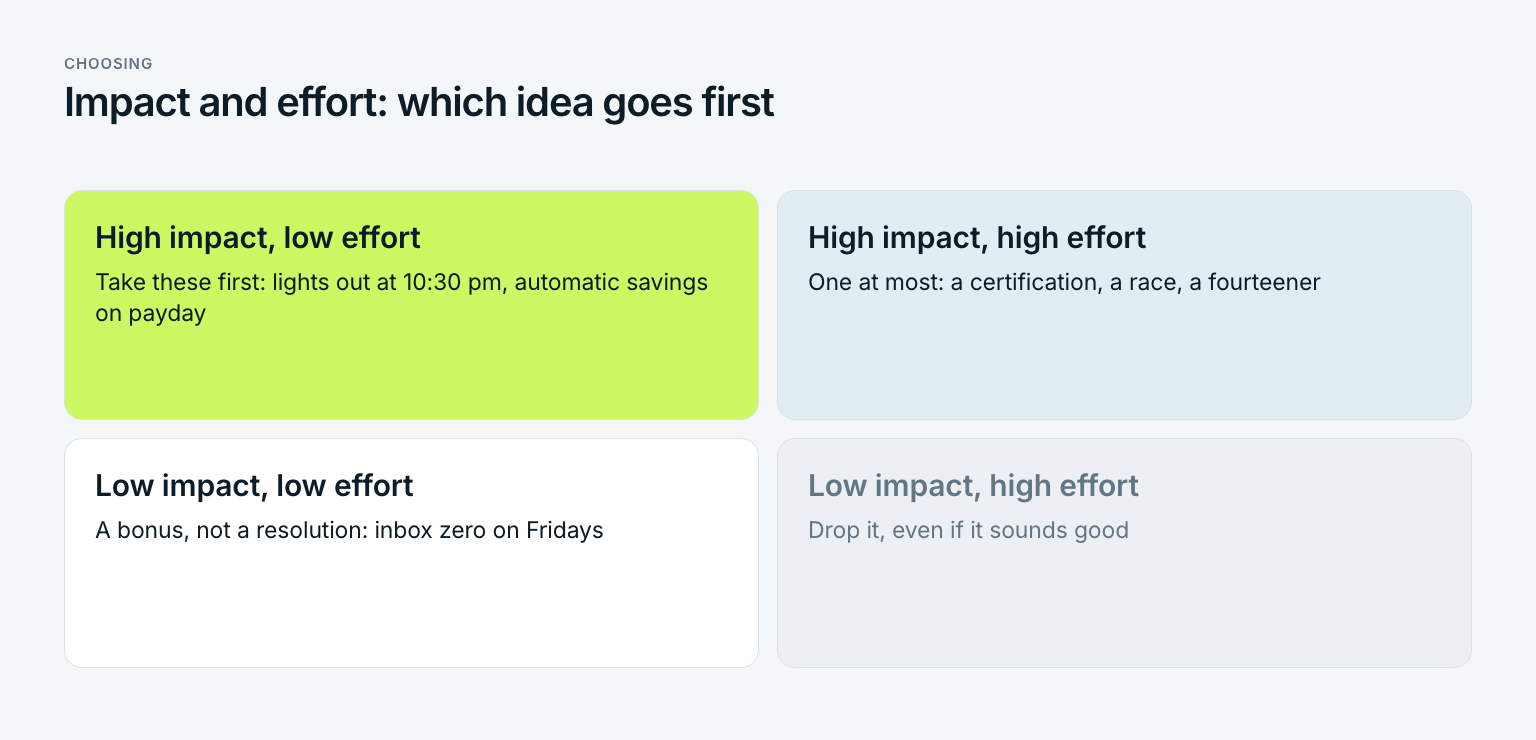
Take exactly one idea from each marked area. Sort the candidates by impact and effort, as in the matrix below. High impact with low effort goes first. Low impact with high effort goes out.
Fit the number to your life, five minutes
The numbers in the list are suggestions. Run the calendar test: on which day and at what time does the first action happen in an ordinary week? If there is no room, the number gets smaller, not the calendar fuller.
Schedule the first week, five minutes
Put the first action for each resolution into the first full week of January, with a day and a time. In 2027 that week starts on Monday, January 4. Whatever is not on the calendar there usually never starts.
Here is what Priya's legal pad looked like at the end. The scores are hers, and yours will look different. What matters is the third column: every area gets a decision, even when the decision is “no resolution.”
| Area of life | Priya's score | Decision |
|---|---|---|
| Fitness and movement | 4 | Resolution one: first fourteener by August 31 |
| Food and drink | 7 | No resolution, going well |
| Sleep, stress, and mental health | 6 | No resolution, the hikes help |
| Money | 3 | Resolution two: $6,000 saved by December 31 |
| Career | 5 | Parked until July 1 |
| Learning | 6 | No resolution |
| Partner and family | 8 | No resolution, going well |
| Friends and community | 3 | Resolution three: twelve first-Saturday dinners |
| Phone and screen time | 5 | No resolution |
| Home and free time | 7 | No resolution, going well |
Priya wanted five resolutions. She took three, because weeknights after 7 pm and Saturdays are her only free time, and three fit there. She did not drop her career goal. She moved it to July 1. That is a decision too, and a good one: Hengchen Dai, Katy Milkman, and Jason Riis showed in 2014 that people are more likely to start pursuing goals after temporal landmarks such as the start of a week, a month, or a quarter. January 1 is just the most famous one.
Anyone who is unsure how to turn an idea into a clean goal sentence will find more patterns in the SMART goals examples. How to carry a resolution through the whole year is covered in the guide to New Year's resolutions.
Three mistakes nobody notices when choosing resolutions
Idea lists have a side effect. They make you want more than one year can carry. Three mistakes happen again and again while choosing, and none of them feels like a mistake in the moment. Which one have you made before?
- Treating the list like a shopping list. Checking off seven good ideas feels great on December 31. But each one needs attention in the first weeks, and attention is limited. Three resolutions that run beat seven that vanish together in February. Why three is the limit is explained in why three goals are enough.
- Borrowed numbers. The 8,000 steps on the list fit someone with a desk job and a dog, and maybe not you. Whoever copies a number without testing it against their own calendar also copies the failure of someone else's week. Adjust the number before January starts.
- All stopping, no doing. Less sugar, less phone, less stress. Resolutions like these are sincere, but they leave open what happens instead. Anyone who turns a stop into a do gives the evening a new action instead of a ban.
The most common mistake: ten areas at once
Whoever tackles every weak area at the same time spreads the energy of early January across too many projects. Gretchen Rubin took a different route in “The Happiness Project”: a new area every month for a year, while the resolutions from earlier months kept running. You do not need to be that strict. But two parked areas with a start date beat five at once without one.
To be fair, there is an objection: choosing only three leaves areas behind that matter too. True. But left behind is not forgotten once the area has a start date. That means: A parked resolution with a date is a plan, and a seventh resolution in January is a risk. Anyone who finds even three resolutions too many can pick a single word instead, one that decides which areas come first. How that word comes out of a review is covered in the guide to choosing a word of the year.
From the list to a Tuesday: Priya's goal chain
A goal sentence is the start, not the plan. The plan appears when you split it into periods: year, quarter, month, week, day. Each level answers the same question: what has to be true at the end of this period for the level above to work? Priya's hiking resolution shows it best, because it has a clear finish line and a long runway.
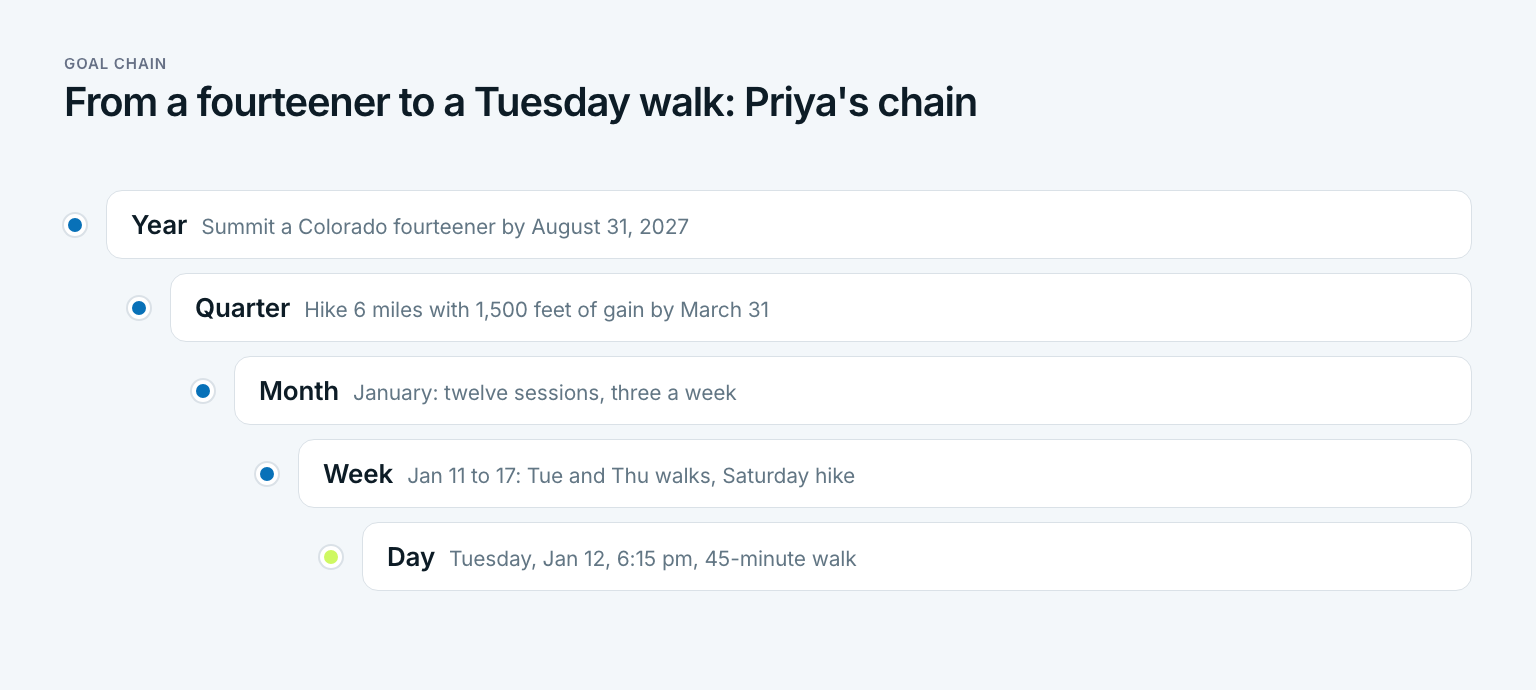
Year: summit a Colorado fourteener, a peak above 14,000 feet, by August 31, 2027. Quarter one: hike 6 miles with 1,500 feet of elevation gain by March 31. January: twelve sessions, two 45-minute weekday walks and one weekend hike each week. Week two, January 11 to 17: walks on Tuesday and Thursday, a 4-mile hike in the foothills on Saturday. Day: Tuesday, January 12, 6:15 pm, a 45-minute walk of about 2.5 miles.
Why break it down that far? Because Tuesday is the only level where anything actually happens. The other two resolutions follow the same logic with different units. The savings goal counts in dollars: $6,000 a year is $1,500 a quarter, $500 a month, or $250 on each of her two monthly paydays, moved automatically. After the first evening of setup, the daily action is nothing at all. The dinner goal counts in Saturdays: twelve dinners in the year, three in the first quarter, one in January, and the action is a single text to four friends on the Monday before.
Progress for a period is the share of its goals you have completed. If Priya gets two of the three sessions done in week two, the week stands at 67 percent, and she sees it on Sunday, not in March. In Gaapp, each of these goals hangs on the one above, from year to day, and a thin line next to the progress shows how much of the period has passed. That is why Priya can tell on a Sunday night not only whether she was busy, but whether she is on track.
Whoever wants to see the breakdown step by step for their own resolution will find it in turn yearly goals into daily steps. The year around that breakdown, with a look back at 2026 and four check-in dates, is in the guide to goals for the new year.
Three questions before you close the list:
- Does each of your resolutions have a number someone else could check?
- Do you know, for each one, on which day of the first week of January the first action happens, and at what time?
- Do you have three resolutions at most, and does every other area have a start date instead of a slot in January?
Whoever answers no to one of these has not picked a bad idea, just an unfinished one. Half an hour between Christmas and New Year's Eve is enough to finish it. In short: A list of resolution ideas is not a resolution yet. It is the material you build three from.
Frequently asked questions about New Year resolution ideas
What are the top 10 New Year resolutions?
Year-end polls in the United States differ in order, but the same ten keep appearing: exercise more, eat healthier, save money, lose weight, improve mental health, spend more time with family and friends, read more, drink less or quit smoking, learn a new skill, and spend less time on the phone. All ten are directions, not goals. Each one becomes a resolution you can keep once it has a number and a date, like the 60 versions above.
What is the best New Year resolution?
The best resolution is the one you can still measure in March: a number, a date, and a first action that fits into this week. For many people a sleep resolution is the strongest candidate, because better sleep feeds energy, mood, and every other goal. A good start is lights out by 10:30 pm on four of five weeknights.
What are 5 New Year's resolutions?
Five solid examples from five areas: walk 8,000 steps on five days a week, move $500 a month into a separate savings account, read one book a month, eat dinner together five nights a week, and charge your phone outside the bedroom from 9 pm. Each has a number and a fixed place in the week. Pick at most three of them for the same year.
What are the 5 most common New Year's resolutions?
The five most common are exercising more, eating healthier, saving money, losing weight, and improving mental health or reducing stress. A Swedish study of more than 1,000 people, published in 2020 by Martin Oscarsson and colleagues, found the same core: physical health, weight loss, and eating habits made up about two thirds of all resolutions. They are common because they matter, and they fail when they stay slogans.
How many New Year's resolutions should I make?
Three at most, ideally from different areas of life. Every new resolution needs attention in the first weeks, and three is about as many as an ordinary week can hold. Every other area gets a start date such as April 1 or July 1 instead of a place in January.
What are some fun New Year's resolution ideas?
Visit twelve places you have never been, one a month. Cook a dish from a different country every month, take one photo a week on a theme, or keep one weekend a quarter completely free. Fun resolutions count as long as they have a number and someone checks at the end of the month.
Last updated: 19 October 2026
Read next
 Goal Setting
Intrinsic Motivation: What Drives You From the Inside
Intrinsic motivation is not a personality trait. Meaning, 12 examples, the three needs behind it and five steps to build it, with a worked example.
17 min read
 Goal Setting
Financial Goals: How to Turn Wishes Into a Plan
Financial goals are not wishes with a dollar sign. Short and long term examples, SMART savings goals and a five step plan, worked through one year.
17 min read
 Goal Setting
WOOP Method: Four Steps From Wish to If-Then Plan
The WOOP method is not positive thinking. What WOOP stands for, the research, if-then plans, eight goal examples and a five-minute guide.
18 min read