Goals for 2027: How to Set Them and Plan the Year
Goals for 2027 are not resolutions with a new date. Get 10 examples, the 2027 calendar by quarter, and a one-hour plan that starts on January 4.

Contents
- 01What makes good goals for 2027 different from a wish list
- 02The 2027 calendar: what a year that starts on a Friday means for your goals
- 03Look back before you look ahead: three questions about 2026
- 04Good goals for the new year: 10 examples for 2027
- 05How to set goals for the new year in one hour: six steps
- 06Danielle's goals for 2027: the goal chain from year to Tuesday night
- 07How to keep New Year's resolutions past February: three planning mistakes
- 08Four check-in dates that carry the year
- 09A self-audit before December 31
- 10Frequently asked questions about goals for 2027
Goals for 2027 are not New Year's resolutions with a new number on top. They are three to five results you want to reach by December 31, 2027, each with a measure, a deadline, and a first action you can take in the first week of January. A resolution says what should change. A goal says how you will know in December that it did. And only a plan tells you what happens on Tuesday.
2027 also comes with a calendar that most goal lists ignore. It starts on a Friday, Easter falls in March, and the federal calendar even ends the year with a holiday on Friday, December 31, because New Year's Day 2028 is a Saturday. Anyone who builds new year goals around those dates plans with real weeks instead of twelve identical months. The example that runs through this guide is Danielle, 34, a high school chemistry teacher in Columbus, Ohio, with a two-year-old daughter. In January 2026 she wrote down nine goals. By October she could not name five of them. Her 2027 plan is worked through step by step: the 2027 calendar by quarter, 10 examples of good goals, a one-hour planning session, and the three planning mistakes that sink most new year goals before February.
What makes good goals for 2027 different from a wish list
A good goal for 2027 has three parts: a result someone else could check, a date inside the year, and an action that is possible in week one. Without the result, it is a wish. Without the date, it is an intention. Without the action, it is a nice sentence that nobody remembers by Valentine's Day.
The research behind this is unusually solid. Edwin Locke and Gary Latham summarized 35 years of goal-setting studies in the American Psychologist in 2002. Their central finding: specific, challenging goals lead to better performance than being told to do your best. That means: "get healthier in 2027" is not a weak goal. It is not a goal yet at all.
The year number is the only new thing about goals for 2027. The calendar underneath is where most plans go wrong. You write goals in months, but you live the year in weeks, and weeks are not equal. Some have four workdays, some fall into spring break, some belong to a toddler with an ear infection. A goal that ignores those weeks ends up too big for the first quarter and too late for the last one.
Danielle knows the pattern. Her 2026 list had nine lines, from paying off the credit card to starting a side business to organizing the garage. By fall the garage was clean and the credit card balance was higher than in January. Was it a lack of discipline? Not really. She had nine directions and not one week in which any of them was actually scheduled.
The 2027 calendar: what a year that starts on a Friday means for your goals
Annual planning for 2027 starts with the calendar, not the wish list. Here is the year by quarter, counted with the federal holidays as they are observed. If your employer or school district follows a different schedule, swap in your own days off.
| Quarter | Dates | Workdays | What the calendar holds |
|---|---|---|---|
| Q1 | Fri, Jan 1 to Wed, Mar 31 | 61 | New Year's Day on a Friday, Martin Luther King Jr. Day on Jan 18, Presidents' Day on Feb 15, Easter on Mar 28 |
| Q2 | Thu, Apr 1 to Wed, Jun 30 | 63 | Tax Day on Thursday, Apr 15, Memorial Day on May 31, Juneteenth observed on Friday, Jun 18 |
| Q3 | Thu, Jul 1 to Thu, Sep 30 | 64 | Independence Day observed on Monday, Jul 5, Labor Day on Sep 6, most of summer break |
| Q4 | Fri, Oct 1 to Fri, Dec 31 | 61 | Five holidays: Columbus Day on Oct 11, Veterans Day, Thanksgiving on Nov 25, Christmas observed on Dec 24, New Year's observed on Dec 31 |
Three things stand out. First, the year starts in slow motion. January 1 is a Friday, so the first full week begins on Monday, January 4. Anyone who launches on New Year's Day gets one day of momentum and then a weekend. The better start date is that first Monday. Hengchen Dai, Katy Milkman, and Jason Riis showed in 2014 that the start of a week or a month triggers the same kind of motivation boost as the start of a year. They call it the fresh start effect, and January 4 delivers it twice.
Second, the end of the year is shorter than it looks. Q4 holds five federal holidays, and from Thanksgiving to New Year's Eve there are barely five weeks, full of travel and year-end deadlines. Anyone who plans to finish a goal in December is betting on the busiest weeks of the year. A smarter deadline for most goals is the Friday before Thanksgiving, November 19.
Third, the middle of the year is your best stretch. April through September hold 127 workdays and the longest evenings. If a goal needs a push, put it in Q2 and Q3, not in January and not in December.
2027 also has exactly 52 Mondays, four blocks of 13 weeks. That is the logic of the 12 week year: plan in quarters and use every thirteenth week for review and catch-up.
Before any goal goes on the calendar, put in what is already fixed: vacations, school breaks, weddings. Whoever does it the other way around finds out in June that three planned work weeks are at the beach.
Look back before you look ahead: three questions about 2026
Good goals for the new year rarely come out of nowhere. They come out of the old year. Anyone who skips the look back tends to write the same list again. All it needs is three questions and fifteen honest minutes:
- What worked in 2026 even though it was never a goal? That is often something you only need to measure in 2027, because it already runs.
- What drained energy and gave nothing back? That is your candidate for a stop, and stopping something is a goal too.
- What did you put off that still bothers you in December? That is usually the most important goal of the next year, and the least comfortable one.
Danielle's answers fit on an index card. What worked: the garage, because it had a clear finish line and took two Saturdays. What drained her: late-night scrolling, which cost her sleep. What she put off: selling the chemistry lab lessons she has written for her own classes for six years. The direction for 2027 is clear before she writes a single goal.
Some people turn this review into one word instead of three goals, a word like calm or brave. That is a different approach with its own logic, covered in the guide to choosing a word of the year. The two work well together. The word sets the direction, the goals set the measure.
Good goals for the new year: 10 examples for 2027
What are some good goals for next year? The ones that pass three tests: a number someone else could check, a date in 2027, and a first action you can schedule in the week of January 4. Here are 10 examples across the areas most people care about. Change the numbers to fit your life, not Danielle's.
| Area | Goal for 2027 | First action in week one |
|---|---|---|
| Money | Pay off $7,800 in credit card debt by December 31, 2027 | Set up an automatic payment of $650 on the 1st of every month |
| Money | Build a $3,000 emergency fund by September 30 | Open a separate savings account and move the first $50 |
| Health | Strength train twice a week, 80 sessions by December 17 | Book two 45-minute slots on Monday and Thursday |
| Health | Average seven hours of sleep on work nights by March 31 | Set a phone downtime alarm for 10 pm |
| Career | Earn a professional certificate by June 30 | Register for the course and block two evenings a week |
| Side income | Publish twelve products, lessons, or articles by August 1 | Outline the first one and pick the platform |
| Family | One new outing with your kid every month, twelve in total | Put the first Saturday of January on the shared calendar |
| Relationships | Call one close friend or relative every Sunday, 50 calls by December | Write down the people you want to call and start with the first |
| Learning | Read 24 books, two per month | Pick the two January books and read 20 minutes on Monday night |
| Home | Cut the grocery bill to $600 a month by April 30 | Track one week of spending to find your baseline |
Notice what is missing: the words more and less without a number next to them. Every goal could be answered with yes or no on its deadline, and every first action is small enough for a tired Monday in January. For a longer menu, the list of 60 New Year resolution ideas sorts them by area of life.
Then comes the hard part: cutting. Six good goals are worse than three, because each goal needs hours every week and the week does not grow. Danielle crosses out the books, the sleep target, and the grocery budget as goals. The Sunday call to her grandmother stays, not as a goal but as a fixed appointment at 4 pm. She keeps three: the debt, the lab lessons, and strength training twice a week.
New year, new goals: why three is enough
New year, new goals, and as many as possible. That is what December feels like. To be fair, a long list has real appeal. Writing it already feels like progress. It just measures nothing. Whoever has three goals can look at each one every week. Whoever has nine looks at a different one each week and at none of them properly.
A simple calculation makes cutting easier. Next to each goal, write how many hours per week it costs. Danielle's lab lessons need two hours of writing. Strength training costs an hour and a half, two sessions of 45 minutes. The debt costs zero hours, because the payment runs automatically. That is three and a half hours a week, and that fits next to a teaching job and a toddler. With a reading goal and Sunday meal prep added, it would have been eight. Danielle does not have eight hours. Now she knows it in December, not in March.
How to set goals for the new year in one hour: six steps
Setting goals for 2027 takes about an hour between Christmas and New Year's, with the 2027 calendar open next to you. If you are still at the resolution stage and want to turn "get in shape" into something you can measure, start with the guide to New Year's resolutions. This is the step after that: three goals become a year with quarters, weeks, and a first Tuesday.
Review 2026, 15 minutes
The three questions above, written on one index card. No more. The review should give you a direction, not a grade for the whole year.
Score your life areas and pick three goals, ten minutes
Rate six areas from one to ten: health, family, career, money, learning, home. Pick three goals from the areas with the most pressure. Check the weekly hours: do all three fit into a normal week in February?
Write the goal sentences, ten minutes
Result, date, number. For Danielle: I pay off $7,800 in credit card debt by December 31, 2027. I publish twelve chemistry lab lessons by August 1. I strength train twice a week, 80 sessions by December 17.
Plan the quarters backward, ten minutes
Open the 2027 calendar. What has to be true on September 30, on June 30, on March 31? Keep Q1 deliberately small. It holds three holidays, flu season, and the weeks when January motivation fades.
Schedule week one, ten minutes
For each goal, one action in the week of January 4, with a day and a time. Add one if-then sentence for the most likely disruption. Danielle's: If my daughter is sick on Tuesday, I move the writing block to Saturday at 1 pm during her nap.
Put the check-ins on the calendar, five minutes
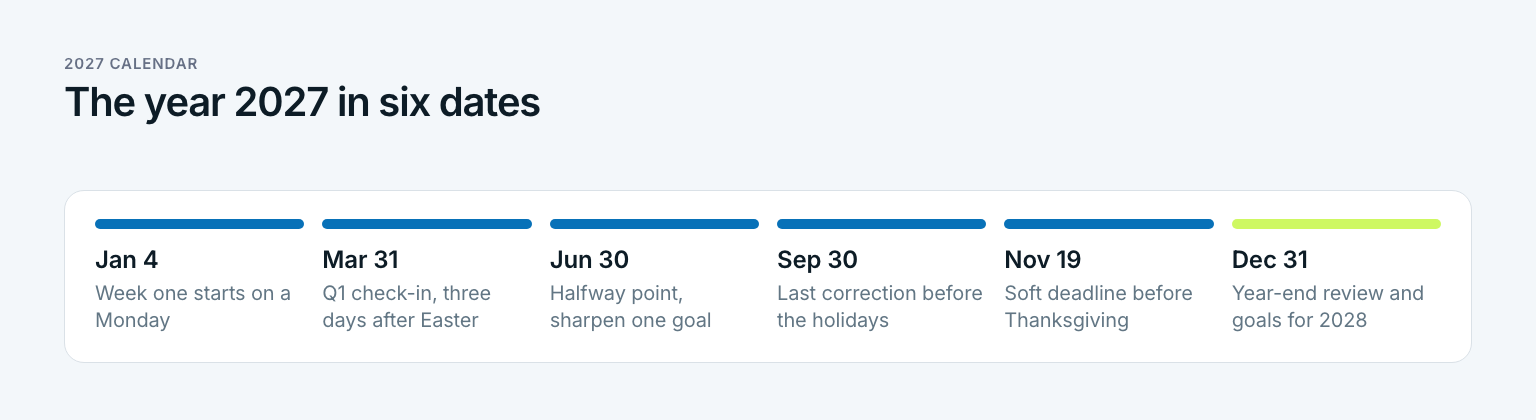
One weekly slot of ten minutes and four review dates: March 31, June 30, September 30, and November 19, the Friday before Thanksgiving. Those dates are the actual safety net. Without them, nobody notices when a goal quietly disappears.
Implementation intentions: one sentence for the bad day
Psychologist Peter Gollwitzer calls them implementation intentions: plans that follow the pattern "if situation X happens, then I will do Y." In a 2006 meta-analysis of 94 studies, Gollwitzer and Paschal Sheeran found a medium-to-large effect on reaching goals. For your 2027 plan, that means: do not only plan the normal Tuesday. Plan the Tuesday when normal falls apart.
Whoever blocks this hour on December 30 walks into January with a calendar, not a list. That is not a motivation hack. An appointment is simply harder to forget than an intention.
Danielle's goals for 2027: the goal chain from year to Tuesday night
The goal chain connects three yearly goals to an ordinary week. It translates each goal into quarter, month, week, and day, so that every level has its own smaller result. Here is the chain for the lab lessons.
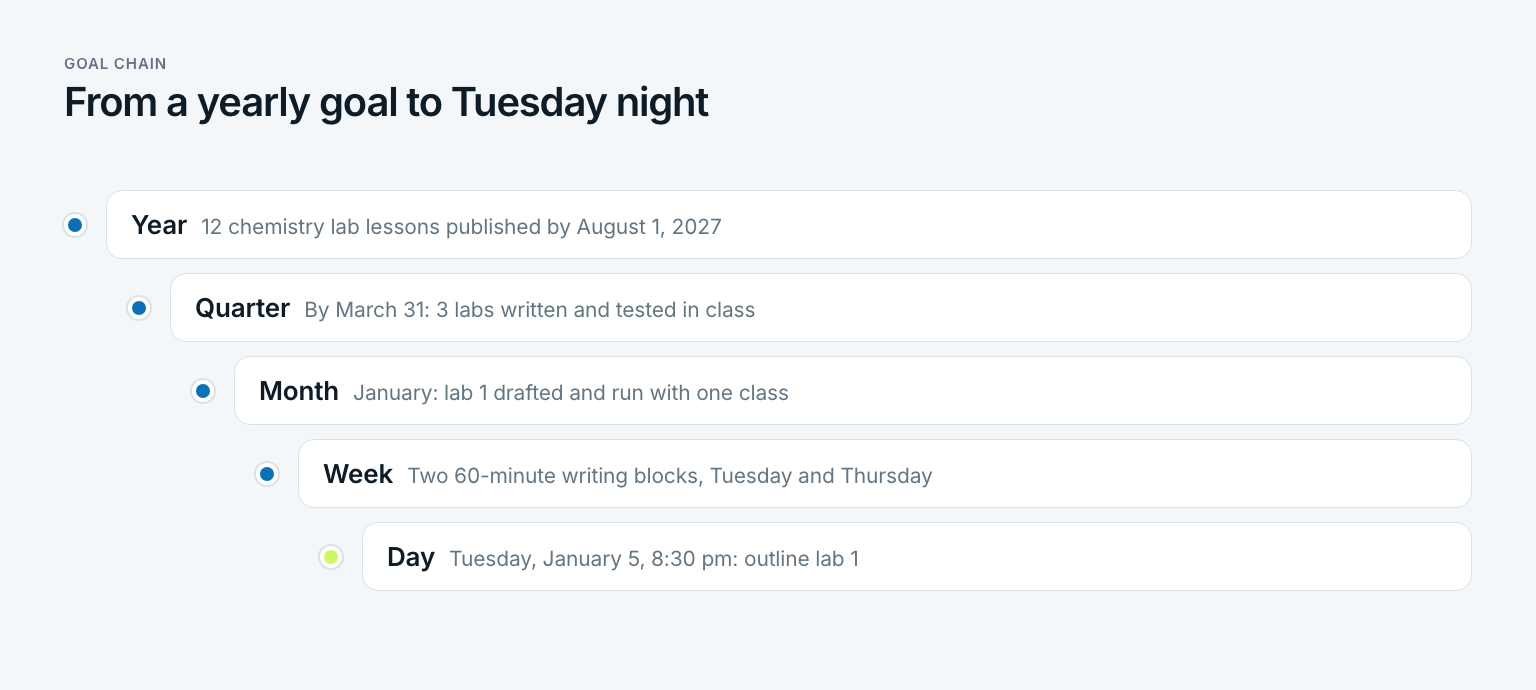
Year: twelve lab lessons published by August 1, 2027, so they are live before other teachers plan the new school year. Q1: three labs written and tested in her own classes by March 31. Only three, because January is slow, February is flu season, and rhythm matters more than pace. Q2: six more by June 30, tested during April and May. Q3: the last three written in the first weeks of summer break, all twelve polished and published by August 1. Q4: no new writing. Instead, she tracks sales and sends every dollar to the credit card.
January: lab one drafted and run with her third-period class. Week: two writing blocks of 60 minutes, Tuesday and Thursday at 8:30 pm after her daughter is asleep, with Saturday at 1 pm as backup. Day: Tuesday, January 5, 8:30 pm, laptop already open on the kitchen table, phone charging in the hallway. That means: on January 5, Danielle does not have to decide whether to work. She only has to sit down.
The other two goals get the same chain, only shorter. The debt needs one level: $650 on the 1st of each month, $1,950 per quarter. Strength training starts on Monday, January 4. Two sessions a week until mid-December would be about 100. Minus breaks, travel, and the flu, Danielle sets 80. A goal that already counts the bad weeks does not have to be renegotiated in May.
Progress at each level comes from the level below. If Danielle finishes seven of eight writing blocks in January, the month stands at 88 percent and the quarter is visibly on track. In Gaapp, every goal hangs on a bigger one, from year to day, and progress is shown next to the time that has passed. On March 31, Danielle sees not only whether three labs are done, but whether she is on pace now that a quarter of the year is gone.
For the full breakdown method, see how to turn yearly goals into daily steps. The logic is the same for a debt, a certificate, or a side project.
Goals for 2027 as a couple or a family
The chain works for two people as well, as long as both calendars sit side by side. Danielle's husband has his own goals, and they share the same evenings. Anyone who plans writing nights without knowing the partner's plans builds the first January argument right into the schedule. So on December 30 they split the week: Tuesday and Thursday for her labs, Monday and Wednesday for his evening class, the first Saturday of the month for an outing with their daughter.
How to keep New Year's resolutions past February: three planning mistakes
Most new year goals do not fail in February. They fail the December before, at the planning stage. A few years ago the fitness app Strava looked at its users' activity and named the second Friday of January Quitter's Day, the point when many New Year's routines stall. In 2027 that Friday is January 8. The cause is rarely willpower. It is one of three mistakes that feel reasonable when you write the list. Which one did you make in 2026?
- Treating the year as one block. Twelve months feel like plenty of time, which is exactly why nothing feels urgent. In March there are still nine months left, in June still six. Whoever has no quarterly goals notices in October that the year is almost over.
- Assuming every week is the same. A plan built on 52 normal weeks breaks on spring break, summer travel, and the February flu. Roger Buehler, Dale Griffin, and Michael Ross showed in 1994 that people consistently underestimate how long their own projects will take, even when they know their past projects ran late. Psychologists call it the planning fallacy.
- Goals without a time budget. Every goal costs hours each week, and the week has no spare room. Anyone who plans three goals worth eight hours a week with only four free hours does not fail on motivation. They fail on arithmetic.
The most common mistake: a December deadline
Most people write "by the end of 2027" behind every goal. In 2027 the end of the year means Thanksgiving on November 25, Christmas observed on Friday, December 24, and New Year's observed on Friday, December 31. Anyone who leaves the finish for December is betting on the most crowded five weeks of the year. Set the real deadline for big goals on November 19, the Friday before Thanksgiving, and treat December as a buffer, not a sprint.
To be fair, a December deadline gives you the whole year. But the whole year is exactly what makes a goal feel optional in April. A November deadline costs six weeks and buys urgency in every quarter.
Four check-in dates that carry the year
Goals for 2027 are not decided on January 1. They are decided on four days of the year and on 52 Sunday evenings. The weekly check-in keeps the rhythm, the quarterly check-ins test the direction. Both take little time, but both need a fixed spot on the calendar.
The weekly check-in takes ten minutes. Danielle uses Sunday at 7 pm and asks three questions. How many writing blocks and workouts happened? What fell through, and why? What changes next week? The answer is a number, not a feeling. Whoever counts every Sunday never has to wonder in February whether they are still on track. They know.
The quarterly check-ins take an hour. In 2027 they fall on Wednesday, March 31, Wednesday, June 30, Thursday, September 30, and Friday, November 19. At each one you check two things: are you on pace, and is the goal still the right one? A goal is allowed to change. It is not allowed to vanish without anyone noticing.
What do you do when a quarter goes wrong? You adjust the next quarter, not the year. If Danielle has two labs instead of three on March 31, she spreads the missing one over April and May. The August 1 deadline stays. Anyone who moves the yearly goal at every setback ends up without a goal, just an intention with a moving date.
A self-audit before December 31
Before you lock in your goals for 2027, run them through three questions:
- Can you say, for each goal, what number has to be true on June 30, 2027 for you to be on pace?
- Do the weekly hours of all your goals fit into a normal week in February, not just a good week in May?
- Does each goal have an appointment with a day and a time in the week of January 4?
Whoever answers no to one of these does not have a bad goal, just an unfinished one. The one-hour session finishes it. For the full structure around it, with quarters, vacation weeks, and reviews, see the guide to annual planning.
In short: goals for 2027 are not a list for New Year's morning. They are a calendar that already has something on January 5.
Frequently asked questions about goals for 2027
Why is 2027 so special?
In numbers, 2027 is an ordinary year: 365 days and 52 Mondays, starting and ending on a Friday. What makes it notable for planning is the calendar itself, with Easter in March, Juneteenth and Christmas observed on Fridays, and New Year's Day 2028 observed on December 31. Beyond the calendar, a total solar eclipse on August 2 will be visible across southern Spain, North Africa, and the Middle East.
What are some good goals for next year?
Good goals for next year name a result, a date, and a first action you can schedule in the first week of January. Examples: pay off $7,800 in debt by December 31, publish twelve lessons by August 1, or strength train twice a week with 80 sessions by mid-December. Most people do best with three goals from three different areas of life.
What are the 10 examples of goals?
Common examples cover money, health, career, side income, family, relationships, learning, and home: paying off debt, an emergency fund, strength training, more sleep, a professional certificate, a side project, monthly family outings, weekly calls, two books a month, and a lower grocery bill. The table above turns each of them into a goal with a number and a date. Pick at most three for one year.
What is supposed to happen in 2027?
The big fixed events of 2027 include the total solar eclipse on August 2 and the FIFA Women's World Cup in Brazil. For your own plan, the dates that matter more are closer to home: holidays, school breaks, and the weeks you already know will be busy. Put those on the calendar first, then add your goals.
How do you keep New Year's resolutions?
Turn each resolution into a goal with a number and a date, break it into quarters and weeks, and schedule a ten-minute check-in every week. When a week goes wrong, adjust the next week and keep the yearly goal. Starting on Monday, January 4, instead of New Year's Day also helps, because the first week then has five normal days.
When should I set my goals for 2027?
The days between Christmas and New Year's are ideal, with an hour of quiet and the 2027 calendar open. Start on Monday, January 4, not on Friday, January 1. If you want a head start, run a short test week in mid-December to see which times of day actually work for you.
Last updated: 19 October 2026
Read next
 Goal Setting
Intrinsic Motivation: What Drives You From the Inside
Intrinsic motivation is not a personality trait. Meaning, 12 examples, the three needs behind it and five steps to build it, with a worked example.
17 min read
 Goal Setting
Financial Goals: How to Turn Wishes Into a Plan
Financial goals are not wishes with a dollar sign. Short and long term examples, SMART savings goals and a five step plan, worked through one year.
17 min read
 Goal Setting
WOOP Method: Four Steps From Wish to If-Then Plan
The WOOP method is not positive thinking. What WOOP stands for, the research, if-then plans, eight goal examples and a five-minute guide.
18 min read