Performance Review Template: How to Write a Fair Review
A performance review template is not a form you fill in from memory: five criteria, a 5-point scale, examples, six questions and a worked review.

Contents
- 01What a performance review template is, and what it is not
- 02Why most performance reviews are written from memory
- 03Five criteria and the 5-point rating scale for performance
- 04How to write a performance review in five steps
- 05Employee review template: twelve fields, filled in
- 06Performance review examples: what to write for each criterion
- 07The review meeting: six questions worth asking
- 08Three rating errors nobody notices
- 09From this year's review to next year's goals
- 10Frequently asked questions about performance reviews
A performance review template is not a form you fill in once a year from memory. It is a fixed structure for rating one employee's work over a set period against goals and criteria agreed in advance: the same criteria for everyone, the same rating scale, and room for evidence under every rating. A form collects opinions. A template built this way collects proof.
Three things make a review fair: criteria everyone knows in January, evidence from the whole year, and a conversation in which both sides put their view on the table. All three are worked through with Dana, 36, a support team lead at a software company in Columbus, Ohio, who has to write seven annual reviews by December 12 for the first time. Along the way: five criteria, a rating scale with anchors, a twelve-field template, examples for every criterion and six questions for the meeting.
What a performance review template is, and what it is not
A performance review is a written assessment of how well someone did their job over a period, usually twelve months, followed by a conversation. The template keeps every review on your team comparable. Three parts are fixed: a standard that was known in advance, a rating for each criterion, and a written reason for every rating. Whoever invents the standard in December is not reviewing. They are grading after the fact.
Performance review, self-assessment, 360 feedback: what each one is built for
Four formats that often get lumped together. None of them is wrong. Each one is built for something else.
| Format | Who writes it | Looks at | Built for |
|---|---|---|---|
| Performance review | the direct manager | a fixed period, usually a year | rating work against goals and setting next year's goals |
| Self-assessment | the employee | the same period, with the same criteria | putting the employee's own view on paper before the meeting |
| 360-degree feedback | peers, direct reports, sometimes customers | how the person works with others | seeing impact from several directions |
| One on one meeting | the employee owns the agenda | this week and the person | trust, coaching and early warning, every week or two |
The one on one is the closest relative. It is a good habit, but it is built for coaching, not for rating. The review is where the year gets a number and next year gets its goals. It is one part of performance management, which adds goals, a rhythm and decisions around the rating. That means: whoever skips the one on ones walks into the review with no material.
Why the written review matters more than it looks
In the US, the written review is also a record. When a performance problem later leads to a warning or a termination, HR and employment lawyers read the past reviews first. A manager who rated someone meets expectations three years in a row and then wants to let them go for performance has written evidence against their own case. Anyone who inflates a review to avoid a hard conversation only moves that conversation into a worse room.
Why most performance reviews are written from memory
Most reviews get written on one afternoon in December. That is the problem. Whoever rates twelve months from memory is really rating the last six weeks. Most managers want to be fair. They just lack the material.
That is how it went for Dana. She leads seven implementation specialists who onboard around 25 new customer accounts a month. Her reviews are due to HR on December 12. She starts with Marcus, 28, who has been on the team for two years. In January, the two of them agreed on three goals:
- Onboarding time: cut the average time from signed contract to first live use for his accounts from 30 days to 21 days.
- Setup guide: write and launch a self-serve setup guide for new customers by June 30.
- Mentoring: coach Priya, a new hire, until she runs onboarding calls alone by the end of Q3.
Dana's first draft takes 25 minutes. It has 16 sentences, and eleven of them are about November. November was rough: a large enterprise account with a complicated data migration ran three weeks late, a teammate went on parental leave, Marcus took over three of her accounts, and the customer's VP emailed the CEO about the delay. Dana's draft rates Marcus as partially meeting expectations on results and drags quality of work down with it.
Then she pulls the numbers from the CRM.
| Period | Marcus: average onboarding time | Goal |
|---|---|---|
| January to March | 28 days | 21 days |
| April to June | 24 days | 21 days |
| July to September | 20 days | 21 days |
| October and November | 26 days | 21 days |
| January to November | 24.4 days | 21 days |
The numbers tell a different story. Marcus got faster three quarters in a row and beat the goal in Q3. October and November were an outlier with an outside cause. Over eleven months, he is 3.4 days short: partially met, with a clear direction. And the other two goals? The setup guide went live on June 12, 18 days early, and how-do-I tickets from new customers dropped 22 percent in Q3 compared with Q2. Priya has run her own onboarding calls since August. Dana's draft gave both goals half a sentence.
Then she goes through her one on one notes and her inbox, month by month. She finds 23 entries about Marcus, 17 of them positive, among them a migration script he shared with the team in May. That means: a fair performance review does not start with writing. It starts with collecting. Anyone who has to hunt for evidence in December finds the loudest piece first.
Five criteria and the 5-point rating scale for performance
Good review criteria are few, observable and known in advance. Five cover almost any individual role. More than eight only make the template longer. The weighting says what counts: results weigh most, because they were agreed.
| Criterion | What you observe | Weight |
|---|---|---|
| Results | the agreed goals for the period, measured by number and date | 40% |
| Quality of work | accuracy, error rate, whether commitments hold | 15% |
| Collaboration | sharing information, helping the team, handling conflict | 15% |
| Initiative | spotting problems and fixing them before anyone asks | 15% |
| Growth | new skills learned, feedback applied, scope expanded | 15% |
Managers of people get a sixth criterion, leadership. What all criteria share: you can name an example from the year for each one. You cannot do that for attitude or culture fit. Whoever rates personality traits is reviewing the person, not the work.
What is the 5 rating scale for performance?
The five-point rating scale is the format most US companies use: five levels from does not meet expectations to far exceeds expectations, with meets expectations in the middle. Labels alone fail, because good means something different to every manager. The fix is anchors: one sentence per level that describes what you would observe.
| Rating | Label | Anchor, using results as the example |
|---|---|---|
| 5 | Far exceeds expectations | All goals met, at least one by a wide margin, plus real work outside the agreed scope |
| 4 | Exceeds expectations | All goals met, one of them earlier or better than agreed |
| 3 | Meets expectations | Goals met at their core, small gaps with a clear reason |
| 2 | Partially meets expectations | One goal clearly missed or several narrowly missed |
| 1 | Does not meet expectations | Most goals missed without an outside cause |
The middle is called meets expectations, and it is a good result. Say that out loud in the meeting, because many employees read a 3 as average in the bad sense. Anyone who meets expectations is doing the job the way it was agreed. That is the norm, not a disappointment, and nobody should have to defend it.
How to write a performance review in five steps
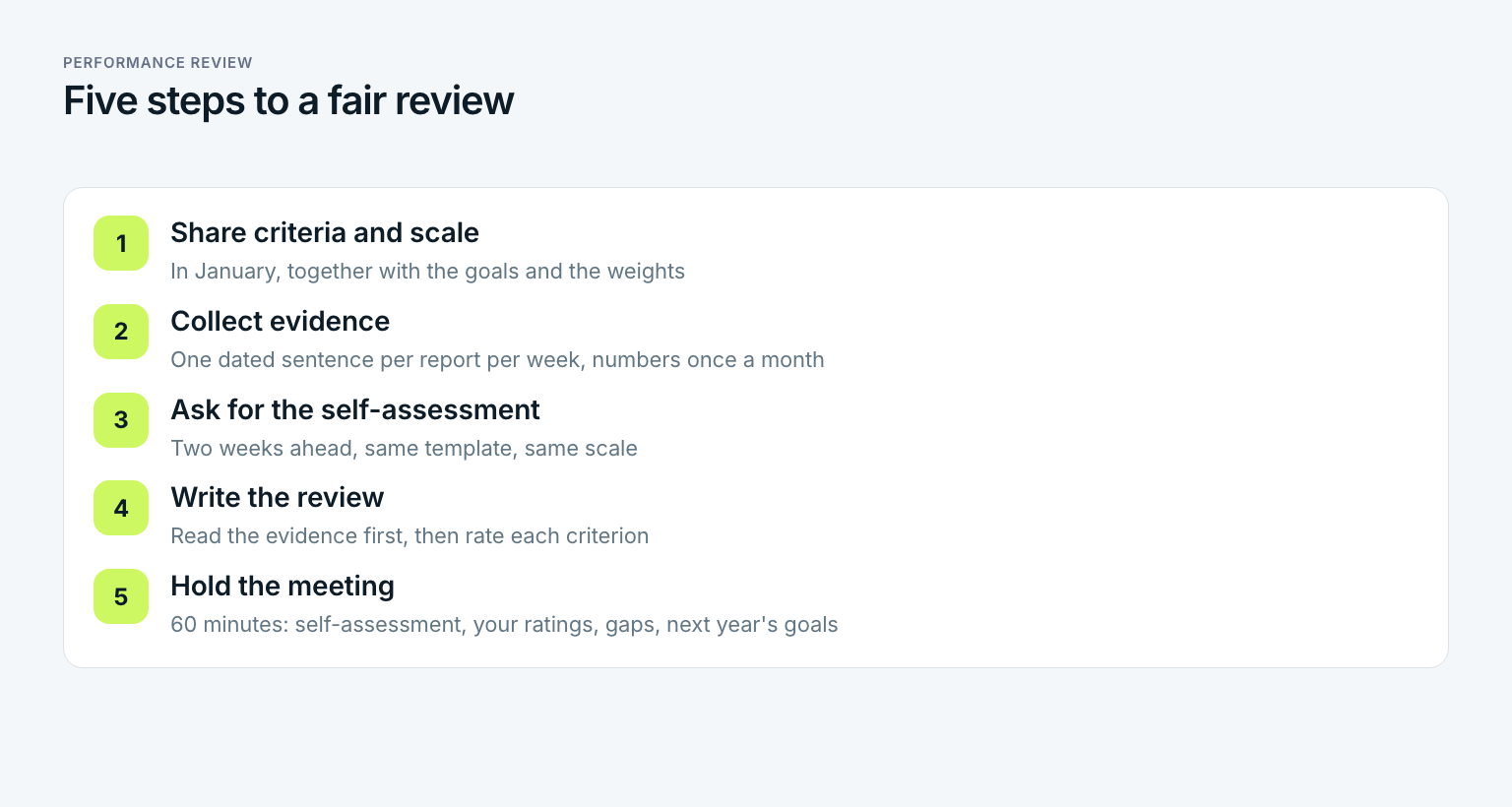
A review built on evidence takes about an hour per person, not counting the meeting. Most of that hour goes into collecting, not writing. Here is the sequence:
Share the criteria and the scale
In January, together with the goals. Your report needs to know how they will be measured before the year starts, not after it ends.
Collect evidence all year
One sentence per report per week: a dated observation, good or bad. Plus the numbers for each goal once a month. With seven reports, that costs Dana about ten minutes a week.
Ask for the self-assessment
Two weeks before the meeting, your report fills in the same template with the same scale.
Write the review
One rating per criterion and two or three sentences, each with evidence. Read the evidence first, then rate, never the other way around. Then do the weighted math.
Hold the review meeting
About 60 minutes. Your report walks through the self-assessment first, then you put yours next to it. You talk through the gaps and agree on next year's goals. Both of you sign, and the review goes into the personnel file.
Performance review example: Dana's review of Marcus
With the numbers and the 23 entries in front of her, Dana starts over. She rates each goal on its own first: onboarding time partially met at 2, setup guide exceeded at 4, mentoring met at 3. The average gives results a 3.0. Only then does she rate the other four criteria, each with its own evidence.
| Criterion | Weight | First draft from memory | Rewrite with evidence |
|---|---|---|---|
| Results | 40% | 2 | 3 |
| Quality of work | 15% | 3 | 4 |
| Collaboration | 15% | 3 | 4 |
| Initiative | 15% | 3 | 4 |
| Growth | 15% | 4 | 4 |
| Weighted total | 100% | 2.75 | 3.60 |
Same employee, same year, same manager. The gap of 0.85 points decides whether Marcus's file says below or above expectations, and at many companies the raise budget follows that number. Is that still a question of writing style? Hardly. In short: evidence does not change how generous a manager is. It changes the result.

Employee review template: twelve fields, filled in
The template has twelve fields and fits on two pages. Manager and employee use the same one, so both versions line up field by field. The right column shows Dana's entries for Marcus.
| Field | What goes in | Example: Marcus, 2026 |
|---|---|---|
| Period and type | annual, mid-year or event-driven, with dates | Annual review, January 1 to November 30, 2026 |
| Role | the job as it actually was during the period | Implementation specialist, from October also three accounts of a colleague on leave |
| Agreed goals | the goals from January, word for word | Onboarding time 21 days, setup guide by June 30, Priya independent by the end of Q3 |
| Results | a rating per goal, with evidence | 24.4 days overall, 20 days in Q3: partially met. Guide live June 12: exceeded. Priya independent since August: met |
| Quality of work | rating and two pieces of evidence | Exceeds: no data errors in eleven migrations, no reopened setup tickets since April |
| Collaboration | rating and two pieces of evidence | Exceeds: mentored Priya, took over three accounts in October without being asked |
| Initiative | rating and two pieces of evidence | Exceeds: wrote a migration script in May and shared it with the whole team |
| Growth | rating and one piece of evidence | Exceeds: finished a data integration course and now runs complex migrations alone |
| Overall rating | weighted score and one sentence | 3.60 of 5: strong collaboration and initiative, onboarding time short of the goal with a clear trend |
| Strengths | two things to keep | Calm under pressure, teaching others |
| Development area | one topic for next year | Telling large customers early when a timeline slips |
| Goals for next year | no more than three, with number and date | Onboarding time 21 days for the year, enterprise migration playbook by April 1, cover team lead duties from Q3 |
The last row matters most. A review that does not end in new goals is an archive. The SMART goals examples show how to give each new goal a number and a date. Ready-made goal sets that break a yearly goal down to daily goals are in the templates.
Performance review examples: what to write for each criterion
What should you write in a performance review? Sentences in three beats: what happened, the evidence, the effect. “Marcus is a great team player” is an opinion. “Marcus took over three accounts from a colleague on leave in October, and none of them missed a milestone” is evidence. Whoever writes that way needs no adjectives, and the employee can check every sentence.
The table gives one example sentence per criterion at three levels. The examples come from customer onboarding, but the pattern fits any role: what happened, when, and what did it change?
| Criterion | Exceeds expectations | Meets expectations | Partially meets expectations |
|---|---|---|---|
| Results | Met all three goals and launched the setup guide 18 days ahead of the deadline. | Met the agreed goals, with onboarding time at 22 days against a goal of 21. | Missed the onboarding time goal by six days, mainly because kickoff calls were scheduled late. |
| Quality of work | No data errors in eleven migrations, and teammates ask him to review their complex setups. | Works carefully, errors are rare and he usually catches them himself. | Three of twelve migrations needed fixes after go-live, two of them noticed by the customer. |
| Collaboration | Mentored a new hire who has run her own onboarding calls since August. | Hands over accounts with complete notes and answers questions from the team the same day. | Handovers in Q2 were often incomplete, which led to two duplicate kickoff calls. |
| Initiative | Wrote a migration script in May and shared it with the team before anyone asked. | Flags risks early and comes with a proposal. | Waits for direction when a project stalls, even when the fix is within his own scope. |
| Growth | Finished the data integration course and taught it to the team in two sessions. | Finished the agreed course and uses what he learned in his own projects. | Postponed the agreed course twice and has no new date yet. |
Three kinds of phrases do not belong in a review:
- Vague praise. “Great attitude”, “rock star”, “always goes above and beyond”. It feels kind, and it tells the employee nothing they can repeat next year.
- Personality labels. “Difficult”, “unreliable”, “too quiet”. These describe a person, not work. Replace the label with the situation in which you saw it.
- Comparisons with peers. “Not as fast as Jordan” measures against a person, not against the goal. The standard is the agreement, not the desk next door.
The review meeting: six questions worth asking
The review meeting is what the whole review is for. A template that only goes into the personnel file changes nothing. Plan 60 minutes, a quiet room and no meeting right after.
The order matters. Your report goes first, then you add your ratings, then you talk only about the gaps, and the last ten minutes belong to next year's goals. Where you are a full level apart, discuss the evidence, not the rating.
Six questions carry most review meetings:
- What are you most proud of this year, and how would someone else notice it? It opens with the employee's evidence, not yours.
- Which goal was hardest, and what got in the way? It separates outside causes from habits.
- Where do your ratings and mine differ by a full level? It puts the gaps on the table instead of hiding them in politeness.
- What should I do more of, or less of, as your manager? It turns the review into a two-way conversation.
- What do you want to be able to do a year from now that you cannot do today? It points the development area forward.
- Which three goals would make next year a clear success? It ends the meeting with numbers and dates instead of good intentions.
In Marcus's meeting, the two were a full level apart on one goal. He had rated onboarding time as met, Dana as partially met. Dana showed him that even without October and November, his average was 24 days. He kept his view, she kept her rating, and both are now in the file. Was the meeting a failure? Quite the opposite. A documented disagreement is more honest than a forced agreement.
How to write the self-assessment
Use the same rules as the review itself: one rating per criterion, two sentences, one piece of evidence. Anyone who rates themselves describes what they did and how others could see it, not how hard it felt. Six sample self appraisal comments show what that sounds like.
Three sentence starters for the self-assessment
“My goal was …, I reached …, you can see it in …”. “What went especially well was …, because I …”. “What went less well was …, next year I will change …”. Three sentences per criterion are enough. Whoever writes this way brings the evidence into the meeting instead of having to defend it there.
Three rating errors nobody notices
Most unfair reviews are not meant to be unfair. They turn unfair because memory takes shortcuts. None of them feels like an error in the moment. Which one is hiding in your last review?
- Recency bias. The last weeks outshine the year. In Dana's first draft, eleven of 16 sentences were about November. The fix: evidence from all four quarters before you give the first rating.
- Halo effect. One standout trait colors all the others. The psychologist Edward Thorndike described it in 1920 after studying how army officers rated their soldiers. In Dana's draft, one angry customer email pulled quality down along with results. The fix: rate each criterion on its own, with its own evidence.
- Central tendency. Unsure managers rate everyone a 3. It feels fair and says nothing. Its twin is leniency, where everyone lands at exceeds so nobody is disappointed. The fix: anchors for every level and a rule that every rating other than 3 needs two pieces of evidence.
The most common mistake: starting the review in December
All three rating errors share a root. Whoever starts collecting at the deadline only has memory to work with, and memory prefers the latest, the loudest and the most convenient. The review therefore starts in January with the goals and lives on one sentence a week. In December, you only summarize.
From this year's review to next year's goals
A year-end review is only as good as the goals it measures against and what happens to them in between. That is why it does not belong in December. It belongs in the goal chain: year, quarter, month, week, day. Each level hands the review something it would otherwise have to pull from memory. Goals written like the employee goals examples by role, with a number and a date, make each of those levels easy to fill.
| Level | What it produces | Example: Marcus, 2027 |
|---|---|---|
| Year | no more than three agreed goals, plus criteria and scale | Onboarding time 21 days for the year, migration playbook by April 1, cover team lead duties from Q3 |
| Quarter | a 30-minute check-in with numbers | Q1: onboarding time 22 days or less, playbook outline reviewed |
| Month | one number per goal, straight from the system | January: average onboarding time checked, two playbook chapters drafted |
| Week | one dated sentence of observation per report | Week 2: unblocked a stalled kickoff by calling the customer's IT lead directly |
| Day | the daily goal the week depends on | Monday: draft the data mapping chapter of the playbook by 11 a.m. |
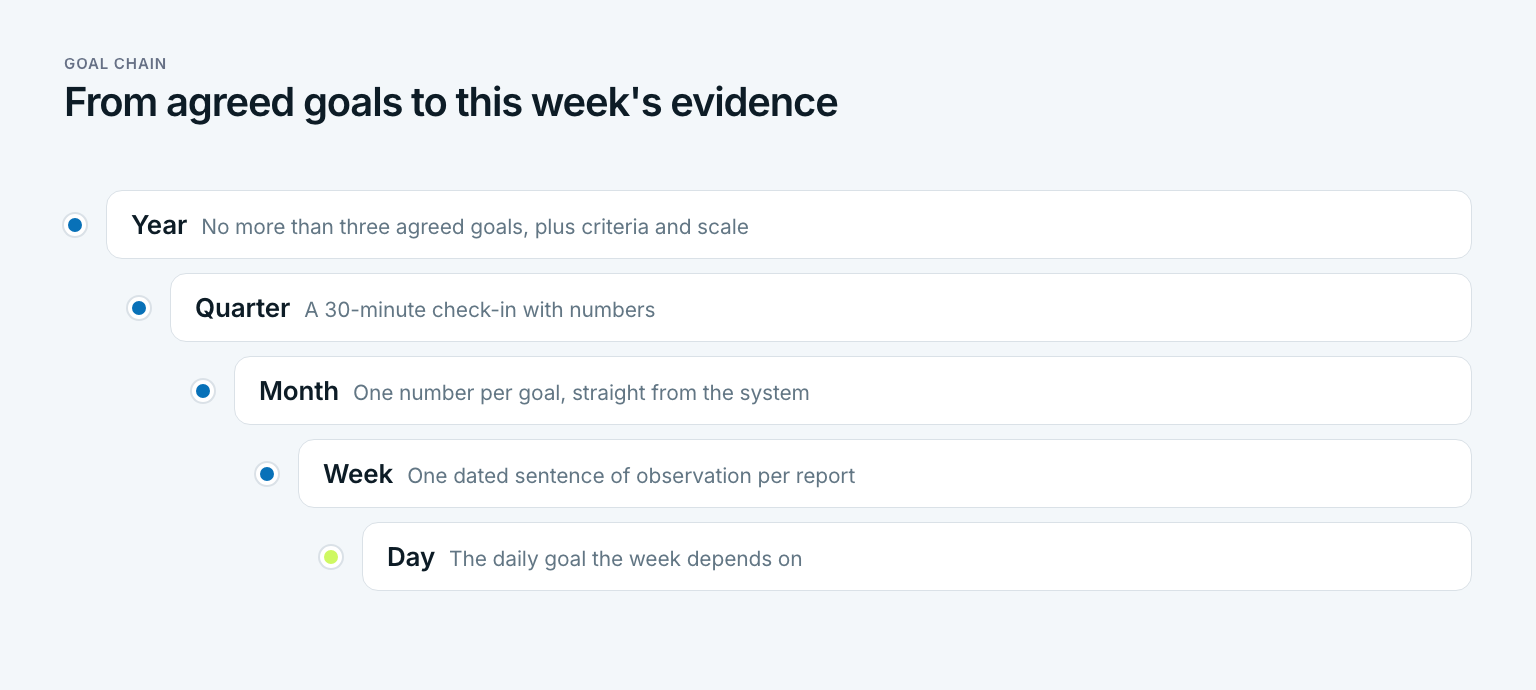
For Dana, this mostly changes one habit: one sentence per report every Friday, about ten minutes for seven people. Over a year, that is more than 40 pieces of evidence per person, and none of them is borrowed from November. The ten-minute weekly review shows how to make the week a fixed checkpoint.
In Gaapp, this chain lives in a shared space: the yearly goal, quarterly and monthly goals below it, weekly and daily goals below those, and manager and report see the same status. Progress for each period is the share of goals completed. By December, half the review is already there, goal by goal. The guide on how to achieve goals shows how to break a yearly goal into these levels.
Ten performance goals examples for next year
How do you write ten performance goals examples that will hold up in next year's review? Each one gets a number, a date and an owner, and each one connects to a team goal. Here are ten from different roles:
- Cut average onboarding time for new accounts from 24 to 21 days by June 30.
- Keep monthly customer satisfaction at 92 percent or higher from January through June.
- Publish four help articles per quarter on the most common ticket topics.
- Resolve 30 percent of first-level tickets through the self-serve guide by September 30.
- Reduce escalations to engineering from twelve to six per month by the end of Q3.
- Close 40 new deals worth at least $5,000 each by December 31.
- Ship the redesigned checkout page with an error rate below 0.5 percent by May 15.
- Mentor one new hire until they run client calls alone, by the end of Q2.
- Finish a certification in the team's data platform by April 30 and run one internal training on it.
- Hand over a documented enterprise migration playbook by April 1.
Three questions to close, about your last review:
- Can you name a dated piece of evidence for every rating you gave?
- Did more than half of your reasons come from the last two months?
- Does the review end with goals that can be measured twelve months from now?
Anyone who hesitates on one of these was not too harsh or too generous. They started collecting too late. In short: a performance review template is not a form you fill in from memory, it is the place where a year of evidence adds up.
Frequently asked questions about performance reviews
What should I write in a performance review?
Write one rating per criterion and two or three sentences that each carry a piece of evidence: what happened, when, and what it changed. Cover the whole period, not just the last few weeks, and rate each criterion on its own. End with no more than three goals for the next period, each with a number and a date. Leave out vague praise, personality labels and comparisons with peers.
What is the 5 rating scale for performance?
It is a five-level scale that runs from does not meet expectations at 1 to far exceeds expectations at 5, with meets expectations at 3. Most US companies use it because it leaves room for a clear middle and two levels on each side. It only works with anchors, one sentence per level that describes what you would observe. Without anchors, every manager reads the levels differently.
What are 6 powerful questions to ask in a performance review?
Ask what your report is most proud of and how others would notice it, and which goal was hardest and why. Then ask where your ratings differ by a full level and what you should do more or less of as their manager. Close with what they want to be able to do a year from now and which three goals would make next year a clear success.
How do you write 10 performance goals examples?
Give every goal a number, a date and a clear owner, and link it to a team or company goal. Spread the ten across results, quality, collaboration and growth, so the next review has something to measure for every criterion. The list above shows ten examples from support, sales, product and engineering roles.
Is a performance review template the same as an employee review template?
In practice, yes. Both names describe the same structured form for rating an employee's work over a period. Some companies use employee review for a broader document that also covers attendance or conduct. What matters is that the template has criteria, a scale with anchors and room for evidence.
How often should performance reviews happen?
Most companies still run one annual review, often with a lighter mid-year review. Once a year is enough for the written record, but not for the goals. Quarterly check-ins with numbers make sure the annual review holds no surprises.
Last updated: 19 October 2026
Read next
 Leadership & Teams
Leadership Styles: Which One Fits Which Situation
Leadership styles are not personality types: 11 types compared, Lewin, Goleman, situational leadership and five steps to find the style that fits you.
14 min read
 Leadership & Teams
Retrospective: How Teams Learn From Every Sprint
A retrospective is not a blame session: what the word means, five phases, seven retrospective examples and action items that stick, shown on one team.
16 min read
 Leadership & Teams
How to Delegate Tasks: Hand Off Work, Keep Results
Delegation is not dumping work: five levels of delegation, seven steps, a handoff script and what to keep, shown on one marketing team.
15 min read