Self Evaluation Examples: How to Write Your Own
A self evaluation is not a brag sheet. It is proof: five parts, a sentence formula, 25 examples and self appraisal comments, worked through on one review.

Contents
- 01What a self evaluation is, and what it is not
- 02Why most self evaluations undersell the year
- 03What to include in a self assessment: five parts
- 04How to write your self-performance evaluation in five steps
- 05Self evaluation examples: twelve before and after rewrites
- 06Self appraisal comments by employees: six examples
- 07Employee self evaluation examples by rating: how to score yourself
- 08The three mistakes nobody notices
- 09From self evaluation to next year's goals: year, quarter, month, week, day
- 10Questions about self evaluations
A self evaluation is not a brag sheet, and it is not a confession. It is the written case you make about your own year before a performance review: which goals you hit, how anyone can check it, where you fell short, and what you want next. Your manager puts their assessment next to yours, and the review is about the gaps between the two. Strong self evaluation examples share one feature: every sentence carries a number, a date, or a name.
Three tools do most of the work: five parts that belong in every self assessment, a sentence formula that turns impressions into proof, and example lines you can adapt. Danielle, 31, is a customer success manager at a 300-person HR software company in Columbus, Ohio, and she looks after 48 mid-market accounts. Her annual review with Kevin, the head of customer success, is in December, and the form arrives two weeks earlier. Her first draft had four sentences. Her second had five numbers, and it changed the meeting.
What a self evaluation is, and what it is not
A self evaluation, also called a self assessment or self appraisal, is the part of the performance review you prepare before anyone else says anything about you. Most companies use a form with open questions and a rating scale. Whoever comes prepared answers with proof. Whoever does not answers with adjectives.
Next to your view sits your manager's view. Both are incomplete. You know the effort and the fires that never reached anyone's desk. Your manager knows the effect your work had on others. That means: your self evaluation is not there to win the argument. It is there to complete the second picture. Where the two agree, one sentence is enough. Where they differ, the real conversation starts.
What it is not is just as clear. It is not a job description, because your manager already knows what your role involves. And it is not a place for self-criticism without a way out. A gap belongs in it, but only with its cause and the next step. The table separates it from the formats it gets confused with.
| Format | Who writes it | Looks at | Built for |
|---|---|---|---|
| Self evaluation | You, before the review | Behind and ahead | Supplying proof, explaining gaps, asking for growth |
| Manager review | Your manager | Your impact on others | Completing the picture, justifying a rating |
| 360 feedback | Peers, customers, your manager, and you | Behavior in collaboration | Finding blind spots |
| Brag document | You, all year long | Wins as they happen | Remembering what you did |
Why most self evaluations undersell the year
Modesty is a good trait. On a team it makes you easy to work with, and in a conflict it makes you credible. In a self evaluation it is built for something else. It leaves your manager guessing, and anyone who guesses falls back on the most recent impression.
Danielle's first draft read: “I managed my accounts reliably this year. I worked well with the team. I didn't get to all of my QBRs. I'd like to keep growing in my role.” Four sentences, none of them wrong. And none that Kevin could not have written without her. What was he supposed to do with that in the meeting?
What is missing are facts only Danielle knows. Her book of business ended the year at 108 percent net revenue retention against a goal of 105. In August a billing error double-charged 17 of her accounts. She called all of them within 48 hours, and none left. And she wants to lead the new enterprise pod that opens next summer. Kevin remembers August as a messy month, not the 48 hours.
In a 1988 meta-analysis, Michael Harris and John Schaubroeck found that self ratings and supervisor ratings agree only moderately, and that people tend to rate themselves somewhat higher. The gap does not close with quieter sentences. It closes with checkable ones. Your manager can verify a number. An adjective can only be believed or doubted.
That means: quiet is not the same as honest. Anyone who leaves out their wins distorts the picture as much as someone who inflates them.
What to include in a self assessment: five parts
Five parts cover every self evaluation, whatever your company's form looks like. Whoever knows the five can fill in any form and handle a review without one. The third column shows Danielle's entries.
| Part | Question | Danielle's entry |
|---|---|---|
| Goals and results | Which goals were agreed, and where are they now, as a number? | Net revenue retention 108 percent against 105. Three churned accounts, goal two. Onboarding playbook live. |
| Wins outside your goals | What did I deliver that was in no goal? | August billing error: 17 accounts called within 48 hours, none churned, FAQ reused for 140 other customers. |
| Gaps and causes | Where did I fall behind, and why? | 41 of 60 QBRs held. Cause: the August incident and eight weeks of leave coverage. |
| Working together | What helped, what slowed me down, what do I need? | Earlier notice on releases that touch billing. A monthly career talk with Kevin. |
| Growth | Where do I want to go, by when, and what do I need? | Lead the new enterprise pod from Q3, with a management course in Q1. |
The second part is the one most people leave blank. What was never planned is the easiest to forget. For Danielle it is the most important line on the form. A goal she hit shows she is reliable. The August incident shows what she does when nobody has a plan.
Most people dread the third part. Whoever names a gap first sets the tone in which it gets discussed. Whoever leaves it out hears about it from the other side of the table, as an accusation instead of a finding.
The fourth part needs one concrete request. The fifth is where you tell your manager where you want to go, before next year's goals are handed out. One growth goal is enough, and no more than three goals for the year in total. Why three goals are enough explains the ceiling.
How to write your self-performance evaluation in five steps
A self evaluation is not written in one evening from memory. Memory is built for something else: it keeps the last eight weeks and the loudest crisis of the year. The five steps below bring the rest back, and Danielle needed two evenings of 45 minutes each.
Collect proof, 30 minutes
Open last year's review notes, your calendar, and your sent folder. Look for numbers on every goal and thank-you notes from customers and colleagues. Danielle found four emails from customers who thanked her for calling in August.
Compare goals, 15 minutes
One line per goal: what was agreed, what was reached, how big the gap is. No judgment yet, just target and actual. Whoever starts judging here talks the year up or down before the numbers are on the table.
Apply the sentence formula, 25 minutes
Every statement about a strength follows result, proof, impact. Every statement about a gap follows gap, cause, next step.
Choose your ratings, ten minutes
Rate yourself only now, after the proof. The rating has to match the sentence next to it. Anyone who writes 108 percent against a goal of 105 and then ticks meets expectations contradicts themselves.
Write the ask, ten minutes
End with one growth goal, a timeframe, and what you need for it. Not: I'd like to keep growing. Instead: I want to lead the enterprise pod from Q3 and need a management course in Q1 to get there. The [SMART goals examples](/en/smart-goals-examples) show how to build sentences like that.
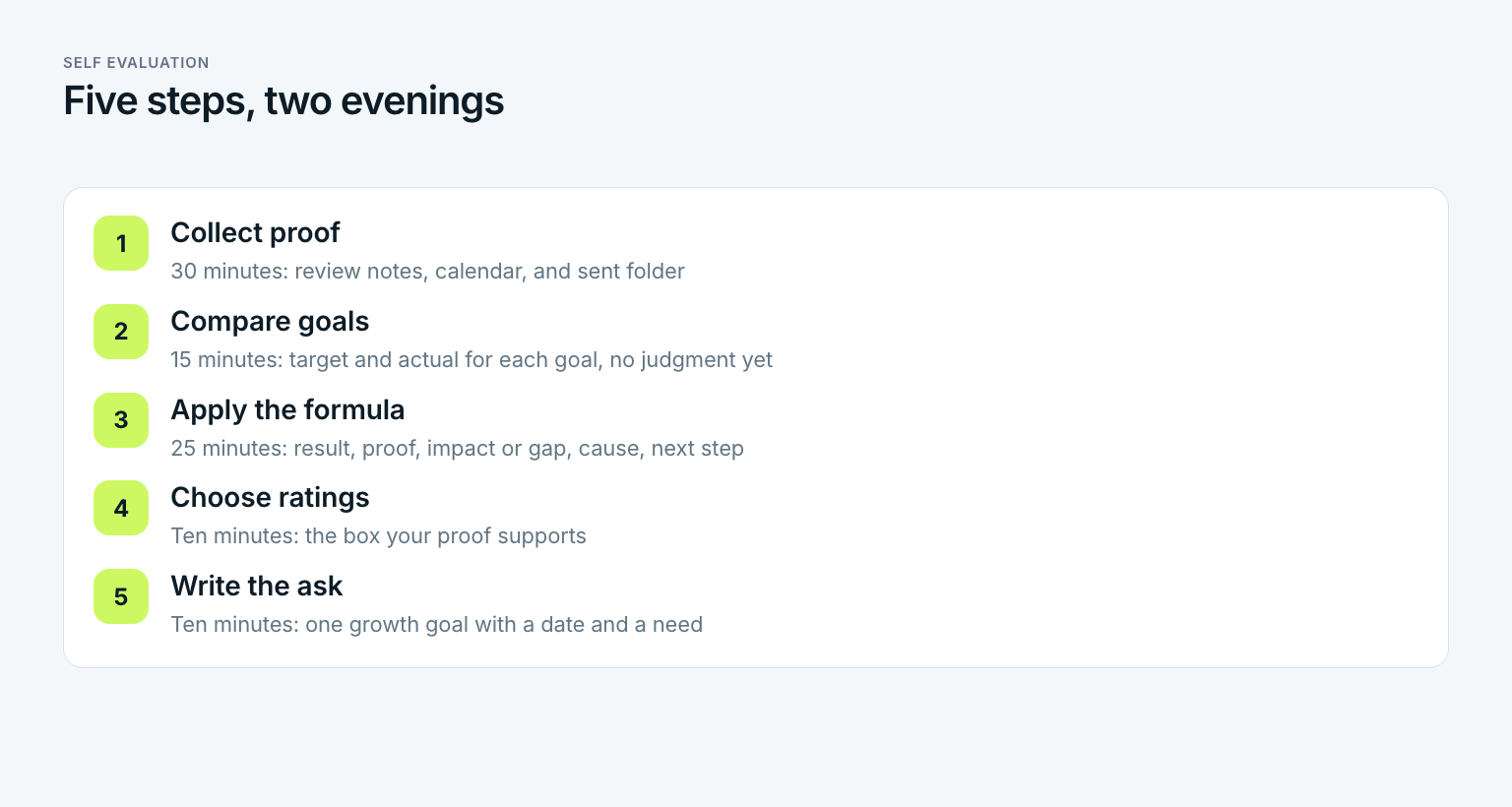
The sentence formula: result, proof, impact
Result is what exists at the end. Proof is how anyone can see it. Impact is what it meant for the business. For Danielle it reads: “I grew my book of business to 108 percent net revenue retention against a goal of 105. The accounts started the year at $2.4 million in annual recurring revenue and ended it at $2.59 million. That is $192,000 in net expansion.” Three sentences, and Kevin has no follow-up questions.
Does the sentence with $192,000 feel uncomfortable? It sounds like bragging. But a number is not praise. It is information. The praise would be the adjective in front of it, and the formula leaves it out. Whoever states the number and drops the adjective leaves the judgment to the manager and still hands over everything the judgment needs.
Gaps use the same structure with different parts. Gap is what is missing, as a number. Cause is the reason, without excuses. Next step is what you will do differently from January. For Danielle: “I held 41 of 60 planned QBRs with my top 15 accounts. The August incident and eight weeks of covering a colleague's book took the time. All 60 for next year are already on the calendar.” Anyone who writes a gap this way takes the sting out of the criticism and turns it into a plan.

Self evaluation examples: twelve before and after rewrites
The twelve examples below follow the competencies a typical performance review template asks about, from goal achievement to areas for improvement. Left is how most people write, right is how Danielle wrote. Borrow the structure, not the sentences, and put in your own numbers, names, and dates.
| Competency | Weak | Strong |
|---|---|---|
| Goal achievement | I met most of my goals. | Two of three goals met, one partly. Net revenue retention 108 percent against a goal of 105, worth $192,000 in expansion. |
| Quality of work | I pay attention to detail. | Of 212 renewal quotes I sent, two needed corrections, both after a same-week pricing change. |
| Reliability | I'm dependable. | All 31 renewals in my book were signed before their end date. None lapsed. |
| Initiative | I take initiative. | During the August billing error I called all 17 affected accounts within 48 hours. None churned. |
| Teamwork | I'm a strong team player. | I covered Tom's 22 accounts for eight weeks during his parental leave and handed them back with no open escalations. |
| Communication | I communicate clearly. | I wrote the billing incident FAQ in one afternoon. Support used it for 140 more affected customers. |
| Customer focus | I care about my customers. | My satisfaction score rose from 4.3 to 4.7 out of 5 across 380 survey responses. |
| Problem solving | I'm good at solving problems. | Onboarding took 45 days. I mapped the steps, cut three handoffs, and brought it to 30 days for eleven new accounts. |
| Adaptability | I handle change well. | When pricing changed in March, I held renewal conversations with all 48 accounts within six weeks. |
| Learning | I'm always learning. | I finished the product certification in April and ran two internal training sessions. |
| Leadership | I'd like more responsibility. | I want to lead the enterprise pod from Q3 and have asked to mentor the two new hires in Q1. |
| Area to improve | I didn't get to all my QBRs. | 41 of 60 QBRs held. The August incident took the time. All 60 for next year are already scheduled. |
Notice what the right column has in common? Every line carries a number, a date, or a name. None contains an adjective that praises itself. That means: the lines on the right are not louder than the ones on the left. They are easier to check. Whoever writes in checkable sentences only has to explain in the review, not persuade.
Self assessment examples for work without hard numbers
Not every job comes with revenue figures. Whoever works in teaching, nursing, or administration still finds numbers: colleagues trained, response times, shifts covered, complaints that stopped coming. Where there is no number, a name and a date do the job. A date turns an impression into an event. Three examples:
- Teacher: “In October I split my seventh-grade reading groups from three levels into five. By March, 19 of my 26 students had moved up at least one level.”
- Nurse: “From October to December I precepted two new graduate nurses on our unit. Both now carry a full patient load.”
- Office administrator: “In February I rebuilt the supply ordering sheet. We have not run out of anything since.”
Self appraisal comments by employees: six examples
Many forms end with a free text box for employee self evaluation comments. A strong self appraisal comment does one of three things: it names your biggest contribution, it names your biggest gap with its fix, or it names what you need next. Six examples, two of each kind:
- Biggest contribution: “The work I am proudest of this year was in no goal. When the billing error hit 17 of my accounts in August, I called every one within 48 hours, and all 17 renewed.”
- Biggest contribution: “My onboarding playbook is now the team standard. Eleven accounts went live in 30 days instead of 45.”
- Gap with a fix: “I held 41 of 60 QBRs. In August I chose the incident over the calendar, and I would make that choice again. Next year's 60 are already scheduled.”
- Gap with a fix: “Three accounts churned against a goal of two. One was acquired by a company on a competing platform. The other two showed warning signs in their usage data that I now check every month.”
- What I need next: “I want to lead the enterprise pod from Q3. To get there, I am asking for a management course in Q1 and the chance to mentor the two new hires.”
- What I need next: “I would like earlier notice from the product team when a release changes billing. One week of warning would have saved most of August.”
Whoever writes the comment box last writes the best one. By then the proof is collected, and the comment only has to choose.
Self evaluation, self assessment, self appraisal: is there a difference?
In practice the three terms mean the same thing. Self evaluation and self assessment are the common terms in US companies. Self appraisal is more common in the UK and in India. What matters is the same in all three: a claim, the proof behind it, and what follows from it.
Employee self evaluation examples by rating: how to score yourself
Most forms come with a five-point scale, from exceeds to does not meet expectations. When employees rate themselves, many tick the middle box everywhere. It feels modest and safe. It also says nothing, because anyone who picks the same box for every goal is not describing the year.
The opposite habit is just as common. Marshall Goldsmith reports in What Got You Here Won't Get You There, from 2007, that when he asks successful professionals to rank themselves against their peers, the large majority place themselves in the top fifth. Whoever rates every line at the top forces the manager to negotiate each one down, and the review turns into a haggle.
So the rule for the scale is simple: rate what your proof supports, not what your gut says. Where you beat the goal, you may tick exceeds. Where you missed it, tick partially meets and add the cause. Danielle filled in her form like this:
- Net revenue retention: exceeds expectations, 108 percent against 105.
- Churn: partially meets, three accounts against a goal of two, one lost to an acquisition.
- Onboarding playbook: meets expectations, live since May, 30 days instead of 45.
- QBR coverage: partially meets, 41 of 60, all of next year's already scheduled.
Two partials look worse on paper than four meets. In the meeting they are stronger. Kevin sees that Danielle found the gaps herself. That means: an honest scale may cost you one box on the form. In return you get the trust that your top ratings are accurate too.
And if your manager rates you differently? Ask for the evidence, not the score. What are you basing that on? Whoever asks about the event instead of the rating turns an argument about boxes into a conversation about what happened.
The three mistakes nobody notices
Most self evaluations do not fail because of bad wording. They fail because of three mistakes that feel right while you write and only show up in the meeting. Which one is yours?
- The eight-week memory. Whoever writes the self evaluation in November from memory describes the fall. The win in February is forgotten, and the slip in October sits on top.
- The hidden gap. You leave out what did not work and hope nobody brings it up. Then the gap comes from the other side, without a cause or a plan, and you defend instead of explain.
- The ask without a date. I'd like to keep growing, I'm open to more responsibility. An ask without a timeframe and a need cannot be approved. It can only be noted.
The most common mistake: tasks instead of results
Most self evaluations describe what someone did: managed accounts, handled renewals, supported colleagues. That is true and still worthless, because it is already in the job description. Without a result, the self evaluation turns into a task list, and a task list can only be checked off, not rated. The test is simple: every sentence must answer what was different at the end than at the start. Anyone who answers that for every line has turned tasks into results.
From self evaluation to next year's goals: year, quarter, month, week, day
A self evaluation is feedback that arrives once a year. Edwin Locke and Gary Latham showed in A Theory of Goal Setting and Task Performance, from 1990, that specific, challenging goals lead to higher performance than being told to do your best, and that feedback on progress strengthens the effect. Whoever looks at a goal only in December gets that feedback too late. The fix is feedback in the week it matters, and the guide on how to give feedback to employees shows what that looks like.
Your self evaluation is the best place to propose next year's goals. For the wording, the employee goals examples show a sentence pattern you can reuse. Four examples of personal performance goals, built the way Danielle built hers:
- Lead the enterprise pod from Q3, with the management course finished by the end of Q1.
- Hold all 60 QBRs with my top 15 accounts, 15 per quarter.
- Keep net revenue retention at or above 107 percent on a book of $2.6 million.
- Bring churned accounts down to two or fewer by checking usage data for all 48 accounts every month.
Danielle's growth goal is the first one. She translates it into five levels. The third column shows which piece of proof each level produces for next year's self evaluation.
| Level | Goal | Proof for next year's self evaluation |
|---|---|---|
| Year | Lead the enterprise pod from Q3 | Handover done, first enterprise renewal closed |
| Quarter | Q1: course started, two hires mentored. Q2: shadow the enterprise lead. Q3: take over. Q4: first renewals | One short check-in with Kevin per quarter |
| Month | January: course modules one to three, two mentoring sessions | A monthly note with three numbers |
| Week | One course module, one mentoring session | Two pieces of proof, logged on Friday |
| Day | Tuesday 7:30 a.m., 30 minutes of course work | A check mark in the calendar |
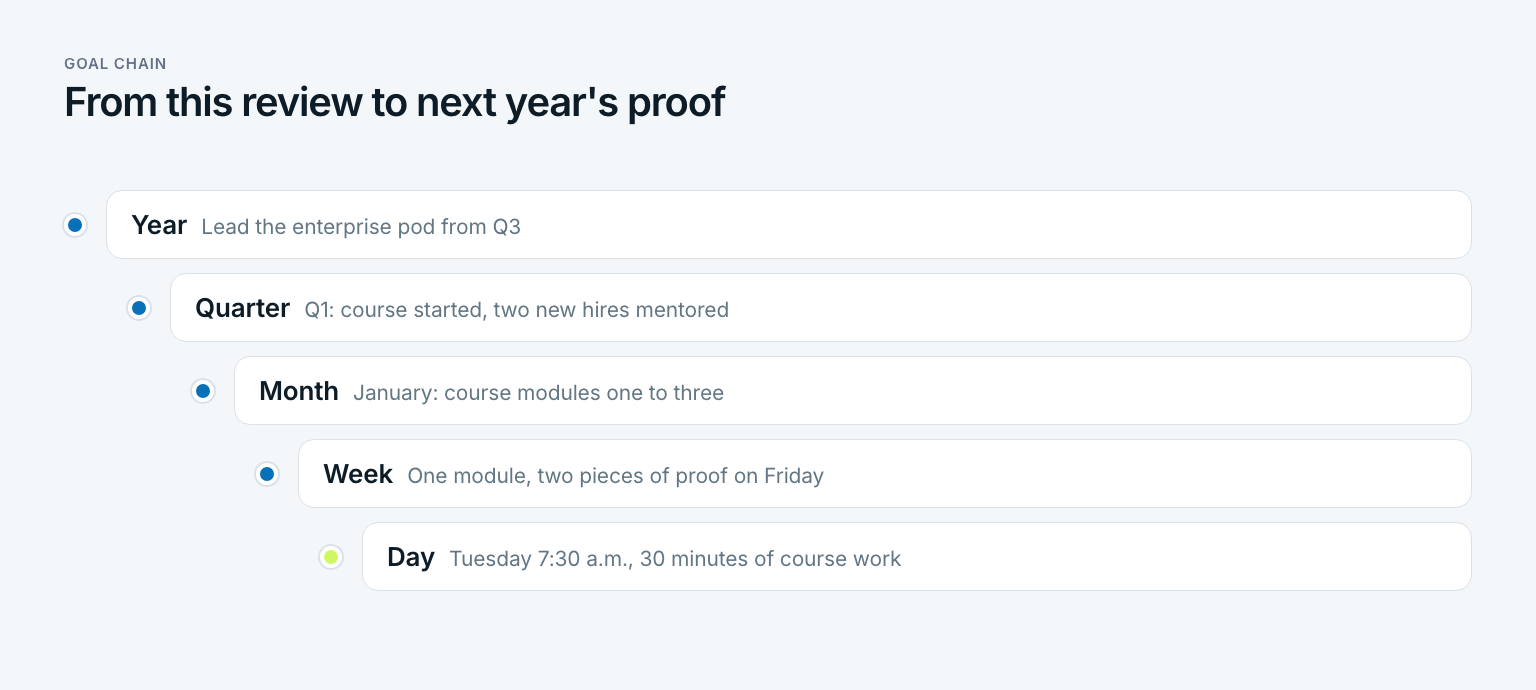
The week is the most important link in the chain. Every Friday Danielle spends ten minutes logging two pieces of proof: what got done, as a number, and what moved, with a date. The ten-minute weekly review shows how to set that up. Anyone who does this for 45 weeks has about 90 entries by December, and next year's self evaluation gets assembled from the list.
Gaapp is built around exactly this chain: a yearly goal at the top, then quarter, month, week, and day, with progress on each level rolling up. You see in June whether Q3 is still realistic. How a yearly goal turns into a path with milestones is covered in how to achieve goals.
Three questions before you hit submit:
- Does every goal on your form have a number your manager can check?
- Have you named at least one gap yourself, with its cause and the next step?
- Does your form end with an ask that has a date and a need?
Anyone who answers no to one of them has not written too modestly, but too vaguely. Danielle's second draft cut 20 minutes from her review, and the time went to the enterprise pod. In short: a self evaluation is not a verdict on you. It is the best briefing your manager will get all year.
Questions about self evaluations
How do I write my self-performance evaluation?
Start with proof, not adjectives. Collect numbers from your calendar, your notes, and your sent folder, then compare each goal's target with the actual result. Write every strength as result, proof, impact and every gap as gap, cause, next step. Rate yourself last and end with one growth goal and what you need for it.
How do I comment on my own performance examples?
Use the comment box for one of three things: your biggest contribution, your biggest gap with its fix, or what you need next. For example: When a billing error hit 17 of my accounts in August, I called every one within 48 hours, and all 17 renewed. A number and a date make the comment checkable instead of decorative.
How do I write my own self-assessment?
Cover five parts: goals and results, wins outside your goals, gaps and causes, working together, and growth. One page is enough if every sentence carries a number, a date, or a name. Leave out tasks that are already in your job description.
Can you give me some examples of personal performance goals?
Lead the enterprise pod from Q3, with a management course finished by the end of Q1. Hold 15 business reviews per quarter with my top accounts. Keep net revenue retention at or above 107 percent. Each goal has a number or a date and fits in one sentence.
Should I rate myself high or low on a self evaluation?
Neither. Rate what your proof supports and write the number next to the rating. Ticking the middle everywhere says nothing, and ticking the top everywhere means defending every line.
How long should a self evaluation be?
One page is usually enough. Three sentences per goal, two or three per gap, and one sentence for your growth ask. Most self evaluations only get longer by listing tasks that are already in the job description.
Last updated: 19 October 2026
Read next
 Leadership & Teams
Leadership Styles: Which One Fits Which Situation
Leadership styles are not personality types: 11 types compared, Lewin, Goleman, situational leadership and five steps to find the style that fits you.
14 min read
 Leadership & Teams
Retrospective: How Teams Learn From Every Sprint
A retrospective is not a blame session: what the word means, five phases, seven retrospective examples and action items that stick, shown on one team.
16 min read
 Leadership & Teams
How to Delegate Tasks: Hand Off Work, Keep Results
Delegation is not dumping work: five levels of delegation, seven steps, a handoff script and what to keep, shown on one marketing team.
15 min read