Situational Leadership: Match Your Style to the Task
Situational leadership is not improvising: the four Hersey and Blanchard styles, readiness levels and five steps, shown on one real team.

Contents
- 01Situational leadership: the Hersey and Blanchard model
- 02The four situational leadership styles
- 03Readiness: ability and willingness for one task
- 04Situational leadership examples from one real team
- 05Hersey vs Blanchard: two versions of the model
- 06How to apply the situational leadership model in five steps
- 07What the research says about situational leadership
- 08The three mistakes nobody notices
- 09Situational leadership in your goal chain, from year to day
- 10Your self-audit: are you really leading situationally?
- 11Situational leadership FAQ
Situational leadership is not improvising, and it is not a personality type. It is a way of choosing how much direction and how much support to give a person, based on how ready they are for one specific task. The best known version is the Hersey and Blanchard situational leadership model from 1969, which describes four styles from telling to delegating. Anyone who leads this way stops asking which style suits them and starts asking which style this task needs.
That sounds obvious. Most managers still lead with one favorite style and apply it to everyone. Some walk every person through every step, including the veterans. Others give everyone room, including the person who started on Monday. Both mean well, and both get half the team wrong.
Throughout this article you will follow Dana. She runs a four-person customer support team at a software company of about 60 people. Her yearly goal: by the end of November, 40 percent of customer questions should be answered by a new self-service help center instead of a ticket. In January the share was 8 percent. Her year shows what situational leadership looks like on a real team, where it slips, and what the numbers say after eleven months.
Situational leadership: the Hersey and Blanchard model
Paul Hersey and Ken Blanchard first published their idea in 1969 as the Life Cycle Theory of Leadership in the Training and Development Journal. The same year their textbook Management of Organizational Behavior carried it into business schools. The name Situational Leadership came later, in the 1970s. The model builds on the 3-D management style theory of Canadian researcher William Reddin, who had argued a few years earlier that effectiveness depends on the situation.
The core fits in one sentence: there is no single best leadership style, only the right one for a given person on a given task. That was a direct challenge to the research of the time, which was still hunting for the ideal leader. Hersey and Blanchard shifted the question from what a good leader is to what a good leader does in which situation.
The model works with two dimensions. The first is task behavior: how precisely you spell out what to do, how, when and by when. The second is relationship behavior: how much you listen, encourage, explain and involve. The two are independent. You can give lots of direction and little encouragement, or the reverse. Combining high and low on each axis produces the four styles.
Term: situational leadership style
A situational leadership style is not a fifth style next to autocratic or democratic. It is a rule for switching between styles. The style follows the needs of the person on a specific task, not the temperament of the manager, and that is what separates it from every model that declares one style correct.
The four situational leadership styles
Hersey and Blanchard label the four styles S1 to S4: telling, selling, participating and delegating. Each one matches one of four readiness levels, R1 to R4, explained in the next section. The table shows how they line up and what each style sounds like in a real conversation.
| Style | Direction | Support | Fits | What it sounds like |
|---|---|---|---|---|
| S1 Telling | high | low | R1: unable and unsure | “Here is exactly how to do it. We'll review it together on Thursday.” |
| S2 Selling | high | high | R2: unable but willing | “Let me walk you through it and explain why. What's still unclear?” |
| S3 Participating | low | high | R3: able but hesitant | “How would you approach it? Let's decide together.” |
| S4 Delegating | low | low | R4: able and willing | “The goal is clear and the approach is yours. Call me if you need me.” |
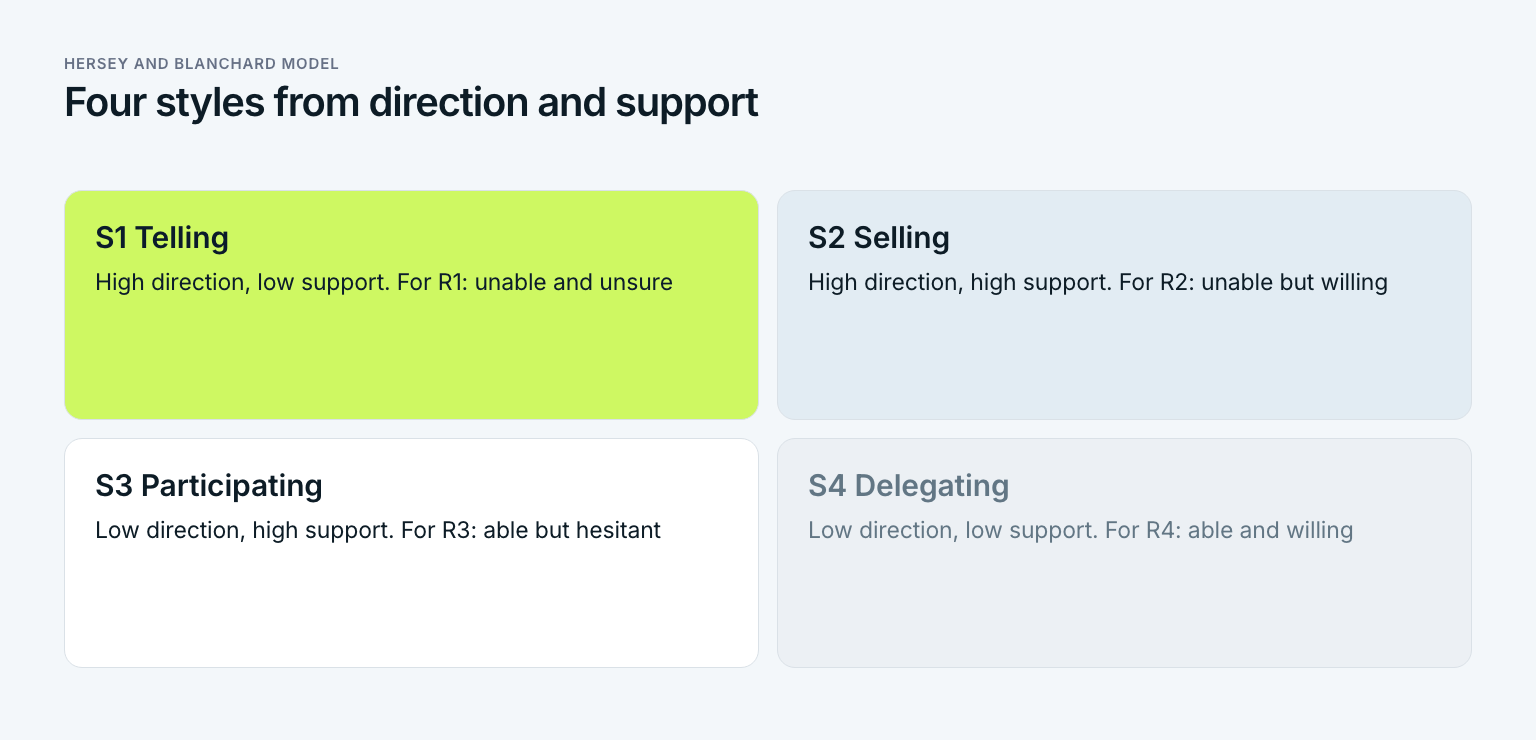
Telling means clear instructions and close follow-up. It can feel strict, yet for someone doing a task for the first time it is often a relief. Selling keeps the same level of direction but adds the why and invites questions. You still make the call.
Participating means you step back on direction and stay present on support. The person knows how to do the work but needs confidence or a sounding board, so you decide together. Delegating hands over both the task and the responsibility. You agree on the goal and the deadline, stay reachable, and stay out of the way. How to run that handover step by step is covered in how to delegate tasks.
One point gets lost in most summaries. Delegating is not the best style, and telling is not the worst. In short: every style is right when it matches readiness, and wrong when it does not.
Readiness: ability and willingness for one task
Readiness is the second half of the model. Hersey and Blanchard originally called it maturity, and Hersey later renamed it readiness. It has two parts: ability, meaning knowledge, experience and skill, and willingness, meaning motivation, confidence and commitment.
- R1: unable to do the task and insecure or unwilling.
- R2: unable to do the task yet, but motivated and confident.
- R3: able to do the task, but insecure or reluctant.
- R4: able to do the task and willing to own it.
The key is in three small words: for one task. Readiness is not a trait of a person. It is a snapshot for a specific activity. Mike on Dana's team has handled enterprise escalations for nine years and is clearly R4 there. Writing help center articles is new to him, and he doubts customers will read them. On that task he sits at R3. Same person, same morning, two different styles.
Whoever assigns readiness to the whole person turns a diagnostic tool into a label. And labels stick. How would you explain to a veteran that you suddenly check his work closely, unless you make clear it is only about the help center?
Term: readiness level
A readiness level describes how able and how willing a person is to complete one particular task. It never describes the whole person, and it changes with every new task. That is why situational leadership always starts with the question of which task is on the table, not who is sitting across from you.
Situational leadership examples from one real team
Models stay abstract until you see them applied to people. In January Dana listed the tasks behind the help center project: write articles, review them, tag tickets that could become articles, and track which articles customers rate as helpful. Then she assessed each person on the task that mattered most for them and picked a style.
Jordan: telling on the first articles
Jordan joined in January straight out of college and is nervous about writing anything customers will see. That is R1. Dana gives him an article template with five fixed sections, edits his first three drafts line by line, and talks each one through for ten minutes. After three weeks Jordan writes on his own and asks for harder topics. In April Dana moves him to S2.
Priya: from selling to participating and back
Priya has been on the team for a year and loves the idea of self-service. She has never written documentation. That is R2, so Dana sells: she shows her good and bad articles, explains why the company is betting on the help center, and answers every question. By April Priya seems confident and Dana shifts to S3. In May customers rate four of Priya's articles as unhelpful and her energy drops. Dana notices it in their weekly one-on-one and goes back to S2 for four weeks. By July Priya is back at R3, and in September she owns article quality for the whole team.
Mike: participating on a task he doubts
Mike can write clearly and knows the product better than anyone, but he does not believe in the project. That is R3. Dana does not give him instructions. She asks: which tickets do customers keep sending us, and how would you answer them once for everyone? Mike suggests starting with the 20 most repeated questions from the last quarter. Dana agrees, and they set the order together. On escalations she keeps delegating.
Elena: delegating from day one
Elena built a help center at her previous job. That is R4. Dana agrees on one goal with her, the article structure and search setup by the end of March, and one monthly review. Everything else is Elena's call. Dana was tempted to ask for weekly updates anyway. She did not, because Elena would have read it as distrust.
| Month | Questions answered by help center | Questions to Dana per week | Dana's leadership hours per week |
|---|---|---|---|
| January | 8 percent | 31 | 10 hours |
| March | 14 percent | 25 | 9 hours |
| May | 21 percent | 21 | 7 hours |
| July | 29 percent | 15 | 6 hours |
| September | 36 percent | 11 | 5 hours |
| November | 42 percent | 9 | 4 hours |
The table shows what situational leadership is really aiming for. Dana's leadership time drops because readiness rises and she can let go one style at a time. That means: done well, situational leadership makes itself unnecessary for each task, step by step. The dip in May is not a flaw in the model. It shows that readiness can fall, and the style has to follow it down.

Hersey vs Blanchard: two versions of the model
Anyone who researches situational leadership runs into two versions that look alike but differ in important ways. Hersey and Blanchard went separate ways in the late 1970s. Hersey continued the model as Situational Leadership through his Center for Leadership Studies. Blanchard developed his own version with Patricia Zigarmi and Drea Zigarmi, introduced in their 1985 book Leadership and the One Minute Manager and called SLII.
| Feature | Hersey: Situational Leadership | Blanchard: SLII |
|---|---|---|
| What is assessed | readiness from ability and willingness | development level from competence and commitment |
| Levels | R1 to R4 | D1 to D4 |
| Style names | telling, selling, participating, delegating | directing, coaching, supporting, delegating |
| Eager beginner | R2, so selling | D1, the enthusiastic beginner, so directing |
| How motivation moves | rises with ability | often drops after the start, then recovers |
The biggest difference concerns the beginner who starts out excited. Hersey rates that person R2 and moves straight to the explaining style. Blanchard rates them D1 and starts with clear direction, because enthusiasm tends to fade once the first problems hit. He calls the second stage the disillusioned learner.
For daily practice, which version you pick matters less than the idea underneath. Both ask you to separate ability from willingness and to match your style to them. Dana's experience with Priya in May fits Blanchard's curve rather well: excitement, a slump after the first bad ratings, then recovery.
How to apply the situational leadership model in five steps
The model only helps if you use it on a schedule. These five steps work because they move the diagnosis out of your head, onto paper and into a conversation with the person. For a team of four, the first round takes about an hour.
List tasks, not people
For each person, write down the two or three tasks that matter most in the next three months. Dana had two lines for Mike: escalations and help center articles. Without that list you end up rating people again instead of tasks.
Rate readiness per task
For each task, answer two questions separately. Can the person do this yet? Do they want to, and do they feel confident? Write the result as R1 to R4. Whoever blends ability and willingness into one gut feeling almost always picks the wrong style.
Compare notes with the person
Ask the person to rate themselves before you share your view. Dana and Mike disagreed: he put himself at R2 on articles, she had him at R3. The conversation about that gap was worth more than either rating. A regular [one-on-one meeting](/en/blog/one-on-one-meeting) is the natural place for it.
Name the style and agree on it
Say out loud which style you will use for which task and why. “I'm checking your work” becomes “on this task we'll review the first three together, then it's yours.” Agreeing on the style takes the sting of distrust out of close direction.
Review monthly and adjust
Readiness moves. Once a month, check whether someone is ready for the next style or, like Priya in May, needs more support again. Move one step at a time, never from S1 straight to S4.
The third step is the one most managers skip. It feels unnecessary because you already know the person. That is exactly why it pays off. Managers tend to judge ability fairly well and willingness and confidence surprisingly badly. To turn a readiness rating into a concrete learning plan, see the guide to the individual development plan.
What the research says about situational leadership
The model is one of the most widely taught frameworks in leadership training, and it is valued for being practical. Peter Northouse makes that point in his textbook Leadership: Theory and Practice: it is easy to understand, easy to apply and pushes managers to be flexible. The evidence behind it, though, is thinner than its popularity suggests.
Claude Graeff argued in the Academy of Management Review in 1983 that readiness is defined loosely and that the model never makes clear how ability and willingness combine into one level. In a 1997 review in The Leadership Quarterly he showed how often the model had changed between editions without empirical reasons for the changes.
Robert Vecchio tested the model in 1987 in the Journal of Applied Psychology with teachers and their principals. He found support mainly for one part: employees low in readiness did better with more structure. For the higher levels he found little effect. Gregory Thompson and Robert Vecchio tested three versions of the model in 2009 and reached a similar conclusion. The most robust finding was that new and inexperienced people benefit from clear direction.
What does that mean for you? Treat the model as a thinking tool, not a formula. The core idea of rating ability and willingness separately for each task costs nothing and holds up well. The exact rule that R2 always calls for S2 is a rule of thumb you should check against what you see.
The three mistakes nobody notices
The common mistakes in situational leadership are not dramatic. They come from good intentions, which is why they go unnoticed. Dana made all three in her first quarter.
The most common mistake: choosing the style by person instead of by task
Many managers rate their people once and then treat them the same way forever: veterans get freedom, new hires get control. But your most experienced person can be R1 on a new task, and your newest hire can be R4 on a familiar one. Anyone who leads by person instead of by task overwhelms some people and micromanages others, often the same person on different days.
- Switching styles without saying so. If you move from delegating to close follow-up without explaining it, the person reads it as distrust. One sentence about the task prevents that.
- Letting go too early. A strong start is not R4. Dana moved Priya to S3 in April because she looked confident. A slump after the first setbacks is normal and calls for more support, not less.
- Confusing delegating with disappearing. Delegating means little direction and little interference, not no goal and no contact. Without an agreed goal and a fixed review, delegating turns into abandoning.
All three mistakes share a root. They treat the style as the manager's decision. Situational leadership is really an agreement between two people about one task. Whoever takes that on board stops asking which style fits them and starts asking which style helps the other person right now.
Situational leadership in your goal chain, from year to day
A style needs a reference point. Without a goal you do not know which tasks matter, and without tasks you cannot rate readiness. A goal chain translates a yearly goal into quarters, months, weeks and days. Anyone who builds situational leadership into that chain sees at every level which task counts and which style it needs. For setting the goal itself with each person, see the guide to goal setting for employees.
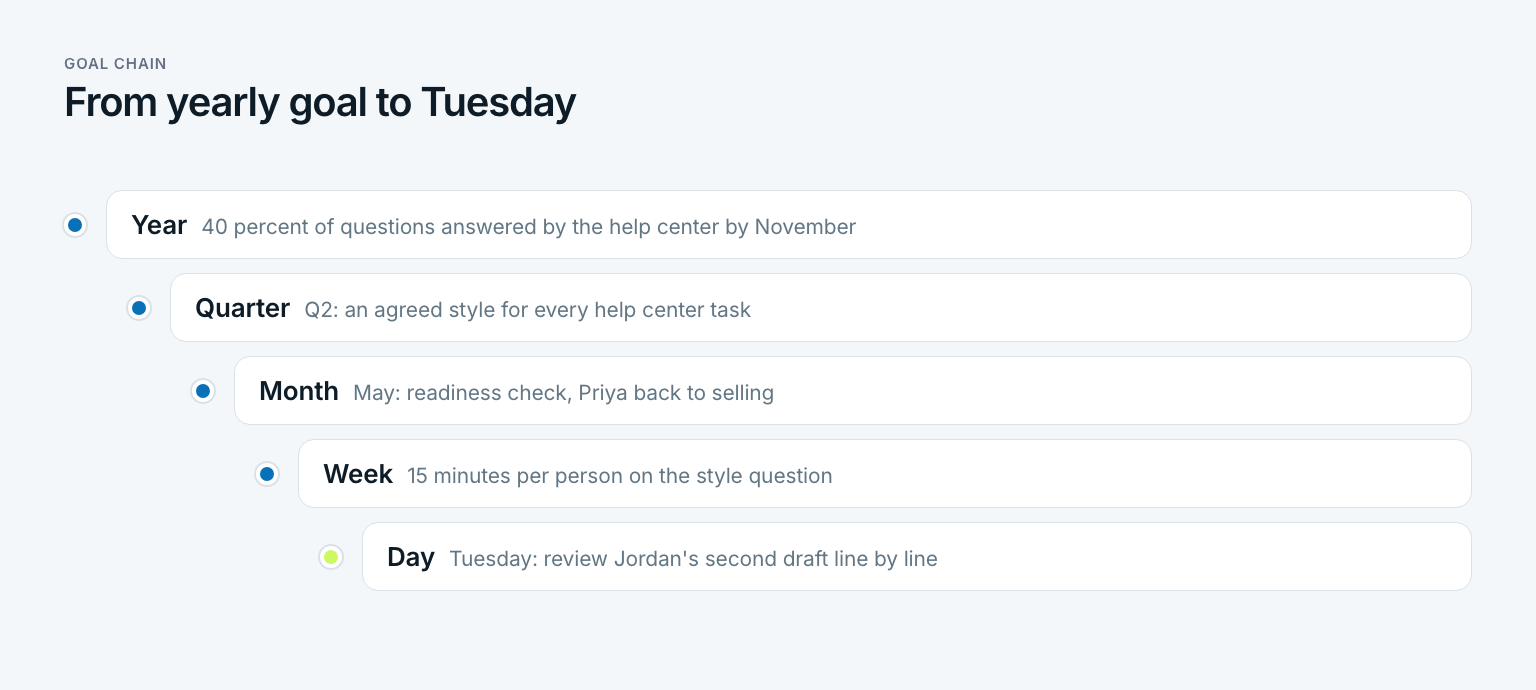
- Year: The goal has a number and a date. For Dana: 40 percent of customer questions answered by the help center by the end of November.
- Quarter: Every person has an agreed style for their main project task. In the second quarter that meant Elena delegating, Mike participating, Priya and Jordan in selling.
- Month: At month end you review readiness and adjust styles. In May that was the step back for Priya.
- Week: 15 minutes per person with one fixed question: on this task, do you need more or less from me right now?
- Day: At the daily level the style becomes an action, such as reviewing Jordan's second article draft on Tuesday.
For yourself, a personal leadership goal helps too, such as cutting your leadership time on one task in half by the end of the quarter. The guide to goals for managers shows how to make that measurable. In a goal app like Gaapp the whole chain lives in one shared space, so each person sees their weekly goal and agreed style next to the yearly goal.
Your self-audit: are you really leading situationally?
Three questions show whether you lead situationally or only think you do. Answer them in writing before you plan your next team meeting:
- Which style did you use with each person over the last two weeks, and on which task?
- With whom did you change styles in the last three months, and did you tell them?
- Which task did you delegate without agreeing on a goal and a review date?
If you write the same style for everyone on the first question, you are leading by habit. If the second question stays blank, either readiness has not moved, or you did not notice. Anyone who answers the third question with a task has probably not delegated there but let go. The difference usually shows only when something goes wrong.
Situational leadership is not about being more flexible than other managers. It is about asking, for each task, what this person needs from you right now, and then giving exactly that.
Situational leadership FAQ
What are the 4 situational leadership styles?
In the Hersey and Blanchard model the four styles are telling, selling, participating and delegating. They differ in how much direction and how much support the leader gives. Blanchard's later SLII version calls them directing, coaching, supporting and delegating.
What are examples of situational leadership?
A manager who edits a new hire's first drafts line by line, explains the why to an eager but inexperienced colleague, brainstorms with a skilled but skeptical veteran and fully hands a project to an expert is leading situationally. The point is that the same manager uses four styles in one week, matched to each person's readiness on each task.
What are the three main skills of a situational leader?
Blanchard, Zigarmi and Zigarmi describe them in Leadership and the One Minute Manager as diagnosis, flexibility and partnering for performance. Diagnosis means reading a person's competence and commitment on a task. Flexibility means being able to use all four styles, and partnering means agreeing on goals and the style with the person.
Who is a famous situational leader?
No historical leader is documented as using the model by name. Articles often point to sports coaches who adjust their approach to each player, which fits the idea but is interpretation, not evidence. The best known names linked to the model are its creators, Paul Hersey and Ken Blanchard.
What is the difference between Hersey and Blanchard situational leadership models?
Hersey's version rates readiness from ability and willingness on levels R1 to R4. Blanchard's SLII rates development level from competence and commitment on levels D1 to D4 and assumes motivation often dips after an enthusiastic start. As a result, an eager beginner gets selling in Hersey's model and directing in Blanchard's.
Is situational leadership supported by research?
Only partly. Studies such as Vecchio in 1987 and Thompson and Vecchio in 2009 mainly confirm that inexperienced employees benefit from more structure. They found little support for the finer matching at higher levels, so the model works best as a thinking tool rather than a formula.
Last updated: 22 October 2026
Read next
 Leadership & Teams
Leadership Styles: Which One Fits Which Situation
Leadership styles are not personality types: 11 types compared, Lewin, Goleman, situational leadership and five steps to find the style that fits you.
14 min read
 Leadership & Teams
Retrospective: How Teams Learn From Every Sprint
A retrospective is not a blame session: what the word means, five phases, seven retrospective examples and action items that stick, shown on one team.
16 min read
 Leadership & Teams
How to Delegate Tasks: Hand Off Work, Keep Results
Delegation is not dumping work: five levels of delegation, seven steps, a handoff script and what to keep, shown on one marketing team.
15 min read