Goals for Managers: Leadership Goals You Can Measure
Goals for managers are not team targets with your name on them: four areas, 18 leadership goals examples by career stage, five steps, one worked case.

Contents
- 01What goals for managers are, and what they are not
- 02Leadership goals vs. team goals vs. performance goals: who owns which
- 03The four areas of leadership goals
- 04Where a manager's week actually goes: Marcus's two weeks
- 05Manager goals examples: 18 leadership goals by career stage
- 06How to set leadership goals in five steps
- 07How to measure leadership goals without grading yourself
- 08Three mistakes nobody notices
- 09Leadership goals in the goal chain: from year to Tuesday
- 10Your self-audit before next quarter
- 11Frequently asked questions about goals for managers
Goals for managers are not team targets with your name on them. They are the two or three goals you use to measure your own work as a manager: where your hours go, how your people grow, what you hand off and what you decide. The team target measures what the group delivers. A leadership goal measures what you contribute to it.
You need three things to set them well: an honest look at your calendar, a clear picture of your role, and goals with a number, a deadline and a source. This guide works through all three with Marcus, who was promoted from top sales rep to sales manager seven months ago. Along the way you get four areas where leadership goals live, 18 manager goals examples sorted by career stage, five SMART rewrites, a five-step process, and the three mistakes that make a manager's own goals vanish by the end of the quarter.
What goals for managers are, and what they are not
A leadership goal is a goal about your own management work. It has a number, a deadline and a place where you can read the result, just like any good goal. The difference is the subject. It does not measure what your team produces. It measures what you do so the team can produce it. "Grow new revenue by 10 percent" is a team goal. "Spend four hours a week coaching instead of closing my reps' deals" is a leadership goal.
Andrew Grove put the idea into a formula in High Output Management in 1983: a manager's output is the output of their organization plus the output of the neighboring organizations they influence. That sounds like the team target is your goal after all. In the end it is. You just cannot steer it directly. What you can steer are the levers: your time, your conversations, your decisions, your handoffs. That means: anyone who watches only the team number will see at the end of the quarter that something is missing, but not what they should have done differently. How a team sets that number together is covered in the guide to team goals.
Julie Zhuo, who became a manager at Facebook in her mid-twenties, describes three levers in The Making of a Manager from 2019: purpose, people and process. Add the question of where your own time goes and you get the four areas where leadership goals live. First, though, the distinction that keeps most manager goals in the wrong box.
Leadership goals vs. team goals vs. performance goals: who owns which
Several kinds of goals run side by side in every team. None of them is wrong. Each one is built for something else, and each one has a different owner. The only question is: which one is yours?
| Goal type | Who owns it | What it measures | Example from Marcus's team |
|---|---|---|---|
| Team goal | the whole team | the shared result | $1.2M in new annual contract value per quarter, last quarter 86 percent |
| Performance goal | one rep, agreed with you | their contribution to the team goal | Jordan books 12 qualified demos a month |
| Development goal | one rep | a skill they can prove | Jordan runs a pricing negotiation without help |
| Leadership goal | you | your contribution as a manager | cut time on reps' deals from 17 to four hours a week |
How to set goals with the people on your team is covered in the guide to goal setting for employees. How a wish to grow becomes a skill someone can prove is in the piece on professional development goals. This article is about the last row, the one most goal systems leave blank.
Why is it blank? Because nobody asks for it. Leadership asks about the team number. Your reps ask about their own targets. Nobody asks about your leadership goals, not even your own boss in your review, where the team result usually fills the form again. In short: whoever does not set their own leadership goals does not have any.
Leadership goal vs. leadership value
A leadership value describes how you want to lead, such as "I'm available to my team." It is built for attitude, not measurement. A leadership goal turns the value into a number: "I answer every question from my team the same business day, checked on two sample days a month." Only then can you see whether the value shows up on a Tuesday.
The four areas of leadership goals
Leadership goals sit in four areas. Two look inward, at you and at the people you lead. Two look outward, at the conditions for results and at the organization around your team. Anyone who sets a goal in all four at once has too many. Two or three areas are enough for a year.
- Lead yourself. Your time, your energy, your role. The classic goal here is letting go of the work that got you promoted. Peter Drucker opens The Effective Executive from 1967 at exactly this point: effective executives do not start with their tasks, they start with their time.
- Lead people. One-on-ones, feedback, growth, trust. This is where you find out whether someone grows because of you or in spite of you.
- Enable results. Clarity about goals, priorities and decisions. Not the result itself, but the conditions for it: does every person know what they are measured on this week?
- Shape the organization. Up, sideways and forward: working with other teams, fixing processes, building a bench. Grove calls this influence on neighboring organizations.
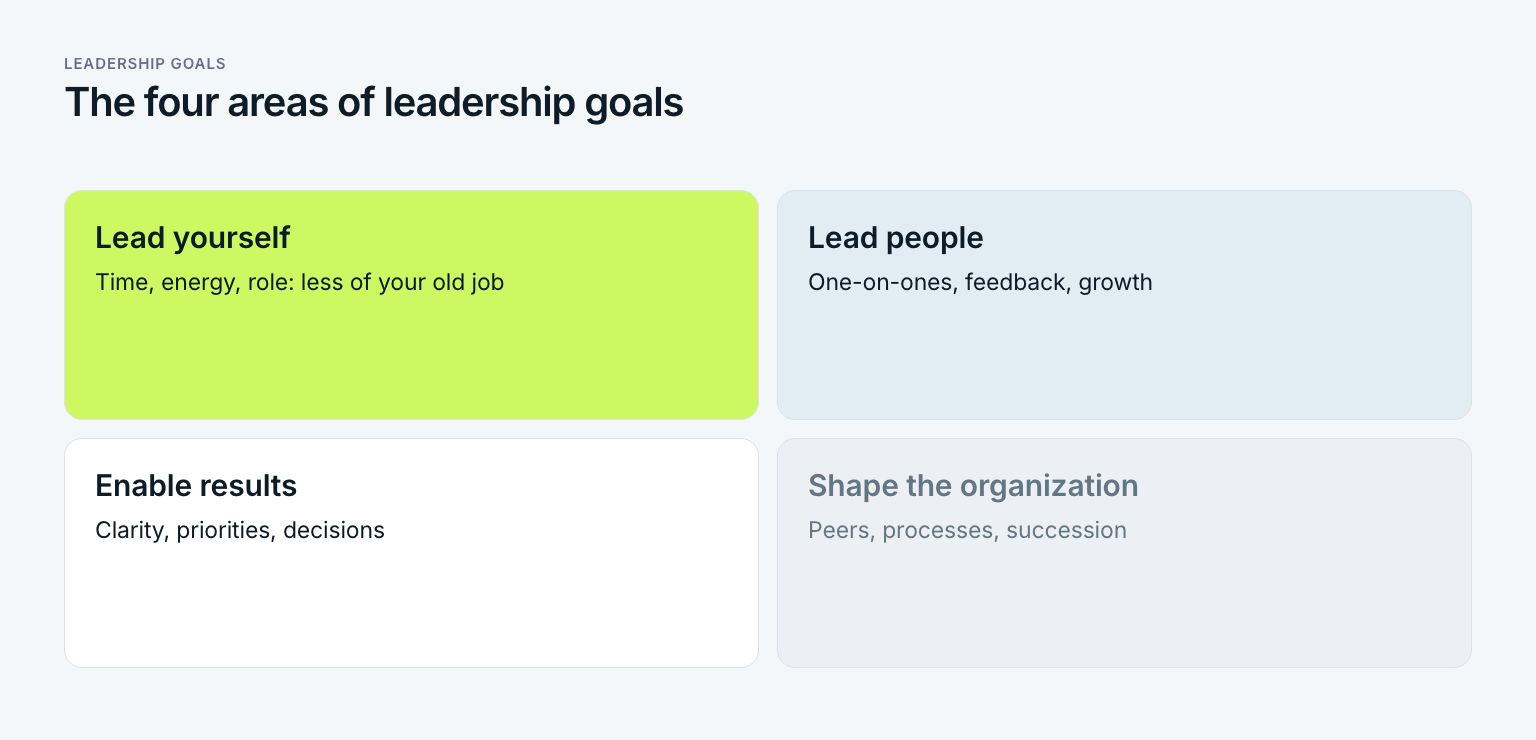
Which area comes first depends on your career stage. First-time managers almost always need a goal in the first area, because the old job still owns their calendar. Managers of managers usually need one in the fourth, because their impact runs through other leaders. That means: the areas are the same for everyone, the order is not.
Where a manager's week actually goes: Marcus's two weeks
Marcus is 37 and runs a team of seven account executives at a B2B software company in Denver. Seven months ago he was the best closer on that team, so he got the job. His VP gave him one target: $1.2 million in new annual contract value per quarter. Last quarter the team hit 86 percent. Marcus has no goals of his own. He feels busy all the time and still does not feel like he is managing.
Before writing any goals, he logs his hours every evening for two weeks. That is Drucker's first step, and it is uncomfortable. Here is what came out:
| What Marcus did in two weeks | Hours | Leadership work? |
|---|---|---|
| Jumped onto reps' calls to close their deals | 24 h | No |
| Worked his own leftover accounts | 10 h | No |
| Forecast calls, CRM cleanup, reports | 16 h | Partly |
| Meetings with marketing, customer success and his VP | 14 h | Partly |
| Email and Slack | 8 h | Partly |
| Hiring interviews for an open seat | 8 h | Yes |
| Call reviews and coaching | 7 h | Yes |
| One-on-ones with reps | 5 h | Yes |
| Thinking and planning without interruptions | 4 h | Yes |
| Total | 96 h | 24 h leadership work, 34 h rep work |
Ninety-six hours in two weeks, 48 a week. Only 24 of them were leadership work in the narrow sense, a quarter. Another 34 hours, more than a third, went to work his reps could do: closing their deals and running his old accounts. For seven people, he had five hours of one-on-ones. That is about 40 minutes per rep in two weeks.
Does that make Marcus a bad manager? No. He is doing what he does best, and every deal he closes is a real deal. That is exactly the problem. Marshall Goldsmith named it in a book title in 2007: What Got You Here Won't Get You There. Anyone who keeps doing the job they were promoted for is missing from the job they are now paid for. And every time Marcus closes a deal for Jordan, Jordan learns that Marcus will close the next one too. Handing deals back is also one of the quietest ways to motivate employees, because people care more about work that is theirs and visibly moves forward.
That means: Marcus's first leadership goal is already in the table. It is not "be a better leader." It is stop closing other people's deals. How he turns that into a goal with a number is in the steps below. First, the examples, sorted by the stage you are at right now.
Manager goals examples: 18 leadership goals by career stage
Good leadership goals depend on where you stand. Whoever was just promoted is fighting the old role. Whoever has led a team for years is fighting routine and blind spots. Whoever leads other managers only has impact through them. The 18 examples below are written so you can copy them and plug in your own number and date.
First-time manager: your first year
- Listen first. By the end of month three, hold a 45-minute conversation with every person on the team, using the same three questions: what works, what bugs you, what should I know?
- Run one-on-ones. Starting now, 30 minutes every week or every other week with each person, and at least 90 percent of them actually happen.
- Let go of the old job. Cut your own individual contributor work from 20 to eight hours a week by the end of the quarter, measured in your calendar.
- Hand off decisions. Each month, give one decision you used to make to the team, and write it on a running list.
- Have the hard talk. By month six, hold the first conversation about a behavior that has bothered you for weeks, instead of quietly covering for it.
- Clarify expectations upward. Once a month, 20 minutes with your own manager: what will you judge me on this quarter?
Experienced manager: years two to five
- Build a backup. By year end, two people on your team can cover for you for two full weeks. The test is a vacation without a phone call.
- Ask for feedback. Twice a year, three anonymous questions to your team, with an average of at least four out of five on clarity.
- Kill something. Every quarter, retire one process nobody would miss: a meeting, a report, an approval step.
- Give feedback fast. Deliver every piece of critical feedback within three business days of the moment, tracked with a simple tally.
- Protect thinking time. Block four hours a week with no meetings, and keep the block in at least 80 percent of weeks.
- Make talent visible. Every six months, put one person from your team on a cross-team project and let them present the result.
Manager of managers
- Secure succession. By the end of the quarter, every team lead has a named person who could step in tomorrow.
- Listen one level down. Each month, three 30-minute skip-level conversations with people on your teams, without their lead, asking: what is slowing you down?
- Explain the direction. By the end of January, fit the three department goals on one page and walk every team through them yourself for an hour.
- Push decisions down. By mid-year, move 80 percent of approvals under $5,000 to your team leads.
- Cut meeting load. Lower your meeting time from 60 to 40 percent of the week, measured over four weeks in your calendar.
- Change one behavior. Pick one habit that holds you back and collect suggestions from peers for four weeks, the feedforward method Goldsmith describes.
Check the verb before you copy any of them. Every example starts with something you do or stop doing, not something your team achieves. In short: the subject of a leadership goal is you.
SMART goals for managers: five before and after
Most leadership goals start as good intentions. The SMART check turns them into something you can track. The full method, with more examples, is in the guide on how to write SMART goals. For managers, these five rewrites cover the usual suspects:
| Vague intention | SMART leadership goal |
|---|---|
| Be a better coach | Review two recorded calls per rep each month and send one written note within 48 hours, through March 31 |
| Delegate more | Hand three recurring tasks to named people by November 30 and stop doing them, checked in my calendar |
| Communicate better | Raise the team pulse score on "I know what matters this week" from 2.8 to 4.0 by December 31 |
| Be more available | Answer every question from my team the same business day, checked on two sample days a month |
| Develop my people | Have one rep run a full pricing negotiation without me by the end of Q1 |

How to set leadership goals in five steps
Five steps take you from a calendar log to two or three leadership goals. Together they take about two hours, spread over two weeks. Marcus went through them in October.
Log your time, two weeks
Every evening for two weeks, spend five minutes writing down where your hours went. Rough categories are fine. At the end, mark every line: leadership work, individual work, or both. For Marcus the result was 25 percent leadership and 35 percent rep work.
Describe your role in one sentence, 20 minutes
Ask yourself: what should be running on my team in twelve months without me in the room? Marcus wrote: "Every rep closes their own deals, and I spend my time making them better at it." That sentence is not a goal yet. It is the yardstick you test your goals against.
Pick two or three areas, 15 minutes
Put the four areas next to your time log. Where is the biggest gap between your sentence and your week? Marcus picks lead yourself, lead people and enable results. He consciously postpones shape the organization to next year.
Write one goal per area with number, date and source, 40 minutes
Use one sentence pattern: I change X from current to target by date, measured in source. Marcus's first goal: I cut the time I spend on reps' deals and my old accounts from 17 to four hours a week by December 31, measured in my calendar. His second: I hold a 30-minute one-on-one with each of my seven reps every week, and at least 90 percent of them happen.
Add a voice from your team, 15 minutes
A leadership goal that only you measure only measures your perception. Pick one statement your team rates anonymously every four weeks on a scale of one to five. Marcus's third goal depends on it: "I know which three deals matter most this week" should rise from 2.8 to at least 4.0.
Marcus stops at three. Whoever runs five personal goals on top of a team target and a full pipeline ends up with room for none of them. And what about the $1.2 million? That stays the team goal. His leadership goals are his bet on how the team gets there.
How to measure leadership goals without grading yourself
Leadership goals have a reputation for being hard to measure. That is only half true. The impact of leadership is hard to measure. The behavior of leadership is easy to count. Anyone who counts their one-on-ones does not yet know if they were good. But they know if they happened, and without that they never get good.
| Area | Metric | Source | Rhythm |
|---|---|---|---|
| Lead yourself | hours of individual contributor work per week | calendar | weekly |
| Lead yourself | blocked thinking time that actually happened | calendar | weekly |
| Lead people | share of one-on-ones that took place | calendar | weekly |
| Lead people | critical feedback given within three business days | tally | weekly |
| Enable results | team pulse on clarity, one to five | anonymous survey | every four weeks |
| Shape the organization | decisions the team made without you | decision log | monthly |
The table holds two kinds of metrics. Counts like hours and meetings tell you whether you are doing what you said you would. The pulse question tells you whether it works. Whoever only counts can be green every week and still have a team that does not know where it stands. Whoever only asks sees the effect but not the cause. You need both.
Edwin Locke and Gary Latham spent decades showing that specific, challenging goals lead to better performance than being told to do your best. For leadership goals, "I want to be there more for my team" is the do-your-best version. It feels good and changes nothing. A one-on-one with a fixed agenda is the easiest place to start, and the guide to the one-on-one meeting has questions you can use from week one.
Three mistakes nobody notices
All three look reasonable at the start. Only after a quarter do you notice that nothing about how you lead has changed, even though your goal sheet was neatly filled out.
The most common mistake: copying the team target
"Hit 100 percent of quota" sits on a lot of managers' goal sheets. It is honest and still not a leadership goal. It describes the result of seven people, not your contribution to it. Anyone whose only goal is the quota will close deals themselves the moment the team falls behind, and end up back at 24 hours of rep work.
Second: activities instead of behavior. "Attend a leadership training" is an activity, not a goal. Training is often a good investment. It just does not tell you whether anything runs differently afterward. The goal is the behavior people can see after the course, such as giving critical feedback within three business days.
Third: goals without your team's voice. Leadership happens in other people. Whoever measures leadership goals only in their own calendar is grading their own homework. After six weeks Marcus would have said: on track, 92 percent of one-on-ones happened. The pulse score was still only 3.1. The meetings took place, but they were pipeline reviews. Only when he borrowed a question from Michael Bungay Stanier's The Coaching Habit, "What's the real challenge here for you?", did the score move. Coaches open sessions with questions like that when they set coaching goals with clients.
Leadership goals in the goal chain: from year to Tuesday
A leadership goal written in October that shows up again in December has steered nothing for two months. It has to reach down into the week and the day, like any other goal. For Marcus's first goal, the chain looks like this:
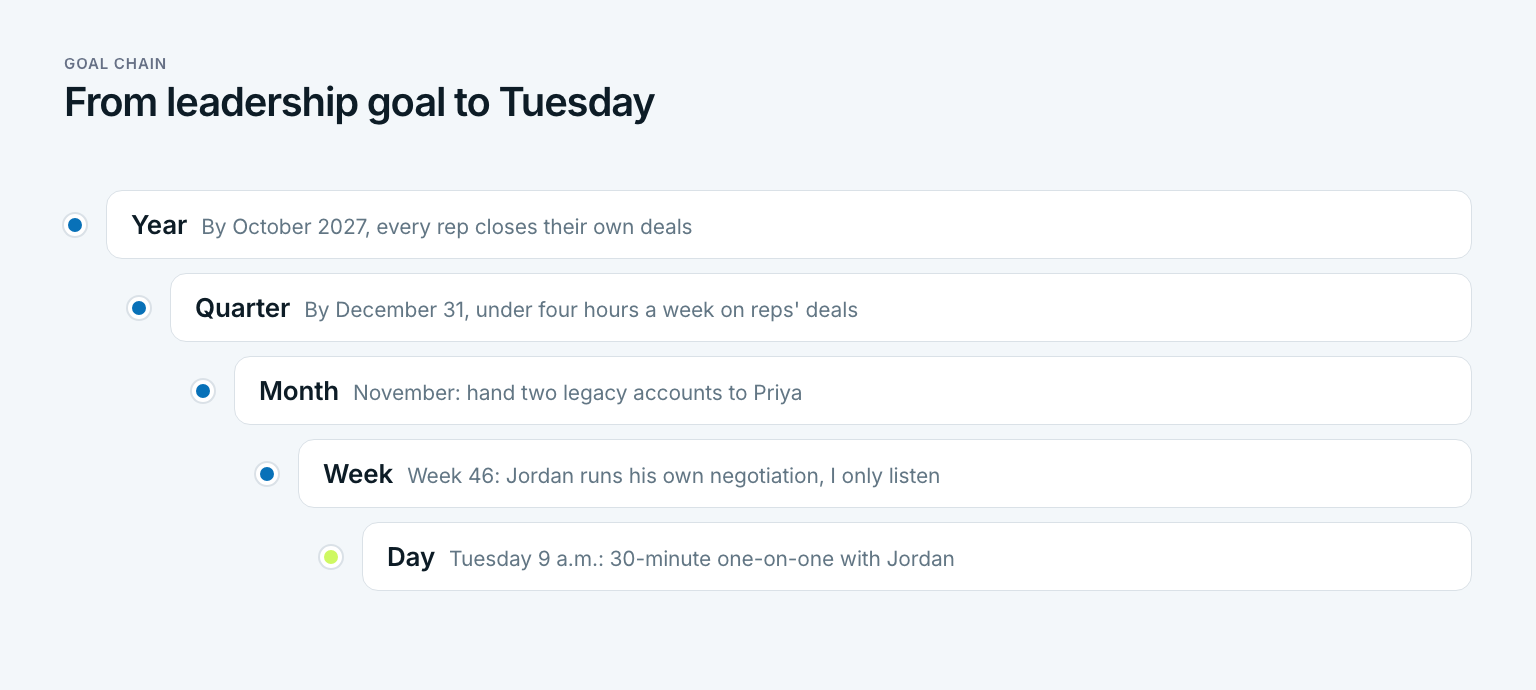
The yearly goal is the sentence from step two, with a date: by October 2027, every rep closes their own deals. The quarterly goal is the first measurable milestone, under four hours a week on reps' deals. In November Marcus hands his two remaining legacy accounts to Priya. In week 46 Jordan runs a pricing negotiation on his own, and Marcus is on the call but stays muted. On Tuesday he asks Jordan in their one-on-one: what was hard about that call?
The week is where leadership goals disappear most often. A big deal wobbles on Monday, a rep calls in sick on Wednesday, and by Friday Marcus is closing again. That is why your weekly review needs its own line: how many hours of rep work this week, and which one-on-one got skipped? Ten minutes on Friday is enough. In Gaapp your leadership goals and team goals sit in the same chain, so on Monday you see both side by side.
After ten weeks Marcus is at five hours of rep work instead of 17. The pulse score is at 3.8. The team closed 94 percent of its quarterly number. Did he hit the team target? Not yet. But he knows which lever works now, and he pulls it every week.
Your self-audit before next quarter
Five questions show you whether you have leadership goals or just a team target with your name on it. Answer them in writing, not in your head:
- How many hours last week did you spend on work someone on your team could have done?
- When did you last talk to each person on your team about something other than a current task?
- Which decision did your team make last month without you?
- What would your team say if you asked what they are measured on this week?
- Which of your goals starts with "I" and has a number in it?
Whoever has no answer to the last question starts at step one: two weeks of calendar. Goals for managers are not an add-on to the team target. They are your answer to the question of what you will do differently to reach it.
Frequently asked questions about goals for managers
What are examples of SMART goals for managers?
A SMART goal for a manager names a behavior, a number and a date. Examples: review two recorded calls per rep each month and send one written note within 48 hours through March 31, or cut individual contributor work from 17 to four hours a week by December 31, measured in your calendar. Both describe what you do, not what the team delivers.
What are 5 good goals for a manager?
Five goals that fit most managers: hold regular one-on-ones with at least 90 percent attendance, cut your own individual contributor work to a set number of hours, hand one decision a month to the team, give critical feedback within three business days, and build one person who can cover for you. Pick two or three, not all five, and add your own numbers.
What are the 10 examples of goals?
There is no official list of ten. For managers, ten useful examples are: listening tours, one-on-ones, letting go of old work, handing off decisions, fast feedback, a trained backup, protected thinking time, retiring one process per quarter, skip-level conversations, and a team pulse on clarity. The 18 examples above give each one a number and a date.
What are some good goals for leadership?
Good leadership goals measure your own behavior, not the team result. Strong ones include building a backup who can cover for you, raising your team's clarity score on a short anonymous survey, and moving decisions closer to the people doing the work. Each should have a number, a deadline and a source you can check.
How many goals should a manager have?
Two or three personal leadership goals per year are enough, on top of the team targets you are accountable for. More goals crowd each other out, because leadership work already competes with individual work and meetings for the same hours. Pick each goal from a different area so they cover different levers.
Who should set a manager's goals?
In most companies, the manager's own boss sets the goals, usually focused on team results. The leadership goals themselves are best proposed by the manager, because only they know where their week goes. Bring two or three written goals to your review and get them confirmed there.
Last updated: 14 October 2026
Read next
 Leadership & Teams
Leadership Styles: Which One Fits Which Situation
Leadership styles are not personality types: 11 types compared, Lewin, Goleman, situational leadership and five steps to find the style that fits you.
14 min read
 Leadership & Teams
Retrospective: How Teams Learn From Every Sprint
A retrospective is not a blame session: what the word means, five phases, seven retrospective examples and action items that stick, shown on one team.
16 min read
 Leadership & Teams
How to Delegate Tasks: Hand Off Work, Keep Results
Delegation is not dumping work: five levels of delegation, seven steps, a handoff script and what to keep, shown on one marketing team.
15 min read