SMART Goals for Work: Examples by Role and Industry
SMART goals for work are not review-form slogans. Over 30 examples by role, industry and career stage, each with its metric, plus a template.

Contents
- 01What makes a SMART goal for work different from a personal one
- 02The four kinds of work goals: volume, quality, speed, skill
- 035 SMART goals examples for work that fit almost any job
- 04SMART goals examples for work, by role
- 05Professional SMART goals by industry
- 06SMART goals for employees at every career stage
- 07Three mistakes that make work goals impossible to score
- 08How to set SMART goals at work in five steps
- 09Your work goal in the goal ladder: year, quarter, month, week, day
- 10Frequently asked questions about SMART goals for work
SMART goals for work are not slogans you paste into a performance review form. A SMART goal for work is one sentence with a result, a number your company already tracks, and a date, and the right number depends on your job: close rate in sales, days to close the books in accounting, time to restore service in IT. Anyone who knows the metric behind their role can write a solid goal in ten minutes. Anyone who doesn't ends up writing “improve processes.”
Dana was promoted in August to lead the seven-person accounts receivable team at an HVAC parts distributor in Columbus, Ohio, with about 220 employees. Every employee there enters three SMART goals for 2027 into the HR system by November 20, and managers approve them by December 15. Dana first pulled her team's goals from the last cycle. She could score six of 21 without an argument. The other 15 said things like “enhance customer relationships” and “drive efficiency.” So she asked peer managers in sales, the warehouse, IT, marketing and HR one question: Which number does your team already look at every week? Their answers became the examples below.
If you want the five letters explained one by one, start with SMART goals. If you already have a vague draft, how to write SMART goals walks through the edits sentence by sentence. This guide answers the question that comes before both: Which number belongs in which job?
What makes a SMART goal for work different from a personal one
A work goal has a second reader. At home, you alone decide whether you hit your goal. At work, your manager reads it on the due date, HR often reads it too, and sometimes a bonus depends on it. That means: The number has to come from a place both of you can see.
This creates three questions a personal goal never needs. First: Which number does your company already track for your role? Second: How much of that number do you actually move with your own work? Third: Who reads it on the due date, and where? Whoever answers these three questions has half the goal written before the first word goes into the form.
Term: system of record
The system of record is the place where the number in your goal lives: the CRM, the help desk, the general ledger, the scheduling app, the warehouse system. A goal without a system of record is measurable on paper and impossible to score in practice, because on the due date someone has to piece the number together from memory. Dana's first rule for her team is simple: Every goal names its system of record in the sentence.
In the 15 goals Dana could not score, the problem was rarely effort. It was the missing source. “Improve customer satisfaction” appeared in four goals on her team alone, and the company had never run a customer survey. So the reviews were scored on gut feeling. Without a source, a goal turns into a conversation topic.
The four kinds of work goals: volume, quality, speed, skill
Almost every work goal measures one of four things. Volume counts units, dollars or accounts. Quality counts errors, complaints or rates. Speed measures duration or on-time delivery. Skill measures a new ability through proof that someone else can check. Which of the four fits your role decides how your sentence sounds.
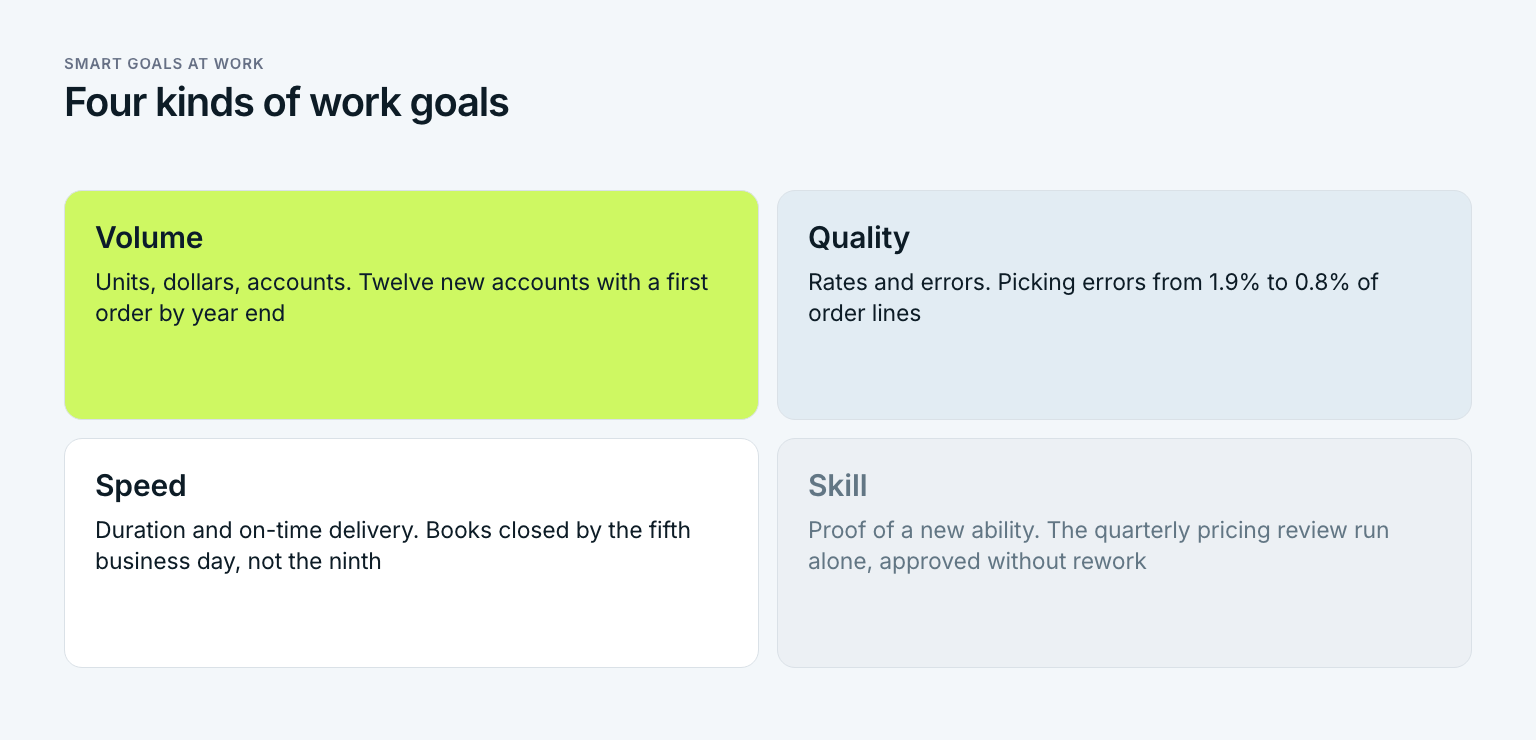
The split matters because each kind has its own trap. Volume goals tempt you to count activity: 40 calls are not 40 meetings. Quality goals need a rate, or errors drop simply because less work got done. Speed goals need a clear start and end point for the clock. Skill goals need proof a third person can verify: an exam, a certificate, or a task you complete on your own for the first time.
So which kind should you pick? For most roles, the answer is one goal from volume, quality or speed for the day job, and one skill goal for your own growth. Dana's company asks for three, so the third goes to a project. How to turn a skill goal into a plan with proof is covered in professional development goals.
5 SMART goals examples for work that fit almost any job
If you need a starting point before you look up your role, these five patterns cover most jobs. Swap the numbers, keep the structure.
- Volume. By December 31, 2027, sign twelve new accounts with a first order of at least $5,000, up from five in 2026, counted in the CRM.
- Quality. By September 30, 2027, billing complaints drop from 30 a month to fewer than ten, counted in the complaint log.
- Speed. By March 31, 2027, the books close by the fifth business day of the following month, down from the ninth, based on the sign-off date in the ERP.
- Skill. By June 30, 2027, run the quarterly pricing review on my own, shown by one review my manager approves without rework.
- Backup. By October 31, 2027, a second person on the team can process refunds without my help, proven by one full week I spend out of the office.
Each sentence has the same five parts: a date, a result, a starting value, a target value, and the place where the number lives. That is the whole pattern.
SMART goals examples for work, by role
The examples come from Dana's conversations with her peers. Each one names a starting value, a target, a date and a system of record. The numbers are theirs, yours will differ. Copy the structure, not the values.
Sales
Revenue is the obvious sales goal and often the weakest one, because prices, supply and the economy write half the number. The stages before revenue are easier to steer: quotes, close rate, repeat orders.
- By June 30, 2027, raise my close rate on quotes over $5,000 from 21% to 28%, measured as a six-month figure in the CRM.
- By December 31, 2027, 60% of my contractor accounts that order in the first quarter order again in the fourth, up from 47% in 2026, read from the CRM.
Customer service
In service, what counts is how many issues get solved on the first contact. Every callback costs twice, once for the customer and once for the team.
- By March 31, 2027, resolve 75% of order status calls on the first contact, up from 61%, quarterly figure from the help desk.
- By September 30, 2027, cut the average hold time on the main line from 3 minutes 40 seconds to under 90 seconds, read from the phone system report.
Software engineering and IT
Good IT goals measure what users feel: downtime, response time, time to fix. Closed tickets and lines of code are activity, not impact.
- By June 30, 2027, cut mean time to restore for priority one incidents from 5 hours to 90 minutes, measured in the incident log.
- By September 30, 2027, ship releases every two weeks instead of every six, with no more than one rollback per quarter, tracked in the deployment pipeline.
Marketing
Marketing invites reach numbers that nobody in sales ever feels. A better goal measures what arrives at the next step in the company.
- By December 31, 2027, generate 150 qualified leads from the website, up from 85 in 2026, counted in the CRM with the source set to website.
- By April 30, 2027, publish six customer case studies, one per product line, up from one, each approved in writing by the customer.
HR and recruiting
HR follows the same rule as everyone else: count the effect, not the number of programs.
- By December 31, 2027, cut first-year turnover from 24% to 15%, calculated from the HR system at year end.
- By March 31, 2027, every new hire has a 30-60-90-day plan signed by their manager in week one, up from about a third today, checked in the onboarding files.
Accounting and finance
In accounting, speed and cash are the numbers leadership feels. These are Dana's own goals for 2027.
- By December 31, 2027, reduce days sales outstanding from 52 to 42, read from the monthly accounts receivable aging report.
- By June 30, 2027, cut invoices more than 60 days past due from $610,000 to $350,000, read from the aging report on the last business day of the month.
Project management
Project goals come with a built-in date, the go-live. What they often miss is a second number: budget, or on-time delivery across several projects.
- By May 15, 2027, the new warehouse management system goes live in the Dayton branch at no more than 5% over budget, tracked on the project cost center.
- By December 31, 2027, 80% of my milestones hit the date in the baseline plan, up from 57% in 2026, measured in the project tool.
Operations, warehouse and manufacturing
On the floor, the numbers usually exist already, often on a board next to the line. That makes these roles the easiest ones to write SMART goals for.
- By March 31, 2027, ship 98% of orders received before 2 p.m. on the same day, up from 90%, measured in the warehouse management system.
- By September 30, 2027, cut picking errors from 1.9% to 0.8% of order lines, monthly figure from the returns report.
Managers and team leads
Managers have one twist. The team's result belongs in the team's goals. A manager's personal goal measures what the manager does so the team can get there. How managers and employees connect their goals is covered in goal setting for employees.
- By June 30, 2027, each of the three critical tasks on my team has a trained backup, up from none, proven by one day where the backup does the task alone.
- By December 15, 2027, all seven people on my team have goals that HR can score without a follow-up question, up from two of seven last cycle.
Administrative and executive assistants
Admin work is often called hard to measure. That holds only as long as you count tasks. Whoever measures turnaround time finds a number quickly.
- Starting April 1, 2027, expense reports are reimbursed within 10 business days of submission, down from an average of 21, read from the accounts payable report.
- By June 30, 2027, prep time for the monthly leadership meeting drops from 3 hours to 1 hour, using one fixed template, tracked in my own time log.
| Role | Typical metric | System of record | Kind |
|---|---|---|---|
| Sales | Close rate, repeat orders | CRM | Volume, quality |
| Customer service | First-contact resolution, hold time | Help desk, phone system | Quality, speed |
| IT and engineering | Time to restore, release frequency | Incident log, pipeline | Speed |
| Marketing | Qualified leads, approved case studies | CRM, content calendar | Volume |
| HR | First-year turnover, onboarding plans | HR system, onboarding files | Quality |
| Accounting | Days sales outstanding, close date | Aging report, ERP | Speed, volume |
| Project management | Go-live, budget, milestones | Project plan, cost center | Speed |
| Operations | Same-day shipping, picking errors | Warehouse system, returns report | Quality, speed |
| Managers | Backups trained, goals HR can score | Coverage plan, HR system | Skill |
| Assistants | Turnaround time, prep time | Accounts payable, time log | Speed |
What all 20 sentences share: None of them measures something that would have to be invented for the goal. Every number already sits in a system somewhere in the company. That is not luck, it was Dana's filter. In short: Find the source first, then write the sentence.
Professional SMART goals by industry
Your role decides the metric. Your industry decides where it lives and how fast it moves. A small contractor may have no CRM but always has a job log. A restaurant counts in shifts, a city office in processing days. One example from each of six industries shows the same structure in a different setting.
Healthcare
By March 31, 2027, cut the wait for a new patient appointment from 24 days to 10, checked in the scheduling system. More examples for nursing, teaching and HR are on the page SMART goals examples.
Education
By June 30, 2027, 85% of my ninth graders pass the district algebra benchmark, up from 68% last spring, read from the district assessment platform. A teacher controls the instruction, not the students, so the goal measures a share of the class rather than one test score.
Retail
By December 31, 2027, raise the average ticket at my store from $38.50 to $43, weekly figure from the point of sale system. For a store manager, ticket size is easier to steer than foot traffic, which depends on weather and the mall.
Restaurants and hospitality
By June 30, 2027, cut the number of shifts that open short-staffed from eight a month to two, counted in the scheduling app. In hospitality, staffing is the bottleneck, so it belongs in the general manager's goal.
Government and public sector
By December 31, 2027, process 85% of building permit applications within 30 days, up from 60%, measured in the case management system. Public agencies rarely have revenue, but they almost always have a processing time, and residents feel it.
Construction and trades
By October 31, 2027, send bathroom remodel estimates within 3 business days of the site visit, down from an average of 9, tracked in the job log. In the trades, the speed of the estimate often wins the job, more than the price does.
SMART goals for employees at every career stage
The same role needs different goals at different stages. A new hire measures what they can do alone for the first time. An experienced employee measures what would not run without them, and whether it could. Anyone who writes goals for a whole team should sort by stage, not only by role.
New hires and entry level
- By May 31, 2027, process credit memos on my own with zero corrections across 25 in a row, checked by my team lead.
Experienced individual contributors
- By September 30, 2027, own the monthly cash forecast for our ten largest accounts, landing within 5% of actual collections in three of the last four months.
Senior experts
- By December 31, 2027, two teammates can run the year-end credit review without me, proven by a two-week vacation without a single call.
The last example sounds odd, and for senior people it is often the most valuable. Whoever is irreplaceable on a team is also a risk to that team. Handing knowledge on is a goal for the business, not against your position.
SMART goals for finding a job
A job search is work too, and it follows the same logic. The final result, an offer, depends on other people. That is why a good job search goal pairs the result with the stage you control.
- By December 15, 2026, hold three informational calls a month with people already in the target role, up from zero, logged in my calendar.
- By February 28, 2027, land five first-round interviews for operations analyst roles in Columbus, up from one in the past three months, tracked in my job search sheet.
- By March 31, 2027, receive one written offer at $68,000 or more, with every application tailored to the posting and logged in the same sheet.
Three mistakes that make work goals impossible to score
Most review goals are written in good faith. Their mistakes are habits from everyday work that look reasonable on paper. Dana found three.
The most common mistake: a number you don't control
“Grow company revenue 8%” shows up in a surprising number of personal goals. It is measurable and time-bound. It also depends on prices, markets and 219 other people. Whoever is scored on a number like that experiences the goal as a lottery. That means: A personal goal holds the part of the number your own work moves, in sales the close rate rather than total revenue.
Mistake two: a goal with no system of record
Customer satisfaction, team morale, innovation: all three matter, and most companies have no number for any of them. There are two clean ways out. Either you create the source before the year starts, with a short survey in January, and your first checkpoint is measuring the starting value. Or you pick a number that already exists and points the same way, such as complaints instead of satisfaction. Without one of these, the goal stays a wish with a date.
Mistake three: goals that collide across teams
Last year, Dana's sales team had a goal to grow rush orders with next-day delivery. The warehouse had a goal to cut overtime by 20%. Both were SMART, and both could not happen at once, because every rush order meant another late shift. Nobody noticed until July. This year, the managers put their goal lists side by side in one meeting before anyone signs. The question in that room: Who pays the price for your goal?
Did you spot one of these three in your own review form? Then the goal is not wrong, only one part of the sentence. Most of the time, it is the number.
How to set SMART goals at work in five steps
Order matters. Whoever starts with the sentence ends up with “improve.” Whoever starts with the source ends up with a number. Dana ran her own goal through these five steps in October.
Name your role and the result in one sentence
What are you paid for, and what is different in December if you do it well? Dana: Customers pay us faster, without sales losing accounts over it.
Find the metric and the system of record
Which number already exists? For Dana, it is days sales outstanding in the monthly aging report. The table above helps you look.
Read the starting value from the system
Not from memory. Dana guessed 45 days. The report said 52.
Set the target, the date and a checkpoint
42 days by December 31, 2027, and 49 by March 31. The checkpoint at the end of the first quarter shows early whether the year is still on track.
Check it with your manager and the team next door
Does your manager read the same number in the same place? Does the goal collide with another team? Dana and the sales manager agree that credit limits stay as they are. She speeds up collection, not approval.
“Help improve cash flow” became a sentence HR can score without a single question. It took 20 minutes, most of them in step three. Anyone who looks up the starting value instead of guessing it is often surprised.
A fill-in template for your review form
| Field | Question | Dana's entry |
|---|---|---|
| Role | What am I paid for? | Accounts receivable lead, cash collection |
| Metric | Which number shows the result? | Days sales outstanding |
| System of record | Where does the number live? | Monthly aging report in the ERP |
| Starting value | What does the source show today? | 52 days |
| Target | Which number on the due date? | 42 days |
| Date | When is it checked? | December 31, 2027 |
| Checkpoint | What is true at the end of the first quarter? | 49 days by March 31, 2027 |
The finished sentence always follows the same shape: “By DATE, METRIC goes from STARTING VALUE to TARGET, read from SYSTEM OF RECORD, with CHECKPOINT by the end of the first quarter.” Before it goes into the form, Dana asks three questions:
- Could someone from another department open the system I named on the due date and say whether I hit the goal?
- Do I move this number with my own work, or does it mostly depend on other people?
- Does the team next door know about my goal, and can they live with it?
Your work goal in the goal ladder: year, quarter, month, week, day
A review goal almost always ends at the yearly level. That is where it helps the least, because December is far away. The goal ladder translates the same goal into quarter, month, week and day, and the same criteria apply at every rung. That is how Dana's yearly goal becomes a Tuesday morning. The step before the ladder is picking three to five yearly goals for work that last, and it has its own guide.
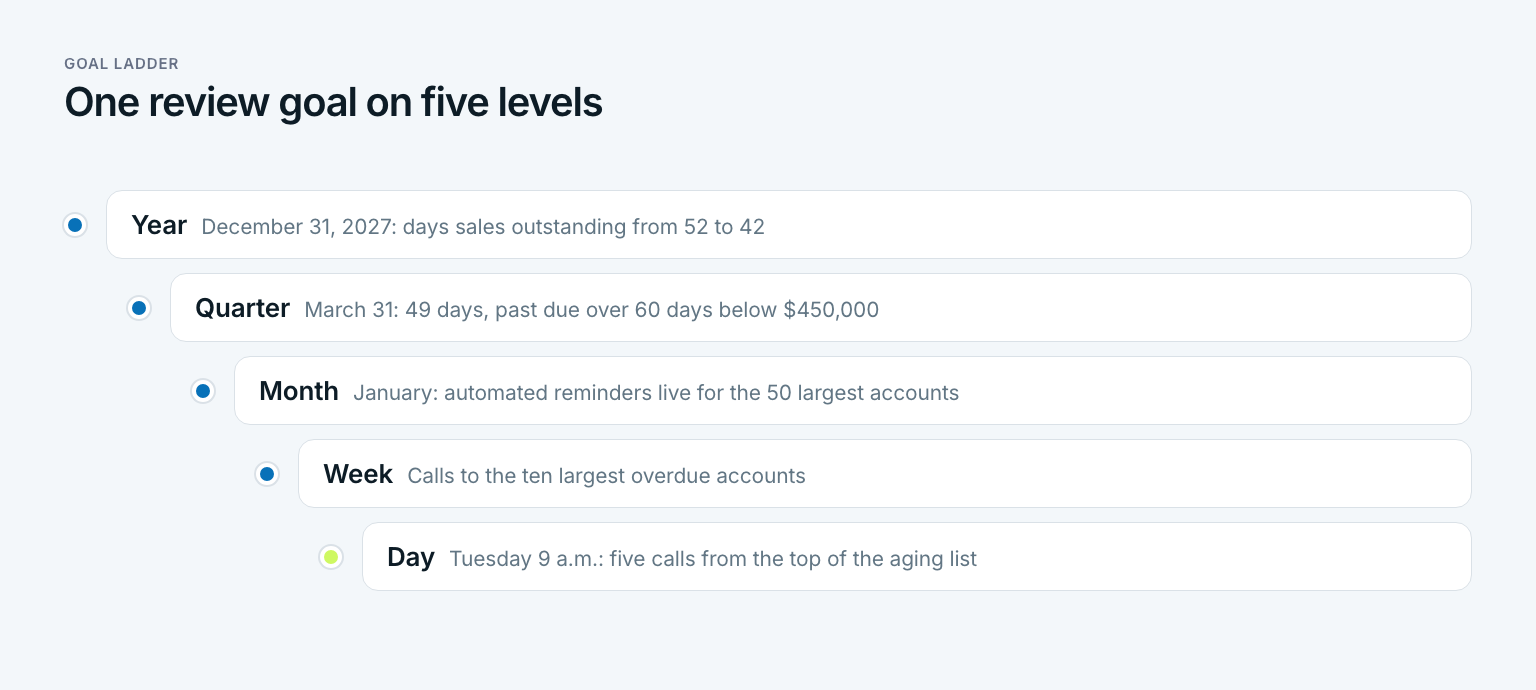
The logic behind it is plain. Ten fewer days of outstanding sales is about two days a quarter, with a little extra in the first quarter while the new routine settles in. In January, automated reminders go live for the 50 largest accounts, which together hold most of the open balance. Every week, Dana's team calls the ten largest overdue accounts. Her own slot is Tuesday at 9 a.m., five calls from the top of the aging list, notes in the CRM before 10.
The review asks about the top line. Daily work decides the bottom line. Whoever only knows the top line finds out in September that February and March went missing. In Gaapp, all five rungs sit on one screen, and Dana sees on Friday whether the week's calls happened. Paper with five lines works too, as long as someone reads it weekly.
Dana submitted her goals on November 18 and approved her team's on December 4, eleven days early. Her manager goal is in the list as well: seven people, 21 goals, every one with a number and a source. In short: A good SMART goal for work is not a nice sentence for the HR file. It is a number you could look at every month anyway, with a date next to it.
Frequently asked questions about SMART goals for work
What are the 5 SMART goals examples for work?
One per kind of goal covers most jobs. Volume: sign twelve new accounts by December 31, up from five. Quality: cut billing complaints from 30 a month to under ten by September 30. Speed: close the books by the fifth business day by March 31, skill: run the pricing review alone by June 30, and backup: a second person can process refunds by October 31.
Can you give me 10 examples of SMART goals?
Ten short ones by role: close rate from 21% to 28%, first-contact resolution from 61% to 75%, time to restore from 5 hours to 90 minutes, website leads from 85 to 150, first-year turnover from 24% to 15%, days sales outstanding from 52 to 42, milestones on time from 57% to 80%, same-day shipping from 90% to 98%, three trained backups up from none, and expense reimbursement from 21 to 10 business days. Each one needs a date and the system where the number lives. Without those two, it is a direction, not a goal.
What are some good goals for work examples?
Good work goals measure a result you influence, not company totals or busy work. Examples: a higher close rate instead of more calls, fewer picking errors instead of more training sessions, or a backup who can do your job for a week. The test is simple: Could someone from another team read the number on the due date without asking you?
What are some SMART goals I can use to find a job?
Pair the final result with the steps you control. For example: hold three informational calls a month with people in the target role by December 15, land five first-round interviews by February 28, and receive one written offer at your target salary by March 31. Track all three in one sheet so you can see which stage is stuck.
How many SMART goals should I have at work?
Two to three a year work for most roles: one for the day job, one for your own growth, and if needed one for a project. More goals get written in November and forgotten by March. Each goal needs a fixed slot in your week, and the week has limits.
What if my job can't be measured in numbers?
Measure turnaround time or proof instead of volume. Almost every task has a start and an end, and the time between them is a number. Where even that does not fit, use a yes or no goal with evidence, such as an exam, a certification, or a task you own alone from a set date.
Last updated: 19 October 2026
Read next
 Goal Setting
Intrinsic Motivation: What Drives You From the Inside
Intrinsic motivation is not a personality trait. Meaning, 12 examples, the three needs behind it and five steps to build it, with a worked example.
17 min read
 Goal Setting
Financial Goals: How to Turn Wishes Into a Plan
Financial goals are not wishes with a dollar sign. Short and long term examples, SMART savings goals and a five step plan, worked through one year.
17 min read
 Goal Setting
WOOP Method: Four Steps From Wish to If-Then Plan
The WOOP method is not positive thinking. What WOOP stands for, the research, if-then plans, eight goal examples and a five-minute guide.
18 min read