To-Do List: How to Make One That Gets Done
A to-do list is a written list of tasks you commit to finishing. Six-step method, one-page template, three mistakes, and one teacher's week as example.

Contents
- 01What a to-do list is and what it is not
- 02What goes on a to-do list: four kinds of items and where each belongs
- 03Why your to-do list does not work: the three mistakes nobody notices
- 04How to make a to-do list that gets done: six steps
- 05The example: Maya's week, from 41 items to three a day
- 06To-do list template: one page, six fields
- 07Daily to-do lists, weekly to-do lists, master list: three lists, three jobs
- 08The to-do list in the goal chain: from a yearly goal to Tuesday evening
- 09Three questions before you write tomorrow's list
- 10Frequently asked questions about to-do lists
A to-do list is not a plan. It is a written list of the tasks you intend to finish, usually within a day or a week, and it only becomes a plan when every item on it has a day, a size, and a reason. Writing tasks down is where most people stop. Deciding what happens to each one is where the list starts to work.
Three things turn a list into a plan: a reason for every item, a size for every item, and a day for every item. Everything else is formatting. The method below has six steps, a one-page template, and three lists that do three different jobs. It is worked through on one week of Maya, 38, a seventh-grade science teacher in Phoenix with two kids and an online master's degree to finish, whose list had 41 items on Sunday night and three on Monday morning.
What a to-do list is and what it is not
A to-do list is the place where tasks wait until you do them. Three things happen on a good one: you capture, you decide, and you check off. Capturing is writing the task down so your head can let go of it. Deciding is choosing when and whether it gets done. Checking off is the small reward that keeps the habit alive. Most lists do the first and the third. They skip the second.
Capturing is a good habit. It just does not decide anything. Bluma Zeigarnik showed in 1927 that unfinished tasks stay active in memory far longer than finished ones, which is why an open loop nags you at 11 p.m. Masicampo and Baumeister found in 2011 that the nagging stops not when the task is done but when you have made a concrete plan for it. That means: writing a task down calms you only if the note says when. A list of 41 bare items is 41 open loops on paper instead of in your head. The paper does not close them.
So the difference between a to-do list and a plan is one column. The list says what. The plan says what, when, and why. Anyone who adds that column to an existing list has done most of the work already. Anyone who keeps adding items without it has built an inventory, and inventories do not get shorter.
To do list, to-do list, or todo list?
Merriam-Webster spells it to-do list, with a hyphen, because to-do works as a single noun here. Todo without the hyphen comes from programmers, who mark unfinished code with the comment TODO. Google treats all three spellings as the same search. Write it however you like, as long as the items on it have a day next to them. The spelling is the one part of a to-do list that has never stopped anyone from finishing one.
What goes on a to-do list: four kinds of items and where each belongs
A to-do list holds tasks. A task is one action with a verb that you can finish in one sitting. Most lists hold three other things as well, and each of them belongs somewhere else. Sorting them out is the first thing that makes a list shorter without doing any work.
| Kind of item | How to recognize it | Where it belongs | Maya's Sunday list |
|---|---|---|---|
| Task | One verb, one sitting, under 90 minutes | The to-do list, with a day next to it | Email Mr. Alvarez about the field trip forms. 23 of 41 items |
| Project | Needs several sittings, has no single verb | A project line, with only its next task on the list | Research paper, science fair, Halloween costumes. Six of 41 |
| Appointment | Has a time and a place | The calendar, not the list | Dentist Thursday 4 p.m., parent conferences, Saturday soccer. Seven of 41 |
| Someday item | No deadline and no goal behind it yet | A someday list you read on the first of the month | Repaint the bedroom, learn Spanish, look into a Roth IRA. Five of 41 |
Maya's 41 items shrank to 23 before she had done a single one. Seven moved to the calendar, where they already were. Five went to a someday list. Six were projects, and each project got exactly one next task on the list, which David Allen in Getting Things Done, 2001, calls the next action. The research paper became write the outline, 60 minutes. The science fair became email the parent volunteer list. Twenty-three tasks remained, and all of them were real.
Why does the sorting matter more than the doing? Because a project on a to-do list never gets checked off. Research paper sits there for six weeks and looks like failure every evening. Write the outline gets checked off on Tuesday. The project is the same. The feeling is not, and the feeling is what decides whether you open the list again on Wednesday.
Why your to-do list does not work: the three mistakes nobody notices
Most to-do lists fail quietly. Nobody decides to abandon one. It just stops being opened, usually in the third week, and the three mistakes that get it there never feel like mistakes while they happen. Which one is yours?
- The list as an inventory. Everything that was ever added stays until it is done. After a month the list has 60 items, and the first thing you see every morning is what you have not done. An inventory is useful. It is just not a to-do list. Keep it as a master list, and build each day's list from it fresh.
- Items without a size. Prepare for the conference, sort out the garage, work on the paper. None of these can be finished, because none of them says where finishing is. A task needs a verb and an end: print the three handouts, take the broken bike to the curb, write the outline. Whoever cannot say how long an item takes is looking at a project in disguise.
- Items without a reason. Every task on your list is there because of something. Some because of a goal you chose, some because of a deadline someone gave you, and some because they were easy to write down. The third kind crowds out the first. Anyone who cannot say why an item is on the list has found the item to cut.
The most common mistake: a list that is never closed
A to-do list needs an end, the way a day does. The most common mistake is not writing too much down. It is never deciding what happens to the items that are left. Every evening, each remaining item gets one of three marks: done, moved to a named day, or cut. Maya's old list still had items from August on it in October. Her new list is empty every night, not because she finishes everything, but because every leftover is given a new day or let go. A list that is closed daily stays trustworthy. A list that only grows gets ignored, and an ignored list is a notebook.
There is a fourth mistake that hides behind the three: the list that is the only tool. A to-do list cannot hold appointments, projects, and ideas at the same time without becoming all of them. That means: the fix for a broken to-do list is rarely a better to-do list. It is a calendar for times, a project line for the big things, and a short list for today. Anyone who starts more than they finish can turn that short list into a personal kanban board, where a cap on open tasks means one gets done before the next begins.
How to make a to-do list that gets done: six steps
The method takes 25 minutes once a week and five minutes each evening. It is built from the four pieces above: capture, sort, size, decide. Here is how Maya ran it on a Sunday night in October, with the timing she actually used.
Dump everything, ten minutes
Write down every open task in one place, from the grading pile to the dentist. Do not sort, do not judge, do not size. The point is to empty your head, not to produce a tidy list. Maya wrote 41 items in nine minutes, and the last six only came out because she kept going after the obvious ones.
Sort into four piles, five minutes
Mark each item as task, project, appointment, or someday. Appointments go to the calendar. Someday items go to a separate list you read on the first of the month. Each project gets one next action with a verb, and the project name goes on a project line beside the list, not on it. Maya kept 23 tasks.
Attach a reason or cut it, five minutes
Next to each task write what it serves: a goal of yours, a deadline from someone else, or nothing. Tasks that serve nothing are candidates to cut, and most lists have four or five of them. Maya cut three and moved eight to the master list because their deadline was more than a week away. Twelve tasks remained for the week.
Size every task, three minutes
Give each task a verb and a time: write the outline, 60 minutes. Email the volunteer list, ten minutes. Anything over 90 minutes gets split. Anything under two minutes you do right now, which is Allen's two-minute rule. Maya did two of her twelve on the spot and had ten left.
Give each task a day, three must-dos a day at most
Spread the week's tasks across Monday to Thursday. Three must-dos per day is the ceiling, not the target, because every week has two days that go sideways. Friday stays free as a buffer for whatever slipped. Maya placed ten tasks on four days: three on Monday and Tuesday, two on Wednesday and Thursday.
Close the list every evening, five minutes
Each remaining item gets one mark: done, moved to a named day, or cut. Then write tomorrow's list, three must-dos and up to two if-time items, the way Ivy Lee told the executives at Bethlehem Steel to do in 1918. A list written the night before is a decision. A list written in the morning is a reaction to the inbox.
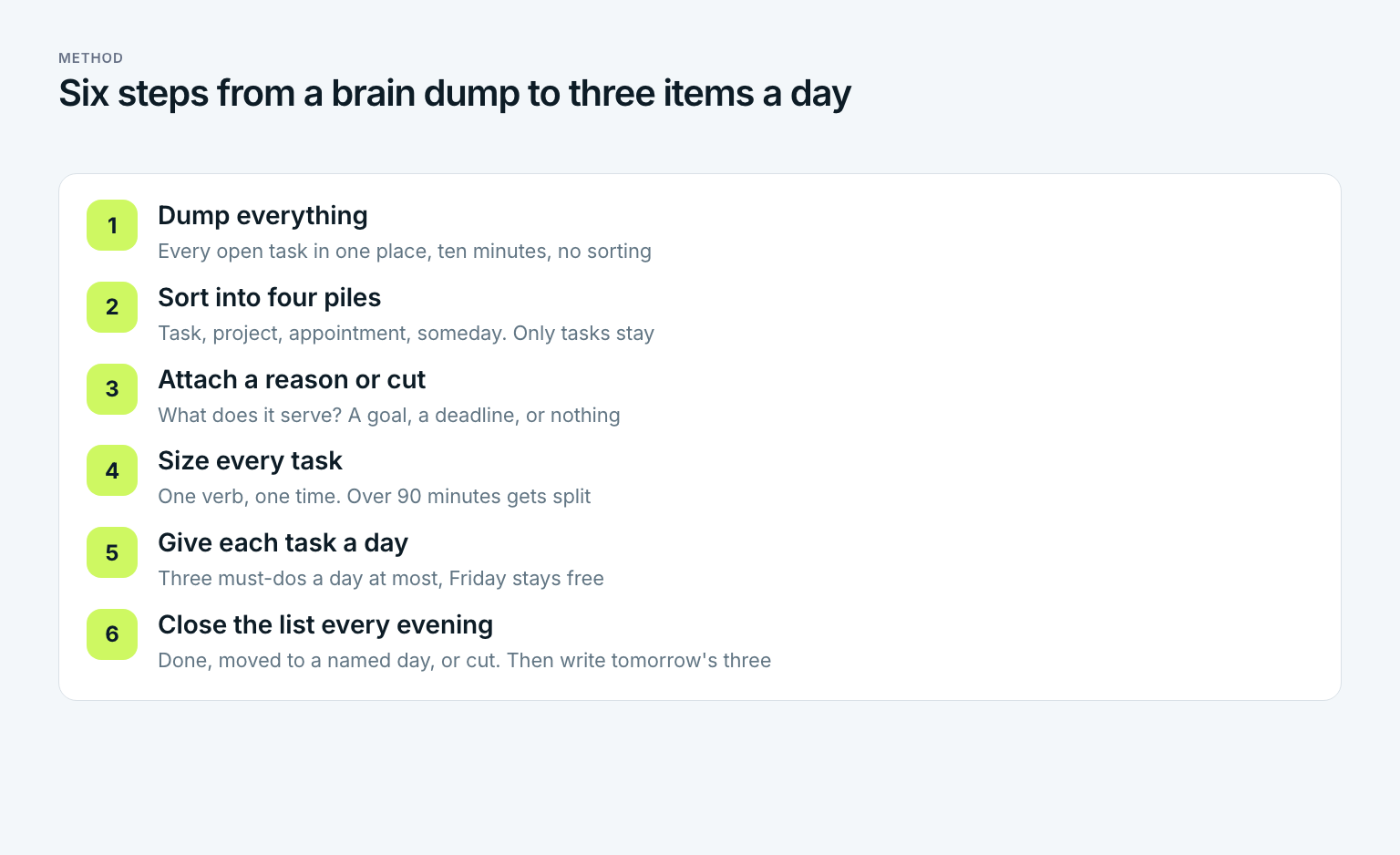
Twenty-five minutes on Sunday, five each evening. The weekly part matters more than it looks, because it is where the cutting happens, and cutting is the only step that makes Monday lighter. Anyone who skips Sunday and only writes daily lists is choosing from an inventory every morning, and the inventory always wins.
The example: Maya's week, from 41 items to three a day
Maya's situation, so the numbers make sense. She teaches seventh-grade science in Phoenix, five classes a day. Her kids are nine and six. She is in the last year of an online master's in school counseling, with a research paper due in November and 300 practicum hours to log by April. Her yearly goal is to finish the degree by May and apply for a counselor position at her own school for the next school year. Her October goal: submit the paper draft and log 35 practicum hours. The week she planned on that Sunday had to carry an outline, eight practicum hours, and the normal load of grading and family.
| Day | Must do, with size | If time | What it serves |
|---|---|---|---|
| Monday | Write the paper outline, 60 min. Grade the lab reports for periods 1 to 3, 45 min. Email the parent volunteer list for the science fair, 10 min. | Order the poster boards | Paper draft. Grading due Tuesday. Science fair in three weeks. |
| Tuesday | Practicum at the counseling office, 3 hours, 3 to 6 p.m. Send the outline to the advisor, 10 min. Grade periods 4 and 5, 30 min. | Call about the Halloween costume sizes | Practicum hours. Paper draft. Grading. |
| Wednesday | Practicum, 3 hours. Read the two articles for section 2 of the paper, 60 min. | Sign the field trip forms | Practicum hours. Paper draft. |
| Thursday | Practicum, 2 hours, before the dentist at 4 p.m. Draft section 1, 60 min. | Pick up the dry cleaning | Practicum hours. Paper draft. |
| Friday | Buffer: whatever moved during the week, then nothing | Keeps the weekend clear |
Count what the week did. Eight practicum hours, logged. An outline and a first section of the paper, written. The grading, done by Tuesday instead of Sunday night. Three if-time items done, two moved to the following week. The eight tasks that went to the master list on Sunday are still there, and none of them was missed, because none of them was due. Her old list would have shown all 41 items on Monday morning. Her new list showed three.
The number that matters is not 41 or 23. It is three. Three must-dos a day fit around five classes and two kids. Twelve would not. Anyone who plans twelve tasks for a day and finishes five has a 42 percent day and feels it. Anyone who plans three and finishes three has a 100 percent day with the same five tasks done, because two if-time items got done as well. The work was the same. The list was different.
To-do list template: one page, six fields
The template fits on an index card, a notes app, or a spreadsheet row. It has six fields, and the third column shows Maya's Tuesday so you see how little each field needs. Write it the evening before. It should take five minutes, and if it takes 15, the sorting from the weekly step has not happened yet.
| Field | What to write | Maya's Tuesday |
|---|---|---|
| Date and weekly goal | The day, and the one thing this week serves | Tuesday, October 13. This week: outline to the advisor, eight practicum hours |
| Must do 1 | Verb, size, time slot | Practicum at the counseling office, 3 hours, 3 to 6 p.m. |
| Must do 2 | Verb, size, time slot | Send the outline to Dr. Nguyen with two questions, 10 min, lunch break |
| Must do 3 | Verb, size, time slot | Grade the lab reports for periods 4 and 5, 30 min, 8:30 p.m. |
| If time | Up to two small tasks, no guilt if they move | Call the costume shop about sizes |
| Closing | Done, moved to a named day, or cut | Three done. Costume call moved to Thursday. |
Fields one and six are the ones most templates leave out, and they are the two that make the list work. The weekly goal at the top tells you why today matters, so a free 20 minutes goes to the paper and not to the inbox. The closing at the bottom is what keeps the list from becoming an inventory. Ready-made goal templates that break a yearly goal down into weeks and days sit under templates, and each one can be renamed or trimmed.
Paper, Google Tasks, Excel, or an app: which format for which list
The format matters less than the two missing columns, but it matters. Each format is good at one of the three lists and poor at the others. Pick by the job, not by the look. Whoever wants all three lists and the calendar in one place can set up a digital planner with a page for each.
| Format | Best at | Weak spot | Use it for |
|---|---|---|---|
| Paper or index card | Today's three. Nothing to open, nothing to sync. | Cannot hold the master list or move items without rewriting | The daily list |
| Google Tasks or Google Keep | Quick capture on the phone. Tasks sits in the side panel of Gmail and Calendar and in its own app. | No reason column, no link between a task and a goal | Capture and the daily list |
| Excel or Google Sheets | The master list. Columns for task, size, reason, day, and status, with filters. | Nobody opens a spreadsheet at 8 p.m. for three items | The weekly sort |
| Goal app with levels | Shows each task under the week, month, and goal it serves | Needs a goal first. A bare task list is the wrong use. | The whole chain, from year to day |
Where is your to-do list in Google? In Google Tasks, which lives in the right-hand side panel of Gmail and Google Calendar and in the Tasks app on Android and iOS. Keep is the other option, with checklists inside notes. Both capture well. Neither asks why. A to-do list in Excel takes four columns, task, size, day, and status, with a filter on the day column so Monday shows only Monday. Excel's checkbox cells or a data validation list for the status column make the checking off feel like checking off. That is the whole build. In short: the tool holds the list. It does not make the decisions. The guide to choosing a to-do list app compares seven of them against clear criteria.
Daily to-do lists, weekly to-do lists, master list: three lists, three jobs
One list cannot do three jobs, and the attempt is why most to-do lists hold 60 items. The master list stores. The weekly list chooses. The daily list executes. They are written at different times, by different rules, and they are different lengths.
| List | Holds | Written when | Length | Maya in October |
|---|---|---|---|---|
| Master list | Every real task that is not due this week, plus the project lines | Added to any time, reviewed on Sunday | As long as it needs to be, often 20 to 40 items | Eleven tasks, six project lines |
| Weekly list | The tasks this week must carry, each tied to a goal or a deadline | Sunday evening, 25 minutes | Ten to fifteen tasks | Twelve tasks, two done on the spot |
| Daily list | Three must-dos and up to two if-time items | The evening before, five minutes | Three to five items | Three must-dos, one or two if-time |
The weekly list is the hinge. Without it the daily list is picked from the master list each morning, and the master list has no opinion about what matters. With it, each evening's choice is made from twelve items instead of 60. Anyone who already runs a weekly review has the weekly list half built: the one thing that counts next week is the first line, and the to-do list hangs underneath it.
What about people who say lists do not work for them? They are usually right about the list they have. A single list that holds appointments, projects, someday ideas, and today's tasks does not work for anyone. It is not a to-do list. It is four lists in one file, and the fix is to separate them, not to try harder.
The to-do list in the goal chain: from a yearly goal to Tuesday evening
Every task on Maya's Tuesday list traces upward. Send the outline serves the paper draft, which is the October goal. The paper draft serves the fall quarter: two courses passed and 100 practicum hours logged. The quarter serves the year: degree finished by May, application filed. That is the goal chain, year to quarter to month to week to day, and a to-do list is its bottom rung. Anyone who can trace a task to the top has the reason column already filled in. Anyone who cannot is holding either a chore or a cut.
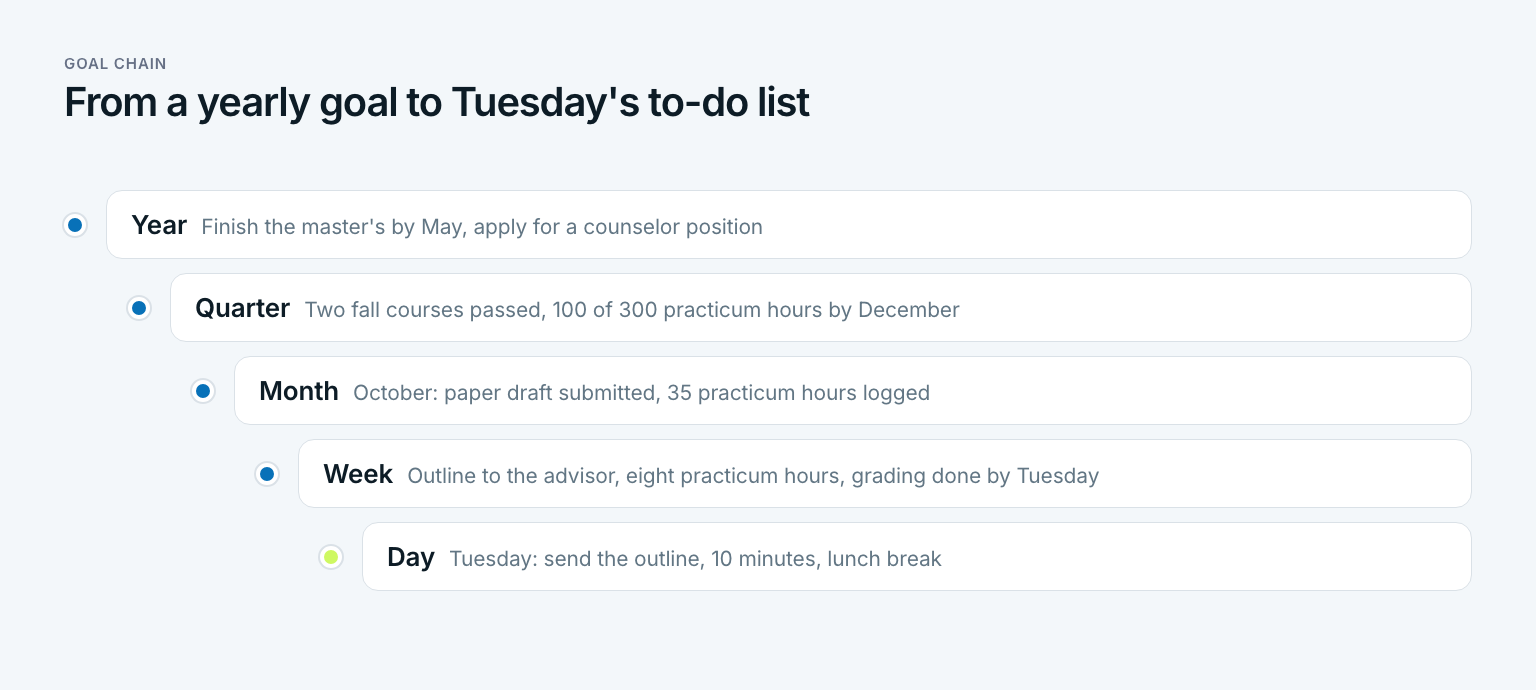
In Gaapp this chain is the structure. A daily goal hangs under a weekly goal, the weekly goal under a monthly one, and the progress of each level is the share of its items checked off. A to-do list item without a parent stands out there, because it has nothing to hang from. That is the question the reason column asks on paper, built into the layout. Chores still exist. The dentist still happens. They go on the calendar, not into the chain.
How you get from a yearly goal to a monthly one is covered in the guide to annual planning. How you phrase a daily item so it can be checked off at 9 p.m. is the subject of the piece on daily goals. The pillar on how to achieve goals puts the whole chain together. The to-do list is the smallest part of it, and the part you touch every day.
Couples and teams run the same chain with shared lists. The rule does not change: three must-dos per person per day, each tied to a goal the group agreed on, closed every evening. A shared list with 80 items is a shared inventory. A shared list with six is a plan for two people.
Three questions before you write tomorrow's list
Three questions, about the list you have right now:
- Can you say, for every item on it, what it serves?
- Does every item have a verb and a size, so you would know when it is done?
- Was the list closed last night, with every leftover given a day or cut?
Anyone who answers no to one of the three does not have a motivation problem. They have an inventory. The fix is 25 minutes on Sunday and five each evening, and the first Sunday is the hardest, because that is when the 41 items come out. In short: a to-do list is not a record of what you owe. It is a decision about what tomorrow is for, made the night before, three items long.
Frequently asked questions about to-do lists
Is there a hyphen in to do list?
Yes. Merriam-Webster and the major style guides spell it to-do list, because to-do acts as one noun that describes the list. Todo in one word is the programmer spelling, from the TODO comment that marks unfinished code. Search engines treat the three spellings as one query, so pick one and keep it.
What is on a to do list?
Tasks: single actions with a verb that you can finish in one sitting, each with a size and a day. Appointments belong on the calendar, projects belong on a project line with one next action on the list, and ideas without a deadline belong on a someday list. A daily to-do list holds three must-dos and up to two if-time items. More than that is a weekly list wearing a daily list's clothes.
Where is my to do list in Google?
In Google Tasks. Open Gmail or Google Calendar on a computer and click the Tasks icon in the right-hand side panel, or install the Google Tasks app on Android or iOS. Tasks you add from a Gmail message or a Calendar event land in the same list. Google Keep is the second option, with checklists inside notes. Both capture well, and neither links a task to a goal.
How to do a todo list in Excel?
Four columns are enough: task, size in minutes, day, and status. Turn the range into a table so you can filter the day column and see only today. For the status column use Excel's checkbox cells, or a data validation dropdown with done, moved, and cut if your version has no checkboxes. Add conditional formatting that strikes through a row once it is done. The spreadsheet works best as the master and weekly list. Today's three items still go on a card or a phone.
How many items should be on a to-do list?
Three must-dos a day, plus up to two if-time items. Ivy Lee's advice from 1918 was six, in order of importance, and that was for executives with no classes to teach and no kids to collect. Three fits a day with a job in it. The weekly list can hold ten to fifteen, and the master list as many as you have, because nobody works from the master list directly.
Should I write my to-do list at night or in the morning?
At night, for the next day. A list written the evening before is a decision made with the whole day in view. A list written at 8 a.m. is a reaction to whatever arrived overnight, and the inbox usually wins. Five minutes before bed, three must-dos, then stop. Masicampo and Baumeister showed in 2011 that a concrete plan for an open task also quiets that task in your head, so the evening list is good for sleep as well.
Last updated: 19 October 2026
Read next
 Planning
Cleaning Schedule: Daily, Weekly and Monthly Tasks
A cleaning schedule is not a Saturday to-do list: daily, weekly and monthly tasks, a printable template and a fair split for families.
15 min read
 Planning
Study Plan: How to Make One You Can Actually Follow
A study plan is not a schedule. Make one in six steps: inventory, hours math, buffer, a sample study schedule and a template, with a worked example.
17 min read
 Planning
Bullet Journal: How to Start One You'll Actually Keep
A bullet journal is not an art project. Learn the bullets, four core modules, migration and a six-step setup, with an example, 12 ideas and a goal chain.
15 min read