Word of the Year: How to Choose Yours for 2027
A word of the year is not a dictionary pick. Five steps from review to one word for 2027, a word test, 40 ideas, and a goal chain down to Tuesday morning.

Contents
- 01What a word of the year is, and what the dictionaries mean by it
- 02Why Renee's word for 2026 was gone by February
- 03How do I pick my word of the year? The review comes before the word
- 04The word test: three questions a word has to pass
- 05Word of the year ideas: 40 words sorted by what last year was missing
- 06From one word for the year to a goal chain: Renee's 2027 in five levels
- 07The three mistakes that kill a word of the year
- 08How to pick your word of the year in five steps
- 09One word for the year for couples, families, and teams
- 10Three questions before you write the word down
- 11Frequently asked questions about the word of the year
A word of the year is one word you choose for yourself to steer your decisions for the next twelve months. It is not the pick that Oxford, Merriam-Webster, or Dictionary.com announces every winter. Those words describe what a language did last year. Your word decides what you will do next year. The dictionaries look back. You look forward, and you pick one word instead of a list of resolutions.
Three things turn a nice word into a working one: a review that comes before the word, a test that the word has to pass, and a chain that connects it to what you do on Tuesday morning. The review takes 20 minutes. The test is three questions. The chain runs from year to quarter to month to week to day. All of it is worked through on the word of Renee, a high school chemistry teacher in Tucson who has had a half-finished master's thesis on her desk for two years, along with 40 word of the year ideas, five steps, and the three mistakes that turn a word into a lock screen by February.
What a word of the year is, and what the dictionaries mean by it
Two things share the same name and have almost nothing in common. The dictionary word of the year is a verdict on the past: Oxford University Press has picked one since 2004, the American Dialect Society has voted on one since 1990, and Merriam-Webster and Dictionary.com each run their own choice built on search traffic and editorial judgment. Those words are chosen by lexicographers, and they describe a mood that already happened. Rage bait, slop, brain rot, 67. Nobody is supposed to live by them.
The personal word of the year is the opposite. You choose it, it points forward, and it is meant to change what you do. The tradition is at least twenty years old in journaling and scrapbooking circles, Jon Gordon, Dan Britton, and Jimmy Page built a book around it in 2013, and Gretchen Rubin has picked a one word theme for every year since and talks about it on her podcast. Anyone who searches for word of the year ideas in December is looking for this second thing. The table shows where it sits among its neighbors.
| Term | Who chooses it | What it looks like | What it is built for |
|---|---|---|---|
| Personal word of the year | you | one word, sometimes a short phrase | steering decisions for twelve months |
| Dictionary word of the year | Oxford, Merriam-Webster, Dictionary.com, the American Dialect Society | one word or expression | describing the past year of a language |
| New Year's resolution | you | an intention like exercise more | changing a behavior, usually without a measure |
| Yearly goal | you | a result with a number and a date | checking whether something actually moved |
| Motto or mantra | you or a group | a sentence like keep going | motivation in the moment |
The word sits above the goals and below the resolutions. Above the goals, because it tells you which goals deserve a place this year. Below the resolutions, because it is more honest: a resolution promises a new person, a word only promises a filter. That means: a word of the year is a decision rule, not a wish. Whoever treats it as a wish gets a pretty word. Whoever treats it as a rule gets a different year.
Why Renee's word for 2026 was gone by February
Renee picked Balance for 2026. She teaches five sections of chemistry, coaches the girls' cross-country team in the fall, and has 52 pages of a 90 page master's thesis sitting in a folder named FINAL that has not been opened since the spring of 2025. Balance felt right in the last week of December. She wrote it on a sticky note, put it on the fridge, and made it the wallpaper on her phone.
To be fair, the word did something. In January she said no to a Saturday tutoring job and went to bed before eleven four nights a week. Picking a word is a good habit. It just measures nothing. By the second week of February the sticky note was under a permission slip, the wallpaper was a photo of the team at regionals, and Balance had quietly turned back into the thing it had always been, a feeling about how the year should go. Nothing in Renee's calendar had changed because of it. No thesis page, no run, no appointment.
The problem was not the word. The problem was that nothing hung under it. Balance did not say which thing to balance first, did not carry a number, and did not have a date on which it would be checked. Anyone who picks a word and stops there has picked a mood. The mood lasts as long as the fridge stays free of permission slips. In short: a word without a goal underneath is decoration, and decoration gets covered.
The fresh start effect: why January 1 helps and why it is not enough
Hengchen Dai, Katherine Milkman, and Jason Riis showed in 2014 that people are more likely to start on a goal right after a temporal landmark such as New Year's Day, a birthday, or the first of a month. Gym visits and goal related searches spike at those points. The landmark supplies momentum. It does not supply a structure. A word of the year uses the January momentum well, but only the goal chain under it carries the word into March.
How do I pick my word of the year? The review comes before the word
The right word comes out of the last twelve months, not out of a list. Most word of the year posts start with the list: Grow, Brave, Shine, Flourish. Lists are fine as a quarry. They are a bad place to start, because a word picked from a list describes a person you would like to be, and a word picked from a review answers a problem you actually have. Renee's second attempt, in the last week of December 2026, started with a review and took 20 minutes.
Three columns for the review
Take one sheet and draw three columns: gave me energy, cost me energy, postponed for the third time. Fill them with keywords, not sentences. Ten minutes for the first two columns, five for the third. The third column is the one most people skip, and it is the one that produces the word. Renee's third column held four lines: thesis chapters three to five, the half marathon she has registered for twice, the garage, the dentist. The first column held her students' lab days, the Tuesday long runs with the team, and two weekends in Flagstaff. The second column held grading on Sunday nights, the sticky note, and every conversation that began with the words how is the thesis going.
Now read all three columns next to each other and write the pattern in one sentence. Not a judgment, a pattern. Renee's sentence: I start everything strong and leave it at 70 percent. Anyone who has a sentence like that has already done the hard part of picking a word. The word is the answer to the sentence.
From the pattern to the word
Write three to five candidates that answer the sentence directly. For Renee: Finish, Complete, Through, Done, Close. Only when the pattern produces nothing should you open a list, and then only the group of words that fits your pattern. A word that comes from the pattern has a job from day one. A word that comes from a list has to find a job first, and most of them never do. That means: the review is not preparation for the word. The review is where the word comes from.
The word test: three questions a word has to pass
A word of the year earns its place by making decisions, so test it against decisions. Take each candidate and ask three questions. First: would this word have changed one real decision from last year? Renee tests Finish against the Saturday tutoring offer. Finish says no, because Saturdays are thesis mornings. It would have changed the decision. Balance would have said maybe. Second: does the word answer all three columns, not just the third? Finish protects the energy column too, because every finished thing is one less open loop on Sunday night. Third: can the word carry a number and a date? Finish carries 38 pages by June 30 and 13.1 miles in the fall. Complete carries the same. Through carries nothing on its own.
One word survives. If two survive, take the less comfortable one. Renee kept Finish and dropped Complete because Finish is a verb, and a verb tells you what to do when the phone rings. Whoever ends up with two words that both pass has usually found the same word in two outfits. Whoever ends up with none has a pattern sentence that is still too vague, and the fix is in the review, not in a longer list.
One word or a short phrase?
Both work, as long as the phrase makes a decision. A single word like Finish fits every situation and is easy to say out loud at 5:30 in the morning. A short phrase like finish before you start is more precise and needs no explanation. Keep it under seven words. Anything longer is a description, and nobody quotes a description to themselves in March.
Word of the year ideas: 40 words sorted by what last year was missing
A list helps once the pattern is clear, and it helps most when it is sorted by the gap it fills. Here are 40 word of the year ideas in five groups. Read only the group that matches your pattern sentence. Reading all five is how people end up with Flourish.
If last year was too full
Less. Enough. Space. Pause. Simple. Slow. Breathe. Subtract. The pattern behind this group usually sounds like I said yes to everything and did none of it well. The strongest word here is the one that names what you will remove, not what you will feel afterward.
If you waited too long
Begin. Ship. Finish. Bold. Ask. Leap. Now. Commit. This is Renee's group. The pattern behind it sounds like I know what to do and I keep not doing it. Finish and Begin are two ends of the same problem: one is for people who do not start, the other for people who do not stop starting.
If people got the short end
Present. Together. Listen. Show up. Home. Call. Host. Kind. The pattern sounds like I was busy and the people I love got what was left. Words in this group need a number faster than any other group, because presence is the easiest word to feel good about and the hardest to prove.
If your body waited
Move. Rest. Strong. Outside. Sleep. Fuel. Steady. Daylight. The pattern sounds like I took care of everything except the thing that carries everything. Rest and Move look like opposites and usually belong to the same person in different seasons.
If you need clarity
Focus. Decide. Clear. One. Deep. Choose. True. Aim. The pattern sounds like I worked hard all year and I could not tell you on what. One is the quietest word on the whole list and the most demanding, because it forces a ranking every single morning.
A warning about the pretty words. Shine, Sparkle, Magic, Flourish, and Bloom appear on almost every list of word of the year ideas, and they almost never survive the test, because they do not make decisions. Nobody turns down a tutoring job because of Sparkle. If you love one of them, keep it as a feeling and pick a working word next to it.
From one word for the year to a goal chain: Renee's 2027 in five levels
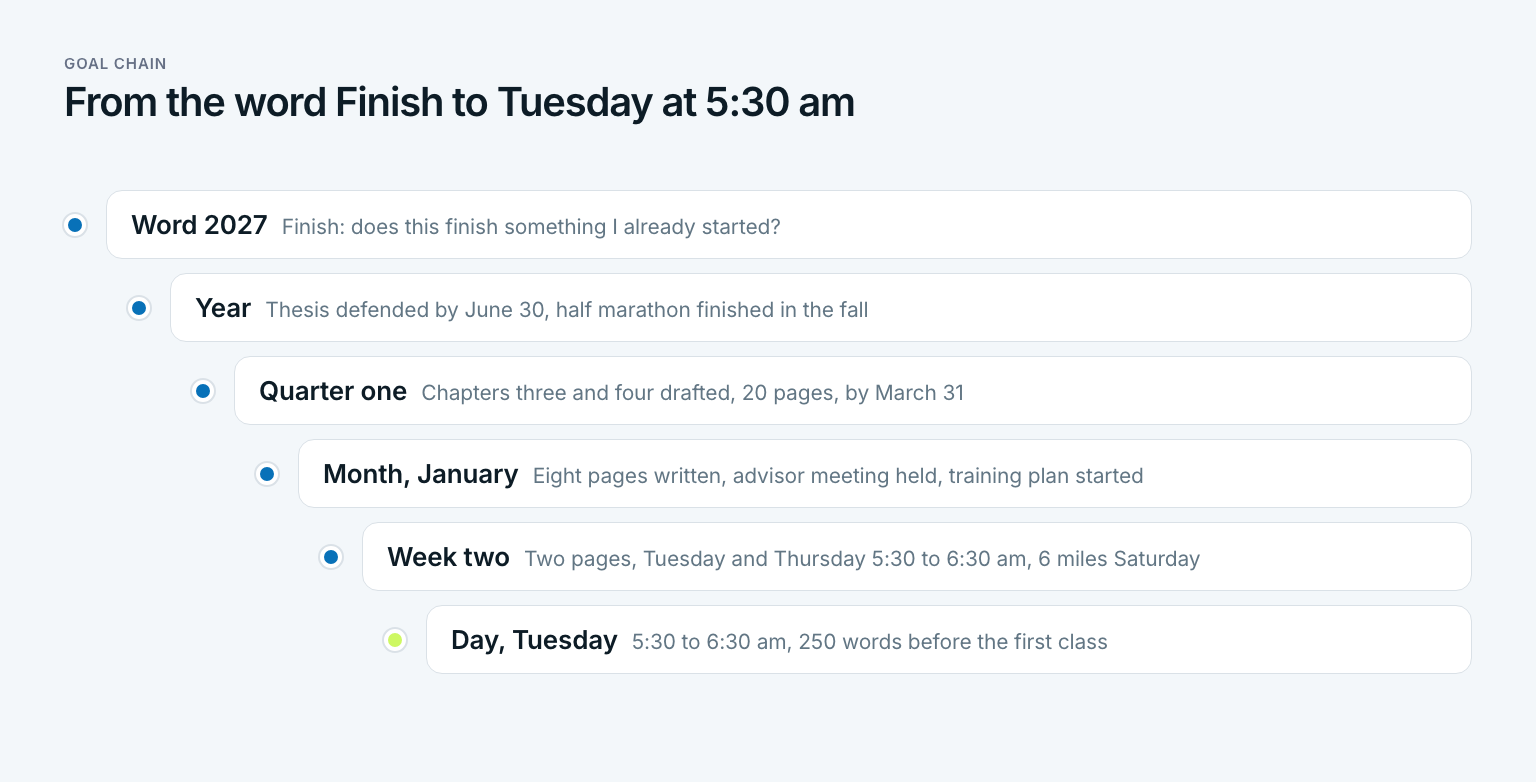
One word for the year becomes real when it has goals under it, and the goals become real when they are broken down to a weekday. The chain has five levels: year, quarter, month, week, day. The word sits on top as the title of the year and as the question you ask every time something new wants a place in the calendar. Renee's question for 2027: does this finish something I already started? Choosing the two or three goals that go under the word takes a planning hour of its own, which the guide to goals for 2027 walks through step by step.
| Level | Renee's goal for 2027 | How she checks it |
|---|---|---|
| Word | Finish | Every request: does this finish something I already started? |
| Year | Thesis defended by June 30, half marathon finished in the fall | Signed defense form, finisher photo |
| Quarter one | Chapters three and four drafted, 20 pages, by March 31 | Page count in the folder, advisor's reply |
| Month, January | Eight pages written, advisor meeting held, training plan started | Pages dated in the file, meeting in the calendar, three runs logged per week |
| Week two | Two pages, Tuesday and Thursday 5:30 to 6:30 am, long run Saturday | Two files with Tuesday and Thursday dates, 6 miles on the watch |
| Day, Tuesday | 5:30 to 6:30 am, 250 words before the first class | Word count at 6:30 |
Read the chain from the bottom. On Tuesday Renee writes 250 words between 5:30 and 6:30. That is one of two writing mornings in the week, which makes two pages. Four weeks of that make eight pages in January, three months make 20 pages and two drafted chapters by March 31, and two quarters make a thesis in front of a committee by June 30. The word Finish never appears on a Tuesday. The 250 words do. That means: the word decides what gets on the list, and the chain decides when it happens.
The second yearly goal runs on the same chain with different numbers: three runs a week in January, 6 miles on Saturday, a 10 mile long run by the end of March, race day in the fall. Two yearly goals under one word is the right size. Three is the maximum. Anyone who hangs five goals under a word has a to-do list with a title. The method is the same one described in how to turn yearly goals into daily steps, only with the word on top deciding which goals get in. If you want the whole year planned in one sitting, the annual planning guide walks through it. In Gaapp, the word is the name of the year, the two goals hang under it, and every Tuesday morning gets its own check mark.
The three mistakes that kill a word of the year
Three mistakes account for almost every word that disappears by February. They have nothing to do with choosing the wrong word. All three are about what happens after the choice.
Mistake one: the word stays decoration. It lives on a mug, a bracelet, and a lock screen, and none of those places ask it a question. Mistake two: the word has no number. Growth, Joy, and Balance cannot be counted, so they cannot be missed, so they cannot be noticed. Mistake three: the word is never checked. Without a fixed ten minutes on Friday, nobody compares the week to the word, and a word that is never compared to anything is a souvenir.
The most common mistake: the word stays decoration
Renee's Balance lived on the fridge, in the wallpaper, and on a bracelet her sister gave her. Every one of those kept the word visible, and not one of them made a decision. A word without a yearly goal underneath is a mood that everyday life covers over by February, in her case literally. The fix is not a nicer picture. The fix is a number: which result, how many, by when. Even if you want to visualize goals, the picture works best as a display of that number. The ten minutes on Friday in the weekly review are where the word gets asked whether it did anything this week.
There is a fourth, quieter mistake: picking the word for the person you want other people to see. Brave sounds better at a dinner party than Finish. Anyone who picks for the dinner party gets a word that performs well in January and does nothing in April. The review protects you from this, because a pattern sentence like I leave everything at 70 percent does not care who is listening.
How to pick your word of the year in five steps
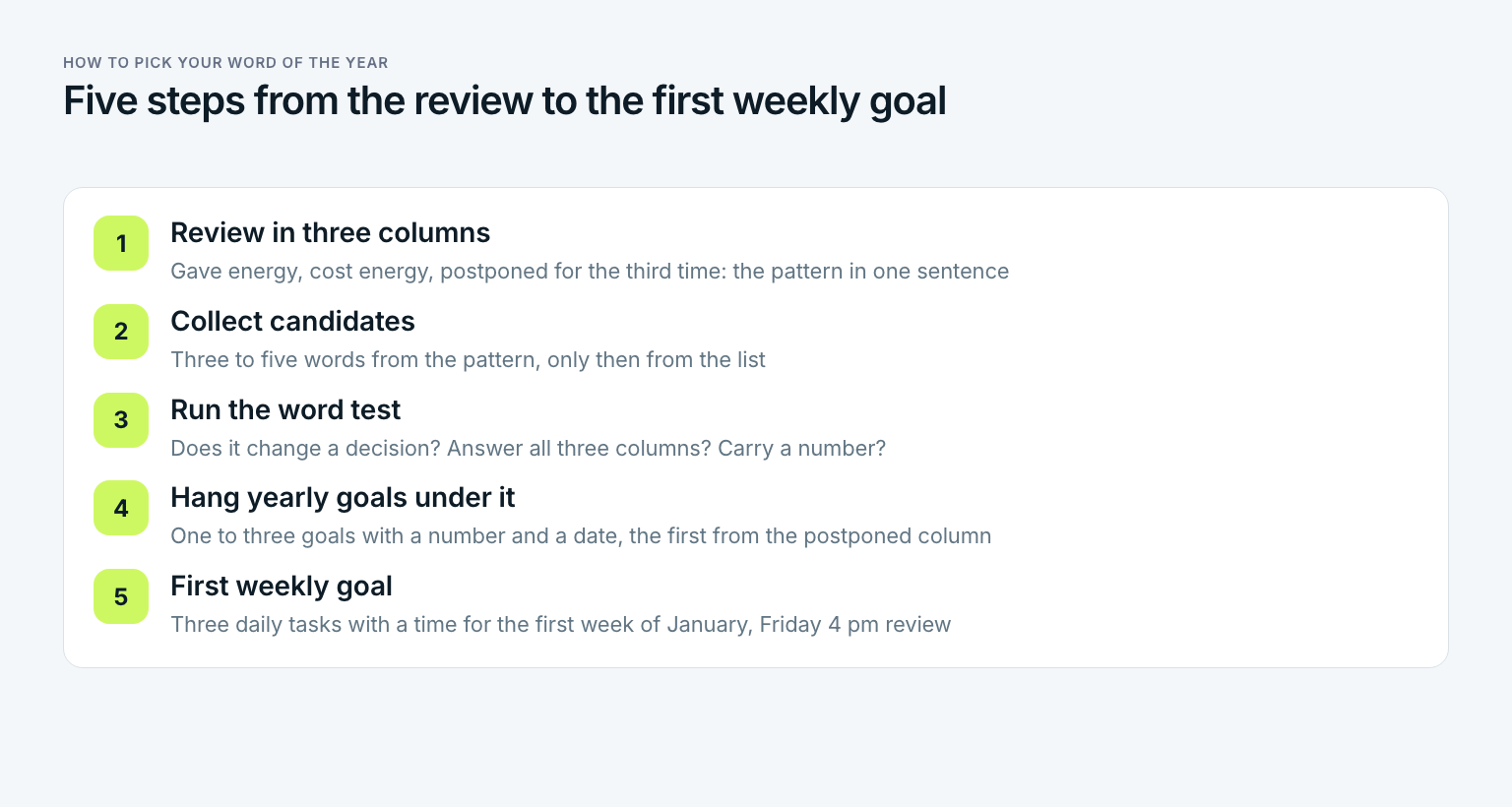
The whole process takes about 90 minutes in the last week of December or the first week of January. Do it on paper first and move it into your calendar or your goal tracker afterward. Each step has a time box, because a word that takes a weekend to choose is already a project instead of a filter.
Review in three columns, 20 minutes
Gave me energy, cost me energy, postponed for the third time. Keywords, not sentences. Read all three columns side by side and write the pattern in one sentence. Renee's: I start everything strong and leave it at 70 percent.
Collect three to five candidates, 10 minutes
From the pattern, not from a list. Only if nothing comes should you open the 40 word list, and then only the group that matches your sentence. One line per candidate, with room for three check marks.
Run the word test, 15 minutes
Three questions per candidate: would it have changed one real decision last year? Does it answer all three columns? Can it carry a number and a date? One word survives. If two survive, take the less comfortable one.
Hang one to three yearly goals under it, 30 minutes
Each yearly goal has a result, a number, and a date. The first goal comes from the third column, the postponed things. Break each goal into a first quarter goal and a January goal. More than three yearly goals and the word stops deciding anything.
Put the first weekly goal in the calendar, 15 minutes
What do you do in the first week of January for the January goal? One weekly goal, three daily tasks with a time. For Renee: 250 words on Tuesday and Thursday at 5:30, 6 miles on Saturday at 7. Add the Friday review at 4 pm, ten minutes in which you read the word out loud and measure the week against it.
One word for the year for couples, families, and teams
A shared word works when every person can translate it into their own goal. A couple who picks Home can hang two different goals under it: she wants the kitchen renovation finished by May, he wants three dinners at the table per week without phones. A family that picks Outside can agree on one number everyone can count, such as 52 Sunday walks. A team that picks Ship can put a release date under it that each member can map to their own quarter. The word is shared. The goals are personal.
Two rules keep a shared word from turning into a wall poster. First, every person names one goal under the word before the word is final. If someone cannot, the word is too abstract for that person, and a different word or a shorter phrase is needed. Second, the word gets a shared check in: the same ten minutes on Sunday evening or in the Monday stand up, where everyone says one thing the word decided this week. Whoever shares a word without a shared check in has shared a mood. The setup for this is described in shared goals in a space.
For coaches and managers there is a quieter use: ask each person for their own word in the first one on one of the year, and write it at the top of their goal sheet. Anyone who knows that a team member's word is Finish will hand them different projects than someone whose word is Begin. It costs one question and tells you more than most personality assessments.
Three questions before you write the word down
Before the word goes on the first page of your planner, sit with it for one more minute and answer three questions honestly. One: if a friend called tomorrow with an offer that does not fit the word, would you say no, and would you know why? Two: name the one thing from last year that this word would have changed. If you cannot name one, the word is a hope. Three: what is the number under it, and on what date will you check it?
Answer all three and you have a word of the year that works. Fail one and you have a nice word, which is also fine, as long as you know the difference. Renee's answers: yes, the tutoring job, because Saturdays are writing mornings. The thesis folder named FINAL that has been closed since spring 2025. 38 pages by June 30, checked every Friday at 4 pm. In short: a word of the year is not a word you like. It is a decision you have agreed to make in advance, about 250 times.
If you want to see how the word fits into the larger picture of goals that actually get reached, the pillar on how to achieve goals covers the whole chain from the first yearly goal to the Friday review.
Frequently asked questions about the word of the year
Is 67 the word of the year?
Dictionary.com named 67, said six seven, its 2025 Word of the Year. It is a nonsense expression that spread among middle and high school students through a rap song and basketball videos and usually comes with a hand gesture. It is a dictionary's description of what young people said in 2025. It is not a word you would pick to steer your own year.
What are the words of the year for 2026?
As of early October 2026, none of the big dictionaries has announced its 2026 word. Oxford, Merriam-Webster, Dictionary.com, Collins, and Cambridge publish their picks between late October and early December, and the American Dialect Society votes in January. Your personal word for 2027 does not depend on any of them. Pick it from your own review in the last week of December.
How do I pick my word of the year?
Start with a 20 minute review of the last twelve months in three columns: gave energy, cost energy, postponed for the third time. Write the pattern in one sentence and list three to five words that answer it. Test each word with three questions: would it have changed a real decision, does it answer all three columns, can it carry a number and a date. Hang one to three yearly goals under the surviving word.
What is Oxford's word of the year?
Oxford University Press has chosen a word of the year since 2004, based on its language data and, in recent years, a public vote. The 2025 word was rage bait, 2024 was brain rot, and 2023 was rizz. It describes how English was used that year. It has nothing to do with the personal word you pick to guide your own decisions.
Can I change my word of the year during the year?
Yes, if the review says so, not if February says so. The right moment is the quarterly review: if the word has made no decisions in three months and the goals under it are moving anyway, the word was wrong. Replace it with the word the first quarter actually followed. Changing it because it feels stale in week six is the mood talking.
What is the difference between a word of the year and a New Year's resolution?
A resolution is a behavior you intend to change, such as exercise more. A word is a filter you apply to every decision, such as Finish. The resolution lives at the level of a single habit. The word sits above your yearly goals and decides which ones belong this year. Many people do best with one word, one to three yearly goals under it, and no resolutions at all.
Last updated: 19 October 2026
Read next
 Goal Setting
Intrinsic Motivation: What Drives You From the Inside
Intrinsic motivation is not a personality trait. Meaning, 12 examples, the three needs behind it and five steps to build it, with a worked example.
17 min read
 Goal Setting
Financial Goals: How to Turn Wishes Into a Plan
Financial goals are not wishes with a dollar sign. Short and long term examples, SMART savings goals and a five step plan, worked through one year.
17 min read
 Goal Setting
WOOP Method: Four Steps From Wish to If-Then Plan
The WOOP method is not positive thinking. What WOOP stands for, the research, if-then plans, eight goal examples and a five-minute guide.
18 min read