Writing Down Goals: What It Does and How to Do It
Writing down goals is not magic. What the research shows, why the Harvard study is a myth, five steps, a template, and a worked example.

Contents
- 01Writing down goals: what it means and what it does not
- 02Does writing down goals actually help? What the research shows
- 03How to write down your goals in five steps
- 04Maya's example: two years in her head, six weeks on paper
- 05Paper, journal or app: where your written goals should live
- 06How often should you write down your goals?
- 07Three mistakes nobody notices
- 08Writing down goals in a goal chain: year, quarter, month, week, day
- 09Three questions before you put the page away
- 10Frequently asked questions about writing down goals
Writing down goals is not a magic trick. It means turning a goal into one sentence with a number and a date, keeping that sentence somewhere you will see it every week, and logging your progress right next to it. The paper does very little on its own. What works is the decision you are forced to make while writing, and the record you build afterward.
The habit has a reputation that is bigger than its evidence. For decades, speakers have quoted a Harvard or Yale study in which a small group of graduates with written goals went on to out-earn everyone else combined. That study does not exist. What does exist is smaller and more useful: one modest study by Gail Matthews, solid research on if-then plans, and a large review showing why it helps to record your progress. All of it is worked through with Maya, 29, an ER nurse in Columbus, Ohio, who has wanted to “get out of debt” for two years and is putting it on paper for the first time. You also get five steps, a one-page template, and the three mistakes that send written goals to the back of a drawer.
Writing down goals: what it means and what it does not
Writing down goals means turning a thought into a sentence someone could check. In your head, a goal is allowed to stay vague: “get healthier,” “save more,” “start my own thing someday.” On paper, the gaps show up at once. How much is more? When is someday? That means: writing forces a decision your head is happy to postpone.
A written goal needs three parts, and everything else is decoration: an end state another person could verify, a number, and a date. How to build that sentence well is covered in the guide on how to write SMART goals. How to decide which goal deserves the sentence in the first place is covered in the guide to goal setting. This article is about the step after that. What happens once the goal is on paper, and how do you keep it alive there?
Writing down goals is also not the same as journaling. Journaling is a good habit. It sorts your thoughts, clears your head, and helps you process a hard day. It is simply built for something else. A journal tells the story of what happened. A written goal states what should be true by a certain date and measures how far along you are. Anyone who keeps both in one notebook should still give the goal its own page, or it gets buried between daily entries.
Does writing down goals actually help? What the research shows
Almost every article on this topic leans on a statistic that is supposed to prove written goals work. Most of those statistics trace back to a story nobody can source. The real research is less dramatic. It is also more useful, because it changes what you should do with the page once you have written it.
The Harvard and Yale goals study that never existed
The story comes in two versions. In one, researchers survey the Yale class of 1953 twenty years after graduation. In the other, they survey the Harvard MBA class of 1979. The punchline is always the same: the small group with written goals ends up earning many times more than everyone else. It sounds convincing. The problem is that nobody has ever found the study.
Journalist Lawrence Tabak looked into the Yale version for Fast Company in 1996. Neither the university nor the speakers repeating the story could point to a study, a data set, or an author. The Harvard version has the same problem. It has been passed along for decades, and no published research behind it is known. In short: the Harvard study on written goals is a myth. Whoever quotes it is quoting an anecdote.
Gail Matthews' study: real, but small
Precisely because the Yale story could not be verified, psychologist Gail Matthews of Dominican University of California set out to test whether there was anything to it. She presented her results at an academic conference in 2015. Roughly 150 participants from a range of professions were split into five groups. The first group only thought about their goals. The others wrote them down, some adding concrete action steps. Some sent their goals and steps to a friend, and the last group also sent that friend a weekly progress report.
After four weeks, everyone rated how far they had come. People who wrote their goals down did better than people who only thought about them. The group with the weekly progress report did best. That is an interesting result, not proof. The sample was small, progress was self-rated, and the study was not published in a peer-reviewed journal. The percentages that circulate online from it are therefore not hard facts. They point in a direction. They do not measure a size.
What is better supported: plans and progress logs
Two lines of research stand on firmer ground. The first is about if-then plans, which psychologist Peter Gollwitzer has studied since the 1990s and calls implementation intentions. A 2006 meta-analysis by Gollwitzer and Paschal Sheeran pooled dozens of studies and found a medium-to-large effect on whether people followed through on what they intended. In many of those studies, participants wrote their plans down. The effect, though, comes from the plan, not the pen.
The second line is about recording progress. In 2016, Benjamin Harkin and colleagues reviewed more than 130 studies in the journal Psychological Bulletin. People who monitored their progress were more likely to reach their goals. The effect was larger when progress was physically recorded or reported to someone else. That means: the stronger benefit does not come from writing the goal down once. It comes from writing down where you stand, again and again.
| Claim | Source | Evidence |
|---|---|---|
| The few with written goals out-earn everyone else combined | Alleged Yale study, class of 1953 | No study found, myth |
| Written goals multiply your income | Alleged Harvard study, MBA class of 1979 | No study found, myth |
| Written goals are more likely to be achieved | Gail Matthews, Dominican University of California, 2015 | Real study, small, self-rated progress, not peer reviewed |
| If-then plans help people follow through | Gollwitzer and Sheeran, meta-analysis, 2006 | Well supported |
| Tracking progress helps, more so when recorded or reported | Harkin and colleagues, meta-analysis, 2016 | Well supported |
Three benefits of writing down goals
Even without a miracle study, there are good reasons to put your goals on paper. None of them is magic. Each one depends on what you do with the page:
- Writing forces a decision. A sentence on paper needs a number and a date. In your head you can leave both open. On paper, the gap is obvious. This fits the goal setting theory of Edwin Locke and Gary Latham, which found that specific, challenging goals lead to better performance than a vague “do your best.” The background is in the article on goal setting theory.
- A plan quiets your head. E. J. Masicampo and Roy Baumeister showed in 2011 that unfinished goals keep pushing into your thoughts, and that making a specific plan can switch that interference off. Anyone who has written down the next step no longer has to carry it around all day.
- A number on paper makes progress visible. Memory flatters. A number from last Sunday does not. Only the gap between planned and actual tells you whether you need to change course.
So what does that mean for you? A goal written once and then filed away only gets the first benefit. The other two need a plan and a routine. The five steps below are built to deliver all three.
How to write down your goals in five steps
The first round takes about 40 minutes. After that, it takes ten minutes a week. You need a sheet of paper, a notebook page, or an app. The only hard requirement is a fixed place.
Write the goal sentence, ten minutes
Write the goal as an end state with a number and a date, as if it were already true: “By September 30, 2027, my credit card balance is $0.” Test it with one question: could someone else answer yes or no on that date? If not, a number or a date is missing.
Add your why underneath, five minutes
One sentence on why this goal matters to you. It is not for anyone else. It is for week three, when the goal starts to feel heavy. Maya writes: “I want to start saving for my nurse practitioner degree instead of paying interest.”
Write the first step and one if-then plan, ten minutes
Decide what you will do in the next seven days, with a day and a time. Then write one if-then sentence for your most likely obstacle: “If I am too tired to cook after a night shift, then I eat the meal I prepped on Sunday.”
Pick one fixed place, five minutes
The goal has to live where you will see it every week without searching: the fridge door, the first page of your planner, your phone's home screen. A goal in a drawer is a forgotten goal.
Log where you stand every week, ten minutes
Once a week, on the same day, write one number next to the goal: dollars paid, miles run, pages written. Add one sentence about what changes next week. The [ten-minute weekly review](/en/blog/ten-minute-weekly-review) shows how to turn this into a fixed routine.
What an if-then plan is
An if-then plan links a situation to an action: “If situation X happens, then I do Y.” Peter Gollwitzer calls this an implementation intention. The plan makes the decision for you at the exact moment your willpower is lowest. That is why it belongs under every written goal.
A one-page template for written goals
Copy these five lines onto a sheet of paper or into a note. A written goal does not need more than this:
- Goal: By [date], [end state with a number].
- Why: [one sentence that will still carry you in week three].
- First step: [action] on [day] at [time].
- If-then: If [obstacle], then [backup action].
- Status: [date], [number], [one sentence for next week].
The last line keeps growing. Every week adds one entry, while the first four lines stay the same. Whoever looks at the page after three months sees not only the goal, but the whole path toward it.
Maya's example: two years in her head, six weeks on paper
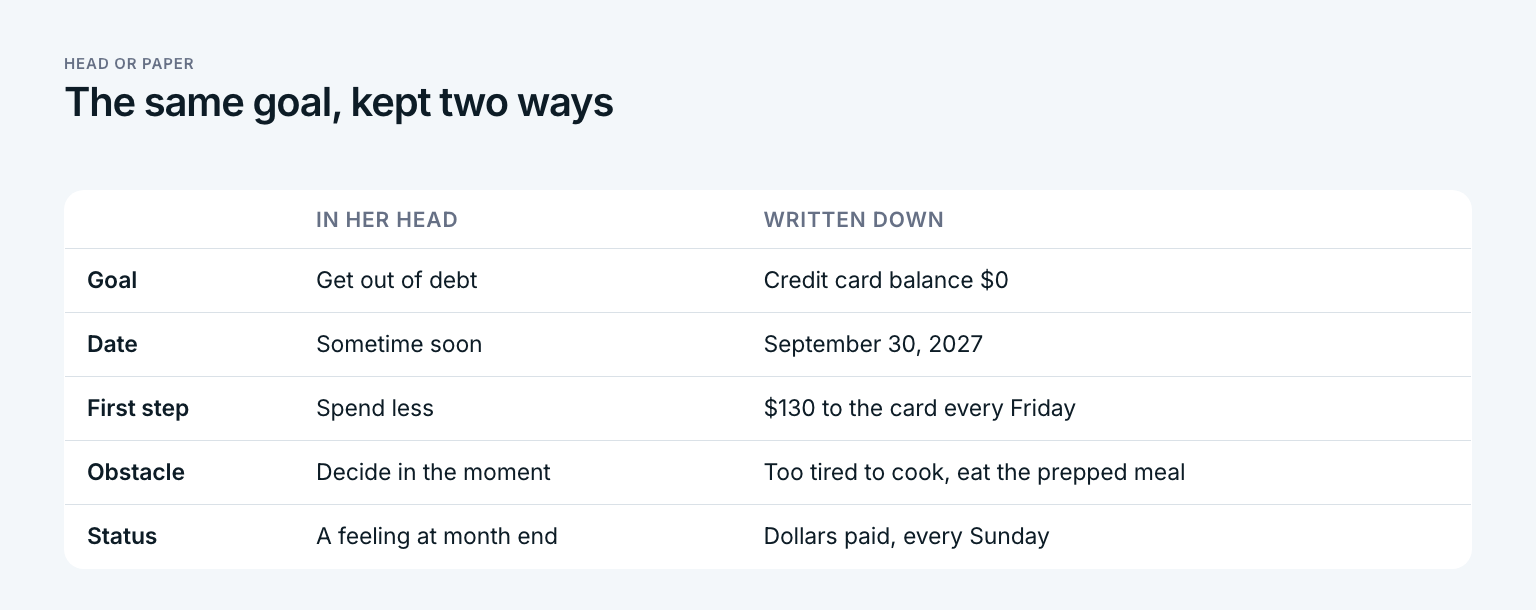
Maya is 29 and works night shifts in the emergency department of a Columbus hospital. She has $6,000 on a credit card, built up during a move and a car repair. For two years she has told herself she needs to get out of debt. She has downloaded a budgeting app twice and deleted it twice. In her head, the goal was always clear. It was never on paper.
In early October, she sits down with a legal pad for forty minutes and works through the five steps. The first step shows her how little “get out of debt” actually says. Out of which debt, and by when? She settles on a balance of $0 by September 30, 2027. That works out to $550 a month, which also roughly covers the interest. For the first time, her goal has a day on which it will either have happened or not.
The why is easy: she wants to start saving for a nurse practitioner degree. The first step is to cancel two streaming subscriptions by Sunday and transfer $130 to the card every Friday. Her if-then plan targets her real weak spot: if she is too tired to cook after a night shift, she eats a meal she prepped on Sunday instead of ordering delivery. The page goes on the fridge, with a pen on a string beside it.
Every Sunday night, Maya writes two numbers: what she planned to pay and what she actually paid. She adds one sentence. After six weeks, her page looks like this:
| Friday | Planned | Paid | Note |
|---|---|---|---|
| Oct 9 | $130 | $130 | Two subscriptions canceled, $27 a month freed up |
| Oct 16 | $130 | $130 | On plan, nothing to change |
| Oct 23 | $130 | $60 | Three delivery orders after night shifts |
| Oct 30 | $130 | $70 | Delivery again, both times after the third night in a row |
| Nov 6 | $130 | $160 | Prepped four meals instead of two, $30 extra |
| Nov 13 | $130 | $170 | Back on plan, gap down to $60 |
What does the log show? In the weeks ending October 23 and October 30, the payment falls short twice, and both times the cause is the same: delivery orders after the third night shift in a row. In her head, Maya would have filed it under “a rough couple of weeks.” On paper, she sees a pattern with a cause. She preps four meals on Sundays instead of two, and from November the plan holds again. That means: the written goal did not motivate her. The written numbers showed her what to change.
Notice also what did not happen. Maya never rewrote her goal during those six weeks. She read it every Sunday and wrote one number under it every Sunday. The sentence at the top stayed the same. Only the lines underneath kept growing.
Paper, journal or app: where your written goals should live
Where you keep the goal decides whether you see it again. Every option has strengths, and none is right for everyone. The only question that matters: where do you already look every week? A written goal you see every week is the simplest way to visualize goals, long before any vision board.
| Where | Strength | Weakness | Best for |
|---|---|---|---|
| Sticky note on the fridge or mirror | Seen every day, zero effort | Fades into the background after a few weeks, no room for progress | One goal with a short timeline |
| Paper notebook or planner | Handwriting forces you to be brief, goal and log in one place | Only visible when you open it | People with a fixed weekly desk routine |
| Notes app or document | Always with you, easy to edit | Gets lost among other notes, no progress at a glance | Goals you rephrase often |
| Goal app with a goal chain | Yearly goal, weekly steps and progress linked, reminder for your weekly check | Takes some setup, one more app on your phone | Several goals over a year, including shared ones with a partner or team |
Is handwriting better than typing? For learning, the findings are mixed. For goals, the question has barely been studied. What matters more than the tool is the rule you attach to it: one place, one fixed day, one number. Anyone who has those three can do as well with a pencil as with an app.
Maya sticks with the page on the fridge because her roommate sees it. Her roommate asks every Sunday how much went to the card. Without planning it, Maya has recreated the condition that did best in Matthews' study: a regular report to someone who asks.
How often should you write down your goals?
Write the goal once, and write your progress every week. That is the short answer. Some advice tells you to rewrite your goals by hand every morning. That can be a good ritual. It points your attention in the right direction, and if you enjoy it, keep it. It just does not measure anything.
Rewriting the goal every day repeats the sentence. A weekly number tests it. Whoever writes the goal every morning but never logs where they stand will know exactly what they want after three months, and not where they are. The review by Harkin and colleagues supports the second habit, not the first.
A rhythm that holds up:
- Once a year: write your three to five big goals fresh, each with a number and a date.
- Once a quarter: read each goal and check whether it still applies. Rewriting a goal is allowed. Quietly forgetting it is not.
- Once a week: log where you stand and write the next step, ten minutes.
- Every day, if you like: read or rewrite the goal sentence as a reminder, not as a measurement.
Rewriting a goal is not failure, by the way. Anyone who realizes in February that $550 a month is too much can change the date, cross out the old one where it stays visible, and keep going. The page then tells the honest story of what happened. A goal that silently disappears tells you nothing.
Three mistakes nobody notices
Most written goals do not fail because of what they say. They fail because of what happens after the writing. One mistake is so common that it gets its own box:
The most common mistake: write it down, then put it away
The goal gets carefully worded on New Year's Day and written into a notebook, and the notebook goes into a drawer. By March, nobody remembers the exact number. Writing it down was an event instead of a beginning. Anyone who does not see their goal at least once a week has not recorded it. They have archived it.
Beyond that, three quieter mistakes tend to go unnoticed for months:
First: too many goals on one page. Twelve goals take ten minutes to write. They cannot all be tracked. Whoever runs more than five goals at once ends up logging numbers on Sunday that even they barely read. Three goals you actually follow beat twelve you merely wrote down.
Second: a sentence without a number. “Live healthier” sits on a lot of fridges. It feels like a goal and can never be checked off. Without a number, your weekly status can only be a feeling, and feelings shift with your mood.
Third: announcing the goal instead of reporting the status. A post about your big goal earns likes and costs nothing. In 2009, Peter Gollwitzer and colleagues found evidence that announcing an intention tied to your identity can create a sense of having already achieved something. The best group in Matthews' study did something different: it reported progress to one person every week. That means: do not share the goal with many people. Share the progress with one.
Writing down goals in a goal chain: year, quarter, month, week, day
A single goal sentence for next September does not tell Maya what to do on a Tuesday in October. So she writes the goal not once but five times, smaller at every level. Each level answers the same question for a shorter stretch of time: what has to be true by then for the level above to hold?
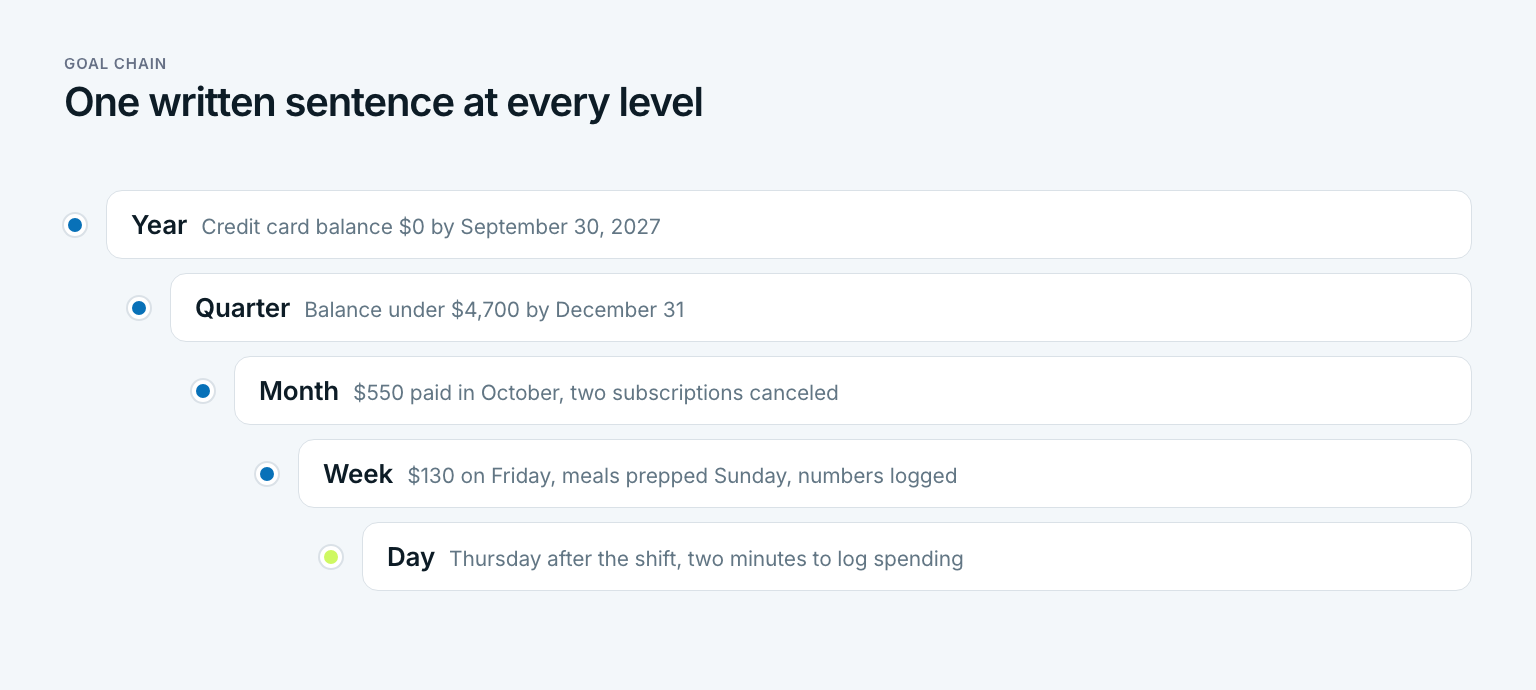
- Year: By September 30, 2027, my credit card balance is $0.
- Quarter: By December 31, the balance is under $4,700.
- Month: In October, $550 goes to the card and two subscriptions are canceled.
- Week: $130 to the card on Friday, meals prepped on Sunday, numbers logged Sunday night.
- Day: Thursday after my shift, two minutes to log what I spent.
Every level is its own written sentence with a number and a date. If one week falls short, Maya sees right away whether the month still holds. If the month wobbles, she checks the quarter. A goal that used to show up once a year becomes a status that asks for an answer every week.
The page on the fridge only carries the weekly level and the log. Maya keeps the upper levels in Gaapp, where year, quarter, month and week are linked and each level's progress sits next to the time that has already passed. Anyone who combines the two gets the paper for daily life and the chain for the big picture. The full method for turning a goal into a finished goal is in the guide on how to achieve goals.
Three questions before you put the page away
Before the page goes on the fridge, run a quick check. Three questions are enough:
- Could someone else say yes or no on your date about whether you reached the goal?
- Do you know exactly what you will do in the next seven days, and what you will do when something gets in the way?
- Is there a fixed weekly slot in your calendar for logging where you stand?
Three yeses, and your goal is recorded. One no, and it is only noted. In short: writing down goals works not because paper is special, but because writing makes you decide, plan, and later measure. The page is not a promise. It is a measuring tool.
Frequently asked questions about writing down goals
How do you write down goals?
Write each goal as an end state with a number and a date, as if it were already true, such as “By September 30, 2027, my credit card balance is $0.” Add one sentence on why it matters, the first step with a day and time, and one if-then plan for your likeliest obstacle. Then keep the page where you will see it weekly and log one number next to it every week.
What are some good writing goals?
If you mean goals for your writing, the same rules apply: pick a number you control and a date. “Write 1,000 words a week until the first draft reaches 60,000 words by June 30” is a writing goal you can log every Sunday. Process goals like words per week usually serve writers better than outcome goals like getting published, because you control them.
Does writing down goals actually help?
Probably yes, but less because of the paper than because of what you do while writing. Writing forces a number and a date, a written plan takes the next step off your mind, and a regularly logged status shows you when to change course. The best-supported part is recording your progress again and again, not writing the goal down once.
What are the 10 examples of goals?
There is no official list of ten, but ten written goals could look like this: run a 10K by May 1, save $3,000 by June 30, pay off one credit card by December 31, read 12 books this year, cook dinner at home five nights a week in March, finish a certification by fall, call a parent every Sunday, sleep seven hours on weeknights for a month, learn 500 Spanish words by summer, and walk 8,000 steps a day in April. What makes each one worth writing down is that it has a number and a date.
Is the Harvard study on writing down goals real?
No. The story about Harvard MBA graduates from 1979 or Yale graduates from 1953, in which the few with written goals earned many times more than the rest, cannot be traced to any study. It is a myth. What is real is a small, non-peer-reviewed study by Gail Matthews from 2015 that points in the same direction but does not deliver hard numbers.
How often should you write down your goals?
Write the goal itself once a year and review it once a quarter. Write your progress once a week, as a number next to the goal. Rewriting the goal every morning can be a helpful ritual, but it does not tell you where you stand.
Last updated: 19 October 2026
Read next
 Goal Setting
Intrinsic Motivation: What Drives You From the Inside
Intrinsic motivation is not a personality trait. Meaning, 12 examples, the three needs behind it and five steps to build it, with a worked example.
17 min read
 Goal Setting
Financial Goals: How to Turn Wishes Into a Plan
Financial goals are not wishes with a dollar sign. Short and long term examples, SMART savings goals and a five step plan, worked through one year.
17 min read
 Goal Setting
WOOP Method: Four Steps From Wish to If-Then Plan
The WOOP method is not positive thinking. What WOOP stands for, the research, if-then plans, eight goal examples and a five-minute guide.
18 min read