Goal Setting: How to Set Goals You Actually Reach
Goal setting means deciding what will be true by when, and writing it down. Five steps, 10 example goals, six strategies compared, and a one-page template.

Contents
- 01What goal setting means, and what it does not
- 02Why most goals die by February: the three mistakes nobody notices
- 03How to set goals in five steps
- 04SMART goals in one paragraph, and where they stop
- 05Goal setting strategies compared: six methods and what each one adds
- 0610 good goals, with examples you can copy
- 07Setting goals in a goal chain: year, quarter, month, week, day
- 08Your goal setting template, one page
- 09Goal setting tips that are worth keeping
- 10Three questions before you write your goals
- 11Frequently asked questions about goal setting
Goal setting is not a wish list. It is the act of deciding what will be true by a specific date, writing it down in a form you can check, and attaching it to the weeks and days where the work actually happens. A wish says what you would like. A goal says what you will do, by when, and how you will know.
Three things separate a goal from a wish: a finish line you can verify, a date, and a next step small enough to fit into this week. All three are worked through here on one real plan, that of Renee, 42, a middle school math teacher in Tucson, Arizona, who wants to become an assistant principal. Along the way you get the five steps for setting goals, ten example goals you can copy, six goal setting strategies compared, the three mistakes that end most goals by February, and a one-page template.
What goal setting means, and what it does not
Goal setting means choosing a result, fixing a deadline, and committing the time and the steps to reach it. The psychologists Edwin Locke and Gary Latham spent four decades testing this and published the summary in 1990 in A Theory of Goal Setting and Task Performance. Their core finding is plain: people who set specific, difficult goals perform better than people who are told to do their best. Not because the goal is magic. Because a specific goal tells you where to point your attention, how much effort the task deserves, and when you are done.
That is also where the misunderstanding starts. Writing down goals is a good habit, and anyone who does it on January 1 is ahead of most people. Writing alone measures nothing. A list of ten resolutions on a sticky note is a list of intentions. It becomes goal setting the moment each line has a date, a test, and a first step. In short: the list is the wish, the structure is the goal.
Renee's wish, in her words: I want to move into school leadership. That sentence has been true for three years. She enrolled in a master's program in educational leadership in January on the strength of the wish alone, took two courses in spring and one in summer, and noticed in August that she was drifting. So she wrote the goal: Complete the master's degree by May 2028, with the 240 hour administrative internship finished and the state principal certification exam passed by June 2028. The wish could not fail, because it could not be checked. The goal can fail. That is exactly what makes it useful.
Goal, objective, intention: what each word is for
An intention is a direction without a date: eat healthier, read more. An objective is a measurable result with a date, the word business planners prefer. A goal, in everyday use, covers both, and that is the problem. In this article a goal always has three parts: result, date, test. Whatever lacks one of the three is an intention, and intentions are fine. They just cannot be tracked.
Why most goals die by February: the three mistakes nobody notices
New Year's resolutions have a reputation for failing, and the reputation is earned. Yet the goals rarely fail because people are weak. They fail because the goal was built wrong, and the three construction errors look harmless on the day you write them. Which of the three is yours?
The most common mistake: a goal without a test
Get in shape. Learn Spanish. Grow the business. None of these can be failed, because none can be checked. The fix takes one question: On the deadline, what will I look at to know whether I made it? A race finish time, a 20 minute conversation in Spanish without switching to English, a revenue number. If you cannot name the thing you will look at, you have not set a goal yet.
- Too many goals at once. Twelve resolutions on January 1 give each one a twelfth of your spare attention. By the third week the two that matter are competing with ten that do not. Three goals per time frame is the ceiling, and whoever keeps more than three alive at the same level is choosing all of them a little and none of them enough.
- A deadline without a path. Finish the degree by May 2028 is a real goal with a real test. If the next step is not written down, 2028 stays comfortably far away until it is suddenly close. A goal needs a week level: what happens in the next seven days that moves it. Renee's first version said May 2028. Her working version says: two courses this fall, two in spring, two in summer, internship hours starting in January. The deadline did not change. The path appeared.
- Mistaking the plan for the work. Buying the running shoes, downloading the app, color coding the calendar: all of it feels like progress and none of it is the goal. Planning is good. Planning that lasts longer than the first real session is avoidance with a nice interface. The test is simple: has the finish line moved by one measurable unit this week?
That means: most failed goals were never goals. They were intentions with a date, or goals without a week. Both are fixable in a single sitting, and the five steps below are that sitting.
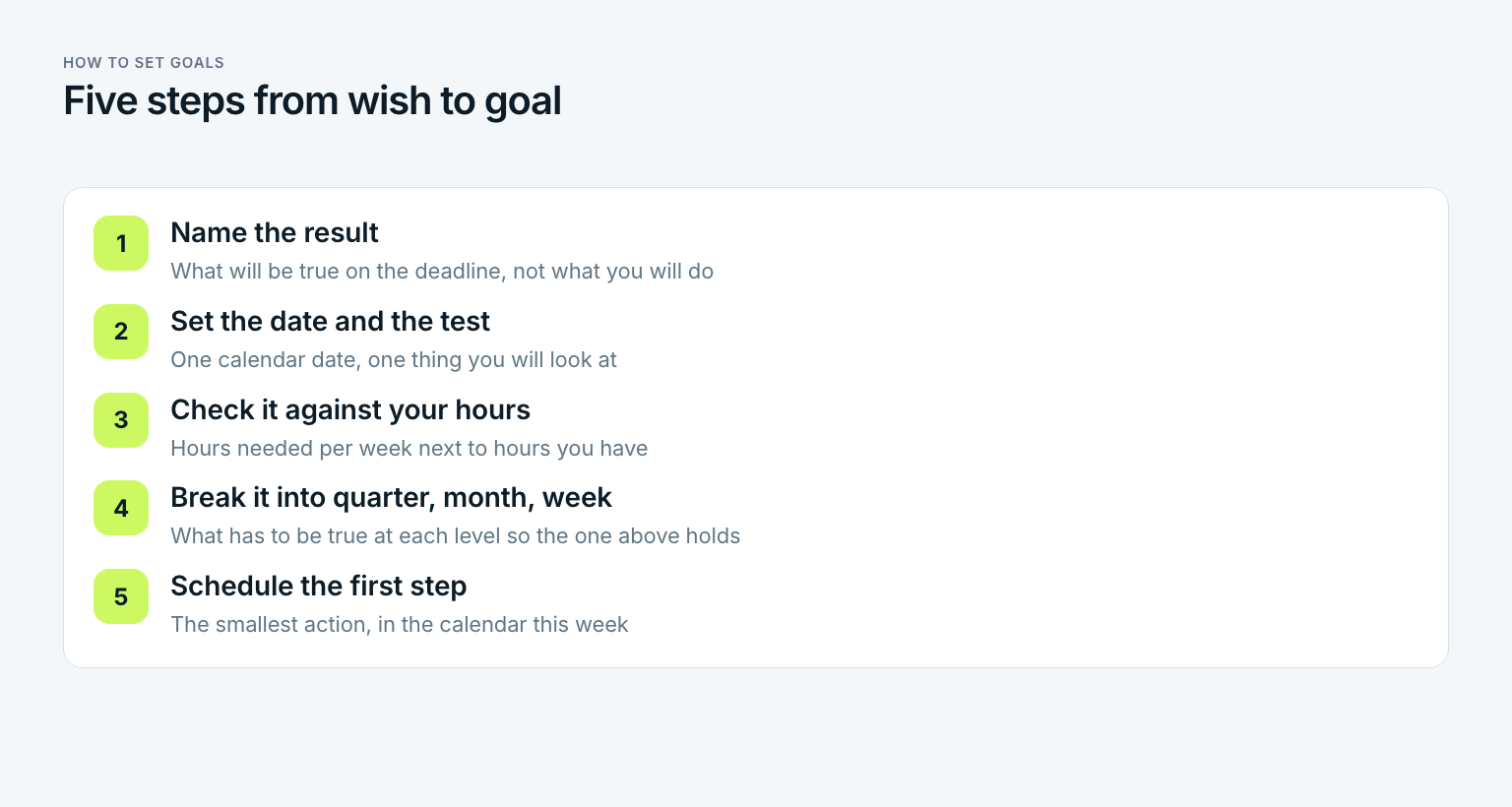
How to set goals in five steps
The five goal setting steps take about 45 minutes the first time and 15 minutes each time you repeat them for a new quarter. You need a blank page, your calendar for the next three months, and honesty about how many hours you actually have. Renee's numbers are in each step.
Name the result, not the activity
Write what will be true on the deadline, in one sentence. Not: study for the master's. But: 15 graduate credits completed with a grade of B or better by December 2026. The result is a state of the world you could photograph. The activity is how you get there, and it comes later.
Set the date and the test
Every goal gets a calendar date and the one thing you will look at on that date. Renee's date: December 18, 2026, the last day of the fall term. Her test: the unofficial transcript showing five courses, all B or better. If the test needs a judgment call, sharpen it until it needs none.
Check the goal against your hours
Count the hours the goal needs and the hours you have. Two graduate courses need about 12 hours a week outside class. Renee teaches full time and coaches soccer on Tuesdays and Thursdays. Her honest count of free hours: 14 a week, mostly evenings and Saturday morning. Twelve fits inside 14. Three courses would need 18 and would not. Whoever skips this step sets goals for a person with more time than they have.
Break it into the next quarter, month, and week
A goal for December needs a goal for the end of the quarter, for this month, and for this week. Renee's quarter: two courses finished by December 18. Her month, for October: the first paper in each course submitted. Her week: three study blocks of two hours, Monday, Wednesday, Saturday, plus the Thursday discussion post. Each level answers one question: what has to be true here so the level above still holds?
Write the first step and schedule it
The first step is the smallest action that moves the goal and fits into a single calendar slot this week. Renee's: Monday, 7 to 9 p.m., read chapter one of School Law and write the one paragraph response. Put it in the calendar with a start and an end time. A goal without a scheduled first step is a goal that starts next week, every week.
Repeat steps four and five every Friday. The first three steps hold for a quarter. The last two change weekly, and whoever runs a ten-minute weekly review already has the slot for them.
SMART goals in one paragraph, and where they stop
SMART is the goal setting acronym most people meet first, and it earns its place. George T. Doran introduced it in 1981 in a short article in Management Review for managers writing objectives, and the five letters, specific, measurable, achievable, relevant, time-bound, are a solid checklist for steps one and two above. Run Renee's December goal through it and it passes on all five. What SMART does not do is tell you how many goals to have, how they connect to each other, or what happens on Tuesday. It checks the sentence. It does not build the path. Use SMART to test a goal after you have written it, and use the chain below to make it reachable. Worked examples for every letter are in the guide to SMART goals examples.
Goal setting strategies compared: six methods and what each one adds
There is no shortage of goal setting strategies, and most of them are right about something. The useful question is not which one is best. It is which gap in your current goal each one closes. Six are worth knowing, and they combine.
| Strategy | Origin | What it adds | Best for |
|---|---|---|---|
| SMART goals | George T. Doran, 1981 | A checklist for a well formed goal sentence | Testing a single goal before you commit |
| Goal setting theory | Edwin Locke and Gary Latham, 1990 | Specific and difficult beats do your best, feedback keeps effort up | Understanding why vague goals fail |
| Implementation intentions | Peter Gollwitzer, 1999 | If situation X, then I do Y: a trigger attached to the action | Goals that stall at the first step |
| WOOP, mental contrasting | Gabriele Oettingen, 2014 | Wish, outcome, obstacle, plan: the obstacle is named before it appears | Goals you have failed at before |
| OKR | Andy Grove at Intel, spread by John Doerr, 2018 | One objective, three measurable key results, graded at the end of the quarter | Teams and ambitious quarterly goals |
| 12 Week Year | Brian Moran and Michael Lennington, 2013 | Treats twelve weeks as a full year to remove the slack of a long deadline | People who start strong in January and fade |
Renee uses three of the six without naming them. SMART checks her sentence. An implementation intention protects her Monday block: if it is 7 p.m. on Monday, I open the course site, whatever the day was like. And WOOP named her obstacle in advance: soccer tournaments on Saturdays in October. Her plan for that obstacle: the Saturday block moves to Sunday afternoon on tournament weekends, decided now, not on the Saturday. Three strategies, 20 minutes of extra work, and the most likely failure point is already handled. WOOP is also the research-backed way to visualize goals: you picture the obstacle, not only the finish line.
The pattern across all six: every strategy that holds up adds either a test, a trigger, or a time frame. Anyone who wants an all-in-one method can stop collecting acronyms. Specific result, honest hours, scheduled first step, named obstacle. That is the whole toolkit, and the name on the box is a matter of taste. Anyone who still wants to compare them finds nine goal setting frameworks sorted by the gap each one closes.
The 5 C's of goal setting, and the five principles behind them
You will meet lists of five C's: clear, challenging, committed, consistent, and a fifth that varies by author. The lists are fine as memory aids. They trace back to the five principles Locke and Latham drew from their research: clarity, challenge, commitment, feedback, and task complexity. Clarity and challenge describe the goal itself, specific and hard enough to matter. Commitment is whether you actually want it or only think you should. Feedback is whether you can see progress along the way, which is the job of the weekly level. Task complexity is the warning: if the goal is new and complicated, you need more time and smaller steps than you think. Whoever applies those five has every C covered, whichever list they read.
10 good goals, with examples you can copy
What are 10 good goals? The honest answer is that good goals are the ones attached to your life, not to a list. Still, people look for examples because the gap between a wish and a written goal is easier to see on someone else's line. Here are ten across the areas most people care about. The middle column is how people usually say it. The right column is the same thing as a goal you can check.
| Area | How it usually sounds | Written as a goal |
|---|---|---|
| Health | Get in shape | Run a 10K in under 65 minutes on May 16, training three mornings a week |
| Money | Save more | Emergency fund of $9,000, three months of expenses, in a separate account by December 31 |
| Debt | Pay off the credit card | Card balance of $6,400 at zero by August 31, paying $800 a month |
| Career | Get promoted | Lead one cross-team project to delivery and complete the internal leadership program by September 30 |
| Learning | Learn Spanish | Hold a 20 minute conversation with a tutor without switching to English by June 30, four lessons a month |
| Relationships | Spend more time with my partner | One evening a week without screens, 44 of 52 weeks, tracked on the calendar |
| Family | Be more present with the kids | Read aloud 20 minutes on at least five nights a week through the school year |
| Home | Declutter the house | Garage cleared and usable as a workshop by March 31, one shelf per weekend |
| Mind | Read more | Twelve books by December 31, one a month, 20 pages a night |
| Contribution | Give back | 60 volunteer hours at the food bank by December 31, one Saturday morning a month |
Notice what the right column shares. Every goal names a number, a date, and the rhythm that gets there: three mornings, $800 a month, one shelf per weekend. The rhythm is the part most example lists leave out, and it is the part that decides whether the goal survives February. Pick three from this table at most. Renee picked one for the year and let the others wait. Goals you reach in sequence beat goals you hold in parallel. A list of goals with 100 measurable lines gives that sequence a pool to draw from.
Setting goals in a goal chain: year, quarter, month, week, day
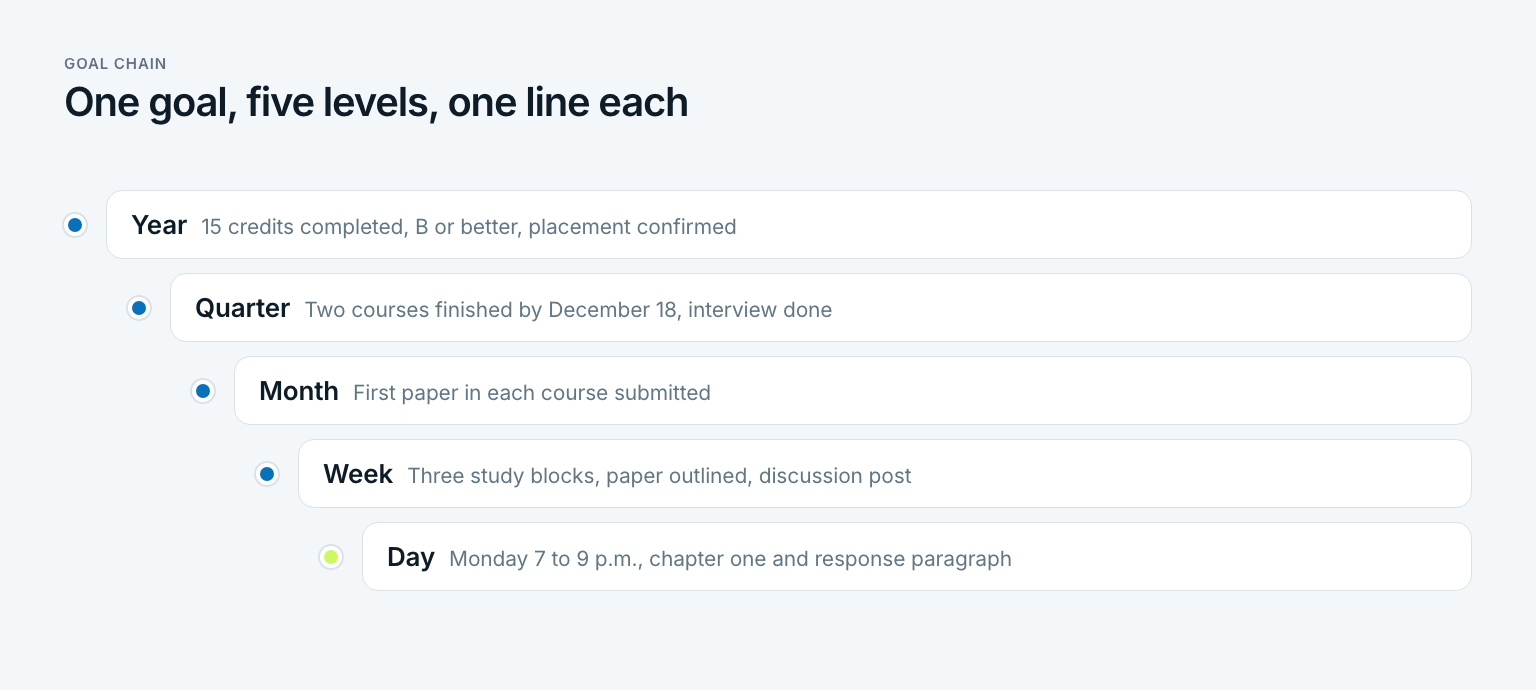
A yearly goal is too big to act on and a daily task is too small to matter on its own. The goal chain connects them: the year sets the direction, the quarter sets the milestone, the month sets the deliverable, the week sets the three things that get done, and the day sets the one thing that happens today. Every level answers the same question: what has to be true here so that the level above still holds? The same question links short-term and long-term goals: a short-term goal earns its place only if it makes the long-term goal more likely.
Renee's chain, from the top. Year 2026: 15 graduate credits completed, B or better, internship placement confirmed. Fourth quarter: two courses finished by December 18, placement interview done. October: first paper submitted in both courses, placement application sent. Week of October 5: three study blocks done, School Law paper outlined, Thursday discussion post up. Monday, October 5: 7 to 9 p.m., read chapter one and write the response paragraph. Five levels, one line each. The yearly goal did not get smaller. It got reachable.
The chain changes how you measure. Progress at any level is the share of goals completed at that level, and time is the share of the period that has passed. On October 5, 76 percent of the year is gone and Renee has nine of 15 credits, 60 percent. Behind, but she knows it in October, not in December, and six credits in one term is exactly what the fall term holds. Without the chain she would find out in May 2028 whether it worked. With the chain she knows every Friday.
In Gaapp this chain is the structure: five levels from year to day, each goal attached to a larger one, progress per level shown next to elapsed time. Setting goals there means writing the yearly line first and the daily line last, and whoever has done the five steps above has already produced all five lines. How to turn the yearly line into the rest is the subject of the guide to annual planning, and how to word the daily line so it gets checked off is in the article on daily goals. The broader question, what to do once the goals are set, is the pillar on how to achieve goals.
Pairs and families use the same chain with a shared level. Teams use it with the quarter as the shared level and the week as the personal one. Coaches use it to turn a client's wish into something the client can report on at the next session. The structure does not change. Only the owner of each line does.
Your goal setting template, one page
The template fits on a single page or in one note, and it is the five steps written as fields. The third column shows Renee's entries so you can see how short an answer is allowed to be. Fill it in once per goal, three goals at most, and bring it to your Friday review.
| Field | Question | Renee's entry |
|---|---|---|
| Result | What will be true on the deadline? | 15 graduate credits completed, B or better, placement confirmed |
| Date | When exactly? | December 18, 2026 |
| Test | What will I look at to know? | Unofficial transcript, five courses, and the placement email |
| Why | What does this goal serve? | Assistant principal role by fall 2028 |
| Hours | Hours needed per week, hours available | 12 needed, 14 available |
| Quarter | What has to be true at the end of this quarter? | Two courses finished, placement interview done |
| Month | What has to be true at the end of this month? | First paper in each course submitted, application sent |
| Week | What are the three things this week? | Three study blocks, paper outlined, discussion post |
| Obstacle and plan | What will get in the way, and what then? | Soccer tournaments on Saturdays, block moves to Sunday 2 p.m. |
| First step | What happens in the calendar this week? | Monday 7 to 9 p.m., chapter one and response paragraph |
Ready-made goal packages that break a yearly goal down to the daily level are in the templates hub. Every line in them can be renamed or deleted, and the empty template above works just as well on paper.
Goal setting tips that are worth keeping
Most goal setting tips are either the five steps in disguise or decoration. Four are neither, and each one closes a gap the steps leave open.
- Write the goal where you will see it on a Tuesday. A goal in a January notebook is a goal you meet twice a year. The test is whether you see it on an ordinary weekday without looking for it: the lock screen, the top of the weekly plan, the first line in your app.
- Tell one person, and tell them the date. Not the whole world. One person who will ask you in March. Renee told the colleague who covers her classroom on exam days. Accountability works best when it is specific and small, not when it is a post.
- Decide the review before you start. Fifteen minutes every Friday, same time, in the calendar. The review is where the goal gets adjusted instead of abandoned. Anyone who sets goals without a review slot has set them once and will find out in December how that went.
- Expect to revise the goal, not just the plan. Halfway through a quarter you know more than you did at the start. A goal that turns out too small gets raised. A goal that turns out wrong gets cut. Cutting a goal on purpose is a decision. Letting it fade is not.
In short: visible, shared with one person, reviewed weekly, and allowed to change. Four tips, none of them new, all of them skipped by most people who set goals in January.
Three questions before you write your goals
Before you fill in the template, three questions about the goals you set last time. The answers tell you which of the three mistakes is yours, and the pattern repeats until you see it.
- Can you say, right now, what the test for your current main goal is, without looking it up?
- How many goals are you holding at the same time, and how many of them have moved in the last 14 days?
- When did you last cut a goal on purpose, instead of letting it fade?
Anyone who stumbles on the first question has an intention, not a goal. Anyone who stumbles on the second has too many. Anyone who cannot answer the third has never run a review. All three are fixed by the same 45 minutes with a blank page. In short: goal setting is not writing down what you want. It is deciding what will be true by when, and building the week that gets you there.
Frequently asked questions about goal setting
What are the 5 goal setting steps?
Name the result rather than the activity, set the date and the test, check the goal against your real hours, break it into quarter, month, and week, and write the first step into the calendar. The first three hold for a quarter. The last two repeat every week. Together they turn a wish into something you can check on a specific date.
What are 10 good goals?
Good goals are specific to your life, but ten common ones with a result, a date, and a test are: a 10K in under 65 minutes, a $9,000 emergency fund, a credit card at zero, a cross-team project delivered, a 20 minute conversation in a new language, a weekly screen-free evening, 20 minutes of reading aloud five nights a week, a cleared garage, twelve books in a year, and 60 volunteer hours. Pick three at most and run them in sequence rather than in parallel.
What is the meaning of goal setting?
Goal setting means choosing a specific result, fixing a date for it, and committing the time and the steps to reach it. Locke and Latham's research since the 1960s shows that specific, challenging goals lead to better performance than vague encouragement. In practice the meaning is simple: a goal has a result, a date, and a test, and anything missing one of the three is still a wish.
What are the 5 C's of goal setting?
The lists vary by author, usually some version of clear, challenging, committed, consistent, and a fifth such as celebrated or checked. They are memory aids for the five principles from goal setting theory: clarity, challenge, commitment, feedback, and task complexity. If you apply those five, every list of C's is covered.
How many goals should I set at once?
Three per time frame is the ceiling: three for the year, three for the quarter, three for the week. More than that and every goal gets a fraction of your attention and none gets enough. One is often better, especially for a goal that needs 10 or more hours a week. Finish one, then start the next.
How often should I review my goals?
Weekly for the week level, 15 minutes on a fixed day, and once per quarter for the goal itself. The weekly review checks whether the three things got done and sets the next three. The quarterly review asks whether the goal is still the right one and adjusts the date, the size, or cuts it on purpose.
Last updated: 19 October 2026
Read next
 Goal Setting
Intrinsic Motivation: What Drives You From the Inside
Intrinsic motivation is not a personality trait. Meaning, 12 examples, the three needs behind it and five steps to build it, with a worked example.
17 min read
 Goal Setting
Financial Goals: How to Turn Wishes Into a Plan
Financial goals are not wishes with a dollar sign. Short and long term examples, SMART savings goals and a five step plan, worked through one year.
17 min read
 Goal Setting
WOOP Method: Four Steps From Wish to If-Then Plan
The WOOP method is not positive thinking. What WOOP stands for, the research, if-then plans, eight goal examples and a five-minute guide.
18 min read