Bucket List: 100 Ideas and How to Finish Yours
A bucket list is a dated list of experiences you commit to before you die. 100 ideas, the top 10, six steps, a template, and one teacher's list.

Contents
- 01What a bucket list is, and where the name comes from
- 02Why most bucket lists end up in a notes app with three check marks
- 03Bucket list ideas: 100 ideas sorted by what they ask of you
- 04The top 10 bucket list items, and what they have in common
- 05How to write a bucket list in six steps
- 06Marcus's bucket list: from 47 wishes to twelve commitments
- 07Your bucket list in the goal chain: year, quarter, month, week, day
- 08The three mistakes nobody notices
- 09A bucket list template you can copy
- 10Three questions before you add an item
- 11Frequently asked questions about bucket lists
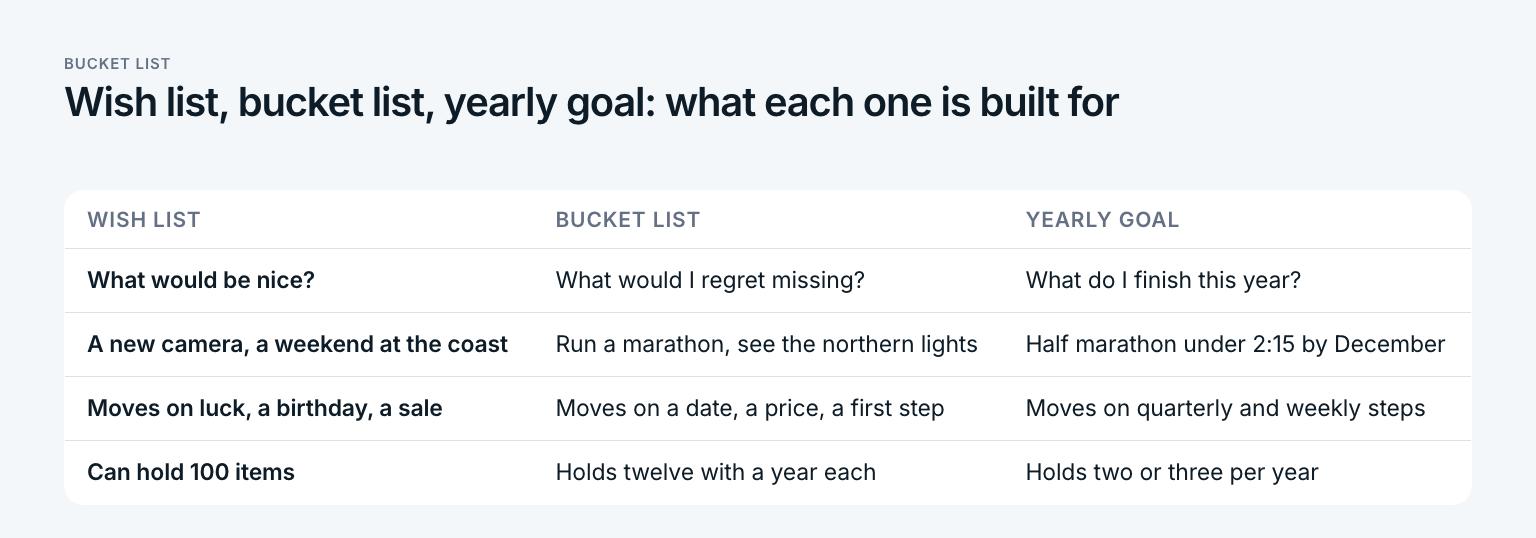
A bucket list is not a wish list. It is a list of experiences you want to have before you die, written down with a date, a price, and a first step, so that each item turns into a project instead of a daydream. A wish list collects things you would like to happen to you. A bucket list names the things you are going to make happen.
Three things separate the two: a filter that keeps only what you would regret missing, a date that turns someday into a year, and a first step that fits into a normal week. All three are worked through on the list of Marcus, a 38-year-old high school history teacher in Austin, Texas. He wrote 47 items on his 30th birthday. On his 38th, three had a check mark. By the end, his list has twelve items with a year and a first step each.
What a bucket list is, and where the name comes from
A bucket list is a personal list of experiences, places, and achievements a person wants to complete in their lifetime. The name comes from the idiom to kick the bucket, a slang phrase for dying that Francis Grose already recorded in his Dictionary of the Vulgar Tongue in 1785. The list itself became a household word in 2007 with the film The Bucket List by Rob Reiner, in which Jack Nicholson and Morgan Freeman play two terminally ill men who leave the hospital to finish their list. Screenwriter Justin Zackham had written his own list years earlier. Merriam-Webster dates the first known use of the term to 2006.
The function matters more than the origin. A bucket list answers one question: What would I regret not having done? That is a different question from what would be nice. Nice fills a wish list in ten minutes. Regret fills a bucket list slowly. Whoever confuses the two writes a travel catalog and calls it a life plan.
| Type of list | Question it answers | Typical item | What moves it forward |
|---|---|---|---|
| Wish list | What would be nice? | A new camera, a weekend at the coast | A birthday, a sale, luck |
| Bucket list | What would I regret missing? | Run a marathon, see the northern lights, learn to sail | A date, a price, a first step |
| Yearly goal | What do I finish this year? | Half marathon under 2:15 by December | Quarterly, monthly, and weekly steps |
| To-do list | What has to get done this week? | Renew the passport, book the flight | Doing it |
Bucket list vs. life goals
Life goals describe who you want to be in ten years: the work you do, the people around you, the shape of your days. A bucket list collects single experiences you can finish and cross off. The two overlap, but a bucket list is the smaller, more concrete tool. Whoever puts become a better father on a bucket list has written a life goal in the wrong place. Take your daughter to the Grand Canyon before she turns twelve belongs there.
Why most bucket lists end up in a notes app with three check marks
Writing down what you want is a good habit. It clears your head and it feels like a start. It just does not move anything by itself. The psychologist Gabriele Oettingen showed in two decades of studies, summarized in Rethinking Positive Thinking in 2014, that imagining a wished-for future on its own lowers the energy people put into reaching it. The daydream pays out a little of the reward in advance. The list in the notes app does exactly that, 47 times. A vision board of finished pictures has the same problem, and the guide on how to make a vision board uses the same research to fix it.
Three reasons explain why the list stalls, and Marcus hit all three. First, no item had a date. Someday is not a year, and a list of 47 somedays has no first item. Second, no item had a price. He had never added up what see the northern lights in Norway costs in dollars and vacation days, so it stayed a picture. Third, nothing on the list fit into a Tuesday. Every item was the finished experience, and none of them was the phone call, the training run, or the savings transfer that leads there. The result is predictable. Whoever only writes down the summit never laces up a boot.
The uncomfortable part: the three items Marcus did complete were handed to him. A friend organized Mexico City, his school sent him to a conference, his brother signed them up for a half marathon. Nothing that depended on Marcus alone got done. Is that a problem with Marcus, or with the list? The list. A list that waits for luck is a wish list, whatever it is called.
Bucket list ideas: 100 ideas sorted by what they ask of you
Idea lists are useful for one thing: finding out what you actually want. Read fast, mark what makes you flinch, skip the rest. The 100 bucket list ideas below are sorted by what they ask of you, not by how they look in a photo. Half cost less than a weekend. A few cost a year of your life.
Travel and places
- See the northern lights from a cabin in northern Norway or Alaska
- Watch the sunrise over the Grand Canyon from the South Rim
- Walk a section of the Camino de Santiago in Spain
- Ride the train from Chicago to San Francisco
- Spend one night in a desert with no light pollution
- Visit the town your grandparents came from
- Stand on the equator and on the Arctic Circle in the same lifetime
- See the cherry blossoms in Kyoto in April
- Drive the length of Highway 1 along the California coast
- Spend a month living in a city where you do not speak the language
Nature and the outdoors
- Climb a mountain above 14,000 feet
- Swim with manatees in Florida or with whale sharks in Mexico
- Sleep under the stars for a full week with no tent
- Watch the monarch butterfly migration in Michoacán
- See a total solar eclipse from inside the path of totality
- Paddle a canoe through the Boundary Waters
- Catch a fish, clean it, and cook it the same evening
- Hike to a glacier before it disappears
- Plant a tree you will visit in 20 years
- Spot a wild bear, wolf, or whale with your own eyes
Skills to learn
- Hold a 15-minute conversation in a second language
- Learn to sail and take a boat out alone
- Play one song on the piano from memory, start to finish
- Learn to read music
- Take a woodworking course and build one piece of furniture
- Earn a scuba certification
- Learn to drive a manual transmission
- Code a small app that someone else uses
- Take a stand-up comedy class and perform a five-minute set
- Learn to bake bread without a recipe
Body and sport
- Run a marathon
- Complete a triathlon, any distance
- Do ten clean pull-ups
- Hold a handstand for ten seconds
- Cycle 100 miles in one day
- Surf a wave and ride it to the beach standing up
- Swim one mile in open water
- Ski or snowboard a run that scares you
- Finish a 50-mile hike in one weekend
- Learn to dance one dance well enough to lead
Food and drink
- Cook a seven-course dinner for eight friends
- Eat at a restaurant you saved up a year for
- Make cheese, pasta, or sausage from scratch
- Harvest grapes and help make the wine
- Eat a dish in the country it was invented
- Grow a tomato from seed and eat it
- Learn to make your grandmother's signature dish
- Eat something that frightens you a little
- Host Thanksgiving for the whole family
- Roast coffee beans at home
Creativity
- Write a book, even if only 100 people read it
- Record a song and release it
- Paint a picture and hang it in your home
- Take one photograph a day for a year
- Write letters to your children to open at 18
- Act in a community theater production
- Build a piece of furniture from a tree you cut down
- Publish an article in a magazine or newspaper
- Learn calligraphy and hand-letter a wedding invitation
- Design and sew a piece of clothing you wear in public
People and relationships
- Take a road trip with your father or mother, just the two of you
- Visit every sibling in their own home within one year
- Reconnect with a friend you lost touch with 20 years ago
- Learn the full story of how your parents met
- Record an interview with the oldest person in your family
- Plan a surprise party that stays a surprise
- Take your partner back to the place you met
- Write a thank-you letter to a teacher who changed you
- Spend one full weekend with no screens and your kids
- Meet the pen pal, online friend, or cousin you have never seen in person
Giving and community
- Volunteer for one full week with a disaster relief team
- Donate blood 20 times
- Mentor someone for a full year
- Build or restore a trail with a volunteer crew
- Teach a free class in something you know
- Fund a scholarship, however small
- Foster an animal until it finds a home
- Serve on a jury without trying to get out of it
- Organize a cleanup of a river, park, or beach
- Give away ten percent of one year's income
Home and everyday
- Pay off every debt except the mortgage
- Build a reading chair and read 50 books in it
- Keep a garden that feeds your family for one summer
- Learn to fix the three things that break most in your home
- Live in a different state or country for a year
- Sleep in a treehouse, a lighthouse, and a boat
- Spend a winter with a fireplace you chop wood for
- Go one year without buying new clothes
- Build a workshop, studio, or darkroom in your own space
- Host a dinner once a month for a full year
Courage and firsts
- Skydive or paraglide
- Give a talk in front of 200 people
- Go a full week alone in silence
- Quit the thing you have been afraid to quit
- Ask the question you have been carrying for years
- Compete in anything, and lose in public
- Swim in the ocean in January
- Cross a country by bicycle
- Spend a night alone in the woods
- Say no to something you have always said yes to
Did any of those make you flinch? That flinch is the filter. Most readers find five to eight that land. Whoever copies all 100 has a longer wish list, nothing more.

The top 10 bucket list items, and what they have in common
Ten items show up on nearly every published bucket list. They are worth a look, not to copy, but because the pattern shows what people actually want from a bucket list.
| Rank | Item | Why it is on every list | What it really costs |
|---|---|---|---|
| 1 | See the northern lights | A rare sight you cannot order | Roughly $2,500 and seven vacation days from Texas, plus a winter |
| 2 | Skydive | Fear faced in one afternoon | About $300 and half a Saturday |
| 3 | Run a marathon | Proof that a body can be trained | 18 weeks of training, four runs a week, a $150 entry fee |
| 4 | Visit Machu Picchu | A world wonder with a trail | A week, about $3,000, altitude acclimatization |
| 5 | Learn a new language | A changed brain, not a souvenir | 20 minutes a day for about two years |
| 6 | Write a book | Something that outlasts you | One hour a day for a year, no money at all |
| 7 | Swim with dolphins or whale sharks | Contact with a wild animal | A trip to the coast, about $200 for the tour |
| 8 | Ride in a hot air balloon | A view that changes perspective | About $250 and one early morning |
| 9 | See the Grand Canyon | Scale that photographs cannot carry | A long weekend from most of the United States |
| 10 | Take a road trip across the country | Time with one person and no agenda | Two to three weeks, about $2,000 in gas and motels |
Look at the right column. Three of the ten cost almost nothing but time. Four cost less than $500. Only three need real savings. The idea that a bucket list is for rich retirees does not survive the arithmetic. What people want is the same every time: a moment with a before and an after. That means: the item is not the point. The change in the person is.
How to write a bucket list in six steps
A bucket list takes one evening to write and one weekend to turn into a plan. Marcus did it over two sittings in August, with his old list of 47 open next to a blank page. The steps are the same whether you start from scratch or from an old list in a notes app.
Dump everything, 20 minutes, no filter
Write down every experience you have ever wanted, from the serious to the silly. Use the 100 ideas above as a trigger. Do not judge, price, or sort. A list edited while it is written stays polite, and polite lists are forgotten.
Sort into five buckets, ten minutes
Mark each item as travel, skill, body, people, or create. Marcus's 47 came out as 19 travel, 11 skills, eight experiences, five people, and four things to own. The four things went to a shopping list. A bucket list holds experiences, not purchases.
Run the regret test, 15 minutes
Read each item and ask: If I am 80 and never did this, does it sting? Yes stays, no goes to a someday list. Marcus cut 47 to 21 here. The 26 that left were mostly places he had seen on other people's feeds.
Price every item in dollars and days, 30 minutes
Estimate roughly, round up. Northern lights: $2,500 and seven days. Marathon: $150 and 18 weeks. Twelve of Marcus's 21 items cost under $500, nine over $2,000. The price does not remove an item. It tells you which year it fits.
Pick twelve for the next five years and give each a year
Twelve in five years is two or three a year, which a working adult with a family can carry. Cheap and near first, expensive and far later. Everything without a year moves to the someday list. Marcus kept twelve and parked nine.
Write the first step for the top three, and put it in the calendar
The first step takes under an hour and happens within seven days: register for the race, open a savings account, email the sailing school. Marcus registered for the Austin Marathon that Sunday night and transferred $100 to an account named Tromsø. The list had become a plan.
Marcus's bucket list: from 47 wishes to twelve commitments
Numbers tell it better than adjectives. The old list: 47 items, zero dates, zero prices, three check marks in eight years. The new list: twelve items, twelve target years, twelve prices, three first steps done. It took about two and a half hours.
| Item | Category | Target year | Cost in money | Cost in time | First step, done within seven days |
|---|---|---|---|---|---|
| Run the Austin Marathon | Body | Next February | $150 entry, $120 shoes | 18 weeks, four runs a week | Registered, training plan printed |
| See the northern lights in Tromsø | Travel | Year two, February | About $2,500 for two people | Seven vacation days | Savings account opened, $100 a week |
| Record a 60-minute interview with his grandmother | People | This year, Thanksgiving | $0 | One afternoon, two hours of editing | Asked her, she said yes |
| Hold a 15-minute conversation in Spanish | Skill | Year two | $0 with free apps, $400 with a tutor | 20 minutes a day | Not yet, starts after the marathon |
| Write a 150-page history of his hometown | Create | Year four | $300 for printing | One hour on Saturdays for two years | Not yet |
| Take his father on a road trip to the Grand Canyon | People | Year three, spring break | About $1,200 | Nine days | Not yet |
Nothing on the new list is more exotic than the old one. Five of the twelve were on the old list too. The difference is three columns: a year, a price, and a first step. Whoever adds those three columns to an existing list has written a bucket list without a single new wish. Notice the grandmother interview. It costs nothing, it is the item Marcus would regret most, and it sat for eight years behind Iceland and New Zealand. The regret test moved it to the top.
The someday list holds the other nine, including Machu Picchu, a sailing license, and a month in Japan. They are not deleted. Marcus reads them once a year in December, when he plans the next one. In short: twelve items with dates beat 47 without, because twelve can be started.
Your bucket list in the goal chain: year, quarter, month, week, day
A bucket list item is a yearly goal with a story attached. That is the whole trick. Once an item has a year, it breaks down like any yearly goal: into a quarter, a month, a week, and a day. The chain makes a Tuesday count toward something that happens in February.
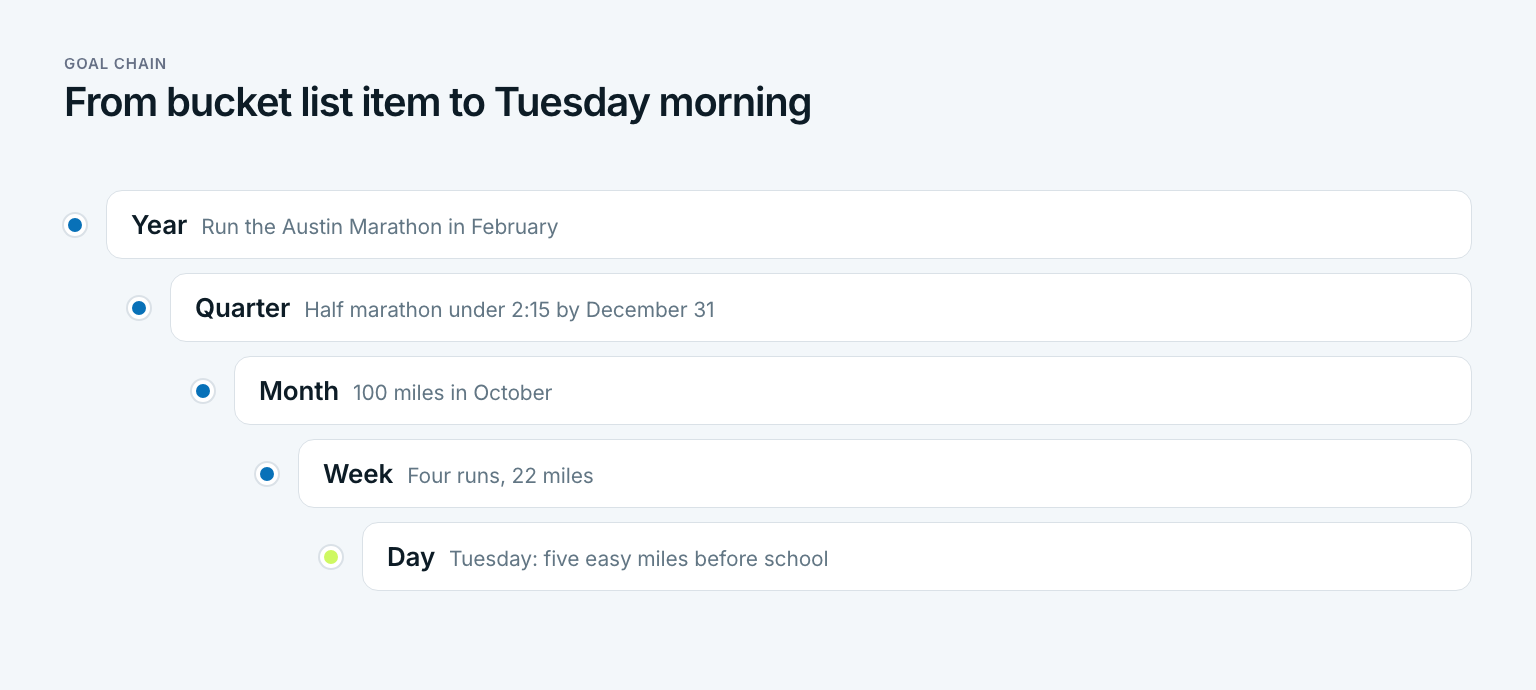
Take the marathon. The yearly goal is the finish line in February. The quarterly goal is a half marathon under 2:15 by the end of December, which the training plan requires at week twelve. The monthly goal for October is 100 miles total. The weekly goal is four runs and 22 miles. Tuesday's goal is five miles at an easy pace, before school. Each level answers the question of the level above it. Whoever runs five easy miles on Tuesday has moved a bucket list item, even though the item itself is five months away.
The northern lights work the same way with money instead of miles. Year two, February: Tromsø. Quarter: $1,300 saved by December. Month: $433. Week: $100 transferred on Friday. Day: pack a lunch instead of buying one. The chain turns a $2,500 trip into a Friday transfer and a sandwich. Not glamorous, but it is how a teacher's salary buys a bucket list item without a credit card.
In Gaapp the item sits as a yearly goal with the quarters, months, and weeks hanging underneath it, so the Tuesday run shows up as progress on the marathon, not as a lonely check mark. How the breakdown works level by level is explained in turning yearly goals into daily steps, and the December session where the someday list gets read belongs to your annual planning.
The three mistakes nobody notices
Most bucket list advice warns about the obvious: do not procrastinate, dream big. The mistakes that actually stall a list are quieter. Marcus made all three for eight years.
Mistake one: the list has 47 items and no first
A long list feels generous. It is a way to avoid choosing. With 47 items and no order, every evening offers 47 equally reasonable things to not start. Twelve with years is the fix, three with a first step is the real fix. The case for fewer is made in why three goals are enough, and it applies to bucket lists word for word.
Mistake two: the list is a travel budget in disguise
Nineteen of Marcus's 47 items were trips. Travel is a fine thing to want. It just makes the list a function of money and vacation days, both scarce for a teacher with a family. Whoever fills a bucket list with trips has written a savings plan with photos. The regret test fixes the balance, because the items that sting most rarely come with a boarding pass.
Mistake three: nobody ever reads the list again
The most common mistake: a bucket list without a reading date
A bucket list that is written once and read never is a letter to nobody. Marcus's list sat in a notes app for eight years and was opened twice, both times to add something. The fix costs ten minutes: read the twelve items once a month, check the first steps once a week in your weekly review, and read the someday list once a year in December. A list that is read moves. A list that is not read is a wish list, however it was written.
A bucket list template you can copy
A sheet of paper, a spreadsheet, or a note with eight columns is enough. The columns are the method. Whoever fills in all eight for an item has done the thinking that separates a wish from a plan.
| Column | What goes in it | Marcus's marathon as the example |
|---|---|---|
| Item | The experience, as a verb | Run the Austin Marathon |
| Category | Travel, skill, body, people, create | Body |
| Why it matters | One sentence, the regret test in words | Proof to myself that I can train for something hard at 38 |
| Cost in money | Rounded up, in dollars | $270 |
| Cost in time | Hours per week and total weeks, or vacation days | Four runs a week, 18 weeks |
| Target year | A year, never someday | Next February |
| First step | Under an hour, within seven days | Register online, print the training plan |
| Status | Not started, in progress, done, someday | In progress, week three of 18 |
Twelve rows in the plan, nine in the someday section underneath, and the template is complete. For the yearly goals that come out of it, the templates hub has the yearly and quarterly layouts the goal chain uses.
Three questions before you add an item
Before anything new goes on the list, Marcus now asks three questions. They take a minute and they have kept the list at twelve for a year.
- Would I regret this at 80, or would I just like it? Like it goes to the wish list. Regret stays.
- Can I name the year and the price today? If not, it goes to the someday list until I can.
- What is the first step, and does it fit into the next seven days? If I cannot name it, the item is not ready, however much I want it.
In short: a bucket list is a wish list that has been made to answer for itself, with a year, a price, and a first step for every line.
Frequently asked questions about bucket lists
What is a bucket list?
A bucket list is a personal list of experiences, places, and achievements you want to complete before you die. The name comes from the idiom to kick the bucket and became common after the 2007 film The Bucket List. A useful bucket list adds a target year, a rough price, and a first step to every item, which is what separates it from a wish list.
What are the top 10 bucket list items?
The ten items that appear on nearly every published list are seeing the northern lights, skydiving, running a marathon, visiting Machu Picchu, learning a new language, writing a book, swimming with dolphins or whale sharks, riding in a hot air balloon, seeing the Grand Canyon, and taking a road trip across the country. Three of the ten cost almost nothing but time. Only three need real savings.
What are your bucket list examples?
Good examples are concrete, dated, and personal: run the Austin Marathon next February, record a 60-minute interview with my grandmother this Thanksgiving, hold a 15-minute conversation in Spanish within two years, take my father to the Grand Canyon over spring break in year three. Each one names an experience, a year, and implies a first step. Travel more or be happier are life goals, not bucket list items.
What are 100 bucket list ideas?
The 100 ideas in this article are sorted into ten groups of ten: travel and places, nature and the outdoors, skills, body and sport, food and drink, creativity, people and relationships, giving and community, home and everyday, and courage and firsts. Read them quickly and mark the ones that make you flinch. Most people find five to eight that land, and those are the ones to price and date first.
How many items should a bucket list have?
Twelve items with a target year for the next five years, plus a someday list for everything else. Twelve is two or three experiences a year, which a working adult can actually carry. Marcus went from 47 items with three check marks in eight years to twelve items with three first steps done in the first week. More items do not produce more experiences. They produce more reading.
Is there a bucket list template I can use?
Yes, and it needs only eight columns: item, category, why it matters, cost in money, cost in time, target year, first step, and status. A spreadsheet or a sheet of paper is enough. Fill in all eight for each item and sort by target year. The first step column is the one most templates leave out, and it is the one that makes the list move.
Last updated: 14 October 2026
Read next
 Personal Growth
Maslow's Hierarchy of Needs: The 5 Levels Explained
Maslow's hierarchy of needs sorts motivation into five levels. What each level means, what research says today and a needs audit you can run yourself.
14 min read
 Personal Growth
Mindfulness Exercises: 12 for Everyday Life
Mindfulness exercises are not about emptying your mind. 12 techniques for stress and focus, what research shows, and a four-week plan to practice daily.
16 min read
 Personal Growth
Positive Affirmations: 50 Examples You Can Believe
Positive affirmations are not magic words. What research shows, 50 daily affirmations you can believe, and a five-step method with a worked example.
16 min read