Life Planning: Your Next Ten Years on One Page
Life planning is not fortune-telling. Make a life plan in seven steps with a one-page template, three draft lives, an age grid and a worked example.

Contents
- 01What life planning is, and what a life plan actually does
- 02Why you don't have goals in life yet, and why that is not the problem
- 03How to make a life plan in seven steps
- 04Jordan's life plan: from a lifeline to four goals
- 05The ten-year timeline: phases, not years
- 06A one-page life plan template
- 07From life plan to this week: the goal chain
- 08The three mistakes that quietly send a life plan to a drawer
- 09How to change your life when the plan breaks
- 10Frequently asked questions about life planning
Life planning is not fortune-telling. It is the work of thinking through the next ten years until you know which big decisions are coming, in what order you will make them, and what your next week is for. A fortune-teller tells you what will happen. A life plan tells you what you will do about it: one direction, four or five milestones with a year attached, and a first step. Everything else is allowed to change, and most of it will.
A life plan that survives real life needs three things: an honest look back, more than one draft forward, and a chain that breaks a decade down to a Tuesday evening. All three are worked through on Jordan, 29, a customer success manager at a software company in Phoenix, with $31,000 in student loans, a roommate, and a 30th birthday coming up in March. His company cut a third of his team in the spring. Jordan kept his job and, for the first time since college, could not say what he wanted it to lead to. You get seven steps to make a life plan, a one-page life plan template, an age grid, and the three mistakes that quietly send most life plans to a drawer.
What life planning is, and what a life plan actually does
Life planning is the process. A life plan is the result: one page you can read in two minutes and revise once a year. It answers three questions. Where am I heading? What has to be true by when? What will I do in the next twelve months to get there? Anyone who answers only the first question has a vision. Anyone who answers all three has a plan.
A complete life plan has six parts:
- A look back. A lifeline with the highs and lows so far. It shows what gives you energy before you decide where to point it.
- A snapshot. Your eight areas of life, each scored from 1 to 10. It shows where something is missing right now.
- Draft lives. Three versions of the next five years instead of one. They prove there is more than one good path.
- Life goals. Three to five states with a year attached, drawn from the draft you choose.
- A timeline. Ten years in phases, with the age of everyone who appears in your plan.
- Next year. One to three yearly goals that serve the first phase, broken down to the week.
The four types of planning, applied to your life
Business schools teach four main types of planning: strategic, tactical, operational and contingency. They were built for companies, but they map onto a life almost one to one. Most people only do the operational kind and wonder why their to-do lists never add up.
| Type | In a company | In your life | Horizon |
|---|---|---|---|
| Strategic | Where the company wants to be | Your life plan: direction and life goals | ten years |
| Tactical | How each department gets there | Your yearly goals and their quarters | one year |
| Operational | What happens this week | Weekly goals and one daily goal | one week |
| Contingency | What happens if plan A fails | Your second and third draft lives | whenever needed |
A life plan covers the strategic and the contingency layer. Your annual planning covers the tactical one, and your week covers the operational one. That means: A to-do list is not a small life plan. It is the bottom layer of one, and without the layers above it, it fills up with whatever is loudest.
Why you don't have goals in life yet, and why that is not the problem
Many people who search for life planning are not short on discipline. They are short on a goal, and that is normal. Goals in life rarely arrive as a flash of insight. They come out of evidence: what has worked for you so far, what has drained you, and which options are actually on the table. Anyone who waits for a calling before planning will wait a long time. If the question of a calling keeps you stuck, the two-week audit in finding purpose in life turns it into evidence.
There is also a well documented reason why the future feels blank. In 2013, Jordi Quoidbach, Daniel Gilbert and Timothy Wilson published a study in Science with more than 19,000 people aged 18 to 68. Some reported how much they had changed over the past ten years. Others predicted how much they would change over the next ten. The people looking back saw a lot of change. The people looking forward expected very little, and that held at every age.
The end of history illusion
That is the name Quoidbach, Gilbert and Wilson gave to the habit of treating who you are today as the finished version. You assume your current self is final, even though your self from ten years ago assumed the same thing. For life planning, it means your plan is written by someone who will want different things in five years. So the plan does not need more detail. It needs a fixed date to be revised.
Dwight D. Eisenhower put the practical consequence into one line in 1957: “Plans are worthless, but planning is everything.” The plan goes stale. What stays is that you thought through the big decisions once, before they were due. In short: If you don't have goals in life, don't invent them. Look back first, sketch more than one future, and let the goals come out of that.
How to make a life plan in seven steps
A life plan does not happen on the side. Budget about three and a half hours, split over two evenings or one Saturday morning. You need a sheet of paper in landscape, a pen, your calendar, and, if you share your life with someone, a date with the people who show up in your plan.
Draw your lifeline, 30 minutes
Draw a horizontal line from your 18th birthday to today. Mark ten to twelve events, the good ones above the line and the hard ones below, the stronger, the further from the line. Then look for what your three highest points have in common.
Score your areas of life, 20 minutes
Give each of eight areas of life a score from 1 to 10 for how satisfied you are today. Circle the two lowest. They are not goals yet. They are hints about where one is missing.
Sketch three draft lives, 60 minutes
Write three versions of the next five years: the path you are on, the path you would take if that one disappeared, and the path you would take if money and other people's opinions did not matter. Rate each draft with four numbers.
Write three to five life goals, 30 minutes
Pick one draft as your main path and write three to five life goals from it. Each goal is a state with a year and a cost, meaning what you will give up for it.
Build a ten-year timeline, 40 minutes
List the next ten years and, next to each one, the age of everyone in your plan. Group the years into three to five phases and give each phase a name.
Break year one down to this week, 20 minutes
Turn the first phase into one to three yearly goals, break the first quarter down to the month and the week, and decide what happens next Tuesday.
Put the review on your calendar, 10 minutes
Schedule one hour, twelve months out, to revise the plan. Note which events would trigger an early review.
The order matters. Anyone who starts with goals writes down what they have always wanted and misses what has actually given them energy over the last eleven years. The look back and the snapshot come first, the goals only in step four. And if you were looking for seven steps to change your life, these are the same seven. Changing your life is life planning with a deadline.
Jordan's life plan: from a lifeline to four goals
Jordan wrote his plan over two evenings in October 2026. These are his first four steps.
The lifeline: what the high points share
Jordan's lifeline has eleven points. Three sit at the top: running the climbing club in college, a project in 2022 where he interviewed 40 customers and rewrote the onboarding emails, and a two-week road trip through Utah with his younger brother. Two sit at the bottom: the year he dropped out of engineering, and eight months on night shifts in a support queue. The pattern is hard to miss. Every high point involved figuring out why people do what they do, and most of them happened outdoors. Both low points meant working through someone else's queue.
That is not proof, but it is a lead. Jordan writes it at the top of his life plan as one guiding sentence: I do my best work when I get to understand people, and I need the outdoors close by. That sentence does what many people hope an ikigai exercise will do, but it comes from evidence, not from filling in four circles.
The wheel of life: two scores stand out
Scoring the eight areas takes Jordan twelve minutes. Career 5, money 4, health 7, romance 5, family 6, friends 8, personal growth 3, fun 7. The two lowest are growth and money, and they are connected. He has not learned anything new at work in two years, and $31,000 in loans makes every option feel expensive. Anyone who looks at one low score alone sets a goal for that score, like an online course. Anyone who puts two low scores side by side finds the shared cause.
Three draft lives instead of one
Bill Burnett and Dave Evans describe this exercise in Designing Your Life, published in 2016, as Odyssey Plans: three serious versions of the next five years. Each one gets four ratings. Do you have the time, money and skills? How much do you like it? How confident are you that it will work? How well does it fit what matters to you? Jordan's three drafts look like this:
| Draft | Jordan at 34 | Resources | Like | Confidence | Coherence |
|---|---|---|---|---|---|
| A: Climb | Director of customer success in Phoenix, team of twelve | 8 | 5 | 7 | 5 |
| B: Pivot | UX researcher on a remote team, living near the mountains | 6 | 8 | 6 | 9 |
| C: Wild card | Two years teaching English in Japan, then decide | 5 | 9 | 4 | 6 |
Draft A is the safest and the dullest. Draft C is the most exciting and the least likely. Draft B scores highest on coherence because it delivers exactly what the lifeline showed: understanding people, with the outdoors close by. Jordan picks B. From C he keeps one piece, a three-week trip to Japan in 2029, which goes on his bucket list. And A? It stays his way back if the switch has not worked by 2030.
Four life goals with a year and a cost
From draft B, Jordan writes four life goals. Each describes a state, not an activity, and each names its cost:
- Career, 2029: I work as a UX researcher, earn at least $85,000, and have two shipped studies in my portfolio. Cost: two weeknights a week for most of 2027, and no new car.
- Money, 2030: My $31,000 in student loans is paid off. Cost: $700 a month, every month, for four years.
- Family, from 2028: I see my brother and my parents in Albuquerque at least four times a year. Cost: about $1,200 a year in gas and four long weekends.
- Home, 2032: I live within 30 minutes of a trailhead, in Flagstaff or Denver. Cost: leaving friends in Phoenix I have had for eight years.
Four goals are enough. Jordan had a fifth, buying a house, but it depends on goals one and two and can wait. That means: A life goal that only becomes possible once another one is reached belongs in next year's review, not in today's plan.

The ten-year timeline: phases, not years
Ten years cannot be planned year by year. They can be split into phases, each with one thing that comes first. Jordan ends up with five. Each gets a name, so he can tell his brother in one word where he stands.
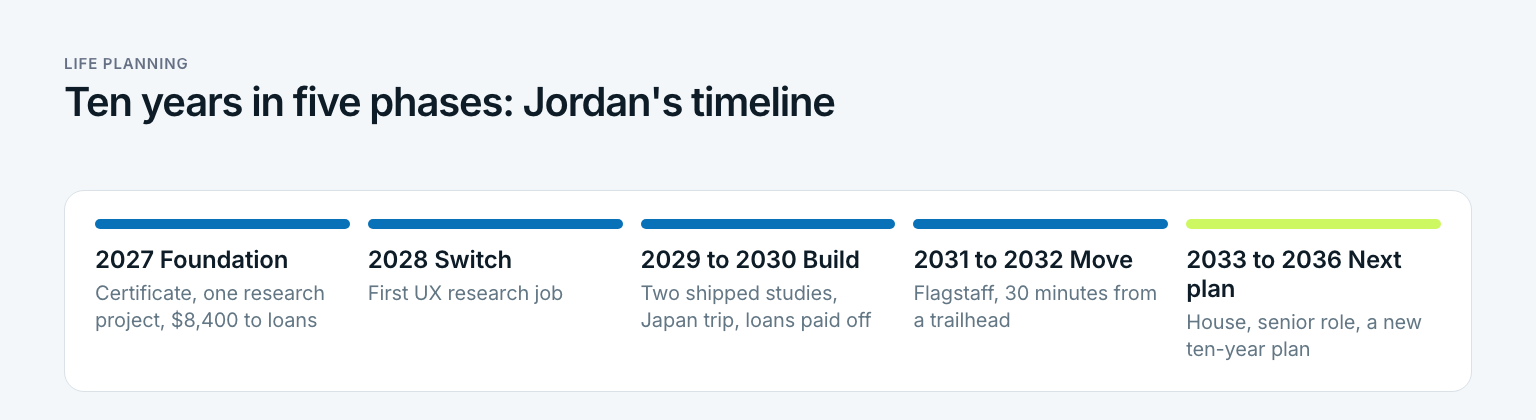
The most useful exercise in this step looks like nothing: the age grid. Next to each year, you write the age of everyone who appears in your plan. For Jordan, that is his brother Eli and his parents in Albuquerque.
| Year | Jordan | Eli | Mom | Dad | What is due |
|---|---|---|---|---|---|
| 2027 | 30 | 27 | 59 | 62 | certificate, first research project, $8,400 to loans |
| 2028 | 31 | 28 | 60 | 63 | first UX research job |
| 2030 | 33 | 30 | 62 | 65 | loans paid off |
| 2032 | 35 | 32 | 64 | 67 | move near the mountains, Dad retires |
| 2036 | 39 | 36 | 68 | 71 | next plan |
The grid shows Jordan something the timeline hid. His dad plans to retire in 2032 at 67, the same year Jordan wants to move. His brother turns 30 in 2030 and already talks about kids. Jordan wants to be the uncle who shows up, not the one who mails gifts. So the move goes to Flagstaff instead of Denver, about two hours closer to Albuquerque by car. Anyone who builds an age grid plans more than their own life. They plan the years they share with other people.
A one-page life plan template
The template fits on one sheet in landscape. The right column shows Jordan's entries, so you can see how short each field can be. Long answers are a warning sign: if you can't say it in two lines, you have not decided it yet.
| Field | Question | Example: Jordan, October 2026 |
|---|---|---|
| Date | When was it written, when is the review? | October 2026, next review October 2027 |
| Guiding sentence | What does the lifeline show? | Best work when I get to understand people, outdoors close by |
| Low scores | Which two areas scored lowest? | Growth 3, money 4 |
| Main path | Which draft, and which one is the way back? | B: pivot to UX research. Way back: A, director track |
| Life goals | Which three to five states, by when? | UX researcher 2029, loans paid 2030, family four times a year, Flagstaff 2032 |
| Phases | Which phase is now, which comes next? | Foundation 2027, then switch 2028 |
| Next year | Which one to three yearly goals? | Certificate done, one research project at work, $8,400 to loans |
| Not now | What is deliberately postponed? | Buying a house, two years in Japan, a master's degree |
The last field matters most, and almost no life plan template has it. A plan without a list of postponed things invites you to start them anyway, quietly, on the side. Anyone who writes down what is not happening now gives themselves permission to leave it alone.
From life plan to this week: the goal chain
A life plan that ends at the year stays a document. It becomes a tool once it puts something on next week's calendar. To get there, you break the first phase down level by level, from the life goal to a single day.
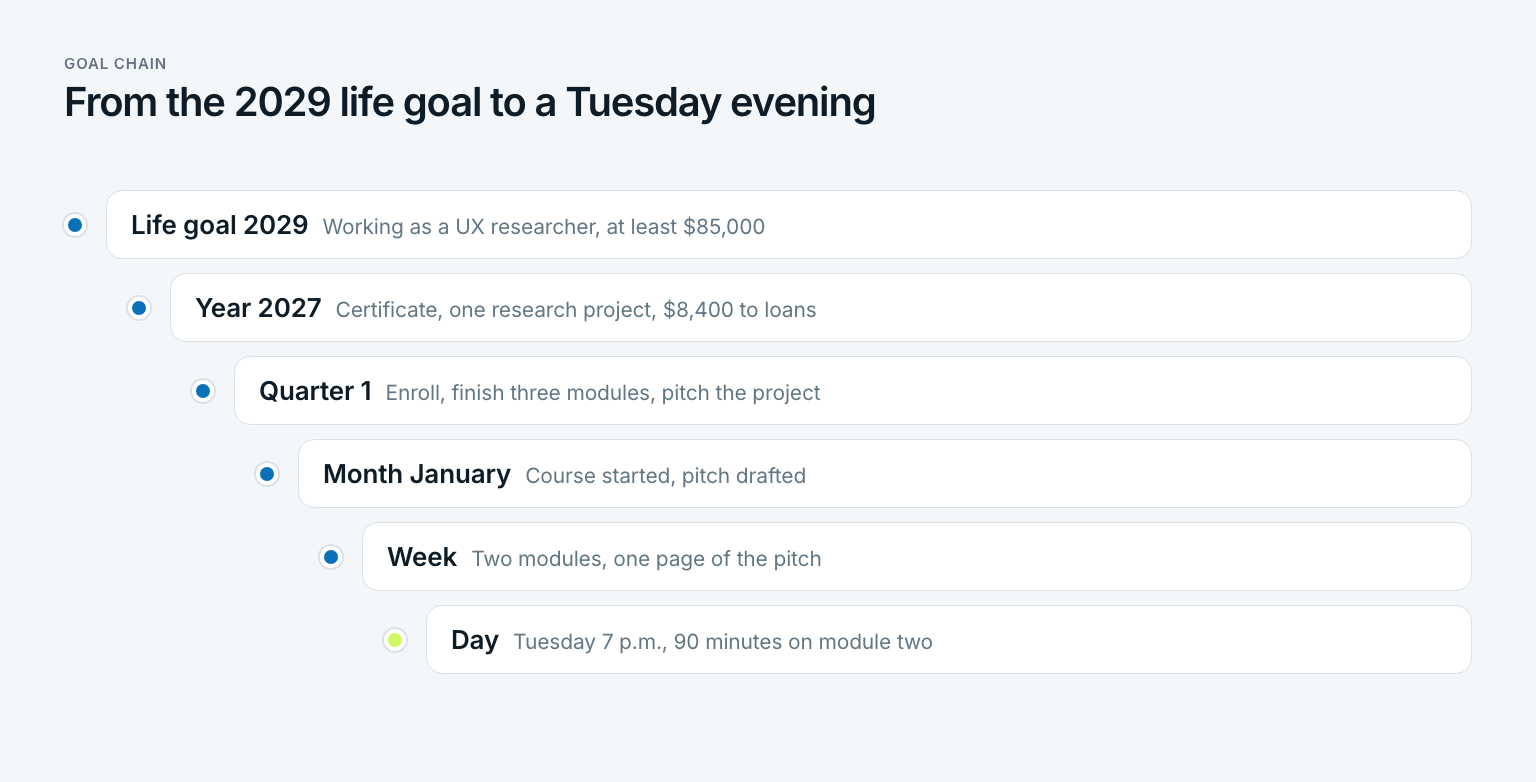
Jordan's yearly goal for 2027 has three parts: finish a part-time UX research certificate, run one real research project at his current job, and pay $8,400 toward his loans. The loans are the easy part, a $700 automatic transfer on the first of each month. The certificate takes about 200 hours, roughly four hours a week. The research project needs his manager's yes. So the first quarter becomes: enroll, finish the first three modules, pitch the project. January becomes: course started, pitch drafted. The week becomes: two modules and one page of the pitch. The day becomes: Tuesday at 7 p.m., 90 minutes on module two. Putting those hours on fixed weeknights keeps the other evenings free, which is how work-life balance gets planned rather than hoped for.
Jordan uses the twelve weeks until New Year's as a trial run. One evening a week, one free intro course, nothing else. If the rhythm holds until Christmas, January is realistic. If it doesn't, he knows before he pays for the certificate. Anyone who writes a life plan in the fall gets this trial run for free.
In Gaapp, this chain is the core: five levels from year to day, every goal hangs from a bigger one, and progress on each level sits next to the time that has passed. The life goals change rarely, the yearly goals once a year, the weekly goals every week. That means: Most of the planning happens at the bottom, and the direction comes from the top.
The most common mistake: planning ten years and not next week
Many life plans are careful, honest and well written. They still end up in a drawer, because not a single line leads to next week's calendar. A life plan without a weekly goal is a statement of intent. So at the end of step six, check one thing only: Is there something on your calendar for the next seven days that would not be there without the plan?
Life planning as a couple, a family, or with a coach
Jordan plans alone, but much of his plan involves other people. If you share your life with a partner, do steps one to three separately and steps four to seven together. Each of you draws your own lifeline and your own draft lives. The life goals, the timeline and the age grid get made at the same table.
Coaches can use the same order with clients, one step per session. How shared goals work for two or more people is covered in shared goals in a space.
The three mistakes that quietly send a life plan to a drawer
Most life plans don't fail for lack of effort. They fail because of mistakes that feel right while you are writing. Which one is in yours?
- Only one draft. A single path feels decisive, and decisiveness is a strength. But a plan with one path breaks at the first detour. Anyone who has written three drafts has already rehearsed the break and knows where to go next.
- Planning alone what you will live with others. A life plan full of goals that involve a partner, kids or parents is a wish list until those people have seen it. Plan your part alone and the shared part together.
- Goals without a cost. A goal without a cost looks free, so everything seems to fit at once. Only the cost shows that paying off $31,000 by 2030 and a new car in 2027 do not fit into the same plan. Name what you give up for each life goal.
All three mistakes share a root. They treat the life plan as a promise instead of a decision. A promise demands to be kept. A decision is allowed to be reviewed, and that is exactly what makes it hold.
How to change your life when the plan breaks
Every life plan breaks at some point. That is not failure. It is the moment you wrote it for. Changing your life then does not mean starting over. It means repeating three of the seven steps: the snapshot, the draft lives and the timeline. The lifeline stays and simply gets a new point.
There are two reasons to revise. The first is the fixed date, once a year, for Jordan every October. One hour is enough: Do the life goals still hold, is the phase still right, what is next year's goal? The second is an event that breaks an assumption, such as a layoff, a breakup, a diagnosis, a birth, a death or a move. Then you don't wait for October.
Say Jordan's company lays him off in the summer of 2027. Without a plan, that is a shock with no direction. With a plan, it is a phase that arrives early: the switch comes a year sooner, half the certificate is done, and he already knows which roles to apply for. Anyone who has worked out once what they would do in that case decides in a week instead of three months.
Three questions before you write your life plan:
- Can you name the three highest points of your life so far and say what they have in common?
- Have you seriously thought through more than one path for the next five years?
- Is there a date on your calendar when you will review your plan?
Anyone who answers no to one of them does not have a bad plan, just an unfinished one. In short: Life planning is not a prediction of your life, it is a decision about what your next week is for.
Frequently asked questions about life planning
Why don't I have goals in life?
Usually because you are waiting for a goal to appear instead of building one from evidence. Look back first and ask what your best years had in common. Then sketch three different versions of the next five years. Goals tend to show up once you can compare options, not before.
What are the four main types of planning?
Strategic, tactical, operational and contingency planning. Applied to your life, the strategic layer is your life plan, the tactical layer is your yearly goals, the operational layer is your week, and the contingency layer is your second and third draft life. Most people only do the operational part.
How can I create a life plan?
Draw your lifeline, score your areas of life, sketch three draft lives, write three to five life goals with a year and a cost, build a ten-year timeline with an age grid, break year one down to this week, and schedule a yearly review. Plan on about three and a half hours over two evenings. The result fits on one page.
What are 7 steps to change your life?
Changing your life follows the same seven steps as making a life plan: look back, take stock, sketch three futures, pick one and set goals, map the next ten years, put the first step on next week's calendar, and set a review date. The difference is speed. When something has already broken, do the snapshot, the drafts and the timeline first and keep the rest short.
How far ahead should a life plan go?
Ten years is a good horizon. It is long enough for big decisions about career, family and where you live, and short enough to stay concrete. Only the next year is planned in detail, everything after it in phases of two to three years.
How often should I update my life plan?
Once a year on a fixed date, ideally right before your annual planning. One hour is enough. Revise it early after any event that breaks an assumption, such as a layoff, a breakup or a birth.
Last updated: 19 October 2026
Read next
 Personal Growth
Maslow's Hierarchy of Needs: The 5 Levels Explained
Maslow's hierarchy of needs sorts motivation into five levels. What each level means, what research says today and a needs audit you can run yourself.
14 min read
 Personal Growth
Mindfulness Exercises: 12 for Everyday Life
Mindfulness exercises are not about emptying your mind. 12 techniques for stress and focus, what research shows, and a four-week plan to practice daily.
16 min read
 Personal Growth
Positive Affirmations: 50 Examples You Can Believe
Positive affirmations are not magic words. What research shows, 50 daily affirmations you can believe, and a five-step method with a worked example.
16 min read