Monthly Planning: How to Plan Your Month in 45 Minutes
Monthly planning is not a to-do list: three goals, a capacity check, four weeks. Six steps in 45 minutes, a monthly planner template and an example.

Contents
- 01What monthly planning is and what it is not
- 02Monthly plan, calendar, weekly plan, annual plan: what each is built for
- 03What actually happens in a month: four weeks are not 30 days
- 04How to plan your month in six steps
- 05Priya's November, worked through
- 06Monthly planner template: one page, twelve fields
- 07The three mistakes nobody notices
- 08Monthly planning in the goal chain: from year to Wednesday night
- 09What makes a good monthly planner: paper, wall calendar, or app
- 10Three questions before you close the month
- 11Frequently asked questions about monthly planning
Monthly planning is not a 30-day to-do list. It is a fixed appointment of about 45 minutes at the end of each month, in which you decide three things: which results the next month must produce, three at most, how many hours you really have for them, and which week carries which part. A to-do list collects everything that might come up. Monthly planning decides what gets finished this month.
You need three things for it: a review, a calculation, and a page. The review scores last month, the calculation shows your free hours, and the page is the monthly planner template below, twelve fields on one sheet. All of it is worked through on one month of Priya, 29, a UX designer in Austin with a full-time job, who is building a freelance practice on the side and wants her first paying client in early 2027. Her numbers are in the tables, including October's, which did not work out.
What monthly planning is and what it is not
Monthly planning is the middle layer between the quarter and the week. It turns a quarterly goal into a month you can score with yes or no on the last day. Three parts are fixed: a review of last month, no more than three monthly goals, and a split across the weeks. Everything else is calendar maintenance.
Anyone who plans the month only in a calendar sees appointments, not goals. A calendar tells you when the dentist expects you. It does not tell you whether November moved your project forward. That means: The calendar is a tool of monthly planning, not monthly planning itself.
It is not four weekly plans stapled together either. A weekly plan spreads hours across days, and the guide to weekly planning shows how to do that in 20 minutes. Monthly planning decides one level higher which results the weeks should deliver at all. Without it, every week plans for itself, and by the 30th nothing adds up.
Monthly plan, calendar, weekly plan, annual plan: what each is built for
Four tools that often get mixed up. None of them is wrong, each one is built for something else. The only question is: Which one decides what gets finished this month?
| Tool | Time span | What it holds | What it cannot do |
|---|---|---|---|
| Calendar | days and hours | appointments, deadlines, birthdays | cannot tell whether an appointment serves a goal |
| Monthly planner grid | one month on one page | what is coming up, day by day | sets no priorities, every line weighs the same |
| Monthly planning | one month inside a quarter | review, three monthly goals at most, capacity, weekly shares | does not replace a daily plan |
| Weekly plan | seven days | weekly goals, focus blocks, one daily goal per day | cannot see whether four weeks add up to a monthly goal |
| Annual plan | twelve months | yearly and quarterly goals, direction | too coarse to steer next Wednesday |
A monthly planner grid is a good habit. It shows what is coming and takes some load off your head. It just measures nothing. Your annual planning sets the direction, your weekly plan sets the hours. Monthly planning sits in between, and it is the layer most people skip. Why that one? A year is too long to steer by, a week too short to see progress. A month can do both. In short: Whoever adds just one planning layer should add the month.
Monthly goal versus monthly plan
A monthly goal is a result you can check with yes or no on the last day of the month, such as “portfolio site live”. A monthly plan is the overview where appointments and tasks live. Anyone who keeps only a monthly plan knows on the 30th what got done. Anyone who keeps monthly goals knows whether it was enough.
What actually happens in a month: four weeks are not 30 days
A month feels long. That is the trap. On the 1st it looks like plenty of time. By the 20th you notice that two weekends were booked and one week went to a cold. November 2026 has 30 days but only four full weeks, and the 30th is a lone Monday. It also has Thanksgiving on the 26th, which eats most of a week for anyone who travels. Whoever plans November as 30 days plans too much.
Priya works on her business in three fixed blocks: Monday and Wednesday from 7 to 9 pm, Sunday from 9 am to noon. That is seven hours a week. In her head, November holds 28 hours. On paper it holds 25. She flies to her parents in Houston on Wednesday, November 25, and comes back on Sunday, November 29, so Thanksgiving week keeps only its Monday. Monday, November 30, adds two hours back.
| Week | Work blocks | Lost | Free hours |
|---|---|---|---|
| Nov 2 to 8 | Mon, Wed, Sun | none | 7 |
| Nov 9 to 15 | Mon, Wed, Sun | none | 7 |
| Nov 16 to 22 | Mon, Wed, Sun | none | 7 |
| Nov 23 to 29 | Mon, Wed, Sun | Wednesday and Sunday, Thanksgiving trip | 2 |
| Nov 30 | Mon | none | 2 |
| Total | 13 blocks, 11 usable | two blocks | 25 |
25 hours is the honest number. It is eleven percent below the number Priya would have planned with. That sounds small. For her it is three hours, roughly half a case study. That means: The capacity check is not a step for pedants. It is the step that decides whether the month works.
And not all 25 hours are plannable. A simple rule holds up well: plan at most 80 percent of the hours you have reserved for your goals and keep the rest as a buffer. Kevin Kruse makes a related point in “15 Secrets Successful People Know About Time Management” from 2015: work from your calendar, not from a list, because a list never tells you when something will fit. For Priya that means 20 plannable hours and five hours of buffer.
How to plan your month in six steps
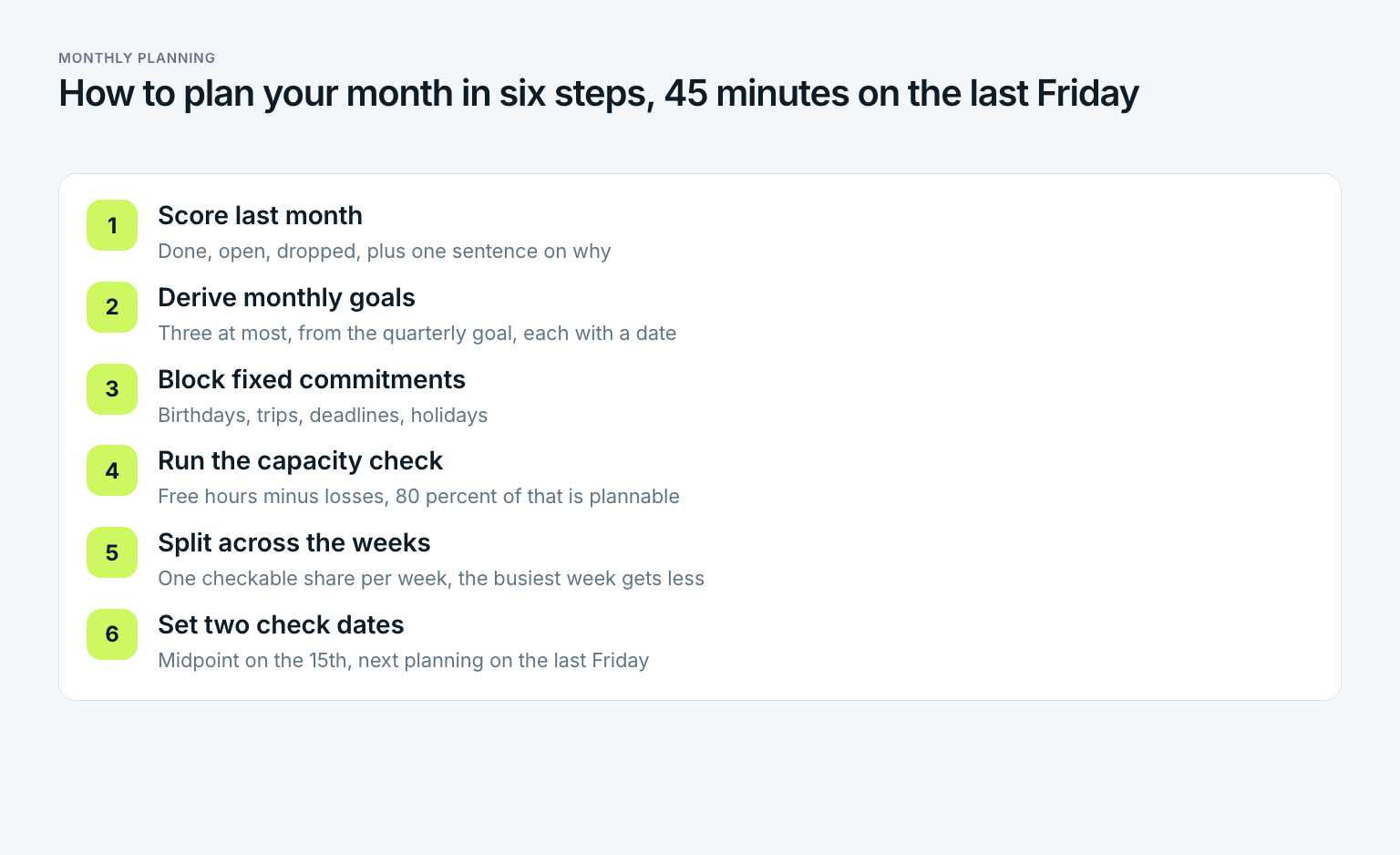
45 minutes is not an estimate, it is a budget. Have your quarterly goal, last month's goals, and next month's calendar in front of you. The best slot is the last Friday afternoon of the month, the second best is the last Sunday evening. Here is how the budget breaks down:
Score last month, 15 minutes
Mark each monthly goal as done, open, or dropped. Work out the share that is done and write one sentence on why an open goal stayed open. That sentence matters more than the score, because it changes the next plan.
Derive monthly goals from the quarter, ten minutes
Read your quarterly goal and ask: What has to be finished this month for the quarter to work? Write down no more than three monthly goals, each as a result with a date. “Work on the portfolio” is not a monthly goal. “Portfolio site live with two case studies by November 22” is.
Block fixed commitments, five minutes
Birthdays, trips, deadlines, holidays. For each one, check whether it hits one of your work blocks. Write down the ones that hit nothing as well, so you stop wondering about them later.
Run the capacity check, five minutes
Count the free hours per week, subtract what is lost, and treat 80 percent of the rest as plannable. Estimate the hours each monthly goal needs. If the total is above the plannable hours, cut now, not on the 25th.
Split the goals across the weeks, eight minutes
Give each week a share that can be checked on Friday. These shares are your candidates for weekly goals. The week with the most losses gets the smallest share, not an equal one.
Set two check dates, two minutes
Put two dates in your calendar: a midpoint check on the 15th and next month's planning on the last Friday. On the 15th you answer one question only: Is half the work behind me?
Priya's November, worked through
Priya plans on Friday, October 30, at 4 pm, after her last meeting of the week. Her yearly goal for 2026: a freelance practice that is ready to take paying clients in January 2027. Her Q4 goal: portfolio site live and three discovery calls booked by December 18.
Step one: the October review
| October goal | Status | Note |
|---|---|---|
| First case study drafted | done | finished on October 25 |
| Portfolio template chosen and bought | done | decided on October 11 |
| Ten gym sessions | open | 6 of 10, all on weekends, none on Monday or Wednesday |
| Read two books on freelancing | dropped | half of one book |
Two of four goals done, 50 percent. Two lines matter. The gym line first. Priya planned workouts at 6 pm on Mondays and Wednesdays, right before her business blocks. She skipped every one of them, because a workout at 6 meant starting the case study at 8 and stopping at 10 with nothing finished. Anyone who stacks two goals into the same evening ends up choosing one. So the gym moves to lunch on Tuesdays and Thursdays, and the target drops to six sessions, because six was her real number.
The book line second. Reading about freelancing felt like progress and was not on the path to a paying client. Priya does not move it to November. She drops it. That is the second sentence the review produced, and it frees an evening she would otherwise have spent on guilt. Four goals were one too many anyway.
Steps two to four: three goals and a plan that does not fit
From her Q4 goal Priya derives three monthly goals: portfolio site live with two case studies by Sunday, November 22. A list of 20 prospects with names and one reason each might need a designer. Six gym sessions. The gym runs at lunch and costs no business hours. For the other two goals, she estimates the hours and holds them against her capacity.
| Task | Monthly goal | Estimated hours |
|---|---|---|
| Finish and edit case study two | Portfolio | 5 |
| Write case study three | Portfolio | 6 |
| Build the site on the template | Portfolio | 6 |
| Write Home and About copy | Portfolio | 3 |
| Prospect list, 20 names | Prospects | 3 |
| First draft total | 23 of 25 free hours, 92 percent |
The first draft fits on paper, 23 of 25 hours. That is exactly the problem. A plan at 92 percent has no room for a sick day, a fire at the day job, or an evening when nothing works. The limit is 20 hours. So Priya cuts case study three and moves it to December. What is left is 17 hours, 68 percent of her free time, with eight hours of buffer.
Does that hurt? Yes. Three case studies look stronger than two. But a site with two case studies that is live on November 22 can book calls in December. A site with three that is almost done books nothing. In short: Cutting on October 30 is planning. Cutting on November 25, at the airport gate, is failing on schedule.
Step five: each week gets its share
| Week | Free hours | Weekly goal candidate | Planned |
|---|---|---|---|
| Nov 2 to 8 | 7 | Case study two finished and edited | 5 h |
| Nov 9 to 15 | 7 | Site built on the template, both case studies uploaded | 6 h |
| Nov 16 to 22 | 7 | Home and About written, prospect list done, site live on Sunday | 6 h |
| Nov 23 to 29 | 2 | nothing planned, Thanksgiving | buffer |
| Nov 30 | 2 | nothing planned, start of December | buffer |
| Total | 25 | two business goals | 17 h, eight hours of buffer |
The whole plan finishes before Thanksgiving. That is not luck, it is the point. The week with the most losses gets the smallest share, and in Priya's case that share is zero. Every other week keeps at least one hour of slack. If the launch slips by a few days, Monday the 23rd and Monday the 30th catch it.
On Sunday evenings Priya turns each candidate into a weekly plan. On Fridays she checks the week in ten minutes, the way the ten-minute weekly review describes it. Monthly planning gives both of them their yardstick. Without it, she would not know on November 15 whether one built site is enough for that week.
Monthly planner template: one page, twelve fields
The template has twelve fields and fits on a letter-size sheet or in a note. It is not a calendar. Appointments only show up where they hit a work block. The third column shows Priya's entries for November, so you can see how short an answer may be.
| Field | Question | Example: Priya, November |
|---|---|---|
| 1 Month | Which month am I planning? | November 2026, planned on October 30 |
| 2 Quarterly goal | What does this month feed into? | Portfolio live, three discovery calls booked by December 18 |
| 3 Review | How many of last month's goals are done? | 2 of 4, 50 percent |
| 4 One sentence on last month | Why did a goal stay open? | Gym and business blocks shared the same evenings |
| 5 Monthly goal 1 | What is finished at month end, and by when? | Portfolio site live with two case studies, November 22 |
| 6 Monthly goal 2 | What is finished at month end, and by when? | Prospect list with 20 names, November 22 |
| 7 Monthly goal 3 | What is finished at month end, and by when? | Six gym sessions at lunch, Tuesdays and Thursdays |
| 8 Fixed commitments | Which ones hit my work blocks? | Thanksgiving trip, November 25 to 29 |
| 9 Capacity | How many hours do I have, how many do I plan? | 25 free, 17 planned, 68 percent |
| 10 Dropped or moved | What is not happening this month? | Case study three moved to December, freelancing books dropped |
| 11 Weekly shares | Which week delivers which part? | Week one case study two, week two the site, week three copy and list, week four nothing |
| 12 Check dates | When do I check? | Midpoint on November 15, December planning on Monday, November 30, because the last Friday falls into the trip |
How to make a printable monthly plan
Take a letter-size sheet in portrait. The top holds fields one to four. Below them go the three monthly goals in large boxes, each with a line for the date. Split the bottom half into four or five rows, one per week, with three columns: free hours, weekly share, done. A narrow month grid fits on the right for fixed commitments. A monthly plan needs nothing more. Anyone who adds more fields fills in half of them by February.
The page hangs where you plan your week, not on the fridge behind the takeout menus. On the 15th you draw a line halfway through each goal box. Is the work behind that line? Then you spend five minutes deciding what comes out of the buffer and what moves to next month.
The three mistakes nobody notices
Most monthly plans do not fail at the start. They fail quietly in week three, because of three mistakes that feel like ambition on the 1st.
The most common mistake: filling the month to the brim
Anyone who plans 100 percent of their free hours is planning for a month that does not exist. Somewhere there is always a cold, a deadline, or an evening with no energy left. A month with 20 percent buffer is not a lazy month. It is one that ends with a yes.
- Too many monthly goals. Five goals sound like a productive month. On the 30th, two are half done and none is finished. Priya learned it in October with four. Three is the ceiling for a month, and the same logic holds one level up for yearly goals: a few that last, not many that end in March.
- Activities instead of results. “Work on the site every Monday” is a habit, not a monthly goal. You can tick it off without anything getting finished. A monthly goal describes the state on the last day: live, sent, booked, six sessions.
- No review before the plan. Whoever plans without a review repeats last month's mistake with a new date. Without her one sentence about October, Priya would have scheduled the gym on Mondays again and skipped it again.
All three mistakes share one root. The month gets planned on the 1st by wish, not by capacity and experience. That means: The two least exciting steps, review and capacity, prevent most of the collapses.
Monthly planning in the goal chain: from year to Wednesday night
A monthly goal never stands alone. It hangs from the quarterly goal above and holds the weeks below. Anyone who writes the chain down once sees right away whether a Wednesday evening serves the year. Priya's chain looks like this:
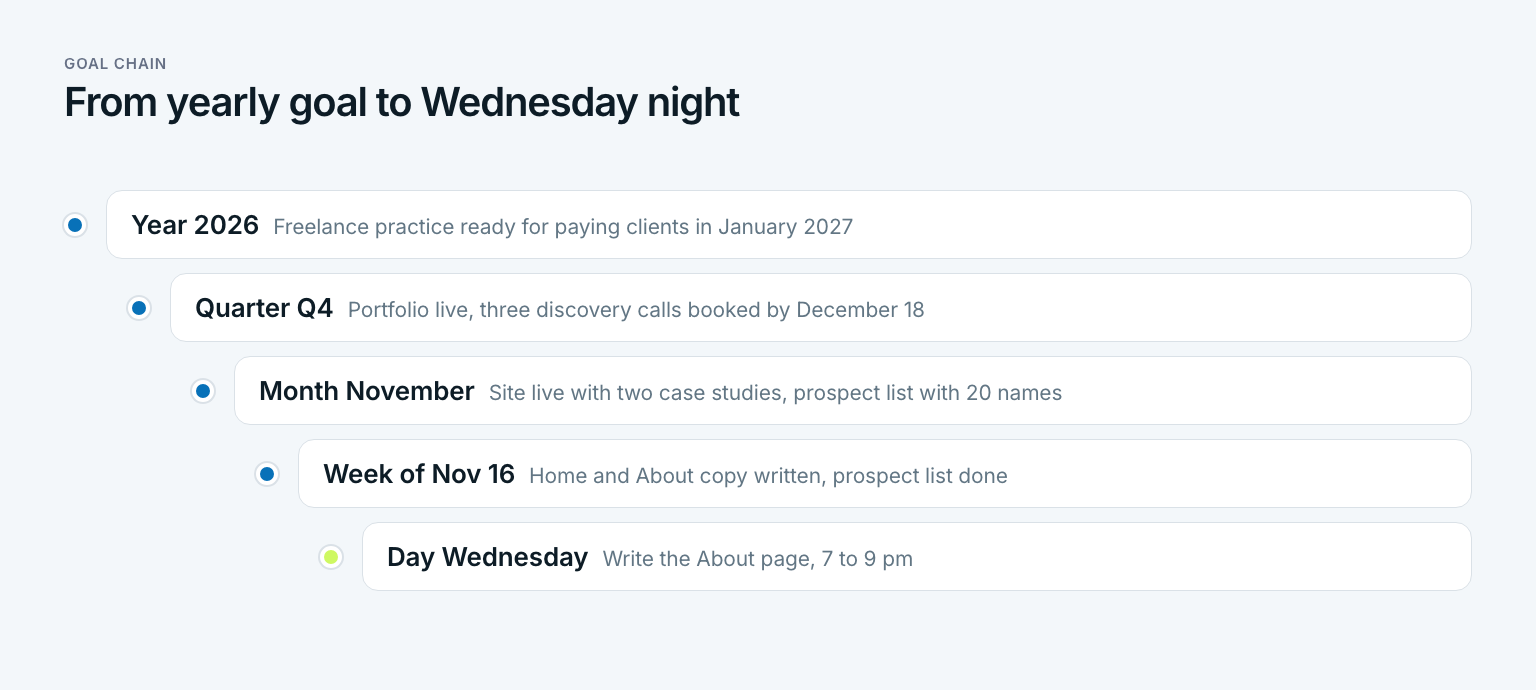
The yearly goal sets the direction: ready for paying clients in January. The quarter turns it into a live portfolio and three discovery calls. November takes the portfolio and the prospect list. The week of November 16 takes the copy and the list. And Wednesday, November 18, has exactly one job: write the About page, from 7 to 9 pm. For the general version of this translation from year to day, read how to turn yearly goals into daily steps.
The chain works in both directions. Top down, it produces the plan. Bottom up, it produces progress: finished daily goals fill a weekly goal, weekly goals fill a monthly goal, three months fill a quarter. In a goal app like Gaapp, every goal hangs from its parent goal. So on November 15 you see how much of the monthly goal is done next to how much of the month has passed.
Monthly planning for two, for a family, for a team
The same six steps work when several people share a month. The difference sits in steps three and four. A couple enters both people's commitments and runs the capacity check together, because one person's Sunday morning often exists only because the other one has the kids. In a family, each older child gets one monthly goal on the sheet, such as passing the swim test or finishing one book. The weeks underneath are laid out in the family weekly planner. A team plans the month in a short meeting on the last Friday, with one shared monthly goal and one goal per person. Whoever plans for a team counts vacation days and last month's sick days honestly.
What makes a good monthly planner: paper, wall calendar, or app
A good monthly planner does three things: it keeps your monthly goals visible, it connects them to the weeks, and it shows a comparison at the end of the month. The format matters less than people think. Which one fits you? Each works if you know its weak spot:
- Paper planner. Fast, visible, good for families. Weak at review, because last month's page gets turned and forgotten. Fix: photograph the twelve fields at the end of every month.
- Big wall or desk calendar. Strong for households and for seeing a whole month at a glance. Weak for goals, because the squares fill up with appointments. Fix: write the three monthly goals across the top margin, not inside the squares.
- Calendar app. Strong for commitments and for reminders on the check dates. Weak for goals, because a goal is not an event. Fix: enter the monthly goals as an all-day event on the 1st.
- Goal app. Strong at linking month, week, and day, and at showing progress. Weak if you open it once a month. Fix: hang the weekly goals directly on the monthly goals.
Anyone who does not know where to start should start with paper for the first month. After three months you know which field you never fill in. That is the one to leave out when you move to another tool. If you prefer to plan digitally, the guide to a digital planner shows how to set one up in six steps.
Three questions before you close the month
On your planning day, before the new plan, you answer three questions. They take five minutes and belong to step one:
- Which monthly goal moved the quarterly goal the furthest, and why that one?
- How many of my planned hours did I actually spend on the monthly goals?
- Which goal would I not write down again today, and what do I do with it instead?
Priya will probably answer on November 30 like this: the portfolio, because without it no call gets booked. 17 planned hours, most of them used, because the buffer absorbed the ones she lost. And no goal she would drop, because November only had two business goals. Monthly planning is not a calendar for 30 days. It is the decision about which three things a month can carry.
Frequently asked questions about monthly planning
How do you do monthly planning?
Take 45 minutes on the last Friday of the month. Score last month's goals, derive no more than three new ones from your quarterly goal, block fixed commitments, count your free hours, and plan at most 80 percent of them. Finally, split the monthly goals across the weeks and set a check date on the 15th.
What is a good monthly planner?
One that keeps three monthly goals visible, links them to the weeks, and lets you compare plan and result at the end of the month. That can be a paper planner, a wall calendar with the goals written across the top, or a goal app. A planner that only shows a grid of days holds appointments, not progress.
What is a good big monthly planner?
A large desk pad or wall calendar works well if several people share the month or if you want to see all weeks at once. Pick one with a wide margin or a notes column, because that is where your three monthly goals go. Without that space, the squares fill up with appointments and the goals disappear.
What is a good 3-year monthly planner?
A three-year monthly planner holds 36 month grids and is useful for long-range dates such as renewals, trips, or exams. It is too coarse for goals, because a month square has no room for a review or a capacity check. Use it next to your yearly goals, not instead of a monthly planning routine.
How many monthly goals should I set?
Three at most, and two in a month with a holiday trip or a big deadline at work. Each monthly goal needs an hour estimate, and together they should stay under 80 percent of your free hours. More goals only spread the same hours across more projects.
What is the difference between monthly planning and weekly planning?
Monthly planning decides which results a month delivers and which week carries which part. Weekly planning spreads that part across days and hours. One takes 45 minutes a month, the other about 20 minutes a week. Without monthly planning, weekly planning has no yardstick.
Last updated: 19 October 2026
Read next
 Planning
Cleaning Schedule: Daily, Weekly and Monthly Tasks
A cleaning schedule is not a Saturday to-do list: daily, weekly and monthly tasks, a printable template and a fair split for families.
15 min read
 Planning
Study Plan: How to Make One You Can Actually Follow
A study plan is not a schedule. Make one in six steps: inventory, hours math, buffer, a sample study schedule and a template, with a worked example.
17 min read
 Planning
Bullet Journal: How to Start One You'll Actually Keep
A bullet journal is not an art project. Learn the bullets, four core modules, migration and a six-step setup, with an example, 12 ideas and a goal chain.
15 min read