Core Values List: 100 Values and How to Pick Yours
A core values list with 100 values in ten families, personal values examples, a six-step exercise, and how to turn a value into a yearly goal.

Contents
- 01What core values are, and what they are not
- 02Core values list: 100 values in ten families
- 03Personal values examples: turning a word into your value
- 04How to find your personal core values in six steps
- 05Three mistakes that make a values list useless
- 06When values collide: Schwartz's values circle
- 07From values to goals: direction, not destination
- 08Your core values in a goal chain, from year to Tuesday
- 09Core values examples at work: company values and personal values
- 10Five questions to check your values every quarter
A core values list is not a personality test. It is a set of words like freedom, family, honesty, or growth, and you use it to choose the three to five personal values you want to make decisions by. A test tells you who you supposedly are. A list asks what you stand for and leaves the answer to you.
Reading a hundred words is the easy part. The hard part is cutting them down, putting each one into your own sentence, and checking it against your calendar, because that is where you see which values you live and which ones you only admire. The worked example is Dana, 34, an ICU nurse in Columbus, Ohio. She has an offer on the table: charge nurse on her unit, $9,000 more a year, and three weekend shifts a month instead of one. Below you will find 100 core values in ten families, a six-step exercise, and the path from a value to a yearly goal.
What core values are, and what they are not
Core values are your beliefs about what matters most in life, and they hold across situations. The social psychologist Shalom Schwartz defined values in 1992 as desirable goals that vary in importance and serve as guiding principles in a person's life. The key word is importance. Almost everyone thinks honesty and health are good. Values only tell people apart when two of them pull in different directions and one has to win.
Most lists of core values mix five different things. None of them is wrong. Each one is built for a different job:
- Values are directions you never finish. Family, freedom, justice. You can follow them for a lifetime and never arrive.
- Goals are destinations with a date. Running a 5K under 30 minutes by June 2027 is a goal. You reach it and check it off. A value never gets checked off.
- Virtues are the habits you use to follow a value. Courage, patience, and diligence describe the how, not the what for.
- Needs are states of lack, like sleep, closeness, or safety. They speak up on their own. The best-known way to sort them is Maslow's hierarchy of needs. Values have to be chosen.
- Interests are topics that pull you in, like photography or history. An interest becomes a value when you would give something else up for it.
That means: a good values list keeps these levels apart, or at least tells you which one you are looking at. Anyone who puts courage and freedom in the same column is comparing a tool with a direction. They end up with three virtues on the page and no idea where they are going.
Intrinsic values: terminal and instrumental
The psychologist Milton Rokeach split values into two kinds in his 1973 book The Nature of Human Values. His 18 terminal values are end states worth having for their own sake, such as freedom, wisdom, inner harmony, true friendship, and self-respect. These are the intrinsic values most people mean when they ask for examples. His 18 instrumental values are ways of behaving, such as honest, courageous, or responsible. Terminal values say where you want to go. Instrumental values say how you walk.
Core values list: 100 values in ten families
The table sorts 100 core values into the ten basic values Schwartz found in surveys from 20 countries in 1992. His theory is one of the most widely tested models of human values, and in 2012 he and his colleagues refined it into 19 narrower values. Which word goes into which family is our sorting along his definitions, not a list he published. Read it through once before you mark anything.
| Value family | What it is about | Ten values from the list |
|---|---|---|
| Self-direction | Thinking, choosing, and acting for yourself | freedom, independence, creativity, curiosity, autonomy, self-reliance, learning, individuality, originality, choice |
| Stimulation | Novelty, variety, and challenge | adventure, variety, courage, spontaneity, excitement, challenge, novelty, daring, exploration, passion |
| Hedonism | Pleasure and enjoying life | pleasure, joy, fun, humor, playfulness, beauty, comfort, leisure, enjoyment, celebration |
| Achievement | Success through competence that others recognize | success, ambition, competence, excellence, hard work, growth, mastery, productivity, professionalism, determination |
| Power | Influence, status, and control over resources | influence, status, wealth, recognition, authority, leadership, control, prestige, assertiveness, reputation |
| Security | Stability for you and the people close to you | health, safety, stability, order, belonging, family, reliability, preparedness, structure, peace of mind |
| Conformity | Respecting rules and not harming others | duty, discipline, politeness, respect, self-control, punctuality, consideration, obedience, restraint, decency |
| Tradition | Honoring heritage, faith, and customs | tradition, faith, spirituality, humility, modesty, gratitude, heritage, devotion, acceptance, ritual |
| Benevolence | Caring for the people you are close to | honesty, loyalty, helpfulness, friendship, love, trust, responsibility, forgiveness, generosity, kindness |
| Universalism | Justice and protection for all people and nature | justice, equality, tolerance, sustainability, peace, wisdom, compassion, fairness, nature, open-mindedness |
Is there a best set of ten? Not as a ranking. Any list that claims to know the top ten values for everyone has mistaken its own priorities for a fact. The strongest answer is the ten families themselves, because Schwartz found the same structure across very different cultures. What repeats is the set of values, not their order. Which family sits at the top for you is what the exercise further down is for.
Every word in the table is a good value, and that is exactly why choosing is hard. Nobody crosses out honesty because it is bad. Anyone looking for their personal core values is not searching for good values. They are searching for the few they would give other good values up for.
Personal values examples: turning a word into your value
Personal values are the three to five words from the list that you have chosen and filled with your own meaning. The word alone is not enough. Family can mean eating dinner together every night. It can also mean earning enough that the kids finish college without debt. Two people circle the same word and then make opposite decisions.
Dana wrote one sentence for each of her five candidates and noted where the value should show up in her calendar. Then she counted the last 14 days. The table shows five personal values examples as they look after that exercise.
| Value | Dana's own sentence | Where it shows up in a calendar | Last 14 days |
|---|---|---|---|
| Growth | I learn one thing a month that I could teach a new nurse. | Study hours, courses, case reviews | 2 hours of certification prep |
| Health | I have energy on my days off, not just on shift. | Runs, seven hours of sleep | 1 run, 4 of 14 nights |
| Connection | The people I love hear from me without a reason. | Dinners, calls, visits | 1 dinner, 3 calls |
| Freedom | My days off belong to me. | Days off without picked-up shifts | 3 of 6 days off |
| Fairness | I speak up when a patient or a colleague is treated worse than others. | Moments she spoke up | 2 of 2 times |
The right-hand column is uncomfortable, and that is its job. Fairness is something Dana already lives. Freedom she lives about half the time, and health hardly at all. That means: a value that shows up nowhere in your calendar is either a wish or an assignment. Both are fine, as long as you know which one you are holding.
Notice that none of Dana's five comes from power or tradition. That is not a flaw in the list. Most people end up with three or four families that sit next to each other on the values circle. Whoever picks values from directly opposite families should expect them to argue on a regular basis.
How to find your personal core values in six steps
The exercise takes just under an hour. You need the list above, a pen, and your calendar for the last two weeks. Anyone who does it in one sitting chooses from the mood of that day. Two sessions work better: steps one to three today, steps four to six two days later, once the first impression has settled.
Mark without thinking, ten minutes
Read all 100 values and check every one that makes you nod. No weighing, no crossing out. Add anything that is missing, since the list is a starting point and not a catalog. Dana had 34 checks after ten minutes.
Group the related ones, ten minutes
Merge the words that mean the same thing to you. For Dana, learning, mastery, and competence became growth, and friendship, love, and belonging became connection. Name each group with the word that speaks to you most. Her 34 checks became 15 groups.
Cut to ten with the either-or question, ten minutes
Compare two values at a time and ask: if I could keep only one, which stays? The other one goes. It feels harsh, and it is the most important step, because values only show themselves in conflict. Dana got to ten in three rounds.
Cut to three to five with the price question, ten minutes
For each remaining value, ask: would I follow it if it cost me money, status, or comfort? Whatever fails that question is a value you admire but do not carry. Dana kept five, then three: growth, health, connection.
Define each value in one sentence, five minutes
Write one sentence per core value that starts with “I” and contains a behavior. Not “health matters to me,” but a sentence you can measure yourself against. The sentences in the table above were written exactly this way.
Check against your calendar, ten minutes
Go through the last 14 days and count where each value showed up. What you live stays a standard. What is missing becomes a goal. Dana wrote one line under her list: growth at work, connection on days off, health as the condition for both.
What is values clarification? It is the name of this whole process, and it goes back to Louis Raths, Merrill Harmin, and Sidney Simon, who described it in 1966 in Values and Teaching. By their seven criteria, something only counts as a value when you have chosen it freely, chosen it from alternatives, weighed the consequences, prized it, affirmed it in front of others, acted on it, and acted on it repeatedly. The first five steps test the choosing. The calendar tests the acting.
The most common mistake: wish values instead of lived values
Most people pick the values they would like to have, not the ones they actually decide by. Anyone who checks adventure and has booked the same beach house for three summers is describing a self-image. That is not a criticism, because wish values show where you want to go. They just belong in another column. They are candidates for goals, not standards for the decisions you make today.

Three mistakes that make a values list useless
Values lists are a good tool. They give you words for something that would otherwise stay a feeling. They are only built for decisions once you cut them down and test them. Three more mistakes send most lists to a drawer within a week:
- Too many values. Whoever has twelve core values has none, because in every conflict one of them will justify the easy choice. The researcher Brené Brown goes further in Dare to Lead from 2018 and asks readers to narrow it down to two. Three to five is a sensible place to start.
- Values without your own definition. A word without a sentence is a label. Only the sentence decides whether family means dinner at six or a college fund, and whether freedom means free evenings or your own business.
- Values that never make a decision. A list that is not on the table for the next yes, the next no, and the next yearly goal is decoration. Values only work where they rule something out.
In short: a core values list is finished when it can tell you what you say no to. Everything before that is preparation.
When values collide: Schwartz's values circle
Values do not sit quietly side by side. They pull in different directions. Schwartz arranged the ten families in a circle. Neighbors get along, opposites clash. That gives four poles and two lines of tension: openness to change against conservation, and self-enhancement against self-transcendence.
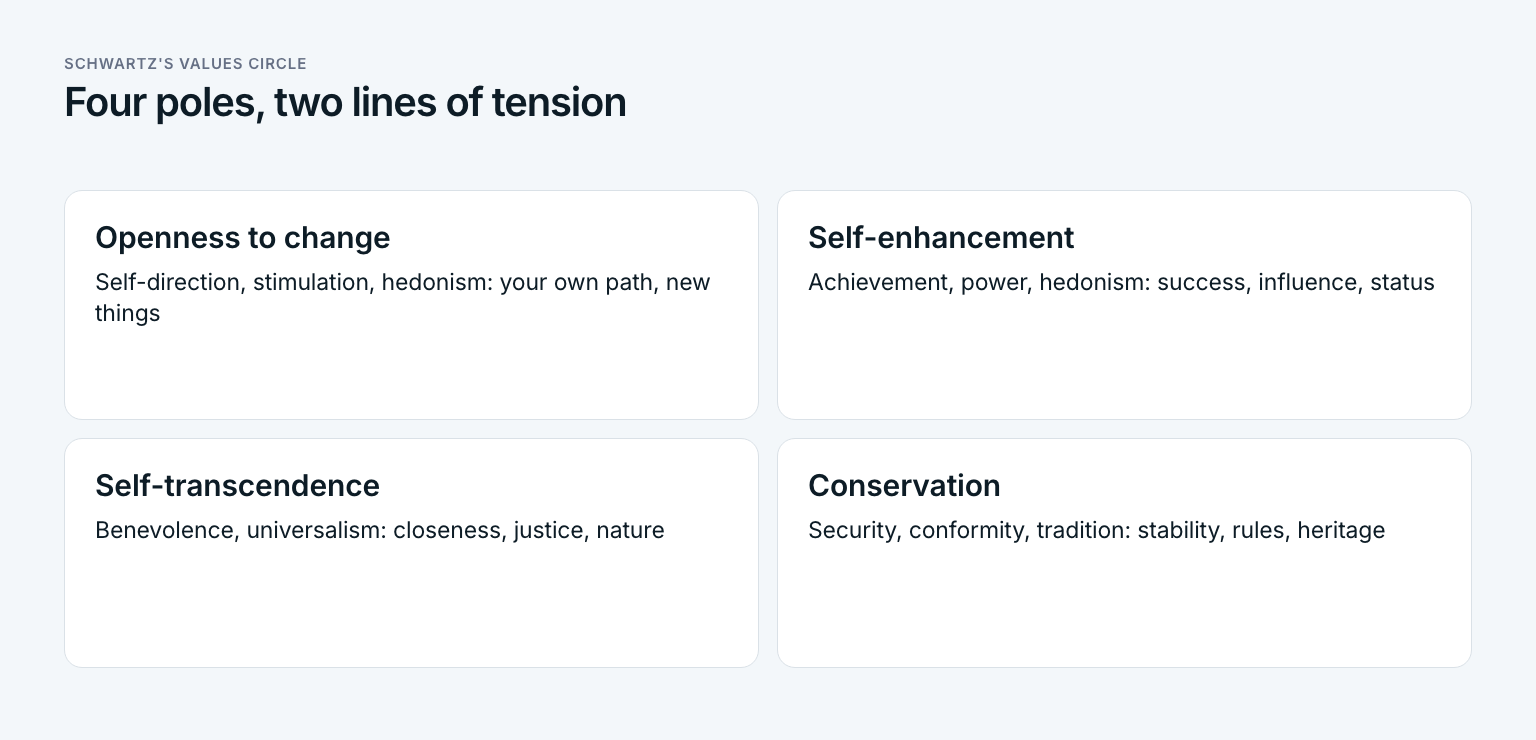
Dana's offer sits right on one of these lines. The charge nurse role pays into achievement and power: growth, recognition, and $9,000 a year. Three weekend shifts a month cost benevolence and security: the Saturday dinners with friends and the long runs on Sunday morning. None of these values is wrong. The only question is which one wins when both cannot happen at once.
Dana answered it with her three sentences. Growth at work means the role genuinely appeals to her, so turning it down by reflex would betray a core value. Connection on days off means three weekends a month is too many. So she accepted for a 90-day trial with two weekend shifts a month and a review date in January. If the unit cannot hold that, she already knows her answer. For a step-by-step way to weigh choices like this, see How to Make Decisions.
How do values influence behavior? Less directly than most self-help promises, and that has been measured. Anat Bardi and Shalom Schwartz found in 2003 that the link between values and behavior varies a lot by value. It was strong for tradition and stimulation and weaker for others. Anyone who only knows what matters to them is still a long way from acting on it. That is why a value needs a sentence, a number, and a date.
From values to goals: direction, not destination
A value is a compass heading, a goal is a city. The distinction comes from acceptance and commitment therapy, described by Steven Hayes, Kirk Strosahl, and Kelly Wilson in 1999. Whoever drives west never arrives at west. They arrive in Indianapolis, then St. Louis, then Kansas City, and each city is a goal on the way in the same direction.
For goal setting, this is more than a nice image. Kennon Sheldon and Andrew Elliot showed in 1999 that people pursue goals that fit their values and interests with more sustained effort, reach them more often, and feel better after reaching them. They called these goals self-concordant. Goals people pursue out of obligation or for someone else's approval tend to lose steam sooner. That means: whoever sets goals without values often ends up chasing other people's goals.
Writing values down: what the research shows, and what it does not
Geoffrey Cohen and colleagues had middle school students write briefly about a value that mattered to them at the start of the school year in 2006. For one group that faced negative stereotypes about their performance, the grade gap narrowed afterward. Later and larger studies by Paul Hanselman and colleagues in 2017 found much smaller effects. Writing your values down is not a cure-all, but it is more than a craft project.
If you want to turn your values into long-term direction, Life Goals covers the next step. If you want to go one level deeper and ask what all of it is for, Finding Purpose walks through a two-week audit. This article is about something smaller and more urgent: making the one value that is missing from your calendar visible by next Tuesday.
Your core values in a goal chain, from year to Tuesday
A value that only lives on paper changes nothing on a Tuesday. So the last step turns each core value that is missing from your calendar into a chain of goals. At the top sits a yearly goal, a city in the direction of the value. Below it come the quarter, the month, the week, and the day. Dana did this for health, the value with the widest gap between her sentence and her calendar.

The numbers come straight from the calendar check. She slept seven hours on four of the last 14 nights, which is under 30 percent. Five of seven nights is about 71 percent, ambitious but possible with a fixed sleep window after shifts. Eight runs in November means two a week, with room for one missed run. On Sunday she counts. If she falls short two weeks in a row, she does not look for more discipline. She looks for the shift swap or late text that ate the morning.
The quarterly goal is the strongest link in the chain. It sets the structure, including the weekend cap in her new role, instead of fighting the same battle every morning. Anyone who only works at the level of week and day is pushing against a structure decided higher up. For how the full chain works, see How to Achieve Goals.
One rule keeps the chain lean: each value gets one yearly goal at a time. Anyone who turns three values into nine goals ends up with another list nobody works through. Dana parked connection for the next quarter on purpose, even though she misses her friends. Sleep first, then the Saturday dinners that sleep makes possible.
Core values examples at work: company values and personal values
Many people look up core values examples because their company is writing a values statement or because a review form asks for theirs. The list above works the same way, with one difference. Company values are promises made outward. Personal values are decision rules turned inward.
In 2002, the consultant Patrick Lencioni warned in Harvard Business Review that many corporate values statements are interchangeable and toothless. His best-known example was Enron, whose annual report listed communication, respect, integrity, and excellence. Whoever picks values for a team needs the same test as for themselves: what do we say no to, and where does it show up in the calendar?
For you personally, you do not have to adopt your employer's values. You only need to know where they match yours and where they do not. Anyone who agrees with their company on achievement and growth, but works against every expectation of evening availability on connection, already knows their next conflict.
Five questions to check your values every quarter
Values change more slowly than goals, but they do change. A first child, an illness, or a new job often moves another family to the top. So a short look at the list at the end of every quarter pays off, ideally alongside your goal review. Five questions are enough:
- Which of my three core values made a decision this quarter, and which ones did not?
- Where in the last two weeks of my calendar does each value show up, in hours, evenings, or appointments?
- Which value won against another one, and would I decide the same way today?
- Which of my goals fits none of my values, and whose goal is it really?
- Is each value's sentence still true, or does it now describe someone else?
Whoever answers these honestly will see quickly whether the list still holds. More questions in the same spirit are in Self-Reflection. In short: your core values are not on the list. They are in your calendar.
Can you give me some examples of intrinsic values?
Intrinsic values are things you value for their own sake, not as a means to something else. Milton Rokeach called them terminal values in 1973 and listed examples such as freedom, wisdom, inner harmony, true friendship, self-respect, and family security. Money is usually not intrinsic, because people want it for what it buys.
How do values influence behavior?
Values act as priorities when choices conflict, but their effect on behavior is weaker than many people assume. Anat Bardi and Shalom Schwartz found in 2003 that the link was strong for some values, such as tradition and stimulation, and weaker for others. Values guide behavior most reliably when they are turned into specific goals with a date.
What is values clarification?
Values clarification is a method for finding out what you actually value, described by Louis Raths, Merrill Harmin, and Sidney Simon in 1966. It uses seven criteria: a value is chosen freely and from alternatives, after weighing the consequences, prized, affirmed publicly, acted on, and acted on repeatedly. The six-step exercise in this article follows that logic.
Can you give me some examples of psychological values?
The best-researched psychological values are Shalom Schwartz's ten basic values: self-direction, stimulation, hedonism, achievement, power, security, conformity, tradition, benevolence, and universalism. Each one covers a family of more specific values, such as curiosity under self-direction or honesty under benevolence. Psychologists use them to compare what people prioritize across cultures.
How many core values should I have?
Three to five core values is a good working number. With many more, every conflict will contain a value that justifies the easy choice. Other values that matter to you can stay on the long list. They just do not get a vote in every decision.
What is the difference between personal values and core values?
Personal values are everything you find important, and that list can be long. Core values are the three to five you have chosen to decide by when values conflict. Every core value is a personal value, but only a few personal values make it into the core.
Last updated: 22 October 2026
Read next
 Personal Growth
Maslow's Hierarchy of Needs: The 5 Levels Explained
Maslow's hierarchy of needs sorts motivation into five levels. What each level means, what research says today and a needs audit you can run yourself.
14 min read
 Personal Growth
Mindfulness Exercises: 12 for Everyday Life
Mindfulness exercises are not about emptying your mind. 12 techniques for stress and focus, what research shows, and a four-week plan to practice daily.
16 min read
 Personal Growth
Positive Affirmations: 50 Examples You Can Believe
Positive affirmations are not magic words. What research shows, 50 daily affirmations you can believe, and a five-step method with a worked example.
16 min read