Finding Purpose: A Two-Week Audit That Shows Yours
Finding purpose is not waiting for a calling. A two-week purpose audit, five steps, six purpose statements and a plan from this year to Thursday night.

Contents
- 01What finding purpose actually means
- 02Why finding purpose in life feels so hard
- 03Where purpose in life comes from: Frankl's three sources
- 04How to find your purpose in five steps: the purpose audit
- 05Marcus's purpose audit: what 14 evenings showed
- 06Purpose statement examples: six sentences from six lives
- 07Purpose in the goal chain: from this year to Thursday night
- 08The three mistakes that keep the search going for years
- 09Signs you've found your purpose
- 10Frequently asked questions about finding purpose
Finding purpose is not waiting for a calling to show up. It means noticing the three or four places your days already draw meaning from, then giving those places fixed hours every week. Purpose in life is less an idea than a trail. It shows up in moments after which you think: that was worth it. Anyone who writes those moments down for two weeks learns more about their purpose than a decade of wondering ever taught them.
You need three things: a log, a sort and a translation into your calendar. The worked example is Marcus, 47, a regional sales manager for a medical supply company in Columbus, Ohio. His youngest daughter left for college in August. Since then the house is quiet on weeknights, and one question keeps coming back around 9 p.m.: What is all of this for? Below you'll find what research says purpose is, Viktor Frankl's three sources, a five-step purpose audit, Marcus's numbers, six example purpose statements, five signs you've found it and the three mistakes that keep the search going for years.
What finding purpose actually means
Finding purpose means knowing what you give your time to and why, and then actually giving it. The most cited definition comes from Stanford psychologist William Damon and his colleagues. In 2003 they described purpose as a stable, general intention to accomplish something that is meaningful to you and that matters to the world beyond you. That definition has three parts, and each one works as a test. Stable means it lasts longer than a mood. Meaningful to you means you'd care even if nobody clapped. Mattering beyond you means somebody else is better off.
Notice what the definition leaves out. It says nothing about a single calling, a dream job or a grand mission. A grandmother who makes sure her grandkids know their family history fits it. So does a nurse, a youth coach or an engineer who builds tools that save other people time. In short: purpose is a direction with a recipient, not a job title.
Psychologist Michael Steger, who published the widely used Meaning in Life Questionnaire in 2006, separates two things people often blur: having meaning and searching for it. You can have plenty of one and little of the other. That matters if you're reading this. Searching is not a sign that something is broken. It's what people do in transitions, after a move, a layoff, a diagnosis or a quiet house in August.
Purpose, meaning, happiness and goals: four words, four jobs
These four words get used as if they were interchangeable. Each one is useful, and each is built for something different. Social psychologist Roy Baumeister and colleagues surveyed nearly 400 American adults in 2013. Happiness was tied more to taking and to the present, meaning more to giving and to linking past and future. People who rated their lives as meaningful actually reported more stress and worry, not less.
| Word | What it is | Time frame | Question it answers |
|---|---|---|---|
| Happiness | a state of feeling good | right now | Do I feel good today? |
| Meaning | the sense that your life makes sense and matters | past to future | Does my life add up? |
| Purpose | a lasting intention that matters beyond you | years | What am I for, and for whom? |
| Goal | a result with a number and a deadline | a year, a quarter, a week | What will be done by when? |
Goals without purpose get checked off and still feel hollow. Purpose without goals stays a nice sentence in a journal. That means: purpose tells you why, goals tell you what by when. Happiness is a welcome guest in both, but it makes a poor yardstick.
Why finding purpose in life feels so hard
Most people who struggle with finding purpose in life aren't missing depth. They're stuck on one of three things, and all three look reasonable from the inside:
- Waiting for a calling. Movies teach us that purpose arrives as a moment of clarity. For a few people it does. For most, the waiting turns into evidence that there's nothing to find.
- Looking only at work. If your job feels empty, it's tempting to conclude your life is too. Yet the evenings with friends, the volunteering and the kid you taught to ride a bike rarely make it into that verdict.
- Losing the container, not the purpose. Life changes remove the structure that used to carry your purpose. Retirement removes the team. An empty nest removes daily parenting. The purpose often survives. What's gone is the place where it used to happen.
Marcus is a textbook case of the third. For eight springs he coached his daughter's softball team, six hours a week from February to June. When she graduated, the team went with her. He didn't lose his purpose in August. He lost its container. Why does that distinction matter? A container can be rebuilt in a few weeks, while a lost purpose sounds like a life sentence.
When nothing feels meaningful right now
Sometimes the problem isn't a lost container. After a loss, under long stress or during an illness, almost everyone's ability to feel meaning drops for a while. That's not a character flaw, and it's not the moment for a big life redesign. Small things help more than any method: one real conversation a week, time outside and one small thing a day done for someone else. If you want a version of your goals that still works on bad days, the guide on how to stay motivated walks through it.
If the emptiness lasts for weeks, or you notice thoughts of not wanting to be alive, please talk to your doctor or a licensed therapist, or call or text 988 to reach the Suicide and Crisis Lifeline, free and at any hour.
Where purpose in life comes from: Frankl's three sources
Purpose in life comes from three sources, and most people only check one. Viktor Frankl, the Viennese psychiatrist who survived several Nazi concentration camps, laid them out in “Man's Search for Meaning,” first published in German in 1946. His point is uncomfortably simple: meaning is discovered, not invented. And it can be discovered in three ways:
- By creating a work or doing a deed. Something you make, build, fix or lead. A house, a well-run team, a rookie rep who closes her first deal because you showed her how.
- By experiencing something or encountering someone. Love, friendship, nature, music. You aren't producing anything here. You're paying attention, and that alone can carry a life.
- By the attitude you take toward what you cannot change. Illness, loss, a door that has closed for good. Frankl called it the last of the human freedoms: choosing how you meet what happens to you.
In practice, almost everyone audits the first source and skips the other two. Anyone who looks only at their job will miss half the evidence. The purpose audit below checks all three on purpose.
“Follow your passion”: good advice for a few, a trap for most
Following your passion works well for people who already have one. Most people don't, and the advice leaves them waiting. Computer scientist Cal Newport argued in “So Good They Can't Ignore You” in 2012 that passion more often follows skill than the other way around: people come to love work they've gotten good at. Treat passion as a possible result of your purpose, not as the entry ticket. The popular ikigai diagram makes a similar move, since passion is only one of its four circles.
How to find your purpose in five steps: the purpose audit
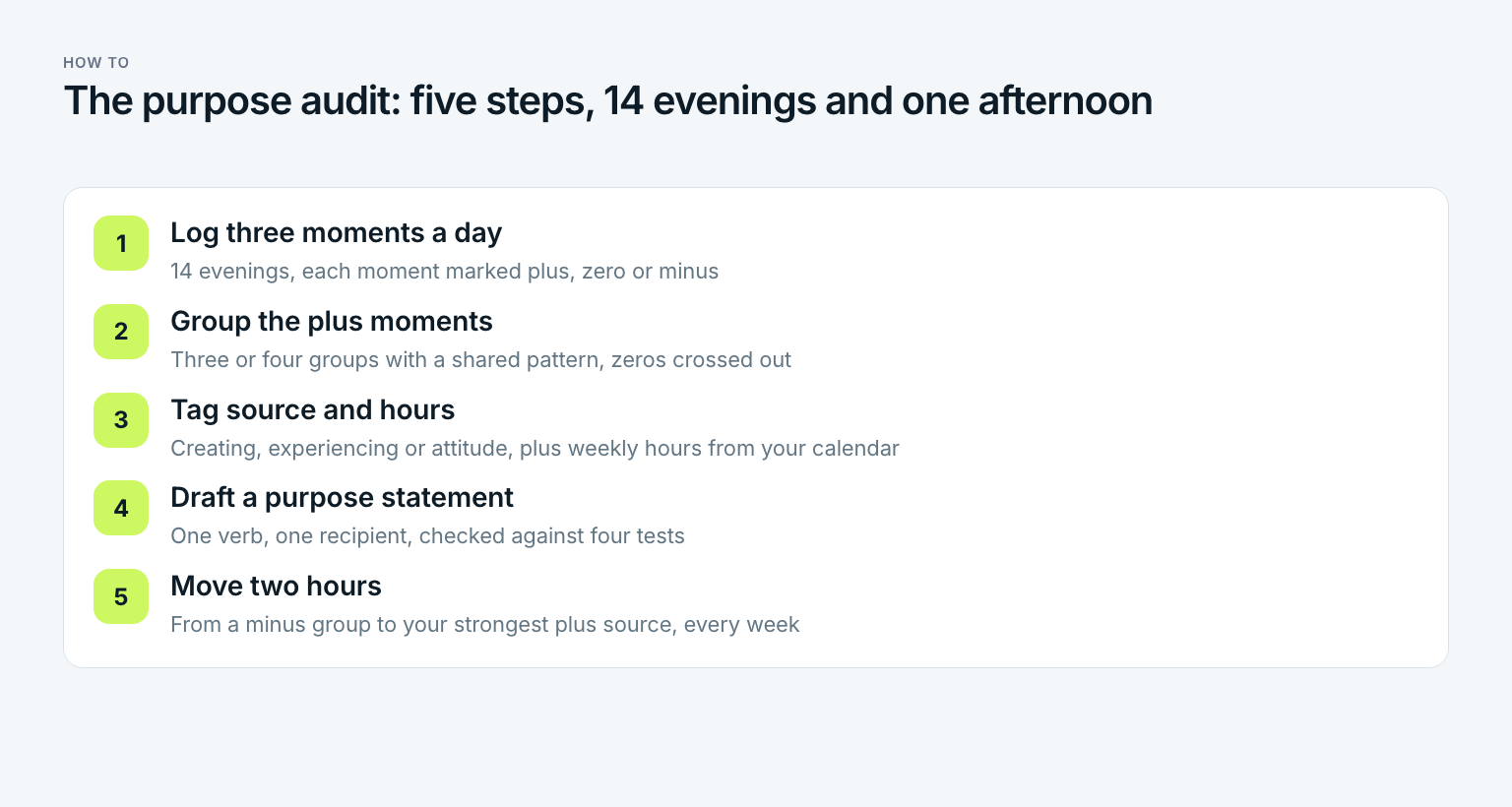
The purpose audit takes 14 evenings at three minutes each, plus one afternoon to sort what you wrote. It swaps thinking about your purpose for observing it. Why does that work better? Memory sorts by mood, a log sorts by fact. Anyone who asks what fulfills them at 9 p.m. on a Sunday mostly hears what 9 p.m. on a Sunday feels like.
Log three moments, 14 evenings, three minutes each
Every evening, write down three moments from the day: what you did, who was there and how long it took. Mark each one plus, zero or minus. Plus means it was worth it and you'd do it again unpaid. Minus means you came out emptier than you went in. After two weeks you have 42 entries, enough to see a pattern.
Group the plus moments, 30 minutes
Cross out every zero. Sort the plus moments into groups that share a pattern: who you helped, what you made, where you were. Three or four groups is normal. More than five usually means you sorted too finely. Do the same with the minus moments.
Tag each group with a source and its hours, 15 minutes
Assign each plus group to one of Frankl's three sources: creating, experiencing or attitude. A missing source is information, not failure. Next to each group, write how many hours a week it gets today, taken from your calendar, not from memory.
Draft a purpose statement, 20 minutes
Put your strongest group into one sentence with a verb and a recipient: I do something for someone. Then test it. Is it meaningful to you? Does it matter to someone else? Will it still be true next year? Does it tell you what to do next Tuesday? Three yeses are enough to start.
Move two hours, don't blow up your life, 30 minutes
Take two hours a week from a minus group and give them to your strongest plus source. Turn that into one yearly goal with a number and a date, and put the two hours on your calendar as fixed appointments. After twelve weeks, run the audit again and compare the number of plus moments.
If you work better with prompts than with a log, the guide to self-reflection has 21 questions for that. If you'd rather sort your groups into fixed areas, the eight segments of the wheel of life make a good grid. For the audit itself, a notebook on the nightstand is plenty. Just write on the same evening, not on Saturday from memory. Anyone who wants to keep writing after the 14 days can pick a format in the journaling for beginners guide.
A template: what one evening in the log looks like
Each entry has four parts: time, activity, people and a mark. Nothing more is needed, and nothing less will do. Without the time you can't do the math later, and without the people you won't see the pattern. Here is Marcus's Wednesday from week one:
- 11:15 a.m., 40 minutes, with Tasha: a ride-along to a hospital account, then a debrief in the parking lot on why the buyer stalled. Plus. She booked the follow-up herself.
- 4:00 p.m., 60 minutes, pipeline call: forecast numbers for the quarter, region by region. Minus.
- 8:30 p.m., 70 minutes, alone: sports highlights and scrolling on the couch. Minus.
Three lines, three minutes. If keywords are all you can manage at night, write keywords. The mark matters more than the wording, and a moment can be hard work and still earn a plus.

Marcus's purpose audit: what 14 evenings showed
Marcus logged 14 evenings in September. He ended up with 42 entries: 11 plus, 10 minus and 21 zero. Half of his days, in other words, were neither good nor bad, just done. The eleven plus moments fell into four groups:
| Source | Plus moments | Hours per week now | Frankl source |
|---|---|---|---|
| Coaching new reps: ride-along debrief with Tasha, role-playing a pricing call, helping a new hire map his territory | 4 | 1.5 h, all by accident | Creating |
| Coaching kids: pitching practice with the neighbor's son, a long text to his daughter's old teammate about tryouts | 3 | 0 h scheduled | Creating |
| Sunday dinner he cooks for his brother's family | 2 | 3 h | Experiencing |
| Evening walks with his wife and the dog | 2 | 2 h | Experiencing |
| Total | 11 | 6.5 h | two of three sources |
The minus side was just as clear. Seven of the ten minus entries came from two things: the weekly pipeline call and the late-night hour of scrolling, which happened on five evenings out of seven. Together they cost him about six hours a week. Frankl's third source, attitude, didn't show up at all. In a calm September, that's no surprise.
What surprised Marcus wasn't the list. It was the weight. Seven of eleven plus moments, 64 percent, came from teaching someone at the start of something hard, and that work had almost no fixed time left on his calendar. The softball team used to give it six hours a week. Now it lived on accidents: a rep who happened to ride with him, a neighbor kid who happened to be in the driveway. Anyone who leaves their strongest source of purpose to chance will feel the gap on a quiet Tuesday night. That means: Marcus hasn't run out of purpose. His purpose has run out of hours.
His purpose statement after step four: “I help people at the start get good at something hard.” It passes all four tests. Meaningful to him: yes, it explains eight springs of softball. Mattering beyond him: yes, it's entirely about other people. Stable: it was true at 30 and it's true at 47. Tells him what to do next week: yes, because his company hires new reps every quarter and the local rec league needs coaches every spring. Dinner and the walks don't get their own statement. They get protected time instead, and he keeps them exactly as they are.
Purpose statement examples: six sentences from six lives
Every purpose is different, but the shape of a good purpose statement is the same: a verb, a recipient, an effect. Six examples from very different lives show how ordinary a strong one can sound:
- ICU nurse, 52: I make sure frightened families understand what is happening to the person they love.
- Electrician, 44: I build things that stay safe for decades, and I train one apprentice a year to do the same.
- Stay-at-home dad, 35: I'm the person my kids never have to perform for.
- Retired teacher, 68: I keep my town's history alive through photos, stories and the historical society.
- Software developer, 29: I build tools that give people back the hours they lose to paperwork.
- Marcus, 47: I help people at the start get good at something hard.
None of these saves the world. Every one of them tells you what to do next Tuesday. If your draft sounds like a poster in a dentist's waiting room, keep cutting until a verb and a person are left. “I want to make a difference” fails that test. “I teach my team to say no to a customer without panicking” passes it.
Is there anything everyone's purpose has in common? The Harvard Study of Adult Development has followed people since 1938, which makes it one of the longest studies of adult life ever run. Its current directors, Robert Waldinger and Marc Schulz, summed it up in their 2023 book “The Good Life”: the quality of people's relationships predicted their health and happiness in later life better than wealth, fame or career success. That's where nearly all good purpose statements meet. They're about other people.
Purpose in the goal chain: from this year to Thursday night
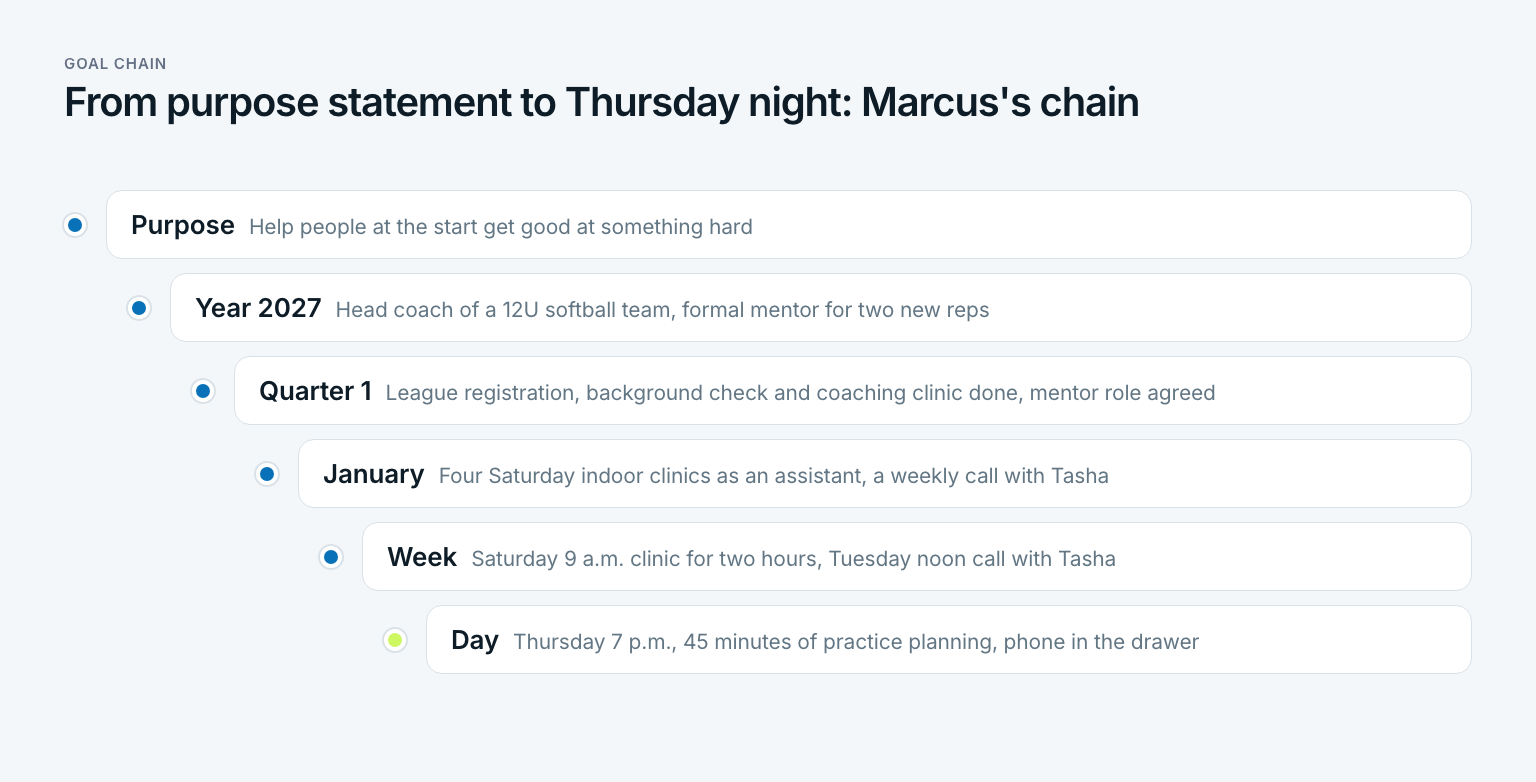
A purpose statement only starts working once it's translated into time. The goal chain does that in five levels: year, quarter, month, week, day. Each level asks the same question at a smaller scale: what will I do in this stretch of time for my sentence? Turning a purpose into a life goal ten or twenty years out is covered in life goals. Here's the shorter path, straight from the sentence into next year.
- Year 2027: Marcus is head coach of a 12U softball team in the spring rec league and the formal mentor for new reps in his region, two of them by December.
- Quarter 1: He registers with the league before the January deadline, passes the background check and the coaching clinic, and gets his VP to make the mentor role official.
- Month of January: Four Saturday indoor clinics as an assistant coach, plus a 30-minute call with Tasha every week.
- Week: Saturday at 9 a.m., two hours at the clinic. Tuesday at noon, the call with Tasha.
- Day: Thursday at 7 p.m., 45 minutes to plan practice drills. The phone stays in the kitchen drawer.
Where do the hours come from? From the minus side. The late-night scrolling drops from five evenings to two, which frees three hours. The pipeline call stays, because it's part of the job. But Marcus changed what he brings to it: once a month he reports on what the new reps learned, and a minus turns into half a plus. In short: he didn't rebuild his life. He moved four hours a week.
Gaapp is built for exactly this chain: the yearly goal on top, then quarter, month and week, down to the daily goal you check off. Anyone who keeps their goals in one place can see by March whether the purpose statement made it onto the calendar or only into the notebook. The method behind it is laid out in how to achieve goals.
The three mistakes that keep the search going for years
The search for purpose rarely fails for lack of depth. It fails because of three habits that look sensible and quietly stretch it out.
The most common mistake: waiting for a revelation
Many people expect purpose to arrive as one clear insight, on a trip, in a book, after a conversation. It can happen. Usually it doesn't, and the waiting becomes proof that there's nothing there. Purpose shows up backwards, in moments you've already had. That's why the audit starts with a log, not with the big question.
Mistake two: confusing purpose with happiness. Anyone who treats every hard task as proof that something's wrong will cut exactly the things that matter later. Raising kids isn't fun on many evenings. Neither is studying for a certification after work. Baumeister's finding is practical here: meaningful days are often the harder ones. The question isn't whether it was fun. It's whether you'd do it again.
Mistake three: blowing up your life instead of moving hours. Quit, move, start over. Sometimes that's right. More often it's an expensive way to answer a question that two hours a week could answer for less. Anyone who feeds their strongest source with fixed time for twelve weeks knows afterwards whether the big leap is needed. For Marcus, a coaching season and a formal mentor role may be enough. If he still wants a career change by next summer, he'll make it with evidence, not on a quiet Tuesday night.
Signs you've found your purpose
You've found your purpose when it shows up in your calendar, not just in your head. Five signs you can actually check:
- You can say it in one sentence with a verb and a person in it.
- It tells you what to do next week, not just how to feel.
- Hard days spent on it still feel worth it, even when they aren't fun.
- Other people come to you for exactly this, without being asked to.
- It has fixed hours every week, and you protect them like a meeting with your boss.
Marcus can check three of the five today. The last two will come with the season. Which of the five can you check right now?
Three questions before tonight
Before you write your first entry this evening, answer three questions honestly and on paper:
- Which moment last week was worth it, even though nobody saw it?
- How many hours does that kind of moment have on your calendar, fixed and not by accident?
- Which two hours a week could you give up for it without missing anything?
Anyone who can answer those three doesn't need a revelation anymore. They need an appointment. Finding purpose doesn't happen at the end of a long search, it happens on Thursday at 7 p.m.
Frequently asked questions about finding purpose
Why am I struggling to find purpose in life?
Usually for one of three reasons: you're waiting for a calling, you're only looking at your job, or a life change removed the structure your purpose used to live in. Retirement, an empty nest or a layoff often take away the container, not the purpose. A two-week log of moments that felt worth it shows which one applies to you.
How do I figure out my purpose?
Observe it instead of thinking it up. Log three moments every evening for 14 days and mark each one plus, zero or minus. Group the plus moments, put the strongest group into one sentence with a verb and a recipient, and give it two fixed hours a week.
What are signs you've found purpose?
You can say it in one sentence with a verb and a person, and it tells you what to do next week. Hard days spent on it still feel worth it. Other people come to you for it, and it has fixed hours in your calendar that you protect.
What does God say about finding your purpose?
The Bible doesn't hand out individual job descriptions, but Christians often point to Micah 6:8, to act justly, love mercy and walk humbly, and to Ephesians 2:10, which describes people as created for good works. Many faith traditions frame purpose as service to others, which matches what secular research finds. If faith is central for you, a pastor or a small group is a good place to test your purpose statement.
What is the difference between purpose and meaning?
Meaning is the sense that your life makes sense and matters. Purpose is narrower: a lasting intention to do something that matters to you and to others, as William Damon and colleagues defined it in 2003. Purpose is one of the strongest sources of meaning, but meaning can also come from love, nature or how you face what you can't change.
Can you have more than one purpose in life?
Yes, and most people do across different stages of life. In any given year, though, one strong purpose statement with fixed hours beats three vague ones. Run the audit once a year, because purpose shifts as your life does.
Last updated: 14 October 2026
Read next
 Personal Growth
Maslow's Hierarchy of Needs: The 5 Levels Explained
Maslow's hierarchy of needs sorts motivation into five levels. What each level means, what research says today and a needs audit you can run yourself.
14 min read
 Personal Growth
Mindfulness Exercises: 12 for Everyday Life
Mindfulness exercises are not about emptying your mind. 12 techniques for stress and focus, what research shows, and a four-week plan to practice daily.
16 min read
 Personal Growth
Positive Affirmations: 50 Examples You Can Believe
Positive affirmations are not magic words. What research shows, 50 daily affirmations you can believe, and a five-step method with a worked example.
16 min read