Life Goals: 50 Examples and How to Find Yours
Life goals describe who you become and what you build in five to twenty years. Five steps to find yours, 50 examples, the top 10, one worked plan.

Contents
- 01What life goals are, and what they are not
- 02Why “what is the goal of life” is the wrong question
- 03How to find your goals in life in five steps
- 04Life goals examples: 50 goals in eight areas of life
- 05The 10 life goals most people land on, and what they have in common
- 06The three mistakes that turn life goals into a list nobody reads
- 07From life goal to Monday: Marcus's goal chain
- 08How to review life goals without rewriting them every January
- 09Five questions to ask before you write your life goals down
Life goals are not a bucket list. A bucket list collects experiences you want to have once. Life goals describe who you want to become and what you want to have built in five, ten, or twenty years, in the areas that matter to you: health, relationships, work, money, learning, contribution. A bucket list is finished when you cross the item off. A life goal is finished when your ordinary Tuesday looks different.
Three things make a life goal usable: a direction you chose yourself, a milestone with a year attached, and a first step you can take this week. All three run through Marcus, a 38-year-old high school teacher in Columbus, Ohio, with two kids, a mortgage, a car loan, and three notebooks full of goals he never started. You get a definition, five steps to find your own goals in life, 50 life goals examples, the ten goals most people end up with, the three mistakes that stall them, and one worked plan from a twenty-year goal down to a single Monday.
What life goals are, and what they are not
A life goal is a long-term outcome you want to be true about your life, chosen by you, that shapes your decisions for years. The horizon is long, usually five to twenty years. The scope is wide, because it touches more than one area of life. And the test is simple: if the goal were reached, would your ordinary week look different? Whoever answers yes has a life goal. Whoever answers no has a wish.
Four words get used as if they meant the same thing. They do not. Each one is built for something else, and mixing them up is where most lists go wrong.
| Term | Horizon | Built for | From Marcus's notebook |
|---|---|---|---|
| Dream | None | Direction and feeling | “I want to feel free” |
| Bucket list item | Once | An experience to have | “See the northern lights” |
| Life goal | 5 to 20 years | Who you become, what you build | “No debt except the mortgage by 2029, and a third of my income from something I built by 2031” |
| Yearly goal | 12 months | One measurable step toward a life goal | “Car loan of 14,400 dollars paid off by December 31, 2027” |
The dream gives the direction. The bucket list adds color. The yearly goal does the work. The life goal sits in between, and it is the layer most people skip. They jump from “I want to feel free” straight to “run a marathon in May”, and six months later they cannot say why the marathon mattered. That means: a life goal is the translation layer. It turns a feeling into something you can plan a decade around.
Why “what is the goal of life” is the wrong question
The goal of life is not a question with one answer, and anyone who sells you one is selling. Viktor Frankl, a psychiatrist who survived four concentration camps, wrote in Man's Search for Meaning in 1946 that meaning is never found in the abstract. It is found in a concrete task that only this person, in this situation, can take on. He refused to name a universal goal of life. He asked instead what life was asking of you, right now, in your circumstances.
That reframing matters for your list. The question “what is the goal of life” leads to philosophy. The question “what do I want to be true about my life in 2036” leads to a plan. Both are legitimate. Only one of them tells you what to do on Monday.
Marcus had spent two years on the first question. He read, he listened to podcasts on his commute, he wrote “figure out my purpose” at the top of three different notebooks. When he switched to the second question, the first answer came in under a minute: “I want my kids to see me do something I chose, not something I fell into.” That is not a goal yet. It has no year and no number. But it is the raw material for one.
Purpose, values, and life goals: how the three fit together
Purpose is the why, usually one sentence, and it rarely changes. Values are the rules you want to live by, such as honesty or curiosity, and they tell you how to pursue anything at all. Life goals are the what: concrete outcomes with a horizon. You can live your values without a single goal. You cannot keep a goal without knowing which value it serves, because you will drop it the first time it costs something. The Japanese idea of ikigai adds a fourth word to this list: the small, daily reasons to get up, which can exist without any big purpose at all.
How to find your goals in life in five steps
Finding your goals in life is a two-hour exercise, not a two-year search. The five steps below are the ones Marcus used on a Saturday in September, after the kids were in bed. You need paper, a timer, and your phone in another room. The order matters. Whoever decides first writes down what sounds good. Whoever scores first writes down what is true.
Score eight areas of life, 20 minutes
Health, relationships, family, work, money, learning, contribution, leisure. Rate each one from 1 to 10 for how satisfied you are today. Then rate each one from 1 to 10 for how much it matters to you. The gap between the two numbers is where life goals hide. Marcus scored work at 4 for satisfaction and 9 for importance. Money was 5 and 8. Health was 7 and 6. The two biggest gaps, work and money, told him where to look.
Write the paragraph you would want read about you, 15 minutes
One paragraph, written as if you were 80 and looking back. Not what you owned. What you built, who you became, what the people around you learned from watching you. Marcus's sentence that stuck: “His kids learned from him that you can change course at 40 without blowing up your life.” Where the paragraph and the biggest gap point to the same area, that is your first life goal.
Turn each gap into one sentence with a year, 30 minutes
For each of your three largest gaps, write one sentence that begins with “By” and a year, and that could be checked true or false by someone else. Marcus wrote three. “By 2031, at least a third of my income comes from tutoring or a course I built.” “By 2029, we have no debt except the mortgage.” “By 2027, I run 5K three mornings a week and it is no longer a decision.” Each sentence has a year, a measurable state, and no adjectives.
Test every sentence with three questions, 15 minutes
Would I still want this if nobody ever knew? Does it change my ordinary week? Does it cost me something I am willing to pay? A goal that fails the first question is borrowed. A goal that fails the second is a wish. A goal that fails the third will not survive February. Marcus's fourth sentence, about writing a novel, failed the first, and he crossed it out without regret.
Pick one for this year and park the rest, 10 minutes
Three to five life goals are enough for a decade. One is enough for this year, two at most. Marcus chose the debt goal, because it unlocked the work goal: with the car loan gone, he could afford to drop one tutoring client and spend those hours building the course. The other two sentences went to the back of the notebook, with the year they come up for review.
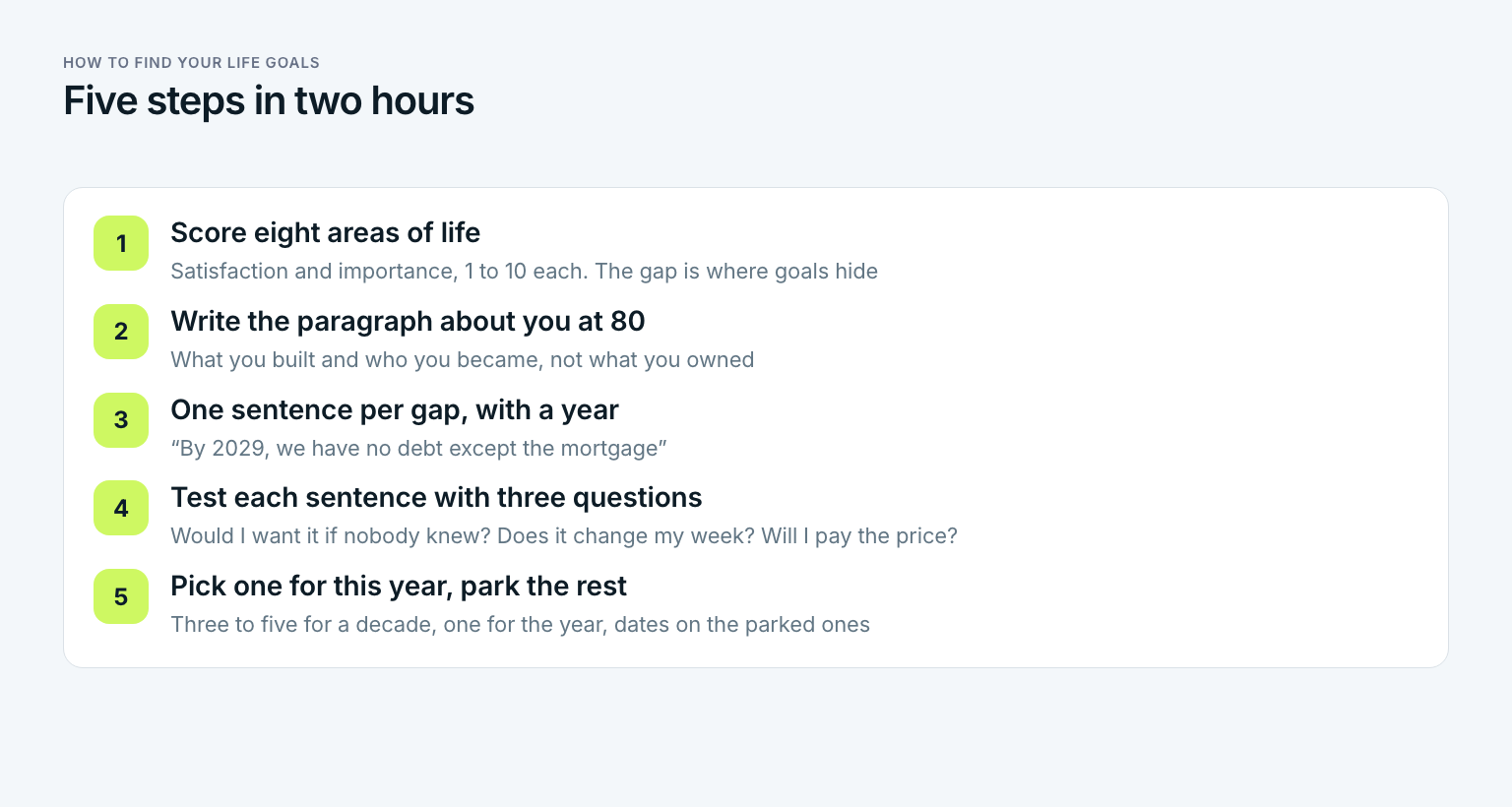
Five steps, two hours, three sentences with years in them. Compare that with the three notebooks. The difference is not insight. Marcus already knew most of what he wrote down. The difference is that each sentence can be checked, and a sentence that can be checked can be broken into a yearly goal, which is where the work of achieving a goal actually begins.
Life goals examples: 50 goals in eight areas of life
Life goals examples are useful for exactly one reason: they show you the shape of a good one. Each example below has a horizon you can attach a year to and a state you can check. Borrow the shape, not the content. Your gaps are not Marcus's gaps. Read the list, notice which lines make you uncomfortable, and start there.
Health and energy
- Run 5K three mornings a week, and have done so for a full year
- Reach and hold a weight at which my annual bloodwork comes back without a warning
- Sleep seven hours on at least five nights a week, tracked for twelve months
- Be able to carry my own luggage up three flights of stairs at 70
- Go a full year without a drink and decide afterward whether to go back
- Cook dinner at home five nights a week as the default, not the exception
- Complete a strength program long enough to deadlift my own body weight
Relationships and family
- Have a marriage in which we still take one weekend a year away without the kids
- Raise children who call home as adults because they want to
- Keep four friendships alive for life, with one real conversation a month each
- Eat dinner together as a family at least four nights a week until the kids leave
- Reconcile with a sibling or parent before one of us runs out of time
- Build a household where disagreements end the same day
- Know my grandchildren well enough that they have a name for me they chose
Work and career
- Earn a third of my income from something I built myself
- Reach a role where I decide what the team works on, not just how
- Leave a job I tolerate for work I would describe as mine
- Teach or mentor at least ten people who go on to do the work better than I did
- Work four days a week by 50 without a drop in standard of living
- Publish a body of work that exists without me: a book, a course, a product
- Be the person in my field that three others call when they are stuck
Money
- Have no debt except the mortgage
- Hold six months of expenses in savings and never touch them for anything but an emergency
- Own a home outright by 60
- Fund a retirement account so that work after 65 is a choice
- Give away ten percent of what I earn every year, to causes I chose
- Pay for my children's first degree without them taking on debt
Learning and skills
- Hold a one-hour conversation in a second language with a native speaker
- Play one instrument well enough to perform a full song for other people
- Read 500 books over the next twenty years, roughly one every two weeks
- Finish a degree or certification I started and stopped
- Learn a craft with my hands, woodworking or pottery or sewing, to the point of making gifts
- Understand my own finances well enough to explain them to a teenager
Contribution and community
- Volunteer in the same place long enough that people there know my name
- Mentor one young person a year through a transition I went through myself
- Serve on the board of a school, a nonprofit, or a neighborhood association
- Build or restore one thing in my town that outlasts me
- Donate blood or register as a donor and keep it up for a decade
- Leave my field with one practice or tool that others still use
Home and place
- Live in a place where I know ten neighbors by name
- Have a garden that feeds us for at least one season a year
- Own a home that needs no apology when people visit unannounced
- Live within an hour of the people I love most
- Spend one month a year living somewhere else and working from there
Leisure and adventure
- Hike a long trail in sections over ten years, and finish it
- Keep one hobby that has nothing to do with work or family for life
- See every national park in my country before I turn 65
- Learn to sail, dive, or climb well enough to go without a guide
- Spend a summer in the country my grandparents came from
- Take my parents on one trip they would never have planned for themselves
Notice what the list does not contain: “be happy”, “travel more”, “be a better person”. Those are directions, and they belong in the dream column. Anyone who writes them down as goals will never know whether they arrived. Every item above can be read in ten years and marked true or false. For the layer below, the one with a twelve-month number, our SMART goals examples do the rest.

The 10 life goals most people land on, and what they have in common
Ask a room of 30 adults for their top five goals in life and the same ten answers come back, in a different order each time. The list below is not a ranking. It is what people say when they stop performing for the room. Life goals are rarely original. They are supposed to be yours, not new.
- Be financially secure: no consumer debt and six months of expenses in savings
- Stay healthy enough to be active and independent at 70
- Raise children who turn out kind and who want to come home
- Have a partnership that still talks after twenty years
- Do work that is mine: a business, a craft, a book, a practice
- Own a home that feels like one, and eventually own it outright
- Keep a handful of friendships for life
- Learn something hard as an adult, a language or an instrument, to the point of using it
- Give back in a way that has a name: mentoring, volunteering, a cause I show up for
- See a part of the world that changes how I see my own
What do they have in common? Not one of them is a single event. Every one describes a state that has to be built and then maintained, which is exactly why these are life goals and not bucket list items. And every one can be translated into a yearly goal with a number. “Be financially secure” becomes “six months of expenses in savings by December 2027”. “Stay healthy at 70” becomes “bloodwork without a warning this year and 150 minutes of movement a week”. The good life goals are the ones that survive that translation. The ones that do not were slogans.
Marcus recognized four of the ten on his own list. He had been embarrassed by how ordinary they looked, until he noticed that none of the three notebooks had ever gotten any of the four to a number.
The three mistakes that turn life goals into a list nobody reads
Marcus's three notebooks were not empty. They were full. Full is the problem. Three mistakes show up in almost every abandoned list of life goals, and all three can be fixed in an afternoon, once you can see them.
The first mistake is too many. Twelve goals across eight areas of life sounds balanced. In practice it is twelve things competing for the same Tuesday evening, and the one that wins is whichever was easiest. Marcus's second notebook had fourteen goals. He could name three from memory. Three to five life goals for a decade is plenty, one for this year. Anyone who needs more than that is listing areas, not goals. The same arithmetic decides your work-life balance each week: three areas with a fixed slot beat eight without one.
The most common mistake: life goals without a year attached
“Become debt free” is a direction. “No debt except the mortgage by December 2029” is a goal. The missing year is the single most common fault in the lists people share, and it is the reason those lists never get a yearly goal underneath them: there is no deadline to divide. Add a year to every sentence. If the year feels arbitrary, pick it anyway. You can move a year. You cannot plan toward a blank.
The third mistake is treating the list as finished once it is written. A list of life goals read once in January and found in a drawer in November has done nothing in between. The goal did not fail. The review did. Whoever writes the list and never schedules the next time to read it has written a letter to a stranger. In short: a life goal with no year, no yearly goal underneath it, and no review date is a dream with better handwriting.
From life goal to Monday: Marcus's goal chain
A life goal only becomes real when it reaches a weekday. The way to get it there is a chain. The life goal sets the direction. The yearly goal sets the number. The quarter sets the milestone, the month the deliverable, the week the action, and the day the one thing that has to happen. Each link is checked against the one above it, never against the mood of the day. Marcus's debt goal, run through the chain, looks like this.
| Level | Marcus's goal | How he checks it |
|---|---|---|
| Life goal, 2029 | No debt except the mortgage | Account balances, first Saturday of January |
| Year 2027 | Car loan of 14,400 dollars paid off by December 31 | Balance on the loan statement |
| Quarter, Q4 2026 | Loan balance below 10,800 dollars, 3,600 dollars extra paid | Statement on December 31 |
| Month, October | 1,200 dollars in extra payments | Four transfer confirmations |
| Week | 300 dollars moved to the loan every Friday | Banking app, Friday at 6 pm |
| Day | One tutoring session on Tuesday, one on Thursday, 75 dollars each | Calendar, done or not done |
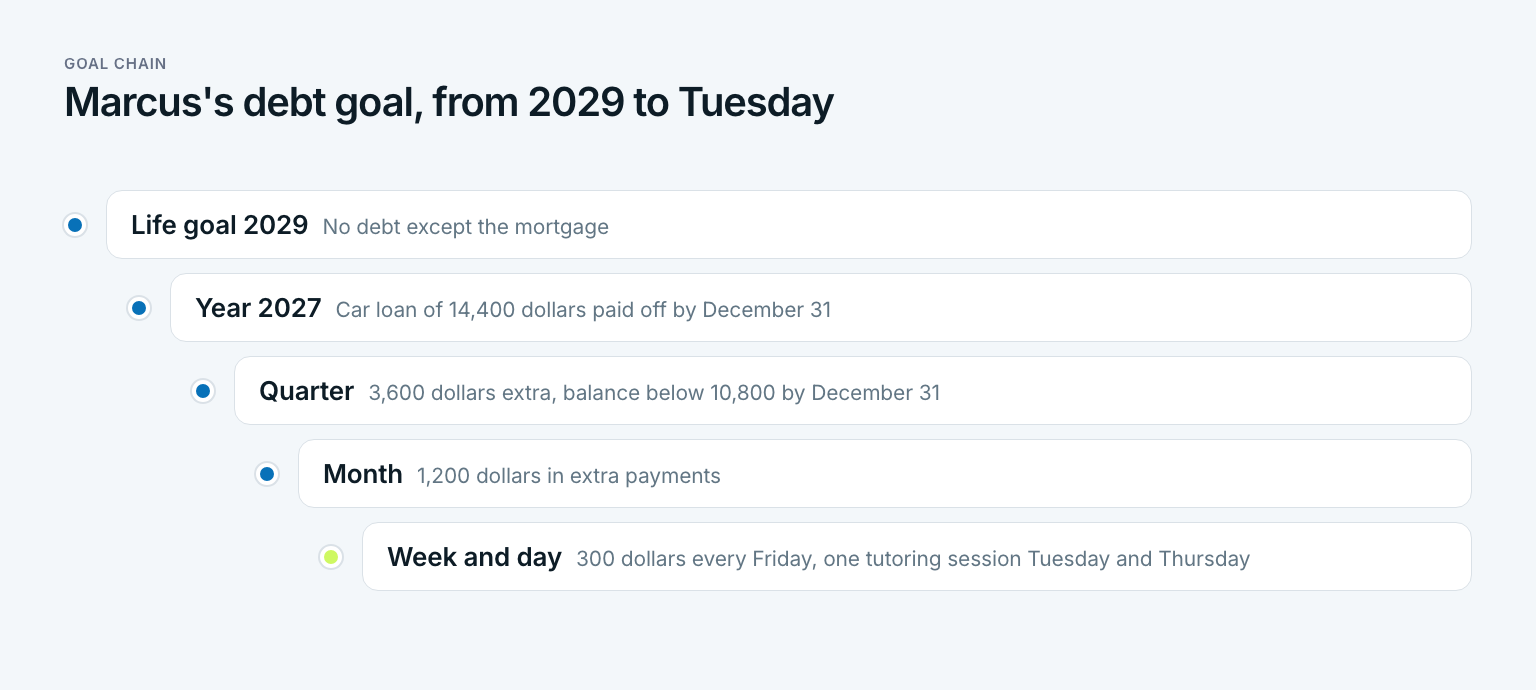
Read the chain from the bottom up and the numbers explain themselves. Two tutoring sessions a week bring in 150 dollars. The other 150 comes from the lines Marcus cut in September: two streaming bundles, a gym he had not entered since March, and the Friday takeout order, together about 640 dollars a month. That makes 300 dollars every Friday, 1,200 a month, 3,600 a quarter, and 14,400 in twelve months. The loan is gone by September 2027, with three months of buffer before the deadline he wrote down.
Read it from the top down and the chain answers a different question: why Tuesday matters. Marcus does not tutor on Tuesday because he likes it. He tutors because the Tuesday session is one eighth of the monthly number, which is one third of the quarterly milestone, which is one quarter of the yearly goal, which is the first half of a life goal he wrote on a Saturday in September. That means: the day is never checked against how he feels. It is checked against the week. The method for the lower links is in how to turn yearly goals into daily steps. This chain is also the structure a goal tracker like Gaapp is built around: one yearly goal at the top, one daily action at the bottom, one number on Friday instead of three notebooks.
What happens to the other two life goals
They wait, and waiting is not failing. The running goal gets a small chain of its own, because it costs time rather than money: three mornings a week, 25 minutes, checked on Sunday. The work goal gets no chain until 2028. It gets a date, the first Saturday of January, when the loan is gone and the hours are free. A parked life goal with a date is still a goal. A parked life goal without a date is the second notebook.
How to review life goals without rewriting them every January
Life goals are reviewed on three rhythms, and each rhythm asks a different question. Every week, ten minutes: did this week pay into the month? Every quarter, an hour: is the yearly number still right? Every year, an afternoon: do the life goals still hold? Whoever reviews only once a year rewrites. Whoever reviews weekly adjusts. The weekly check is the one most people skip, and it is the one that keeps the other two honest. The ten-minute weekly review covers the format.
The rule for what may change is simple. The yearly number, the method, and the deadline may change at any quarterly review, because a plan that never changes was never tested. The life goal itself changes only when you change: a child, a diagnosis, a move, a loss. One bad quarter is not a reason to rewrite a twenty-year sentence. It is a reason to rewrite the quarter. Marcus's rule is on the inside cover of the fourth notebook: life goals get rewritten on the first Saturday of January, and only if the paragraph from step two changed.
The yearly review is also where the next yearly goal comes from, and where the parked goals come off the shelf. Marcus will sit down in January 2028 with a paid-off loan and the work sentence from 2026, and ask what the twelve-month number underneath it is. Our guide to annual planning walks through that afternoon. How the same goals fit into a ten-year timeline with phases is covered in how to make a life plan.
Five questions to ask before you write your life goals down
Before the next notebook, run your list through these five questions. Each takes a minute, and together they catch almost everything the three mistakes above let through.
- Which two areas of life have the biggest gap between how satisfied I am and how much they matter? Do my goals live there, or somewhere more comfortable?
- Does every sentence have a year, and could someone else check it true or false?
- Would I still want each one if nobody ever knew?
- Which single goal gets this year, and what is the twelve-month number underneath it?
- When is the next time I will read this list, and is that date in my calendar?
Marcus's list passed four of the five on the first Saturday. The fifth, the review date, was missing, which is how three notebooks happened. He added it. In short: life goals are not a list of things to do before you die. They are the three or four sentences that decide what you do on Tuesday, and the only test that matters is whether Tuesday has changed.
What are 10 life goals?
The ten life goals people name most often are financial security, staying healthy into old age, raising children who want to come home, a partnership that lasts, work that feels like your own, owning a home, keeping lifelong friendships, learning something hard as an adult, giving back in a named way, and seeing a part of the world that changes your view of your own. None of them is a single event. Each describes a state you build and maintain, which is what separates a life goal from a bucket list item.
What are your life goals examples?
Good life goals examples have a year and a checkable state: no debt except the mortgage by 2029, a third of my income from something I built by 2031, running 5K three mornings a week by 2027, a one-hour conversation in a second language by 2030. The article above lists 50 of them across eight areas of life. Borrow the shape, not the content, and start with the area where the gap between satisfaction and importance is largest.
What are the good life goals?
A good life goal passes three tests. You would still want it if nobody ever knew. It would change your ordinary week if you reached it. And it costs you something you are willing to pay. Goals that fail the first test are borrowed, goals that fail the second are wishes, and goals that fail the third do not survive February. Good life goals also carry a year, so a yearly goal can be built underneath them.
What are the top 5 goals in life?
When people are asked honestly, the top five are almost always financial security, health that lasts into old age, a family or partnership that holds, work that is their own, and a few friendships for life. The order varies by person and by decade. What does not vary is that each one needs a yearly number underneath it to become more than a slogan, such as six months of expenses saved by December or a loan paid off by a date.
How do I find my life goals?
Score eight areas of life for satisfaction and importance, write one paragraph about the person you want to have been, turn the two or three largest gaps into sentences that begin with a year, test each sentence with the three questions above, and pick one goal for this year. The whole exercise takes about two hours with paper and a timer. The result is three to five sentences you can check, not a purpose statement.
How many life goals should you have?
Three to five for a decade, one for this year, two at most. More than five means you are listing areas of life rather than goals, and more than two in a single year means they compete for the same evenings. Park the rest with a date for when they come up for review. A parked life goal with a date is still a goal.
Last updated: 19 October 2026
Read next
 Personal Growth
Maslow's Hierarchy of Needs: The 5 Levels Explained
Maslow's hierarchy of needs sorts motivation into five levels. What each level means, what research says today and a needs audit you can run yourself.
14 min read
 Personal Growth
Mindfulness Exercises: 12 for Everyday Life
Mindfulness exercises are not about emptying your mind. 12 techniques for stress and focus, what research shows, and a four-week plan to practice daily.
16 min read
 Personal Growth
Positive Affirmations: 50 Examples You Can Believe
Positive affirmations are not magic words. What research shows, 50 daily affirmations you can believe, and a five-step method with a worked example.
16 min read