SMART Goals for Students: Examples for School and College
SMART goals for students are not resolutions. Academic examples for finals, a thesis, nursing and high school, with a template and five steps.

Contents
- 01What SMART goals for students are, and what they are not
- 02Three kinds of academic goals: degree, exam, mastery
- 03SMART goals for college students during finals: plan backward from the exam
- 04SMART goals for a capstone or senior thesis: pages are not progress
- 05SMART goals in education: for kids, high schoolers and teachers
- 06Academic SMART goals examples for every level
- 07How to set SMART goals as a student in five steps
- 08Three mistakes that sink study goals before finals
- 09SMART goals for students in the goal ladder: year, quarter, month, week, day
- 10Template and self-check before the semester starts
- 11Frequently asked questions about SMART goals for students
SMART goals for students are not New Year's resolutions with a syllabus attached. They are sentences with a result, a number and a date that you can check against your course schedule, your gradebook and your degree audit. “Study harder this semester” is a resolution. “By December 3, I score 80% or higher on two timed pediatric practice sets in a row” is a SMART goal. You won't notice the difference in September. You notice it in the second week of November, when the resolution has faded and the goal still tells you how many practice sets are left.
School has one advantage almost no other part of life has: the numbers already exist. Credit hours, exam dates, due dates, grading scales and passing thresholds are set before you write a single goal. Everything below is worked through with Maya, a senior in a nursing program who works 16 hours a week as a nursing assistant and graduates in May. Along the way you get goals for high school and younger kids, a learning objective for teachers, ten academic SMART goals examples, a template, five steps and the three mistakes that sink most study goals before Thanksgiving.
What SMART goals for students are, and what they are not
SMART is a checklist with five criteria. A goal is specific, measurable, achievable, relevant and time-bound. The acronym comes from George T. Doran, who described it in a 1981 issue of Management Review for managers writing company objectives. Still, the method fits school better than almost anywhere else, because most of the criteria are handed to you by the institution. The general method, with every variant of the acronym, is covered in the guide to SMART goals. This article answers a narrower question: what do the five letters look like when the result is an exam, a degree or a skill?
Doran's original letters were slightly different. His A stood for assignable, meaning it is clear who owns the goal, and his T stood for time-related. For a student, the owner is almost always you, which is why most schools now teach achievable and relevant instead. The table shows what each letter asks of a student and how Maya answers it for her fall semester.
| Letter | Question for a student | Maya's answer |
|---|---|---|
| Specific | Which course, which exam, which paper? | All four fall courses, with Pediatric Nursing as the one at risk |
| Measurable | How do you count it: credits, grade, score, pages? | 15 credits passed, Pediatrics exam average at 78% or higher |
| Achievable | Does it fit into your actual week? | 15 credits are about 45 hours a week. Her job adds 16. She cuts to one shift a week from Thanksgiving to finals |
| Relevant | Does it move the bigger goal? | Passing Pediatrics is a condition for graduating in May |
| Time-bound | Which date counts? | December 11, 2026, the last day of finals |
The table already shows what SMART does for a student. It forces you to translate a number from the catalog into a number for your week. A resolution can't do that. It stays vague on purpose. Under the federal definition, one credit hour means one hour in class plus at least two hours of work outside it each week. Anyone who signs up for 15 credits is signing up for about 45 hours a week, whether they write it down or not. In short: achievable is not a feeling in college. It is arithmetic.
Term: credit hour
A credit hour measures workload, not seat time. The US Department of Education defines it as one hour of classroom instruction and at least two hours of out-of-class work per week over roughly 15 weeks. A three-credit course therefore stands for about nine hours a week. That means: your schedule already contains the A in SMART. You only have to do the math.
Three kinds of academic goals: degree, exam, mastery
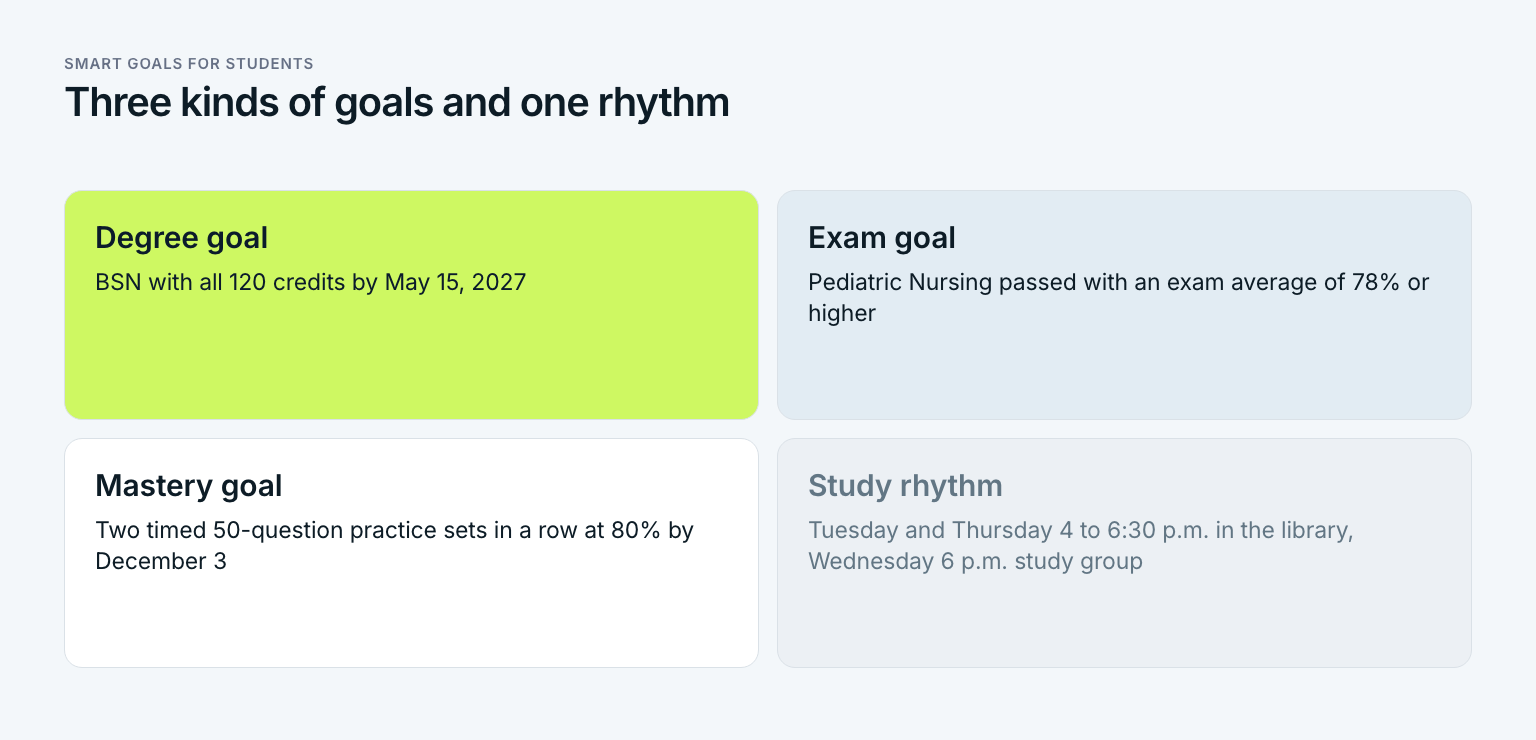
Not every goal in school is built the same way. A degree is months away and depends on dozens of exams. An exam is weeks away and depends on a single morning. A mastery goal, by contrast, can be measured almost every day. Whoever mixes these three up writes a goal that is either too big to act on or too small to matter. That means: first decide what kind of goal you are writing. It is the same split as between short-term and long-term goals, only on the scale of a semester.
- Degree goal. The big result with a date. Maya: “By May 15, 2027, I graduate with my BSN and all 120 credits.” It sets the direction and rarely changes.
- Exam goal. One test, one paper, one presentation. “I finish Pediatric Nursing with an exam average of 78% or higher.” It is concrete, but you only partly control it, because someone else writes the questions.
- Mastery goal. What you can prove you know before you walk into the exam room. “By December 3, I score 80% or higher on two timed 50-question pediatric practice sets in a row.” This one you control almost completely.
Next to these sits your study rhythm, the fixed blocks in your week. It is not a goal. It is what carries every other goal. Maya studies Tuesday and Thursday from 4 to 6:30 p.m. on the second floor of the library, and her study group meets Wednesday at 6 p.m. Without those blocks, every mastery goal stays a wish.
Why does the mastery goal matter so much? Goal-setting research has a precise answer. Dan Winters and Gary Latham compared two kinds of goals in 1996: a performance goal that only names the result, and a learning goal that asks for strategies and skill. On a simple task, the performance goal helped more. On a complex, unfamiliar task, the learning goal helped more. An exam in a subject you haven't mastered yet is exactly that kind of task. Anyone whose only goal there is “pass” has a destination without a route.
Maya scored 72% on her first Pediatrics exam. Her program requires a 78% exam average to pass the course. She knows that “do better next time” won't be enough. So under her exam goal sits a mastery goal with a number she can measure herself every week: scores on timed practice sets. The exam goal says where. The mastery goal says whether she is there yet.
SMART goals for college students during finals: plan backward from the exam
A good exam goal starts on exam day and counts backward. Final exam dates are usually published early in the semester, so you have the T in SMART by September. Many students still plan forward: first the lectures, then we'll see. That is understandable, because December feels far away in September. Counting backward simply shows that it is closer than it feels. Here is Maya's finals plan:
| Course | Credits | Date | Mastery target one week before |
|---|---|---|---|
| Nursing Research | 2 | Paper due December 4 | Full draft done, read by one classmate |
| Adult Health II | 6 | Final December 8 | Three practice sets of 50 questions at 75% or higher |
| Pediatric Nursing | 4 | Final December 10 | Two timed practice sets in a row at 80% or higher |
| Community Health | 3 | Final December 11 | All twelve case studies answered without notes |
The table turns into a schedule. Maya counts the work: eight practice sets for Pediatrics, because she starts at 72%, three for Adult Health II, twelve case studies for Community Health. Pediatrics is her weakest course, so most of the Pediatrics blocks land in November, not in finals week. The other courses fill the days between. That means: no course gets its first practice test in the week before the exam.
For the blocks themselves she works in 50 minutes of focus and ten minutes of rest, a variant of the Pomodoro technique. A timed 50-question set plus reviewing the rationales fills almost exactly two of those blocks. That creates a simple rule: one study block is one practice set with review. Whoever knows how many blocks are left before the exam also knows whether the mastery target is still realistic.
One detail makes the difference. Maya reviews every practice set right away and writes the score in a list. On October 27 she is at 68% on pediatric content, on November 10 at 74%, on November 24 at 79%. Those three numbers say more about her chances than any count of hours. Study time feels like progress. Scores are progress.
SMART goals for a capstone or senior thesis: pages are not progress
The capstone project or senior thesis is the biggest single goal in most degrees and usually the worst written one. “Write 30 pages by April” sounds measurable. But pages measure volume, not progress. Ten pages of background without a research question are worth less than two pages of methods your advisor has approved. Anyone who plans a thesis in pages writes a lot in March and deletes half of it in April.
A chain of milestones carries better, each with a result someone can check. Maya's spring capstone is an evidence-based practice project worth six credits, presented as a poster and written up as a paper. The semester runs from January 19 to May 7. Alongside it she takes nine more credits. Her SMART goal reads: “By April 29, 2027, my evidence-based practice paper is submitted, with an approved clinical question, at least twelve appraised studies and two rounds of feedback.”
| When | Milestone | How Maya checks it |
|---|---|---|
| January 29 | Clinical question | Faculty advisor has approved it in writing |
| Week 3 | Search done | Search strategy saved, 30 sources screened |
| Week 5 | Evidence appraised | Twelve studies rated with the program's appraisal tool |
| Week 8 | Rough draft | Every section exists, even if it is clumsy |
| Week 10 | Feedback | Advisor and one classmate have read it, comments worked in |
| April 22 | Poster | Presented at the program's research day |
| April 29 | Paper | Submitted two days before the deadline |
The first milestone is the telling one. It sits in week two, before most students have opened a database. The clinical question is the one decision everything else depends on, so Maya counts back from the poster date and lands at the end of January. The rough draft in week 8 is the most important buffer. It is allowed to be clumsy. Its job is that from that day on she only improves and no longer writes from scratch.
SMART goals in education: for kids, high schoolers and teachers
SMART goals in education follow the same logic with shorter time frames and different numbers. Instead of credits there are grades and percentages. Instead of finals weeks there are unit tests, report cards and standardized tests. Maya's brother Eli is in tenth grade. In Algebra II he sits at 74%, a C. His resolution was “try harder in math.” His SMART goal is: “By the semester final on January 21, 2027, I raise my Algebra II grade from 74% to 82%.”
Below it hangs, just like his sister's, a mastery goal: “By January 14, I score 80% or higher on two unit review packets without looking at my notes.” Then a rhythm a 15-year-old can keep without help: ten problems on Monday and Thursday, 30 minutes each, checked off on a list taped to his door. Anyone writing their first goal with a number and a date at 15 does not need an elaborate system. They need a number they can see.
What goals might a younger child have at school? Shorter and more concrete ones. In elementary school, two to four weeks is long enough, and the number should be something a child can count: “By spring break, I read two chapter books from the class library and tell the story of each in five sentences.” Other good examples are learning the times tables up to ten, turning in every homework sheet for a month or raising a hand once per lesson. What matters most is that the child helps write the goal. A goal only the teacher or the parent wants is not a goal for the child. It is an instruction.
How teachers write a learning objective as a SMART goal
Teachers usually meet SMART through a different door: writing learning objectives, student learning objectives and, in special education, IEP goals. Federal law under IDEA requires that an individualized education program contain measurable annual goals, so the M is not optional there. For the objective itself, the American educational psychologist Robert F. Mager set out three parts in 1962: an observable behavior, the conditions and the criterion. That overlaps almost entirely with SMART.
Term: learning objective
A learning objective describes what students can visibly do at the end of a lesson or unit. Example: “Given 20 two-digit multiplication problems and no calculator, students solve at least 17 correctly within 15 minutes.” “Solve” is the observable behavior, “no calculator” and “15 minutes” are the conditions, “17 of 20” is the criterion. That means: the objective is the SMART goal of the lesson, and the unit goal is its yearly goal.
Verbs like “understand” fail this test because no one can see them. If you want to build such sentences piece by piece, the before and after examples in how to write SMART goals show the pattern.
Academic SMART goals examples for every level
Examples are useful when they show the pattern, not when you copy them. Each one below has a result, a number, a date and a way to check it. Swap in your own course, your own score and your own deadline.
| Level | SMART goal |
|---|---|
| Elementary | By spring break, I know my times tables up to ten and answer 45 of 50 flash cards correctly in five minutes. |
| Middle school | By the end of the quarter on March 26, I turn in every math homework assignment on time, checked in my planner each day. |
| High school | By January 21, I raise my Algebra II grade from 74% to 82%. |
| High school | By the March SAT, my practice score in math goes from 560 to 620 on two full timed tests. |
| High school | By November 1, I submit three college applications with essays read by my counselor. |
| College | This semester I pass all 15 credits, with every exam score logged in one list by Friday each week. |
| College | By the midterm on October 15, I explain every chapter one to six of Microeconomics aloud without notes in under three minutes each. |
| Nursing | By the end of my med-surg rotation on November 20, I complete a full head-to-toe assessment in under 15 minutes, signed off by my clinical instructor on three separate shifts. |
| Nursing | By December 3, I score 80% or higher on two timed pediatric practice sets in a row. |
| Graduate | By March 1, I submit my thesis proposal with a methods section my advisor has approved. |
Notice how few of these goals say “study.” They name a score, a submission or a skill someone else can see. The nursing examples answer a question nursing students ask often: a SMART goal for clinicals measures a skill your instructor can observe and sign, not how many hours you spent on the unit.
How to set SMART goals as a student in five steps
The method is quick to explain. The hard part is actually writing it down on a Sunday in September, when December still feels far away. These five steps take about an hour the first time and ten minutes each semester after that. Maya did them on the first weekend of the fall term.
Count backward from graduation
How many credits are missing, and when do you want to be done? Maya: 30 credits left, graduation May 15, 2027. That means 15 in the fall and 15 in the spring. The degree goal goes at the top in one sentence.
Write down every exam date and a mastery target for it
Open the syllabus for each course, enter the dates, and decide what you need to be able to do one week before. Timed practice tests with a score are the best measure, problem sets the second best.
Check the hours
Multiply your credits by three for the weekly workload. Add your job, commute and practice. If the total goes beyond 55 hours a week, drop a course, move it or reduce another load, the way Maya cut her shifts before finals.
Put fixed study blocks on the calendar
Day, time, place. Maya: Tuesday and Thursday 4 to 6:30 p.m. in the library, Wednesday 6 p.m. study group. A block that isn't on the calendar disappears the moment work or friends want that evening.
Measure on Friday and adjust
Last practice score, milestones done, blocks missed. Three numbers, five minutes. Whoever measures on Friday notices in early November that Pediatrics is behind, not the week before the final.
The fifth step decides whether the other four are worth anything. A goal without a weekly check is forgotten within three weeks, no matter how SMART it was. Maya sets three weekly goals every Friday: one score, one milestone and one block that cannot be skipped. In short: SMART goals for students are not a formula to memorize. They are a formula to use once a week.
Three mistakes that sink study goals before finals
Student goals rarely fail because of the wording. They fail because of three patterns that look so normal nobody notices them. Maya made all three in her junior year, when she barely passed Pharmacology.
The most common mistake: tracking study time instead of mastery
“I study three hours every day” sounds measurable and disciplined. But it measures effort, not results. Whoever spends three hours highlighting slides has studied for three hours and may still be unable to answer a single exam question. In her junior year, Maya logged 120 hours on Pharmacology in her study app and took one practice test the night before the final. That means: hours belong in the plan, scores belong in the goal.
The second mistake is a grade as the only goal. A grade is a legitimate goal, since it ends up on your transcript. But you only partly control it, because the questions, the grading and the day itself are not up to you. Anyone whose only goal is “an A in Pharmacology” experiences a B+ as a failure, even after doing everything right. A pair works better: the grade as the exam goal, and underneath it a mastery goal that is entirely in your hands.
The third mistake is a goal for the semester but none for the week. “Pass everything by December” is time-bound, but the date is 15 weeks away. What happens in week three? Nothing urgent, so nothing at all. Without a weekly goal, the work slides toward the end until it all arrives in November. Whoever is stuck right there and moves the practice test to tomorrow every day will find a smaller first step in how to stop procrastinating.
SMART goals for students in the goal ladder: year, quarter, month, week, day
A degree and a Tuesday afternoon in the library seem to have nothing in common. The goal ladder connects them. Every rung gets its own SMART goal, and each one feeds the rung above it. This is Maya's ladder:
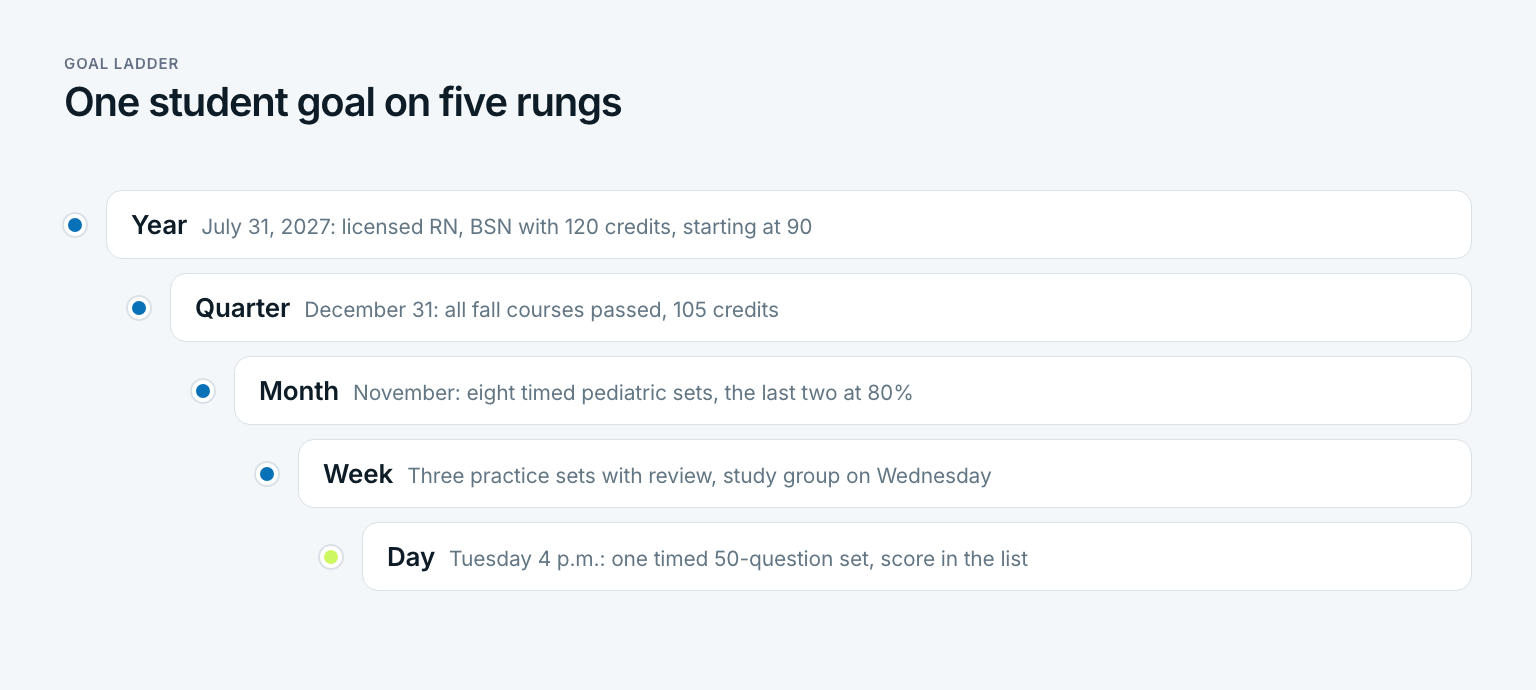
- Year. By July 31, 2027, licensed RN: BSN with 120 credits on May 15, NCLEX passed on the first attempt. Starting point today: 90 credits.
- Quarter. By December 31, 2026, all fall courses passed, 105 credits, Pediatrics exam average at 78% or higher.
- Month. In November, eight timed pediatric practice sets, the last two at 80%, and the research paper drafted by November 20.
- Week. Three practice sets with review, study group on Wednesday, scores logged on Friday.
- Day. Tuesday 4 p.m., library, second floor: one 50-question pediatric set, timed, then rationales and the score in the list.
The ladder shows something a single SMART goal can't. On Tuesday, Maya knows which piece of her license is due today. On Friday, she sees whether the week moved November. On December 31, she sees whether the quarter moved the year. In Gaapp she sets up the yearly goal with a starting value and a target, then hangs the quarter, month and week underneath, so every rung shows its own number. If you prefer paper, you need one sheet with five lines and a fixed time on Friday. The tool is not the point. The point is that every line has a number.
Template and self-check before the semester starts
The template has seven fields. Fill it in once per semester for your degree goal, then once per course for its exam and mastery goals. Maya's entries show how concrete each line needs to be.
| Field | Question | Maya's entry |
|---|---|---|
| Result | What is different at the end? | Pediatric Nursing passed |
| Measure | How do you count it? | Exam average 78% or higher, mastery in practice set scores |
| Starting value | Where are you today? | 72% on exam one, 68% on the first practice set |
| Target | Which number counts as done? | Two timed sets in a row at 80% or higher |
| Date | By when? | Mastery by December 3, final on December 10, 2026 |
| Hours | Does it fit the week? | 4 credits, about twelve hours a week, more in November |
| Weekly step | What happens every week? | Two timed sets with review, score logged on Friday |
Before the semester begins, ask yourself three questions. They take five minutes and could save you the November Maya had as a junior:
- Could a stranger say on the due date, without asking you, whether your goal was reached?
- Does every exam goal have a mastery goal you can measure yourself before the exam?
- Is there already a fixed block on your calendar for the first practice test, with a day and a time?
Whoever answers yes to all three has a semester with goals. Whoever answers no to even one still has resolutions. A SMART goal for a student is not a promise to yourself. It is a calculation that has to work out every week.
Frequently asked questions about SMART goals for students
What are some examples of goals my child might have at school?
Good school goals for children are short and countable: reading two chapter books by spring break, knowing the times tables up to ten, turning in every homework sheet for a month or raising a hand once per lesson. Keep the time frame between two and four weeks for younger kids. Let your child help write the goal, so it belongs to them and not only to you.
Can you give me an example of a SMART goal for a nursing student?
“By the end of my med-surg rotation on November 20, I complete a full head-to-toe assessment in under 15 minutes, signed off by my clinical instructor on three separate shifts.” It names a skill, a time limit, a date and someone who checks it. For exams, a mastery goal such as two timed practice sets in a row at 80% works well.
How do you write 10 performance goals examples?
Take ten areas you are measured on, such as courses, a sport or applications, and write one result for each with a number and a date. Then check each one with the five SMART questions and pair every grade goal with a mastery goal you control. The examples table above shows ten finished sentences you can adapt.
What are SMART goals in education?
In education, SMART goals are learning goals that are specific, measurable, achievable, relevant and time-bound. Teachers use them for learning objectives, student learning objectives and IEP goals, which federal law requires to be measurable. Students use them to turn a course, an exam or a degree into weekly steps.
How many SMART goals should a student have?
One goal for the semester or the degree, plus one exam goal and one mastery goal per course that matters most. With four courses that adds up to about nine goals, all hanging from one top goal. Work on no more than three weekly goals at a time.
Is a GPA a good SMART goal?
A GPA is a valid goal because it is measurable and time-bound. You only partly control it, so it needs mastery goals underneath, such as practice test scores. That keeps the goal fair even when an exam turns out harder than expected.
Last updated: 19 October 2026
Read next
 Goal Setting
Intrinsic Motivation: What Drives You From the Inside
Intrinsic motivation is not a personality trait. Meaning, 12 examples, the three needs behind it and five steps to build it, with a worked example.
17 min read
 Goal Setting
Financial Goals: How to Turn Wishes Into a Plan
Financial goals are not wishes with a dollar sign. Short and long term examples, SMART savings goals and a five step plan, worked through one year.
17 min read
 Goal Setting
WOOP Method: Four Steps From Wish to If-Then Plan
The WOOP method is not positive thinking. What WOOP stands for, the research, if-then plans, eight goal examples and a five-minute guide.
18 min read