Kaizen Method: How Small Changes Add Up
The kaizen method explained: meaning, origins, principles, six steps and a worked example from a bookkeeping practice, plus personal kaizen for your goals.

Contents
- 01What Is the Kaizen Method?
- 02Kaizen Meaning and Where It Comes From
- 03The Principles of Kaizen Methodology
- 04Kaizen Continuous Improvement vs Lean and Kaikaku
- 05How to Use the Kaizen Method in Six Steps
- 06A Kaizen Example: Priya's Month-End Close
- 07Personal Kaizen: Small Questions, Small Steps
- 08Does Kaizen Really Work?
- 09Kaizen in Your Goal Chain: Year, Quarter, Month, Week, Day
- 10Kaizen Method FAQ
The kaizen method is not a plan for one big transformation. It is a habit of small improvements. The kaizen method means you improve a process continuously in small, measurable steps, test each step, and make whatever works better the new standard. Anyone who changes one small thing a week and measures it will have made about 50 improvements by the end of the year without ever launching a major project.
That sounds modest, and that is the point. Big changes often fail because of their size. They need budget, courage, and a free month nobody has. Small steps need none of that. This guide follows Priya, a freelance bookkeeper in Columbus, Ohio, whose month-end close takes six hours per client. You get the meaning and origins of kaizen, its principles, how it relates to Lean, six steps you can copy, a worked example with real numbers, and a way to connect kaizen to your goals from the year down to the day.
What Is the Kaizen Method?
Kaizen is a mindset that turns into a method. The mindset says every process can be improved, and the people who run it every day are the ones best placed to improve it. The method turns that idea into a loop. You watch where things get stuck, try one small change, measure the effect, and write down what worked.
Three traits set kaizen apart from other improvement approaches:
- Small, not big. A kaizen improvement costs little money and little time. You can test it in a week and undo it if it fails. A new warehouse is not kaizen. A labeled shelf is.
- Ongoing, not one-off. Kaizen has no end date. Today's improved process is the starting point for the next improvement. That means: there is never a state where you are done.
- Everyone, not a few. Improvements do not only come from managers or consultants. Whoever performs a task a hundred times a day is the first to see where time gets lost.
Kaizen methodology is not tied to factories. It started in manufacturing, but it works anywhere something repeats: in an office, a clinic, a household, or your own habits. What matters is not the industry but the repetition. A task you do once is not worth a kaizen loop. A task you do every week almost always is.
In short: kaizen swaps the question “How do we fix this for good?” for “What can we make a little better this week?”
Kaizen Meaning and Where It Comes From
Kaizen is a Japanese word made of two characters. Kai means change, zen means good. Together they mean change for the better. In Japanese it is an everyday word with no special weight. It only became the name of a management method in the West.
The person who made the term famous is Masaaki Imai. His book “Kaizen: The Key to Japan's Competitive Success” came out in 1986 and explained to Western readers why Japanese companies like Toyota were winning with countless small improvements. A year earlier, Imai had founded the Kaizen Institute, which still teaches the method to companies today.
The roots go further back, and they are not purely Japanese. After World War II, the American occupation brought the Training Within Industry programs to Japan. These had been developed in US factories during the war to teach supervisors how to observe and improve work steps. In 1950, the statistician W. Edwards Deming gave a series of lectures on quality in Japan that left a lasting mark. At Toyota, Taiichi Ohno spent decades shaping these ideas into the Toyota Production System, where kaizen is a core building block.
So is kaizen Japanese or American? Both. The tools came partly from the US. The discipline of using them every day, on the shop floor, by everyone, was built in Japan.
The Principles of Kaizen Methodology
There is no official, numbered list of kaizen principles. Consultancies and textbooks list five, ten, or twelve. A common list of five reads: know your customer, let it flow, go to gemba, empower people, and be transparent. Behind every list sit the same core ideas, most of them already in Imai's book:
- Gemba: go where the work happens. Gemba is Japanese for the actual place. Improvements are not found in a conference room but at the workbench, the desk, or the checkout. Anyone who wants to improve a process should watch it first.
- Muda: see the waste. Muda means waste. Taiichi Ohno described seven kinds: transport, inventory, motion, waiting, overproduction, overprocessing, and defects. Each one costs time without giving anyone value.
- Standard work: lock in the gain. An improvement that is not written down disappears the next time someone new does the job. The standard is not a straitjacket. It is today's best known way, and the baseline for the next round.
- PDCA: plan, do, check, act. The cycle goes back to Walter Shewhart and was made famous by Deming. You plan a change, try it on a small scale, check the result, and either adopt it as the standard or drop it.
- Fix the process, not the person. Kaizen asks what in the process made the mistake possible, not who made it. Whoever gets blamed for reporting a problem will not report the next one.
5S: order as the first kaizen step
Many teams start kaizen with 5S, five Japanese terms for an orderly workspace, usually translated as sort, set in order, shine, standardize, and sustain. It works well as a starting point because the effect is visible at once and saved search time can be measured with a stopwatch. For Priya, 5S meant her digital folders, and it became week four of her first kaizen run.
What about the 12 steps of kaizen? You will find twelve-step lists online, but they are compilations, not a standard. Most of them stretch the same PDCA loop across more steps. If you remember observe, change one thing, measure, and standardize, you have the core of every list.
Kaizen Continuous Improvement vs Lean and Kaikaku
These terms get used as if they were the same. That is understandable, because they share a history. They do describe different levels, though. Lean is a full management system. Kaizen is its engine for continuous improvement. The opposite of kaizen is kaikaku, radical change in one big leap.
| Term | What it describes | Pace and size | Priya's example |
|---|---|---|---|
| Kaizen | Ongoing small improvements made by the people doing the work | One small step a week | A fixed checklist for every month-end close |
| Kaizen event | A focused workshop on one process, often three to five days | Short and intense | One Saturday spent rebuilding the client onboarding process |
| Lean | A full system that aligns work with customer value and removes waste | Long term, covers the whole operation | Designing the practice so client books flow without waiting |
| Six Sigma | A data-heavy method for reducing variation and defects | Project based, statistical | Analyzing error rates across hundreds of reconciliations |
| Kaikaku | A radical overhaul in one step | Rare, big, expensive | Switching every client to new accounting software at once |
James Womack and Daniel Jones summed up Lean in their 1996 book “Lean Thinking” with five principles: define value from the customer's view, map the value stream, create flow, establish pull, and pursue perfection. The fifth principle is where kaizen lives. Perfection is not a state there. It is the direction every small step points toward.
For individuals and small teams, kaizen on its own is usually enough. A full Lean system needs an organization with many connected processes. A kaizen loop needs one process, one number, and one week.
How to Use the Kaizen Method in Six Steps
To start, you need a single process that repeats often and noticeably costs you time or energy. The smaller it is, the better. Then work through these steps:
Pick one process
Choose something you do at least once a week, like a client report, a month-end close, or the weekly grocery run. Write it down in one sentence with a clear start and end. A process without a clear end cannot be measured.
Measure where you are
Time two or three runs exactly as they happen today. One number is enough: minutes, errors, or follow-up questions. Also note where you wait, search, or do something twice. That is the waste Ohno was talking about.
Choose one small change
From your notes, pick one spot and think of a change you can test within a week. It should cost little and be easy to undo. One change per round, or you will not know afterward what made the difference.
Run it for a week
Work with the change for one week and measure the same number as in step two. Note what you notice, including what gets worse. A test that changes nothing is not a failure. It is a result.
Check and decide
At the end of the week, compare before and after. If the number improved, keep the change. If it did not, drop it or adjust it. Ten minutes is enough for this.
Write the new standard
Record the better way so it holds even on a bad day, as a checklist, a photo, or a note at your desk. Then the next round starts again at step two, this time from the new baseline.
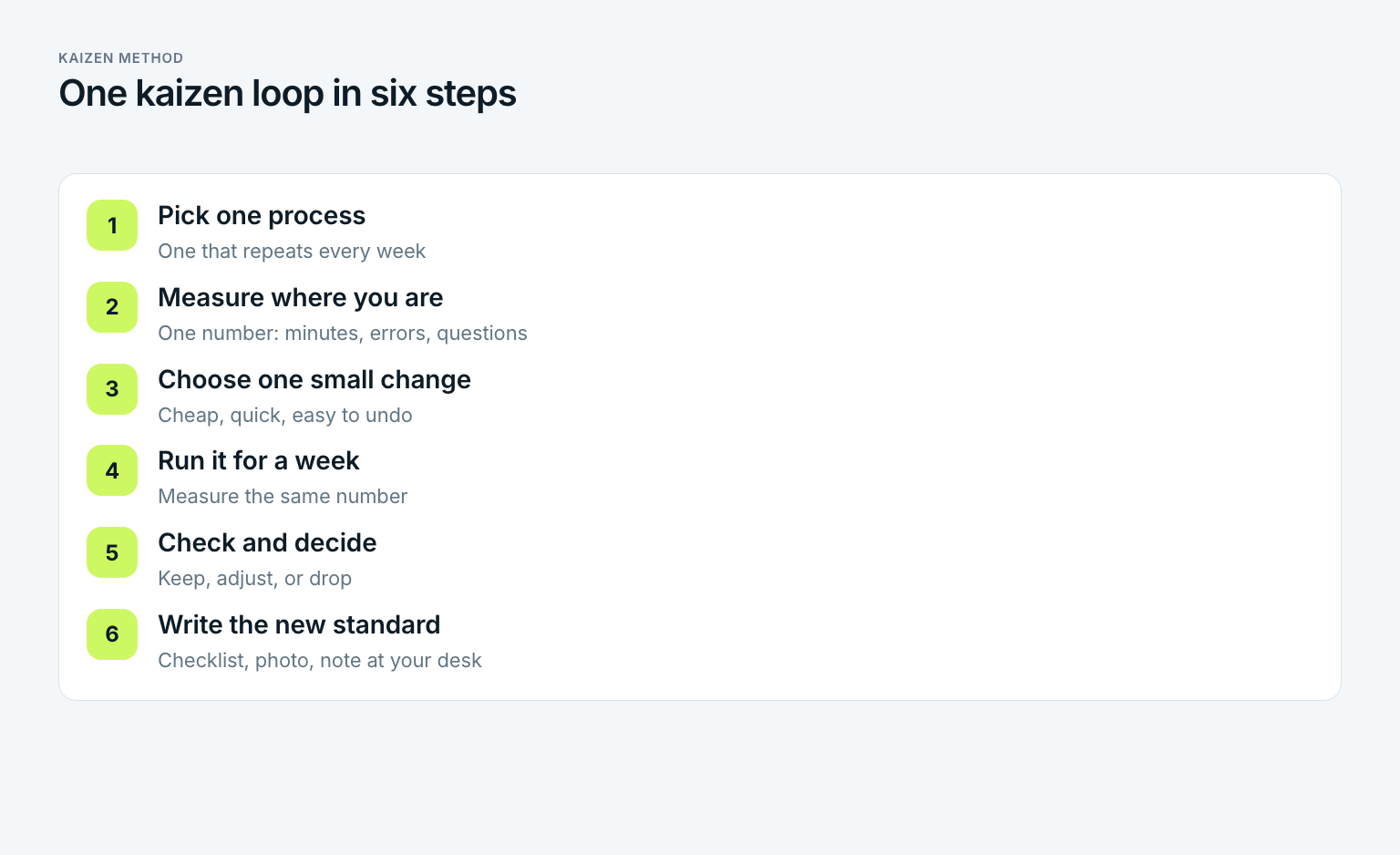
These steps are the PDCA cycle in plain language. Step three is plan, step four is do, step five is check, and step six is act. Step two is the one most people skip. Without a measurement there is no before, and without a before you cannot tell whether the change worked or just felt new.
Anyone who tries to improve several processes at once loses track quickly. A simple board with three columns helps: ideas, testing, standard. How such a board works, and why you should cap the middle column, is covered in the guide to Personal Kanban.
A Kaizen Example: Priya's Month-End Close
Priya is 36 and has run her own bookkeeping practice for five years. She serves 14 small businesses, from a dental office to two food trucks. Every month the close for each client lands in the first ten days, and she has been working Saturdays to get through it. She timed three closes with a stopwatch app. On average they took 360 minutes each. She did not want to hire, and she could not raise prices yet. So she tried kaizen for six weeks, one change per week.
| Week | What she noticed | One small change | Close per client after |
|---|---|---|---|
| Start | Three closes timed | None | 360 minutes |
| 1 | About 40 minutes per client went to chasing missing receipts by email | A standard document request with a checklist, sent to every client on the 25th | 335 minutes |
| 2 | Recurring vendors like rent and software were categorized by hand every month | Bank feed rules for the 20 most common recurring transactions | 310 minutes |
| 3 | The order of steps changed by client, and in 3 of 14 closes something had to be redone | One close checklist in a fixed order for every client | 290 minutes |
| 4 | Files were scattered across downloads, email, and three folder styles | One naming rule for every file: year, month, client, document type | 278 minutes |
| 5 | She switched between clients and tools all day | All bank reconciliations batched into one morning | 265 minutes |
| 6 | The summary email to each client was written from scratch | A summary template with the same five numbers every month | 250 minutes |
After six weeks, a close takes 250 minutes instead of 360. That is 110 minutes less per client, almost a third. Across 14 clients, it adds up to about 25 hours a month, which is roughly every Saturday she had been working. None of the changes cost more than an afternoon of setup. None of them would have been enough on its own. Together they made the difference.
Two things in this kaizen example are worth noticing. First, two of the six ideas came from clients. The owner of the dental office suggested the document request on the 25th because her own staff already closed their books then. Whoever runs kaizen alone at a desk misses half the ideas.
Second, not everything worked. In week one, Priya first tried a client portal for uploading receipts. After four days, only three of her 14 clients had logged in. She dropped the portal and switched to a plain email checklist that clients could reply to. That is kaizen too. The week produced a result, just not the one she expected.
Personal Kaizen: Small Questions, Small Steps
Kaizen does not need a business. Psychologist Robert Maurer showed how to apply it to personal goals in his 2004 book “One Small Step Can Change Your Life: The Kaizen Way.” His core idea: big resolutions trigger resistance, while ridiculously small steps slip past it. Anyone who works on something for one minute a day has no reason to put it off.
Maurer suggests asking small questions. Not “How do I finally get organized?” but “What is one thing I can improve today in one minute?” A small question is easier to answer, and the answer is easier to act on. Once the small step has become routine, it can grow into a bigger one.
Priya tried this on a goal she had postponed for two years: passing the Enrolled Agent exam, the IRS credential for tax professionals. Her first kaizen step was one practice question every morning with her coffee. After three weeks she raised it to five. After three months she was doing 20 a day and had booked the first exam part. The step was never big enough to skip.
Why does this work? Teresa Amabile and Steven Kramer analyzed nearly 12,000 diary entries from 238 employees for their 2011 book “The Progress Principle.” Their finding: of everything that makes a workday good, the strongest factor is the sense of making progress in meaningful work, even when the progress is small. Kaizen delivers exactly that, a visible number each week that is better than the week before.
If this sounds familiar, you may be thinking of James Clear. In his 2018 book “Atomic Habits” he calculates that getting one percent better every day makes you about 37 times better after a year. It is a good motivating example. It is not a measurement, because real improvement does not compound that smoothly. What else Clear's book offers is in the Atomic Habits summary. How long a new routine takes before it runs on its own is covered in how long it takes to form a habit.
Does Kaizen Really Work?
Yes, with one condition. Kaizen works where a process repeats often and where someone keeps the improvements in place. In manufacturing, it has been standard practice for decades. The ISO 9001 quality standard in its 2015 version explicitly requires continual improvement. In agile teams, the retrospective after each sprint is nothing more than a scheduled kaizen meeting.
The condition is follow-through. Kaizen events often produce quick wins that fade within months when nobody maintains the new standard. That is not a flaw in the method. It is its most common misunderstanding. An improvement with no standard and no next round is a one-time burst, not kaizen.
The most common mistake: starting too big
Whoever introduces kaizen often wants to fix ten things at once. Two weeks later, nobody knows which change caused what, and the list becomes a burden. Kaizen runs on one change per round. That feels slow, but it is actually faster, because every round produces a clear result and no energy is wasted on experiments nobody evaluates.
Two other mistakes are quieter. The first is kaizen without measurement. If you only feel that things are better, you cannot tell real improvement from the excitement of something new. The second is kaizen as a cost-cutting program. When people notice that every saved minute is converted into more work, the suggestions stop. Priya made a rule for herself: half of the saved time goes to new clients, the other half goes to having her Saturdays back.
So does kaizen really work? It works as well as your follow-through. Anyone who measures, keeps one change per round, and writes the standard down will see the numbers move.
Kaizen in Your Goal Chain: Year, Quarter, Month, Week, Day
Kaizen and big goals seem to pull in opposite directions. One is small and ongoing, the other is big and far away. In fact, they need each other. A yearly goal without small steps stays a wish. Small steps without a yearly goal improve something, but not necessarily the right thing. The goal chain connects them: the year sets the direction, and the week delivers the kaizen step.
| Level | Priya's goal | Kaizen link |
|---|---|---|
| Year | Month-end close under 180 minutes per client, no weekend work, room for four new clients | The direction for every improvement |
| Quarter | Close under 250 minutes, all 14 clients on the document checklist | About twelve kaizen rounds |
| Month | November: close checklist and bank rules in place for every client | Four rounds with one change each |
| Week | Test one change: the file naming rule, timed across three closes | One full PDCA loop |
| Day | Monday 8:30: ten minutes reviewing yesterday's close notes, one observation written down | Gemba on a small scale |
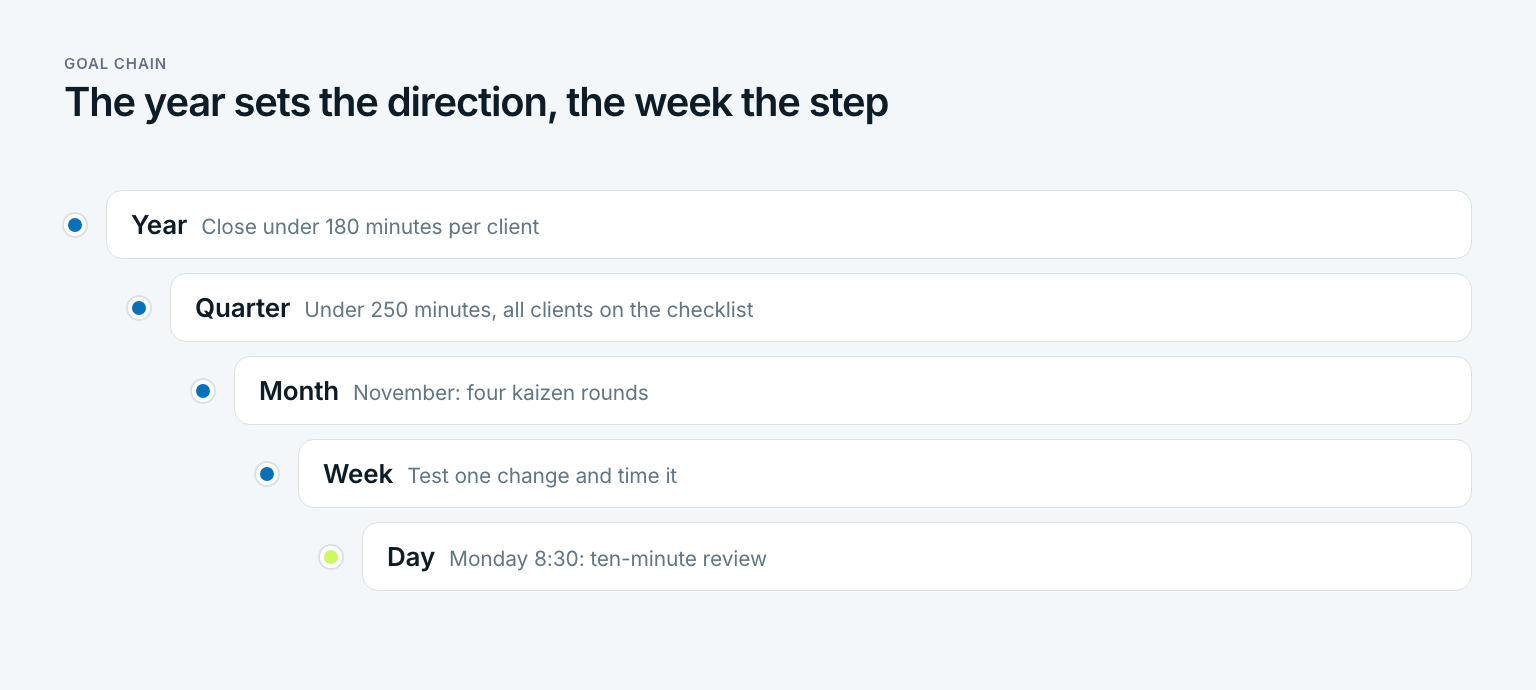
Read from the bottom up, each level is a kaizen loop at a different size. The day supplies the observation, the week the experiment, the month the sum of experiments, and the quarter the checkpoint. At the end of each week you ask the same three questions as in the ten-minute weekly review: what moved, what did not, and what is the next step? How to break a yearly goal down level by level is explained in turn yearly goals into daily steps.
Before you start your first kaizen loop, ask yourself three questions:
- Which process repeats every week and noticeably costs me time or energy?
- Which single number tells me whether it is getting better?
- Which change is small enough that I can test it this week without budget or permission?
Anyone who answers these three questions has already picked their first kaizen step. The kaizen method is not a promise that everything will get better. It is an agreement to make one thing better every week.
Kaizen Method FAQ
How to use Kaizen method?
Pick one process that repeats every week and measure it with a single number. Choose one small change, test it for a week, and compare before and after. Keep what works as the new standard and start the next round from there.
Does Kaizen really work?
Yes, when the improvements are measured and kept in place. Kaizen has been standard practice in manufacturing for decades and is built into the ISO 9001 quality standard and agile retrospectives. It fails mostly when teams change too much at once or never write down the new standard.
What are the 12 steps of Kaizen?
There is no official twelve-step version of kaizen. Lists with twelve steps are compilations by consultancies and trainers, and most of them stretch the same plan, do, check, act loop across more steps. The core is always the same: observe, change one thing, measure, and standardize.
What are the 5 principles of Kaizen?
A commonly cited list names five: know your customer, let it flow, go to gemba, empower people, and be transparent. It is not an official standard, but it captures the core ideas behind Masaaki Imai's work. In practice they all serve one goal, making small improvements a daily routine.
What does kaizen mean in English?
Kaizen combines the Japanese characters for change and good, so it means change for the better. In business it stands for continuous improvement, the ongoing practice of making small, measured improvements to a process.
What is the difference between kaizen and kaikaku?
Kaizen improves in many small steps, while kaikaku changes things radically in one big leap. Both have their place: kaikaku for the rare overhaul, kaizen for the ongoing work afterward. Without kaizen, even a successful overhaul loses its effect over time.
Last updated: 22 October 2026
Read next
 Productivity
Feynman Technique: Four Steps to Real Understanding
The Feynman technique is not a memorization trick: four steps, a worked example from a stats class, a one-page template, and what research says.
16 min read
 Productivity
Zettelkasten: How to Turn Notes Into Your Own Ideas
A Zettelkasten is not an archive: Luhmann's method, the three note types, a five-step setup and an Obsidian template, with a worked example.
15 min read
 Productivity
Second Brain: How to Build One You Actually Use
A second brain is not a note archive: Tiago Forte's CODE steps, the PARA method with an example, a five-step setup and the mistakes that sink it.
15 min read