How to Be More Confident: Act First, Feel It Later
Confidence is not a feeling you wait for. Five steps, seven daily exercises and a 12-week example of building self confidence through action.

Contents
- 01What confidence is, and what it is not
- 02Confidence, self-esteem, self-efficacy and arrogance compared
- 03Signs of low confidence you can actually see
- 04Why positive thinking alone won’t build self confidence
- 05How to be more confident in five steps
- 06Seven exercises to boost self confidence every day
- 07Marcus: twelve weeks from silent to running the review
- 08How to build self confidence that lasts: keep promises to yourself
- 09Confidence in your goal chain: year, quarter, month, week, day
- 10Frequently asked questions about confidence
How to be more confident comes down to one move: do the thing you have been avoiding in steps small enough to survive, then write down what actually happened. Confidence is not a feeling you wait for before you act. It is the residue of actions you took while still nervous. The feeling arrives, but it arrives late, usually a few weeks behind the behavior. Anyone who waits to feel ready first can wait for years.
This article treats confidence as something you can see: how you speak up, push back, ask, say no, and stand in front of people. It is worked through on one person. Marcus, 36, is a project manager at a regional logistics company in Columbus, Ohio. In September 2026 he was promoted to lead a team of eight, which means he now sits in a Thursday operations review with his director and five other leads. In his first six weeks he spoke there twice, both times because someone asked him directly. When he rated his belief that he could disagree with his director in that room, he wrote 3 out of 10.
What confidence is, and what it is not
Confidence is the belief that you can handle a situation, shown in the way you behave in it. That second half matters. When people describe someone as confident, they rarely mean a private thought. They mean a voice that does not trail off, a question asked without an apology, a no that comes without three paragraphs of explanation. Confidence is visible. That is why it can be practiced like any other visible skill.
It helps to split confidence into three parts. There is a thought: I can do this. There is a feeling: tension or calm before the moment. And there is a behavior: you speak, or you stay quiet. Most advice aims at the thought and hopes the other two follow. They rarely do. The thought is the part you control least directly. The behavior is the part you can change at ten o’clock on Thursday morning.
Marcus knows the loop by heart. He prepares for every review and usually has one point that would save his team a week of rework. He rehearses the sentence in his head. Then someone else starts talking, the moment passes, and on the drive home he replays it. He does not lack the knowledge or the idea. He lacks the sentence, said out loud. In short: confidence is less a trait you own than an action you repeat.
Confidence, self-esteem, self-efficacy and arrogance compared
Four words get used as if they meant the same thing. They do not, and each one points to a different kind of practice. Which of them is actually holding you back? If the question is whether you are okay as a person, the guide on how to improve self-esteem is the better fit.
| Term | The question behind it | What you can observe |
|---|---|---|
| Confidence | How sure am I when I act and speak in front of others? | Voice, eye contact, speaking up, asking, declining |
| Self-esteem | Am I a worthwhile person, even when I fail? | How you handle criticism, mistakes and praise |
| Self-efficacy | Can I carry out this specific task myself? | Persistence on one concrete task, after Bandura, 1977 |
| Arrogance | Do I need to look better than everyone else? | Interrupting, dismissing, no interest in being wrong |
Confidence is closest to self-efficacy, the concept Albert Bandura introduced in 1977. How that belief grows from four sources is covered in depth in the guide to self-efficacy. One line from it is enough here: the strongest source is your own experience of having done the thing. Everything that follows builds on that line.
The difference between confidence and arrogance is the one insecure people worry about most. A confident person holds a position and stays open to being wrong. An arrogant person does not need to be open, because disagreement gets dismissed anyway. Justin Kruger and David Dunning showed in 1999 that people with the least skill in an area often overrate their performance the most. Volume is not evidence of competence. That means: you do not have to become louder than the loudest person in the room. You only have to say your sentence.
Signs of low confidence you can actually see
Low confidence rarely looks dramatic. It shows up in small phrases and habits that seem harmless on their own. Three openers come up again and again. None of them is a clinical sign, but each one does quiet damage:
- “Sorry, this might be a dumb question, but …” The question gets downgraded before anyone hears it, and listeners often accept the label they would never have applied themselves.
- “I just wanted to quickly …” The word just shrinks the request before it is made. In a meeting where everyone else speaks without permission, it asks for permission.
- “I’m not really a presenter.” It sounds modest. It is actually a forecast, and whoever repeats it often enough avoids every situation that could prove it wrong.
The phrases matter less than the precautions behind them. Psychologists call them safety behaviors. Paul Salkovskis described the idea in 1991, and David Clark and Adrian Wells made it central to their 1995 model of social anxiety. A safety behavior feels like protection. What it actually does is block the one experience that would change your mind.
Safety behaviors
Safety behaviors are small precautions meant to prevent a feared embarrassment: sitting near the door, reading from notes, speaking only when called on, softening every claim with maybe. The catch is that when things go well, you credit the precaution instead of yourself. Adrian Wells and colleagues found in 1995 that facing a feared situation worked clearly better when people dropped their safety behaviors during it. That means: every practice round counts double when you leave one precaution behind.
In week one, Marcus wrote down his own list. He sits at the far end of the table. He drafts his point word for word and reads it off his laptop. He opens every contribution with “sorry, quick one.” And he only speaks when his director looks at him. Four precautions, each one reasonable. Together they meant that in six weeks he had not collected a single piece of evidence that his point lands fine without them.
Why positive thinking alone won’t build self confidence
Positive thinking is not useless. It feels good, and sometimes it gives you the nudge to try. What it rarely does is change behavior by itself. Three lines of research explain why working only on your thoughts tends to go in circles.
First, you overestimate how closely people watch you. In a 2000 study, Thomas Gilovich, Victoria Medvec and Kenneth Savitsky had students walk into a room of peers wearing an embarrassing T-shirt. The wearers guessed that about half the room would notice it. Roughly a quarter did. The researchers called it the spotlight effect. Two years earlier, Gilovich, Savitsky and Medvec had shown a related bias they called the illusion of transparency: people believe their nervousness is far more visible than it is. Whoever thinks the whole table can see their pulse before they speak is usually wrong.
Second, affirmations can backfire. Joanne Wood, Elaine Perunovic and John Lee asked people in 2009 to repeat the statement “I am a lovable person.” Participants with high self-esteem felt slightly better. Participants with low self-esteem felt worse. A sentence you do not believe mostly reminds you that you do not believe it. That makes affirmations an unreliable tool for exactly the people who want them most. If you use sentences at all, pick positive affirmations small enough that your mind does not argue back.
Third, the power pose did not hold up. Dana Carney, Amy Cuddy and Andy Yap reported in 2010 that two minutes in an expansive posture shifted hormone levels and risk taking. Eva Ranehill and colleagues repeated the study in 2015 with about 200 participants and found no effect on hormones or behavior, only a small bump in how powerful people said they felt. In 2016 Carney stated publicly that she no longer believed the original effects were real. Standing up straight does no harm. It just does not replace the sentence you came to say.
So what does work? Experience, with a little knowledge riding along. Kenneth Savitsky and Thomas Gilovich showed in 2003 that speakers who were told about the illusion of transparency beforehand felt calmer and were rated as better speakers by their audience. Knowing the bias helped, but only because the people were about to act. In short: thinking can open the door, but you still have to walk through it.
How to be more confident in five steps
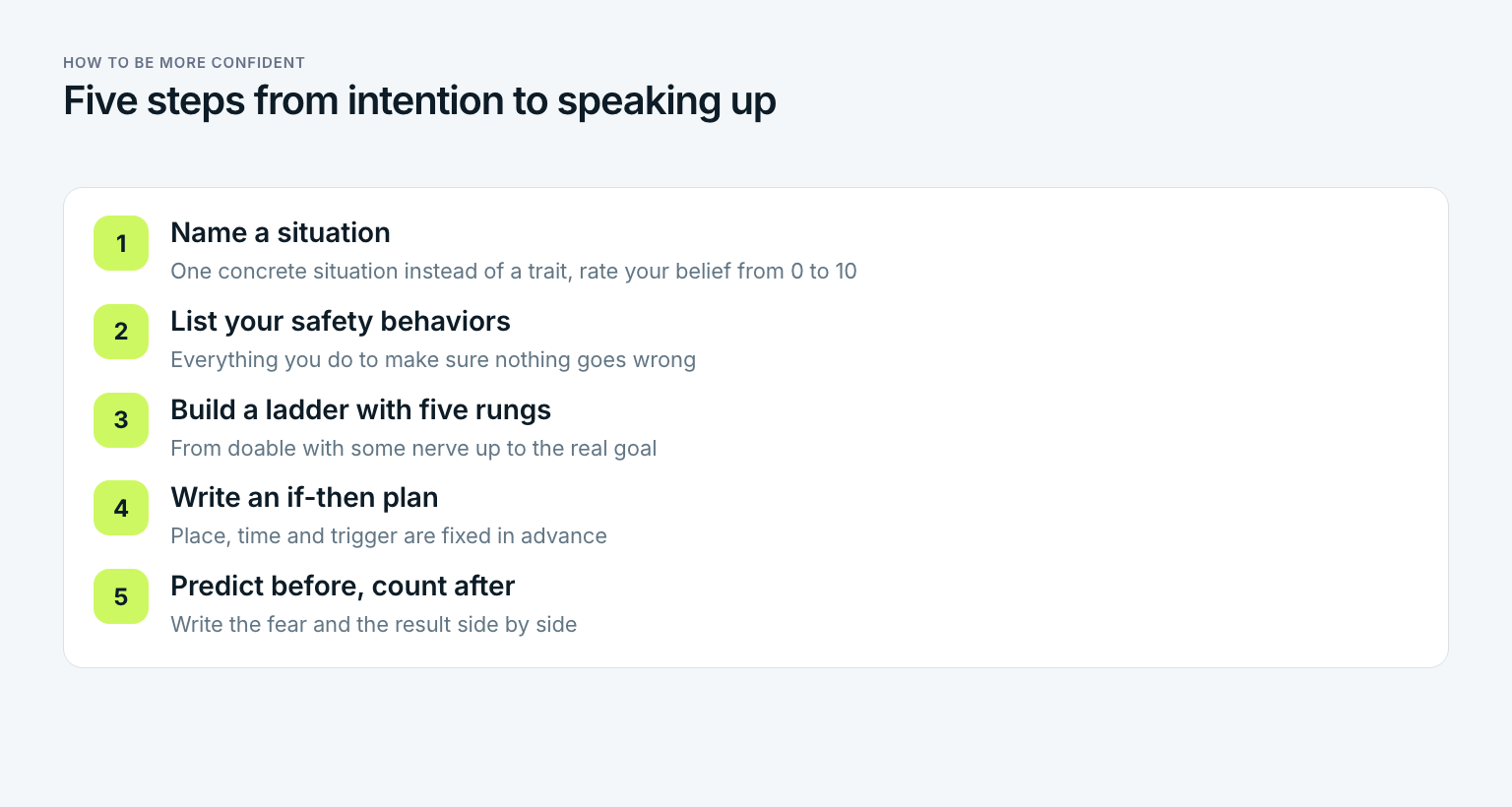
The five steps follow one logic. You pick a concrete situation, build a ladder of small rungs from it, and collect evidence on every rung. Anyone who works this way slowly replaces an old forecast with their own data. The first rungs take two to three weeks.
Name a situation, not a trait
Do not write “be more confident.” Write the one situation where your confidence fails you most, as narrowly as you can: “Disagree with one point in the Thursday review.” Rate your belief that you can do exactly that on a scale from 0 to 10. Marcus wrote 3.
List your safety behaviors
Write down everything you do in that situation to make sure nothing goes wrong. Sitting by the door, reading from notes, apologizing first, waiting to be asked. This list is your training plan, because every rung of the ladder drops at least one item from it.
Build a ladder with five rungs
Order five actions from easier to harder. The bottom rung should take some nerve but be clearly doable. The top rung is the real goal. Marcus started with one clarifying question and ended with leading part of the review himself.
Write an if-then plan
Fix the place, the time and the trigger: “If my director finishes the first agenda item, then I ask my question.” Peter Gollwitzer called these implementation intentions in 1999. They take the decision away from the moment when your nerve is at its lowest.
Predict before, count after
Before the situation, write down what you fear will happen and how likely it feels. Afterward, write down what actually happened. Only that comparison turns a good moment into evidence your mind cannot explain away.
The fifth step is the one almost everyone skips. Without it, a moment that went fine disappears behind the one second when your voice wobbled. Cognitive behavioral therapy calls this a behavioral experiment, and James Bennett-Levy and colleagues collected the method in the Oxford Guide to Behavioural Experiments in 2004. The principle is simple. A fear becomes a hypothesis, the situation becomes the test, and the result becomes a note.
Three mistakes nobody notices
- Starting too high. Whoever opens with the big presentation and stumbles gets the old forecast confirmed. The first rung should succeed through effort, not luck.
- Climbing each rung only once. One success looks like a fluke. The third or fourth repetition turns it into a pattern. Marcus stayed on every rung for two reviews.
- Reading a setback as a verdict. At some point someone will be curt with you. That is not proof you cannot do it. It is one data point among many, and it goes in the notes like every other.
The most common mistake: waiting to feel confident before you act
Most people wait for a feeling of certainty before they speak up, push back or present. The sequence runs the other way. Action produces experience, and experience produces the feeling. Anyone who waits for the feeling collects no experience, and without experience the feeling never comes. That means: plan the action small enough that you can do it with your heart pounding. The pounding is allowed to come along.

Seven exercises to boost self confidence every day
The ladder is your main project. Alongside it, a few small exercises fit into any day without needing a special occasion. Seven of them work well, and each one targets behavior rather than mood:
- The prediction note. Before any uncomfortable moment, write one line: what do I fear, and how likely is it? Afterward, one line: what happened? After four weeks you have a record that is more accurate than any gut feeling.
- The early contribution. Say something in every meeting within the first ten minutes, even if it is only a clarifying question. The longer you stay quiet, the higher the bar feels.
- Cut the softeners. Drop openers like “just,” “sorry” and “this might be dumb.” Start with the content. The sentence gets shorter and clearer, and nobody misses the apology.
- Call it excitement. Before a nerve-racking moment, tell yourself “I am excited” instead of “I need to calm down.” Alison Wood Brooks found in 2014 that people who did this performed better at singing, public speaking and math than people who tried to calm themselves.
- One request a day. Ask for something small: a different table, a quick answer, five more minutes. Whoever asks more often learns how rarely a no actually hurts.
- One no a week. Once a week, politely decline something you would normally accept out of insecurity. One sentence is enough, without a long justification.
- The evidence log. Every Friday, write down three moments when you showed up the way you wanted to. Teresa Amabile and Steven Kramer analyzed nearly 12,000 diary entries for their 2011 book The Progress Principle and found that visible progress at work lifts motivation more than almost anything else.
None of these takes more than a few minutes. Their effect comes from repetition, not size. Anyone who keeps three of them going for a month ends up with 20 to 30 small pieces of evidence. That is more than most people consciously notice in a year.
There is a limit worth stating. These exercises are meant for the ordinary insecurity almost everyone feels in some situations. If fear of other people is strong enough that you cancel plans, avoid conversations or struggle to get through the day, a licensed therapist is the right next step, and social anxiety responds well to treatment. If you are in crisis, call or text 988 to reach the 988 Suicide and Crisis Lifeline in the US, any time.
Marcus: twelve weeks from silent to running the review
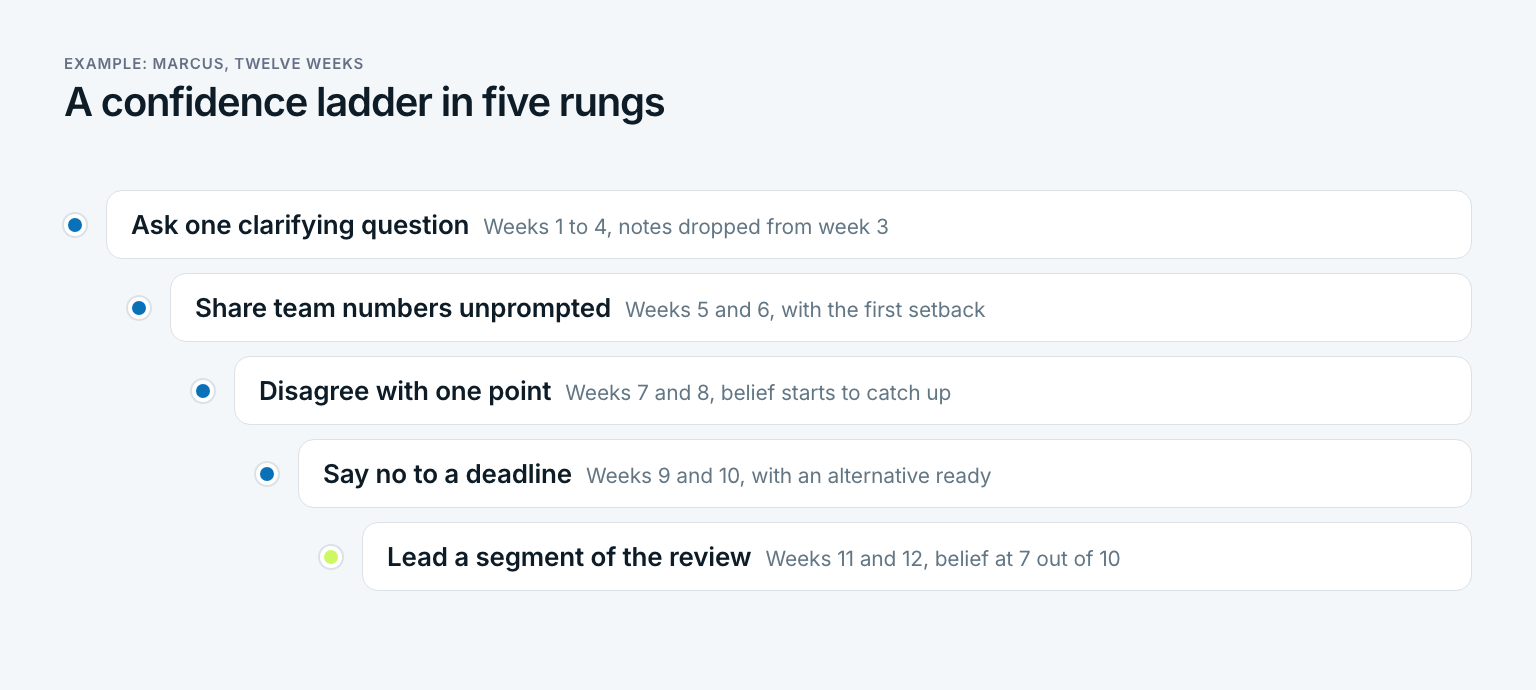
Marcus started in early November 2026. He stayed on each rung for two Thursday reviews and wrote a prediction note after every one. The table shows his numbers. Dread is how bad he expected the outcome to be beforehand. Belief is his rating afterward of whether he can disagree with his director in that room.
| Weeks | Rung | Contributions per review | Dread before, 0 to 10 | Belief after, 0 to 10 |
|---|---|---|---|---|
| 1 and 2 | Ask one clarifying question | 1 | 8 | 3 |
| 3 and 4 | Same rung, no notes and no “sorry, quick one” | 1 | 7 | 4 |
| 5 and 6 | Share team numbers without being asked | 1 to 2 | 7 | 4 |
| 7 and 8 | Disagree with one point and give a reason | 2 | 6 | 5 |
| 9 and 10 | Say no to a deadline and offer an alternative | 2 | 5 | 6 |
| 11 and 12 | Lead the carrier segment for 15 minutes | 3 | 4 | 7 |
Three things stand out. Dread fell from 8 to 4, and belief rose from 3 to 7. But the feeling lagged the behavior the whole way. From week three to week six Marcus was already speaking in every review, and his belief barely moved. It only caught up from week seven, after seven or eight contributions. Anyone who quits after two weeks because they do not feel any different stops right before the point where it starts to pay off.
Week six brought the setback. Marcus suggested moving a carrier contract renewal up by a month, and his director cut him off with “Not now.” That evening he wanted to go back to rung one. His notes told a different story: of 21 fears he had written down so far, exactly one had come true. Two days later his director emailed and asked for the proposal in writing. That email is still the note he likes best.
What changed that other people could see? Marcus no longer sits at the end of the table. He starts sentences with the content instead of an apology. And in week eleven he closed a discussion that had gone in circles for 20 minutes by saying, “I suggest we decide this now.” Nobody commented. That was the evidence.
How to build self confidence that lasts: keep promises to yourself
Trusting yourself works like trusting anyone else. You trust people who do what they say. The same goes for you. Whoever promises every Monday to finally speak up, and then does not, teaches themselves that their own commitments mean nothing. Whoever makes a small promise and keeps it builds trust in the one person they cannot avoid.
That leads to an uncomfortable rule: make a small promise you will definitely keep rather than a big one you will break. “I will make one point in Thursday’s review this week” beats “From now on I will always speak up.” The first one you can check off on Friday. The second one you can only fail. How to phrase commitments that still hold on Friday is covered in the guide to weekly goals.
A short look back at the end of each week helps you improve self confidence on purpose rather than by accident. Which promise did I keep, which did I break, and why? Anyone who answers those three questions every week quickly sees whether the rungs are set too high or too low. How to run that kind of review without it turning into rumination is laid out in the guide to self-reflection. In short: self confidence is the sum of promises to yourself that you kept.
Confidence in your goal chain: year, quarter, month, week, day
Confidence sounds like something you cannot plan. The opposite is true. Because the feeling lags the behavior, you need a plan that carries the behavior while the feeling is still catching up. A goal chain translates the big goal down to a single day, so that every Monday you know which rung is next. This was Marcus’s chain for 2027:
- Year: “In 2027 I present my team’s quarterly plan to the vice president twice and run the Thursday review whenever my director is out.”
- Quarter: “By March 31 I present the second-quarter carrier plan, 15 minutes, without a script.”
- Month: “In February, two dry runs, first in front of two team members, then in front of my director, each with a prediction note.”
- Week: “Three contributions in the Thursday review, one dry run, one no.”
- Day: “Thursday, 10 a.m.: first contribution within ten minutes. Tuesday, 4 p.m.: 20 minutes of practice in the small conference room.”
The chain has an advantage no resolution has. On a bad day, it shows you that you are still on track. Whoever looks at the quarter after a clumsy Thursday sees ten solid contributions before it. The general method for breaking a big goal down to the day is in the guide on how to achieve goals. In Gaapp, Marcus’s yearly goal sits at the top, and every daily promise he keeps shows up as progress underneath it.
Three questions to close, about your hardest situation
- In which one situation does your confidence fail you most, and how would you rate your belief there today, from 0 to 10?
- Which safety behavior will you leave out next time?
- What small promise to yourself can you definitely keep this week?
Confidence is not a state you reach but a trail of kept promises you can read backward.
Frequently asked questions about confidence
How do you get a lot of confidence?
You build it through repeated action in specific situations, not through a single breakthrough. Pick one situation, break it into a ladder of small steps, drop one safety behavior at a time, and write down your prediction before and the result after. Over weeks, the evidence piles up and the feeling follows it.
What’s the difference between confidence and arrogance?
Confidence means holding your position while staying open to being wrong. Arrogance means needing to look superior, which usually shows up as interrupting and dismissing other people. Research by Kruger and Dunning in 1999 found that people with the least skill in an area often overrate themselves the most, so loudness is not a reliable sign of competence.
At what age are people most confident?
Research on self-esteem, the closest measured trait, points to later adulthood. A 2018 meta-analysis by Ulrich Orth, Ruth Yasemin Erol and Eva Luciano found that self-esteem tends to rise through young and middle adulthood, peaks around age 60 to 70, and declines in old age. Confidence in specific situations depends far more on practice than on age.
What are signs of low confidence?
Common signs are apologizing before speaking, softening every statement, avoiding eye contact, waiting to be asked before contributing, and turning down chances to present or lead. Underneath these are safety behaviors, small precautions meant to prevent embarrassment. They feel protective but keep you from collecting evidence that you can handle the situation.
How can I boost my self confidence fast?
Fast means weeks, not days. Choose one situation, drop one safety behavior, and repeat the action several times a week while recording your fear beforehand and the result afterward. Other people often notice a change in how you come across within two to three weeks, and your own feeling of confidence follows somewhat later.
Do affirmations and power poses work?
The evidence is weak. A 2009 study by Joanne Wood and colleagues found that repeating “I am a lovable person” made people with low self-esteem feel worse, and a 2015 replication by Eva Ranehill and colleagues found no hormonal or behavioral effect from power posing. A concrete, checkable plan such as “I speak in the first ten minutes on Thursday” works better.
Last updated: 22 October 2026
Read next
 Personal Growth
Maslow's Hierarchy of Needs: The 5 Levels Explained
Maslow's hierarchy of needs sorts motivation into five levels. What each level means, what research says today and a needs audit you can run yourself.
14 min read
 Personal Growth
Mindfulness Exercises: 12 for Everyday Life
Mindfulness exercises are not about emptying your mind. 12 techniques for stress and focus, what research shows, and a four-week plan to practice daily.
16 min read
 Personal Growth
Positive Affirmations: 50 Examples You Can Believe
Positive affirmations are not magic words. What research shows, 50 daily affirmations you can believe, and a five-step method with a worked example.
16 min read